Record Hot Atlantic Basin to Fuel Brutish 2016 Hurricanes?

robertscribbler's avatarrobertscribbler

Last week, Gulf of Mexico sea surface temperatures off Tampa Bay were outrageously hot. On July 10, the ocean temperature measure hit 93 degrees Fahrenheit (34 Celsius). By the 11th, temperatures had warmed still more. And by the 12th, ocean surfaces had hit a sweltering 95 F (35 C).

Tampa bay water temperatures

(NOAA shows extreme sea surface temperatures at Old Port in Tampa, FL. Hat tip to Michael Lowry.)

It’s pretty rare that you see ocean waters anywhere on Earth become so hot. And when you do, it’s often in places like the Red Sea or the Persian Gulf — not the Gulf of Mexico. But in the new world driven to increasingly extreme warmth by human fossil fuel emissions, the potential heat bleeding off of ocean surfaces has jumped by quite a bit.

And it’s not just true with Tampa Bay. According to Michael Lowry, a hurricane specialist at…

View original post 713 more words

Sad Polar Bear Kept In Tiny Enclosure In Chinese Mall For Selfies

Sad Polar Bear Kept In Tiny Enclosure In Chinese Mall For Selfies,
Animal Rights Group Campaigns To Shut It Down
http://www.inquisitr.com/3324681/sad-polar-bear-kept-in-tiny-enclosure-in-chinese-mall-for-selfies-animal-rights-group-campaigns-to-shut-it-down/
“Animals Asia, an animal rights group headquartered in Hong Kong, is
campaigning to shut down an exhibit in a Chinese mall where a polar
bear is kept in a tiny enclosure for locals and tourists to gawk at
and take selfies with.”

Animal rights group has big beef with NZ live cattle exports
http://www.stuff.co.nz/business/farming/beef/82299399/animal-rights-group-has-big-beef-with-nz-live-cattle-exports
“WARNING GRAPHIC CONTENT: SAFE will fight any plans to export live
animals and believes that this trade will damage New Zealand’s
reputation as a responsible exporter.

Animal rights group filing appeal
http://www.thecalifornian.com/story/news/my-safety/2016/07/19/animal-rights-group-filing-appeal/87321186/
“An animal rights group alleging that the California Salinas Rodeo
underreports animal injuries plans to file an appeal in a lawsuit
against the rodeo that was dismissed earlier this year.
“Showing Animals Respect and Kindness, also known as SHARK, sued the
California Salinas Rodeo in 2014, and last months, Monterey County
Superior Court Judge Susan Matcham dismissed the suit in court.”

Global Heat Leaves 20th Century Temps ‘Far Behind’ — June Another Hottest Month on Record

robertscribbler's avatarrobertscribbler

We’ve left the 20th century far behind. This is a big deal. — Deke Arndt, head of NOAA’s National Centers for Environmental Information

*****

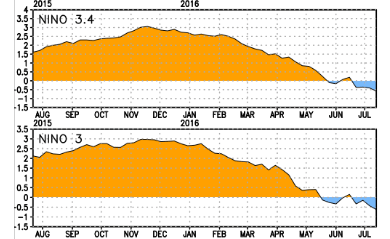
One of the top three strongest El Ninos on record is now little more than a memory. According to NOAA, sea surface temperatures (SSTs) in the Central Equatorial Pacific hit a range more typical to La Nina conditions last week. This cool-pool formation follows a June in which ocean surfaces in this zone had fallen into temperatures below the normal range.

El Nino Gone

(El Nino had faded away by June and turned toward La Nina-level temperatures by late June and early July. Despite this Equatorial Pacific cooling, June of 2016 was still the hottest June on record. Image source: NOAA.)

But despite this natural-variability related cooling of the Equatorial Pacific into below-normal ranges, the globe as a whole continued to warm relative to previous June temperatures…

View original post 852 more words

Too Many Deer on the Road? Let Cougars Return, Study Says

Cougars can kill hundreds of deer over the course of their lives, leading some scientists to argue that restoring them to 19 states with large populations of deer could prevent automobile-deer collisions.
KONRAD WOTHE / MINDEN PICTURES
JULY 18, 2016
Trilobites
By JAMES GORMAN
What large mammal regularly kills humans in the Eastern United States?

And what other large mammal might significantly reduce those deaths?

The answer to the first question is the white-tailed deer. Deer do not set out to murder people, as far as anyone knows, but they do jump out in front of vehicles so often that they cause more than a million collisions a year, resulting in more than 200 deaths.

The answer to the second question, according to a new scientific study, is the cougar.
Show Full Article:

Humans, the Pinnacle of Evolution?

The following is an excerpt from Richard Leaky’s book The Sixth Extinction: Patterns of Life and the Future of Humankind, chapter six, “Homo sapiens, the Pinnacle of Evolution?”

“The answer to the above question appears self-evident. Yes of course we are. In the penultimate chapter of The Origin of Species, Darwin wrote, ‘As natural selection works solely by and for the good of each being, all corporeal and mental endowments will tend to progress towards perfection.’ Homo sapiens, since its origin some 150,000 years ago, has come to occupy every continent, with the exception of the hostile wastes of Antarctica, and even there we have a toehold. This surely attests to our corporeal endowment, as we have adapted to these many environments. And there is no question about our mental endowment, which is unmatched in all of nature. We are intellectually analytical, we are artistically creative, and we have invented ethical rules by which society operates. No one can doubt that our species has advanced toward, if not perfection, than a high point–the highest point–among the diversity of life on Earth. We are the pinnacle of evolution. Or are we?

“Anthropologists and biologists have struggled with this issue for a very long time, and the resolution has never been simple. We feel ourselves unique in the world of nature, and of course we are: each species is unique, by definition, so that doesn’t help much. We are but one species among many millions in today’s world. However, we feel ourselves special, among this exuberant diversity of life, because we have an unmatched capacity for spoken language and introspective consciousness, and we can shape our world as no other species can. We judge this to place us on the top of the heap. Before the fact of evolution was demonstrated, beginning with Darwin in the mid-nineteenth century, we considered Homo sapiens to have been placed on the top by Divine Creation. In the Darwinian world, our species was said to have achieved its ascendancy through the natural selection of our special qualities. The intellectual context changed, but the outcome was the same. We judged ourselves to be the pinnacle of the world of nature.

“This assessment brings two assumptions with it–one implicit, the other explicit. The implicit assumption is that the evolution of Homo sapiens was an inevitable outcome of the flow of life, in the unfolding of evolution. The explicit assumption is that the qualities we value in ourselves as a species are indeed superior in some way to the rest of the world of nature. Through evolutionary time, life became ever more complex, producing an arrow of progress. As Darwin stated in the above passage, by means of natural selection life ‘will tend to progress towards perfection.’ We are the tip of the arrow of progress, the expression of perfection. …

“Man’s view of Man in the world of nature has changed over the centuries, reflecting the scholarly context. Only in the relatively recent past have anthropologists begun to discuss human origins as they would the origin of oysters, cats and apes. …”

10418292_778659628825562_4081410081902108848_n


‘Animal versus animal’ as elk, dogs clash

By R.J. Marx

The Daily Astorian

Published on July 19, 2016 8:25AM

Last changed on July 19, 2016 9:09AM

GEARHART — A pet whippet was trampled and killed by a herd of deer at the Reserve at Gearhart this month. In another incident reported to Gearhart Police, an elk kicked a dog and broke the dog’s legs. A Little Beach resident said he saw a herd menace kayakers this month when they approached too close to the shore.

“They will sometimes get aggressive,” Wildlife Communications Coordinator Michelle Dennehy of the Oregon Department of Fish and Wildlife said. “It can happen anytime. The advice for pets and people is to try to keep away.”

Oregon has two types of elk, Dennehy said, Roosevelt elk on the coast and Rocky Mountain elk in the Cascades. Roosevelt elk bulls typically weigh 900 pounds, and cows clear 600 pounds. Roosevelt elk in western Oregon have the larger body size, but typically Rocky Mountain elk — prevalent in Eastern Oregon — have larger antlers. “This makes sense when you think about how Roosevelt elk need to get through very thick brush,” she said.

With calving season, people and their pets are well-advised to steer clear of the herd, she said, which can reach 60 or more.
Dogs no match
A sign posted by the dunes in Gearhart warns: “Keep clear of the elk. Elk will charge to defend calves.”

Gearhart Police Chief Jeff Bowman said the risk increases at a time when elk cows are protective of newborn calves. “It all boils down to an animal versus animal, and the elk aren’t going to back down from a dog coming at them. They’ve got babies. If people are walking and not having their dogs on a leash, they’d better be looking for the elk.”

Everywhere there are elk, “people should have their dogs on leash,” naturalist and photographer Neal Maine said. “A modern-day dog really doesn’t understand an elk, and most people think the elk are going to run away from a dog. Elk can chase them, much like people take their dogs to the beach to chase birds around for exercise. Coyotes and wolves are two of their past enemies, so they’re all set up to take them out.”

The behavior may be brutal. Once they get a dog down, “they pound on them with their feet,” Maine said. “It’s part of their reaction to a predator.”

“If your dog is cornered — you wouldn’t want to intervene, unless you’re really foolhardy,” Maine added.

John Dudley has a home by Little Beach in Gearhart, ground zero for the elk population, where he chronicles the path of the elk with his camera. “The difference lately has been there have been calves in the herd, week-old calves,” Dudley said. “It’s postpartum time for the cows.”

One “alpha bull,” recognizable by a small but visible scar on his right shoulder, in the herd is particularly aggressive, Dudley said.

Sometimes the bull becomes “rather agitated,” herding the others, corralling them, and fighting off young bulls who consider themselves “pretenders to the throne.”

Dudley said he witnessed an encounter when a kayaker in the estuary was pulled toward the shore by the tide. The kayakers drifted closer to the herd and they pulled out cellphones to film the encounter.

“Suddenly something spooked the elk and en masse they galloped south,” Dudley said. “They could have just as easily stampeded over the kayakers.”
Taking cues
Normally, Gearhart’s elk herd “kind of moseys,” Bowman said.

Hikers and visitors should take heed when “their heads come up from their feeding and they’re staring at you and they’re not turning,” he said. “Turn around and go back,” Bowman said. “They’ll leave you alone. They aren’t going to chase you down. Their heads are going to go back down and they’ll continue eating.”

Elk eat 50 pounds a day — “and they don’t care if it’s your garden, off the golf course or through the woods,” Bowman said.

People should not attempt to approach the elk for cellphone pictures. “If they want to do photography, get a camera,” Maine said. “Elk photography with a cellphone is not productive.”

“The two times I’ve seen chase-downs, they’d been trying to get close enough to get a cellphone shot,” Maine said.
Observing nature
Maine advised the best way to enjoy the elk is to appreciate “an amazing creature that’s been here for thousands of years.”

“We should learn to become observers of wildlife, he said, and take 15 minutes to watch the interaction between the cows and the calves and the spikes,” Maine said. “Keep your distance and watch the phenomena of them moving, feeding, interacting, so you’re observing something, not just trying to get a picture. Watch their behavior and be intrigued and interested in that part of it. That gets missed by the drive-by folks.”

Prior to European settlement, more than 10 million elk roamed nearly all of the United States and parts of Canada, with about 1 million today.

Maine said at one point, less than a century ago, the elk were virtually extinct in Clatsop County from overhunting. Hunting was closed for about 10 years as elk were reintroduced into the area. “There are people who say their grandpa had a picture of elk being unloaded from a train in downtown Seaside to transplant here.”

To stay safe, keep your dog on a leash, no elk selfies and observe, don’t interfere, Maine said. “The reason this area is so rich and so beautiful and so wonderful is because there’s still wildlife in the habitat. So observe it, enjoy it and have it make your day richer.”

Greenland’s Contribution to Sea Level Rise Doubled During 2011-2014 — Larger Melt Pulses on the Horizon

robertscribbler's avatarrobertscribbler

According to a new report, the Greenland Ice Sheet lost one trillion tons of water due to melt during the four-year period from 2011 through 2014. That’s about double the typical rate of loss during the 1990s through mid-2000s. Subsequently, Greenland’s contribution to sea-level rise also doubled. As a result, Greenland alone contributed 0.75 mm of sea-level rise every year during the 2011 to 2014 period.

(The above video briefly explains the findings of a new scientific study indicating a doubling in the rate of Greenland melt during 2011 through 2014.)

Bear in mind, the study focuses on Greenland only. Those numbers don’t include thermal expansion from the world’s warming oceans. Nor do they include an increasing amount of melt from Antarctica. Nor do they include large volumes of melt coming from the world’s rapidly disappearing mountain glaciers. Together, all of these in total are pushing sea levels higher by…

View original post 582 more words

Scores of City-Sized Siberian Wildfires Spew 2,500 Mile-Long Plume of Smoke Over Northern Hemisphere

robertscribbler's avatarrobertscribbler

Today’s satellite pass by NASA’s LANCE MODIS array tells a dire story that practically no one in the global mainstream media is talking about. Northern and Central Siberia is burning. Scores of massive fires, some the size of cities and small states, are throwing off a great pall of smoke 2,500 miles long.

The vast boreal forests are lighting off like climate-change-enhanced natural fireworks. The tundra and permafrost lands — some of them frozen for hundreds of thousands to millions of years — are thawing and igniting. But for all of the loudly roaring fires, most of the major media reporting agencies have thus far produced only deafening silence.

Country-Sized Swath of Siberia is Covered With Wildfires

Massive Siberian Wildfires

(Large sections of Russia, Eastern Europe, and Scandinavia are blanketed by smoke from massive Siberian wildfires in today’s LANCE MODIS satellite shot.)

Imagine an enormous rectangle. At its northwestern end is the Yamal…

View original post 706 more words

Man killed in hunting accident in Sussex County – $350,000 Verdict

http://valawyersweekly.com/2016/07/05/man-killed-in-hunting-accident-in-sussex-county-350000-verdict/

Decedent, 61, and shooter, Dr. Correll, were both members of WAIDS Hunt Club in Sus­sex County. Both were experienced hunters. On Dec. 30, 2013, the hunt club organized a group deer hunt with the use of hunting dogs. Shooter had hunted the particu­lar tract of land numerous times prior to this hunt, thus was familiar with the topography. Decedent had never hunted that tract and was thus unfa­miliar with the area. Each hunter was assigned to a particular “stand” (loca­tion) strategically determined prior to the hunt. Decedent and shooter rode together to the area. Shooter instruct­ed decedent where his “stand” was located and advised decedent to walk into the woods, continue down the hill, cross the swamp and take his stand. Shooter watched decedent enter the woods. After walking approximate­ly 10 yards into the woods, decedent encountered a ground blind (tent) in his line of travel. Concerned about the ground blind, decedent via two-way radio questioned shooter as to wheth­er the ground blind would be occupied. Shooter walked in the field towards the wood-line and then advised dece­dent to continue walking past the ground blind down the slope, cross the swamp and take his stand. Decedent did as instructed.

Shooter took his stand in the cor­ner of the field. Shooter was standing in a relatively flat field and the field sloped gradually toward the woods line, where it then sloped precipitous­ly down to the swamp. The difference in elevation from the ground where shooter stood to the ground where decedent stood was 6.66 feet. Deer began running parallel to the swamp and towards decedent. Decedent took four shots at the deer. Shooter heard the four shots fired and acknowledged that he knew decedent had fired at the deer. Two doe broke out into the open field as a result of decedent’s firing at them. Once they entered the field in site of shooter, one turned to his left and ran parallel with the woods line and the other turned to his right and did the same. Shooter fired twice at the doe that turned to his left. This doe was, according to the shoot­er, about 8-10 feet from the woods line. The pellets from the first shot missed the doe and struck at several locations into the woods along a fair­ly tight and consistent pattern from the shooter to the decedent. Due to the slope, approximately four inches of the decedent’s head was just above the ground level of the field. One pel­let from the shot struck decedent in the left temple, entered his brain and did irreversible and permanent dam­age. Decedent died at MCV the follow­ing day. Shooters’ second shot killed the doe.

Based on his written admission to DGIF officers, after the shots were fired and decedent was not respond­ing to radio communications, shooter entered the woods in the location he saw decedent enter, walked by the same ground blind and within seconds located decedent on the ground. In re­sponse to further questions by DGIF officers as to where he observed dece­dent enter the woods, shooter pointed in the same direction of the shot path that ultimately killed decedent.

Shooter contested liability. Shooter contended that based on his proximity to the doe he fired upon, it appeared to be a safe shot and believed that the ground in the field was an adequate backstop for the buckshot. He further contended that because of his own knowledge that the swamp was more shallow to the right of the line that decedent walked down to the swamp, he assumed the decedent would have realized that, walked further to his right and crossed the swamp there, and further assumed that had he crossed the swamp at that location, he would have stayed in that location. Shooter also argued that decedent was contributorily negligent in not using his radio to advise shooter that he was not where shooter assumed he would have been.

Widow of decedent retired from her job of 28 years, effective Dec. 31, 2013, the very day her husband died.

Mediation was attempted twice with different mediators with no success.

Prior to the civil action, shooter had been charged criminally with man­slaughter and reckless handling of a firearm. Shooter pled guilty to reckless handling of a firearm and the man­slaughter charge was noll prossed.

Originally both the hunt club and the shooter were named defendants. Prior to trial, hunt club was nonsuit­ed. After two days of trial and after hearing from experts from both sides as well as the shooter, and the shoot­er’s criminal lawyer, the plaintiff, wid­ow of the decedent, made a motion for a directed verdict on the issue of liability, arguing negligence per se and no evidence of contributory negli­gence for a jury to consider. The court agreed and instructed the jury that the shooter was negligent as a mat­ter of law, that his negligence was the proximate cause of the injury, and that they should only consider the issue of damages. The jury returned a verdict of $350,000.

[16-T-090] 

Type of action: Wrongful Death – Hunting Accident
Injuries alleged: Lethal wound by buckshot pellet in head and died next day
Name of case: Harris, Adm’r of Estate of Thomas Harris, deceased v. James Allen Correll and Waids Hunt Club
Court: Sussex Circuit Court
Case no.: CL15000063-00
Tried before: Jury with directed verdict
Name of judge: Hon. Robert G. O’Hara
Date resolved: May 4, 2016
Special damages: $87,959.50 medical bills; $1787.95 funeral expenses; decedent was unemployed receiving social security disability in amount of $ 1600.00 per month, after taking in account the widow’s benefit of $400.00 per month, the loss of income claimed was @ $ 1200.00 per month.
Verdict or settlement: Directed verdict on issue of liability; jury verdict on damages
Amount: $350,000.00
Attorneys for plaintiff: Steven Novey, Prince George