Photo @ Jim Robertson


More than 300 shipments of grizzly bear products – including skins, skulls and rugs – have moved from Canada to the United States through U.S. ports over the past three years.
Those transactions are among nearly 17,000 imports of North American bear parts – mostly black and brown, but including grizzlies – from Canada to the United States over the same period, according to the U.S. Fish and Wildlife Service.
0102030405060708090100110120130BonesRugTrophySkullSkin2
| Part | Number |
| Skin | 127 |
| Skull | 122 |
| Trophy | 78 |
| Rug | 13 |
| Bones | 2 |
The United States has no restrictions on the legal import of grizzly bear parts and products. The European Union, however, suspended imports of grizzly hunting trophies from British Columbia in 2004 over conservation concerns.
The shipments reflect a key factor in British Columbia’s controversial grizzly hunt – American trophy hunters, who pay thousands of dollars to come to the province to hunt a species protected in parts of the United States.
Faisal Moola, director-general for Ontario and Northern Canada with the David Suzuki Foundation, estimates “the vast majority” of grizzly imports to the United States over the past three years came from B.C., based on previous research he conducted and export data he recently obtained from the provincial government.
“About 40 per cent of grizzly bears being killed in B.C. are being killed by foreign trophy hunters,” Dr. Moola said.
“The reason Americans are coming to Canada to shoot grizzly bears in B.C. is because there are no more grizzly bears in places like Washington State or California – or they are legally protected and you can’t shoot them, in places like Montana or Wyoming,” he added.
According to B.C. government figures, 29 per cent of bears were killed by “non-resident” hunters – those who don’t live in British Columbia and must enter a lottery to win the right to hunt a grizzly – in 2013. The rate was 38 per cent in 2014 and 29 per cent last year.
The average number of grizzly bears killed in each of the last three years, province-wide, was 242, with the majority of those killed by B.C. residents.
According to documents obtained through a freedom of information request from the U.S. Fish and Wildlife Service, thousands of bear products – sorted into three-letter categories that include TRO, or trophy, which means “all the parts of one animal,” and SKU, for skull – have been shipped to the United States through dozens of ports since the beginning of 2013.
The U.S. import data obtained by The Globe and Mail do not distinguish between bears killed in recent hunting seasons and trophies that may be years or even decades old. The data also do not say whether the imports came from British Columbia or elsewhere in Canada, including Nunavut and the Northwest Territories, which also have legal grizzly hunts. (Alberta suspended its hunt in 2006.)
British Columbia’s grizzly hunt draws impassioned debate. Opponents decry the killing of animals for sport. Supporters maintain that a regulated grizzly hunt can help protect stocks of other animals, such as moose and caribou, while generating significant economic benefits.
There is also debate over whether British Columbia’s hunting regulations, which keep about 35 per cent of the province off-limits to grizzly hunting, do enough to protect grizzly bears.
Both the provincial government, which oversees the grizzly hunt, and an industry group that represents guide outfitters who depend on the hunt for part of their livelihoods say the number of bears “harvested” do not pose a conservation concern.
“Research completed by highly qualified experts over the past 20 years has consistently indicated that there are between 14,000 and 16,000 grizzly bears in B.C.,” the Guide Outfitters Association of British Columbia said in an April statement about the hunt. “Hunters only take 250 to 350 bears per year – a sustainable level that poses no conservation threat, especially considering that harvest is heavily biased towards mature males.”
Regulations prohibit hunters from killing bears that are less than two years old.
Conservation groups, including the Suzuki Foundation, challenge those claims, maintaining that the hunt is unsustainable and aggravates threats to grizzlies from other factors, including habitat loss.
Hunt opponents also worry that bears killed in British Columbia could be from threatened grizzly populations – either from parts of the province where hunting is restricted because of conservation concerns, or from Alaska or other states where some grizzly populations have been deemed at risk.
Grizzlies are not officially “endangered.” The Committee on the Status of Endangered Wildlife in Canada, or COSEWIC, lists grizzly bears as a species of “special concern” – one that may become threatened or endangered. Grizzly bears are also listed in Appendix II of CITES, the Convention on International Trade in Endangered Species of Wildlife Fauna and Flora, as a species that is “not necessarily now threatened with extinction but that may become so unless trade is closely controlled.”
The U.S. Fish and Wildlife Service in March proposed “delisting” grizzly bears from the Greater Yellowstone Ecosystem – which would open the door to a grizzly hunt in the area, although not in Yellowstone and Grand Teton national parks – after conservation measures resulted in bear numbers rebounding from as few as 136 in 1975 to about 700.
A comment period that closed in May resulted in more than 100,000 submissions, both for and against the proposal.
According to NOAA, the United States just experienced its hottest June ever recorded in the whole of the national climate record starting 122 years ago in 1895. That’s an average temperature of 71.8 F (22.1 C) across the contiguous United States — or 3.3 F (1.83 C) hotter than a typical June.

(The United States just experienced its hottest June on record. The extreme heat comes alongside a period of record global warmth and helped to spur numerous extreme weather events across the country. Image source: NOAA.)
The new national June record broke the old record set back in 1933 and comes amidst a 13 month long streak of record hot months in the NOAA Climate measure. The record US heat also coincided with an extreme Southwestern heatwave, an apparently unquenchable California drought, record low Lake Mead water levels amidst a 16 year drought in the Colorado…
View original post 494 more words
That great roaring sound you’re hearing may just be another 3.6 billion dollar climate disaster…
*****
Reports are in and it’s official — the Fort McMurray Fire was the costliest disaster ever to impact Canada. According to the Insurance Bureau of Canada (IBC), claims of damages for the massive Alberta wildfire have now topped 3.6 billion dollars. That’s worse than the Alberta floods of 2013 at 1.8 billion dollars (ranked third), and worse than the great Quebec ice storm of 1998 which inflicted 1.9 billion dollars (in 2014 dollars) in damages.
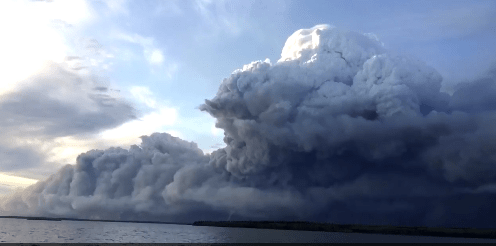
(Fires in northern regions and within the Arctic are now so energetic that they often produce pyrocumulus clouds — like this one which was thrown off by the Fort McMurray Fire.)
CEO Don Forgeron of IBC stated that the damage from the fires provide “alarming evidence” that extreme weather events have increased in frequency and severity in Canada
View original post 345 more words
A Seattle neighborhood is divided over a coyote pack that was recently killed.
According to USDA APHIS, someone asked for them to remove the coyotes. Other neighbors are horrified.
“It was howling. It was crying. It was moaning. It was horrible,” Nancy Bagnulo said.
Early Tuesday morning, several people woke up to gunshots near the Talaris conference center in Seattle’s Laurelhurst neighborhood.
Bozena Jakubik left her house to see what happened, noticing a white truck driving off. Daylight revealed more of what she’d heard overnight.
“I saw this huge stain of blood coming from the exit of her den,” she said.
According to USDA, three coyotes were killed.
“Wildlife services received a request to assist in the management of several coyotes near the Laurelhurst neighborhood in Seattle. The coyotes had become increasingly aggressive toward people and pets in the area,” Jeanine Neskey said.
The coyotes were killed on the Talaris conference center property. The center did not return phone calls asking for comment.
Neighbors said the coyote had pups, and by simply leaving her alone, they never had an issue.
“I’m bothered by the fact we weren’t given the notice or chance to weigh in on this decision,” Janice Sutter said.
According to USDA, someone requested their services. They worked for 3-nights, and used a call box, which is a device that mimics animal distress sounds and attracts coyotes.
“The thing that bothers me mostly is that they’re baiting them. I just don’t think that’s right,” Linn Blakeney said.
“I like the coyotes and it just makes me sick,” David Barnes added.
Wildlife officials believe there are no more coyotes left in this spot, but neighbors worry there may be a pup remaining.
“I’ve seen him running frantically out on the property and calling and crying and looking for his family,” Jakubik said.
Nancy Bagnulo and others say, they like living here because it’s a little bit of wild in the heart of a city, and that means learning to live together.
“If not, there’s not going to be any wildlife left. It’s just going to be people. And who wants that, really?” Bagnulo said.
Copyright 2016 KING
This year’s Asian monsoon has been a real beast for China. Inflated by the aftermath of a strong El Nino combining with record global temperatures, the system has sent powerful thunderstorms roaring over eastern sections of the Yangtze River Valley for the better part of two weeks.
These storms have spurred record tornadoes, rocked the Chinese landscape with lightning strikes, and dumped more than 16 inches of rain over a region near Wuhan and just west of Shanghai. The powerful downpours and related winds have now resulted in more than 54,000 building collapses and an estimated 7.7 billion dollars in damages. 32 million people have already been impacted. 1.4 million people have been displaced. And 231 people are now dead or missing (see China Flooding).
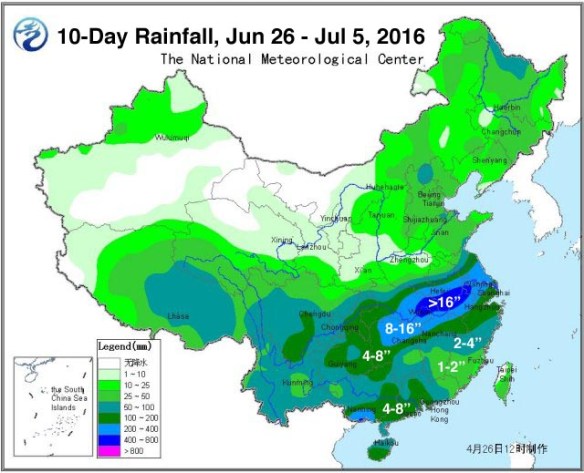
(Very intense rainfall over the past two weeks over the Yangtze River Valley region of China has resulted in severe flooding that…
View original post 982 more words

http://www.bornfree.org.uk/animals/hippos/zambia-hippo-cull/
Update July 4th 2016
Born Free calls for independent Presidential inquiry and a permanent halt to the killing.
Two thousand of Africa’s increasingly rare hippo, living in the wildlife haven of Zambia’s Luangwa Valley, face the renewed threat of terror and death, following a meeting held in Lusaka on Wednesday 22nd June.
Will Travers OBE, President and CEO of Born Free Foundation, stated: “Leaving aside the moral and ethical arguments and Born Free’s consistent opposition to culling, we are asking for urgent clarification on a number of key issues and the publication of all scientific evidence that might support such drastic measures.”
International and Zambian opposition to the cull has been widely reported in the media.
A temporary suspension of the cull, announced on 14th June, was, according to the Department of National Parks and Wildlife (DNPW), to allow for “extensive consultation”. However, following the brief meeting in Lusaka on Wednesday 22nd June it now appears the hiatus is over and the cull is set to resume.
This “invitation only” meeting was called by Stephen Mwansa, Permanent Secretary of the Ministry of Tourism & Arts, and Paul Zyambo, Director of DNPW. The company contracted by DNPW to carry out the cull, Mabwe Adventures, was in attendance, along with only one local stakeholder, the Luangwa Safari Association – representing safari camps and lodges in South Luangwa National Park.
Information from Zambia indicates that DNPW is now poised to push ahead with the cull of 2,000 hippos over five years using paying trophy hunters, as was recently promoted on Theo De Marillac Safaris’ website.
Why this decision has been taken, and on what basis, remains shrouded in secrecy. In light of this, Born Free Foundation wrote to the President of Zambia, His Excellency Edgar Chagwa Lungu, on 27th June, requesting the cull be abandoned and that key information pertaining to DNPW’s justifications for the cull to be made publically available. To date, no response has been forthcoming.
Born Free Foundation, together with other wildlife conservation and animal protection organisations, believe that five critical issues still need to be addressed:
Given the highly contentious nature of culling; the unanswered questions raised above; the possible conflict of interest; and the concerns about the lack of transparency of the tendering process, Born Free Foundation is calling for the planned cull to be abandoned and for the matter to be investigated at the highest possible level by an independent inquiry, established under the auspices of The Office of The President.
Travers added: “The longer these vitally important issues go unanswered, the more the authorities come up with different and, as yet, unsubstantiated justifications for the cull, the more Zambia – one of Africa’s great wildlife strongholds – will suffer lasting reputational and potentially economic damage. The independent inquiry, called for by Born Free, seems to me the only way to establish the truth and determine whether any of the claimed justifications for the cull – a measure which could see 2,000 wild hippo lose their lives – can withstand the scrutiny they deserve.”
Please contact Zambia’s President and Minister of Tourism politely calling for this ‘temporary’ halt to be permananet.
Please write to:
His Excellency Edgar Chagwa Lungu
President of Zambia
State House
PO Box 30135
Lusaka
Zambia
Email: lunguedgar@gmail.com
Stephen Mwansa
Permanent Secretary
Ministry of Tourism & Arts
National Assembly of Zambia
Parliament Buildings
Parliament Road
PO Box 30575.
Lusaka
Zambia
smwansa@mota.gov.zm
Start both letters ‘Your Excellency’ and sign off both ‘Yours respectfully and sincerely’.
Thank you.

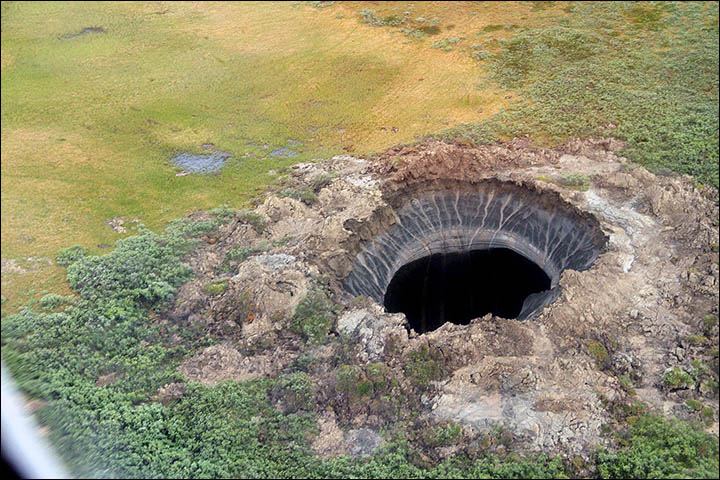
70.8 North, 69.2 East. It’s a section of the Yamal Peninsula in Siberian Russia. A typically chilly region of frozen but now thawing ground more than 4 degrees of Latitude north of the Arctic Circle. A place that saw the appearance of odd, disturbing (and now controversial) methane blowholes pockmarking the melting permafrost during 2014. Today, the high temperature in a land now being forced to rapidly warm by human-caused climate change spiked to a tropical 80 degrees Fahrenheit (26.4 C) at 0800 UTC. Tomorrow, temperatures are expected to again rise to 80 F (26.5 C). And in the same location on Thursday, the mercury is forecast to strike close to 86 F (30 C).
Across the Arctic Ocean at Latitude 71.4 North and Longitude 111.7 W, Canada’s Victoria Island is today also seeing temperatures spike to near 80 F (26.8 C). It’s a place encircled by sounds of…
View original post 858 more words


 Exposing the Big Game