Exposing the Big Game

Forget Hunters' Feeble Rationalizations and Trust Your Gut Feelings: Making Sport of Killing Is Not Healthy Human Behavior

Exposing the Big Game

A Season of Record Melt — Sea Ice Extent In Uncharted Territory For 94 Days

robertscribbler's avatarrobertscribbler

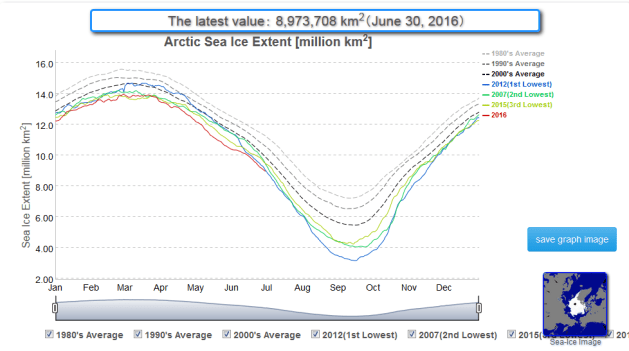
From March 25th through June 26th, sea ice extent measures, as provided by Japan’s Arctic data system were in record low ranges. In other words, for about a quarter of a year, and according to this monitor, the Arctic Ocean and its surrounding estuaries have witnessed the lowest ice coverage ever measured for any similar period since record keeping began in the 1979.

Sea Ice Extent JAXA

(An amazingly long period of record low sea ice extents in JAXA’s sea ice monitor.)

This new period of extreme sea ice record lows comes during a time of continuous decadal sea ice losses. Average sea ice coverage for each successive ten year period since the 1980s during the March through June period has fallen by about 400,000 to 500,000 square kilometers. For 2016, the new record lows widened this gap to more than 2 million square kilometers — or a surface area of sea ice…

View original post 732 more words

NOAA reminds people not to touch or pick up seal pups

By PHUONG LE

Associated Press

Published on July 1, 2016 9:19AM

Last changed on July 1, 2016 10:21AM

A harbor seal pup rests on seaweed-covered rocks after coming in on the high tide in the West Seattle neighborhood of Seattle in October 2011. At least five times this season, well-meaning people have illegally picked up seal pups in Oregon and Washington thinking they were abandoned or needed help, but that interference ultimately resulted in two deaths, said Michael Milstein, a spokesman with the National Oceanic and Atmospheric Administration.

AP Photo/Elaine Thompson

A harbor seal pup rests on seaweed-covered rocks after coming in on the high tide in the West Seattle neighborhood of Seattle in October 2011. At least five times this season, well-meaning people have illegally picked up seal pups in Oregon and Washington thinking they were abandoned or needed help, but that interference ultimately resulted in two deaths, said Michael Milstein, a spokesman with the National Oceanic and Atmospheric Administration.

Ralph Heitt picks up a “Seal Sitters” sign after the harbor seal pup he and other volunteers had been watching during his rest period returned to the water in Seattle in October 2011. As harbor seals are being born in the Pacific Northwest this time of year, marine mammal advocates are urging people not to touch or pick up pups that come up on beaches and shorelines to rest.

AP Photo/Elaine Thompson

Ralph Heitt picks up a “Seal Sitters” sign after the harbor seal pup he and other volunteers had been watching during his rest period returned to the water in Seattle in October 2011. As harbor seals are being born in the Pacific Northwest this time of year, marine mammal advocates are urging people not to touch or pick up pups that come up on beaches and shorelines to rest.

A baby seal is seen laying across a shopping tote used to carry it off a beach in Westport, Wash. State wildlife officials had to euthanize the harbor seal pup after it was determined to be unresponsive and lethargic.

Marc Myrsell/Westport Aquarium

A baby seal is seen laying across a shopping tote used to carry it off a beach in Westport, Wash. State wildlife officials had to euthanize the harbor seal pup after it was determined to be unresponsive and lethargic.

<!–

–>

SEATTLE — As harbor seals are being born in the Pacific Northwest, marine mammal advocates up and down the West Coast are urging people not to touch or pick up pups that come up on beaches and shorelines to rest.

At least five times this season, well-meaning people have illegally picked up seal pups in Oregon and Washington thinking they were abandoned or needed help, but that interference ultimately resulted in two deaths, said Michael Milstein, a spokesman with the National Oceanic and Atmospheric Administration Fisheries.

It’s an ongoing issue along the entire West Coast, from Alaska to California, when people who think they’re doing the right thing end up stressing or harming the animals instead, officials say.

State wildlife officials had to euthanize one harbor seal pup last month after a woman picked it up on a beach in Westport, Washington, and apparently carried it back to a house in a shopping tote. The animal was unresponsive and lethargic, Milstein said.

Another couple found a seal pup on the beach in Garibaldi, Oregon, and fearing the animal was abandoned, wrapped the seal in a beach towel, put it in their car and placed it in their shower at home, said Kristin Wilkinson, a NOAA Fisheries regional stranding coordinator. Wildlife officers returned that seal to the beach, but it was discovered dead the next day, she said. That couple received a written warning.

In California last year, there were at least 60 cases where people either illegally picked up or fed marine mammals, said Justin Greenman, NOAA’s assistant stranding coordinator for the state. Some of those animals were re-released; others died in care or had to be euthanized.

Selfies with seals or sea lions are also a growing problem, he added.

People’s impulse is to rush in and help, but it’s better to let nature run its course, Wilkinson said. The risk in taking baby seals off the beach is that adult seals may abandon them. “The best chance they have to survive is to stay wild,” she said.

Last month, in a case that garnered national attention, a Canadian man and his son loaded a bison calf into their SUV at Yellowstone National Park because they thought it was an abandoned newborn that would die without their help. The calf later had to be euthanized because it couldn’t be reunited with its herd.

“This is our Northwest version, apparently,” Milstein said.

NOAA Fisheries has launched a “Share the Shore” campaign to remind beachgoers to leave marine mammals alone, to stay at least 100 yards away and reduce other disturbances, such as keeping dogs on leashes. It’s illegal to harass, disturb or try to move young seals or other marine mammals.

Wilkinson said they typically see six to 10 illegal animal handling cases a year, but this year they’re seeing them earlier in the season and within a wider area.

Harbor seal pups are born along the West Coast, typically from February to May in California and from spring to late summer in the Northwest. They use beaches, docks and other shoreline areas to rest, regulate their body temperatures or wait for their mothers, who typically are nearby but may not come near the pups if there are too many disturbances.

Dr. Jeff Boehm, executive director of The Marine Mammal Center in Northern California, said so far this year 18 marine mammals have been brought to his center because they were harassed or illegally picked up. Most were eventually released into the wild after being treated but three have died.

“These animals have an innate charm. When you see one on the beach, they just draw you in. They’re small. They’re vulnerable,” he said, but people should really pause, take a step back and call local authorities who know best what to do with them.

NOAA wildlife officers in Washington are investigating a number of cases, including one in which a seal pup born prematurely parked up on the beach and a homeowner placed the animal in a tote and removed it, worried about bald eagles preying on the seal and making a mess on the beach, Wilkinson said.

Last month, a seal wasn’t illegally picked up but the pup was killed after wildlife officials determined that too much traffic and people on the beach meant that the mother was not likely to reunite with her pup.

In another case, a woman picked up a seal and briefly put it in her car before someone else told her to put the animal back on the beach, said Marc Myrsell, who directs the Westport Aquarium and whose staff responded to that incident. That pup returned to the water on its own.

Last week, a pup was handled so extensively at a beach park that wildlife responders determined the constant human interaction permanently separated the pup from its mother. People held the pup in their laps, cuddled it and pet the animal for many hours, she added. That seal was eventually taken to a rehabilitation facility.

With rehabilitation, “you’re giving them a second start, but you might not be giving them all the tools they need,” said Dr. Joe Gaydos, a wildlife veterinarian with SeaDoc Society. “They probably have a much better chance if they stay with their moms.”

Animal rights activists file suit against State Game Commission over cougar traps

http://www.taosnews.com/news/article_23810c2e-3e0f-11e6-b957-2fef0a8f45d0.html

  • By Phaedra Haywood, The Santa Fe New Mexican
  • Updated Jun 29, 2016

The lawsuit says “deadly leg-hold traps” set for cougars could snare wolves and jaguars, both protected under the federal Endangered Species Act, as well as female cougars with kittens, which are protected under state law.

There are an estimated 97 Mexican wolves in the wild in Arizona and New Mexico, officials have said, despite a federal program to recover the species. Jaguars — the largest cat species native to the Western Hemisphere — are far more rare in the U.S., after being driven to the brink of extinction by “human-caused factors like poaching and trapping,” the lawsuit says. It also names the state Game and Fish Department as a defendant.

Humane Society attorney Nicholas Arrivo, in a phone interview Tuesday, said the trapping program presents “a pretty unjustifiable risk to nontarget animals.”

Mexican wolves, jaguars and cougars share overlapping territory in New Mexico, Arrivo said. “Traps that are set for cougars are not intelligent. They are indiscriminate machines that will snap shut on any animal unfortunate enough to cross its path,” he said. He likened traps to land mines, saying both are “brutal, unnecessary and indiscriminate as to what they take.”

The State Game Commission could not be reached for comment on the case.

Lance Cherry, a spokesman for the state Game and Fish Department, said in an emailed statement Tuesday that the suit “is only a distraction; the rule was crafted after nearly a yearlong process of public and scientific scrutiny, including consideration of potential impacts on endangered species. The Department will vigorously defend the rule, which is part of a world-class effort to manage New Mexico’s wildlife.”

The State Game Commission reviews the rules for hunting and trapping bears and cougars every four years. In 2015, the panel held five public meetings on the topic before approving changes in August that cleared the way for “sport harvest” trapping of cougars on private and state trust lands between Nov. 1 and March 31 without a special permit. The new rule also doubled the number of cougars a hunter or trapper can take in some areas, increasing the kill limit in those lands to four from two.

Representatives of the New Mexico Council of Outfitters and Guides, the New Mexico Trappers Association and the New Mexico Cattle Growers’ Association spoke in favor of the proposed changes at a hearing in August.

But numerous other residents spoke in opposition, including Animal Protection of New Mexico’s wildlife campaign manager, Phil Carter. He cited a 2015 poll of 1,000 New Mexico voters, saying that “across the board” those surveyed opposed the changes — and trapping in general — by a 3-to-1 margin.

“That is consistent across every congressional district in the state and every political party,” Carter said at the hearing.

Retired elementary school teacher Jean Ossorio and her husband, Peter Ossorio of Las Cruces, have signed on to the suit as plaintiffs. They’ve been Mexican wolf advocates for more than 20 years and have volunteered for many federal wolf recovery efforts, along with outreach and education activities.

According to the complaint, Jean Ossorio has attended “virtually every state and federal public meeting pertaining to Mexico wolf recovery” since 1998.

The couple could not be reached for comment.

Carter, at the August hearing, accused the State Game Commission of using outdated data to draw its conclusions about cougar populations.

“This is not about sportsmanship,” he said. “This is about killing.”

Wildfires in the Land of Frozen Ground — 1,000 Mile Long Pall of Smoke Blankets Burning Siberia

robertscribbler's avatarrobertscribbler

It’s another day in a record hot world. And in a few hours, just below the Arctic Circle in Siberia, the temperature is predicted to hit 33.2 C (or just shy of 92 degrees Fahrenheit). According to climate data reanalysis, that’s about 15-20 C above average for this time of year over a land filled with cold weather adapted boreal forests and covering ground that, just below the first few feet of duff, is supposed to be continuously frozen.

image

(33. 2 C [92F] temperatures run to within 3.7 degrees of Latitude south of the Arctic Circle [66 N]. These are readings in the range of 15-20 degrees Celsius above normal and are likely record ranges for the area. Nearby, enormous Siberian wildfires now burn. Image source: Earth Nullschool.)

All along the southern and western boundary of this region of extreme heat, very large wildfires now rage. Sparking near…

View original post 477 more words