WA lawmakers OK new way to deter wolves

http://www.capitalpress.com/Washington/20170420/wa-lawmakers-ok-new-way-to-deter-wolves

Washington lawmakers thrust Department of Agriculture into new campaign to prevent wolves from killing cattle in Ferry, Stevens, Okanogan and Pend Oreille counties.
Don JenkinsCapital Press

Published on April 20, 2017 9:11AM

Washington lawmakers thrust Department of Agriculture into new campaign to prevent wolves from killing cattle in Ferry, Stevens, Okanogan and Pend Oreille counties.

U.S. FISH AND WILDLIFE SERVICE

Washington lawmakers thrust Department of Agriculture into new campaign to prevent wolves from killing cattle in Ferry, Stevens, Okanogan and Pend Oreille counties.

OLYMPIA — A bill creating a new program to prevent wolves from attacking livestock in northeast Washington has been sent by lawmakers to Gov. Jay Inslee.

House Bill 2126 directs the state Department of Agriculture and conservation district board members in Ferry, Okanogan, Stevens and Pend Oreille counties to oversee the awarding of money to nonprofit groups to protect herds, including by hiring range riders. The groups would be required to consult with resource agencies such as the Department of Fish and Wildlife and U.S. Forest Service.

HB 2126 proponents hope locally organized efforts to prevent depredations will be efficient and gain acceptance among producers.

“It needs to be a community-based approach where ranchers up here are largely steering the boat,” said Jay Shepherd of Conservation Northwest, an environmental group active in wolf recovery.

The program would be in addition to WDFW’s depredation-prevention program. Some ranchers have been reluctant to enter into formal agreements with WDFW.

The bill would assign to the state agriculture department for the first time a role in reducing livestock losses to wolves. WSDA stayed neutral on the bill because it wasn’t in the governor’s budget proposal, but will carry out the legislation if signed by Inslee, a department spokesman said.

The bill passed the House and Senate unanimously. It’s unknown how much money would be available to deploy new deterrence measures. The Legislature has not set aside money to fund the program. The bill creates an account in which grants, donations and state appropriations can be deposited.

“This is an important bill that will help us resolve the issue in wolf country,” said the bill’s prime sponsor, Aberdeen Democrat Brian Blake, chairman of the House Agriculture and Natural Resources Committee. “It creates a pot to put contributions into to help fund the efforts to keep wolves and people and livestock separate.”

Cattle Producers of Washington President Scott Nielsen, who’s also vice president of the Stevens County Cattlemen’s Association, said he liked the bill’s intent to involve local residents in making decisions.

But he said that he feared a new program could be used to justify delaying lethal removal of wolves in some cases. Ranchers who have lost livestock to wolves were using non-lethal deterrence measures, he said.

“We already know it has real limited effects,” Nielsen said. “I don’t know that there needs to be more money thrown at it.”

The Department of Fish and Wildlife, which manages wolves, supported the bill.

“We think this is a good approach because it is community based and will increase the uptake of these tools and help reduce the loss of livestock and ultimately the loss of wolves,” WDFW wolf policy coordinator Donny Martorello said.

Dog’s Death Spotlights Use of Cyanide ‘Bombs’ to Kill Predators


http://news.nationalgeographic.com/2017/04/wildlife-watch-wildlife-services-cyanide-idaho-predator-control/

One of the weapons the U.S. government uses to poison predators killed a pet Labrador in Idaho, sparking new calls to ban the devices.

Fourteen-year-old Canyon Mansfield was out walking the family Labrador, Casey, on public land in the outskirts of Pocatello, Idaho, last month. As they roamed a hill near their home, Canyon spied a piece of metal protruding from the snowy ground that resembled the head of a garden sprinkler. When he bent down to touch it, the device exploded, jolting him off his feet and emitting a powdery substance. Some of the granules got into his eyes, which he scrubbed out with wet snow.

The bulk of the substance blew downwind into Casey’s face. Within a minute the dog was writhing with convulsions, a reddish foam emanating from his mouth. In front of Canyon, the yellow Lab made guttural sounds then went still.

Heeding the cries for help, Canyon’s parents, Theresa and Mark Mansfield, rushed to the scene. Theresa cradled the dog while Mark, a family physician, administered chest compressions. He was about to try mouth-to-mouth resuscitation when Canyon shouted, “Don’t do it, Dad, I think Casey’s been poisoned.”

All three of them had some of the residue on their skin and clothes. Only by luck did it not get into their mucous membranes, and only later did they learn that this wasn’t just any poison. It was sodium cyanide—a federal Category One toxicant and one of the deadliest substances on Earth.

“When it went off, I was so confused because it caught me by surprise and happened so fast,” Canyon said. “I panicked because the next thing I knew Casey was dying.” Since the incident Canyon has been suffering from headaches, a telltale symptom of exposure to cyanide.

Sodium cyanide is considered by the Department of Homeland Security to be a potential weapon for terrorists. It’s a key ingredient in the M-44s, or “cyanide bombs,” used by Wildlife Services, an obscure agency of the U.S. Department of Agriculture, to kill wildlife predators on public and private lands in the West.

According to the U.S. Environmental Protection Agency, an average of 30,000 M-44s, deployed by the federal government in concert with Western states and counties, are triggered each year. Baited to entice animals, they’re indiscriminate in their victims. So far, no humans have been killed by M-44s. But according to an investigation by theSacramento Bee, 18 Wildlife Services employees and several other people were exposed to cyanide by M-44s between 1987 and 2012, and between 2000 and 2012 the devices killed more than 1,100 dogs.

Established 120 years ago under a different name, Wildlife Services exists primarily for the benefit of the livestock industry. The agency spends more than $120 million a year killing animals deemed “nuisances” to humans: everything from coyotes and wolves to mountain lions, bears, foxes, bobcats, prairie dogs, and birds (in part to prevent collisions with planes at airports). During the past decade the agency has killed some 35 million animals. It killed 2.7 million in 2016 alone.

In recent disclosure forms Wildlife Services reported that out of 76,963 coyotes killed in 2016 for livestock protection, 12,511 were felled with M-44s. Another 30,000 were gunned down by sharpshooters from fixed-wing planes and helicopters, and 15,000 more died in choking neck snares.

WILDLIFE SERVICES ADHERES TO A MIND-SET BETTER SUITED TO ROGUE COWBOY CULTURE OF THE 19TH CENTURY.

PETER DEFAZIO U.S. HOUSE OF REPRESENTATIVES

“Predators are a problem [for ranchers], and some of the predators are a problem for game animals,” says John Peavey, a longtime rancher near Carey, Idaho, who has battled coyotes and wolves getting into his cattle herds and sheep flocks. “These devices [M-44s], ugly as they are, are important. They should be highly supervised. They should not be set close to places where people recreate. But they are a tool, especially if properly used.”

While Peavey has sympathy for the Mansfields, he says the press has a fascination with writing only about the predator controversies and poisons when the real issue is maintaining the condition of Western rangelands. He believes some anti-livestock activists are using the poison issue to renew calls for prohibiting cattle and sheep from grazing on public lands.

For decades, however, environmentalists, animal welfare advocates, and some politicians have pushed for Wildlife Services to be radically reformed—if not abolished—arguing that it’s an anachronism.

“Wildlife Services, with much of what it does, adheres to a mind-set better suited to rogue cowboy culture of the 19th century, and it’s just not consistent anymore with modern values,” U.S. Representative Peter DeFazio, a Democrat from Oregon, told National Geographic by phone last week. Over the years DeFazio has pressed for investigations into Wildlife Services related to alleged animal cruelty, budget irregularities, illegal use of toxic chemicals, and convoluted statistics as to how many animals it actually destroys. “It’s an agency that lacks transparency and accountability, and I believe it’s out of control,” De Fazio said.

In a documentary titled, EXPOSED: USDA’s Secret War on Wildlife, former agency trappers corroborate that assertion.

DeFazio said the agency has managed to dodge significant oversight in Congress because of resistance from lawmakers, primarily in the West, who say that lethal removal of predators is essential to protecting the livelihoods of ranchers grazing cattle and sheep on public and private lands.

INCIDENT UNDER REVIEW

Following Casey’s death, Wildlife Services has been mostly silent.

In response to repeated phone calls from National Geographic to offices at local, regional, and national levels, its Washington, D.C., communications office issued the same written statement it circulated on March 17 and has made no further comment since. The statement noted that the incident was under review, that procedures are designed to minimize unintentional run-ins with pets, that precautions were taken and signs put up as warnings, and that such accidents are rare, this being the first in Idaho involving M-44s since 2014.

Dan Argyle, a captain in the Bannock County Sheriff’s Office, told National Geographic that no warning signs were observed at the scene and that a second M-44 had been positioned nearby, then removed by the trapper who put it there.

“As a program made up of individual employees, many of whom are pet owners, Wildlife Services understands the close bonds between people and their pets and sincerely regrets such losses,” the Wildlife Services statement says. “We are grateful that the individual who was with his dog when it activated the M-44 device was unharmed, however, we take this possible exposure to sodium cyanide seriously and are conducting a thorough review of this inPHOTOGRAPH COURTESY THERESA MANSFIELD

The statement concluded: “Wildlife Services provides expert federal leadership to responsibly manage one of our nation’s most precious resources—our wildlife. We seek to resolve conflict between people and wildlife in the safest and most humane ways possible, with the least negative consequences to wildlife overall. Our staff is composed of highly skilled wildlife professionals who are passionate about their work to preserve the health and safety of people and wildlife.”

On its website, Wildlife Services describes the way M-44s work: “The M-44 device is triggered when a canid (i.e. coyote or wild dog) tugs on the baited capsule holder, releasing the plunger and ejecting sodium cyanide powder into the animal’s mouth. The sodium cyanide quickly reacts with moisture in the animal’s mouth, releasing hydrogen cyanide gas. Unconsciousness, followed by death, is very quick, normally within 1 to 5 minutes after the device is triggered. Animals killed by sodium cyanide appear to show no overt signs of distress or pain.”

The Mansfields, incredulous at that description, say their dog suffered an agonizing death.

Sander Orent, a toxicologist in Boulder, Colorado, has for decades been tracking the USDA’s sanctioning of biocides—including a variation of M-44s called “coyote getters,” which also use cyanide, and lethal collars around the necks of sheep filled with deadly sodium fluoroacetate—to control predator populations. Of death by M-44 he said, “You could compare it to the recent sarin gas attack in Syria because the concept of how cyanide kills is similar. It basically suffocates any living being it comes in contact with. It ties up the ability of the blood to carry oxygen. When that dog is gasping for air, it experiences an extremely uncomfortable feeling of panic and desperation, then it convulses and dies. For an animal experiencing it and a person watching it happen, it would be horrifying.”

Orent, who has served as a scientific adviser to conservationists, said that animals as large as horses and cows have died from coming in contact with M-44s. “They’re frickin’ dangerous, especially when baited. It makes me think of war-torn parts of the world where munitions are meant to look attractive to children so they pick them up.”

According to Orent, who said it was incredibly lucky that neither Canyon nor his parents died or were seriously injured, “There’s no compelling scientific justification for these devices. I think it’s awful a society like ours still allows them to be used, because they’re not necessary.”

PREDATOR AND LIVESTOCK DEATHS

The Department of Agriculture’s Animal and Plant Health Inspection Service publishes an annual report on causes of death for livestock. In most parts of the West, predators rank behind disease, bad weather, and accidents when it comes to livestock deaths.

Predators kill more sheep than cattle, and Idaho ranks in the upper tier of sheep-producing states. In Idaho in 2014 (the most recent year for which numbers are available) predators were blamed for the loss of about 4,600 of the 16,000 lambs and adult sheep that died. (Conservationists dispute the figures.) Most of the losses were lambs taken by coyotes. Predators killed less than one percent of adult sheep. Bad weather, unknown non-predator causes, and lambing problems accounted for most deaths.

The state and federal government pay compensation for livestock killed by wolves, and in some cases Idaho reimburses ranchers for animals taken by mountain lions and black bears. Damages are not paid for kills by coyotes. Payments can range from a couple of hundred dollars for a lamb to a few thousand dollars for a cow.

Consistent statistics are often out of date, and it’s hard to reconcile different numbers presented by various agencies. Ranchers often say predators take more livestock than are officially reported, but some former Wildlife Services trappers, such as Carter Niemeyer, who wrote a memoir titled Wolfer about his career as an animal control specialist, say predator kills are often exaggerated and that statistics put into reports can’t always be trusted.

BLACK-FOOTED FERRETS, THE MOST ENDANGERED LAND MAMMAL IN NORTH AMERICA, DEPEND ON PRAIRIE DOGS, POISONED IN THE MILLIONS BY WILDLIFE SERVICES.

Niemeyer was a government trapper for several decades before retiring a few years ago. As a senior Wildlife Services director in Montana, he said that he and the agency trappers who reported to him had serious misgivings about using M-44s. “Trappers didn’t like using them because they’re dangerous and kill indiscriminately,” he said. Even when Niemeyer argued that there were better options for controlling coyotes, the agency’s “clients”—ranchers—would demand that M-44s be deployed against his objections, he said, noting that M-44s can indeed kill other non-target species, including wolves, bears, imperiled wolverines, and Canada lynxes.

“I’ve had half a dozen government trappers tell me that ranchers routinely inflate the number of losses that occur,” said Brooks Fahy, founder of Predator Defense, a conservation organization in Eugene, Oregon, devoted to advancing public understanding of predators. In some cases, he said, they “aren’t suffering losses at all, yet they just want Wildlife Services to come in and prophylactically kill predators whether they’re a problem or not.”

Whatever the actual numbers, one recent study showed that the best science done on predator control reveals that non-lethal methods are more effective than lethal ones at reducing livestock losses. But because strategies such as guard dogs, range riders, flashing lights, fencing, lamb sheds, and trapping and relocating predators can be more expensive, they’re less favored.

“The whole premise for Wildlife Services’s existence is based on a crumbling foundation of misinformation,” asserts Wendy Keefover, carnivore protection manager for the Humane Society of the United States, based in Colorado. “Cattle losses from wild carnivores and feral dogs together amount to 0.23 percent of the entire U.S. cattle inventory. For that reason alone it makes no sense for the federal agents to use chemical warfare on animals.”

On April 4 the Humane Society—along with the Center for Biological Diversity, Wildlife Guardians, and the Fund for Animals—sued the U.S. Fish and Wildlife Service, which, under the domain of the U.S. Department of the Interior Department, has management jurisdiction over endangered species. The lawsuit alleges that the service has failed to consider the impacts of Wildlife Services poisons on protected animals such wolves, grizzly bears, swift foxes, lynxes, raptors, black-footed ferrets, and others. Black-footed ferrets, the most endangered land mammal in North America, depend on a diet of prairie dogs, which have been poisoned in the millions by Wildlife Services. As of April 20, the Fish and Wildlife Service had not responded to the suit.

A FORMER INSIDER’S EXPERIENCE

Sam Sanders, who has a degree in biology from the University of Nevada-Reno, spent seven years, from 2004 to 2011, with Wildlife Services as a trapper and manager in northern Nevada. He called attention, he claims, to alleged violations of the law and protocols, but his complaints fell on deaf ears.

Today Sanders, who resigned from Wildlife Services because he felt the agency wasn’t seriously addressing problems, is an animal control specialist in the private sector. He told National Geographic that he’s regulated more stringently now than he was at Wildlife Services. He still has a few friends at the agency and said that “WS and I compete for a variety of work, including urban work at airports, rural work protecting livestock, and wildlife protection as well. So I’m fairly well informed.”

Contrary to Wildlife Services’ claims of being an industry leader in ethical animal control, Sanders said that not all its agents monitor their equipment (M-44s, leg-hold traps, and snares) in a timely way or post adequate warning signs. With regard to leg-hold traps, Sanders says animals caught in them can linger in pain for a week before they’re put out of their misery.

Sanders doesn’t use M-44s anymore. But, he said, “If you want to control predators, M-44s are effective tools, and there are responsible trappers out there who use them. I know, because I was one of them. But M-44s can be misused, and they have been to the point where stupid things can happen, involving irresponsible management, like the incident in Pocatello.”

And, he added, M-44s are “better from an animal welfare perspective than some of the ready-available alternatives.” People can buy rat poison from hardware stores and pepper it into animal carcasses left as bait for coyotes that can also kill pets and non-target animals. Sanders said he knows of people pouring gasoline into the dens of predators or starting fires that suck all the oxygen out of animal dens, causing death by suffocation. Not long ago he learned of a trapper who claimed to use large treble fishing hooks baited with meat dangling four feet off the ground. Predators reaching for the meat would suffer a gruesome death by choking and hanging.

For those who seek a ban on the use of M-44s, Sanders cautions that “you have to think of unintended consequences. People are going to employ other alternatives and come up with their own,” he said. “Until there’s a better way that solves conflicts between predators and livestock in ranch country, predators are gonna get it one way or another. Just because you ban what you believe is the bad stuff doesn’t mean it will stop the killing.”

IS POCATELLO A TIPPING POINT?

According to Brooks Fahy, public outrage sparked by the death of the Mansfields’ dog represents a tipping point in bringing the kind of scrutiny to bear on Wildlife Services that opponents say has been lacking.

“Wildlife Services has taken a beating for its controversial aerial gunning and gassing of predators, its trapping and snaring, but its use of deadly poisons has been a dirty little secret, especially where it has placed unsuspecting people and their pets in danger,” Fahy said. “This time it can’t run away from the truth.”

The trapper working for the Idaho branch of Wildlife Services mistakenly placed the M-44 that killed Casey on Bureau of Land Management land near the Mansfields’ residential subdivision, despite the agency’s promise last November, following a review of options for dealing with predators, not to use M-44s on public land in Idaho.

“It’s a fact that it was installed on BLM land,” Bannock County Sheriff Lorin Nielsen told a reporter in Idaho. “It was about 300 yards from the residence, and there were no posted warning signs at the time this happened. All three of those are violations of the protocol.”

CANYON WILL CARRY THE MEMORY OF WHAT HAPPENED TO HIS FAVORITE DOG FOR THE REST OF HIS LIFE.

THERESA MANFIELD CANYON’S MOTHER

On March 28 Western Watersheds, an advocacy group that monitors effects of livestock grazing on public lands, and 19 other conservation organizations submitted a petition calling on Wildlife Services to end the use of M-44 cyanide bombs in Idaho and retrieve all those now in place in the state.

Wildlife Services complied, ordering three dozen existing M-44s to be removed and temporarily banning use of M-44s in Idaho.

Congressman DeFazio said that doesn’t go far enough and that the ban needs to be applied nationwide. But, he added, at least “Idaho and Wildlife Services are now under a spotlight.” On March 30 DeFazio submitted a House bill, “The Chemical Poison Reduction Act of 2017,” calling for a total ban on M-44s in the name of public health, animal welfare, and national security.

Meanwhile the Bannock County prosecutor’s office is deciding what criminal or misdemeanor charges to bring against Wildlife Services.

Theresa Mansfield told National Geographic that no one from the agency reached out to to express sympathy for the family’s ordeal. She and Canyon went down to the Wildlife Services office in Pocatello and happened to meet the trapper who deployed the M-44.

“When I confronted him face to face, he said, ‘I’m sorry this happened to your son and dog,’ but, really, what else could he do standing in front of an upset mother and her child who could’ve been killed?” Theresa said. “It angers me that no one from Wildlife Services had the decency to reach out. All Wildlife Services did was issue a cut-and-paste statement to the public. I’ve been told they’re unwilling to apologize personally to us because that would be an admission of guilt.”

Fahy said this is consistent with Wildlife Services’ previous responses to other families who lost pets to M-44s or had members get sick by coming in contact with them. “It fits a troubling pattern. In the past Wildlife Services has actually implied that people may seek out M-44s and get their dogs killed so they might sue and collect a huge settlement from the government,” he said. “So their posture is to deny.”

On June 21, 2006, Michael J. Bodenchuk, then the state director of Wildlife Services in Utah, wrote a memo stating why he didn’t want to pay damages to a woman who lost a dog to M-44 poisoning. “I have concerns about the government settling cases with dog owners because it is all too easy for someone to intentionally take a dog into an area posted with signs with the intention of getting the dog killed,” Bodenchuk said.

Theresa and her husband are considering filing a lawsuit against Wildlife Services. They’ve written to President Donald Trump asking him to take action, and they plan to travel to Washington, D.C., in support of DeFazio’s legislation.

Never in their worst dreams, Theresa said, would they have imagined their son becoming a poster child for the need to reform a government agency. For now the couple is focusing on being profoundly grateful that their teenage son is still alive.

“Any time Canyon talks about it, his mood instantly changes,” Theresa said. “He feels responsible for what happened to Casey. He asks, ‘What if I hadn’t touched it? What if I hadn’t gone outside. He questions why he went up that hill, and I tell him that none of this is your fault. Canyon will carry the memory of what happened to his favorite dog for the rest of his life.”

Trump Junior’s plans for Saturday morning in Montana causing controversy

Apr 19, 2017 6:38 PM PDTUpdated: Apr 19, 2017 6:38 PM PDT

Trump Junior’s plans for Saturday morning in Montana causing controversy
BOZEMAN –We are learning more about Trump Junior’s plans for Saturday morning and it’s sparking some controversy with local environmentalists. The Ravalli Republic reported that Gianforte told a crowd in Hamilton Monday that he plans to take Donald Trump Jr. Out to shoot prairie dogs.

It’s important to note that shooting prairie dogs in Montana is completely legal, but at least one wildlife advocate says it is far from ethical.

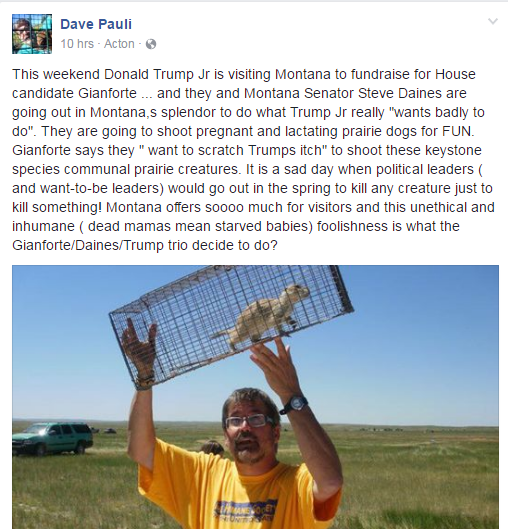
Dave Pauli Senior Advisor for Wildlife Policy with the Humane Society of The United States said, “I was disappointed I guess that any national or international politician or celebrity would have the opportunity to come to Montana in the spring and their first choice of things they want to do is shoot prairie dogs.”

In a Facebook post posted on Wednesday, Pauli voiced his frustrations about the idea of Gianforte and Trump Jr. Spending their time in Montana shooting prairie dogs.

The Facebook post has garnered a lot of attention with more than 300 likes and 400 shares in just a few hours. And there are plenty of comments on both sides of the issue.

Ruth Gessler Farnsworth simply said, “Awful.”

While Jeremy Parish said, “totally legal and encouraged. Just like the coyote slaughter in most states.”

Shane Scanlon Communication Director for Greg Gianoforte says Ginaforte is proud to hunt in Montana. Scanlon released a statement saying…

“Hunting is a big part of gain forte’s life; he’s a sportsman and an outdoorsman and tries to get out when he can. He’s just looking to have a good time with Donald Trump Jr. and shooting some prairie dogs this weekend.”

Pauli says he’d rather see the duo hit a shooting range.

Trump Junior’s first appearance in Montana will be on Friday in Kalispell, from there he will visit Hamilton and close out his trip in Bozeman.

He’s attending several fundraisers for Gianforte who is running against Democrat Rob Quist for Montana’s lone congressional seat.

Trump hosted ‘trailer park trash’

http://thehill.com/homenews/administration/329762-olbermann-trump-hosted-trailer-park-trash

Olbermann: Trump hosted ‘trailer park trash’

A detailed analysis of the Trump-Palin-Nugent-Kid Rock photo

http://www.cnn.com/2017/04/20/politics/donald-trump-sarah-palin-kid-rock-ted-nugent/

Washington (CNN)Former Alaska Gov. Sarah Palin as well as rock stars Kid Rock and Ted Nugent were at the White House on Wednesday night, dining with President Trump and snapping a few pics in the Oval Office. “Asked why I invited Kid Rock and Ted Nugent I joked, ‘Because Jesus was booked,'” Palin wrote on her website.

This photo was taken of the quartet:

It is, in a word, amazing. I spent a fair amount of time studying it — cue Twitter outrage; “Don’t you have anything better to do?????” — and I have a few thoughts.
Donald Trump: The President is, of course, talking. What is he talking about? Something on those papers he is holding up. I zoomed in until my eyes blurred to try to figure out what the papers on his desk say. No dice. Maybe you have better eyesight than me? Here’s the close-up:

The look on the president’s face says something like “See, now, isn’t this interesting” to me. Or maybe, “Then I figured out…”
Kid Rock: Robert James Ritchie — and, no, I didn’t know Kid Rock’s real name without looking it up — makes this whole photo for me. He’s the unquestioned star. First of all, the hat: A+. And then “The Thinker” pose: A+++++. Whatever is on those papers Trump is showing RJR, he finds it totally fascinating. In fact, I wish one day I could find something in life as interesting as Kid Rock finds what the President is saying.
Ted Nugent
: First off, I sort of respect the fact that The Nuge didn’t abandon his trademark camo cowboy hat even though he was going to the White House. You do you, Ted. When it comes to the rest, Nugent is the anithesis of Kid Rock. Whereas K. Rock is all attentiveness, Nugent looks more dutiful than anything else. “OK, this guy is the president. He’s talking about something. I am looking and acting interested.”
Sarah Palin: The angle from which this photo was taken makes Palin’s facial expression unknowable. Which makes me sad. But, given how good the rest of the photo is, I won’t get greedy.

Rescue Gajraj the Elephant From Torture at Indian Temple

https://animalpetitions.org/243668/rescue-gajraj-the-elephant-from-alleged-torture-at-temple/

Target: Modi Narendra, Prime Minister of India 

Goal: Rescue Gajraj the elephant, who has been tortured and held in captivity for over 50 years, from the Satara Temple.

A 63-year-old elephant named Gajraj has been living in devastating conditions for most of his life. Currently, he is being kept in chains as a tourist attraction at the Satara Temple in India. Before he was there, he was used by handlers to beg visitors for money. Since becoming ill and too sick to continue doing that, he was left at the Satara Temple.

Gajraj’s living conditions were revealed anonymously to The Sun newspaper in the U.K. in the form of video footage. Due to being chained to a hard floor, he has developed abscesses on his hind quarters and elbows. He reportedly spends time every day trying to free himself from those chains. Pictures also show that the ends of his tusks have been cut off and that he has overgrown and broken toenails on all of his feet.

He is also exhibiting classic signs of severe psychological distress, presumably as a result of both his social isolation and the terrible conditions he is living in. He is apparently not receiving the appropriate care because he can no longer make the handlers any money, but he does not deserve to die in agony because of that.

Something needs to be done to save Gajraj and to prevent this from happening to more animals in the future. Sign this petition to demand that the appropriate measures are taken as soon as possible.

PETITION LETTER:

Dear Prime Minister Modi Narendra,

Gajraj the elephant is dying in agony at the Satara Temple and it seems that no one at that facility cares. You have the power to do something about this and to send someone in to rescue Gajraj before it’s too late.

He has spent the majority of his life being tortured and held in captivity. At the Satara Temple, he is chained to the ground and completely alone. This is driving him into severe psychological distress that no living creature deserves to experience.

We ask that you help save Gajraj and take the measures necessary to implement legislation that prevents this from happening to more animals in the future.

Sincerely,

[Your Name Here]

https://animalpetitions.org/243668/rescue-gajraj-the-elephant-from-alleged-torture-at-temple/

Chicken franchise sales rise in 2016 despite bird flu, economic slump

Exposing the Big Game's avatarThe Extinction Chronicles

Sales of South Korea’s major chicken franchises rose last year from the previous year despite the outbreak of avian influenza and weak economic growth, government data showed Wednesday.

Fried chicken and beer, called “chimaek” in South Korea, is one of the most popular foods in the country, as well as soju and samgyeopsal, or grilled pork belly.

(Yonhap)

Kyochon, the biggest franchise, posted a 13-percent increase to 291 billion won ($255 million) last year from $257 billion won a year earlier, according to the statistics compiled by the Financial Supervisory Service.

BHC witnessed a whopping 26-percent surge to 232 billion won last year from the previous year, taking back the status as the country’s second largest chicken franchise.

BBQ slipped to third place with 219 billion won, although up 1.8 percent from the previous year. Goobne Co. came in fourth with 146 billion won in sales last…

View original post 144 more words

South African hunter is believed to have been eaten by crocodiles

http://www.dailymail.co.uk/news/article-4422260/Hunter-believed-eaten-crocodiles.html#ixzz4eoQTFi7C
Follow us: @MailOnline on Twitter | DailyMail on Facebook

South African hunter is believed to have been eaten by crocodiles after human remains are found inside two beasts

  • Hunter Scott Van Zyl, 44, vanished last week after going on a hunting safari 
  • His footprints were later found leading to banks of Limpopo River in Zimbabwe
  • Police shot two Nile crocodiles who they suspected of eating the father-of-two
  • Remains found inside the crocs are now being tested by forensics experts

A South African hunter is believed to have been eaten by crocodiles after human remains were found inside two beasts.

Scott Van Zyl, 44, vanished last week after going on a hunting safari with a Zimbabwean tracker and a pack of dogs.

The father-of-two, whose company runs hunting trips for foreign clients, is thought to have been eaten by crocodiles on the banks of the Limpopo River in Zimbabwe.

South African hunter Scott Van Zyl, 44, is believed to have been eaten by crocodiles after human remains were found inside two beasts

South African hunter Scott Van Zyl, 44, is believed to have been eaten by crocodiles after human remains were found inside two beasts

He vanished last week after going on a hunting safari with a Zimbabwean tracker and a pack of dogs

He vanished last week after going on a hunting safari with a Zimbabwean tracker and a pack of dogs

The professional hunter and his tracker had left their truck and walked into the bush in different directions.

Later that day his dogs returned to the camp without Mr Van Zyl. His rifle and belongings were found inside the truck.

Mr Van Zyl’s footprints were later spotted leading to the river bank and trackers found his backpack nearby.

Sakkie Louwrens, who was part of the search team, said police suspected two Nile crocodiles may have eaten Mr Van Zyl.

‘We found what could possibly be human remains in them,’ he told The Telegraph.

The father-of-two, whose company runs hunting trips for foreign clients, is thought to have been eaten by crocodiles on the banks of the Limpopo River (pictured) in Zimbabwe

 Police and animal nature conservation services decided to shoot the reptiles.

The remains are being tested by forensic experts to see whether they belong to Mr Van Zyl.

At least four people have been killed by crocodiles in Zimbabwe in the past month.

In March, villagers cut open a crocodile and found the remains of an eight-year-old boy inside the beast.

The shocking scene was captured by an eyewitness with a smartphone in the village of Mushumbi Pools in northern Zimbabwe’s Mashonaland Central Province.

Villagers suspected the crocodile had killed and eaten the young boy, and shot the animal dead.

Police shot the crocodiles and are testing the remains found inside them to see if they belong to Mr Van Zyl (pictured with his wife)

Zimbabwe has recently been hit by heavy rain, raising river and dam levels, which can bring crocodiles to areas where they are not normally seen.

A crocodile was recently shot dead in Beatrice, a farming community in the neighbouring province of Mashonaland East, with what were believed to be the remains of a fisherman in its stomach.

In November, last year a 13 year old boy who was fishing to pay for his school fees was killed by a crocodile in southern Zimbabwe.

Owen Chianga and his friend, Liberty Ruzivo, 15, were attacked by two crocodiles while they were fishing in the Save River near the village of Birchenough Bridge.

Nile crocodiles typically feed on fish, antelope and zebra, which they snatch from the shallows and before engaging in a twirling, drowning method known as ‘the death roll’.

Read more: http://www.dailymail.co.uk/news/article-4422260/Hunter-believed-eaten-crocodiles.html#ixzz4eoRDkIKd
Follow us: @MailOnline on Twitter | DailyMail on Facebook

http://www.dailymail.co.uk/news/article-4422260/Hunter-believed-eaten-crocodiles.html#ixzz4eoQszeJf

Karmic Disaster: Dead Meat as Gastronomic and Economic Sustenance

http://www.all-creatures.org/articles/ar-karmic-disaster-dead-meat.html

An Animal Rights Article from All-Creatures.org

FROM

John R. Hall, The GreanvillePost.com
April 2017

A nation of zombies feeds on the flesh of dead animals, salutes, pledges allegiance to, and sings the patriotic songs of the Empire which spreads death and destruction worldwide. Few have noticed Bad Karma nibbling away at their sorry asses. Few have noticed the Fall of Empire in progress. Their national borders are prison bars, their economy in shambles, their hopes and dreams gone. When it comes to neighbors, love has been replaced by fear. More firearms than humans populate the land…

sue coe
By Sue Coe, the world’s foremost political artist focusing on humanity’s tyranny over non-human creatures.

Hindu scriptures teach that anyone who kills or causes harm to other sentient beings is in for a big dose of Bad Karma as a result. The shit can hit the fan in this lifetime or in some future reincarnation, but it will happen. Not that I personally subscribe to Hinduism or any other religion, but I do believe that there’s a large dose of merit in their world view. A lot can be said for lifestyles which involve veganism and peaceful coexistence with our fellow beings. Stray from the path, commit the crime, and you’ll eventually do the time. Like the Hindus, we’ll define “sentient beings” as including (most) humans, all other creatures with eyes and mothers, and most importantly Mother Earth herself; for she’s borne the brunt of harm caused by her thoughtless, careless, greedy human children.

Dead meat is the fuel that powers Empire, and the resulting karmic disaster now bites all its citizens in the ass in oh so many ways. We’ve been told since birth that we need to kill and consume cows, pigs, chickens, turkeys, ducks, sheep, goats, rabbits, and/or squirrels, to maintain a necessary level of protein in our diets. Whack ’em, gut ’em, skin ’em, cook ’em (optional), and eat ’em. We’ve also been instructed to drink the milk meant for calves, in its many forms, and to ingest the embryos of large birds. If you are a believer in the studies and lifework of Dr. Caldwell Esselstyn, or are even mildly observant, you understand that your morbidly obese friends and neighbors (or you) are dying prematurely from meat/dairy/egg-intensive diets, in ever-increasing numbers. Heart/coronary artery disease, cancers, diabetes, dementia, Alzheimer’s, and untold other karmic paybacks are their rewards for either directly killing animals or buying their dead flesh from Safeway’s meat case, and consuming it. If Dr. Esselstyn is correct, by the time the average meat-consuming high school graduate in The U.S.A. accepts his diploma, coronary artery disease is already ravaging his body.

Dead meat is the fuel that powers Empire. War is its business, and fast becoming its only business. Bombs, bullets, missiles, rockets, warships, and warplanes are its preferred delivery methods. Its young people are lured into the bloody, tangled web of death and destruction by slick-huckster, pseudo-patriotic, U.S. Military-glorifying advertising schemes. The lucky do their time, emerging with bodies largely intact, suffering only a lifetime of residual mental anguish and PTSD, souls stolen away, brains scrambled, expressionless, and aimless, demented, self-doubting heroes to the masses who cheerlead Empire’s wars. Warfare for profit drives the stock markets. In my lifetime alone: A few million dead Koreans, a few million dead Vietnamese, Cambodians, Laotians, a few million dead Afghans, Iraqis, Libyans, and Syrians, and the market values of Boeing, Exxon-Mobil, Raytheon, Halliburton, Monsanto, and Northrop Grumman soar. Billionaires, corporate executives, bankers, and politicians rake in the blood money. Combat boots leave their marks upon the faces of dead populations across the globe, as the looming shadow of Bad Karma darkens the land.

Dead meat, the fuel that powers Empire, brings a tear to the eye of Mother Earth. Mega-corporate meat-growing mass-execution operations grow sentient mammals and birds in immobile squalor, pumping them full of antibiotics and growth hormones, raping (force-breeding) them, stealing their progeny and milk, unceremoniously slaughtering them, and feeding them to the masses of sick, mindless, obese humans. Filling the atmosphere with the stench of uncontained defecation and urination, and contributing more greenhouse gas emissions than all other sources combined. Crops feeding death-row, USDA-inspected, four-legged or feathered prisoners consume more water in Empire than all other uses combined, both domestic and agricultural, not to mention the associated, indiscriminate use of toxic soil-killing herbicides and pesticides connected with corporate agriculture.

Dead meat. Populations of third world countries cry out for food and drinking water, but receive bombs instead. Citizens unfortunate enough to live in oil-rich lands yearn for basic needs, but find themselves to be testing grounds for Empire’s newest, state-of-the-art WMD’s. But who needs rice when you can have depleted uranium? Countries ravaged, war’s ultimate goal; death, destruction, chaos. Dead meat litters broken countrysides. Empire’s exceptional citizens stuff their fat faces full of dead meat. They watch in awestruck approval the fireworks of death, in countries they can’t find on a map, on their favorite corporate “news” channels. Meat; it’s what’s for dinner. Meat; it’s what you become if you’re not in sync with Empire’s agenda. Meat; it’s what all sentient beings are, in the eyes of those who push the buttons and pull Empire’s strings. Resources to be harvested. Meat.

sue coe
By Sue Coe, the world’s foremost political artist focusing on humanity’s tyranny over non-human creatures.

The U.S.A. is now ground zero for karmic disaster. A nation of zombies feeds on the flesh of dead animals, salutes, pledges allegiance to, and sings the patriotic songs of the Empire which spreads death and destruction worldwide. Few have noticed Bad Karma nibbling away at their sorry asses. Few have noticed the Fall of Empire in progress. Their national borders are prison bars, their economy in shambles, their hopes and dreams gone. When it comes to neighbors, love has been replaced by fear. More firearms than humans populate the land. Pawnshops and porn stores offer temporary solace from wretched lives of impending poverty and loveless relationships with despised partners. Self-loathing zombies cover their bodies, head to toe, with senseless colorful graffiti, squalor of the skin, ill-conceived epidermal etchings. Drug and alcohol addiction run rampant. Hungry, homeless, hopeless people beg on every street corner, while others turn a blind eye. The Police State grows like a malignant tumor across the land, but soulless faces buried in miniature electronics fail to pay heed.

It would be easy to end this sordid little piece on a hopeless note, for Empire’s apparent future appears to hold little in the way of hope. If only there was someone who might have a chance of gaining enough power to turn things around, end constant warfare for profit, and bring a degree of sanity to The U.S.A. before Bad Karma brings the wrath of the rest of the world down upon us in a big and final way. Someone who would have the huevos to run for and be elected POTUS, buck the power of The C.I.A., The U.S. Military, the neocon/neolib war consortium, and Wall Street. A John F. Kennedy reincarnate. Maybe a disillusioned combat veteran who’s also a beautiful, well-spoken, and fearless U.S. Congresswoman from Hawaii. Someone who’s travelled to Syria (with Dennis Kucinich), spoken with President Assad, doubts that he was responsible for the sarin gassing of his people, and would be extremely hesitant to EVER AGAIN start another war. How about a lifelong vegetarian Hindu? President Tulsi Gabbard….hmmm. We can only hope and dream. Karmic disaster is imminent as our karmic debt comes due, but there may yet be time to bury Empire and save The U.S.A. Hope springs eternal.


The Greanville Post Senior Contributing Editor, John R. Hall is a street-trained agnotologist with an advanced degree in American Ignorance. Other hats include: photojournalist, novelist, restaurateur, mountaineer, grocer, nurseryman, and janitor. He’s written three novels which have been read by almost nobody: Embracing Darwin, Last Dance in Lubberland, and Atlas fumbled. An untrained writer and college drop-out, he began his short career in journalism writing the ‘Excursion’ column for The Jackson Hole News & Guide. More recently he penned the ‘Left Column’ for The Molokai Island Times; appropriately on the island once known as a leper colony. John currently resides, writes, and protests injustice in the shadow of the Sangre de Cristo Mountains, and walks among the spirits of those who once occupied the 79 Disappeared Pueblos.

Washington lawmakers seek to shield wolf-plagued ranchers from threats

Exposing the Big Game's avatarThe Extinction Chronicles

OLYMPIA — The Washington Senate and House have approved legislation to withhold records that name ranchers who report that wolves are attacking livestock or sign agreements to prevent depredations.

House Bill 1465 stems from threats ranchers and public employees received last summer as the Department of Fish…

View original post 363 more words