Shooting emperor geese in Alaska is legal for the first time in 30 years, but officials are hoping hunters take it easy.
| April 19, 2017, at 12:53 p.m.
BETHEL, Alaska (AP) — Shooting emperor geese in Alaska is legal for the first time in 30 years, but officials are hoping hunters take it easy.
Federal managers have opened a subsistence hunt for the birds and are visiting coastal villages to lay down ground rules before the geese migrate, KYUK-AM reported (http://bit.ly/2pg3aVE ).
The rules call for targeting one bird at a time instead of spraying the flock, only taking juvenile birds that are not yet breeding, limiting the number of birds taken and only taking one or two eggs from a nest.
About 80 percent of the world’s emperor goose population breeds along the west coast of Yukon Delta in southern Alaska. The migration is expected to begin in mid to late May.
Officials hope the large number of geese doesn’t get to hunters’ heads, though.
“With the season opening for emperor geese for the first time in 30 years, there is a concern of overharvest of emperor geese, because they’re ignorant to a lot of hunting activities, because they haven’t been harvested, so they haven’t learned how to avoid hunters,” said Bryan Daniels, a waterfowl biologist with the U.S. Fish and Wildlife Service.
The six-week hunt is now open and runs until the beginning of June.
The 1980s was the last time hunters could go out for emperor geese, which was before the bird’s population dropped dangerously low.
Now, the population is just above the threshold to sustain a hunt.
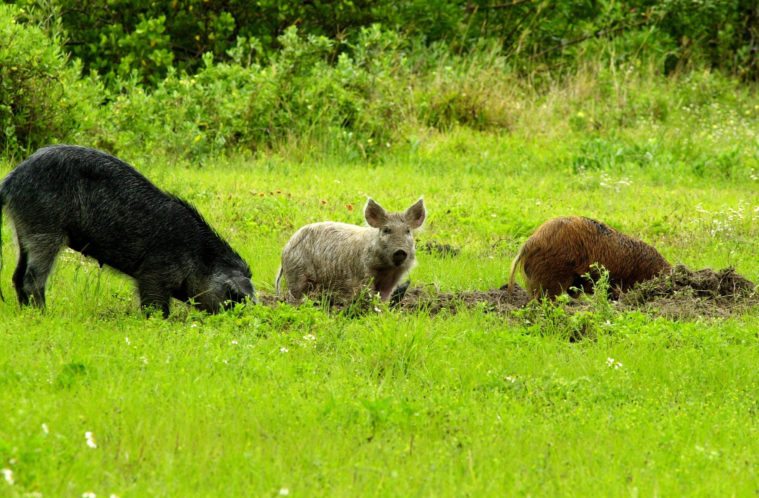
Policymakers in Texas continue to scratch their heads over the state’s feral hog problem, and the solutions are getting weirder.
Hot air balloon FLICKER/IRULAN_AMY
Researchers and policymakers for years have searched fruitlessly for effective ways to significantly drop feral hog population levels in Texas, with proposals ranging from eating our way out of the problem to widespread poisoning.
Roughly 2 million wild hogs are estimated to live in Texas, and they cause more than $50 million in damage each year. The invasive animals’ high breeding rate and lack of predators have fueled their proliferation in South, Central and East Texas, leading to big business for hunters and trappers.
In 2011, Agriculture Commissioner Sid Miller, then a state rep, passed what became known as the “pork chopper” bill, legalizing the hunting of feral hogs from a helicopter. On its face, the bill sounded more like a joke than an actual solution.
Hunter prepares to shoot feral hogs with a rifle from a helicopter. YOUTUBE/NICK LEGHORN
Turns out, it’s really hard to shoot anything from a helicopter. In addition to being ineffective, the method is also very dangerous (and not just for the hogs.) The only results produced by the bill were some crazy YouTube videos and an industry in which people pay upwards of $3,000 per hunt to pick off pigs from a chopper.
Enter state Representative Mark Keough, a Republican and pastor from The Woodlands. He told the Observer that he “loved” Miller’s pork chopper bill and found himself asking: “What are more ways we can take more feral hogs?”
After chatting with hunters and conducting his own informal research, Keough believes he’s found an alternative solution: hot air balloons.
His House Bill 3535 would authorize Texans to hunt feral hogs and coyotes from a hot air balloon with a permit.
If the idea seems crazy, that’s because it is. No one hunts from a hot air balloon. Go ahead, Google it. “I haven’t found people anywhere doing this,” Keough admits.
But he thinks it would be pretty damn sweet to try. (It’s currently illegal, or he would’ve tried already, he said.)
The fast-moving helicopter approach, Keough says, has a lot of “safety issues,” leads to many misses and often scares off the hogs. “They’re smart,” he said.
Feral hogs damage land in rural areas, but have increasingly caused problems in suburban and urban areas. U.S. FISH AND WILDLIFE SERVICE
Hot air balloons, on the other hand, are more stable, slower and offer a better rifle-shooting platform, Keough said.
Last July, 16 people were killed in the deadliest hot air balloon crash in U.S. history near Lockhart when the pilot lost control and crashed into power lines. The incident led to calls for stricter regulation of the balloon industry.
Still, Keough says, “It’s far safer than if you were hunting out of a helicopter.”
But more effective? Probably not.
Even Keough admits there’s a good chance hunters could spend all day in a balloon and not shoot anything. And its clumsy, slow-moving nature will keep hunters from effectively chasing the animals.
The animals, which can grow to weigh 100-400 pounds, have a gestation period that’s shorter than four months and litter sizes of up to 12. They are considered a non-game animal, meaning there are no seasons or bag limits, but a state hunting license is required.
Billy Higginbotham, a professor and wildlife and fisheries specialist with the Texas A&M AgriLife Extension Service, said the balloon strategy faces the same problem as helicopters in the eastern third of the state: trees.
“Aerial gunning by any vehicle [in East Texas] is not widely used because of the extensive tree cover,” Higginbotham said.
State Representative Mark Keough, R-The Woodlands. FACEBOOK
Keough said the “pork choppper” bill “was more about creating an industry” and that no single strategy will significantly reduce hog populations.
“I think there is a possibility [with hot air balloons] for an industry, but the motivating factor is this is another way to get rid of the problem,” he said
Keough also sponsored legislation that would require more research on the effects of widespread lethal pesticides, including warfarin, before they can be used on hogs. The measure passed the House Monday.
A Texas Parks and Wildlife Department spokesperson declined to comment on pending legislation, citing agency policy. HB 3535 would require the agency to license individuals who want to hunt from the balloons.
Keough, who said he’s “interested in anything that will help us get rid of these things,” believes his bill represents the spirit of Texas.
“We’ve got a problem here, and we are willing to fix it ourself,” he said. “We have that Western, swashbuckling, cowboying type of way to deal with things. It’s part of the culture, it’s different than any other state.”
Correction: An earlier version of this story reported no license is required to hunt feral hogs in Texas. A state-issued license is required, although there are no seasons or bag limits.
For 2 years in a row, a pair of wolves has managed to survive on Isle Royale, Michigan, the last of their kind on the wilderness island. Researchers continue to track the wolves and their moose prey, in the last installments of the world’s longest running predator-prey study. They report today that although the wolves hunt successfully, they are too few to affect the moose population. Aquatic as well as terrestrial vegetation is taking a hit as moose numbers climb, according to the study’s 59th annual report.
After Canadian wolves colonized the island in 1949, the wolf population peaked at 50 in 1980, and as recently as a decade ago, 30 wolves prowled the island, a U.S. National Park. The island’s now-famous predator-prey study has tracked how wolf and moose numbers have risen and fallen in tandem over the decades, and left their mark on the island’s ecology.
In contrast to last year’s winter study, when wolf tracks were the only evidence of the predators, wildlife ecologist Rolf Peterson spotted both wolves sitting on lake ice on the January afternoon he arrived on the island. Weeks later, Peterson and co-investigator John Vucetich, both of Michigan Technological University in Houghton, found the wolves feeding on a freshly-killed moose calf. “We were very lucky,” Peterson says. “There was no mystery left in terms of the wolf population,” or what they were eating.
The researchers also observed that, in what normally would have been the wolves’ breeding period, the 7-year-old female bared her teeth in response to the close interest of the 9-year-old male; he is both her father and half sibling. Researchers don’t expect the highly inbred pair to reproduce.
The two wolves otherwise appeared healthy and still have all their canines, a key sign of well-being in the carnivores. The pair has already surpassed the average Isle Royale wolf lifespan of 4 years, dodging the main causes of death for their ancestors on the island: other wolves and starvation. “They are swimming in moose,” Vucetich says.
The four wolf-killed carcasses the researchers spotted made little dent in the overall moose population, estimated at 1600 in aerial surveys conducted this past winter. The 20% increase from last winter is consistent with the population’s growth rate over the past 6 years, as the inbred wolf population dwindled and collapsed. Both beaver and moose abundance have tripled since 2011, “undoubtedly because of lack of predation,” Vucetich says.
With moose density on the Guam-sized island already five to ten times higher than on the mainland–and with the numbers on track to double in three to four years—browsing on the island’s vegetation is intense. One aquatic plant, floating watershield (Brassenia schreberi), which was abundant six years ago when moose were at historic lows, now thrives in ponds only where moose are excluded. “It’s the aquatic equivalent of deforestation,” says plant ecologist Eric Hellquist of SUNY Oswego, noting that moose’s effect on aquatic vegetation is not as well studied as that on terrestrial plants. Isle Royale’s ponds are demonstrating “how apex predators can have cascading effects on food webs.”
As the effects of the missing predators ripple through the island, the Park Service is assessing about 5000 public comments on its proposal to introduce 20 to 30 wolves to the island to establish a new population. The next steps on that plan are expected by the end of this year.
On April Fools Day, when motorists discovered three ridiculously cute, teddy-sized, two-month-old black bear cubs inside a locked roadside washroom in Banff National Park, it must have seemed like some kind of prank.
April 1 has another significance in Alberta, however. It marks the start of the spring bear hunt. The cubs could have separated from their mother in any number of natural ways. But given that they were far too small to open a bathroom door on their own, and Parks Canada rangers were unable to find the mother bear or her body after a wide two-day search, it appears someone illegally shot a nursing sow, and rather than leave her cubs to starve, instead locked them somewhere they were sure to be found — like a wilderness version of leaving a baby on the church steps.
With most of Washington focused on fights over government funding, Obamacare and Russian meddling, a few congressional aides and outside advocates are quietly preparing for what could be an epic battle over the Endangered Species Act.
The contentious conservation law was protected by President Obama’s veto from Republican efforts to ease restrictions on farmers, energy companies and developers.
But with Republicans now controlling Capitol Hill and the White House for the first time since 2004, the endangered species law — which hasn’t been significantly updated since 1988 — appears vulnerable.
On one side of the fight are staffers for House Natural Resources Chairman Rob Bishop (R-Utah), who said last year that he wants to repeal and replace the law (E&E Daily, Dec. 9, 2016).
But in the 115th Congress, Bishop is instead focused on narrow sections of the ESA that Republicans and industry groups find problematic.
His first hearing this year centered on a provision requiring input from the Fish and Wildlife Service or National Marine Fisheries Service — agencies that jointly administer the ESA — on government-approved or -funded projects that could “jeopardize the continued existence of any endangered species or threatened species, or result in the destruction or adverse modification of [critical] habitat of such species”(E&E Daily, March 29).
The hearing was held by the increasingly important Subcommittee on Oversight and Investigations, a panel Bishop created after winning the Natural Resources gavel two years ago (E&E Daily, Jan. 14, 2015).
Led since January by Rep. Raúl Labrador (R-Idaho), Oversight has seven full-time GOP staffers — more than any other Natural Resources subcommittee, according to data from LegiStorm, a congressional staff tracking service.
Oversight staff director Rob Gordon, a veteran of the Hill’s periodic ESA fights, and counsel Megan Olmstead, a relative newcomer, will provide Republican lawmakers with most of the legislative ammunition they need. They and many other staffers featured in this story were not made available for interviews.
Gordon, who spent seven years at the conservative Heritage Foundation before returning to the Natural Resources panel when Bishop took over, also served as the Trump transition team’s advisor on regulatory reform (E&E Daily, Jan. 22, 2015). He has been working for decades to overhaul the law.
At the time, Gordon was the executive director of the National Wilderness Institute. The Vanderbilt University graduate left the oil industry-funded environmental group in 2004 to support the failed ESA reform efforts of former Resources Chairman Richard Pombo (R-Calif.).
Olmstead is working closely with Gordon on the committee’s reform efforts. After graduating a decade ago from the University of Portland, a Catholic school in Oregon, she bounced between Capitol Hill, the Idaho governor’s office and the University of Notre Dame’s law school before ending up with Natural Resources in September 2015, her profile on the social networking site LinkedIn shows. In law school, she studied the gray wolf’s status under the ESA.
Senate players
Across the Capitol, staffers for Senate Environment and Public Works Chairman John Barrasso (R-Wyo.) are also formulating an overhaul strategy.
So far, Barrasso has held one hearing that sought to build bipartisan consensus for ESA reform and marked up a bill that he introduced with ranking member Tom Carper (D-Del.) that would revive and bolster several wildlife protection programs and launch annual innovation prizes for endangered species management and other conservation challenges (Greenwire, April 5).
Matt Leggett, the committee’s deputy chief counsel, and Andrew Harding, who took his first Hill job as counsel in September 2016, are two of Barrasso’s lead ESA reformers.
Leggett began working for the chairman in 2012 as policy counsel for the Senate Republican Policy Committee, which Barrasso then led. The University of Virginia and Vanderbilt University Law School graduate also worked in corporate law and served on the House Agriculture Committee and in the offices of Rep. Tim Murphy (R-Pa.) and former Sen. Jesse Helms (R-N.C.). As an intern, Leggett worked with Robert Spencer, when he was U.S. attorney for the Eastern District of Virginia, and Erskine Bowles, when he was chief of staff to President Clinton.
Soon after joining the committee, Harding helped get last year’s water infrastructure bill (S. 612) passed into law. He is now mainly focusing on wildlife and oceans policies.
Harding previously worked for corporate law firms, President George W. Bush’s Energy secretaries and USA Synthetic Fuel Corp., a bankrupt coal liquefaction company. He earned his bachelor’s degree at Washington and Lee University and graduated from the University of Virginia School of Law, according to LinkedIn.
The counselors’ efforts are overseen by staff director Richard Russell, who earned a bachelor’s degree in biology at Yale University, and deputy staff director Brian Clifford, who has worked for Barrasso in a variety of roles over the past decade.
Any reform legislation Barrasso’s team produces will need to secure the votes of at least eight Democrats on the Senate floor to beat a filibuster. Their first challenge, however, will be winning over Mary Frances Repko, Carper’s deputy staff director.
“If you have dealt with the environment, if you have dealt with energy, or if you have dealt with the history of the Senate and the House on energy legislation and environmental legislation over the last 20 years, you know Mary Frances Repko,” House Minority Whip Steny Hoyer said in a January floor speech honoring her for a decade of service in his office. The Maryland Democrat also noted she had worked closely with Minority Leader Nancy Pelosi (D-Calif.) on “fighting partisan anti-environment riders.”
Repko headed to the Senate Environment and Public Works Committee the following month, the committee she staffed from 2003 until 2007, when she left to join Hoyer. She has also served on the staffs of Sen. Maria Cantwell (D-Wash.) and former Sen. Russ Feingold (D-Wis.).
Prior to coming to the Hill, Repko worked on water issues for the World Wildlife Fund, a conservation group, and the Great Lakes Commission. The native of East Lansing, Mich., earned her bachelor’s degree at Johns Hopkins University and a master’s from the University of Michigan School of Natural Resources and Environment.
Outside voices
Republicans’ push for an ESA overhaul is likely to draw support from the Western Governors’ Association.
Under the leadership of Wyoming Gov. Matt Mead (R) in 2016, the conservative-leaning organization began advocating for ESA changes. At the same time, WGA endorsed a policy position urging Congress to reauthorize the law and this year convinced the National Governors Association to adopt a similar resolution (E&E News PM, March).
While Mead is no longer WGA chairman, policy adviser David Willms is still leading a series of meetings with a broad coalition of participants that aim to produce a specific set of recommendations that could make the ESA work better.
“We took some of the ideas that came out of that first year and have made them the subject of work sessions during the second year of this initiative,” Willms said in a phone interview from Cheyenne, Wyo., which he, his wife and two young daughters call home.
The sessions will wrap up in May, and the WGA hopes to have a list of fixes ready to promote by midsummer.
“Whether that is a set of recommendations that is taken to the Fish and Wildlife Service for regulatory changes, whether it includes recommended statutory changes, policy changes — all of that is to be determined,” he said. “But that’s what we’re moving towards, is seeing if there are places where there is consensus.”
The recommendations are being put together by representatives from state and federal government as well as groups representing sportsmen, environmentalists and the energy, lumber and agriculture industries. But Willms, who has also served in the Wyoming attorney general’s office and worked in private practice, declined to say exactly who is involved at this point.
One unlikely participant: the conservation group Defenders of Wildlife.
“I certainly believe fundamentally that the Endangered Species Act could work better,” said Jamie Rappaport Clark, the president and CEO of Defenders. “And if there are ways to work better, we want to help that effort.”
But if a GOP reform bill emerges, Rappaport Clark — who often works seven days a week and uses a treadmill desk when she’s in the office — is ready to lead the fight against it.
“I don’t see a reform effort strengthening the law” in this Congress, she said. “I can only see a reform effort that will undermine and weaken the law’s ability to achieve its purposes.”
Rappaport Clark, an avid equestrian who lives in Virginia horse country with her husband and teenage son, is already working to educate Democratic senators about the damage that Defenders fears Republicans could do to vulnerable species and habitats. She is also attempting to rally other more broadly focused conservation groups, which are busy fighting to prevent the rollback of climate protection regulations and other environmental policies.
Her pitch is that the ESA is essentially the law of last resort for the environment.
“When the Clean Water Act fails, when the land laws fail, the Endangered Species Act will save enough,” she said. “We’re not going to allow extinction.”
That should be enough to mobilize the progressive community of Democratic lawmakers, environmentalists, minority groups, labor unions, religious groups and human rights organizations, Rappaport Clark reasoned.
“If — maybe I should say, when — the Endangered Species Act is truly under an assault, I have every expectation that folks will be there with us,” she said, before tapping her desk for good measure. “Knock on wood, please. They’d better be.”
SAN FRANCISCO (CN) – In a win for government-transparency advocates, the FBI has agreed to turn over records it created when it spied on two anti-war journalists and pay $299,000 to settle their attorneys’ fees.
The deal, which brings to a close a four-year battle for the records under the Freedom of Information Act, is spelled out in two stipulations filed in San Francisco federal court – one on Friday and the other in January.
Julia Mass, an attorney with the American Civil Liberties Union of Northern California, which filed suit on behalf of the journalists, said in an interview Monday that her clients are pleased with the results.
But, Mass said, “it’s unfortunate that we had to litigate so extensively in order to get the documents, and the documents themselves reveal a very troubling focus on our clients’ political speech.”
With the ACLU’s help, Journalists Eric Garris and…
My Montana bathroom is like most Americans’ bathrooms, complete with a rack stuffed full of magazines and a book or two. Above it is a page from poet Gary Snyder’s book of essays, The Practice of the Wild. The page ends with this passage:
Creatures who have traveled with us through the ages are now apparently doomed, as their habitat—and the old, old habitat of humans—falls before the slow-motion explosion of expanding world economies. If the lad or lass is among us who knows where the secret heart of this Growth Monster is hidden, let them please tell us where to shoot the arrow that will slow it down. And if the secret heart stays secret and our work is made no easier, I for one will keep working for wildness day by day.
A wolf trudges through snow in Yellowstone National Park.
A yearling wolf pup looks around in Yellowstone National Park’s Lamar Valley in northern Wyoming in 2012.
BILLINGS, Montana – Wolves are the perfect animal to help reduce the spread of chronic wasting disease among elk, deer and moose, wolf advocates told the Montana Fish and Wildlife Commission last week during the board’s meeting in Helena.
“And it doesn’t cost us anything,” said Marc Cooke, president of Wolves of the Rockies.
Cooke’s comment Friday was later endorsed by former Fish and Wildlife Commissioner Gary Wolfe, who was once the program leader for the CWD Alliance, which tracks and provides information on the fatal disease.
“I would have to agree that wolves can be an effective control,” Wolfe said. “They are the best natural defense Montana has.”
Legislature
The comments come as the Montana Legislature is considering Senate Joint Resolution 9, introduced by Sen. Mike Phillips, D-Bozeman, that would request a study of the potential impacts of and methods to prevent chronic wasting disease in Montana. The measure already passed the Senate and is now moving through the House.
Phillips also introduced SJ8, which would have asked Wyoming to discontinue artificial feeding of elk, a place where diseases like CWD could quickly spread. That resolution was tabled in the House Fish, Wildlife and Parks Committee after clearing the full Senate with a 50-0 vote.
Spreading
Meanwhile, the disease continues to spread in Montana’s neighbor to the south. In late March the Wyoming Game and Fish Department reported officials had detected CWD in a female mule deer found dead near the Pinedale airport in February, the first case of CWD found in Sublette County, which is home to 13 elk feedgrounds.
CWD map
“This deer was found in Deer Hunt Area 139, where CWD has not been previously discovered, and is not adjacent to any other positive CWD deer, elk or moose hunt areas,” according to a WDGF news release.
The discovery prompted the Sierra Club Wyoming Chapter and to issue a public plea this week to “begin phasing out winter feeding of elk to prevent the rapid spread of disease among elk densely concentrated on feed lines for months each winter,” the groups wrote in a press release.
“It is incumbent upon state officials, as well as managers of the National Elk Refuge in Jackson, to implement a realistic plan to phase out artificial winter feeding now,” said Roger Hayden, WWA executive director. “Once CWD reaches feedgrounds we likely will have a more serious problem on our hands. We need to act now.”
Elk fears
CWD was first discovered in Wyoming in 1985 when a mule deer in the southeastern corner of the state tested positive. Since then the disease, which affects the animals’ brains and is always fatal, has slowly spread north and west.
“Over the past 20 years surveillance data has shown an increase in prevalence and distribution of CWD in Wyoming, particularly in deer,” according to the WGFD. “CWD is now found across the majority of the state, with new detections suggesting continued westward spread of the disease.”
CWD has never been detected in wildlife in Montana, except in a captive elk herd that was destroyed. However, the disease has been discovered in the Dakotas and Canada, as well as Wyoming, which all border Montana.
Could wolves become an unexpected ally in protecting Montana’s most popular big game animals? That would be a hard reality to swallow for some hunters and hunting groups who have long opposed the large canines’ reintroduction to Yellowstone and spread into Montana.
Practically three-in-four voters in five rural British Columbia constituencies are opposed to the practice.
Vancouver, BC – The majority of British Columbians living in rural ridings oppose trophy hunting of grizzly bears, a poll conducted by Insights West on behalf of the Commercial Bear Viewing Association has found.
The results, based on a telephone study conducted in late January, show that 74% of voters in five rural ridings with strong hunting traditions are opposed to the trophy grizzly hunt.
The results align with a 2015 Insights West survey, where 91% of British Columbians voiced opposition to trophy hunting. This is the first in-depth poll carried out to gauge attitudes towards this issue in the Interior.
The percentage of voters who are opposed to the trophy hunting of grizzly bears stands at 81% in Kamloops North Thompson, 79% in Boundary Similkameen, 78% in Fraser Nicola, 66% in Cariboo North and 65% in Kootenay East.
“This poll categorically shows that there is no urban-rural divide on the issue of grizzly trophy hunting, something that has been asserted endlessly by politicians,” says Julius Strauss of the Commercial Bear Viewing Association. “British Columbians want an end to trophy hunting by a clear majority, even in deeply rural ridings with strong hunting traditions. It’s time government policy reflected that reality.”
“Few voters who cast a ballot for either of the two major provincial parties in 2013 are satisfied with the status quo on grizzly trophy hunting,” says Mario Canseco, Vice President, Public Affairs at Insights West. “Voicing support for the current state of affairs is not bound to be a winner with voters at their doorstep.”
About the Commercial Bear Viewing Association:
The Commercial Bear Viewing Association represents the interests of bear-viewing operators in British Columbia. Its purpose it to develop guidelines and policies for the industry and make recommendations to government. It is calling for a ban on the hunting of grizzly bears in the province, a move that it believes would make environmental and economic sense.
About Insights West:
Insights West is a progressive, Western-based, full-service marketing research company. It exists to serve the market with insights-driven research solutions and interpretive analysis through leading-edge tools, normative databases, and senior-level expertise across a broad range of public and private sector organizations. Insights West is based in Vancouver and Calgary.
About this Release:
Results are based on a telephone study conducted by Insights West from January 24 to January 31, 2017 among 400 voters in Boundary-Similkameen, Caribou North, Fraser Nicola, Kamloops-North Thompson and Kootenay East provincial constituencies. The data has been statistically weighted according to Canadian census figures for age, gender and region. The margin of error – which measures sample variability – is +/- 4.9 percentage points. View the detailed data tabulations.
For further information, please contact:
Julius Strauss
Chairperson, Political Committee, Commercial Bear Viewing Association
250-505-4166 or 250-275-4856 julius@grizzlybearranch.ca
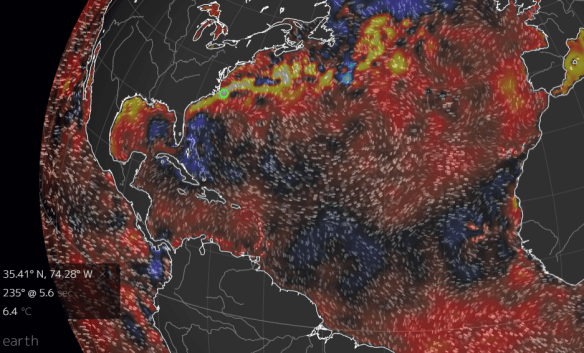
Like pretty much everywhere else in the world ocean these days, and due primarily to a rampant injection of greenhouse gasses into the Earth’s atmosphere through fossil fuel burning, the North Atlantic is now considerably warmer than during the 19th and 20th Centuries…
Warming Waters and An Angry Jet Stream
That extra heat provides more available fuel for tropical storm and hurricane formation. It increases the top potential peak intensity of the most powerful storms. And it extends the period in which such tropical cyclones are capable of forming — for sea surface temperatures of at least 70-75 degrees Fahrenheit are often necessary to fuel such systems (please also see the present science on how climate change is impacting tropical cyclones).
(Sea surface temperatures in the North Atlantic now range between 1 and 7 degrees Celsius above average for most regions. These warmer than normal sea surfaces provide…









 Exposing the Big Game