Exposing the Big Game

Forget Hunters' Feeble Rationalizations and Trust Your Gut Feelings: Making Sport of Killing Is Not Healthy Human Behavior

Exposing the Big Game

“ON THE ROAD”

Poem from Rosemary Lowe:
I HAVE BEEN LYING HERE FOR HOURS, SINCE THE COLD NIGHT’S DEATH WIND HURTLED MY LIVING BODY INTO THE COLD GRIP OF DEATH…
SO SOON  MY  YOUNG LIFE,  TORN FROM ME, TERRIFIED BY THE CRUSH OF METAL UPON MY FLESH–OH, THE BLOOD AND THE PAIN….
THE ROAD– HUMANS CALL IT– WITH THEIR POWERFUL KILLING MACHINES, SO FAST, SO FINAL—GOING WHERE?
MILLIONS OF MY KIND–FOUR LEGGEDS–WITH PLACES TO GO, FAMILIES TO BE WITH, NEVER TO MAKE IT TO OUR DESTINATION…
NEVER TO SNUGGLE AGAIN, AGAINST FAMILIAR FUR, THE WARMTH AND LOVE OF ONE’S OWN KIND…
TOO FAST, TOO BIG–HARD METAL AGAINST A SOFT LIVING BODY–THAT BREAKS AND BLEEDS..DO YOU HEAR MY CRIES?
DO YOU SEE MY SHATTERED, BLOOD-SOAKED BODY ON THE ROAD?— DO YOU EVER SEE?
I AM NOT JUST A BODY, A THING.
I WAS SOMEONE’S MATE, SOMEONE’S CHILD, I WAS SOMEONE.
I WAS AN ANIMAL, JUST LIKE YOU.
——Rosemary Lowe

How we are breeding the next swine flu or bird flu

Exposing the Big Game's avatarThe Extinction Chronicles

Swine Flu

Bernard Keane did well to summarise the recent Productivity Commission“Regulation of Agriculture” report’s chapter on animal welfare. It’s 61 pages in an 800-page report, but there were a few more relevant chapters that are crucial to understanding how agriculture is and isn’t regulated in Australia. Probably the most important is that on biosecurity, and it demonstrates how easily the Productivity Commission can be led astray.

Keane notes that the commission brings animal welfare within its remit by putting numbers on the costs and benefits to the community of changing the way factories treat animals. I use the word “factories” because well over half of the meat eaten here comes from animals you’d never see in any drive…

View original post 1,042 more words

23 Environmental Rules Rolled Back in Trump’s First 100 Days

Exposing the Big Game's avatarThe Extinction Chronicles

President Trump, with help from his administration and Republicans in Congress, has reversed course on nearly two dozen environmental rules, regulations and other Obama-era policies during his first 100 days in office.

Citing federal overreach and burdensome regulations, Mr. Trump has prioritized domestic fossil fuel interests and undone measures aimed at protecting the environment and limiting global warming.

OVERTURNED

1. Approved the Dakota Access pipeline.Feb. 7

WHO WANTED IT CHANGED? Republicans in Congress criticized President Barack Obama for delaying construction of the pipeline — which they argued would create jobs and stimulate the economy — after protests led by the Standing Rock Sioux Tribe. Mr. Trump ordered an expedited review of the pipeline, and the Army approved it.

2. Revoked a rule that prevented coal mining companies from dumping debris into local streams.Feb. 16

WHO WANTED IT…

View original post 1,465 more words

Letter in the NY Times re: Donald Trump Jr.’s Hunting

To the Editor:

According to news reports, Donald Trump Jr. spent Earth Day shooting prairie dogs in Montana. His guide was Greg Gianforte, a Republican candidate for Congress and himself a hunting enthusiast. Prairie dogs are not killed to be eaten, but strictly for fun.

Fun? What’s wrong with these people? How can killing defenseless rodents in their natural habitat be seen as fun? This fact further underscores how pathetic and callous the Trump family is. C’mon, Don Jr., really?!

SCOTT CITRON, NEW YORK

Stephen Hawking says we have 100 years to colonize a new planet—or die. Could we do it?

Exposing the Big Game's avatarThe Extinction Chronicles

http://www.popsci.com/stephen-hawking-human-extinction-colonize-mars

Here’s what it would take to survive this particular doomsday prophecy

human on Mars

Living on Mars would arguably be harder than fixing up our own planet.

NASA

Stephen Hawking is making apocalyptic predictions again. The respected theoretical physicist warns that humanity needs to become a multi-planetary specieswithin the next century if we don’t want to go extinct. Last year, he prophesied that we had maybe 1,000 years left on Earth, and the inspiration for this newly-urgent timeline is unclear—except for the fact that Hawking’s new documentary about colonizing Mars is coming out soon.

To be sure, Earth is facing some big problems, including climate change, overpopulation, epidemics, and asteroid strikes. But before we flee this planet like an action hero jumping out of an explosion, let’s think about this for a second. Sure, it’d be great to have a backup civilization somewhere in…

View original post 710 more words

Why did the Crown waste resources prosecuting woman who gave water to pigs?

Animal rights activist Anita Krajnc gives water to a pig in a truck

http://news.nationalpost.com/full-comment/christie-blatchford-on-anita-krajnc

by Christie Blatchford

These days, you can hardly pick up a paper or click on a news site without reading another story about the woes of the Canadian criminal courts.

They’re chronically short of judges! There aren’t enough Crown prosecutors! Legal aid is a mess and no one qualifies to get a lawyer any more! The buildings are old and crumbling!

And delay: Such a hue and cry about delay in the courts.

Since about six months ago, when in a case called R v Jordan the Supreme Court of Canada pronounced upon the unacceptable length of time it takes to get a case to trial in this country, and blamed what it called “a culture of complacency,” knickers have been in a knot across the land.

Defence lawyers are pressing to have charges against their clients dismissed because of egregious delay, years sometimes. Prosecutors say no, wait a minute – we’re doing our best here with limited resources. Judges are all over the map, here throwing out cases, there throwing up their hands. There is wild talk of such drastic measures as doing away with preliminary hearings.

Halton Region, west of Toronto, is no different, and maybe worse.

A simple Google search reveals that for the past five years, there’s been a steady drumbeat of whingeing emanating from the bar and the judiciary in the area, particularly about the “unmitigated disaster” that is the Milton courthouse, as one local lawyer has called it.

Area judges have taken judicial notice of the situation, meaning they’ve worked criticism of government into their decisions.

“Let the ministries that fund and operate the various arms of our court system be forewarned,” Ontario Court Judge Stephen Brown said in a March 8, 2012 decision in which he tossed a case of impaired driving. “Failure to increase judicial and physical resources to match the growing population will quite possibly result in a floor of delay applications being granted.”

Seven months later, Brown was at it again: “Because of the chronic persistent and growing demands on the limited resources in Halton Region, we are slipping further into a crisis situation where the lack of allocation of government resources by way of an increase in judicial resources and a proper physical plant and infrastructure to deal with the explosive growth in this region is leading to a breaking point.”

So the point is made, and undoubtedly legitimate: There’s no time or resources to waste in the justice system.

It’s in this light that the trial of animal rights activist Anita Krajnc might be considered.

On June 22 two years ago, Krajnc and other activists on a traffic island took advantage of a stopped tractor trailer (it was stopped at a red light) to talk to and pet the 190 pigs inside being taken to a nearby slaughterhouse in Burlington.

As a short video that was played at trial shows, the pigs were clearly thirsty and some of them were panting, and breathing open-mouthed.

Krajnc began giving some of them water.

The truck driver got out of the vehicle, approached her and asked what she was doing, told her to stop, and then phoned 911. He later went to the local police station to file a complaint, and Krajnc was charged.

(In the interests of full disclosure, let it be known that I have a white-and-pink English bull terrier, aka “a pig dog”, so named for its magnificent resemblance to a pig – big pig ears, piggy sort of snout and body, sort of dogs in pig skin. Balancing off that bias, I eat bacon, or at least I did until I read the expert report of Dr. Lori Marino, a neuroscientist who testified at trial. Her evidence was that in fact pigs are dog-like, every bit as sentient and capable of feelings as dogs are. They are also ridiculously cute, but that’s just my view.)

In any case, however one sees Krajnc’s cause, the fact is that the overburdened and impoverished justice system nonetheless allowed this prosecution not only to proceed, but also to eat up seven full days of court time, and all the public resources that entails – seven days of salary for the judge and prosecutor Harutyun Apel, court officials and security officers, court reporter and clerk, etc.

Blessedly, both for Krajnc and the taxpayer, she was represented pro bono by lawyers Gary Grill and James Silver.

Prosecutors had offered to settle the case with a peace bond, Grill said in a phone interview, but that was hardly reasonable given “she believes she’s done absolutely nothing wrong” and also recognized a PR and public education opportunity when she sees one.

A request for comment to prosecutor Apel Thursday resulted in a referral to the spokesperson for the attorney general’s ministry, who at first referred the query to the agriculture ministry, but when pressed – this is an issue which is clearly within the AG’s bailiwick — then declined to comment until the appeal period is over.

The government is considering an appeal? What, insufficient public funds haven’t yet been squandered?

As Gary Grill said, “There’s definitely real money being spent on this. Nobody in Milton can ever say they don’t have the resources.” Amen.

CDC is tracking emerging, deadly bird flu in China

Exposing the Big Game's avatarThe Extinction Chronicles

http://www.fox5atlanta.com/health/fox-medical-team/252487097-story

– As the U.S. flu season winds down, scientists in the Centers for Disease Control and Prevention’s Atlanta flu lab are focused on finding the next pandemic flu threat.

And they’re watching a deadly strain of bird flu in China.

“There are features of this strain that are worrisome,” says CDC Acting Director Dr. Anne Schuchat.

She’s talking about the H7N9 bird flu, which began spreading from poultry to people in 2013, with lethal consequences.

“And while this is the fifth year of seeing the disease, this year has been worse than any of the previous ones in China,”  Dr. Schuchat says.

So far, in the fifth outbreak alone, the World Health Organization says 623 people have been sickened.

That brings the total of lab-confirmed H7N9 infections to 1,421 since 2013.

Most of those infected had been exposed to poultry, but there were some…

View original post 319 more words

New Crack Found in Delaware-Sized Chunk of Larsen C Ice Shelf as it Heads Toward Southern Ocean

robertscribbler's avatarrobertscribbler

A 2,000 square mile section of the Larsen C Ice Shelf is hanging by a thread as it continues to drift toward the Weddell Sea.

(A second crack develops in Larsen C Ice Shelf. Image source: Project MIDAS.)

The break-off section represents fully 10 percent of all the ice contained in the Larsen C system. It has been divided from the larger ice shelf by a 180 kilometer long crack that began to develop in 2009 and that swiftly lengthened during recent years. Now only a 10 kilometer wide bridge links the breaking section to the larger ice shelf. And considering the enormous stresses now being placed on this break-off section it is expected to go at any time.

Since January, according to researchers at Project MIDAS, the large crack has been widening but its length growth has stalled. However, recent reports out this week…

View original post 451 more words

Romania bans trophy hunting of brown bears, wolves, lynx and wild cats

https://www.theguardian.com/environment/2016/oct/05/romania-bans-trophy-hunting-of-brown-bears-wolves-lynx-and-wild-cats

Unexpected move reverses a trend that has seen increasing numbers of large carnivores shot by hunters each year since Romania’s accession to the European Union

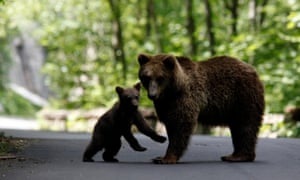
A brown bear and her cub play on the road on the outskirts of Sinaia, north of Bucharest
In 2016, the largest hunting quotas yet gave hunters the mandate to shoot 550 bears, 600 wolves and 500 big cats over 12 months. Photograph: Radu Sigheti/Reuters

Romania has banned all trophy hunting of brown bears, wolves, lynx and wild cats in a surprise decision that gives Europe’s largest population of large carnivores a reprieve from its most severe and immediate threat.

The move on Tuesday reverses a trend which has seen the number of large carnivores being shot by hunters grow year on year since Romania’s accession into the European Union in 2007. In 2016, the largest hunting quotas yet gave hunters the mandate to shoot 550 bears, 600 wolves and 500 big cats over 12 months.

Over the last decade, hunting has grown into a multimillion-euro industry in Romania, with hunters from all over the world paying up to €10,000 (£8,800) to claim a ‘trophy’ – hunting parlance for the carcass of a hunted animal – from the Carpathian mountains.

The government has claimed that in order to exist, the industry relies on a loophole in European law which allows for the culling of wild animals that have been proven to be a danger to humans. Under the habitats directive, all large carnivores are protected in European Union member states, yet the state can order the killing of specific animals if shown to have attacked a person or damaged private property.

“Hunting for money was already illegal, but it was given a green light anyway,” environment minster, Cristiana Pasca-Palmer, told the Guardian. ‘The damages [clause in the habitats directive] acted as a cover for trophy hunting.”

Each year, hundreds of hunting associations across the country would submit two numbers; the total population of each large carnivore species, and the total number which they believed to be likely to cause damages. The second number would then act as a basis for a government-issued hunting quota for each species. These quotas were then carved up between hunting companies and sold as hunting rights to the public.

“This method raised some questions,” says Pasca-Palmer. “How can hunting associations count how many animals are causing damages a priori – before the damages have happened? By introducing the ban, what we are doing is simply putting things back on the right track, as the habitats directive originally intended.”

Wildlife NGOs claim that the methodology also tended to dramatically overestimate the populations of large carnivores. The official figure for the number of bears in Romania is over 6,000, and for wolves is 4,000. Yet with hundreds of hunting associations each responsible for monitoring a small area of land, and animals prone to wandering, it is understood that individual animals were often counted multiple times, potentially pushing the total population statistics up by thousands.

Announced late on Tuesday evening, the ban is expected to divide Romania’s population, pitching rural and urban dwellers against each other. The government’s decision has strong support in the larger cities, which have seen a growing movement against hunting in recent months. But in much of Romania’s remote countryside large carnivores are a daily threat to villagers and a persistent nuisance to livestock farmers, and many see hunting as the only solution.

Csaba Domokos, a bear specialist with wildlife protection NGO Milvus group, is convinced that the success or failure of the hunting ban rides on the government’s ability to address the rural population’s fears.

“Damages caused by large carnivores are a very real concern in the countryside,” he said. “The system up until now did not work; hunting does not reduce conflicts between carnivores and humans; in fact many studies show that with wolves and large cats, it can actually increase the problem.

“But the rural population believe that hunting is the answer, and unless they can be convinced otherwise, people may well start to take the problem into their own hands. The ban is a great step, but we don’t want hunting to be replaced by poaching.”

Domokos points out that hunters also have a vested interested in the protection of their quarry. “To some extent, hunting acts as a financial incentive for wildlife management, from preventing poaching to conserving habitats. There is some concern that once you take that away, the government will not invest enough to replace it.”

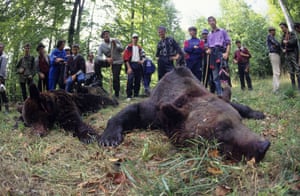
Hunters pay up to €10,000 to trophy hunt in the Carpathian mountains
Pinterest
Hunters pay up to €10,000 to trophy hunt in the Carpathian mountains. Photograph: Nick Turner/Alamy

The government’s response is to take management into its own hands. A special unit is to be set up within the paramilitary police force that will assess any reports of damages by large carnivores and deal with the culprit animal directly. The ministry of environment have discussed the possibility of relocating the target animals abroad to countries interested in ‘rewilding’.

The ban comes amid a growing push for the protection of Romania’s wild mountains that has seen anti-corruption officers convict dozens of foresters, hunters and local officials in recent years.

Gabriel Paun, an activist and conservationist behind a petition that collected 11,000 signatures in the weeks before the hunting ban, sees the government’s decision as a step towards a safer future for Europe’s wild spaces: “The Carpathian mountains are home to more biodiversity than anywhere else in Europe, but for too long they have been ruthlessly exploited for forestry and hunting. Let’s hope the government’s decision is a sign of things to come.”

Denmark gets its first wild wolf pack in 200 years

Arrival of a female wolf, that trekked 500km from Germany, means the pack could have cubs by spring

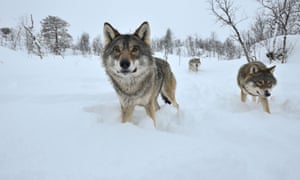
Three wolves in snow
Wolves are returning to well-peopled landscapes after centuries of persecution. Photograph: Fred van Wijk/Alamy Stock Photo

A wolf pack is roaming wild in Denmark for the first time in more than 200 years after a young female wolf journeyed 500km from Germany.

Male wolves have been seen in Denmark since 2012 and the new female could produce cubs this spring in farmland in west Jutland after two wolves were filmed together last autumn.

It is further evidence that the wolf is returning to well-peopled landscapes after centuries of persecution, with wolf packs also re-establishing themselves in France and Germany and individuals sighted in Holland and even Luxembourg. Before the new population, Denmark’s last wolf was killed in 1813.

“We expect that they will have cubs this year or the next,” said Peter Sunde, a senior researcher at Aarhus University.

“People were very surprised when wolves first appeared in Denmark but they are highly mobile and are just as adaptable to cultural landscapes as foxes are. The only problem historically is that we killed them.”

DNA from two faeces samples have confirmed that the female wolf came from a pack 25km south of Berlin in Germany before travelling to north-west Denmark, probably leaving her family group last spring to do so.

There is sometimes speculation that wolves are deliberately released into the countryside by unofficial rewilders but according to Guillaume Chapron, a researcher at the Swedish University of Agricultural Sciences, this female’s trek north was entirely natural. “The wolf went on its four legs, it makes complete biological sense,” he said. Wolves can walk 50km in 24 hours and have been recorded making journeys of more than 1,000km across Europe from Germany, where they re-established themselves in 1998. Germany’s wolf population is currently growing at 25-30% each year, with the young dispersing across central Europe.

Researchers have found wolves in some cases living in suburban areasalongside up to 3,050 people per square kilometre – higher than the population density of Cambridge or Newcastle.

“The wolf is a predator to the roe deer – if you can have roe deer, you can have wolves,” said Chapron. “As long as we don’t disturb them, they will be fine in these human-dominated landscapes. In Denmark there’s no reason wolves can’t thrive. But the question has to be asked, are people going to accept the wolves? The wolf will need to eat something. When they realise that Danish sheep don’t taste too bad that may be a little problematic. It will be interesting to see how far we can coexist with big predators.”

Denmark’s wolves have settled in a well-farmed area of heathland and small pine plantations with plentiful prey in the form of burgeoning populations of red and roe deer.

There have been reports of wolves killing several sheep in the area over winter but the Danish government has already established a wolf management plan with compensation for farmers and funding so livestock farmers can erect wolf-proof fencing. The management plan, drawn up in consultation with game hunters as well as farmers and conservationists, allows for wolves that become “habituated” and live too close to humans to be controlled.

“There is a tradition in Denmark of reaching compromises and reaching solutions,” added Sunde, who said he was optimistic that Danes could coexist peacefully with wolves. “Technically, we can relatively easily manage the wolf population but the challenge is the psychology of humans. There are so many feelings and opinions about wolves in Denmark, as everywhere. The wolf debate is very much value-driven rather than related to concrete problems.”

There are more than 12,000 wolves in continental Europe (excluding Russia, Ukraine and Belarus) and the wolf is a protected species under the EU’s habitats directive. According to Chapron, southern European countries have often been better at accepting new wolf populations than northern Europe. Several countries with relatively small wolf populations including Finland and Norway still pursue controversial annual culls of the animals.

Chapron said he would not like to predict how many wolves could live wild in Denmark. “Let the wolf decide and let people decide as well because we are sharing the landscape. It’s very positive news for nature conservation. It shows that attitudes have changed and when we let nature take care of itself, nature comes back.

“Forget Little Red Riding Hood – it’s not a myth that is back, it’s just a natural part of the European fauna.”