Exposing the Big Game

Forget Hunters' Feeble Rationalizations and Trust Your Gut Feelings: Making Sport of Killing Is Not Healthy Human Behavior

Exposing the Big Game

Demand an end to trapping of beavers

Exposing the Big Game's avatarCommittee to Abolish Sport Hunting Blog

Join us in supporting our petition to end beaver trapping.

<http://www.thepetitionsite.com/>

<https://www.care2.com/go/z/e/A_ZJ4/zUMz/js4K>

Demand an end to trapping of beavers in Stanley Park Marsh.

Sign Now

“Drowning traps” are currently being used to kill beavers, so they don’t build dams, at Stanley Park Marsh in Canada. Drowning is a horribly cruel death that no animal should suffer. <https://www.care2.com/go/z/e/A_ZJ4/zUMz/js4K>

Concerned local people recently released a drowning beaver from one of these traps. That beaver was in absolute distress. The beaver was pulled to shore and when released it was exhausted. It caught its breath, groomed itself and slipped into the water, hopefully to survive after the trauma. Many more beavers will not be so lucky.

If it’s essential to stop dams being built in this particular area, non-lethal methods should be used, such as relocating the beavers to another park. But ideally, beavers should be allowed…

View original post 102 more words

Game hunter who enjoys killing exotic wildlife ‘for the adventure’ horrifies This Morning viewers

Exposing the Big Game's avatarCommittee to Abolish Sport Hunting Blog

Game hunter who enjoys killing exotic wildlife ‘for the adventure’ horrifies This Morning viewers

Adam StarkeyWednesday 19 Sep 2018 11:59 am Share this article via facebookShare this article via twitterShare this article via messenger 133 SHARES Phillip Schofield suggests that hunters should use spears Play Video Loaded: 0% 0:00Progress: 0% PlayMute Current Time 0:00 / Duration Time 1:01 Fullscreen This Morning viewers were outraged over a big game hunter who has killed over 100 species of wildlife for ‘the adventure’. The show raised the debate of hunting following a criticised picture showing a woman flaunting her record kill of a large male leopard. Olivia Opre, friend of the woman in question and fellow hunter, spoke to This Morning hosts Phillip Schofield and Holly Willoughby where she defended the actions of hunters. Olivia Opre appeared on This Morning (Picture: ITV) Asked what she’d shot, Olivia said: ‘There’s an extensive list. I’ve…

View original post 455 more words

New web-based system in place to gather hunting data

Exposing the Big Game's avatarCommittee to Abolish Sport Hunting Blog

Hunting
By The Associated Press |

AUGUSTA, Maine (AP) – Maine wildlife managers are making it easier for hunters to register their big game animals with a new web-based system.

The Maine Department of Inland Fisheries and Wildlife says the new system’s running at tagging stations around the state. Department Commissioner Chandler Woodcock says the system will allow tagging stations and hunters to quickly register their animal.

Woodcock says one of the advantages of the new system will be to provide biologists and game wardens with real-time harvest data about game animals.

The system went into use on the first day of the bear season, Aug. 27. It replaces the old system of game registration booklets, which needed to be filled in by hand.

Maine has 215,000 licensed hunters. The new system will be available for fur tagging next year

View original post

The pitfalls of simplification when looking at greenhouse gas emissions from livestock

Exposing the Big Game's avatarExposing the Big Game

http://news.trust.org/item/20180918083629-d2wf0/

What we choose to eat,  how we move around and how these activities contribute to climate change is receiving a lot of media attention. In this context, greenhouse gas emissions from livestock and transport are often compared, but in a flawed way.

The comparison measures direct emissions from transport against both direct and indirect emissions from livestock. The Intergovernmental Panel on Climate Change (IPCC) identifies and monitors human activities responsible for climate change and reports direct emissions by sectors. The IPCC estimates that direct emissions from transport (road, air, rail and maritime) account for 6.9 gigatons per year, about 14% of all emissions from human activities. These emissions mainly consist of carbon dioxide and nitrous oxide from fuel combustion. By comparison, direct emissions from livestock account for 2.3 gigatons of CO2 equivalent, or 5% of the total. They consist of methane and nitrous oxide from rumen digestion…

View original post 649 more words

The pitfalls of simplification when looking at greenhouse gas emissions from livestock


http://news.trust.org/item/20180918083629-d2wf0/

What we choose to eat,  how we move around and how these activities contribute to climate change is receiving a lot of media attention. In this context, greenhouse gas emissions from livestock and transport are often compared, but in a flawed way.

The comparison measures direct emissions from transport against both direct and indirect emissions from livestock. The Intergovernmental Panel on Climate Change (IPCC) identifies and monitors human activities responsible for climate change and reports direct emissions by sectors. The IPCC estimates that direct emissions from transport (road, air, rail and maritime) account for 6.9 gigatons per year, about 14% of all emissions from human activities. These emissions mainly consist of carbon dioxide and nitrous oxide from fuel combustion. By comparison, direct emissions from livestock account for 2.3 gigatons of CO2 equivalent, or 5% of the total. They consist of methane and nitrous oxide from rumen digestion and manure management. Contrary to transport, agriculture is based on a large variety of natural processes that emit (or leak) methane, nitrous oxide and carbon dioxide from multiple sources. While it is possible to “de-carbonize” transport, emissions from land use and agriculture are much more difficult to measure and control.

Using a global life cycle approach, FAO estimated all direct and indirect emissions from livestock (cattle, buffaloes, goat, sheep, pigs and poultry) at 7.1 gigatons of CO2 equivalent per year, or 14.5% of all anthropogenic emissions reported by the IPCC. In addition to rumen digestion and manure, life cycle emissions also include those from producing feed and forages, which the IPCC reports under crops and forestry, and those from processing and transporting meat, milk and eggs, which the IPCC reports under industry and transport. Hence, we cannot compare the transport sector’s 14% as calculated by the IPCC, to the 14.5% of livestock using the life cycle approach.

Though it is the most systematic and comprehensive method for assessing environmental impacts according to the IPCC, there is no life cycle approach estimate available for the transport sector at a global level to our knowledge. Non-availability, uncertainty or variability of data limit its application. But several studies, including some reported by the IPCC, show that transport emissions increase significantly when considering the entire life cycle of fuel and vehicles, including emissions from extracting fuel and disposing of old vehicles. For example in the US, greenhouse gas emissions for the life cycle of passenger transport would be about 1.5 times higher than the operational ones.

Comparing transport and livestock raises another issue. Wealthy consumers, in both high and low income countries, who are rightly concerned about their individual carbon footprint, have options like driving less or choosing low carbon food. However, more than 820 million people are suffering from hunger and even more from nutrient deficiencies. Meat, milk and eggs are much sought after to address malnutrition. Out of the 767 million people living in extreme poverty, about half of them are pastoralists, smallholders or workers relying on livestock for food and livelihoods. The flawed comparison and negative press about livestock may influence development plans and investments and further increase their food insecurity.

Livestock emissions have come into particular focus because it generally takes more resources to produce beef than comparable other food items. Hence emissions from land-use change and feed production are high, in addition to enteric fermentation. Moreover, methane has a higher global warming potential than carbon dioxide but it’s lifespan in the atmosphere is only 12 years, which means that reducing methane emissions would have a positive impact on climate change in a much shorter time span.

Countries, particularly in Latin America, are responding to these challenges by developing low carbon livestock production that will achieve emission reductions at scale, focusing on emission intensity, soil carbon and pasture restoration, and better recycling of by-products and waste. Such programmes also produce a number of environmental and socio-economic co-benefits, like biodiversity and water conservation, or generation of rural employment and income.

The world needs both consumers that are aware of their food choices and producers and companies that engage in low carbon development. In that process, livestock can indeed make a large contribution to climate change mitigation, food security and sustainable development in general.

Anne Mottet is a Livestock Development Officer with the Food and Agriculture Organization (FAO) of the United Nations in Rome, specialising in natural resource use efficiency and climate change. She has 15 years of work experience in research, quantitative analysis and strategic consulting to the agricultural sector.

Henning Steinfeld is head of the livestock sector analysis and policy branch at the Food and Agriculture Organization (FAO) of the United Nations in Rome, Italy. He has been working on agricultural and livestock policy for the last 15 years, in particular focusing on environmental issues, poverty and public health protection. 

Nuclear Plant Declares Emergency, Second Breach Reported at Coal Ash Site Amid Florence’s Rains

Exposing the Big Game's avatarThe Extinction Chronicles

https://earthfirstjournal.org/newswire/2018/09/19/nuclear-plant-declares-emergency-second-breach-reported-at-coal-ash-site-amid-florences-rains/

by EA Crunden / Think Progress

A second breach was reported at a coal ash landfill site in North Carolina on Monday according to the Environmental Protection Agency (EPA), the latest impact from Hurricane Florence’s heavy rains. That update comes amid a state of emergency declared at a nuclear power plant overseen by the landfill’s operator, Duke Energy, as the extent of the damage from Florence — now a tropical depression — slowly becomes apparent.

The first Duke Energy Corp. coal ash landfill site experienced a breach on Saturday following an initial spill at the company’s Sutton Power Plant, which is near Wilmington where Florence first made landfall.

Reggie Cheatham, the EPA’s director for its Office of Emergency Management, told reporters Monday that the second spill occurred when some of the landfill’s water eroded, Bloomberg reported. The location of the second breach is not currently known to the EPA.

View original post 482 more words

Trophy hunter becomes the HUNTED: Anger as woman shows off slaughtered leopard

Exposing the Big Game's avatarCommittee to Abolish Sport Hunting Blog

A TROPHY hunter has sparked worldwide fury after a pro-hunting group shared a shocking photo of her proudly holding up a leopard she shot dead.

The image of the female big game hunter, who has been referred to as Britany L, was shared by US-based Safari Club International on their Facebook page causing outrage not only among animal rights activists, but celebrities too.

Supermodels Naomi Campbell and Doutzen Kroes were among the first to express their horror after experts said the stunning big cat was likely the ninth largest ever hunted.

The two shared an Instagram post from anti-ivory poaching group Knot on my Planet founder David Bonnouvrier, who asked his followers to “find this b****” in an angry post.

He wrote: “#findthisb**** A very large male Leopard recently killed by Britany L. Member of the safari club international based in Tucson AZ call them and give…

View original post 78 more words

3.4 million poultry, 5,500 hogs drowned in Florence flooding

Floodwaters from Hurricane Florence have killed at least 1.7 million chickens in N.C.
 https://www.yahoo.com/news/1-7-million-chickens-drown-175600464.html
investors Monday that at least 1.7
million of its chickens had perished in N.C
Floodwaters from Hurricane Florence have killed at least 1.7 million chickens in N.C.
Yahoo News Video

Scroll back up to restore default view.

About 3.4 million chickens and turkeys and 5,500 hogs have been killed in flooding from Florence as rising North Carolina rivers swamped dozens of farm buildings where the animals were being raised for market, according to state officials.

The N.C. Department of Agriculture issued the livestock mortality totals Tuesday, as major flooding is continuing after the slow-moving storm’s drenching rains. Sixteen North Carolina rivers were at major flood stage Tuesday, with an additional three forecasted to peak by Thursday.

The Department of Environmental Quality said the earthen dam at one hog lagoon in Duplin County had breached, spilling its contents. Another 25 of the pits containing animal feces and urine have either suffered structural damage, had wastewater levels go over their tops from heavy rains or had been swamped by floodwaters. Large mounds of manure are also typically stored at poultry farms.

North Carolina is among the top states in the nation in producing pork and poultry, with about 9 million hogs at any given time and 819 million chickens and 34 million turkeys raised each year.

The N.C. Pork Council, an industry trade group, said the livestock losses from the storm should be taken in the context.

“Our farmers took extraordinary measures in advance of this storm, including moving thousands of animals out of harm’s way as the hurricane approached,” the group said in a statement issued Tuesday. “We believe deeply in our commitment to provide care for our animals amid these incredibly challenging circumstances.”

The industry lost about 2,800 hogs during flooding from Hurricane Matthew in 2016.

Sanderson Farms, a major poultry producer in the state, said it lost about 1.7 million chickens after flooding at more than 60 of the independent farms that supply its poultry processing plants. The company said its facilities suffered no major damage, but supply disruptions and flooded roadways had caused shutdowns at some plants.

In addition, about 30 farms near Lumberton have been isolated by flood waters, hampering the delivery of feed to animals. The lack of food could cause additional birds to die if access isn’t restored quickly, the company said.

Smithfield Foods, the world’s largest pork producer, said its plants also suffered no significant damage and are operating at limited capacity. The company said it would ramp up production as roads become passable.

An environmental threat is also posed by human waste as low-lying municipal sewage plants flood. On Sunday, the Cape Fear Public Utility Authority reported that more than 5 million gallons of partially treated sewage had spilled into the Cape Fear River after power failed at its treatment plant.

The Environmental Protection Agency said Monday that 16 community water treatment facilities in North Carolina are unable to supply drinking water and that seven publicly owned sewage treatment works are non-operational due to the flooding.

Duke Energy is continuing cleanup operations Tuesday following a weekend breach at a coal ash landfill at its L.V. Sutton Power Station near Wilmington.

Duke spokeswoman Paige Sheehan said a full assessment of how much ash escaped from the waterlogged landfill is ongoing. The company initially estimated Saturday that about 2,000 cubic yards (1,530 cubic meters) of ash were displaced, enough to fill about 180 dump trucks.

The coal-fired Sutton plant was retired in 2013 and replaced with a new facility that burns natural gas. The company has been excavating millions of tons of leftover ash from old pits there and removing the waste to a new lined landfill constructed on the property. The gray ash left behind when coal is burned contains toxic heavy metals, including arsenic, lead and mercury.

Photos from the site provided to AP by Cape Fear River Watch, an environmental advocacy group, show cascades of gray-colored water spilling from at least two breaches at the landfill and flowing toward Sutton Lake, the plant’s former cooling pond which is now used for public recreation, including fishing and boating.

Sutton Lake drains into the Cape Fear River. Sheehan said Duke’s assessment is that there was minimal chance any contaminants from the spill had reached the river.

At a different power plant near Goldsboro, three old coal ash dumps capped with soil were inundated by the Neuse River. Duke said they had no indication those dumps at the H.F. Lee Power Plant were leaking ash into the river.

Duke’s handling of ash waste has faced intense scrutiny since a drainage pipe collapsed under a waste pit at an old plant in Eden in 2014, triggering a massive spill that coated 70 miles (110 kilometers) of the Dan River in gray sludge. The utility later agreed to plead guilty to nine Clean Water Act violations and pay $102 million in fines and restitution for illegally discharging pollution from ash dumps at five North Carolina power plants. It plans to close all its ash dumps by 2029.

In South Carolina, workers with electricity provider Santee Cooper erected a temporary dike in hopes of preventing flooding of an old coal ash dump at the demolished Grainger Generating Station near Conway. The dump is adjacent to the Waccamaw River, which is expected to crest at nearly 20 feet (6 meters) this weekend. That’s nine feet above flood stage and would set a new record height.

Deadly pig virus threatens China’s $128 billion pork industry

LINKEDINCOMMENTMORE

Scientists and officials in China are trying to isolate a deadly pig virus potentially threatening the nation’s pork industry.

According to Reuters, an outbreak of African swine fever was discovered on a farm in inner Mongolia. Eight pigs died and 14 more were infected.

Since August 1, the virus has spread to seven provinces in China, reports Bloomberg. About 40,000 pigs have died, disrupting a pork industry valued at $128 billion.

China has introduced several new rules to attempt to curb the spread of the virus. Reuters reports Chinese officials have banned transporting live hogs or pig products from areas bordering a province with an outbreak.

More: 458 pigs found hoarded on Kentucky farm will be euthanized if not rescued, nonprofit says

More: U.S. slaps tariffs on another $200 billion in Chinese goods as trade tensions escalate

China also introduced bans on feeding kitchen waste or using feed from pig blood, reports Reuters.

African swine fever is a virus affecting pigs. There is currently no vaccine to combat the disease, reports Bloomberg. The virus does not affect humans.

Last month, the U.N.’s Food and Agriculture Association warned the outbreak could move to neighboring countries in Asia, reports The Associated Press

Florence Flooding Is The Slow-Motion Train Wreck Forecasters Warned About

Exposing the Big Game's avatarThe Extinction Chronicles

Days after landfall, the remnant storm continues to pummel flood-scarred communities in North Carolina.
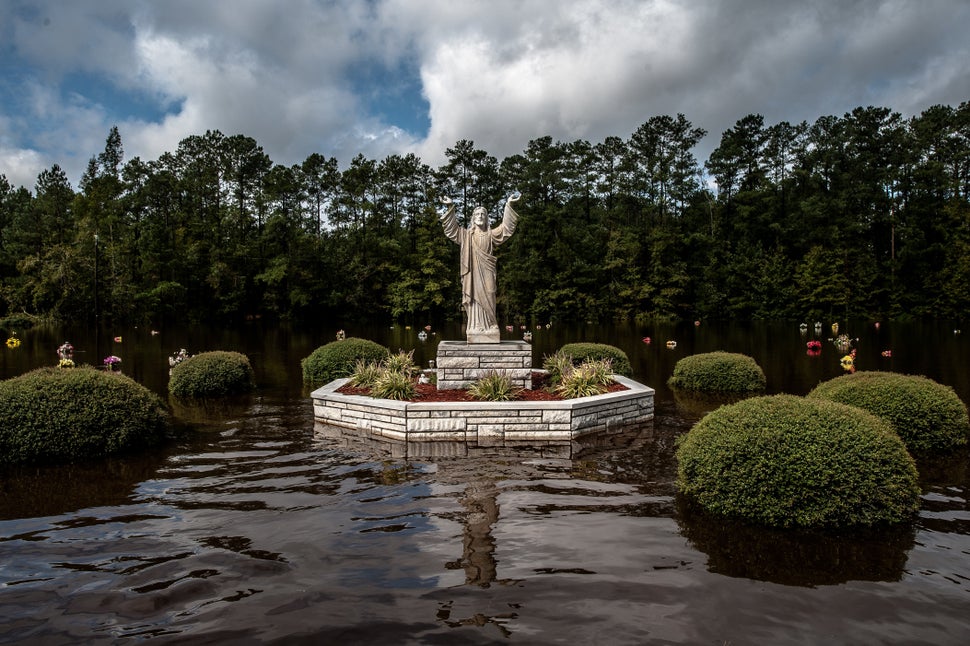
A cemetery is partially submerged near Manchester, North Carolina, a few miles from Fayetteville.
JOSEPH RUSHMORE FOR HUFFPOST
A cemetery is partially submerged near Manchester, North Carolina, a few miles from Fayetteville.

FAYETTEVILLE, N.C. — On Monday, amid a mandatory evacuation order, residents of this inland city of around 200,000 flocked to a bridge east of town to gaze at the rapidly rising Cape Fear River.

Under the first blue skies in days, they took pictures of large trees and other debris that made its way south down a wide and muddy river toward the Atlantic coast. And they were reminded of the devastating scenes less than two years ago during Hurricane Matthew, when the town was severely flooded and hundreds of residents had to be rescued from inundated buildings.

“I came [here] for Matthew,” said Laura Walters, a lifelong Fayetteville resident, as she looked…

View original post 1,051 more words