Exposing the Big Game

Forget Hunters' Feeble Rationalizations and Trust Your Gut Feelings: Making Sport of Killing Is Not Healthy Human Behavior

Exposing the Big Game

The Unintended Consequences that Could Stem from Ford’s Ignorance of Cormorants

https://www.bornfreeusa.org/category/blog> , Canada
<https://www.bornfreeusa.org/category/canada> on December 13, 2018

My last two blogs have been about the horrific plan by Ontario’s newly
elected Progressive Conservative government (although it is anything but
either progressive or conservative) to wipe out as much as possible, and
certainly most, of the province’s population of double-crested cormorants
(read these blogs here
<https://www.bornfreeusa.org/2018/11/26/cormorant-hunt-is-the-single-worst-w
ild-game-management-decision-in-canadian-history/> and here
<https://www.bornfreeusa.org/2018/12/05/these-hunters-must-stop-pretending/>
) by allowing holders of small-game licenses to kill up to 50 of the birds
per day from March 15 to December 31. As a colonial nesting species, the
cormorant is extremely vulnerable to extirpation – it has happened before –
and the whole idea is predicated on concerns, which have been repudiated by
scientists many times over, that the birds are damaging to the environment.

The whole concept of this hunt is wrong on many different levels and for
many different reasons, including the hideous cruelty of leaving an
unpredictable number (certainly in the thousands) of orphaned baby birds to
die of dehydration and other forms of exposure. This is an exceptionally
ill-conceived notion by a premier, Doug Ford, with an authoritarian mindset,
who has been called “thuggish” and “bullying” by pundits, but like his
apparent role model, U.S. President Donald Trump, he does not seem to care.
Authoritarian mindsets tend to be blind to unintended consequences.

I get that the less informed among those who hunt and fish tend to see
predatory animals as their competitors who need to be killed. They neither
know or care about the importance of apex predators within healthily
functioning environments. And, I realize that cormorants, like wolves,
sharks, and other predators, can evoke irrational levels of fear, hatred,
and loathing. If such attitudes did not lead to cruelty and destruction, I’d
pity the people who have them, cut off, as they are, from the joy that comes
from knowledge of the intricate interactions of the web of life within the
ecological whole; a web that humans seem so eager to destroy.

As my friend, Buzz Boles, points out:

“In 1934, J. A. Dymond, Acting Director, Royal Ontario Museum of Zoology and
Assistant Professor in the Department of Biology, University of Toronto,
reacting to loon hunting he observed on Ontario’s Rideau waterway pointed
out that Sir Arthur Thomson, an eminent British biologist of the day,
related the following story that is indicative of killing cormorants and
destabilizing a lake and river system.

“‘In Australia, on the Murray River swamps, several species of cormorant use
to swarm in the thousands, but ruthless massacres, based on the supposition
that the cormorants were spoiling the fishing, reduced them to hundreds.
But, the fishing did not improve; it got worse. It was then discovered that
the cormorants fed largely on crabs, eels, and some other creatures that
devour the spawn and fry of desirable fishes. Thus, the ignorant massacre of
the cormorants made for the impoverishment, not the improvement of the
fishing. The obvious moral is that man should get at the facts of the web of
life before, not after, he has recourse to drastic measures of
interference.'”

Sadly, we never seem to learn.

Nelson-area man wants trapping laws changed after dog killed

Exposing the Big Game's avatarCommittee to Abolish Sport Hunting Blog

https://www.nelsonstar.com/news/nelson-area-man-wants-trapping-laws-changed-after-dog-killled/

Louis Seguin’s 10-month-old Australian shepherd died in a body-gripping trap last month

Louis Seguin heard a cry from his dog and thought she had been attacked by a bear or cougar.

Instead Seguin and his partner Anik discovered Shasta, their 10-month-old Australian shepherd, with a body-gripping trap around her head. She was a short distance away from where the couple were taking a daily walk near their home in Winlaw, northeast of Nelson, on Nov. 23.

The couple tried to free Shasta, but didn’t know how to open the trap. She died less than 10 minutes later.

“She was so ready for life,” said Seguin. “We didn’t know these things were out there.”

Body-gripping, or Conibear, traps are a popular means of trapping — and killing — wildlife such as raccoons and beavers. In B.C., placement of these traps — up to a certain…

View original post 337 more words

TAKE ACTION TO STOP THE U.S. PREDATOR CHALLENGE WILDLIFE KILLING CONTESTS!


The first leg of a new, nationwide wildlife killing contest, the “United States Predator Challenge,” began this month. This gruesome competition, which bills itself as “the first contest series ever started to truly crown the first ever US champion coyote calling team,” encourages participants to slaughter coyotes in three regions and bring them to check-in points in Virginia on January 11 to 13, 2019; and in Nebraska on February 1 and 2, 2019. (The first leg of this horrific event has already taken place, with a check-in point in central Utah on December 7 and 8.) You can read more at www.uspredatorchallenge.com.

Please join wildlife advocates across the country in opposing the United States Predator Challenge!

Here’s how you can help:

Urge your state legislators to support a ban on wildlife killing contests in your state. Locate your state legislators here. Ask them to support legislation to ban cruel and unsporting wildlife killing contests in your state. Find more guidance on passing local and state bans on wildlife killing contests at this link.

Urge your city and/or county council to pass a resolution condemning wildlife killing contests and calling for a statewide legislative ban. This year, the city councils of Albuquerque, New Mexico, and Dewey-Humboldt, Arizona, passed similar resolutions.

Write letters to the editor of your local newspaper.
a. For tips and tools about writing letters to the editor, click here.
b. Talking points (it’s important to be polite and personalize your message):
°  States should follow the lead of California and Vermont and ban the killing of coyotes and other wildlife for prizes and fun.
°  Wildlife killing contests are conducted for profit, entertainment, prizes, and simply for the “fun” of killing.
°  No evidence exists showing that indiscriminate killing contests serve any effective wildlife management function. Coyote populations that are not hunted or trapped form stable family groups that naturally limit populations. Indiscriminate killing of coyotes disrupts this social stability, resulting in increased reproduction and pup survival. Read more here and here.
°  Coyotes play an important ecological role helping to maintain healthy ecosystems and species diversity. As the top carnivore in some ecosystems, coyotes provide many benefits including providing free rodent control and regulating the number of mesocarnivores (such as skunks and raccoons), which in turn helps to boost ground and song bird abundance and biodiversity. Read more here.
°  Wildlife killing contests perpetuate a culture of violence and send the message to children that life has little value and that animals are disposable.
°  Wildlife killing contests put non-target wildlife, companion animals, and people at risk.
°  Killing as many animals as possible conflicts with traditional fair-chase hunting values and contravenes science-based wildlife conservation principles and practices.

Post this sharegraphic on social media, accompanied by the requests above.

Help raise awareness about wildlife killing contests by distributing this educational postcard and this factsheet.

Help sponsor a screening of KILLING GAMES ~ Wildlife In The Crosshairs in your community. Contact Project Coyote at info@projectcoyote.org about sponsorship opportunities.
For more information about wildlife killing contests, please visit the National Coalition to End Wildlife Killing Contests’ website here.

Thank you for speaking out against cruel wildlife killing contests!

Beef-eating ‘must fall drastically’ as world population grows

https://www.theguardian.com/environment/2018/dec/05/beef-eating-must-fall-drastically-as-world-population-grows-report

Current food habits will lead to destruction of all forests and catastrophic climate change by 2050, report finds

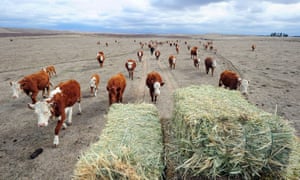
Cattle farming in California.
 Cattle farming in California. Photograph: Frederic J Brown/AFP/Getty Images

People in rich nations will have to make big cuts to the amount of beef and lamb they eat if the world is to be able to feed 10 billion people, according to a new report. These cuts and a series of other measures are also needed to prevent catastrophic climate change, it says.

More than 50% more food will be needed by 2050, according to the World Resources Institute (WRI) report, but greenhouse gas emissions from agriculture will have to fall by two-thirds at the same time. The extra food will have to be produced without creating new farmland, it says, otherwise the world’s remaining forests face destruction. Meat and dairy production use 83% of farmland and produce 60% of agriculture’s emissions.

Increasing the amount of food produced per hectare was the most critical step, the experts said, followed by cutting meat-eating and putting a stop to the wasting of one-third of food produced.

“We have to change how we produce and consume food, not just for environmental reasons, but because this is an existential issue for humans,” said Janet Ranganathan, vice-president for science and research at the WRI.

Tim Searchinger, of the WRI and Princeton University, said: “If we tried to produce all the food needed in 2050 using today’s production systems, the world would have to convert most of its remaining forest, and agriculture alone would produce almost twice the emissions allowable from all human activities.”

The new report, launched at the UN climate summit in Katowice, Poland, follows other major scientific analyses showing that huge reductions in meat-eating are “essential” to avoid dangerous climate change. Another found that avoiding meat and dairy products was the single biggest way to reduce an individual’s environmental impact on the planet, from slowing the annihilation of wildlife to healing dead zones in the oceans.

The world’s science academies concluded last week that the global food system was “broken”, leaving billions of people either underfed or overweight and driving dangerous global warming. Another new reportconcluded that the global food system required “radical transformation” if climate change and development goals were to be met, including “widespread dietary change”.

After increased productivity, the WRI report focuses on meat from ruminant animals. The digestion of cattle and sheep produces methane, a potent greenhouse gas. Beef provided 3% of the calories in the diet of US citizens but was responsible for half the emissions, the WRI said.

The report recommends that 2 billion people across countries including the US, Russia and Brazil cut their beef and lamb consumption by 40%, limiting it to 1.5 servings a week on average. Most of the world’s citizens would continue to eat relatively little beef in the WRI scenario.

But Searchinger said: “The world’s poor people are entitled to consume at least a little more.” The 40% reduction is a smaller cut than in other studies. “We think that is a realistic goal,” he said. “In the US and Europe, beef consumption has already reduced by one-third from the 1960s until today.”

Tobias Baedeker, of the World Bank, said farmers would require a lot of support to make the changes required but that redirecting the world’s huge subsidies could be a “game-changer”. Subsidies of more than $590bn (£460bn) a year are given to farmers in 51 nations, representing two-thirds of global food output, according to the OECD. In the US, these subsidies halve the current price of beef, the WRI says.

The sophisticated marketing and behaviour-change strategies that food companies already used to influence customers could help shift diets, said Ranganathan, as could governments encouraging less meat in schools, hospitals and other public institutions.

Other changes to farming that are needed, according to the WRI, include better feed to reduce methane production from cows, limiting biofuels made from food crops, managing manure and fertiliser better and cutting energy use by farm machinery. It also said the overall demand for food could be cut, with policies to curb population growth such as “improving women’s access to education and healthcare in Africa to accelerate voluntary reductions in fertility levels”.

The WRI report was launched at the UN climate summit in Poland where almost 200 nations are aiming to turn the carbon-cutting vision set out in Paris in 2015 into reality. The rapid ramping up of action is another key goal. Climate action must be increased fivefold to limit warming to the 1.5C scientists advise, according to the UN.

Exposing the Big Game's avatarCommittee to Abolish Sport Hunting Blog

Like a lot of folks, I was saddened…maddened…sickened really, to read that Cinder, the young, “mellow, calm bear” survived the Carlton Complex fire and months of painful rehabilitation only to be killed by a sport hunter. And this just a few short years after her release back to the wild, before she had even a chance to raise cubs of her own.

The December 12th Methow Valley News article, “Cinder the bear, fire survivor and worldwide inspiration, is dead,” goes to great length’s to convince us that no laws were broken in the murder of the collared animal, but has no take on whether animals like bears—each with “…their own personality”—should be hunted down and killed, be it for sport or sausage.

People are quick to point out how far we’ve come technologically or morally, but the recreational killing of our fellow sentient beings should have long since been…

View original post 9 more words

“Each bear has its own personality,” [yet] none are protected: Cinder the bear, fire survivor and worldwide inspiration, is dead

Exposing the Big Game's avatarCommittee to Abolish Sport Hunting Blog

Photo by Ann McCreary

Cinder dashes for freedom after being released into a forest north of

Leavenworth.

Famous bear’s remains found near where she was released after recovery

By Ann McCreary

Shortly after discovering Cinder, Steve Love shot this photo of her holding her injured paws up near his French Creek home before being airlifted to California for treatment. Photo courtesy of Steve Love

Cinder, the young black bear that was badly burned in the 2014 Carlton Complex Fire and underwent almost a year of treatment and rehabilitation before being released into the wild in 2015, is dead.

Cinder was saved through the concern and compassion of many people, and her story of recovery and release gained international attention through news reports and social media. She became a source of inspiration to Methow Valley residents as a…

View original post 1,845 more words

Groups Seek to Stop National Wildlife Killing Contest

Exposing the Big Game's avatarCommittee to Abolish Sport Hunting Blog

December 12, 2018

Scientists and Wildlife Protection Organizations Call for an End
to the U.S. Predator Challenge

WASHINGTON, D.C. — Today more than 50 North American scientists and more than 30 wildlife and animal protection organizations that are part of the National Coalition to End Wildlife Killing Contests (“Coalition”) are calling on state and local officials to reject the United States Predator Challenge (“USPC”), a barbaric competition that will award prizes for killing the most coyotes in three regional contests over the next few months.

Wildlife killing contests are held in almost every U.S. state and are becoming more frequent, but the USPC is one of the first to take it to the national level. Wildlife killing contests are a bloodsport similar to dogfighting and cockfighting. While the USPC organizers claim the competition will “set the bar for the highest standards of excellence in predator competitions through sportsmanship, honesty and…

View original post 740 more words

ARCTIC REPORT CARD DETAILS EFFECT OF RECORD MELTING ON GLOBAL ENVIRONMENTAL CHANGES

Exposing the Big Game's avatarThe Extinction Chronicles

The Arctic report, in its 13th edition, explains changes, impacts of melting on the ecosystem & marine life.

https://www.firstpost.com/tech/science/arctic-report-card-details-effect-of-record-melting-on-global-environmental-changes-5714191.html

Global warming is heating the Arctic at a record pace, driving broad environmental changes across the planet, including extreme storms in the United States and Europe, a major US scientific report said Tuesday.

Persistent heat records have assaulted the fragile Arctic for each of the past five years — a record-long warming streak, said the 2018 Arctic Report Card, released by the National Oceanic and Atmospheric Administration (NOAA).

The mounting heat in the north is upsetting typical weather patterns, a trend that “coincides” with severe winter storms in the eastern United States and an extreme cold snap in Europe in March, it said.

“Continued warming of the Arctic atmosphere and ocean are driving broad change in the environmental system in predicted…

View original post 744 more words

Wolf advisory group meeting in Spokane

Exposing the Big Game's avatarCommittee to Abolish Sport Hunting Blog

http://www.spokesman.com/stories/2018/dec/10/wolf-advisory-group-meeting-in-spokane/

Mon., Dec. 10, 2018, 10:12 p.m.

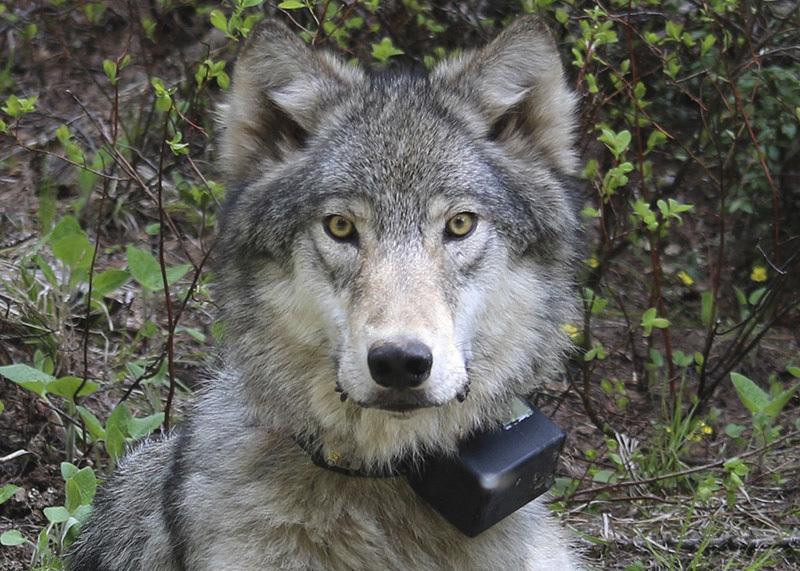
FILE - This March 13, 2014 file photo provided by the Oregon Department of Fish and Wildlife shows a female wolf from the Minam pack outside La Grande, Ore., after it was fitted with a tracking collar. A member of the wolf pack occupying the old Profanity Peak pack area was shot and killed Sunday. (Uncredited / AP)
FILE – This March 13, 2014 file photo provided by the Oregon Department of Fish and Wildlife shows a female wolf from the Minam pack outside La Grande, Ore., after it was fitted with a tracking collar. A member of the wolf pack occupying the old Profanity Peak pack area was shot and killed Sunday. (Uncredited / AP)

Washington’s Wolf Advisory Group is scheduled to meet Tuesday and Wednesday in Spokane following a difficult year of state wolf management.

Livestock depredations led to state management actions including the killing of wolves in several Eastern Washington packs.

The group will discuss topics ranging from wolf and livestock range management to procedures for managing wolves in Washington after they are delisted from state endangered species protections.

The advisory group is charged with finding policy compromises for wolf management in the state.

An open-house style public…

View original post 83 more words

‘Planet of the chickens’: How the bird took over the world

  • 12 December 2018
HenImage copyrightGETTY IMAGES

A study of chicken bones dug up at London archaeological sites shows how the bird we know today has altered beyond recognition from its ancestors.

With around 23 billion chickens on the planet at any one time, the bird is a symbol of the way we are shaping the environment, say scientists.

Evolution usually takes place over a timescale of millions of years, but the chicken has changed much more rapidly.

The rise of the supermarket chicken mirrors the decline in wild birds.

“The sheer number of chickens is an order of magnitude higher than any other bird species that’s alive today,” said Dr Carys Bennett, a geologist at the University of Leicester, who led the study.

“You could say we are living in the planet of the chickens.”

Fried chickenImage copyrightGETTY IMAGES
Image captionChicken meat is consumed across the world

Chickens in numbers

  • 65.8 billion – the number slaughtered in 2014, compared to 1.5 billion pigs and 0.3 billion cattle
  • 25,500 – the number of stores in the world selling a popular brand of fried chicken
  • 70% – the number of broiler chickens that are intensively reared (figures from 2006)
  • Five to seven weeks – the lifespan of a broiler chicken
  • 3- 5bn – the population of the passenger pigeon in the 1800s, now extinct, which is thought to be the most common wild bird in human history.
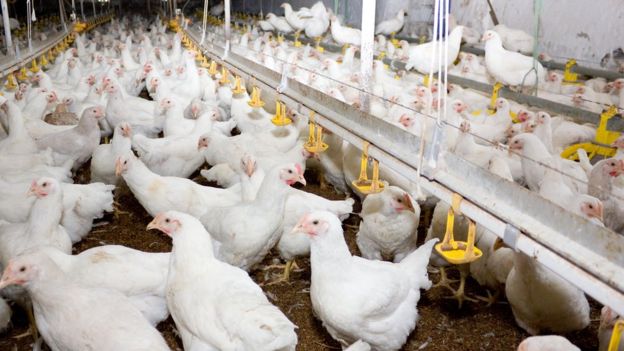
Chickens bred for meatImage copyrightGETTY IMAGES
Image captionChickens bred for meat

The researchers used the archaeological record to look at how chickens have changed over the years – and say they are a symbol of this geological era.

We are entering the Anthropocene, the period during which human activity has been the dominant influence on climate and the environment.

“Human activities have altered the Earth’s landscapes, the oceans, atmosphere and land surface,” said Dr Bennett.

“As the most numerous terrestrial vertebrate species on the planet, with a biology shaped by humans, modern chickens are a symbol of our changed biosphere.”

She said when future generations examine rocks from our time, they will probably see “tin cans, glass bottles, and bits of material that were once plastic, and amongst that will be bones of chickens”.

Domesticated animals now make up the majority of animal species on land, shaping the natural world.

Stories you might also like to read:

Rats and pigeons ‘replace iconic species’

The vast scale of life beneath our feet

Hidden fossils enter ‘digital museum’

The domestic chicken is descended from the red jungle fowl, which is native to tropical South East Asia. The bird was first domesticated around 8,000 years ago, and rapidly spread around the world, to be used for meat and eggs.

In the 1950s the “chicken-of-tomorrow programme” was launched to produce bigger birds. Since then, the bird has undergone extraordinary changes.

It has been selectively bred to put on weight fast, which is evident from its body and the chemistry and genetics of its bones.

Meanwhile, roast chicken has gone from being an occasional treat to a global food enterprise.

The research is reported in the journal Royal Society Open Science.