MAYVILLE, N.Y. — Western New York man was sentenced to one to three years in prison this morning following a 2017 hunting accident that occurred on Thanksgiving 2017 when he fatally shot and killed a neighbor who was out walking her dogs.
Thomas Jadlowski, 34, of Sherman in Chautauqua County, had previously pleaded guilty to criminally negligent homicide and hunting after sunset to the death of Rosie Billquist. The sentence of one year to 15 months in prison was handed down before a packed courtroom this morning by Chatauqua County Judge David Foley, according to wivb.com.
Rosemary Billquist, a 43-year-old hospital worker, hospice volunteer and marathoner, was shot by Jadlowski while walking her two yellow Labradors, Stella and Sugar, behind her home in the town of Sherman about 5:30 p.m. – 40 minutes after sunset that day.
Eloise Gibson is Newsroom’s environment and science editor. She’s written for the New Zealand Herald, Stuff.co.nz, The Listener, and BBC Future.com. Twitter: @eloise_gibson.
ENVIRONMENT
The Government’s proposal for a Zero Carbon Bill has exposed an argument between scientists about the importance of methane. But it’s not really about science, as Eloise Gibson reports in this deep-dive news feature.
There’s beef in the world of methane.
Like a piece of marbled Wagyu, it is probably quite healthy — if consumed in moderation.
The argument is over when and how much New Zealand should reduce the methane from cow and sheep burps, which make up almost a third of our emissions, as we currently record them.
On one side is David Frame, director of Victoria University’s Climate…
Which is better for the environment: organic or conventional agriculture? For consumers trying to make sound food choices, it’s an important question. A new international study finds that organic agriculture actually contributes more to climate change than conventional farming does. The study argues that since organic agriculture requires slightly more land for the same yield, organic systems lead to more deforestation, which in turn results in more carbon dioxide emissions. But measuring environmental impact is extremely complicated.
Back in 2010, Nadia El-Hage Scialabba and Maria Müller-Lindenlauf, of the Food and Agriculture Organization of the United Nations (FAO), took an in-depth look at the climate impacts of organic agriculture. F.A.O.’s Codex Alimentarius Commission defines organic agriculture as:
a holistic production management system that avoids use of synthetic fertilizers, pesticides and genetically modified organisms, minimizes pollution of air, soil and water, and optimizes the health and productivity of interdependent communities of plants, animals and people.
Organic agriculture still uses fertilizers and pesticides, but not synthetic ones. And when it comes to climate, the F.A.O study suggests, the fertilizer issue is key.
Conventional agriculture relies on nitrogen fertilizers, produced through a process involving copious amounts of ammonia and methane. Nitrogen fertilizers in turn, release some degree of nitrous oxide, an extremely potent greenhouse gas, with a much greater warming potential per unit released than carbon.
Organic farms bypass the need for chemical fertilizers by planting legumes. Organic farms also tend to store more carbon in the soil, slightly offsetting other greenhouse gas emissions, though, as the F.A.O. study notes, the carbon storage is likely not permanent. Plus, organic farms may burn more fossil fuels through machinery when weeds are removed mechanically.
As for the suggestion that organic agriculture requires slightly more land for the same yield, it depends on the crop. Conventional dairy production, for example, produces much more milk per cow. But there is hardly any yield difference when it comes to organic vs. conventional rice. In some cases, the same crop may have different yields-per-area in the developing world vs. the developed world—organic yields are often higher in developing countries. This is because, as the F.A.O. report notes, some of the ecologically sound practices are difficult to scale up to industrial levels, and work better at smaller scales.
Get Our Newsletter
Sign up for the JSTOR Weekly Digest and get the week’s best stories right in your inbox.
Privacy PolicyContact Us
You may unsubscribe at any time by clicking on the provided link on any marketing message.
On the other hand, grass-fed livestock requires a lot more space than feedlots, often leading to deforestation.
Many conscious consumers want a definitive answer about whether conventional or organic farming is better, when in fact, both have effects on the climate. There are also other concerns that go into consumer choices, such as animal welfare. And, as Stefan Wirsenius, one of the authors of the international study, says, “The type of food is often much more important. Eating organic beans or organic chicken is much better for the climate than to eat conventionally produced beef.”
A new analysis has found that Earth’s oceans are heating up 40% faster than a United Nations panel estimated 5 years ago.
Sharing is caring!
45
1
Since the mid-2000s, a fleet of nearly 4,000 floating robots have been drifting throughout Earth’s oceans, every few days diving to a depth of about 1.25 miles (2,000 meters) and measuring the ocean’s temperature, pH, salinity and other bits of information as they rise back up. This ocean-monitoring battalion is called Argo.
New research finds that ocean warming is accelerating more rapidly than previously thought. The new analysis, published January 9, 2019, in the peer-reviewed journal Science, found that Earth’s oceans are heating up an average of 40 percent faster than a United Nations panel estimated five years ago.
Zeke Hausfather is an environmental economist at University of California…
The extravagant splendor of the animal kingdom can’t be explained by natural selection alone — so how did it come to be?
A male Indian peafowl.CreditCreditKenji Aoki for The New York Times
By Ferris Jabr
Amale flame bowerbird is a creature of incandescent beauty. The hue of his plumage transitions seamlessly from molten red to sunshine yellow. But that radiance is not enough to attract a mate. When males of most bowerbird species are ready to begin courting, they set about building the structure for which they are named: an assemblage of twigs shaped into a spire, corridor or hut. They decorate their bowers with scores of colorful objects, like flowers, berries, snail shells or, if they are near an urban area, bottle caps and plastic cutlery. Some bowerbirds even arrange the items in their collection from smallest to largest, forming a walkway that makes themselves and their trinkets all the more striking to a female — an optical illusion known as forced perspective that humans did not perfect until the 15th century.
Yet even this remarkable exhibition is not sufficient to satisfy a female flame bowerbird. Should a female show initial interest, the male must react immediately. Staring at the female, his pupils swelling and shrinking like a heartbeat, he begins a dance best described as psychotically sultry. He bobs, flutters, puffs his chest. He crouches low and rises slowly, brandishing one wing in front of his head like a magician’s cape. Suddenly his whole body convulses like a windup alarm clock. If the female approves, she will copulate with him for two or three seconds. They will never meet again.
The bowerbird defies traditional assumptions about animal behavior. Here is a creature that spends hours meticulously curating a cabinet of wonder, grouping his treasures by color and likeness. Here is a creature that single-beakedly builds something far more sophisticated than many celebrated examples of animal toolmaking; the stripped twigs that chimpanzees use to fish termites from their mounds pale in comparison. The bowerbird’s bower, as at least one scientist has argued, is nothing less than art. When you consider every element of his courtship — the costumes, dance and sculpture — it evokes a concept beloved by the German composer Richard Wagner: Gesamtkunstwerk, a total work of art, one that blends many different forms and stimulates all the senses.
This extravagance is also an affront to the rules of natural selection. Adaptations are meant to be useful — that’s the whole point — and the most successful creatures should be the ones best adapted to their particular environments. So what is the evolutionary justification for the bowerbird’s ostentatious display? Not only do the bowerbird’s colorful feathers and elaborate constructions lack obvious value outside courtship, but they also hinder his survival and general well-being, draining precious calories and making him much more noticeable to predators.
A male plum-throated cotinga.CreditKenji Aoki for The New York Times
Image
A male plum-throated cotinga.CreditKenji Aoki for The New York Times
Numerous species have conspicuous, metabolically costly and physically burdensome sexual ornaments, as biologists call them. Think of the bright elastic throats of anole lizards, the Fabergé abdomens of peacock spiders and the curling, iridescent, ludicrously long feathers of birds-of-paradise. To reconcile such splendor with a utilitarian view of evolution, biologists have favored the idea that beauty in the animal kingdom is not mere decoration — it’s a code. According to this theory, ornaments evolved as indicators of a potential mate’s advantageous qualities: its overall health, intelligence and survival skills, plus the fact that it will pass down the genes underlying these traits to its children. A bowerbird with especially bright plumage might have a robust immune system, for example, while one that finds rare and distinctive trinkets might be a superb forager. Beauty, therefore, would not confound natural selection — it would be very much a part of it.
Charles Darwin himself disagreed with this theory. Although he co-discovered natural selection and devoted much of his life to demonstrating its importance, he never claimed that it could explain everything. Ornaments, Darwin proposed, evolved through a separate process he called sexual selection: Females choose the most appealing males “according to their standard of beauty” and, as a result, males evolve toward that standard, despite the costs. Darwin did not think it was necessary to link aesthetics and survival. Animals, he believed, could appreciate beauty for its own sake. Many of Darwin’s peers and successors ridiculed his proposal. To them, the idea that animals had such cognitive sophistication — and that the preferences of “capricious” females could shape entire species — was nonsense. Although never completely forgotten, Darwin’s theory of beauty was largely abandoned.
Now, nearly 150 years later, a new generation of biologists is reviving Darwin’s neglected brainchild. Beauty, they say, does not have to be a proxy for health or advantageous genes. Sometimes beauty is the glorious but meaningless flowering of arbitrary preference. Animals simply find certain features — a blush of red, a feathered flourish — to be appealing. And that innate sense of beauty itself can become an engine of evolution, pushing animals toward aesthetic extremes. In other cases, certain environmental or physiological constraints steer an animal toward an aesthetic preference that has nothing to do with survival whatsoever.
These biologists are not only rewriting the standard explanation for how beauty evolves; they are also changing the way we think about evolution itself. For decades, natural selection — the fact that creatures with the most advantageous traits have the best chance of surviving and multiplying — has been considered the unequivocal centerpiece of evolutionary theory. But these biologists believe that there are other forces at work, modes of evolution that are much more mischievous and discursive than natural selection. It’s not enough to consider how an animal’s habitat and lifestyle determine the size and keenness of its eyes or the number and complexity of its neural circuits; we must also question how an animal’s eyes and brain shape its perceptions of reality and how its unique way of experiencing the world can, over time, profoundly alter both its physical form and its behavior. There are really two environments governing the evolution of sentient creatures: an external one, which they inhabit, and an internal one, which they construct. To solve the enigma of beauty, to fully understand evolution, we must uncover the hidden links between those two worlds.
A male lesser bird-of-paradise.CreditKenji Aoki for The New York Times
Image
A male lesser bird-of-paradise.CreditKenji Aoki for The New York Times
Perhaps no living scientist is as enthusiastic — or doctrinaire — a champion of Darwinian sexual selection as Richard Prum, an evolutionary ornithologist at Yale University. In May 2017, he published a book, “The Evolution of Beauty,” that lucidly and passionately explains his personal theory of aesthetic evolution. It was nominated for the Pulitzer Prize for general nonfiction, but within the scientific community, Prum’s ideas have not been as warmly received. Again and again, he told me, he has asked other researchers for feedback and received either excuses of busyness or no reply at all. Some have been openly critical. In an academic review of Prum’s book, Gerald Borgia, one of the world’s foremost experts on bowerbirds, and the ethologist Gregory Ball described the historical sections as “revisionist” and said Prum failed to advance a credible case for his thesis. Once, over a lunch of burritos, Prum explained his theory to a visiting colleague, who pronounced it “nihilism.”
Last April, Prum and I drove 20 miles east of New Haven to Hammonasset Beach State Park, a 900-acre patchwork of shoreline, marsh, woodland and meadow on Long Island Sound, with the hope of finding a hooded warbler. Birders had recently seen the small but striking migratory species in the area. Before he even parked, Prum was calling out the names of birds he glimpsed or heard through the car window: osprey, purple martin, red-winged blackbird. I asked him how he was able to recognize birds so quickly and, sometimes, at such a great distance. He said it was just as effortless as recognizing a portrait of Abraham Lincoln. In Prum’s mind, every bird is famous.
Binoculars in hand, we walked along the park’s winding trails, slowly making our way toward a large stand of trees. Prum wore jeans, a quilted jacket and a beige hat. His thick eyebrows, round spectacles and sprays of white and gray hair give his face a vaguely owlish appearance. In the course of the day, we would see grazing mallards with emerald heads, tree swallows with iridescent turquoise capes and several sparrow species, each distinguished by a unique ornament: swoops of yellow around the eye, a delicate pink beak, a copper crown. On a wooded path, we encountered a lively bird flinging leaf litter into the air. Prum was immediately transfixed. This was a brown thrasher, he told me, describing its attributes with a mix of precision and fondness — “rufous brown, speckled on the breast, yellow eye, curved beak, long tail.” Then he reprimanded me for trying to take a picture instead of observing with my “binos.”
About two hours into our walk, Prum, who is a fast and fluid talker, interrupted himself midsentence: “Right there! Right there!” he said. “There’s the hooded! Right up against the tree!” Something gold flashed across the path. I raised my binoculars to my eyes and scanned the branches to our right. When I found him, I gasped. He was almost mythological in his beauty: moss-green wings, a luminescent yellow body and face and a perfectly tailored black hood that made his countenance even brighter by contrast. For several minutes we stood and watched the bird as it hopped about, occasionally fanning white tail feathers in our direction. Eventually he flew off. I told Prum how thrilling it was to see such a creature up close. “That’s it,” Prum said. “That moment is what bird-watching is about.”
As a child growing up in a small rural town in southern Vermont, Prum was, in his words, “amorphously nerdy” — keen on reading and memorizing stats from “The Guinness Book of World Records” but not obsessed with anything in particular. Then, in fourth grade, he got glasses. The world came into focus. He chanced upon a field guide to birds in a bookstore, which encouraged him to get outdoors. Soon he was birding in the ample fields and woods around his home. He wore the grooves off two records of bird calls. He befriended local naturalists, routinely going on outings with a group of mostly middle-aged women (conveniently, they had driver’s licenses). By the time Prum was in seventh grade, he was leading bird walks at the local state park.
In college, Prum wasted no time in availing himself of Harvard University’s substantial ornithological resources. The first week of his freshman year, he got a set of keys to the Museum of Comparative Zoology, home to the largest university-based ornithological collection in the world, which today has nearly 400,000 bird specimens. “I’ve been associated with a world-class collection of birds every moment of my adult life,” he says. “I joke with my students — and it’s really true — I have to have at least 100,000 dead birds across the hallway to function intellectually.” (He is now the head curator of vertebrate zoology at Yale’s Peabody Museum of Natural History.) He wrote a senior thesis on the phylogeny and biogeography of toucans and barbets, working on a desk beneath the skeleton of a moa, an extinct emu-like bird that stood 12 feet tall and weighed 500 pounds.
After graduating from Harvard in 1982, Prum traveled to Suriname to study manakins, a family of intensely colored birds that compete for mates with high-pitched songs and gymnastic dance routines. In 1984, he began graduate studies in biology at the University of Michigan, Ann Arbor, where he planned to reconstruct the evolutionary history of manakins through careful comparisons of anatomy and behavior. In the process, a colleague introduced him to some research papers on sexual selection, piquing his interest in the history of this fascinating yet seemingly neglected idea.
Yellow plumes from a male lesser bird-of-paradise.CreditKenji Aoki for The New York Times
Image
Yellow plumes from a male lesser bird-of-paradise.CreditKenji Aoki for The New York Times
Darwin was contemplating how animals perceived one another’s beauty as early as his 30s: “How does Hen determine which most beautiful cock, which best singer?” he scribbled in a note to himself sometime between 1838 and 1840. In “The Descent of Man,” published in 1871, he devoted hundreds of pages to sexual selection, which he thought could explain two of the animal kingdom’s most conspicuous and puzzling features: weaponry and adornment. Sometimes, males competing fiercely for females would enter a sort of evolutionary arms race, developing ever greater weapons — tusks, horns, antlers — as the best-endowed males of each successive generation reproduced at the expense of their weaker peers. In parallel, among species whose females choose the most attractive males based on their subjective tastes, males would evolve outlandish sexual ornaments. (It’s now well known that all sexes exert numerous different evolutionary pressures on one another and that in some species males choose ornamented females, but to this day, many of the best-studied examples are of female preference and male display.)
ADVERTISEMENT
Unlike natural selection, which preserved traits that were useful “in the struggle for life,” Darwin saw sexual selection as exclusively concerned with reproductive success, often resulting in features that jeopardized an animal’s well-being. The peacock’s many-eyed aureole, mesmerizing yet cumbersome, was a prime example and remains the mascot of sexual selection today. “A great number of male animals,” Darwin wrote, “as all our most gorgeous birds, some fishes, reptiles and mammals, and a host of magnificently colored butterflies have been rendered beautiful for beauty’s sake.”
Darwin’s peers embraced the idea of well-armed males dueling for sexual dominance, but many scorned the concept of animal aesthetics, in part because it was grounded in animal consciousness and female desire. In one critique, the English biologist St. George Mivart stressed “the fundamental difference which exists between the mental powers of man and brutes” and the inability of “vicious feminine caprice” to create enduring colors and patterns. The English naturalist Alfred Russel Wallace, who independently formed many of the same ideas about evolution as Darwin, was also deeply critical. Wallace was particularly tormented by Darwin’s suggestion of beauty without utility. “The only way in which we can account for the observed facts is by the supposition that color and ornament are strictly correlated with health, vigor and general fitness to survive,” Wallace wrote. In other words, ornamentation could be explained only as a heuristic that animals use to judge a potential mate’s fitness — a view that came to dominate.
In the early 1980s, while researching the history of sexual selection, Prum read a seminal 1915 paper and a 1930 book on the subject by the English biologist and statistician Ronald Fisher, who buttressed Darwin’s original idea with a more sophisticated understanding of heredity. At first, Fisher argued, females might evolve preferences for certain valueless traits, like bright plumage, that just happened to correspond with health and vigor. Their children would tend to inherit the genes underlying both their mother’s preference and their father’s trait. Over time, this genetic correlation would reach a tipping point, creating a runaway cycle that would greatly exaggerate both preference and trait, glorifying beauty at the expense of the male’s survival. In the early 1980s, the American evolutionary biologists Russell Lande and Mark Kirkpatrick gave Fisher’s theory a formal mathematical girding, demonstrating quantitatively that runaway sexual selection could happen in nature and that the ornaments involved could be completely arbitrary, conveying no useful information whatsoever.
Although Fisherian selection was certainly not ignored, it was ultimately overshadowed by a series of hypotheses that seemed to rescue beauty from purposelessness. First, the Israeli biologist Amotz Zahavi proposed a counterintuitive idea called the handicap principle, which put a new spin on Wallace’s utilitarian explanation for sexual ornaments. Extravagant ornaments, Zahavi argued, were not merely indicators of advantageous traits as Wallace had said — they were a kind of test. If an animal thrived despite the burden of an unwieldy or metabolically expensive ornament, then that animal had effectively demonstrated its vigor and proved itself worthy of a mate. Similarly, in 1982, the evolutionary biologists W.D. Hamilton and Marlene Zuk proposed that some ornaments, in particular bright plumage, signaled that a male was resilient against parasites and would grant his children the same protection. Many scientists began to think of sexual selection as a type of natural selection. Scores of researchers joined the hunt for measurable benefits of choosing an attractive mate: both direct benefits, like better parenting or more desirable territory, and indirect benefits, namely some evidence that more alluring males really did have “good genes” underlying various desirable qualities, like disease resistance or higher-than-average intelligence.
A male Guianan cock-of-the-rock.CreditKenji Aoki for The New York Times
Image
A male Guianan cock-of-the-rock.CreditKenji Aoki for The New York Times
After more than 30 years of searching, most biologists agree that although these benefits exist, their prevalence and importance is uncertain. A few compelling studies of frogs, fish and birds have shown that females who choose more attractive males typically have children with more robust immune systems and a greater chance of survival. On the whole, however, the evidence has not equaled the enthusiasm. A 2012 meta-analysis of 90 studies on 55 species found only “equivocal” support for the good-genes hypothesis.
Prum thinks the evidence for the heritable benefits of choosing a beautiful mate is scant because such benefits are themselves rare, whereas arbitrary beauty is “nearly ubiquitous.” Over the years, the more he contemplated runaway selection, the more convinced he became that it was a far more powerful and creative evolutionary force than natural selection, which he regards as overhyped and boring. “Animals are agents in their own evolution,” he told me during one conversation. “Birds are beautiful because they are beautiful to themselves.”
In the summer of 1985, around the same time that biologists were rekindling their interest in sexual selection, Prum and the nature documentarian Ann Johnson (who would later choose him as her husband) traveled to Ecuador to continue studying manakins. The first morning, while hiking through a cloud forest, Prum heard odd bell-like notes, which he took to be the murmurings of parrots. Later that day, on the same trail, he heard the strange sounds again and followed them into the forest. He was astonished to find that the source was a male club-winged manakin, a small cinnamon-bodied species with a red cap and black-and-white mottled wings. The manakin was jumping around in a showy manner that suggested he was courting females. Instead of singing with his throat, he repeatedly lifted his wings behind his back and vibrated his feathers furiously against one another, producing two electronic blips followed by a shrill buzzing ring — a sound Prum transcribes as “Bip-Bip-WANNGG!”
At the time, Prum had not fully developed his evolutionary theory of beauty, but he immediately suspected that the club-winged manakin was emblematic of nature’s capacity for pushing creatures to aesthetic extremes. The bird’s singular vibrato haunted him for years. In the early 2000s, when Prum had become a professor of biology at the University of Kansas, he and his graduate student Kimberly Bostwick revealed that the demands of courtship had drastically altered the bird’s anatomy, turning it into a living violin. Male club-winged manakins had feathers with contorted shafts that rubbed against each other 100 times a second — faster than a hummingbird beats its wings. Whereas a vast majority of birds have light, hollow bones in service of flight, Bostwick has recently shown via CT scans that male club-winged manakins have solid ulnas — wing bones — which they need to withstand the intense quivering. Female manakins have inherited related anomalies as well.
Although there are no published studies of the club-winged manakin’s aeronautics, Prum says it’s obvious from observation that the birds fly awkwardly — even the females. The self-perpetuating pressure to be beautiful, Prum argues, has impeded the survival of the entire species. Because the females do not court males, there can be no possible advantage to their warped bones and feathers. “Some of the evolutionary consequences of sexual desire and choice in nature are not adaptive,” Prum writes in his recent book. “Some outcomes are truly decadent.”
In the following decade, as Prum’s hearing declined, he withdrew from field research and birding, but he still managed to make a series of groundbreaking scientific discoveries: He helped confirm that feathers evolved in dinosaurs long before the emergence of birds, and he became one of the first scientists to deduce the colors of a dinosaur’s plumage by examining pigment molecules preserved in fossilized feathers. All the while, he never stopped thinking about sexual selection. Prum formally presented his theory of aesthetic evolution in a series of scientific papers published between 1997 and 2015, proposing that all sexual ornaments and preferences should be regarded as arbitrary until proven useful.
Despite his recent Pulitzer nomination, Prum still stings from the perceived scorn of his academic peers. But after speaking with numerous researchers in the field of sexual selection, I learned that all of Prum’s peers are well aware of his work and that many already accept some of the core tenets of his argument: namely that natural and sexual selection are distinct processes and that, in at least some cases, beauty reveals nothing about an individual’s health or vigor. At the same time, nearly every researcher I spoke to said that Prum inflates the importance of arbitrary preferences and Fisherian selection to the point of eclipsing all other possibilities. In conversation, Prum’s brilliance is obvious, but he has a tendency to be dogmatic, sometimes interrupting to dismiss an argument that does not agree with his own. Although he admits that certain forms of beauty may be linked to survival advantages, he does not seem particularly interested in engaging with the considerable research on this topic. When I asked him which studies he thought offered the strongest support of “good genes” and other benefits, he paused for a while before finally responding that it was not his job to review the literature.
A male painted bunting.CreditKenji Aoki for The New York Times
Image
A male painted bunting.CreditKenji Aoki for The New York Times
Like Darwin, Prum is so enchanted by the outcomes of aesthetic preferences that he mostly ignores their origins. Toward the end of our bird walk at Hammonasset Beach State Park, we got to talking about club-winged manakins. I asked him about their evolutionary history. Prum thinks that long ago, an earlier version of the bird’s courtship dance incidentally produced a feathery susurration. Over time, this sound became highly attractive to females, which pressured males to evolve adaptations that made their rustling feathers louder and more noticeable, culminating in a quick-winged strumming. But why, I asked Prum, would females be attracted to those particular sounds in the first place?
To Prum, it was a question without an answer — and thus a question not worth contemplating. “Not everything,” he said, “has this explicit causal explanation.”
Prum’s indifference to the ultimate source of aesthetic taste leaves a conspicuous gap in his grand theory. Even if we were to accept that most beauty blooms from arbitrary preferences, we would still need to explain why such preferences exist at all. It’s entirely conceivable that an animal might be inherently partial to, say, a warbling mating call or bright yellow feathers, and that these predilections would have nothing to do with advantageous genes. Yet such inclinations are inarguably the product of an animal’s neurobiology, which is itself the result of a long evolutionary history that has adapted the animal’s brain and sensory organs to specific environmental conditions. In the past two decades, a cohort of biologists have dedicated themselves to studying how an animal’s “sensory bias” — its ecological niche and its particular way of experiencing the world — sculpts its appearance, behavior and desires. Like Prum, they don’t think beauty has to be adaptive. But where Prum celebrates caprice, they seek causality.
ADVERTISEMENT
Molly Cummings, a professor of integrative biology at the University of Texas at Austin, is a leading researcher in the field of sensory ecology. When I visited her last spring, she drove us to one of her field laboratories: a grassy clearing populated with several large concrete basins. The surface of one basin was so packed with woolly algae and pink-flowered water lilies that we could hardly see the water. Cummings began pushing some of the vegetation out of the way, forming shady recesses that permitted our gaze at the right angle. “Let me see if I can find a big, beautiful boy,” she said.
A paper-clip-size fish swam toward us. I leaned in for a closer look. His silver body was decorated with a single black dot and a stripe of iridescent blue; his lengthy tail, shaped like a knight’s blade, was streaked with yellow. “Oh, yeah, there’s a guy courting,” Cummings said. “He’s coming up to that female, trying to impress her.” The fish, a male swordtail, seemed almost manic in his effort to be noticed. He darted back and forth in front of the female, shimmying as he went, his scales reflecting whatever light managed to breach the murk.
A little while later, we drove the few miles back to her campus laboratory, where shelves of fish tanks lined several rooms and Ernst Haeckel’s resplendent illustrations of jellyfish undulated across the walls. As we toured the facilities, Cummings told me about the arc of her career. While an undergraduate at Stanford University, she spent a summer scuba diving in the giant kelp forests at Hopkins Marine Station, adjacent to the world-renowned Monterey Bay Aquarium. After college, she moved to James Cook University in Townsville, Australia, where she studied marine ecology and discovered the work of the biologists John Lythgoe and John Endler, both of whom were interested in how the type of light in an animal’s environment shaped its visual system.
Cummings thought about the fish she had observed in California and Australia. She was astounded by the dynamic beauty of surfperch in the kelp forest: the way they communicate through the color and brightness of their skin, flashing blue, silver and orange to attract mates. Equally impressive was the diversity of their aquatic habitats. Some patches of water were sparkling and clear; others were cloudy with algal muck. In Australia, sunlight bathed the many vibrant species of reef fish almost constantly, but they lived against a kaleidoscopic backdrop of coral. How did fish evolve effective and reliable sexual ornaments if the lighting and scenery in their homes were so variable?
The tips of the outer tail feathers of a male king bird-of-paradise.CreditKenji Aoki for The New York Times
Image
The tips of the outer tail feathers of a male king bird-of-paradise.CreditKenji Aoki for The New York Times
After earning a postgraduate degree in Australia in 1993, Cummings began a Ph.D. at the University of California, Santa Barbara. For several years, she studied various species of surfperch, repeatedly diving in the kelp forests with a Plexiglas-protected spectrometer to quantify and characterize the light in different habitats. At night, she would use powerful diving lights to stun surfperch and take them back to the lab, evading the hungry seals that routinely trailed her in hopes of making a meal of the startled fish. After hundreds of dives and careful measurements, Cummings discovered that water itself had guided the evolution of piscine beauty. A female’s preference for a blaze of silver or blue was not arbitrary; it was a consequence of the particular wavelengths of light that traveled farthest through her underwater niche. Whichever males happened to have scales that best reflected these wavelengths were more likely to catch the eye of females.
In her studies, Cummings showed that surfperch living in dim or murky waters generally preferred shiny ornaments, while surfperch inhabiting zones of mercurial brightness favored bold colors. Later, Cummings found that Mexican swordtails occupying the upper layers of rivers, where the clear water strongly polarized incoming sunlight, had ornaments that were specialized to reflect polarized light — like a stripe of iridescent blue. These findings parallel similar studies suggesting that female guppies in Trinidad prefer males with orange patches because they first evolved a taste for nutritious orange tree fruits that occasionally fell into the water. “Some people think female preferences just somehow emerge,” Cummings says, “but what has been overlooked is that in many cases, it’s a result of environmental constraints. It’s not always random.”
What a creature finds attractive depends on more than the unique qualities of its environment, however; attraction is also defined by which of those qualities cross the threshold of awareness. Consider the difference between what we see when we look at a flower and what a bumblebee sees. Like us, insects have color vision. Unlike us, insects can also perceive ultraviolet light. Many plants have evolved flower parts that absorb or reflect ultraviolet light, forming patterns like rings, bull’s-eyes and starbursts. Most creatures are oblivious to these ornaments, but to the eyes of many pollinators, they are unmistakable beacons. There is an entire dimension of floral beauty invisible to us, not because we are not exposed to ultraviolet light, but because we do not have the proper biological hardware to perceive it.
ADVERTISEMENT
Michael Ryan, a professor of zoology whose lab and office are just a few floors below Cummings’, has spent more than 30 years investigating how the quirks of an animal’s anatomy determine its aesthetic preferences — a career he details in his recent book, “A Taste for the Beautiful.” Since 1978, Ryan has been traveling to Panama to study a mud-colored frog called the túngara. Like the club-winged manakin, the túngara has a unique form of beauty that is not visual but aural. At dusk, male túngara frogs gather at the edges of puddles and sing to seduce females. Their mating call has two elements: The main part, dubbed the whine, sounds precisely like a miniaturized laser gun; sometimes this is followed by one or more brief barks, known as chucks. A long and complex mating call is risky: It attracts frog-eating bats. Yet there is a high payoff. Ryan has shown that whines followed by chucks are up to five times as appealing to females as whines alone. But why?
According to the adaptive model of beauty, the chucks must convey something about the males’ fitness. As it happens, larger males, which produce the deepest and sexiest chucks, are also the most adept at mating, because they are closer in size to females. (Frog sex is a slippery affair, and a diminutive male is more likely to miss his target.) Moreover, the túngara frog has an inner organ tuned to 2,200 hertz, which is close to the dominant frequency of a chuck. Together, these facts seem to indicate that the túngara’s puddle-side serenade is an example of adaptive mate choice: Females evolved ears tuned to chucks because they indicate the biggest and most sexually skilled males.
Ryan’s research revealed a stranger story. When he examined the túngara frog’s family tree, he discovered that eight frog species closely related to the túngara also have inner ear organs sensitive to frequencies of about 2,200 hertz, yet none of them produce chucks in their mating call. Ryan thinks that eons ago, the ancestor of all these species probably evolved an inner ear tuned to roughly 2,200 hertz for some long-abandoned purpose. The túngara later revived this neglected auditory channel, probably by happenstance. Male frogs that happened to burp out a few extra notes after whining were automatically favored by females — not because they were more suitable mates, but simply because they were more noticeable.
Like the glistening scales on the surfperch and swordtails that Cummings studied, the túngara’s costly mating call did not evolve to convey any pragmatic information about health or fitness. But that doesn’t mean that these traits were arbitrary. They were the result of specific, discernible aspects of the animals’ environments, anatomy and evolutionary legacy. “I took a real beating when I suggested this idea in 1990,” Ryan says. “It was very widely criticized. But now sensory bias is considered an important part of the evolution of these preferences.”
During our walk at Hammonasset, while admiring seabirds from shore-side cliffs, I asked Prum about sensory bias. He said it could not possibly explain the staggering diversity and idiosyncrasy of sexual ornaments — the fact that every closely related sparrow species has a unique embellishment, for example. Prum sees sensory bias as just another way to maintain the predominant “adaptive paradigm” that refuses to acknowledge his theory of aesthetic evolution. Tellingly, Prum and Ryan do not discuss each other’s work in their recent books.
A male king bird-of-paradise.CreditKenji Aoki for The New York Times
Image
A male king bird-of-paradise.CreditKenji Aoki for The New York Times
While mulling over the similarities and discrepancies between Prum’s ideas and those of his peers, I kept returning to a passage in his book. In 2010, Prum and his colleagues revealed that a crow-size dinosaur called Anchiornis huxleyi was beautifully adorned: gray body plumage, an auburn mohawk and long white limb feathers with black spangles. Why dinosaurs originally evolved feathers has long perplexed scientists. At first, layers of fuzzy filaments, similar to a chick’s down, most likely helped dinosaurs repel water and regulate body temperature. But what explains the development of broad, flat feathers like those found on Anchiornis? Flight is the intuitive answer, but the first planar feathers were probably too primitive for flight or gliding, lacking the distinct asymmetry that makes birds’ feathers aerodynamic. In his book, Prum advocates for an alternative hypothesis that has been gaining support: Large feathers evolved to be beautiful.
The aesthetic possibilities of fuzzy down are limited. “The innovative planar feather vane, however, creates a well-defined, two-dimensional surface on which it is possible to create a whole new world of complex color patterns within every feather,” Prum writes. Only later did birds co-opt their big, glamorous plumes for flight, which is probably a key reason that some of them survived mass extinction 66 million years ago. Birds transformed what was once mere frippery into some of the most enviable adaptations on the planet, from the ocean-spanning breadth of an albatross to the torpedoed silhouette of a plunging falcon. Yet they never abandoned their sense of style, using feathers as a medium for peerless pageantry. A feather, then, cannot be labeled the sole product of either natural or sexual selection. A feather, with its reciprocal structure, embodies the confluence of two powerful and equally important evolutionary forces: utility and beauty.
ADVERTISEMENT
Most of the scientists I spoke with said that the old dichotomy between adaptive adornment and arbitrary beauty, between “good genes” and Fisherian selection, is being replaced with a modern conceptual synthesis that emphasizes multiplicity. “Beauty is something that arises from a host of different mechanisms,” says Gil Rosenthal, an evolutionary biologist at Texas A&M University and the author of the new scholarly tome “Mate Choice.” “It’s an incredibly multilayered process.”
The environment constrains a creature’s anatomy, which determines how it experiences the world, which generates adaptive and arbitrary preferences, which loop back to alter its biology, sometimes in maladaptive ways. Beauty reveals that evolution is neither an iterative chiseling of living organisms by a domineering landscape nor a frenzied collision of chance events. Rather, evolution is an intricate clockwork of physics, biology and perception in which every moving part influences another in both subtle and profound ways. Its gears are so innumerable and dynamic — so susceptible to serendipity and mishap — that even a single outcome of its ceaseless ticking can confound science for centuries.
On my last day in Austin, while walking through a park, I encountered a common grackle hunting for insects in the grass. His plumage appeared black as charcoal at first, but as he moved, it shimmered with all the colors of an oil slick. Every now and then, he stopped in place, inflated his chest and made a sound like a rusty swing set. Perhaps dissatisfied with the local fare, or uncomfortable with my presence, he flew off.
In his absence, my attention immediately shifted to something his presence had obscured — a golden columbine bush. From a distance, its flowers resembled medieval illustrations of comets, big and bold with long, trailing streamers. Up close, I was struck by the complexity of a single blossom: a large yellow star wreathed a cluster of five tubular petals, shaped like angel’s trumpets and pooled with nectar. A tuft of pollen-tipped filaments fizzed through the very center. Viewed from above, the flowers looked like huddles of tiny birds with their beaks pressed together and wings flared. The name “columbine” comes from the Latin for “dovelike.”
Why are flowers beautiful? Or, more precisely: Why are flowers beautiful to us? The more I thought about this question, the more it seemed to speak to the nature of beauty itself. Philosophers, scientists and writers have tried to define the essence of beauty for thousands of years. The plurality of their efforts illustrates the immense difficulty of this task. Beauty, they have said, is: harmony; goodness; a manifestation of divine perfection; a type of pleasure; that which causes love and longing; and M = O/C (where M is aesthetic value, O is order and C is complexity).
Evolutionary psychologists, eagerly applying adaptive logic to every facet of behavior and cognition, have speculated that the human perception of beauty emerges from a set of ancient adaptations: Perhaps men like women with large breasts and narrow waists because those features signal high fertility; symmetrical faces may correlate with overall health; maybe babies are irresistibly cute because their juvenile features activate the caregiving circuits in our brains. Such claims sometimes verge on the ludicrous: The philosopher Denis Dutton has argued that people around the world have an intrinsic appreciation for a certain type of landscape — a grassy field with copses of trees, water and wildlife — because it resembles the Pleistocene savannas where humans evolved. In a TED Talk, Dutton explains that postcards, calendars and paintings depicting this universally beloved landscape usually include trees that fork near the ground because our ancestors relied on their conveniently low branches to scramble away from predators.
Of course, it is undeniable that we, like all animals, are products of evolution. Our brains and sensory organs are just as biased as any other creature’s. Our inherited anatomy, physiology and instincts have undoubtedly shaped our perception of beauty. In their recent books, Richard Prum and Michael Ryan synthesize research on animals and people, exploring possible evolutionary explanations for our own aesthetic tastes. Ryan is particularly interested in the innate sensitivities and biases of our neural architecture: He describes how our visual system, for example, may be wired to notice symmetry. Prum stresses his conviction that in humans, as in birds, many types of physical beauty and sexual desire have arbitrarily co-evolved without reference to health or fertility. What complicates their respective arguments is the overwhelming power of human culture. As a species, we are so thoroughly saturated with symbolism, ritual and art — so swayed by rapidly changing fashions — that it is more or less impossible to determine just how much an aesthetic preference owes to evolutionary history as opposed to cultural influence.
ADVERTISEMENT
A male Mandarin duck.CreditKenji Aoki for The New York Times
Image
A male Mandarin duck.CreditKenji Aoki for The New York Times
Perhaps more than any other object of aesthetic obsession, flowers expose the futility of trying to contain beauty in a single theoretical framework. Consider how flowers came to be and how we grew to love them: 150 million years ago many pollen-producing plants depended on the wind to spread their pollen and reproduce. But certain insects, perhaps beetles and flies, began to eat those protein-rich pollen grains, inadvertently transporting them from one plant to another. This proved to be a much more efficient means of fertilization than capricious air currents. Plants with the richest and most obvious sources of pollen were especially successful. Likewise, insects that were particularly adept at finding pollen had an advantage over their peers.
Through a long process of co-evolution, plants and pollinators transformed one another. Some plants began to modify their leaves into proto-flowers: little flags that marked the location of their pollen. Bold colors and distinctive shapes helped them stand out in a tangle of green. Strong aromas and ultraviolet beacons played upon pollinators’ senses. Nectar sweetened the deal. Insects, birds and mammals began competing for access, evolving wings, tongues and brains better suited to the quest for floral sustenance. As the pressure from both parties intensified, plants and their pollinators formed increasingly specific relationships, hurtling each other toward aesthetic and adaptive extremes — a bird that hums and hovers like an insect, an orchid that mimics the appearance and scent of a female bee.
Many millions of years later, flowers enchanted yet another species. Perhaps the initial attraction was purely utilitarian: the promise of fruit or grain. Maybe we were captivated by their consonance of color, form and aroma. Whatever the case, we adopted numerous flowering plants into an expanding circle of domesticated species. We brought them into greenhouses and laboratories, magnifying their inherent beauty, creating new hybrids and tailoring their features to our individual tastes. We contracted orchid delirium and tulip mania, and we have never fully recovered. The flower began as a plea and became a phenomenon.
If there is a universal truth about beauty — some concise and elegant concept that encompasses every variety of charm and grace in existence — we do not yet understand enough about nature to articulate it. What we call beauty is not simply one thing or another, neither wholly purposeful nor entirely random, neither merely a property nor a feeling. Beauty is a dialogue between perceiver and perceived. Beauty is the world’s answer to the audacity of a flower. It is the way a bee spills across the lip of a yawning buttercup; it is the care with which a satin bowerbird selects a hibiscus bloom; it is the impulse to recreate water lilies with oil and canvas; it is the need to place roses on a grave.
Young Cobb 500 chicks at Irvine’s farm in Kilimanjaro, which are ready to be sold to local chicken farms. All photographs by Peter Caton
A US mega-farm, a Christian backer and Africa’s oldest industrial chicken producer are bringing the world’s super birds to reform central Africa’s food market and feed the poor
On the evening of 7 August 2018, a KLM charter flight left Amsterdam, landing 11 hours later at Kilimanjaro airport in northern Tanzania. Its young occupants were nodded through immigration and driven 50 miles to their new home, close to some of Africa’s most famous game parks.
These were no tourists hoping to see lions in the nearby Serengeti. The 2,320 little cockerels and 17,208 hens on the plane were a flock of European-bred pedigree Cobb 500 chickens, the world’s most popular breed. Their destination: a remote 200-hectare mega-farm under construction in the windy foothills of snow-capped Mount Kilimanjaro.
Here, where wildlife and nomadic tribes have always roamed, Tyson, the world’s second-largest food company, has set up with Irvine’s, Africa’s oldest industrial chicken producer. With the backing of a devout Christian businessman, Donnie Smith, the three partners aim to revolutionise food production in central Africaand “save” people from hunger by growing chickens on an American scale. The little chicks and hens are the expeditionary force of an army of Cobb 500s to follow.
Irvine’s $20m (£15m) parent stock laying eggs on the high plains below Mount Kilimanjaro is just the start. In a year’s time they expect to be sending 500,000 fertilised eggs a week to a sister hatchery on the Tanzanian coast, where millions of one-day-old chicks will be sold to local farmers. In a few years they could be rearing and exporting 40m or even 50m broilers a year to neighbouring Kenya, Rwanda, the Democratic Republic of the Congo and other African countries.
No one knows if they will flood the market and undermine local producers, or if they will improve food security in countries where millions of people regularly go hungry.
But they should make money. There is an insatiable appetite for chicken meat in African cities, and only a handful of industrial farms across the continent competing with imports from the US, Europe or Brazil.
Tyson sees central Africa as a promising new market. The corporate behemoth, which turns over $38bn (£30bn) a year, says it is “faith-friendly” and rooted in Christian values. It processes and sells about 11bn chickens a year worldwide, according to Bloomberg.
And for Donnie Smith (below left), the genial former chief executive of Tyson, from Tennessee, the Kilimanjaro plant is “God’s plan”.
Smith, who spent 35 years with Tyson, says he feels impelled by his faith to feed the world’s poor. He has already set up a small chicken charity in Rwanda that offers loans to small farmers to buy a few hundred birds. His mission now is to bring chickens to Africa on a grand scale.
“I am a Christian. I feel a call to use my poultry background and put that to work. Poultry is the most efficient converter of feed to meat; no religions are against eating poultry. If you want an impact on the poor, providing them with high-quality, affordable protein from chicken is the best way.
“Why Africa? The need is tremendous. I have travelled in sub-Saharan Africa and in the largest population centres you see fairly rapid progress, but [not] in rural areas. All my experience tells me that God wants me to work in Africa,” he says.
Nature’s Arnie Schwarzeneggers
The farm looks like aliens have landed. Planet Cobb sees giraffes on their way between national parks pass many low, 120 metre-long, 12 metre-wide, shiny white structures; Maasai pastoralists in woven red shuka blankets drive their cattle over land dotted with steel masts, tanks and towers. The snows of Kilimanjaro glisten above the clouds.
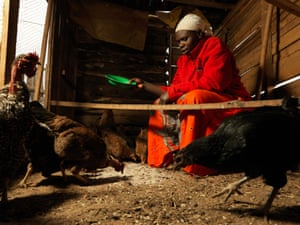
As happens all over Africa, many households in the few nearby villages keep chickens for eggs or to eat on occasional celebrations. But unlike the bright white Cobb 500s in their sealed sheds, these birds are scrawny, gaudy and all shapes and sizes. They look spectacular and taste strong.
In contrast, the Cobbs are nature’s Arnie Schwarzeneggers – all jutting chests, rippling thighs, big feet and bland flesh. These meat machines have been highly bred for 100 years to grow fast, bulk up their breasts and to eat only small quantities of cheap soya and maize.
Irvine’s $20m farm and hatchery in Dar es Salaam
Today, the Cobb 500 is an industrial marvel. A parent hen will lay on average 192 eggs in its short 15-month life, more than twice as many as any backyard bird; and a young Cobb 500 broiler can grow from a day-old chick to a 2kg bird ready for the pot in just 33 days.
The Cobb is now the chicken that ate the world, identically bred in 120 countries and the first choice of most of the world’s big poultry farmers and fast-food chains from McDonald’s to Wendy’s, KFC and Zaxby’s.
No one has counted, but there are probably far more Cobb 500s alive than there are humans. The UN’s Food and Agriculture organisation (FAO) estimated in 2011 that there were 19bn chickens across the globe. Of those bred for their meat, nearly half are thought to be Cobbs. In the next few years chicken is expected to overtake pork and beef to become the world’s most popular meat. Cobb flesh by then could be in the diet of billions of people.
The multinational company Cobb-Vantress, which has developed the bird and is owned by Tyson, declined to speak to the Guardian. But, says Hal Herzog, a US author and anthro-zoologist: “Once its feathers are plucked, its feet and head chopped off, its gut scraped out and its blood drained, 73% of a Cobb 500’s carcass will be eviscerated yield.
“A broiler chicken’s bones cannot keep up with the explosive growth of its body.” He says that unnaturally large breasts may torque a chicken’s legs, causing lameness, ruptured tendons and twisted legs.
But the Cobb 500 is the likely future of food. With scientists urging people to eat less meat to reduce greenhouse gas emissions, Cobb broilers are proving to have the best carbon footprint of all land-based animals. According to one calculation, kilo for kilo, a broiler emits five times less CO2 equivalent than lamb, and is environmentally better than cheese.
‘These birds live like kings and queens’
To get the best, soft white meat from a Cobb 500 you need more than genetics, says Enzo Faglioni, the young Brazilian vet who is Irvine’s breeder operation manager at the farm. “You must minutely control the birds’ environment. They must be as comfortable as possible at all times, and be treated like babies,” he says. “These birds live like kings and queens.”
He accepts that commercial poultry farms have made welfare mistakes in the past, but says the lessons have been learned. No antibiotics are used unless there is an outbreak of illness, and no hormones are pumped into their feed.
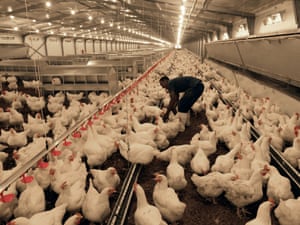
To go inside the sealed, dark, windowless Kilimanjaro chicken sheds you must shower twice, brush your teeth, wash your hair and wear special clothes. When the doors are opened, there are identical white chickens as far as the eye can see.
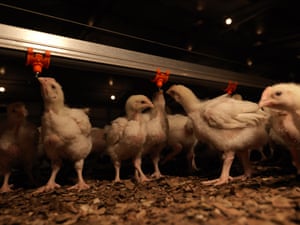
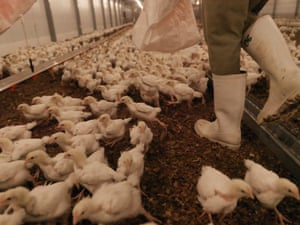
From top left: young Cobb chicks drink from a mechanical water dispenser; each room contains about 9,000 birds; herding chicks to keep them from crowding in groups; repairing the mechanical chicken feeder
There is a deep rumble of tens of thousands of clucks, interspersed with the crowing of many hundreds of cocks, and a whiff of ammonia. But random checks show no lameness, blisters or sores. The birds are not aggressive and look content. The mortality rate over their 15-month lifetime is said to be about 5%, far less than in the average European or American broiler house.
It is only when you get down on floor level that the large Cobb cocks attack. Feet out, wings flapping and beaks thrusting, they come at you hard. It hurts and all you can do is yell and run.
‘The need is great’
“This is how Africa can feed itself,” says Smith. The continent’s population is going to double to 2 billion people in the next 30 years and chicken is needed to provide the protein to avoid malnourishment and stunting, he says. “Chickens are good for the environment, too, because they need less land, less food and less water [than cattle and pigs] to produce the same amount of meat.
“We’re not there yet but we are making chicken more affordable. I don’t think that we will undermine other producers or traditional breeds. You will see two food systems running side by side.
“I believe that chicken will become the most affordable, complex protein on the African continent. We know what the future is going to look like and this is it. We want to access the future in Africa because the need is so great.”
Food security will be strengthened by improving the availability of broiler chicken products, confirms Anne Mottet, a livestock development officer for the FAO. But she emphasises the importance of small-scale operations. “Overall you want diversity of production sources. It’s more resilient than putting all your eggs in one basket. The more small-scale producers you have, the more resilient you are.”
Is sub-Saharan Africa ready for unchecked corporate concentration and the pollution and potential animal welfare problems that have plagued broiler-chicken production in Europe and the US?
Yes, says the Tanzanian government, which struggles to feed its fast-urbanising population and is a target for chicken imports from Europe and Brazil. Nearly a million people needed food aid in the country last year and Tanzania adds 1.6 million people a year. By 2035 its population will have grown by another 32 million.
“Definitely we are ready,” says Rose Sweya (left), a young Dar es Salaam chicken farmer who is eager to buy thousands of Donnie’s day-old Cobbs to fatten up. She says she welcomes competition and that the demand for chicken is insatiable.
“People desperately need protein and chicken is the best way to get it. The population is growing fast so the demand is rocketing. Eating chicken was rare when I grew up. It was seen as the food of high-class people. We had it for celebrations, and on special occasions like Christmas. For most people it is still quite rare,” she says.
With British aid, her company, Kingchick, is investing heavily in four poultry farms and a processing plant. She expects to employ another 20 or more women and could be selling 2,000 Cobbs a week within a year.
“There was always this mentality that frozen supermarket chicken was not good and that village chicken was best. But this is changing. ”
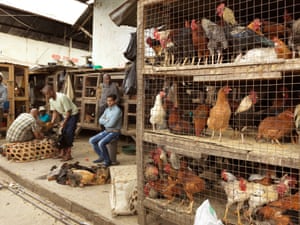
Locally grown chickens in a market in Arusha, Tanzania
Yet the arrival of the Cobbs is a mixed blessing for the villagers near the farm. It has provided well-paid work for some, but Maasai herders have complained that the farm’s high fences restrict their access to traditional pasture land. This, says Faglioni, has been resolved.
“Industrial-scale farming goes hand in hand with development,” he says. “We are changing the way that people eat and how they see the world. People here are proud that they are producing safe food for the country. They have money and can buy better food. We are offering a better way of life for both chickens and people.”
In this photo taken on Sunday, Jan. 5, 2014. three dead minke whales lie on the deck of the Japanese whaling vessel Nisshin Maru.
TIM WATTERS
Peter Singer is an author and professor of bioethics at Princeton University, Laureate Professor at the University of Melbourne and founder of the non-profit organization The Life You Can Save.
On Dec. 26, Japan announced that it was leaving the International Whaling Commission (IWC). Yoshihide Suga, Japan’s chief cabinet secretary, emphasized the cultural significance of the whaling industry for local Japanese communities and said that the IWC had focused too much on conserving whales and not on its stated goal of developing a sustainable whaling industry.
That the IWC has ceased to act in accordance with its original purpose is difficult to deny. The IWC was set up…
In this photo taken on Sunday, Jan. 5, 2014. three dead minke whales lie on the deck of the Japanese whaling vessel Nisshin Maru.
TIM WATTERS
Peter Singer is an author and professor of bioethics at Princeton University, Laureate Professor at the University of Melbourne and founder of the non-profit organization The Life You Can Save.
On Dec. 26, Japan announced that it was leaving the International Whaling Commission (IWC). Yoshihide Suga, Japan’s chief cabinet secretary, emphasized the cultural significance of the whaling industry for local Japanese communities and said that the IWC had focused too much on conserving whales and not on its stated goal of developing a sustainable whaling industry.
That the IWC has ceased to act in accordance with its original purpose is difficult to deny. The IWC was set up by the International Convention for the Regulation of Whaling, which was agreed to in 1946. The preamble of the convention describes whale stocks as “great natural resources” and indicates that the purpose of the convention is “to provide for the proper conservation of whale stocks and thus make possible the orderly development of the whaling industry.”
That is how the IWC operated for its first 25 years. From the 1970s on, however, attitudes toward whales began to change. Many governments that had previously been members of the IWC because they engaged in whaling and wanted to protect these “resources” from unsustainable overuse instead began to reflect the more positive attitudes to whales of their citizens. As a result, in 1986, the IWC passed a moratorium on commercial whaling, which has been maintained ever since, even though it is today difficult to argue that all stocks of all species of whales are so imperilled that no commercial hunting could be sustainable.
Japan has not openly breached the moratorium; instead, it has got around it by exploiting a loophole allowing the killing of whales for scientific research. Each year, Japanese whaling ships have killed about 300 whales, allegedly for this purpose. The carcasses of the whales were taken to Japan and their meat was sold to the dwindling minority of Japanese who continue to eat whale meat.
In 2010, Australia took Japan to the International Court of Justice, which found that Japan was in fact engaging in commercial whaling, in breach of IWC rules. But Japan simply tweaked the “research program” a little, and went back to killing the same number of whales it had been killing before.
The IWC’s change of purpose was made clear just last September, when at a meeting in Florianopolis, Brazil, member countries voted 40 to 27 for a Brazilian proposal to maintain the ban on commercial whaling, and assert that whaling is no longer a necessary economic activity. For Japan, which sees maintaining its whaling industry as a matter of national pride, that vote would have been the final straw that made continued membership of the IWC pointless.
What we cannot disregard, however, is the fact that the new attitude to whales that has led to the change in the IWC’s purpose is neither a purely emotional response to killing mysterious big animals nor the imposition of Western attitudes on other cultures. It has a solid basis in our improved scientific understanding of whales, and in the moral progress we are making in extending the circle of moral concern beyond our own species. That concern is very much in accord with Japan’s own Buddhist tradition, which teaches compassion for all sentient beings.
We have learned a lot about whales since 1946, We know that they are social mammals with big brains, capable of communicating with each other by various sounds. They bond with their children and with their social group. They live long lives – bowhead whales live much longer than any other mammal; some have been found with 200-year-old ivory spear tips embedded in their flesh. Many other whales live at least 40 years. They appear to be capable of both pleasure and pain – and not only physical pain, but very likely also distress at the loss of a child or one of their group.
Whales are therefore not stocks in the sense in which we as a country may have stocks of coal. Nor are they resources to be harvested like a field of wheat. They are individual beings, with lives of their own that may go well or badly.
In modern commercial whaling, whales are killed by an explosive harpoon fired from a moving vessel at a moving target. That makes it very difficult to hit the whale in the right spot for an instantaneous loss of consciousness. Nor are commercial whalers willing to use enough explosive to be sure of a quick kill, because they want an intact whale carcass, not one blown to bits. Hence harpooned whales typically die slowly and painfully. If we needed to eat whales to survive, inflicting that kind of death on a sensitive social mammal might be defensible. For well-fed people in Japan or other affluent countries, it is not.
Nor is the fact that there are areas of Japan in which whaling is an ancient cultural heritage a sufficient justification for killing whales. In China, the binding of girls’ feet was an ancient cultural heritage, but it maimed women. We should be glad that it is now firmly in the past. Whaling should go the same way.
And perhaps it will. Once Japan leaves the IWC, it will no longer be able to continue whaling in the Southern Ocean under the guise of “scientific research.” Recognizing this fact, Japan has said it will carry out commercial whaling only in its territorial waters and exclusive economic zone (EEZ), which means, roughly speaking, an area of 4.5-million square kilometres around its territory. That’s a large area, but it contains far fewer whales than the Southern Ocean, and if Japan wants to have a sustainable industry, that will place strict limits on the number of whales its ships can kill.
Perhaps instead of feeling dismay at Japan’s departure from the IWC, we should celebrate the fact that the Southern Ocean Whale Sanctuary, established by the IWC in 1994, will now be the true sanctuary for whales that it never could be while Japanese ships were conducting their brutal “scientific research.”
In leaving the IWC, Japan has put itself on the outside, as a nation that is oblivious to the legitimate moral concern of many countries and people, including, as polls in Japan show, its own people. The next generation of Japanese leaders will surely see this as a false step that they will want to reverse.
Project Coyote Praises New Mexico Land Commissioner for Banning Wildlife Killing Contests on State Trust Lands
The Ban Represents a Significant Step Forward in Ending Wildlife Killing Contests in New Mexico
Events to Raise Awareness About Wildlife Killing Contests to Follow; Winners of New Mexico Coyote Photography Contest to Be Announced
Santa Fe, New Mexico — Today, New Mexico State Land Commissioner Stephanie Garcia Richard signed an Executive Order banning wildlife killing contests for coyotes and other unprotected species on State Trust Lands as one of her first acts since taking office in January. With the State Land Office overseeing 9.5 million acres of land in 32 of 33 counties in New Mexico, the ban considerably advances the campaign of Project Coyote and our coalition partners to end wildlife killing contests in New Mexico once and for all. Throughout New Mexico, coyotes and other wild animals fall victim to killing…
A new study finds the world’s oceans are warming significantly faster than previously thought. The analysis, published Thursday in the journal Science, raises the stakes for curbing climate change.
Since 1970, the ocean has warmed 40 percent more than previous estimates, according to climate scientist Zeke Hausfather, one of the authors of the study.
The study examined four new or updated Ocean Heat Content records — a fancy term for measuring how warm the ocean is, taking into account deeper water, not just surface temperatures — and finds the ocean warming is significantly higher than estimated in the last comprehensive report by the U.N.’s Intergovernmental Panel on Climate Change (IPCC) in 2013.
Ninety-three percent of the excess heat trapped in the Earth’s system by human-caused greenhouse gas emissions is stored in the oceans. If it weren’t for this ocean buffer absorbing so…








/arc-anglerfish-tgam-prod-tgam.s3.amazonaws.com/public/JU5NB6XAQNBDBFTN26BEAKZDJY.JPG)
 Exposing the Big Game