Exposing the Big Game

Forget Hunters' Feeble Rationalizations and Trust Your Gut Feelings: Making Sport of Killing Is Not Healthy Human Behavior

Exposing the Big Game

Deer camp & gay bars

(Beth Clifton photo)

A 1974 study by James Kennedy for the Wildlife Society found that 75% of the hunters surveyed would prefer hunting with their buddies in an area with only a 10% chance of killing a deer to hunting alone with a 50% chance of making the kill.

Seeking the kill is only the pretext for the various other rituals that “separate the men from the boys,” determining “who’s a pussy.”

This,  not the supposed difficulty of shooting a deer,  probably best explains why approximately 70% of all licensed hunters don’t get one – while those for whom the kill is the paramount experience tend to “get their deer” year after year,  perennially bagging the limit and/or placing high in the buck pool.

The deer camp atmosphere of exaggerated masculinity is apparently not unlike the atmosphere of “leather trade” gay bars,  albeit that the gay bars more likely try to emulate deer camps than the other way around.

Ernest Hemingway himself appears on this book cover, with a lion he shot in Kenya in 1934. But the story the photo illustrates does not portray hunters in a positive light.

“Hunting is anything but expression of manhood”

One must wonder,  ultimately,  how sexually secure any of the posturing denizens are.

“You can take my word for it,” snorted former hunting guide Douglas Townsend some years ago.  Having escorted hundreds of big game hunters,  he concluded,  “This hunting habit is anything but an expression of manhood.”

Gregory Hemingway,  son of author Ernest Hemingway,  would probably have concurred.

Trying to impress his macho father,  a living symbol of hunters and hunting to a whole generation,  Gregory at age 11 won the World Life Pigeon Shooting Championship.  At 19 he was arrested for transvestitism.  Trying to regain his father’s respect,  he next slaughtered 18 elephants on a single African safari.

(Beth Clifton collage)

Gregory turned Gloria

But Gregory Hemingway remained an unhappy transvestite,  who spent,  he admitted in a 1987 interview,  “hundreds of thousands of dollars” trying to overcome the cross-dressing habit.  He had partial sexual reassignment surgery in 1995 and changed his first name to Gloria,  but then changed his mind,  tried to have the surgery reversed,  and remarried his fourth ex-wife.

Gregory/Gloria Hemingway died on October 1,  2001 at the Miami-Dade Women’s Detention Center,  hours before he was to appear in court after being arrested for indecent exposure and resisting arrest.

Gregory Hemingway appears to have never been an actual practicing homosexual,  just insecure – like his father,  who likewise spent his whole life trying to prove masculinity that no one else ever seriously called into question.

Marysville school shooter Jaylen Ray Fryberg (Facebook)

“Killed the wrong animal”

Literally killing the female,  Cameron Robert Kocher of Stroudsburg, Pennsylvania, nearly ten years old,  said he was only “playing hunter” on March 6, 1989, when he fatally shot Jessica Ann Carr,  age seven,  with his father’s rifle.

Observing subsequent legal proceedings,  Cleveland State University law professor Victor L. Streib unequivocally blamed the killing on Kocher’s exposure to guns and hunting. “All he has done,” Streib summarized,  “is kill the wrong animal.”

There have been hundreds of comparable incidents,  including one not far from ANIMALS 24-7.  Avid hunter Jaylen Ray Fryberg, 14, on October 24,  2014 shot five fellow students at Pilchuck High School in Marysville, Washington, killing two, putting two more into critical condition, and then killing himself

(See Marysville school shooter loved hunting & pit bulls;  and Killing the white deer & the Marysville massacre.)

Woodchucks. (Susan Federico photo)

“Just another woodchuck”

An upstate New York man named Dave Goff cited childhood hunting experience,  which he said helped him learn to “kill the wrong animals,”  in persuading former Congressional Representative James T. Walsh to obtain for him a Distinguished Service Cross,  a Silver Star,  and nine other medals for Vietnam War service that he never performed.

“I was brought up on a dairy farm,”  Goff explained to syndicated veterans’ affairs columnist Laura Palmer.  “I used to shoot woodchucks all the time.  It got to the point where I would flash it through my head that it was just another woodchuck and it didn’t mean anything.  It was just a job.”

Goff claimed to have been assigned to killing civilians as part of the CIA’s infamous Operation Phoenix while still in his teens.  After military service,  Goff said,  he went through 13 years of breakdowns and alcohol abuse,  trying to deprogram himself from having been a killer,  trying to find his way into becoming a caring,  responsible human being.

Walsh saw to it that Goff in 1989 received the medals he said he had earned.  But Goff was in 1994 prosecuted for unlawfully wearing military medals and decorations,  after Stolen Valor author B.G. Burkett established that Goff actually spent his alleged time in Vietnam as an Army mail clerk in Okinawa.

Mandatory Daily Trap Check Bill has a hearing date!

Exposing the Big Game's avatarCommittee to Abolish Sport Hunting Blog

View this email in your browser


The bill will be heard before the House Fish and Wildlife Committee
On Thursday, February 7!
The meeting starts at 3:00. Room 172 in the Capital in Helena.

The bill is now HB287.

Please contact Representatives, NOW, especially, the Representatives on the House Fish and Wildlife Committee!
Call and simply INSIST THEY VOTE YES FOR HB287. 

Leave a message if they do not answer, urging them to VOTE YES on TRAP CHECK Bill HB287 with your name and Montana town.

The House Fish & Wildlife Committee Members are:

Chairman Rep. Bob Brown (R) THOMPSON FALLS, MT
Primary ph: (406) 827-9894 Secondary ph: (406) 242-0141 Email: Bob.Brown@mtleg.gov

Vice Chair Rep. Ross Fitzgerald (D) FAIRFIELD, MT
Primary ph: (406) 788-1443 Secondary ph: (406) 467-2032 Email: Ross.Fitzgerald@mtleg.gov

Vice Chair Rep. Zac Perry (D) HUNGRY HORSE, MT
Primary ph: (406) 261-9642 Email: Zac.Perry@mtleg.gov

Rep. Seth Berglee (R)…

View original post 581 more words

Plain language: 16 year old kid does what scientists find hard to do

Exposing the Big Game's avatarThe Extinction Chronicles

he following is a slightly edited version of remarks delivered by 16-year-old Swedish climate activist Greta Thunberg to attendees at the World Economic Forum in Davos, Switzerland on Friday, January 25, 2018.

Our house is on fire. I am here to say, our house is on fire.

According to the IPCC (Intergovernmental Panel on Climate Change)we are less than 12 years away from not being able to undo our mistakes. 

In that time, unprecedented changes in all aspects of society need to have taken place, including a reduction of our CO2 emissions by at least 50%.

At places like Davos, people like to tell success stories. But their financial success has come with an unthinkable price tag. And on climate change, we have to acknowledge we have failed. All political movements in their present form have done so, and the media has failed to create broad public…

View original post 601 more words

Crocodiles moved from world’s tallest statue, angering environmentalists

Rob Picheta, CNN • Published 26th January 2019
http://www.cnn.com/travel/article/crocodiles-removed-worlds-tallest-statue-india-scli-intl/?iid=ob_article_footer_expansion

PauseMuteMute

Current Time0:36
/
Duration Time1:08

Loaded: 0%

Progress: 0%

Fullscreen

(CNN) — Officials have started removing hundreds of crocodiles from the site of the world’s largest statue in India, prompting an outcry from conservationists and concerns about the welfare of the reptiles.
The crocodiles are being relocated to allow for a seaplane service to carry tourists to the Statue of Unity, a 597-foot-tall statue that opened in Gujarat in October, AFP reported.
At least 15 have already been lured into metal cages and moved elsewhere in the west Indian state, the Indian Express newspaper reported, with hundreds still remaining in the waters surrounding the landmark.
But the operation has been criticized by environmentalists and politicians.

The statue is twice the height of the Statue of Liberty.

The statue is twice the height of the Statue of Liberty.
SAM PANTHAKY/AFP/AFP/Getty Images
“Have we collectively lost our minds?” Bittu Sahgal, the editor of environmental magazine Sanctuary Asia, tweeted in response to the story.
“As any environmentalist will tell you, this is sheer insanity!” Indian journalist and activist Pritish Nandy added, while others questioned whether the move contravenes the country’s wildlife protect laws.
Crocodiles are a protected species in India, listed under Schedule 1 of the country’s Wildlife Protection Act, meaning they cannot be moved unless a state government determines it is “necessary for the improvement and better management of wildlife therein.”
Local forestry official Anuradha Sahu said the state’s government had ordered the removals “for safety reasons as the tourist influx has increased,” according to AFP.
But the All India Mahila Congress, the female wing of opposition party the Indian National Congress, said the move showed Prime Minister Narendra Modi’s government was “keeping the environment at bay again.”
The Gujarat Forest Department did not immediately respond to a CNN request for comment.
The towering Statue of Unity depicts Sardar Vallabhbhai Patel, a popular political and social leader who was part of the freedom struggle that resulted in India’s independence from British colonial rule in 1947.
Twice the height of the Statue of Liberty, the landmark is estimated to have cost more than $410 million to erect.

Indian construction workers at the plinth structure of the statue.

Indian construction workers at the plinth structure of the statue.
SAM PANTHAKY/AFP/AFP/Getty Images
It is widely seen as the personal project of Modi, who announced the plans in 2010 and formally unveiled the statue in October.
But transport links to the site, which sits in a remote part of the Narmada district around 100 kilometres from the city of Ahmedabad, are limited, with most tourists currently arriving by bus.
The government finalized three seaplane routes in the region in June to improve access.

75% of the US will suffer below-freezing temps this week. But wait! There’s more …

Exposing the Big Game's avatarThe Extinction Chronicles

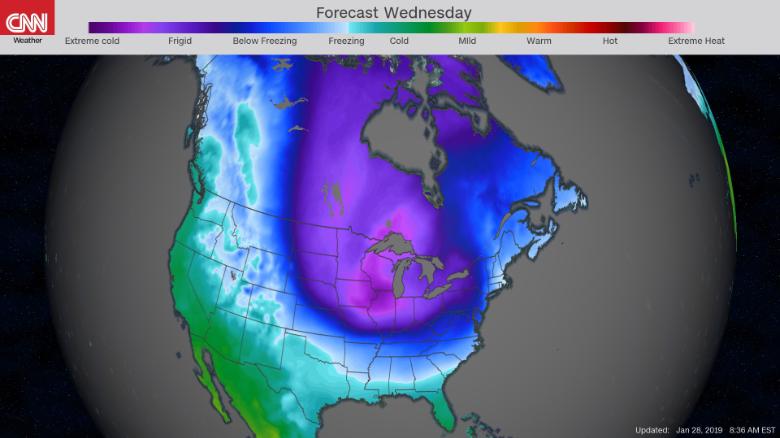
(CNN)Absurdly cold weather is about to grip much of the US, trapping millions of Americans in sub-zero temperatures and bringing “dangerous to impossible travel conditions.”

Some states could suffer the coldest air in a generation, the National Weather Service said.

The coldest air will come between Tuesday and Thursday in the Upper Midwest and Great Lakes, with temperatures plunging to 20-40 degrees below zero, CNN meteorologist Dave Hennen said. Wind chills will plummet to 35-60 below zero.
“Chicago will likely see its coldest readings in nearly 25 years, with lows approaching the all-time record of 27 below and a daytime high on Wednesday of around 15 below,” Hennen said.
“It could remain below zero in Chicago from around…

View original post 230 more words

Florida dogs abandoned in woods after hunting season need homes

Exposing the Big Game's avatarCommittee to Abolish Sport Hunting Blog

Florida dogs abandoned in woods after hunting season need homes.png

BAKER COUNTY, Fla. (WTXL) – Dozens of hounds have been abandoned in the woods in one Florida county because of a practice called “hound dumping.”

Authorities said hunters abandon their dogs in the woods at the end of hunting season.

The London Sanctuary is stepping in to help, along with Baker County Animal Control, but with limited resources, they are overwhelmed with the dogs.

If the animals don’t find forever or foster homes, some will have to be euthanized.

According to Connie Cannaday, the vice president of The London Sanctuary, at least 100 hounds were dumped in the past year.

Many of the animals end up in dog boxes set up around Baker County and some even have broken legs and gunshot wounds.

To find out how to help The London Sanctuary or for pictures of the adoptable dogs, go to https://thelondonsanctuary.rescuegroups.org/ or https://www.facebook.com/TheLondonSanctuary/.

View original post

 Trapping ban sought on public lands

Exposing the Big Game's avatarCommittee to Abolish Sport Hunting Blog

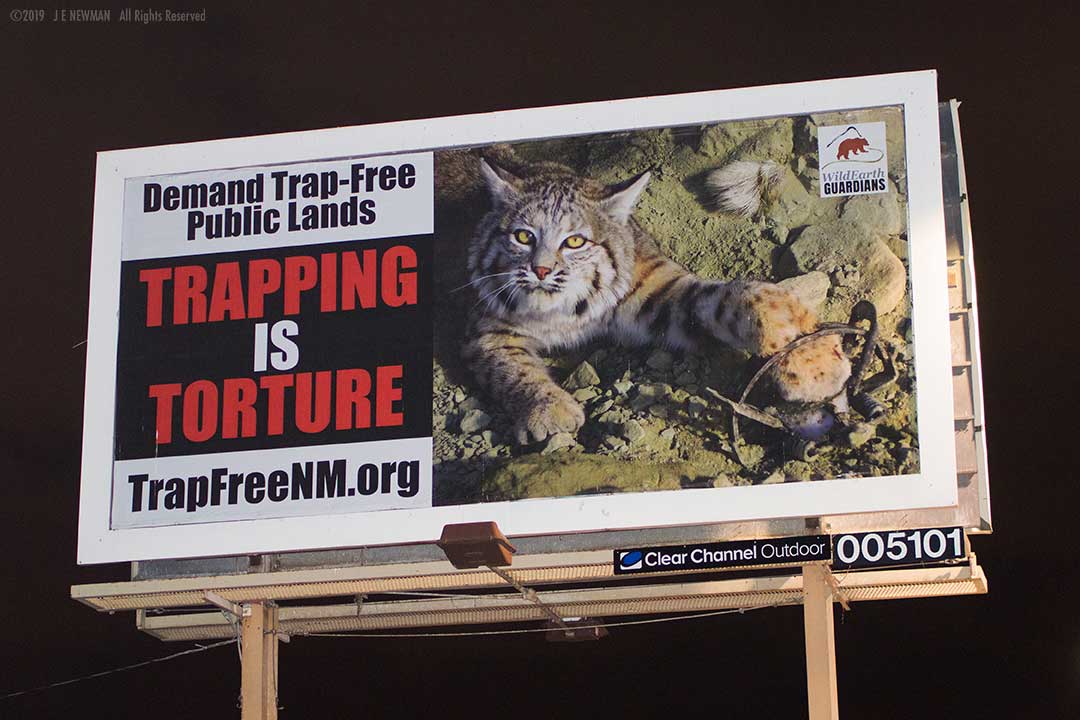
Billboard makes the case against trapping on public land as legislators meet to debate bill

Drivers in Albuquerque and Las Cruces are confronting a brutal reality about wildlife management in New Mexico thanks to a series of billboards, bus shelter ads and bus banners recently unveiled by WildEarth Guardians.

The billboards feature a bobcat in a steel leg-hold trap with the message “Trapping is Torture: Protect Public Lands.” The billboards were deployed this month in an effort to mobilize popular support for a New Mexico legislative campaign to ban trapping on public lands.

Read the article in the Ruidoso News »

Trapping is Torture - Ban traps on public lands

View original post

The plight of the ‘snow oxen’

Exposing the Big Game's avatarThe Extinction Chronicles

A biologist draws on his fieldwork to consider the world of muskoxen during climate change.

Life in the planet’s latitudinal and altitudinal margins has long weathered extremes: Tibetan wild yaks, Arctic muskoxen, Bhutanese takin (“gnu goats”), or the Gobi’s saiga gazelles became inured to dryness, thin air and cold. Now rampant climate change together with hunters, poachers, herders and predators (which increasingly include feral dogs) is driving these “elusive, dazzling treasures” to the brink. In refreshingly footnote-free dispatches, the conservation biologist Joel Berger discusses the Pleistocene ancestry of these ungulates — physical and behavioral traits that may yet allow social slow-breeders to adapt. In spite of a “disquieting desperation” pervading the no-longer-so-icy barrens, Berger finds grace notes of…

View original post 727 more words

Climate Friendly Diets Are Healthier

Eating less red meat and more plant-based protein is better for the climate and for people’s health.

By Alexa Lardieri, Staff WriterJan. 24, 2019, at 6:00 a.m.
A healthy vegan/vegetarian lunch bowl of salads, grains, seeds, vegetables, avocado slices and a rich peanut-miso sauce.

A low-carbon diet consists of less red meat and dairy, and more beans, whole grains and plant-based proteins.(ENRIQUE DÍAZ/7CERO/GETTY IMAGES)

PEOPLE WHO FOLLOW A planet-friendly, diet eat healthier than those who don’t.

Food production is a major contributor to climate change, and a study published Thursday in the American Journal of Clinical Nutrition found that people who adhere to a climate-friendly diet, one that has a lower carbon footprint, eat healthier than those who don’t.

Diego Rose, lead author and a professor of nutrition and food security at Tulane University’s School of Public Health and Tropical Medicine, said in a press release that people who follow a diet that has a low carbon footprint “were eating less red meat and dairy, which contribute to a larger share of greenhouse gas emissions and are high in saturated fat, and consuming more healthful foods like poultry, whole grains and plant-based proteins.”

Researchers examined the diets of 16,000 Americans and ranked them by the amount of greenhouse gas emissions per 1,000 calories consumed. They also rated the nutritional value of the diets using the U.S. Healthy Eating Index.

The study discovered that people following diets that had a low carbon footprint ate an overall healthier diet. However, these diets did contain some low-emission foods that aren’t healthy, such as sugars and refined grains, the press release states. Additionally, the climate-friendly diets also contained lower amounts of important nutrients, such as iron, calcium and vitamin D.

Diets that had the most impact on the planet accounted for five times the emissions of those in the lowest-impact group. The diets consisted of more beef, veal, pork, game, dairy and solid fats per 1,000 calories than the diets with low carbon footprint.

Martin Heller, co-author and researcher with the University of Michigan’s Sustainable Systems Center at the School for Environment and Sustainability, tells U.S. News that adopting a diet with a low carbon footprint is “beneficial for health and the environment” and that it doesn’t take drastic measures to make a difference.

RELATED CONTENT

Scientists Push Vegetarian Diet to Save the…

Heller says that one of the biggest changes people can make is to replace beef with plant-based alternatives, such as beans, peas and lentils, as well as meat alternatives, even choosing chicken over beef “is a significant benefit.”

The reason is that the production of red meat has one of the largest effects on the environment due to the amount of work it takes to produce it. A cow requires a lot more resources than a chicken, or plants, to produce the same amount of calories. Cows require much more feed, and they produce methane, mostly in the form of burps, which is a powerful greenhouse gas.

Rose echoed this sentiment in the press release, saying that Americans can have both “healthier diets and reduce our food-related emissions,” and doing so “doesn’t require the extreme of eliminating food entirely.” Just a small shift from red meat to chicken “could reduce our carbon footprint and improve our health at the same time.”

UW Researchers Use Scat-Sniffing Dogs to Bolster Wolf Count in Washington

Exposing the Big Game's avatarCommittee to Abolish Sport Hunting Blog

Wandering Wolves
Wolf tracks in the snow.

The number of wolves roaming Washington is higher than official estimates, according to University of Washington researchers.

Samuel Wasser, of UW’s Center for Conservation Biology, presented the findings of a two-year study using scat-sniffing dogs to Washington Senate Agriculture, Water, Natural Resources and Parks committee Tuesday.

In one study area in Stevens and Pend Oreille counties, Wasser said his dogs detected 68 individual wolves between 2015-16 and 95 individual wolves in the 2016-17 season.

“This is quite a bit higher than the minimum number that WDFW had (for the same area),” he told the committee.

According to the latest Washington Department of Fish and Wildlife estimate, there are a minimum of 122 wolves, 22 packs and 14 successful breeding pairs statewide. That estimate was reported nearly a year ago.

Although Wasser hasn’t completed a statewide survey…

View original post 676 more words