Drinking her coffee one sunny winter morning, Pamela Karaz looked out the window of her home in upstate New York and saw a coyote walking up the driveway. It was an uncommon sight – coyotes tend to be secretive – but what happened next was even more surprising. The coyote marked a tree with his scent, strolled across her yard, sniffed at a few tracks and then noticed a bright blue plush toy Karaz had bought a few days earlier for Bristol, her golden retriever.
Bristol had left the toy outside, as was her habit. Now the coyote sniffed it, picked it up in his mouth, dropped it, picked it up again. Then the coyote started to have fun. ‘He tossed it up in the air. It fell down. He picked it up again and bucked around,’ Karaz said. ‘At no point do I ever think he thought it was prey. He wasn’t trying to tear it apart. He was literally playing with it, like a dog.’ This went on for about 10 minutes before the coyote trotted away with the toy still in his mouth.
Karaz is a wildlife photographer, and the photos she took had a moment of internet fame. They resonated: a fierce wild animal, behaving like a pet! Or, as Karaz noted, like a dog. Which of course coyotes are, albeit dogs who embody the very complicated relationship of humanity to canines.
Subscribe to our newsletter
Updates on everything new at Aeon.
See our newsletter privacy policy here
Some dogs exist inside the circle of human domesticity: beloved companions and friends, respected and often pampered. They sleep in our homes, sometimes in our beds. We buy them plush toys. Other dogs live outside, free and independent. They possess the essential cognitive and emotional faculties as our dogs; domestication has introduced refinements, but the raw material was already there. They have personalities, memories, love their pups, and are devoted to their packs. Every so often, they play with toys we don’t bring inside.
They’re also treated arbitrarily: sometimes respected, sometimes ignored, and frequently persecuted with extreme prejudice if not outright cruelty. It’s a dissonant state of affairs, and one that sometimes makes me wonder about the future of wild dogs. Not about whether they’ll survive through this century and beyond, but what sort of lives they’ll lead. Whether they’ll thrive or live on our margins, fearful and broken, a perpetually abused canine underclass.
Karaz, who considers her dogs to be family, is a coyote advocate. To her, they’re just wild dogs trying to survive. But if she’d wanted to kill that coyote and had a hunting licence, she could have. For $22, or $100 for out-of-state residents, people can kill as many coyotes as they want for six months a year in nearly all of New York state – which, compared with most parts of the United States, is quite restrictive. In many states, coyotes can be killed year-round, day or night, in just about any way: poisoned, lured into range with electronic calls that mimic their voices, chased from planes, shot with semi-automatic assault weapons or sniper rifles. They live in killing fields.
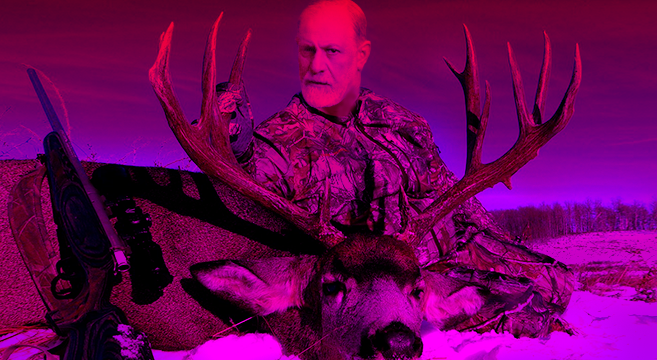
Coyote-killing is different from hunting deer, elk or so-called game birds, traditions that are steeped in an ethos of stewardship, provision and even fairness. It’s killing for fun. YouTube abounds with videos that revel in the death of a coyote; in many parts of the western US, so-called coyote derbies are common, documented in photographs of stacked bodies – the kinds of photos we associate with the rapaciousness of the 19th-century frontier.
The advocacy group Project Coyote in northern California estimates that 500,000 coyotes are killed every year in the US, roughly one-fifth by the federal government for the purpose of reducing harm to livestock (the effectiveness of which is scientifically debatable) and the rest for their fur, to increase populations of prey animals we’d prefer to shoot ourselves, or simply for pleasure. ‘Think of a 35-pound dog, lying on the couch, and people doting on it,’ said the ecologist Shelley Alexander, leader of the Canid Conservation Science Lab at the University of Calgary in Canada. ‘But coyotes, some people enjoy killing, even torturing. And they’re the same animal.’
For Alexander, this disparity challenges the fundamentals of conservation – not just the obvious institutions and organisations, but the mindset guiding human concern with the natural world. A few small advocacy groups and the Humane Society, which is powerful but generally viewed as an animal welfare organisation, raise objections to the cruelty of coyote killing. But mainstream conservationists tend to be silent on it or, in the case of governmental wildlife agencies, actively support it. Even among those who don’t like it, says Alexander, wanton killing is tolerated because coyotes reproduce quickly. Their populations are not threatened. It’s populations and species rather than individuals that are the focus of wildlife management for conservation.
In cities and suburbs across the US, coyotes have been greeted with unease and fascination, symbols of wild nature in unexpected places
That animals have inner lives, a fact made abundantly clear by cognitive science and animal behaviour research, is not considered in these calculations. Nor are the ethical considerations that naturally follow from those insights. Which isn’t to say conservationists don’t care about animals as thinking, feeling individuals – many do – but those concerns are considered separately. Individual lives matter only when there’s few of them, and coyotes are in no danger of extinction.
Quite the opposite. Indeed, coyotes respond to persecution by increasing their breeding rates. Kill some, and soon there’s more than before, though survivors endure the pain of loss and upheaval. ‘These are animals who are intelligent, have unique personalities and family lives,’ said Kevin Bixby, executive director of the Southwest Environmental Center in New Mexico. ‘Individuals are not just automatons. One coyote is not necessarily replaceable.’
In the past few decades, coyotes have taken up residence in cities and suburbs across the US. There, they’ve been greeted with both unease and fascination, symbols of wild nature in unexpected places. I’m sometimes uncomfortable with that characterisation: coyotes might be symbolic, but they’re also, like Karaz said, just dogs trying to survive. Of more importance is a little-asked question: what sort of lives are urban coyotes leading?
I put the question to Alexander. It depends where they are, she said. Some live peacefully amid lots of green space. Many live in constant fear and stress. They’re harassed by people and our dogs, hit by cars, spooked by strange noises, and end up eating garbage. Yet Stan Gehrt, an ecologist at Ohio State University who studies the Chicago area’s booming coyote population, offered a different view. Suburbs, he said, are great life for coyotes. Even downtown, where there’s traffic, human disturbance and other hardships, Chicago’s coyotes are in excellent health.
‘All of it is much better than unprotected rural areas,’ said Gehrt, ‘where they will be shot and killed.’ Not long ago, Chicago’s city council passed an ordinance forbidding animal control officers from harming coyotes unless they had a track record of threatening or attacking people. It’s the opposite of the traditional approach, and suggests that cities could become oases of peace and security for creatures persecuted in more rural areas.
As for Karaz’s coyote, he trotted away with the toy in his mouth. She hasn’t seen him again, but her own dogs still have a habit of leaving their toys outside. Occasionally, she finds them in the woods nearby.
Shortly after his arrival at the Evelyn Downs cattle station in South Australia, on a routine patrol of the nearly 900-square-mile property, the ecologist Adam O’Neill encountered a pack of dingoes. Roughly a dozen of the tawny, medium-sized dogs were tearing a dead calf to pieces: five feeding on the body, and the rest skulking nearby, fighting for their turn. Watching the scene, O’Neill considered whether to shoot them. After all, though he and his fellow ecologist Arian Wallach were at Evelyn Downs to study its natural communities, they were also tasked with managing its cattle.
Before becoming a scientist, O’Neill had made his living as a professional hunter, hired by Australian landowners to kill invasive and unwanted animals. He knew how to use his gun. He was also tired of killing, which is why he’d become an ecologist. Reflecting on the cruelty often shown to animals in that part of the world, O’Neill used his rifle’s scope to examine one of the dingoes. The dog, he thought, looked desperate.
It’s an impression that might once have been denounced as anthropomorphic. In a few shrinking circles, it might still be. Who’s to say whether an animal is desperate? Yet to anyone who’s known a dog well it won’t seem implausible at all, and the Evelyn Downs dingoes likely had good reason.
In Australia, killing dingoes is a basic part of livestock management. Between poisoning, shooting and fencing, there are few places where dingoes are left alone. The constant assault disrupts pack relationships and atomises families, leaving behind what O’Neill would describe as ‘young, unruly, displaced refugees… just a bunch of poor lost souls living in a world of turmoil’. He lowered his gun.
Apart from being compassionate, it was also a sensible research decision. The ubiquity of dingo persecution has made it difficult to appreciate their natural behaviours and roles. Even when present, they’re often not functioning in stable packs. O’Neill and Wallach were especially interested in understanding the ecology of a landscape with healthy dingoes, and even hoped to show that a successful cattle operation might be run without killing them.
In the months following O’Neill’s mercy, the dingoes found their level. They formed packs, established territories and stopped killing calves, instead focusing their attentions on wild prey. O’Neill regularly encountered their tracks, but only rarely saw them in the flesh. ‘When they’re socially stable, they virtually disappear from sight,’ he said. ‘I’ve noticed this throughout the whole of my working life.’
O’Neill attributes it to the development of a local canine culture, with lessons passed down between generations: don’t mess with the two-legs and their property. In healthy families, he said, ‘they are invariably well-behaved. I guess what it all comes down to is mutual respect. We respect their right to keep breathing, and they respect our rights as owners of resources in a shared landscape.’
Which might again seem like anthropomorphism. People don’t usually think about animals possessing such sophisticated value systems. Yet dingoes, like other wild dogs, routinely navigate complex social scenarios, and animal culture is a burgeoning area of research. Customs taught to offspring and shared between groups can shape local behaviour in important ways. What O’Neill suggests is at least a plausible hypothesis. And dingoes living in stable packs, learning their landscapes and passing hunting lessons between generations would certainly have less need for the risky pickings offered by livestock.
The Evelyn Downs dingoes soon assumed their natural position as apex predators, a term for creatures who live at the top of food chains, eating other animals but not themselves being eaten. It’s a role they’ve played for the past several thousand years, and – along with hunting and habitat management by the continent’s indigenous inhabitants – one that shaped Australia’s thriving pre-colonial communities of life.
As a rule, apex predators are the bosses of nature’s regulatory system, promoting ecological richness and stability by suppressing irruptions of prey and smaller predators. ‘They allow the number and variety of species occupying any given area to be higher,’ said Wallach, now a research fellow at the University of Technology Sydney and co-founder with O’Neill of the Dingo for Biodiversity Project. ‘In a nutshell, large predators make the world green.’
As a conservation strategy, killing foxes and cats has caused extraordinary suffering while failing in its aim of reducing their populations
In their uninterrupted presence, ecologies gravitate towards what once would have been called balance, but is better understood as dynamic equilibrium: nothing gets out of control. There are many examples. Eliminating mountain lions from a landscape, for example, can lead to dramatically increased deer populations, which in turn means a loss of streamside vegetation and declines in aquatic life. After sea otters were hunted to near-extinction off North America’s western coast, exploding sea-urchin populations devoured the great kelp beds that formed aquatic forest ecosystems; when otters returned, so did the kelp and the life they supported. And at Evelyn Downs, the presence of dingoes regulated, among many other creatures, foxes and cats.
That observation – also described in other studies elsewhere on the continent – is especially relevant in light of the country’s ongoing ecological turmoil. Australia has the world’s highest mammalian extinction rate; dozens of native species are declining or endangered, a fact blamed in part on an onslaught of foxes and cats, which were introduced by European colonists and found rich pickings among creatures unprepared by evolution to withstand their predations.
‘Having dingoes is a great and very practical way to effectively control the smaller predators,’ said Mike Letnic, a conservation biologist at the University of New South Wales whose own research traces many of Australia’s ecological problems to the absence of dingoes. More dingoes means more of the species now declining so precipitously – more bilbies and rock wallabies and kowari, more malleefowl and painted dragons – and more stable populations of species such as kangaroo and emu that are prone to overpopulation remedied by controversial extermination campaigns.
Until now, the conservation approach to feral predators has been to focus on killing foxes and cats, a strategy that’s caused extraordinary suffering while failing miserably in its aim of reducing their populations. Wallach considers this ethically reprehensible, ecologically senseless and a terrible way of getting people to respect the natural world. She identifies as a compassionate conservationist: part of a small but growing movement in conservation to promote biodiversity while respecting animals as individuals.
‘Dingoes will do a better job of it than we’ll ever do,’ said Letnic of their biodiversity-protecting ways. Yet they’re not allowed to do that job. Not only are dingoes killed by the livestock industry, says Wallach, but also as a form of environmental management, either as a favour to sheep and cattle pastoralists or inadvertently, with poisons intended for the animals they would otherwise keep under control.
Killing, say Letnic and Wallach, offers an easy and misleading out. Meanwhile, the Australian government announced last year its intent of killing 2 million wild cats in the next several years. Ecologists recently began trials of a trap designed to spray poison onto cats, who will then lick it off their fur and die after days of seizures and vomiting. Somehow this is preferable to simply allowing wild dogs to live. It continues to be easier to kill than to coexist.
Whereas most coyotes and dingoes live and die in anonymity, many wolves are known as individuals – tracked by scientists, even named and followed by a fascinated, often adoring public.
There’s OR-4, the alpha male of Oregon’s Imnaha pack, who was killed this spring after, old and sick, he turned to hunting livestock. Or his son, OR-7, whose 1,000-mile walkabout made him the first known wolf in nearly a century to visit California. He eventually returned north, met a mate and sired a litter of pups – a much happier story than that of Echo, the first wolf seen in the Grand Canyon in more than 70 years, who was shot in late 2014 by a hunter who supposedly mistook her for a coyote.
Most emblematic of all, though, are the wolves of Yellowstone National Park. Canine celebrities since their mid-1990s reintroduction, their histories are as detailed and dramatic as Nordic sagas, but have taken a tragic turn over the past several years as hunting groups and western state wildlife agencies lobbied to remove gray wolves from the federal list of endangered species. Many of Yellowstone’s wolves have been shot and killed after stepping outside the park’s boundaries; they literally cross from one world into another, from a place where their lives are respected to one where they are not.
That dynamic captures tensions surrounding wolves throughout much of the US. Nearly a century after being almost completely exterminated, protection under the Endangered Species Act has allowed their numbers to rise again. The rise is relative – there are still just a few thousand in the continental US, occupying a small fraction of their historical range – but their species-level existence is not quite so precarious. Across the western and upper midwestern states, people are now fighting over what to do with them.
The nitty-gritty of wildlife agency proposals, court decisions and voter referenda are confusing to trace, but certain themes are universal. From one point of view, the lives of individual wolves have value, and should not be taken except to prevent otherwise unavoidable human harm. From another, individual wolves are members of populations that might annually be reduced without eliminating them altogether. And others would be happy to see the entire wolf population reduced. Wolves who previously were protected are now being killed for fun, or for reasons poorly supported by fact.
Killing wolves to prevent attacks on livestock, for example, doesn’t seem to work very well. It makes sense if individuals misbehave, as in the case of OR-4, but quota-based killing with no regard for which wolves are being targeted is likely to backfire: packs are destabilised, territorial fights ensue, and livestock attacks tend to rise. The social fabric is torn. And in places where wolves are killed to enhance populations of deer or elk, there are usually better alternatives available.
Take the case of 527, a famed Yellowstone wolf shot by a man who said he wanted to help elk. Many hunters blamed wolves for dramatic regional elk declines over the past two decades; the real culprits, though, turned out to be a loss of summer habitat and a change in predation by grizzly bears, who’d turned to elk after non-native trout released by fishermen into Lake Yellowstone outcompeted native fish on whom the bears had feasted. Wolves made a convenient scapegoat. Ditto in Idaho and British Columbia, where killing wolves is largely a distraction from more important habitat issues.
Again and again, research shows that rationales for state-sanctioned wolf hunts are flimsy. Yet that science, say wolf advocates, is ignored or applied inconsistently. This was a recurring frustration at a Humane Society-organised carnivore research conference I attended last year: having expected that the best available science would be used to guide decisions, researchers and advocates find that it’s not.
A deeper issue was evident too: one that gets at the very fundaments of how human society interacts with the non-human world. Almost invariably, government wildlife agencies are funded by sales of licences for hunting, fishing and trapping, and are strongly biased towards the treatment of wild animals as resources to be managed for human consumption. Many wolf advocates argue that such agencies, especially at the state level, can’t be trusted to be fair or – crucially – democratic.
That arrangement is the foundation of what’s known as the North American Model of Wildlife Conservation, codified early in the 20th century following the precipitous decline of now-common animals such as white-tailed deer, bison and elk, and focused on managing predator populations in order to maximise hunters’ favoured species. In many ways, that model has been successful, yet it’s also showing its age. Hunting is less popular than it once was; at the same time, there’s an ever-swelling number of people who care about animal welfare. At present, they’re largely excluded from wildlife management. At best, their views might be entertained by officials, but rarely are they shared.
As noted in ‘Predators and the Public Trust’ (2015), an article published in the journal Biological Reviews by researchers critical of the North American model, government wildlife agencies tend to see those who advocate for animal welfare as a threat to their work. And indeed, those values do challenge the treatment of animals as a resource – yet they also mean that those agencies no longer represent the public they’re supposed to serve, but just one interest group.
Rather than thinking of wolves as belonging to us, we might think of them as citizens of their own wild nation
To the authors of that Biological Reviews paper, including the ecologist Adrian Treves of the University of Wisconsin-Madison and the environmental scientist Jeremy Bruskotter of the Ohio State University, recreational wolf hunting violates the bedrock legal principle that wildlife belongs to everyone, not just a few people who would claim them. The Yellowstone wolves have embodied this literally. Inside the park, they belong to every American; outside it they belong to people who would hunt them. And that, in turn, is a microcosm of the passage of wolves from federal endangered-species protection to state-level management.
There are complications to this view that wildlife is a matter of public trust and shared ownership. There’s a case to be made that, so long as wolves are not completely eliminated, hunting them is compatible with the public trust: it’s not individual animals who belong to everyone, the argument goes, but populations and species across time. From the other end of the spectrum, animal rights advocates object to the idea that animals might be owned by anybody apart from themselves. As Sue Donaldson and Will Kymlicka arguein Zoopolis: A Political Theory of Animal Rights (2011), the logic guiding our treatment of wild animals is broadly that of colonialism – or perhaps even slavery. We do with them as we please, regarding them as subject entirely to the human realm. Rather than thinking of wolves as belonging to us, we might think of them as citizens of their own wild nation.
In practical terms, though, Zoopolis and ‘Predators and the Public Trust’ end up in the same place: calling for political institutions and processes to include people who speak for animal welfare and interests. For every hunter on a state wildlife commission there should be someone who argues on behalf of the animals. Rather than starting with a stacked deck, the full range of both science and ethics would be considered.
If this sounds radical, it’s not. Something similar is already happening in California, where the state’s five-person Fish and Game commission now includes two who don’t hunt. Contrary to some fears, many types of hunting do continue in the state – but practices that are socially unpopular and offer no ecological benefit, such as coyote derbies and bobcat trapping, have been banned. Wolves remain protected as endangered.
But California is a progressive state. Such an arrangement will not come so easily elsewhere, especially in relation to wolves. ‘The 21-year old controversy over wolf restoration in the West is not really about wolves,’ wrote Ralph Maughan, the founder of the Greater Yellowstone Coalition conservation group, in an op-ed published this spring in the Idaho State Journal. ‘It has become another “values” contest.’
Anti-wolf sentiment is frequently intertwined with conservative politics, gun rights, rural disenfranchisement and a distrust of government. Which could help to explain why research on non-lethal prevention of wolf/livestock conflicts hasn’t found much traction among ranchers. It also hints at a troubling possibility: Maughan speculates that regional ecologies might eventually be shaped as much by political as by natural features, producing red state/blue state distributions of wildlife.
Yet there’s reason for optimism, too. The Wood River Wolf Project, an Idaho-sited collaboration of ranchers, wildlife officials and conservationists working to show how wolves and livestock can coexist, has been successful. Though it’s usually the methods, such as guard dogs, range riders and remotely monitored packs, that get the headlines, the project’s success is as much about people and relationships.
‘You start small and build from there,’ said Suzanne Stone, a wolf restoration officer with the advocacy group Defenders of Wildlife. ‘It takes time. Being able to sit down and have a cup of coffee.’ Which applies to democracy generally, and is its saving grace. Whatever our disagreements in principle with strangers, we can often sit down and figure out something in good faith with neighbours. And if political representation of animal interests might not yet be practical everywhere, for every species, it might at least start with wolves, coyotes and dingoes.
After all, to speak on their behalf reflects both the spirit of democracy and the inescapability of animal intelligence, especially among these close cousins of humankind’s best friends. To treat them so differently from the dogs we love is hypocritical. It sets a bad example – one that makes it a little easier to stigmatise and mistreat fellow human beings. As the ethicist William Lynn argues: ‘Wolves are not just good for ecosystem health. They are critical to the moral health of a society.’



 Exposing the Big Game