Human Extinction by 2030 The Reality of An Ice Free Arctic
Reply


Vladimir Konjushenko/ThinkStock
Conservation officials say eight people were shot, three of them fatally, during the 2018 fall deer and turkey hunting seasons.
View original post 112 more words
A rapid shift under way in the Barents Sea could spread to other Arctic regions, scientists attending a conference in Norway have warned. The Barents Sea is said to be at a “tipping point”, BBC News explains, changing from an Arctic climate to an Atlantic climate as the water warms. The Arctic Ocean has a surface layer of freshwater “which acts as a cap” on a layer of warmer, saltier water below. “But now in the Barents Sea there’s not enough freshwater-rich sea ice flowing from the high Arctic to maintain the freshwater cap,” BBC News reports.
A new study warns that if greenhouse gas emissions continue at current rates, Earth’s vegetation may not be able to keep up. “Once plants and soil hit the maximum carbon uptake they can handle, warming could rapidly accelerate”, MailOnline writes. The study from Columbia University’s School of Engineering and Applied Science investigates how changes in soil moisture affect its capability to act as a “carbon sink”. Currently, “plants and soil around the world absorb roughly a quarter of the greenhouse gases that humans release”, the New York Times explains. But “when the soil is dry, plants are stressed and can’t absorb as much CO2 to perform photosynthesis”. And with warmer conditions microorganisms in the soil become more productive and “release more CO2”. The researchers found that although “plants and soil could absorb more CO2 during the wetter years, it did not make up for their reduced ability to absorb CO2 in the years when soil was dry”. Carbon Brief has also covered the study.
Scientists have succeeded in cutting a 2km hole through the West Antarctic Ice Sheet to its base using a hot-water drill, BBC News reports. The team then collected sediment from the bottom of the hole and “deployed a series of instruments”. The researchers from the British Antarctic Survey hope that the data collected can help them determine how fast Antarctica might lose its ice in a warming world. Dr Andy Smith, who led the team, commented: “There are gaps in our knowledge of what’s happening in West Antarctica and by studying the area where the ice sits on soft sediment, we can understand better how this region may change in the future and contribute to global sea-level rise.”
2019 will see the retirement of nearly 6GW of coal power in the US, while 49GW of new power generation capacity will be added to the grid, according to the latest figures from S&P Global Market Intelligence, which is highlighted by CleanTechnica. In a related story, E&E News reports that a group of US utilities and other power producers say they may have to shut down their coal-fired power plants if a court rolls back a Trump administration extension to the deadline for closing some coal ash dumps. Their filing to the US Court of Appeals follows a legal challenge brought by environmental groups to the administration’s changes last July to the Obama-era regulations governing coal ash disposal, the article explains.
In other coal news, the Australian Financial Review reports that Jeremy Grantham, the “legendary British hedge fund manager” who founded GMO, has said that thermal coal is “dead meat”. Bloomberg investigates how a “loophole” lets Norway’s $1 trillion sovereign wealth fund boost its coal exposure. Meanwhile, Forbes says that China’s “coal reliance is not falling nearly as fast as some like to claim”. Chinese coal demand “hasn’t been falling in the absolute sense”, the piece argues, continuing: “China approved nearly $6.7bn worth of new coal mining projects in 2018, and production increased 5.2% to 3.55bn tonnes”.


HONOLULU(KHON2) – It’s now 32 days into the federal government shutdown. People who work at the Pacific Tsunami Warning Center are considered essential workers so they have been working without pay.
The Pacific Tsunami Warning Center alerts the public when there is a tsunami threat.
Dr. Nathan Becker is an oceanographer and a steward for the National Weather Service Employees Organization. He also works at the Pacific Tsunami Warning Center. He said the tsunami warnings will still go out during the shutdown, but added that completing their mission to protect the public, gets harder with every passing day.
“We’re not going to miss a tsunami, but the quality may be less, impacting more people with a warning. It would take longer to have a cancellation. We may not get a warning…
View original post 282 more words
A pedestrian walks across the street in downtown Scranton, Pennsylvania January 20 after a major winter storm brought some of the coldest temperatures of the season and covered a
…
A record-breaking cold snap is relentlessly descending on parts of the U.S. this month. It spawned from a split polar vortex that sent cold, Arctic air across the continent.
In a time when climate change is discussed in the context of record highs, droughts, and wildfires, cold weather and blizzards can seem out of place. For those who deny that climate change is happening, it’s an opportunity to undermine scientific consensus.
How do you explain a cold winter in a world that scientists say is…
View original post 526 more words
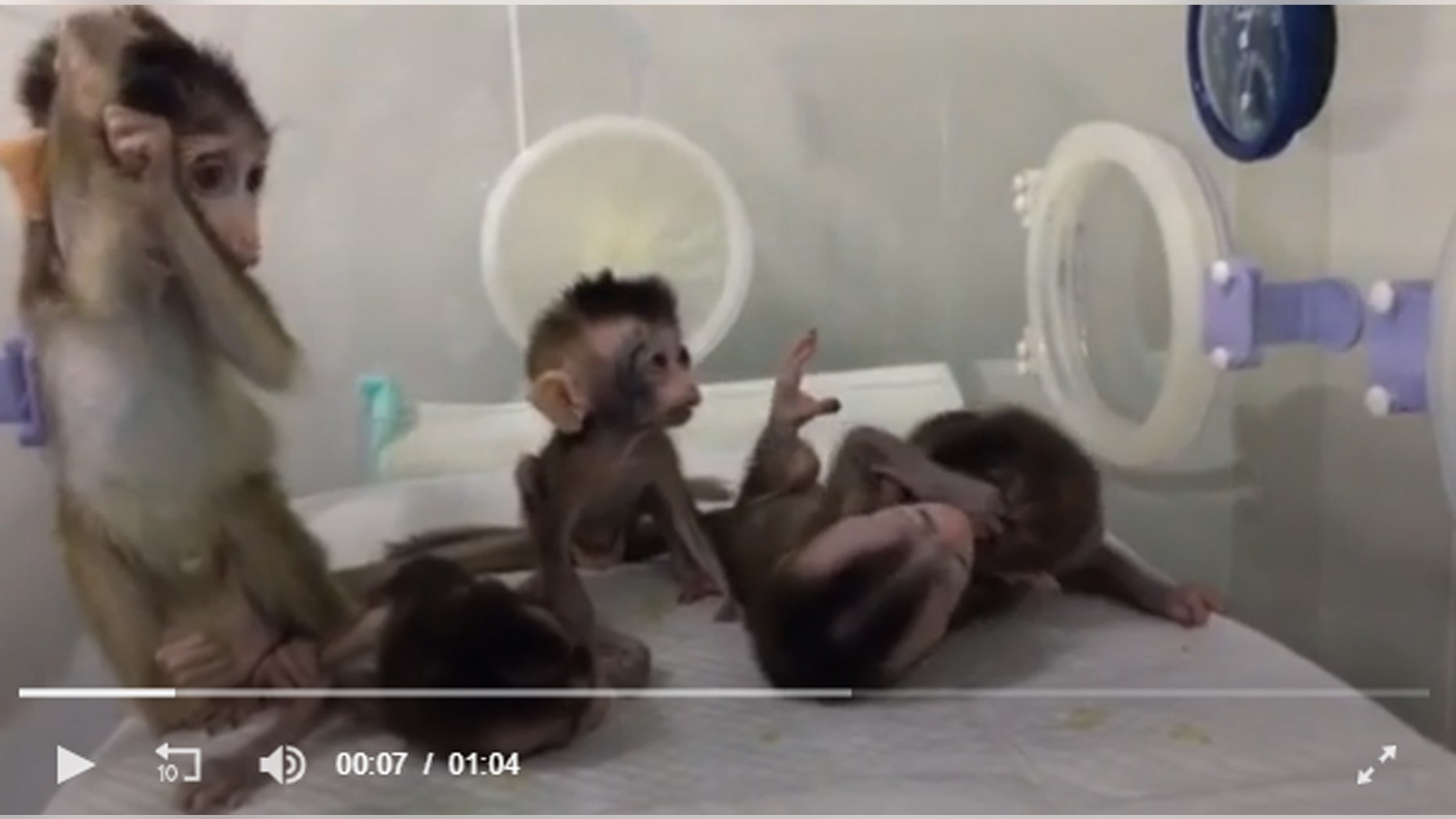
A screen grab of the five cloned monkey. (Credit: Science China Press)
China’s latest monkey cloning experiment has sparked outrage and been labeled “monstrous” by animals welfare advocates.
Researchers at the Chinese Academy of Sciences Institute of Neuroscience have cloned five monkey babies from a single donor with genes edited to cause diseases.
The Chinese scientists tinkered with a specific gene in the original donor monkey to produce the unhealthy animals which they say will help medical research.
The gene is BMAL1, which helps regulate the circadian rhythm but scientists made it inoperative using a gene-editing tool, known as CRISPR. With the gene turned off, the animals are at greater risk of developing sleeping problems, hormonal disorders and a host of diseases.
Researchers said the monkeys demonstrated increased anxiety and depression, reduced sleep time, and even “schizophrenia-like behaviors,” according to a pair of papers published by the scientists in the National Science Review.
All five macaques were born with identical genes, which include the mutation.
“Disorder of circadian rhythm could lead to many human diseases, including sleep disorders, diabetic mellitus, cancer, and neurodegenerative diseases, our BMAL1-knock out monkeys thus could be used to study the disease pathogenesis as well as therapeutic treatments” said Hung-Chun Chang, senior author and investigator of the Chinese Academy of Sciences Institute of Neuroscience in a statement.
Researchers used a cloning technique known as somatic cell nuclear transfer to produce the five macaques, the same method they used to generate the first two cloned monkeys this time last year.
It is also the same general method used to clone Dolly the sheep more than two decades ago.
The experiment to clone the two healthy monkeys, reported in the journal Cell in January last year, also caused some apprehension among the broader scientific community.
“The genie’s out of the bottle now,” said Jose Cibelli at the time, a cloning expert at Michigan State University in the US.
Animals rights advocated have slammed the latest experiment. Dr. Julia Baines, Science Policy Adviser at PETA UK, said: “Genetically manipulating and then cloning animals is a monstrous practice that causes animals to suffer.”
But speaking to news.com.au in June, Director of the Chinese Academy of Sciences Institute of Neuroscience and co-author of the latest papers, Dr Mu-ming Poo, defended the practice of using cloned animals for medical research.
“More cloned monkeys will soon be produced,” he said at the time. “Some of them will carry gene mutations known to cause human brain disorders, in order to generate useful monkey models for drug development and treatment.”
It’s important to note that because primates share approximately 95 percent of human genes and a number of physiological and anatomical similarities, biomedical research currently uses a large number of monkeys, sometimes up to 100,000 annually around the globe.
“This number will be greatly reduced by the use of monkeys with uniform genetic background that reduces the noise in experimental studies,” Dr. Poo said, pointing to the example of testing drug efficacy before clinical trials.
“This will greatly help the ethical use of non-human primates for biomedical purposes.”
The team behind the latest experiment reiterated that position in the statement this week, saying the institute is following strict international guidelines for animal research.
The gene-edited monkey clones come hot on the heels of a rogue Chinese scientist announcing he used CRISPR technology to create the world’s first gene-edited human babies.
The controversial doctor made headlines last November after claiming he altered human embryos resulting in the birth of genetically edited twin girls.
This story originally appeared in news.com.au.
By PATRICK WHITTLEtoday
FILE – In this March 28, 2018 file photo, a North Atlantic right whale feeds
on the surface of Cape Cod bay off the coast of Plymouth, Mass. Rescuers who
respond to distressed whales and other marine animals say the federal
government shutdown is making it more difficult to do their work. (AP
Photo/Michael Dwyer, File)
PORTLAND, Maine (AP) – Rescuers who respond to distressed whales and other
marine animals say the federal government shutdown is making it more
difficult to do their work.
A network of rescue groups in the U.S. works with the National Oceanic and
Atmospheric Administration to respond to marine mammals such as whales and
seals when the animals are in trouble, such as when they are stranded on
land or entangled in fishing gear. But the federal shutdown, which is
entering its 33rd day on Wednesday, includes a shuttering of the NOAA
View original post 522 more words
JOHNSON COUNTY, Ark. (KFSM) — Dale Williams, 61, was charged with manslaughter Tuesday (Jan. 22) after shooting and killing a woman he mistook for a deer in northern Johnson County back in November 2018.
On November 11, 2018, at 1:45 p.m., the Johnson County Sheriff’s office was called out to a shooting at the Yale Church on Highway 215. That’s where Jane Rust, 72, was found dead.
Witnesses, Henry Nalls and Rosemary Castille, say Rust wanted to stop at the church to take some pictures. They parked their vehicle in a dirt parking lot that sits east of the Yale Church.
Rust walked a short distance down a trail that leads to the Mulberry River.
That’s when Nalls and Castille heard…
View original post 199 more words
 Exposing the Big Game