Exposing the Big Game

Forget Hunters' Feeble Rationalizations and Trust Your Gut Feelings: Making Sport of Killing Is Not Healthy Human Behavior

Exposing the Big Game

Urge Ridgeland, Wisconsin Officials to Stop Chicken Toss

Chicken being tossed from the roof of a building into a crowd of people.

United Poultry Concerns is joining Wisconsin-based Alliance for Animals again this year in politely urging the village of Ridgeland in Dunn County, Wisconsin to cancel the “Chicken Toss” in February (most likely Saturday, Feb. 16th since it is always held in mid-February although we could not confirm the date as yet).

The chicken toss consists of throwing many chickens, one or two at a time, up in the air from a roof. Crowds scramble to grab the birds as they fall to the ground. The chickens huddle together, freezing and fearful, in crates and bags waiting to be thrown by participants who consider this activity fun.

There is no similarity between a chicken being pulled from a container and thrown roughly up in the air from a roof in the midst of a screaming mob, and a chicken fluttering voluntarily to the ground from a perch in a quiet place.

What Can I Do?

Please call these Dunn County officials, and politely urge them to prohibit the “chicken toss” this year. Whether you reach a live person or a recording, leave a brief, clear, and respectful message expressing your concern for the chickens: their fear and possible injury and the frigid weather.


Thank you for taking action for these birds.
– United Poultry Concerns

http://upc-online.org/alerts/190123_chicken_toss_happening_again_in_february_please_make_a_call.html

A Collision With Another Planet May Have Seeded Earth With the Ingredients for Life

Exposing the Big Game's avatarThe Extinction Chronicles

Artist’s depiction of a planet-on-planet collision.
Image: NASA/JPL-Caltech

New research suggests that much of the material that made life possible on Earth arrived after a cataclysmic collision between our planet and a Mars-sized object billions of years ago—likely the same collision that produced the Moon, the scientists say.

For life to emerge on an otherwise dead planet, an assortment of chemical compounds, or volatile elements, are required, including carbon, nitrogen, and sulfur. Conventional thinking has it that Earth’s volatile elements arrived through the steady bombardment of ancient meteorites. New researchpublished today in Science Advances proposes an alternative delivery mechanism: a catastrophic collision between Earth and a Mars-sized object, sometimes referred to as Theia, some 4.4 billion years ago. This hypothetical collision, which would have happened while our planet was still forming, seeded our baby planet with the volatile elements required…

View original post 1,289 more words

Two brothers went hunting in Dzilam, one gets shot in the chest in “hunting accident”

Two brothers went hunting in Dzilam, one gets shot in the chest in “hunting accident”

(Photo: reporteroshoy.mx)

A sad ending had a hunting trip for a couple of brothers in the forest near Dzilam Bravo, after one of them got shot to death in what is apparently a “hunting accident”.

On Saturday Jan. 19, around 22:00 hours, brothers Arturo and Víctor C. C. went hunting north of the town, but by Arturo was accidentally shot in the chest and he died right on the spot.

His brother Víctor, in his first statement, said that his brother and him were hunting but they got separated, after a few hours in the mountain he heard a shot and the screams of his brother so he ran to the place.

When he arrived, he saw his brother Arturo who managed to say to him “I was shot” before he fell unconscious, so he immediately informed the municipal authorities who arrived with SSP paramedics, but could not do anything, because Arturo no longer showed vital signs.

Hours later, ministerial police officers arrived on site, to collect data of the incident and to proceed with the lifting of the body.

Meanwhile, Victor was arrested as the main suspect in the death of his brother, in what could be an imprudence homicide. Local authorities already open the corresponding file in the municipality of Motul.

TYT Newsroom with information from reporteroshoy.mx

Toxic animal carcass may have led to fatal eagle poisonings

Exposing the Big Game's avatarCommittee to Abolish Sport Hunting Blog

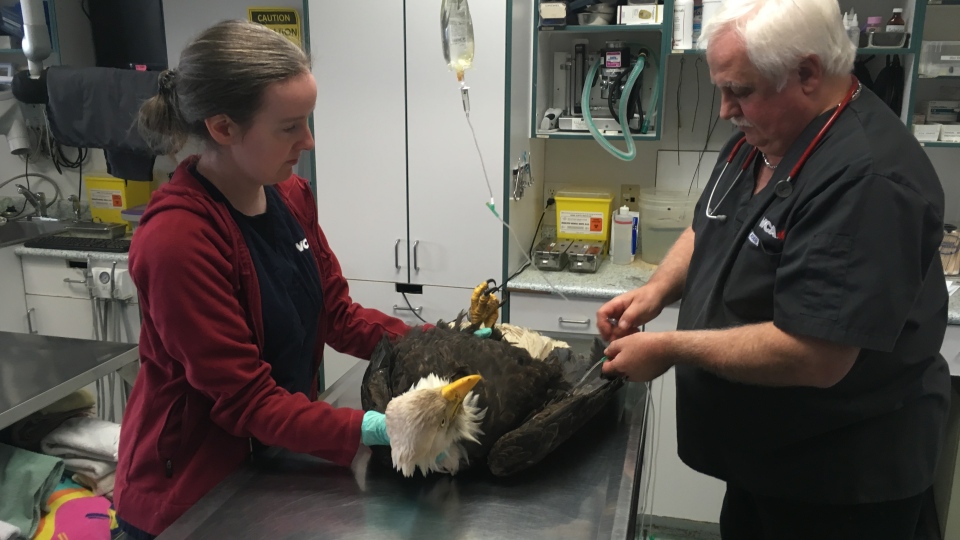
A euthanized farm animal that was improperly disposed of could be the reason behind several eagle deaths on Vancouver Island.

Christina StevensWeekend Anchor & Online Reporter

@ctv_christina

Published Monday, January 21, 2019 5:46PM PST 
Last Updated Monday, January 21, 2019 7:59PM PST

Warning: This story contains graphic images.

Wildlife officials are hopeful they have identified the source of the poison that has killed six bald eagles on Vancouver Island, and left another half-dozen very sick.

Investigators have theorized that someone euthanized a farm animal and did not dispose of the carcass properly, leading to eagles eating the poisonous remains.

“It’s a tragic situation…

View original post 391 more words

Hidden camera investigation reveals chicken slaughterhouse practices

The slaughter of chickens that end up on Canadian dinner plates is supposed to be humane and efficient. But is it? Tom Kennedy investigates.

Hidden camera video shows the often painful deaths of chickens at a Canadian poultry processing plants. Can the industry find a better way?
Published Friday, March 27, 2015 3:30PM EDT 
Last Updated Monday, March 30, 2015 11:16AM EDT

Don’t ask the question if you might not like the answer.

It is a common piece of wisdom that could apply to many things. How sausages get made for example. Or, how chickens end up on our plates.

As much as many people would probably prefer to avoid the question, Mercy for Animals Canada is trying to make them face it.

For six months, an employee of the animal rights group worked inside one of the largest chicken slaughterhouses in Canada, while using a hidden camera to secretly videotape what he was seeing.

He spoke to CTV’s W5 on the condition that we not use his real name. So, we’ll call him John.

“It is one of the ugliest places you can imagine,” he said.

The slaughterhouse is owned and operated by Maple Lodge Farms. By any standard, the place is big, a sprawling series of factory style buildings in a field located on the edge of Brampton, Ont. near Toronto.

A steady stream of tractor trailers arrive from mostly Ontario farms that raise the chickens from hatching to slaughter.

Reading this from an app? Tap here for a better experience.

The birds are bred to grow quickly, their lives last usually no longer than two months. And the sheer numbers can be staggering.
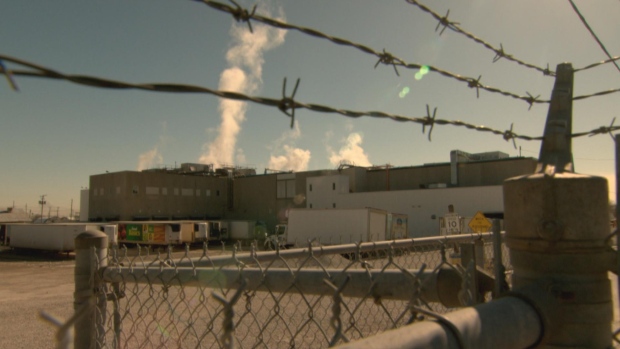
Maple Lodge Farms plant

Nearly half a million birds are slaughtered at the Maple Lodge plant every day, feeding a Canadian market that consumes more than 650 million chickens every year, making it the most popular meat source in the country.

The Maple Lodge Farms website states that it treats the birds humanely and with respect. But the undercover video shot by Mercy for Animals Canada does show things that many viewers probably would find difficult to watch.

Harsh conditions

“There are birds that arrive dead in the hot months,” John told W5. “They die from over-heating. And in the colder months, chickens die from being too cold. They actually arrive frozen like ice blocks.”
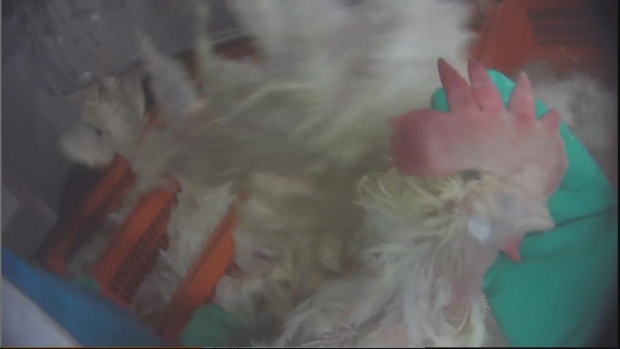
Frozen chicken

A frozen chicekn is unloaded from a crate.

Once inside the plant, the crates of chickens are unloaded, and placed, sometimes roughly thrown, onto a conveyor belt.

Chickens unloaded

Then they arrive at the beginning of an assembly line.

The video shows workers pulling chickens out of the crates and hanging them upside down by the legs. They have to work fast.

“Each employee is expected to hang 20 birds a minute,” John said. “So employees are hanging birds as fast as they can to keep up. So it’s being grabbed pretty violently. Sometimes you’ll see bones protruding out of the skin, you see toes ripped off. It’s pretty horrific.”
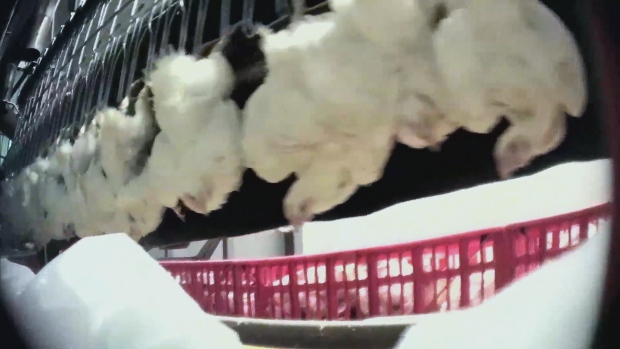
Chickens on the line

The line carrying the suspended birds then moves quickly through the various stages of the slaughter process.

The heads are pulled through an electrified pool that stuns the animals, and then through a machine that cuts their throats, and finally into scalding tanks that make it easier for another machine to pluck out the feathers.
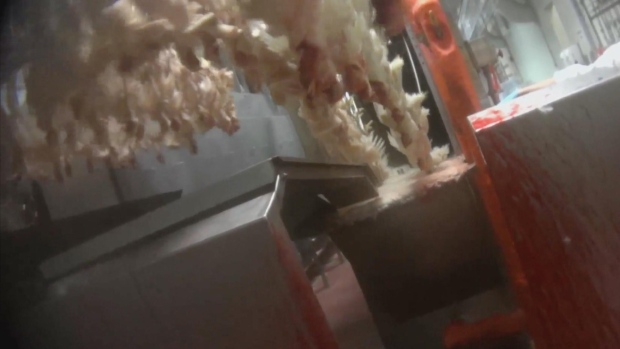
Scalding tanks

It isn’t pretty, but it is supposed to be efficient, and humane.

Except the Mercy for Animals Canada investigator said he often saw birds come out of the stunning pool conscious, and because of their flapping and struggles to release themselves, sometimes would miss the blade designed to cut their throats.

There is a provision for that. There are employees positioned with knives so they can manually dispatch the birds that have survived till that point.

“They told me they do a thousand a day, sometimes two thousand,” John told W5.

The technology being used at Maple Lodge Farms is standard in the industry. So the inevitable question, is the company actually doing anything wrong?

Treatment ‘unacceptable’

W5 put the question to one of Canada’s poultry experts who believes that some of the things he saw in the undercover video should not happen.

Ian Duncan

University of Guelph professor Ian Duncan, right, reviews footage with W5’s Tom Kennedy.

He is Ian Duncan, a professor at the University of Guelph. After looking at video of the way crates were loaded on to the conveyor belt, he said: “That’s unacceptable, throwing them down like that.”

On the physical appearance of some of the birds, he said, “There is a bone sticking through there. Something’s been dislocated. That is very unusual. That shouldn’t happen.”
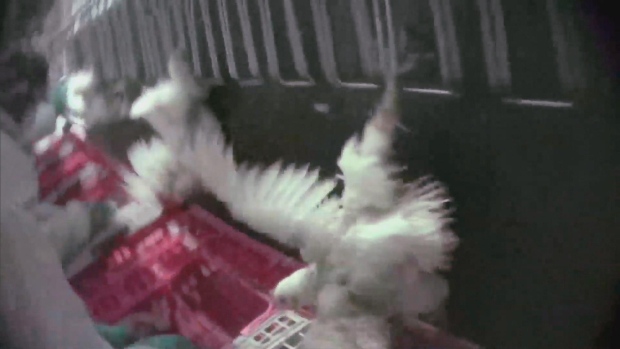
Chickens hanging by one leg

After looking at some birds hanging by one leg instead of two, he said, “That’s unacceptable. It puts huge pressure on the hip joint and there’s also a danger that when it comes to where the bird is to be stunned, it won’t go into the stunning bath properly and won’t meet the knife that’s going to cut its neck.”

When asked if birds could live through that whole process, he answered bluntly. “Yes. Yes.”

Previous conviction

Maple Lodge Farms has had trouble before. In September of 2013, it was convicted of two offences under the Health of Animals Act and later pleaded guilty to another 18 counts, all related to “…the failure to prevent undue suffering by undue exposure to weather of a large number of chickens.”

Thousands of birds had died while being transported to slaughter at Maple Lodge Farms. A few of the counts related to inadequate ventilation.

In the ruling, the judge commented, “Economic imperatives trumped animal welfare.”

The company was fined nearly $100,000 and put on probation for a period of three years, during which it was expected to comply with numerous conditions.

And now, Mercy for Animals Canada has prepared a complaint that it has forwarded to the federal regulator, the Canadian Food Inspection Agency and the Ontario Society for the Prevention of Cruelty to Animals.

Among the accusations, Mercy for Animals Canada claims:

  • Birds continued to be exposed to freezing temperatures during transport.
  • Birds became trapped in the doors of transport crates and severely injured in the transport crates.
  • The excessive line speed made it impossible for workers to handle and hang birds humanely.

Responses

W5 exchanged several emails and left phone messages with Michael Burrows, the CEO of Maple Lodge Farms, requesting a meeting to show him the undercover video and to get his comment.

In subsequent correspondence, Mr. Burrows wrote us back to say, “Maple Lodge Farms has stringent policies and practises that govern all aspects of animal care and food safety… The humane treatment of the birds we rely on for our livelihood is a priority and a moral responsibility that we take seriously.”

He also wrote that his company was very disturbed by what W5 had told him and he had launched his own investigation of the allegations made by Mercy for Animals Canada. But he never did agree to an interview.

W5 also telephoned and emailed the federal regulator, the Canadian Food Inspection Agency. On repeated occasions, it said it would call back. It never did.

But 20 days after W5 first contacted them, the regulator did sent an email to say “The CFIA is conducting a thorough and careful review of the complaint and will take any necessary measures that it may deem appropriate.”

It added that it has the power to impose fines, and in the event of serious and repeated offences, “…the CFIA may refer non-compliance for criminal prosecution.”

Mercy for Animals Canada is also pushing for major changes to the aging technology prevalent in the business of poultry slaughter.

Instead of the electrified pools being used to stun the birds and the automated cutter used to slice throats, the animal rights organization is openly urging the adoption of what is called Controlled Atmosphere Killing, or CAK for short.

Video from a plant in Norway shows crates of birds arriving at a CAK facility, placed inside a chamber where inert gases replace oxygen causing all birds to slip into unconsciousness and then death. Only then are they handled by humans.

A major retooling of the industry would inevitably be costly and could drive up the price and therefore, reduce the demand for chicken.

Ian Duncan

But Duncan suspects the industry will take a hard look at change anyway, especially if the poultry-consuming public begins to take a critical look at how one of their favourite foods actually arrives on their plates.

“If the video showed race horses or some other animal that people valued (being killed this way), there would be a huge outcry,” Duncan said. “Chickens can still suffer.”

NM Land commissioner bans killing contests on state property

Exposing the Big Game's avatarExposing the Big Game

Prohibition impacts coyote killing contests on 9 million acres of state land

Many hunters abhor killing contests and the carcasses they leave behind. | Matt Grubs | Matt Grubs

Calling animal killing contests “brutal, barbaric and inhumane,” new State Land Commissioner Stephanie Garcia Richard banned the practice on state trust land Thursday.

She made the prohibition by executive order, signed at a news conference.

“If you want to hold a contest to see who can accumulate the most coyote carcasses … from today forward, you will not be able to do that on state trust land,” Garcia Richard, who took office Jan. 1, said to a small group of staff and advocates.

Her office oversees more than 9 million surface acres of state trust land. Much of it is checkerboarded among private property and other government agencies, which will likely present a challenge for enforcing the…

View original post 474 more words

NM Land commissioner bans killing contests on state property

Prohibition impacts coyote killing contests on 9 million acres of state land

Many hunters abhor killing contests and the carcasses they leave behind. | Matt Grubs | Matt Grubs

Calling animal killing contests “brutal, barbaric and inhumane,” new State Land Commissioner Stephanie Garcia Richard banned the practice on state trust land Thursday.

She made the prohibition by executive order, signed at a news conference.

“If you want to hold a contest to see who can accumulate the most coyote carcasses … from today forward, you will not be able to do that on state trust land,” Garcia Richard, who took office Jan. 1, said to a small group of staff and advocates.

Her office oversees more than 9 million surface acres of state trust land. Much of it is checkerboarded among private property and other government agencies, which will likely present a challenge for enforcing the ban. Garcia Richard said the office’s legal team can file action against those who violate the ban. She told reporters she’s also considered implementing a fee structure for hunters who are caught participating in the contests. Any new criminal penalities would likely have to be adopted by the state Legislature.

The ban impacts “unregulated” species like coyotes, and does not impact animals which hunters need a permit to pursue. Those hunters fall under the purview of the state Department of Game and Fish and its officers.

Animal advocates with Animal Protection Voters, Project Coyote, WildEarth Guardians, the Sierra Club and others applauded the order. Many members  stood behind the land commissioner as she made the announcement.

“She knows that healthy ecosystems and sustainable land use rely on robust interconnected wildlife populations,” said Jessica Johnson of Animal Protection Voters.

“This is not to say that NMSLO does not support hunters; hunters who hunt ethically, hunters who use practices that follow the law and include fair chase, hunters who use what they kill,” Garcia Richard said during the news conference. “This is not to say that our 3,000 agricultural lessees are going to be dissuaded from humanely combating depredation on their land to livestock and other companion animals. That’s not what today is about.”

Tiger Espinoza, vice president of the New Mexico chapter of Sportsmen for Fish and Wildlife, tells SFR the group has purposely avoided taking a stance on political issues like the contests.

“We don’t either support or not support this ban,” he says over the phone from Farmington. “I will say that Sportsmen for Fish and Wildlife 100 percent supports predator control. And if that involves killing a few coyotes, then that’s what it involves.”

The lifelong hunter says there are “thousands upon thousands” of coyotes in the state and that sometimes the public misunderstands their place in the food chain. “People think that they are not little baby deer, fawn killers. In all reality they are. I have seen that with my own eyes. It’s not just mountain lions. I’ve seen coyotes take down a buck deer with my own eyes.”

Opponents of the contest agree with people like Espinoza, who says the events don’t put a dent in coyote populations.

“There is no documented scientific evidence that coyote killing contests permanently reduce coyote abundance, increase populations of deer or other game species, or prevent conflicts between predators, humans and livestock,” Dave Parsons of Project Coyote said in a statement Thursday.

The anti-contest group plans to hold screenings of “Killing Games: Wildlife in the Crosshairs” tonight in Las Cruces and Saturday afternoon at the South Broadway Cultural Center in Albuquerque. Both shows have panel discussions planned after the film.

The order isn’t the first such ban on state trust lands. Former commissioners Ray Powell and Jim Baca also implemented such a prohibition during their terms.

Another American hunts Markhor in G-B, pays $105,000 for permit

Exposing the Big Game's avatarCommittee to Abolish Sport Hunting Blog

Dianda Christopher Anthony became the second American to hunt down the flare horned Markhor in Gilgit. PHOTO: EXPRESS

Dianda Christopher Anthony became the second American to hunt down the flare horned Markhor in Gilgit. PHOTO: EXPRESS

GILGIT: As trophy hunting season continues in Gilgit-Baltistan (G-B), local communities are receiving more financial benefits in return for facilitating the legal hunt of the wild animals.

Last week, Dianda Christopher Anthony became the second American to hunt down the flare horned Markhor in the region. Anthony’s hunt came in return for $105,000, an amount he had paid to purchase a permit in October when permits for four-Markhor hunts were auctioned.

Of the amount paid by him, 80 per cent went to the community as a reward for conserving the wildlife.

Shooting permit: Three Markhor trophy hunting licences go for Rs10m each

The Himalayan goat that Anthony shot down had 48-inch long horns, which officials say are the longest ever. “To my knowledge it’s the biggest horn size of Markhor…

View original post 220 more words

Hunter threatened for posing with dead elephant he shot

Exposing the Big Game's avatarCommittee to Abolish Sport Hunting Blog

A Georgia hunter under fire for posting pictures of himself alongside a pair of dead elephants said criticism he’s received is unfair — he shot the giants in “self-defense.”

A photo of Mike Jines posing…

View original post 211 more words

Ways to help kids cope with — and help combat — climate change

Exposing the Big Game's avatarThe Extinction Chronicles

As the tone surrounding climate change becomes more dire, our conversations about it with children grow more important. (Jon Cannell/For The Washington Post)

January 22 at 9:00 AM

News of the coming environmental collapse has broken with unnerving regularity, and with each new tidbit — the Arctic Ocean has lost 95 percent of its oldest ice, global warming is making already-dramatic natural disasters more fierce, Europe’s climate disaster is growing, and October’s news that we have 12 years to limit climate-change catastrophe — my anxiety about the future grows.

But I’m far more worried about our kids.

They hear about our planet’s rising temperature and rapidly melting ice, giant islands of floating plastic, and the more than 16,000 animals threatened with extinction almost as much as we do, and they’re feeling the impact.

Conversations about threats to the environment and the plight of…

View original post 1,427 more words