Exposing the Big Game

Forget Hunters' Feeble Rationalizations and Trust Your Gut Feelings: Making Sport of Killing Is Not Healthy Human Behavior

Exposing the Big Game

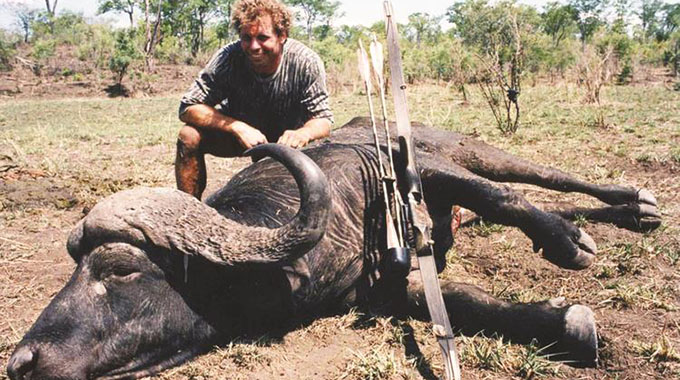
Bow and arrow for hunting buffalo

Exposing the Big Game's avatarCommittee to Abolish Sport Hunting Blog

Bow and arrow for hunting buffaloThis file picture shows a hunter with a buffalo killed using a bow and arrow

Elita Chikwati Senior Reporter
The Zimbabwe Parks and Wildlife Management Authority has relaxed conditions relating to the hunting of buffaloes by allowing the use of specific bows and arrows as part of efforts to diversify options for professional hunters and boost revenue from the sport.

The bows and arrows, however, need approval from the relevant authorities.

Parks and Wildlife Management Authority spokesperson Mr Tinashe Farawo confirmed the development, saying hunters were now allowed to use specific types of bows and arrows to hunt the buffalo.

“There are specifications for the bow and arrow. These type of bows and arrows kill instantly. Before this, hunters would use big rifles. We have been advocating for this and we welcome the new development,” he said.

Mr Farawo said there are categories of…

View original post 291 more words

Residents report finding animal traps near river

Exposing the Big Game's avatarCommittee to Abolish Sport Hunting Blog

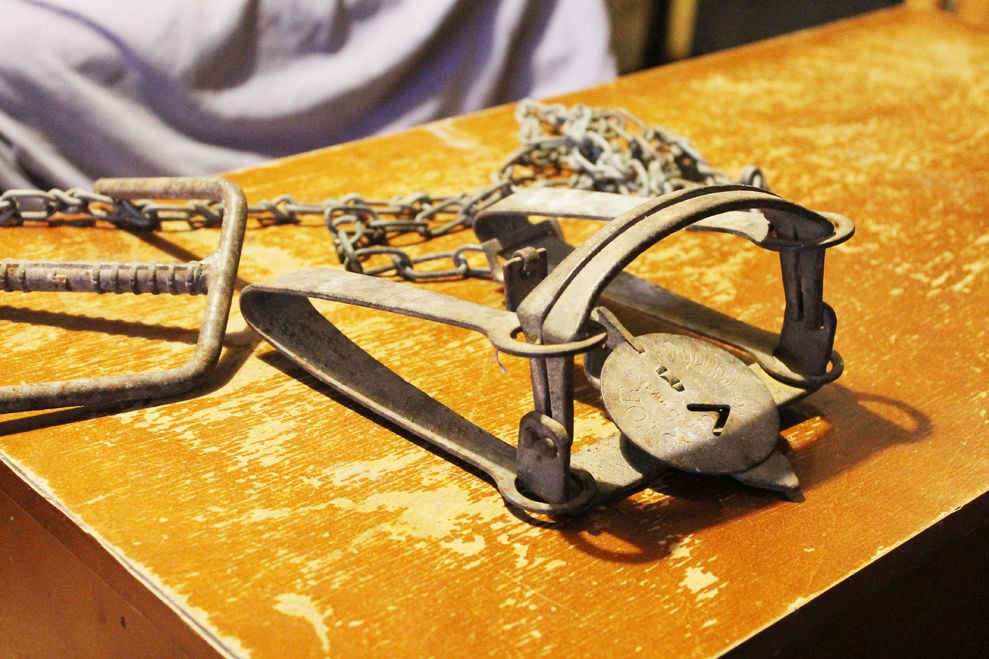
GRAHAM COUNTY — Some Valley residents have recently reported animals caught, and left in, leghold traps near the Gila River, raising the question of whether such traps are legal.

The answer is that, in some cases, they are. Approved by voters in 1994, the Arizona Public Land Trapping Statute prohibited using leghold traps on public land with a few exceptions (health or safety uses, scientific research, wildlife relocation, rodent control). However, the ban does not apply to private property.

Mike Taylor said he first noticed a trapped skunk on one of his trips to the Gila River.

“I didn’t want to mess with the skunk, and it…

View original post 463 more words

U.S. Supreme Court sides with Native American elk hunter

Exposing the Big Game's avatarCommittee to Abolish Sport Hunting Blog

By Lawrence Hurley

,

FILE PHOTO: A bull elk with velvet still on it's antlers grazes near Madison in Yellowstone National Park, Wyoming, June 19, 2011. Over 30,000 elk spend their summer in park.
FILE PHOTO: A bull elk with velvet still on it’s antlers grazes near Madison in Yellowstone National Park, Wyoming, June 19, 2011. REUTERS/Jim Urquhart/File Photo
More

By Lawrence Hurley

WASHINGTON (Reuters) – The Supreme Court on Monday ruled in favor of a Native American elk hunter, citing an 1868 treaty between his tribe and the U.S. government as it revived his legal challenge to a conviction for hunting out of season in Bighorn National Forest in Wyoming.

In a 5-4 ruling, the high court sided with Crow Tribe member Clayvin Herrera. It found that the treaty, which gave tribe members hunting rights on “unoccupied” lands, is still in force even though it was signed before Wyoming became a U.S. state in 1890.

Conservative Justice Neil Gorsuch, who has a record of backing tribal rights, sided with the court’s four liberals, with the other…

View original post 315 more words

Plastics Industry on Track to Burn 14 Percent of World’s Remaining Carbon Budget

Exposing the Big Game's avatarThe Extinction Chronicles

The plastics industry plays a major — and growing — role in climate change, according to a report published last week by the Center for International Environmental Law (CIEL).

By 2050, making and disposing of plastics could be responsible for a cumulative 56 gigatons of carbon, the report found, up to 14 percent of the world’s remaining carbon budget.

In 2019, the plastics industry is on track to release as much greenhouse gas pollution as 189 new coal-fired power plants running year-round, the report found — and the industry plans to expand so rapidly that by 2030, it will create 1.34 gigatons of climate-changing emissions a year…

View original post 1,545 more words

Millions of Birds Are Vacuumed to Death Every Year for Our Martini Olives

[I don’t usually go around agreeing with Trump, but I won’t defend windmills when it comes to bird-killing… and noise. Eventually we’ll need to quit trying to supply power for quite so many humans…]

<https://www.vice.com/en_us/article/3k3vd8/millions-of-birds-are-vacuumed-to
-death-every-year-for-our-martini-olives>

Olives have a better flavor if they’re harvested at night, which is bad news
for the birds who tend to sleep in those trees.

Earlier this week, President Donald Trump stood behind a podium in
Hackberry, Louisiana, spitting hyperbolic half-truths about the Green New
Deal, assorted Democrats, and the eternal shittiness of LaGuardia airport
(OK, that was one of the truth-truths). He also spent 30 bewildering seconds
talking about bird cemeteries.

“You want to see a bird cemetery? Go under a windmill sometime,” he said.
“You’ll see the saddest—you got every type of bird. You know, in California
you go to jail for five years if you kill a bald eagle. You go under a
windmill, you see them all over the place. Not a good situation.”
Advertisement

First, no, I do not want to see a bird cemetery. But if someone does want or
need to see a large quantity of bird carcasses, European olive groves have
them by the millions. According to an absolutely horrifying report from
Nature, every year, more than two million birds are literally sucked out of
trees and killed by the machinery used to harvest olives in Portugal and
Spain.

The olive season stretches from October through January and, unfortunately,
it overlaps with the migration patterns of millions of birds who seek out
the warmer climates in those countries. Olives have a better flavor if
they’re harvested at night when the temperatures are cooler, which is
tragically bad news for the birds who tend to sleep in those trees.

“The machinery is perfectly fine if used during the day, as birds are able
to see and escape while they are operating… However, during the night they
use very strong lights which confuse the birds and lead to their death as
they are ‘sucked in’ by the tractor,” Vanessa Mata, the lead researcher at
Portugal’s Research Center in Biodiversity and Genetic Resources told The
Independent.

The birds affected include several different warblers, thrushes, wagtails,
and finches, as well as the common robin. “It’s a real problem with serious
environmental repercussions that transcend the Andalusian and national
geographical limits, affecting the environmental values of several countries
within the European Union,” the Andalusian Ministry of Environment and
Planning wrote in a report.

The Ministry estimates that more than two million birds are vacuumed to
their deaths every year and, as a result, it is asking for changes to the
harvesting process. (It would also like the machinery operators to stop
illegally selling the dead birds to “rural hotels for consumption as ‘fried
bird.’”)
Advertisement

In Portugal, the Institute for Nature Conservation and Forests (INCF)
estimates that an average of 6.4 birds are killed in every hectare of olive
groves; those groves cover 15,000 hectares in the country’s Alentejo region.
But—disappointingly—the INCF president has decided that 96,000 dead birds
aren’t “statistically relevant” enough to prohibit nighttime harvesting. He
said that they’ll just count the bird carcasses later this year, and maybe
decide what to do then. ( Nature reports that the other countries with
significant numbers of olive groves, France and Italy, have not released any
data on bird deaths.)
“Numbers of farmland birds in Europe have plummeted by 55 percent over the
last three decades and this is another shocking example of how modern
agricultural practices are impacting our bird populations, including some UK
species passing through the region,” Martin Harper, the director of
conservation for the Royal Society for the Protection of Birds told The
Independent.

I’d be willing to trade slightly less flavorful olives for the lives of
several million birds. Because nobody—honestly, NOBODY—wants to see a bird
cemetery.

Malaysia’s last surviving male Sumatran rhinoceros in poor health

Exposing the Big Game's avatarThe Extinction Chronicles

image: data:image/gif;base64,R0lGODlhAQABAAAAACH5BAEKAAEALAAAAAABAAEAAAICTAEAOw==

Tam Rhinoceros Malaysia

Tam is the last surviving male Sumatran rhino in Malaysia. (Photo: Facebook/WWF-Malaysia)

KOTA KINABALU: The health of Malaysia’s last surviving male Sumatran rhinoceros is deteriorating, said Sabah’s Tourism, Culture and Environment Minister Christina Liew on Sunday (May 19).

“Tam’s appetite and level of activity have dropped suddenly since the end of April, and he is now given medicine daily because some of his internal organs are not functioning well,” she added.

If Tam dies, it would leave Iman as the last surviving female Sumatran rhinoceros in Malaysia, after another female rhinoceros Puntung was euthanised in June 2017.

“Hopes to find a mate for him were dashed when Puntung was found to have multiple cysts throughout her uterus,” Ms Liew was quoted as saying by the New Straits Times.

“Iman, on the other hand, was found to have massive uterine fibroids,” she added.

Puntung was captured in 2011, while Iman was…

View original post 137 more words

Is burning plastic waste a good idea?

Exposing the Big Game's avatarThe Extinction Chronicles

[Nothing’s a good idea these days…]

A conveyor belt carries mixed plastic to an optical sorter.
PHOTOGRAPH BY RANDY OLSON, NAT GEO IMAGE COLLECTION

Many within the trash industry think so. But incineration and other “waste-to-energy” projects may pose dangers to the environment.

This article was created in partnership with the National Geographic Society.

WHAT IS TO be done with the swelling flood of plastic waste, if we don’t want to see it snagged in tree branches, floating in ocean gyres, or clogging the stomachs of seabirds and whales?

Plastic production is expected to double in the next 20 years, according to a report issued by the World Economic Forum. Plastic recycling rates, meanwhile, hover around 30 percent in Europe, just nine percent in the U.S., and zero or close to it in much of the developing world.

This…

View original post 1,157 more words

Meating In The Middle: The Challenge of Lowering Greenhouse Gas Emissions On Farms

  5 HOURS AGO
Originally published on May 20, 2019 7:33 am

Cow guts are quite the factory. Grass goes in, microbes help break it down and make hydrogen, then other microbes start converting it to another gas. In the end, you get methane, manure and meat.

One of those things is not like the other. Methane emissions are considered the second-worst greenhouse gas after carbon dioxide, according to Stanford University professor Rob Jackson.

Agriculture is the leading producer of methane emissions in the U.S., with animal digestion producing almost as much as oil and gas operations. So, one way to reduce that is to just stop eating beef, right? That’s what researchers near and far believe, including Paul West at the University of Minnesota.

“As an individual, one of the biggest effects that we can have [to reduce greenhouse gas emissions from agriculture] is changing what we’re eating to eating a smaller amount of beef,” said West, who is co-director and lead scientist of the Global Landscapes Initiative, which aims to balance future food needs with ag sustainability.

However, West and Jackson also advocate for sustainable agriculture systems to mitigate climate change. Just don’t go getting rid of all those gassy ruminants. They’re likely a key part.

Various seedlings sprouted by the dozens in early May on PrairiErth Farm near Atlanta, Illinois.
CREDIT MADELYN BECK / HARVEST PUBLIC MEDIA

Beefing up on sustainability

Molly is not one to be left behind.

The old Great Pyrenees followed Dave Bishop’s Gator as he drove around his 350-acre operation called PrairiErth Farm. Here, Oreo cows coexist with all kinds of crops and vegetables either coming up in the fields or in hoop houses. And the friendly relationship between his two chickens and the cat? “It’s just not right!” he said, smiling and chuckling.

Dave Bishop stands in one of his hoop houses, which was heating up in the sunshine.
CREDIT MADELYN BECK / HARVEST PUBLIC MEDIA

In the mid-20th century, U.S. farms used to look a lot more like Bishop’s, but many were sold or consolidated as farmers looked to economies of scale to stay afloat.

Bishop bought this land in central Illinois as the ’80s farm crisis set in. But it was the 1988 drought that forced him to change his farm’s makeup.

“Everything burned up in the field and it became pretty apparent that we had to do something differently then,” he said. “So we just began looking for things to reduce costs. If I have livestock, I can generate some more fertility. If I have more than just corn and soybeans to sell, I have more diverse marketing opportunities.”

He’s turned to regenerative agriculture, which means creating a sustainable farming operation that isn’t too hard on the landscape and involves everything from cover crops to diverse crop rotations to drainage water management.

Climate change is a real concern of his, as is staying economically sound. That’s why he says any regenerative farm system needs to integrate animals and shift toward diversity in plants and livestock.

West also mentioned the need for crop diversity, saying that large-scale corn production is an issue in the Midwest — and not because farmers are seeing low prices on the billions of bushels grown each year.

“Even though we grow [corn] much more efficiently than a number of places around the world, because corn is a crop that is requiring a tremendous amount of fertilizer …it still affects our climate a lot,” he said.

Dave Bishop only has a few chickens, which roam about near the house and have a friendship with the cat.
CREDIT MADELYN BECK / HARVEST PUBLIC MEDIA

Remember the cow methane? Agriculture generates two other problematic greenhouse gases: carbon dioxide and nitrous oxide. The latter is boosted by excess nitrogen fertilizer applications, and is about 300 times more potent than carbon emissions (though it doesn’t last as long in the atmosphere as carbon or methane emissions).

The future of agriculture

Researchers are making inroads to reducing the amount of methane individual cows produce, feeding them seaweed or other kinds of supplements. Some are even looking to breed cows that naturally make less methane.

However, the animal’s gut microbes that produce methane also help the animal — cut out too many, and that could be toxic. Because of that, Jackson said, “there is no way, that I can see, where we reduce methane emissions completely.”

There are also some perennial crops on the horizon, like wheat and miscanthus (a grass that could be grown for biofuel), that can sequester more carbon because the root-dense soil won’t need to be disturbed to replant every year. Those will likely take years to be adopted by the agriculture sector, though.

In the meantime, Colorado State University professor Keith Paustian said we know enough to start making a dent in ag emissions.

He helped create some of the first methods to calculate greenhouse gas emissions from country to country. He also helped create the COMET-farm tool, which allows farmers to calculate their own greenhouse gas emissions and recommends ways to reduce them.

While the prospect of land use changes could help farms sequester more carbon emissions than they put off, he said that’s not the only solution for climate change or even reducing agriculture’s greenhouse gas emissions.

Brussels sprout starter plants sit in the sunshine at PrairiErth Farm. Exposing them to wind outside encourages them to grow stronger root systems, according to farmer Dave Bishop.
CREDIT MADELYN BECK / HARVEST PUBLIC MEDIA

Bishop at PrairiErth Farm said vilifying cows won’t help when it comes to finding more sustainable agriculture operations, which he said will need both plants and animals. Researchers need to listen to farmers, he said, and farmers need to listen to researchers, too.

Because at the end of the day, he said, it’s about making sure there’s food for the future, “so we’ve got to get this right.”

This story is part of a multi-newsroom collaborative project called “Middle America’s Low-Hanging Carbon: The Search for Greenhouse Gas Cuts from the Grid, Agriculture and Transportation.” The effort, led by nonprofit news organization InsideClimate News, includes 14 newsrooms in the Midwest, and aims to give readers local and regional perspectives on climate change. For more, go to the project page.

Follow Madelyn on Twitter @MadelynBeck8

Deer hunting debate heads to June 5 hearing

Exposing the Big Game's avatarCommittee to Abolish Sport Hunting Blog

Deer hunting, which appears to have dramatically reduced car-deer road accidents in Ridgefield, will be up for debate by townspeople on June 5.

The number of deer killed by hunters in Ridgefield was at 123 in 1996, peaked at 336 in 2009, and had fallen back down to 153 in 2018, according to state figures presented to the selectmen by the town deer committee.

Over those years the count of deer roadkill from accidents with cars declined from about 150 a year early on — 149 deer in 1996, 133 in 1997, 172 in 1998, 157 in 1999, 148 in 2000 — to fewer than 20 a year recently, with 13 deer roadkills in 2015, 11 in 2016 14 in 2017, three in 2018, the committee said.

“Deer auto accidents are down to almost zero,” First Selectman Rudy Marconi said May 8 after the…

View original post 1,211 more words

Taiwanese Leopard Considered Extinct, Spotted For The First Time Since 1983

Mar 04 2019 

Taiwanese Leopard Considered Extinct, Spotted For The First Time Since 1983

With scientists and conservationists saying that the Earth is currently undergoing the sixth mass extinction of plants and animals and species going extinct at up to 1000, to 10,000 the natural, rate, the world is going downhill, fast. However, very rarely, everyone is reminded that it’s perhaps not too late.

One of these rare occasions has just occurred in Taiwan where a rare species of large cat, the Formosan clouded leopard, has just been spotted in the wilderness by a number of people across the archipelago’s southeast region. The leopard has been spotted walking around in the countryside near Taitung County’s Daren Township, where the area’s Paiwan tribal authorities had formed indigenous ranger groups to patrol the region and guard the sensitive areas.

Leopard Formosan Clouded

Species hasn’t been sighted since 1983

This is actually great news because this particular species of Leopard hasn’t been officially sighted since 1983, more than 35 years ago, and 6 years ago, in 2013, it was officially decades as extinct. This gives hope to many other animals that were once thought to be extinct. Maybe they are still out there somewhere. It was first spotted by a group of rangers when it suddenly climbed up a tree and then scrambled up a cliff side to go and hunt for goats. Another group also spotted it when it darted in front of their scooter before quickly claiming another tree and disappearing from sight for good. Even though the group didn’t manage to see it again, at least they know it exists and was able to report back about it.

Tribal members want to stop hunting in the area

As soon as the news was heard, a tribal meeting was held by the locals to discuss how is best to move forward. The tribal members of the village are aiming to stop hunting in the area by outsiders, while village elders are lobbying Taiwanese authorities to end logging and other activities that harm the land, and potentially this rare animal as well. The Formosan is known to be quite agile and vigilant, eluding human attempts to trap or otherwise capture it, so it’s somewhat of a mystery that should probably just be left in its natural habitat.

Taiwan Clouded Leopard

Historical records of the rare cat date back to around the 13th century, when indigenous people brought the leopard’s pelts to trade at the busy markets of port cities like Tainan. Many believe that Japanese anthropologist Torii Ryūzō, in 1900, was the only non-indigenous person to have actually seen a live Formosan clouded leopard.