Some Nuu-chah-nulth leaders are blaming federal mismanagement of seals and
sea lions for the chinook salmon crisis affecting much of BC’s coast.
Larry Johnson, chair of the Maa-nulth Treaty Society’s fisheries committee,
told Ha-Shilth-Sa Newspaper that they are looking to develop a plan that
brings back a controlled harvest of seals and sea lions.
Johnson said meat from the marine mammals was part of the Nuu-chah-nulth
diet for thousands of years.
He said the pinniped population has exploded since the federal government
prohibited hunting them more than 50 years ago.
First Nations, recreational anglers, and commercial fishers have all urged
DFO to look beyond simple fishing closures, and take a wider ecosystem
approach to restoring dwindling Fraser River chinook stocks.
People marched near the White House during the People’s Climate Movement in Washington, DC, on April 29, 2017, to protest President Donald Trump’s attack on the climate and the Environmental Protection Agency.Astrid Riecken/Getty Images
The Trump administration is stepping up its war against measures to address climate change, according to The New York Times.
The administration reportedly plans to prevent the National Climate Assessment, a report funded by the federal government, from assessing worst-case scenarios in its four-year reports.
The US Geological Survey will also be made to change its modeling to project only until 2040, not a century ahead, as in previous assessments, The Times said.
“What we have here is a pretty blatant attempt to politicize the science — to push the science in a direction that’s consistent with their politics,” Philip B. Duffy, the president of the Woods Hole Research…
A man scavenges in a garbage dump in Lhokseumawe, Indonesia, in April. Malaysia will be sending 60 containers of waste back to their countries of origin, the country’s environmental minister announced Tuesday.ZIKRI MAULANA/SOPA IMAGES/LIGHTROCKET VIA GETTY IMAGES
MALAYSIA PLANS TO SEND back roughly 3,300 tons of plastic trash to countries like the U.S. and Canada, its environmental minister announced Tuesday.
Environment Minister Yeo Bee Yin said the country will be sending 60 containers of waste back to their countries of origin. They were discovered while they were being smuggled to illegal processing facilities.
“These containers were illegally brought into the country under false declaration and other offences which clearly violates our environmental law,” Yeo said.
RELATED CONTENT
China Doesn’t Want Your Trash
Yeo added that many citizens in developed countries were mostly unaware that their trash – which they think is being recycled – is actually being dumped in Malaysia.
“We are urging developed nations to review their management of plastic waste and stop shipping garbage to developing countries,” she said. “If you ship to Malaysia, we will return it back without mercy.”
At least 14 countries, including the U.S., Canada, Japan, France, Australia, Saudi Arabia and China, will get trash shipped back to them, according to Malaysian officials.
The move makes Malaysia the latest Asian country to start rejecting other nations’ trash.
Last week the president of the Philippines said he would send back 69 containers of garbage to Canada to be left in international waters if the country doesn’t accept them.
As the world grapples with what to do with its trash, many nations have promised to try to address the problem.
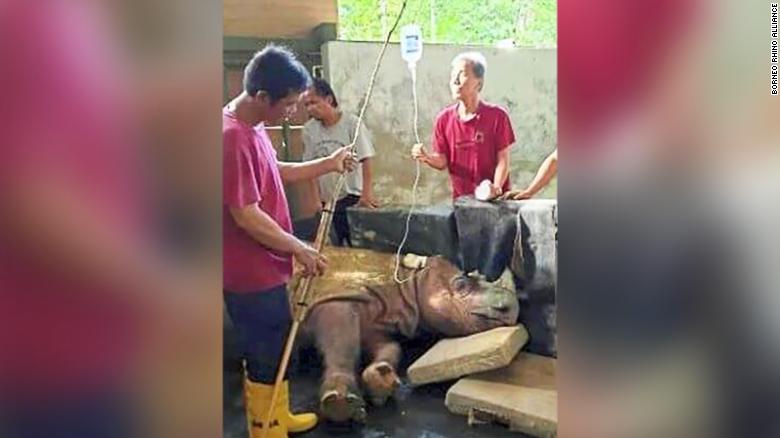
Experts believe there are fewer than 80 Sumatran rhinos left in the wild.
(CNN)Malaysia’s last male Sumatran rhino has died, leaving behind just one female of the same rare species in captivity in the country.
The Borneo Rhino Alliance (BORA) confirmed the animal’s death in a statement on Facebook on Monday, saying: “It is with heavy hearts that we share the tragic news that Tam, Malaysia’s last male Sumatran rhino, has passed away.”
Tam had been suffering from organ failure before his death, BORA said.
Sumatran rhinos are the world’s smallest rhinoceros species, standing at around 4 feet 3 inches high, when fully grown. They are the only Asian rhinos with two horns, and are covered in hair.
At this critical planetary moment, the two of us are each considering what it means to deeply accept that our planetary home is in crisis — and how to move forward. Here are some of our individual reflections.
On Life After Death: Dahr
From 1996 until 2003 I climbed in Alaska’s mountains as a religion. My entire life revolved around training for, preparing around, and engaging in climbing trips and expeditions around Alaska’s mountains, the high volcanoes of Mexico, the Andes…
Tombstones are seen across Arlington National Cemetery Section 33 ahead of Memorial Day on May 26, 2019, in Arlington, Virginia.TOM BRENNER / GETTY IMAGES
A grieving, unnamed woman stood outside a funeral parlor awaiting the arrival of the remains of one of the latest U.S. servicemembers killed in the Afghanistan War. She was wearing a vest adorned with a variety of military-style patches, one identifying herself as a Gold Star mother, her son being another of the 2,426 U.S. servicemembers killedthus far in what has become the U.S.’s longest war, now in its 18th year.
When interviewed by one of the plethora of news reporters covering the wake and funeral, she responded that though she did…
NASHVILLE, Tenn (CLARKSVILLENOW) – The Tennessee Fish and Wildlife Commission has made changes to deer hunting regulations in continued response to chronic wasting disease (CWD) which was found in three southwestern Tennessee counties last winter.
The commission approved the Tennessee Wildlife Resources Agency’s recommendation to establish a new CWD deer hunting unit for the counties in which we have found CWD-positive deer (Fayette, Hardeman, and Madison) and counties within 10 miles of a positive CWD deer location (Chester, Haywood, McNairy, Shelby and Tipton). The goal of these modified regulations in unit CWD is to keep CWD from spreading and to keep the number of infected deer to a minimum.
For the three-day August (23-25) deer hunt, muzzleloaders were authorized, in addition to archery, for use in Unit CWD. Selected public lands will also be open to hunting in…
One million animal and plant species are at imminent risk of extinction.
“The essential, interconnected web of life on Earth is getting smaller and increasingly frayed,” notes Professor Josef Settele, a contributor to the recent report by the Intergovernmental Science-Policy Platform on Biodiversity and Ecosystems Services. “This loss is a direct result of human activity and constitutes a direct threat to human well-being in all regions of the world.”
It is clear that if we continue on our path of profit at any cost, consumerism, and massive trapping of wild animals for “recreation and profit,” Montana will contribute to pushing some animal species over the cliff of no return.
The United Nations report urged “transformative changes needed locally and globally to restore and protect nature.”
We need leadership now. The Montana Department of Fish, Wildlife and Parks could immediately suspend recreational trapping…
For twenty-some years I lived in a remote cabin in Washington’s North Cascades mountains. My place was the last human inhabitance on a gravel forest service road that dead-ended at the Lake Chelan Saw-tooth Wilderness boundary. Almost no one drove out that way and far fewer ever stopped in to visit, so I was surprised one autumn morning when a truck drove down my long, dusty driveway.
It turned out to be a young hunter who frantically explained that he just shot his father in law (mistaking him for a deer) and asked to use my phone. I told him I was sorry, but the nearest telephone was at my neighbor’s, two miles downriver. He raced off to call for an ambulance, but it was too late. Like so many hunting accidents, this one proved fatal for the victim.
Protesters in front of Marineland theme park. Photograph: Tara Walton/Toronto Star via Getty
A controversial theme park in Canada is facing renewed criticism following the deaths of three animals in recent weeks, triggering fresh calls from activists for the attraction to be shut down.
Officials at Marineland, which sits on the Canadian side of Niagara Falls in Ontario, said two deer were killed in a stampede allegedly caused by a father and son taunting the animals. The incident, which occurred last weekend when the attraction opened for the season, has prompted staff to temporarily close the deer park area.
Days after the stampede, the park also announced the results of a postmortem on one of its walruses which died in April, citing a heart attack as the cause of death for the 18-year-old animal named Apollo. Apollo is the fourth walrus to die in the park over the last two years, leaving it with only one remaining animal – a female called Smooshi.
Speaking of the deer deaths, Marineland said: “We are all upset by this terrible act against innocent animals. In order to protect our animals, we are closing the deer park to make modifications to prevent this type of incident from ever happening again.” It added that this was the first time such an incident had occurred.
Deer sit around the perimeter of Marineland’s deer park. Photograph: Tara Walton/Toronto Star via Getty Images
But Phil Demers, a former animal trainer at the park who has become Marineland’s most vocal critic, rejected the park’s explanation, claiming that a move to reopen the deer park to visitors after years of closure could cause panic among the animals.
Advertisement
“There’s been countless incidences of patrons stressing out the animals. [Marineland] took a gamble. They opened it for the first time in years,” he said.
Marineland has increasingly become a target for activists, who argue the park has a moral responsibility to release the animals it keeps in captivity. The park dismissed protests outside its gates over the opening weekend as a “small group of annual demonstrators [who] continue to seek to damage Marineland at all costs”.
The park was the focus of a 2012 investigation by the Toronto Star, which interviewed a number of employees alleging incidences of animal neglect. The park is contesting the claims.
“Marineland is in what can only be described as a significantly worse condition than when I spoke out in 2012. There has been exactly no investment in improvement to the animal life support systems whatsoever,” said Demers.
Marineland has vigorously denied the claims and has been in a legal battle with Demers over the last seven years, alleging he attempted to steal a walrus – an allegation he calls “absurd”.
Despite pressure from critics, the park continues to house an estimated 51 beluga whales. It also has five bottle-nosed dolphins and a single orca named Kiska.
A male beluga whale at Marineland. Photograph: Denis Cahill/AP
Proposed legislation in the Canadian parliament – dubbed the “Free Willy bill”– is likely to receive royal assent in the coming weeks and would ban the captivity of cetaceans, including orcas, dolphins and beluga whales across the country. The province of Ontario previously passed similar legislation, which banned the acquisition of large marine mammals, but allowed Marineland to keep its whales.
Ever since the park’s owner, John Holer, died last year, the company – Holer Family Amusements – has been at a “crossroads”, the Niagara Falls mayor, Jim Diodati, told the Toronto Star, as it explores a possible expansion of the park, or sale of its land to developers.








 Exposing the Big Game