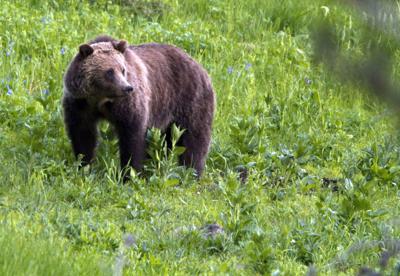
Grizzly bears roam both Yellowstone and Glacier national parks.
Jim Urquhart, Associated Press file
OKANOGAN —Federal agencies will hold a public meeting on plans for possible grizzly bear restoration in the North Cascades.
The meeting is set for 5 p.m. Oct. 24 at the Okanogan County Fairgrounds Agriplex, 175 Rodeo Trail Road, Okanogan.
The North Cascades National Park and the U.S. Fish and Wildlife Service are in the draft environmental analysis portion of the plan and haven’t made a decision whether they will pursue grizzly bear restoration.
The public comment period will start at 5:30 p.m. and people will be given two minutes to speak through a lottery system.
The draft environmental analysis is open for written public comment to be submitted through Oct. 24 at http://wwrld.us/2lMP4ZP.
Democratic presidential candidates take the stage at the beginning of the Democratic presidential debate at the Fox Theatre on July 30, 2019, in Detroit, Michigan.SCOTT OLSON / GETTY IMAGES
In my bleaker and more cynical moments, I wonder if the TV networks are doing this deliberately. The next big DNC-sanctioned Democratic presidential confab, broadcast this time by ABC and Univision, is taking place Thursday night in Houston. Like the other elaborately failed debate formats so far, this one will also feature 10 candidates vying for attention on the same platform, except for three hours instead of two.
“Each candidate will have one minute and 15 seconds to directly respond to questions from moderators,” reportsTime, “and 45 seconds to respond to follow-up questions and rebuttals. Candidates will give opening statements, but no closing statements.”
Spiffy. There were gusts of relief sighed across the land when it was announced the debate would not be broken up into two back-to-back nights, but I did not share in the sentiment. Allowing even one more candidate to participate would have indeed necessitated two nights, but those two nights would have featured five or six candidates each, instead of Thursday’s clotted 10-candidate format I have come to detest and abhor.
Despite the fact that, once again, the Democrats are putting the equivalent of an entire college lacrosse team before the cameras, the dynamics between the candidates will be worth watching.
ABC has placed Joe Biden front and center on the debate stage, directly between the podiums to be occupied by Elizabeth Warren and Bernie Sanders. Given the operatic, bloody-eyed debacle that was Biden’s showing at the recent CNN climate town hall, and that his frontrunner status is about as firm as pudding on a Houston sidewalk in high summer, the pressure on him will be extreme. The speed-dating format may shield him for a time, but I strongly suspect Jojo will not enjoy the overall experience. If he has another bad night, watch for the vultures to begin circling his campaign bus.
As for the other participants — Kamala Harris, Beto O’Rourke, Cory Booker, Pete Buttigieg, Andrew Yang, Julián Castro and Amy Klobuchar — the night will be yet another chapter in their ongoing quest for relevance. All seven continue to poll in single digits, and between the established establishment candidate (Biden) and the two progressive standard-bearers (Sanders and Warren), there isn’t much room for any of them to stand out in a campaign-salvaging manner.
As for the topics that are sure to get short shrift in the 10-person format, the recent spate of massacres will likely bring gun reform to the fore. Donald Trump’s astonishing cruelty toward Dorian refugees from the Bahamas will certainly inspire a discussion on immigration. If the previous debates are any guide, climate change, foreign policy and Trump himself will also be featured on the spinning roulette wheel of topics.
Like as not, however, health care reform will again be a major topic. It will be featured prominently, I believe, because it is important, and because it allows the corporate media moderators to say “raise your taxes!” to Medicare for All advocates like Sanders 400 times within the confines of time restrictions that thwart proper explanations for why this is actually OK.
Speaking of health care in the U.S., a little girl from Sudbury, Massachusetts, fell suddenly ill on September 3, and was rushed to Boston Children’s Hospital for treatment. She was diagnosed with Eastern equine encephalitis (EEE), a mosquito-borne illness climate scientists have warned will become more prominent and dangerous with the ongoing onset of climate disruption. She remains in critical condition as of this writing.
To offset expenses, her parents initiated a GoFundMe campaign to help raise money for her medical care. “She remains in the ICU,” reads the fundraising request, “and while the family has a full medical insurance plan through their employer, the out-of-pocket medical costs will be massive.” As of Tuesday morning, according to the Boston Globe, the appeal had generated more than $88,000.
Here we have a heartwarming story of basic human compassion, of a community rallying to support one of its most vulnerable members, right? I see it differently. In fact, stories like this — meant to flood the heart with joyful tears — make me scream in my soul.
This is not an uplifting story about people helping other people. That is what it is framed to sound like, even as it is framed to sound like something perfectly normal and ordinary. It is a story of last-ditch desperation, one of millions taking place every single day.
It is the thoroughly commonplace tale of a family that has been financially subsumed by a sudden illness, even as they are in possession of full medical coverage, who require the largesse of strangers to run the expensive gauntlet of our for-profit medical industry.
This child should be getting treatment for free, or at least at minimal expense to her family, as should every person who falls ill in this country, because health care is a human right enshrined on the hood ornament of our founding documents: “Life, Liberty and the Pursuit of Happiness.” Try locating any of those when you are sick — and broke because you are sick.
The people who have donated to this fund are to be commended, don’t get me wrong, because we are all screwed if we don’t help each other survive the lethal cruelty of late-stage U.S.-style capitalism. The fact that this little girl could very well die if strangers don’t pony up to cover her astronomical medical bills, however, is what’s wrong with how we do medicine in this country. Stories like this one are octaves in the dying wail of a carnivorous paradigm that needs to be shattered and buried under salted earth before it kills us all.
Please remember this story as you watch the debate on Thursday night. Remember that the stakes are human lives. The stakes are us.
I don’t imagine the debate format will properly encompass the health care crisis, or any of the others. That, right there, is the problem.
In a controversial move earlier this year, Botswana lifted a hunting moratorium that will allow for as many as 400 elephants to be hunted annually. Many in Botswana welcome the move.
RACHEL MARTIN, HOST:
OK. We’re going to shift our focus across the world to Botswana. The southern African country is home to more elephants than any other country in the world. There are about 130,000 or so of them. But the government says violent run-ins between elephants and humans are on the rise. Last spring, the government lifted a hunting moratorium and allowed up to 400 elephants to be hunted every year. Reporter Krista Mahr traveled to Chobe District in Botswana to bring us the story.
(SOUNDBITE OF ENGINE RUNNING)
KRISTA MAHR, BYLINE: Flying over the Chobe River in northern…
The Grand Portage Band of Lake Superior Chippewa and the Bois Forte Band of Chippewa will take a combined total of 10 bull moose in northeastern Minnesota this year. The hunt is expected to begin as soon as Oct. 22.
Members of the Fond du Lac Band of Lake Superior Chippewa took 25 bull moose in the same region this fall, plus three additional moose for community needs. The Fond du Lac hunt ended on Oct. 14 when the bull moose quota was met.
Seth Moore, director of biology and environment for the Grand Portage Band of Lake Superior Chippewa, talks with WTIP’s Joe Friedrichs about the 2016 moose hunt.
A pair of hunters moves out into the forest at Swatara State Park in northern Lebanon County just before sunrise on the first day of the firearms hunting season for deer, Monday, November 26.
A House Game and Fisheries Committee hearing on Sunday hunting in Pennsylvania on Tuesday temporarily became a lecture on the civility of addressing one another in the halls of the State Capitol.
After representatives of several state and national organizations again outlined their positions for and against Sunday hunting – specifically Senate Bill 147, which would remove Pennsylvania’s ban on Sunday hunting from 3 Sundays during the hunting season, this time around – several legislators launched into criticisms of comments by Harold Daub, executive director of the Pennsylvania Federation of Sportsmen and Conservationists.
(Consistent with testimony at previous hearing, the Keystone Trails Association and Pennsylvania Farm opposed SB…
Imports to Argentina, Peru and Hong Kong restricted. Outbreak of a low-pathogenic avian influenza (LPAI) virus is under control, the Chilean State Agricultural and Livestock Service (SAG) reported Wednesday.
The importing of Chilean turkey meat has been restricted in Argentina, Peru and Hong Kong, due to an outbreak of bird flu in central Chile.
The outbreak, of a low-pathogenic avian influenza (LPAI) virus, is under control, the Chilean State Agricultural and Livestock Service (SAG) reported on Wednesday.
“Regarding shipments of poultry and its products from Chile to various markets, the SAG has been notified of restrictions only on the part of Argentina, Peru and Hong Kong,” the SAG said in a statement.
The three nations made that determination after an outbreak was detected on August 27 in a turkey pen at the Sopraval company, located in the Los Nogales commune, Valparaíso, 120 kilometres west of Santiago.
Let’s imagine for a moment that we’ve reached the middle of the century. It’s 2050, and we have a moment to reflect—the climate fight remains the consuming battle of our age, but its most intense phase may be in our rearview mirror. And so we can look back to see how we might have managed to dramatically change our society and economy. We had no other choice.
There was a point after 2020 when we began to collectively realize a few basic things.
One, we weren’t getting out of this unscathed. Climate change, even in its early stages, had begun to…
Tourists planning to visit Yellowstone National Park or elsewhere in bison country might want to store some AC/DC on their playlists.
The Gallatin County Sheriff’s Office in Montana on Tuesday revealed that the heavy-metal band’s music has helped to clear the roadways of stubborn bison.
“When deputies respond to a bison on the road, they turn on lights and siren and encourage the animals to leave the road with an air horn,” the Sheriff’s Office wrote Tuesday on Facebook. “With a reluctant bison, they’ve been known to play ‘Hells Bells’ over the speakers – that usually seems to work.”
So-called bison jams are fairly common inside Yellowstone National Park, and can leave tourists stranded for 30 minutes or longer.
The iconic critters are encountered outside the park, too, and local motorists can attest that it’s sometimes difficult to persuade a 1,000- to 2,000-pound bison to let traffic pass.
It’s usually a job best left to sheriffs or park rangers.
Yellowstone guidelines call for tourists to remain inside their vehicles when in close proximity to bison, because the enormous animals are surprisingly fast and unpredictable.
But that does not always prevent scary encounters.
Last month a tourist recorded dozens of bison in a stampede. One of the animals smashed into the family’s rental car and cracked its windshield.
It’s doubtful that music would have helped in that case.
However, the power of music is not to be underestimated when it comes to close wildlife encounters.
A geoscientist calls the unearthed fossils, including the bodies and trails left by an ancient animal species, the most convincing sign of ancient animal mobility, dating back about 550 million years.
In a remarkable evolutionary discovery, a team of scientists co-led by a Virginia Tech geoscientist has discovered what could be among the first trails made by animals on the surface of the Earth roughly a half-billion years ago.
Shuhai Xiao, a professor of geosciences with the Virginia Tech College of Science, calls the unearthed fossils, including the bodies and trails left by an ancient animal species, the most convincing sign of ancient animal mobility, dating back about 550 million years. Named Yilingia spiciformis — that translates to spiky Yiling bug, Yiling being the Chinese city near the discovery site — the animal was found in multiple layers of rock by Xiao and Zhe Chen, Chuanming Zhou, and Xunlai Yuan from the Chinese Academy of Sciences’ Nanjing Institute of Geology and Palaeontology.
The findings are published in the latest issue of Nature. The trails are from the same rock unit and are roughly the same age as bug-like footprints found by Xiao and his team in a series of digs from 2013 to 2018 in the Yangtze Gorges area of southern China, and date back to the Ediacaran Period, well before the age of dinosaurs or even the Pangea supercontinent. What sets this find apart: The preserved fossil of the animal that made the trail versus the unknowable guesswork where the body has not been preserved.
“This discovery shows that segmented and mobile animals evolved by 550 million years ago,” Xiao said. “Mobility made it possible for animals to make an unmistakable footprint on Earth, both literally and metaphorically. Those are the kind of features you find in a group of animals called bilaterans. This group includes us humans and most animals. Animals and particularly humans are movers and shakers on Earth. Their ability to shape the face of the planet is ultimately tied to the origin of animal motility.”
The animal was a millipede-like creature a quarter-inch to an inch wide and up to 4 inches long that alternately dragged its body across the muddy ocean floor and rested along the way, leaving trails as loing as 23 inches. The animal was an elongated narrow creature, with 50 or so body segments, a left and right side, a back and belly, and a head and a tail.
The origin of bilaterally symmetric animals — known as bilaterians — with segmented bodies and directional mobility is a monumental event in early animal evolution, and is estimated to have occurred the Ediacaran Period, between 635 and 539 million years ago. But until this finding by Xiao and his team, there was no convincing fossil evidence to substantiate those estimates. One of the recovered specimens is particularly vital because the animal and the trail it produced just before its death are preserved together.
Remarkably, the find also marks what may be the first sign of decision making among animals — the trails suggest an effort to move toward or away from something, perhaps under the direction of a sophisticated central nerve system, Xiao said. The mobility of animals led to environmental and ecological impacts on the Earth surface system and ultimately led to the Cambrian substrate and agronomic revolutions, he said.
“We are the most impactful animal on Earth,” added Xiao, also an affiliated member of the Global Change Center at Virginia Tech. “We make a huge footprint, not only from locomotion, but in many other and more impactful activities related to our ability to move. When and how animal locomotion evolved defines an important geological and evolutionary context of anthropogenic impact on the surface of the Earth.”
Rachel Wood, a professor in the School of GeoSciences at University of Edinburgh in Scotland, who was not involved with the study, said, “This is a remarkable finding of highly significant fossils. We now have evidence that segmented animals were present and had gained an ability to move across the sea floor before the Cambrian, and more notably we can tie the actual trace-maker to the trace. Such preservation is unusual and provides considerable insight into a major step in the evolution of animals.”
The study was supported by the Chinese Academy of Sciences, the National Natural Science Foundation of China, the U.S. National Science Foundation, and the National Geographic Society.
When we’re faced with threats of inundation, our reaction has traditionally been to build walls. Sea-level rises, storms and floods have been held back with solid barriers, seawalls and dykes. We have used walls to keep out people, too: the fact that this has failed throughout the ages has not stopped its recent revival in the United States.
The climate crisis threatens global sea-level rises of well over half a metre if we fail to act, while tidal storm surges will reach many times that height. Fiercer and more frequent hurricanes will batter us, and millions of people who live in areas where crops have failed and wells run…








 Exposing the Big Game
