Exposing the Big Game

Forget Hunters' Feeble Rationalizations and Trust Your Gut Feelings: Making Sport of Killing Is Not Healthy Human Behavior

Exposing the Big Game

Ex-owner of Tipitina’s dies in apparent hunting accident in Mississippi

Exposing the Big Game's avatarCommittee to Abolish Sport Hunting Blog

https://www.clarionledger.com/story/news/2019/09/03/ex-owner-tipitinas-dies-apparent-hunting-accident-ms-roland-von-kurnatowski/2197778001/

NEW ORLEANS  — The former owner of a historic New Orleans music club has died in an apparent Mississippi hunting accident.

Gulf Coast news outlets report that 68-year-old Roland Von Kurnatowski, the former owner of Tipitina’s, died Sunday.

Hancock County, Mississippi, Coroner Jim Faulk told WWL-TV in New Orleans he does not suspect foul play, but the cause of death remains under investigation.

Hancock County Sheriff Ricky Adam told WLOX-TV in Biloxi that Von Kurnatowski was hog hunting over the weekend. Adam said Kurnatowski’s weapon discharged as he climbed a ladder to a hunting stand.

Von Kurnatowski drew praise for his support of music education. But he also faced apparent financial troubles. And questions arose in 2018 about his business practices, including ties between the nonprofit Tipitina’s Foundation and his private companies.

View original post

Mass extinction event 2 billion years ago killed 99 percent of life on Earth, study says

Exposing the Big Game's avatarThe Extinction Chronicles

There have been several mass extinction events during the planet’s history, including the Cretaceous–Paleogene extinction event, arguably the best known because of the death of the dinosaurs. Now, researchers may have discovered a new mass extinction event, one that happened 2.05 billion years ago and likely killed between 80 percent and 99.5 percent of all of life on Earth.

In a study published in PNAS, a group of researchers looked at rocks in Hudson Bay, Canada, that formed billions of years ago and found that there was a sharp drop in life 2.05 billion years ago. This happened in conjunction with the end of the Great Oxidation Event (GOE), a period between 2.4 billion and 2 billion years ago that saw a surge and ultimately, a huge drop…

View original post 462 more words

Japan’s decision to resume commercial whaling ‘disappointing’, Boris Johnson tells country’s prime minister at G7

A whale hunt in the Faroe islands
A whale hunt in the Faroe islands CREDIT: ANDRIJA ILIC/AFP/GETTY IMAGES

The Japanese Prime Minister’s decision to resume commercial whaling was described by Boris Johnson as “disappointing” at the G7 meeting.

The Prime Minister took the chance to raise the topic with Shinzo Abe when they met on Bank Holiday Monday.

The Telegraph understands he told Mr Abe that he was very disappointed with their decision to continue the practice, which has been condemned by animal charities for putting whales at risk of extinction.

Carrie Symonds, Boris Johnson’s partner, has campaigned for some time on the issue in her role as head of communications for the conservation NGO Oceana.

Ms Symonds attended an anti-whaling protest outside the Japanese Embassy in January alongside the Prime Minister’s father, Stanley Johnson.

She said at the time that the practice should be consigned to the “dustbin of history”, adding: “It’s cruel beyond belief. We have all seen the pictures of the sea turning red with blood, while a whale dies slowly in agony with a sharp metal implement pushed through its body. How can that be right?”

Carrie Symonds and Stanley Johnson at an anti-whaling protest earlier this year
Carrie Symonds and Stanley Johnson at an anti-whaling protest earlier this year CREDIT: JOHN STILLWELL/PA WIRE

It is understood Ms Symonds will be unable to attend as she will be in the United States for her work at Oceana.

Defra minister Zac Goldsmith is meeting with NGOs to discuss the issue of whaling next week.

He said: “Very pleased to hear that ⁦‪Boris Johnson raised Japan’s awful decision to resume commercial whaling with the Japanese PM today at the G7. Hope they will seriously rethink.”

Japan’s first commercial whale hunt since 1986 commenced in early July, after the country left the International Whaling Commission, which has a ban on commercial hunting.

The ban was put in place after whales were brought to the brink of extinction by hunting in the 19th and 20th century.

The creatures are hunted for their meat, and many coastal communities in Japan argue that it is an important tradition.

Boris Johnson has been pushing biodiversity to the forefront of the agenda at the G7 meeting, and he said: “We cannot sit back as animals and plants are wiped off the face of the planet by mankind’s recklessness. If we do not act now our children and grandchildren will never know a world with the Great Barrier Reef, the Sumatran tiger or the black rhino.”

An Idaho resident illegally raised an elk in captivity: ‘A sad ending’


This elk was illegally raised by a Gem County resident, Fish and Game says. (Photo courtesy Brian Marek, IDFG)

A bull elk may spend the rest of its life in captivity after an Idaho resident illegally raised the elk in Gem County.

Idaho Fish and Game says a resident of Sweet illegally removed the elk when it was a calf in the spring of 2018. The elk ended up leaving the area during the winter, but it returned to Sweet this spring.

Officers were receiving calls about the 400-pound elk roaming around the small town and it was unafraid of people.

“With the fall rut approaching, things could only get worse,” Idaho Fish and Game said.

“With plenty of elk in the Bear Valley area, it was hoped that the young bull would integrate into one of the local herds,” Fish and Game said. “But after two weeks in the wild, the young bull appears uninterested in its own kind, instead approaching curiosity seekers who have driven to Bear Valley in the hopes of spotting the animal.”

The elk, recaptured on Sunday, was deemed to be too habituated toward humans and will now live out its days in captivity. Previous attempts of finding the elk a home at an accredited facility were unsuccessful.

“A sad ending for what should be a wild animal,” Fish and Game said.

Friendly elk relocated to prime hunting region in Idaho one day before archery season

Exposing the Big Game's avatarCommittee to Abolish Sport Hunting Blog

Some people disagree with Idaho Fish and Game’s decision to relocate “Elliot the Elk” to Sawtooth National Forest.

SWEET, Idaho — Dogs are the animals known as man’s best friend but in Sweet, Idaho, that animal happens to be an elk.

They call him “Elliot the Elk,” and he has made the town of Sweet his home for about two years. That was until Idaho Fish and Game relocated him to Bear Meadows in the Sawtooth National Forest.

“As the animal matured we knew it was gonna be a problem,” Evan Oneale, a spokesperson of Idaho Fish and Game said.

A Sweet resident said there were differing opinions of Elliot.

“Elliot should’ve never been put in the position that he’s been put in,” Kim Newman said. “He ended up relying on people…

View original post 299 more words

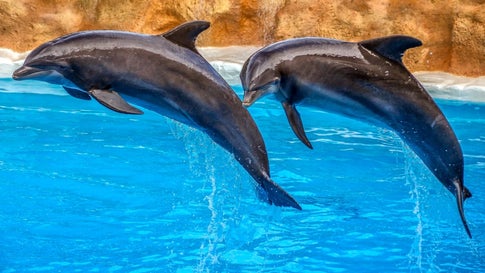
Japan Starts Controversial Dolphin Hunt

Exposing the Big Game's avatarCommittee to Abolish Sport Hunting Blog

By IANS

15 hours ago

TWC India

Dolphins

(Pixabay)

Japan has started its controversial annual dolphin hunt in the coastal town of Taiji, a media report said on Monday.

The hunt sees the animals driven into a cove where some are slaughtered for their meat with knives in shallow waters, the BBC report said. Other dolphins are sold to aquariums and marine parks.

This year’s Taiji hunt kicked off on Sunday, but according to Japanese media, the boats returned without any dolphins. On Monday, the fishing fleet went out again to drive a dolphin pod towards the shore.

Environmentalists have said that the practice is cruel because the dolphins can take up to 30 minutes to die by suffocation or drowning. But the fisherman from Taiji say the community’s livelihood is dependent on the trade.

The dolphin hunting season is expected to last for about six months.

The Taiji…

View original post 64 more words

Canada goose hunting season opens in New York state

ALBANY, N.Y. (AP) — Canada goose hunting season is open throughout most of New York state.

Environmental Conservation Commissioner Basil Seggos says the September goose hunting season is designed to help reduce the resident Canada goose population, which has expanded to nuisance levels in some areas.

New York’s population of non-migrating Canada geese has grown from 80,000 in 1995 to more than 340,000 today. Hunting seasons have been liberalized in efforts to curb population growth.

The September Canada goose season runs from Sept. 1 through Sept. 25 in upstate goose hunting zones.

Hunters are allowed to take eight to 15 birds a day depending on the zone.

ISIS Resorts to ‘Booby-trapped Cows’ in Iraq

Exposing the Big Game's avatarThe Extinction Chronicles

Iraqi security forces gather at the site of a car bomb …
Baghdad – Hamza Mustafa
Iraq’s security situation has been relatively stable despite ongoing plots by ISIS terrorist organization to create chaos, most recently by booby trapping animals, especially cows.

At the height of its power, ISIS had suicide bombers and a membership from different generations. But it is no longer capable of making new recruitments after its defeat in Iraq in late 2017.

Despite its territorial losses, the terrorist organization remains barricaded in various mountainous and desert areas of western governorates, namely Diyala, Kirkuk, al-Anbar, Saladin, and Nineveh.

However, no one expected that ISIS would resort to animals to carry out attacks. In 2005, 2006, and 2007, al-Qaeda used animals in its operations before it was defeated by the Awakening Council, the tribal organization established by the US in al-Anbar.

In Diyala province, 65…

View original post 130 more words

Beyond Meat uses climate change to market fake meat substitutes. Scientists are cautious

[These articles never even mention the cruelty issue of animal agriculture, which is the main reason I, and other vegans, boycott meat…]
KEY POINTS
  • As concerns mount over the dangers of a rapidly warming planet, upstart food companies are targeting a major climate-damaging food: beef.
  • Beyond Meat and its privately held rival Impossible Foods have recently grabbed headlines and fast-food deals for their plant-based burgers that imitate the taste of beef.
  • They’ve also turned the environmental benefits of abstaining from meat into a key marketing tool for their products — drawing some skepticism from environmental researchers who say plant diets are healthier and less carbon emitting than producing processed plant-based products.
  • “Beyond and Impossible go somewhere towards reducing your carbon footprint, but saying it’s the most climate friendly thing to do — that’s a false promise,” said Marco Springmann, a senior environmental researcher at the University of Oxford.
GP: Impossible Burger at Burger King 190808
In this photo illustration, the new Impossible Whopper sits on a table at a Burger King restaurant on August 8, 2019 in Brooklyn, New York.
Drew Angerer | Getty Images

As concerns mount over the dangers of a rapidly warming planet, upstart food companies are targeting a major climate-damaging food: beef.

Beyond Meat and its privately held rival Impossible Foods have recently grabbed headlines and fast-food deals for their plant-based burgers that imitate the taste of beef.

They’ve also turned the environmental benefits of abstaining from meat into a key marketing tool for their products — drawing some skepticism from environmental researchers who say plant diets are healthier and less carbon emitting than producing processed plant-based products.

Animal agriculture is responsible for 14.5% of global greenhouse emissions, according to the United Nations’ Food and Agriculture Organization, with 65% of those emissions coming from beef and dairy cattle. Scientists warn that climate change will trigger an international food crisis unless humans change the way they produce meat and use land.

While companies producing imitation meat boast of the environmental benefits, some researchers point out that for people wanting to substantially lower their carbon footprint, having unprocessed plant-based diets instead of eating imitation products is healthier and better for the planet.

Beyond and Impossible use different sources of proteins to create their meatless meats. Beyond primarily works with protein from peas, while Impossible uses genetically modified soy.

“It makes sense to develop alternatives to beef, because we have to change our eating habits to more plant-based diets if we want to limit global warming to under 2 degrees Celsius. Impossible and Beyond tap into this market,” said Marco Springmann, a senior environmental researcher at the University of Oxford.

“However, while their processed products have about half the carbon footprint that chicken does, they also have 5 times more of a footprint than a bean patty,” he said. “So Beyond and Impossible go somewhere towards reducing your carbon footprint, but saying it’s the most climate friendly thing to do — that’s a false promise.”

VIDEO06:05
Is fake meat a healthier choice?

In fact, a recent landmark report from the Intergovernmental Panel on Climate Change, a group of UN scientists, said that shifting towards plant-based diets would be a critical way to mitigate and adapt to climate change, as simply cutting carbon emissions from automobiles and factories won’t be enough to avert an impending crisis.

“On the consumption side, with people in developed countries wanting more cheap meat, and now in developing countries people wanting cheaper meat — it’s pushing the planet in the wrong direction,” said Hans-Otto Portner, a climatologist who co-chairs the IPCC’s working group on impacts, adaptation and vulnerability.

“It’s not sustainable. It’s a warning signal. If the world wants to keep to the UN’s sustainable development goals by 2030, there is something wrong here, there is a mismatch.”

Millennials driving shift away from meat

On Beyond Meat’s website, “positively impacting climate change” is listed second, behind “improving human health.” The founders of both Beyond and Impossible have named the environment as the motivating factor for creating their businesses.

Mintel found that 16% of U.S. consumers avoid animal products for environmental reasons. That reasoning is much more common with the 18 to 34 year olds, with nearly a quarter of that demographic saying that rationale applied to them.

“There’s a large enough group of millennials where it’s worth it to them to pay for more for their food. They take into account the values of the company, whether it’s best for the environment,” said Kit Yarrow, a professor at Golden Gate University who researches consumer psychology.

Products from Beyond and Impossible target flexitarians – people are looking to consume less meat. For the same reason, if you look for a Beyond Burger in the grocery store, you’re more likely to find it in the meat case than next to other vegan or vegetarian options.

There has been a historical dietary shift away from beef in the U.S. American consumers eat about a third less beef than they did in the 1970s, according to the World Resources Institute.

Promoting dietary shifts can be complicated, and assessing the impact of these changes on an international scale involves making assumptions about agricultural practices, the ability to choose what you eat and market forces.

Still, if everyone in the U.S. were to reduce meat consumption by a quarter, and eat substitutes like plant proteins, it would save 82 million metric tons of greenhouse emissions each year, according to a new study in the journal Scientific Reports. If everyone went vegetarian, it would save 330 metric tons per year – roughly 5% saved.

Impossible’s website includes a 2019 lifecycle assessment report by the sustainability firm Quantis, which spells out the smaller environmental footprint of the Impossible Burger. It found that the Impossible Burger used 96% less land, 87% less water and 89% less greenhouse gas emissions.

Rachel Konrad, Impossible’s chief communications officer, said that the Impossible Burger also has public health benefits because of its reduced land, water and energy use.

“It doesn’t contribute to the antibiotics arms race or the well known risk of antibiotic resistance — one of the biggest threats to global health, food security, and development today,” Konrad said in a statement.

“If Beyond’s products help people switch from normal beef to a replacement, it’s not so bad. But it should not be the end goal,” Springmann said. “The carbon footprint of these processed plant-based products falls in between chicken and beef.”

Beyond commissioned its own lifecycle assessment, which was published in September 2018. The company has since tweaked the formula for its burgers. The report completed by the University of Michigan includes customers and consumers among the list of primary audiences for the study.

The study found that from cradle to distribution, the Beyond Burger generates 90% less greenhouse gas emissions and requires 46% less energy, 99% less water and 93% less land compared to a quarter pound of U.S. beef.

The data about U.S. beef production came from a 2017 lifecycle assessment by the National Cattleman’s Beef Association, a lobbying group for beef producers. Beyond and its vendors primarily contributed the data for the Beyond Burger.

Climate researchers called on corporations making these meat substitutes and touting environmental benefits to continue assessing the carbon footprint of their production methods.

“In principle, the processed meat substitutes makes production more efficient. In that respect, it’s a benefit, and these plant burgers could be an attractive product,” Portner said. “It also depends on the carbon footprint of [the company’s] production. That needs to be keyed into the picture.”

Springmann said that Beyond and Impossible need to better assess their carbon footprint, saying that these companies make claims about sustainability that they do not sufficiently back with data.

“At minimum, they should continually assess the carbon footprint of their companies,” he said.

GP: Beyond Meat inc. Debuts Initial Public Offering At Nasdaq MarketSite
Ethan Brown, founder and chief executive officer of Beyond Meat, center, celebrates with his wife Tracy Brown, center left, and guests during the company’s initial public offering (IPO) at the Nasdaq MarketSite in New York, on Thursday, May 2, 2019.
Michael Nagle | Bloomberg | Getty Images

New normal for plant-based burgers

Partnering with Beyond or Impossible allow restaurants or food service companies to tout a commitment to the environment, as Sodexo did in its August announcement.

“Sodexo is committed to providing customers with more plant-forward and sustainable options as part of their diet,” said Rob Morasco, senior director culinary development, Sodexo, when the company partnered with Impossible.

In recent years, consumers have increasingly put pressure on restaurants to become more environmentally friendly by swapping out plastic straws or using compostable to-go containers.

In turn, by serving an Impossible or Beyond burger, Burger King or Carl’s Jr. can normalize plant-based burgers for consumers because of their meat-oriented reputation, Yarrow said.

“People say all the time that they want to eat more fish or eat less sugar, but they don’t normally do it,” she said.

Last year, McDonald’s became the first restaurant chain to commit to science-based targets to reduce greenhouse gas emissions at its restaurants and offices by 36% by 2030. While the Golden Arches has yet to offer a plant-based burger at its U.S. restaurants, doing so could demonstrate its commitment to the targets.

Big Food companies jumping in on the plant-based food trend are also using the environmental angle.

For example, when Nestle announced that it would bring a meatless ground meat product to Europe last week, it said in a tweet that it was meeting consumer demand for food “with less impact on the environment.”

Beyond Meat did not respond to a request for comment.

17-year-old has half her face blown off while posing for selfie with hunting rifle, miraculously survives

Exposing the Big Game's avatarCommittee to Abolish Sport Hunting Blog

https://meaww.com/teenager-loses-half-face-shot-accident-posing-for-selfie-friend-with-hunting-rifle-gun-icu

The bullet hit the teenager near her nose and crushed the bones in her face, she was rushed to the ICU and had to undergo a seven-hour surgery


                            17-year-old has half her face blown off while posing for selfie with hunting rifle, miraculously survives

A teenage girl suffered from horrific injuries after her best friend accidentally shot her in the face in Ukraine. 17-year-old Polina Gordik had to be hospitalized in a critical condition with half her face injured by the bullet.

The incident took place in the Komyshuvakha village in southern Ukraine in the Zaporizhia Oblast region, reported DailyMail. Polina was at a party at her best friend’s house on Wednesday when the unfortunate accident occurred.

At the party, her friend Veronika had carried her father’s hunting rifle and had decided to pose for a picture with Polina. They then placed the rifle with the barrel pointing up…

View original post 270 more words