Swan Lake National Wildlife Refuge near Chillicothe, Missouri, will be open for the second year for dove hunting during the Missouri season starting today.
Steve Whitson, refuge manager, said the Missouri dove hunting season will be held for the second year at the refuge starting Sept. 1. The recently approved Refuge Hunting Plan opened areas of the refuge to dove hunting.
He said the dove hunting area is located on the north end of the refuge near the Hunting Headquarters site.
“The spring flood took out mist of the crops on the unit so habitat conditions were impacted but we decided to keep the hunt open this year,” Whitson said.
Last year, there were 29 hunters that participated in the opening weekend and 71 doves were harvested.
Hunters must check in at the Hunting Headquarters prior to entering the dove hunting area and when leaving the hunt area. A Missouri Small Game Hunting Permit and a Migratory Bird Hunting Permit along with a check-in stub are required to hunt dove. Hunters may check in 2 hours prior to official sunrise.
He said hunting dogs used for dove hunting are allowed for retrieval only and must be under the control of the owner at all times.
There is no overnight camping allowed on the refuge. Nontoxic shot is required while dove hunting on Swan Lake NWR and lead shot is prohibited. All Missouri dove hunting regulations will apply.
Whitson said hunting is a priority for public use in the refuge system and is allowed when found compatible with that specific refuge’s mission and purpose.
The dove hunting regulations flyer along with an area map can be found on the Swan Lake NWR website under the hunting section at https://www.fws.gov/refuge/Swan_Lake/.
ALBUQUERQUE, N.M. — Several conservation groups expanded claims a federal agency issued an order to trap or kill the Mexican gray wolf.
A coalition of conservation groups, including the Western Watersheds Project, Wolf Conservation Center and Lobos of the Southwest, issued a letter last week to U.S. Fish and Wildlife leadership asking if it was the organization’s intention to retain the services of Bill Nelson.
“Last week, it came to our attention that the U.S. Fish and Wildlife Service was seeking input on the decision to issue a sole-source award to Bill Nelson Wildlife Control (DUNS# 117125795) out of Datil, N.M., to assist the agency with trapping, capturing and radio collaring of endangered Mexican wolves,” the groups wrote.
“Does the agency actually plan to hire an alleged wolf killer for these sensitive services to the program? At best, he…
The hunting season for dolphins using a controversial “drive-hunting” method began Sunday in the whaling town of Taiji in western Japan, without any major protest from animal-rights groups.
While local police officers were on high alert for anti-whaling campaigns, 12 boats left the town’s port around 5 a.m., but all returned without any catch, according to a fisheries cooperative official.
The hunting method, in which fishermen herd dolphins and small whales into a cove before sealing the area with a net, has drawn fierce criticism from animal-rights groups at home and abroad.
As a member of the International Whaling Commission, Japan halted commercial whaling in 1988 but hunted whales for what it called research purposes, a practice criticized internationally as a cover for commercial whaling.
Japan had long sought to lift the moratorium and finally left the IWC on June 30 after the organization last year voted down its proposal to resume commercial whaling of species considered abundant, such as minke whales.
(Dolphin hunt off Taiji pictured in 2010.)
Hunting dolphins and other small cetaceans in waters near Taiji was not subject to controls by the IWC, although critics have said the technique is cruel and it has become the subject of an Oscar-winning documentary.
Ahead of the hunting season’s start, local authorities were anxious that there could be obstruction from international anti-whaling activists, but only about 10 members of a Japanese animal-rights group gathered at the port on Sunday.
The hunting season continues for about six months. An ad hoc police box has been set up near the port and, together with police officers, personnel from the Japan Coast Guard will be deployed around the area.
“Thanks to the security, we can do (hunting) with ease,” said Teruto Seko, head of the fisheries cooperative.
Southern African nations are threatening to quit the global wildlife trade regulator after it refused to relax restrictions on trade in ivory and rhino horn and imposed a near total ban on zoos taking African elephants captured in the wild.
Ties soured during this week’s meeting of the Convention on International Trade in Endangered Species (CITES) in Geneva after numerous proposals from the Southern African Development Community (SADC) regional bloc were rejected.
Botswana, Namibia and Zimbabwe – home to the world’s largest elephant population – asked for the right to sell ivory acquired through natural deaths, confiscations and culling.
The demand was rejected by a majority of 101 votes.
The CITES treaty, created more than four decades ago, regulates trade in some 36 000 species of plants and animals and provides mechanisms to help crack down on illegal trade and sanction countries that break the rules.
But members of the 16-nation SADC bloc accuse it of turning a blind eye to Africa’s problems.
“The result has been failure to adopt progressive, equitable, inclusive and science-based conservation strategies,” Tanzanian Environment Minister George Simbachawene told the Geneva meeting.
“Time has come to seriously reconsider whether there are any meaningful benefits from our membership to CITES,” he said.
Past sell-by date
The ministers accused the regulatory body of bowing to animal rights groups and unreasonably prohibiting the trade of African wildlife and products rather than regulating it fairly.
“A great disappointment, shocking outcomes,” said Botswana’s Environment Minister Onkokame Kitso Mokaila.
“I think CITES has long passed its sell-by date,” he said, adding SADC needs “something else… that speaks to the issues of today.”
No member has permanently quit the Convention since it was adopted in 1963.
The United Arab Emirates withdrew in 1988 but rejoined in 1990.
The largely aid-dependent SADC region hosts the lion’s share of Africa’s wildlife.
Zimbabwean President Emmerson Mnangagwa blasted the decision not to relax ivory laws saying the money – estimated to have a combined value of $600 million – could fund conservation projects.
‘Divide and rule Africa’
“They bar us from killing our animals for selling ivory, but they want us to protect them from being poached,” he protested.
Namibian Environment Minister Pohamba Shifeta said CITES was “increasingly becoming a forum dominated by non-state players with the agenda to divide and rule African states.”
“We are reconsidering our stay in CITES,” Shifeta said, suggesting regional and national talks could take place this year.
CITES’ refusal to overturn the international ban on ivory trade was, however, welcomed by conservationists.
Wildlife NGO Born Free’s head of policy, Mark Jones, told AFP that lifting it would have “seriously undermined” existing conservation efforts.
Poaching has decimated the world elephant population, which slumped in Africa from several million at the turn of the 19th century to around 400,000 in 2015.
Jones said devastated and vulnerable elephant populations would face “increased risk from poachers and traffickers who would not hesitate to use legal markets to launder illegal ivory into trade”.
He urged SADC countries to continue their membership and work with the international community to find solutions for species threatened by trade and trafficking.
Competition for resources is fierce, as growing human and wildlife populations increasingly encroach on each other’s space.
Zimbabwean Parks spokesman Tinashe Farawo told AFP 15 people had died in animal attacks during the first eight months of this year.
More than 200 people were killed in the past five years, he said. Crops have also been destroyed.
“Our people must benefit, this is a resource we think we can monetise, Farawo said.
“That’s why we have been saying we believe that the elephants must pay for their upkeep.”
Botswana’s environment minister Mokaila said detractors need to consider that rural communities were being affected by increasing wildlife numbers, climate change, water shortages and loss of land fertility.
“It’s not just about talking about elephants or rhino, it’s about talking about economies in Southern Africa,” he said.
“We cannot be emotional about it. We cannot bury our heads in the sand and think that the problem will solve itself by saying stop trade,” said Mokaila.
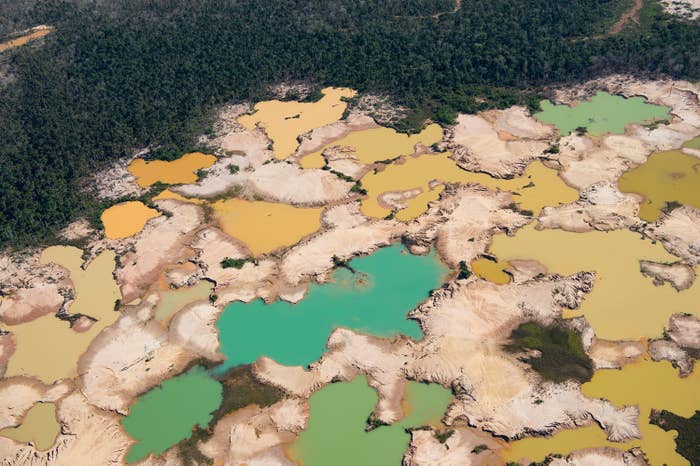
An aerial view over a chemically deforested area of the Amazon jungle caused by illegal mining activities in the river basin of the Madre de Dios region in southeast Peru, on May 17, 2019, during the ‘Mercury’ joint operation by Peruvian military and police ongoing since February 2019.
The wildfires ripping through the Amazon have drawn the world’s attention to the destruction of the “lungs of the planet.” Many scientists believe cattle ranchers clearing land caused the flames, spurring groups around the world — including the government of Finland — to call for a boycott of Brazilian beef. But to boycott all of the products damaging the Amazon, you’d have to do much more than give up steak. You’d have to toss out your phone, laptop, wedding band, and anything else with gold in it.
“There’s no way to get the gold out without destroying the forest. The more acres you cut down, the more gold you get. It’s directly proportional,” Miles Silman, the cofounder of Wake Forest University’s Center for Amazonian Scientific Innovation (CINCIA), told
“There’s no way to get the gold out without destroying the forest.”
Fueling that demand is not just the world’s appetite for gold bars and jewelry — the largest categories for which gold is used — but also high tech. Tiny electrical currents are constantly running through your iPhone, Alexa speaker, and laptop — and carrying those currents is gold, a fantastic conductor of electricity that’s also resistant to corrosion. While there isn’t much gold inside a single device — an iPhone 6, for example, contains 0.014 grams, or around 50 cents’ worth — in the aggregate, the amount is staggering. According to market researcher Gartner, over 1.5 billion smartphones were sold last year, with 1.3 billion of them being Android devices. It was followed by 215 million iOS devices.
So the tech industry, which consumes nearly 335 tons of gold yearly, will only need more and more of the metal. “There’s a gold rush in the Amazon right now that’s just like the gold rush that happened in California in the 1850s,” said Silman.
According to a 2018 CINCIA study, artisanal mining, or small-scale mining conducted by independent miners, have uprooted nearly 250,000 acres of rainforest in the Madre de Dios region of Peru, where Silman focuses his work. Another study, by researchers at the University of Puerto Rico in 2015, found that approximately 415,000 acres of tropical forest across South America has been lost to gold mining. A map compiled by environmental group Amazon Geo-Referenced Socio-Environmental Information Network shows 2,312 illegal mining sites in 245 areas across six countries, which the group called an “epidemic.”
And just as the California gold rush gave rise to a lawlessness that took generations to tame, the tech industry’s suppliers can’t always meet demand and sometimes turn to the Amazon’s illegal mining economy.
Afp / AFP / Getty Images
An artisan miner shows a piece of gold after extraction and processing on May 6, 2008 in El Ingenio, Peru, 420 kms south of Lima. Artisan mining accounts for the livelihood of more than 40 thousand Peruvian families, though almost 15% of the nation’s gold production comes from this activity. Since the 1980s many extracting camps have been converted into small mining towns lacking basic services and containing high levels of pollution.
A Miami Herald investigation in 2018 detailed how a handful of traders from Southern Florida–based precious metals company NTR Metals bought $3.6 billion of gold from outlaw mines across South America. NTR Metals has since been shut down and the traders arrested. The company was a subsidiary of Elemetal, a major US gold refinery that supplied Tiffany & Co. and other consumer brands, like Apple, which said it stopped working with the supplier, in corporate disclosures for the year 2017 and 2018.
Apple is far from the only tech giant that sources gold from the Amazon region. A review of corporate disclosures by BuzzFeed News found that Amazon (the company), Apple, Samsung, Sony, and Google list refiners Asahi and Metalor as suppliers. In turn, these firms, based respectively in Switzerland and Japan, buy some of their gold from South American mines. According to the Herald, those companies buy from brokers, who source their gold from a range of legal and illegal mines in the region.
Companies like Alphabet, the parent company of Google, are aware of the impacts of gold mining in the Amazon, and have taken steps to address it. A Google company spokesperson pointed to its conflict minerals policy, and says it relies on third party audits to ensure that smelters are in compliance. Samsung, Sony, and Amazon did not return a request for comment. Apple told BuzzFeed News all its gold refiners participate in third party audits. “If a refiner is unable or unwilling to meet our standards, they will be removed from our supply chain,” an Apple spokesperson said it a statement. “Since 2015, we’ve stopped working with 60 refiners of gold for this reason.”
Dirty gold doesn’t just end up in electronics. A 2015 report by Ojo Publico reported that companies with ties to the London Bullion Market Association — an organization that determines the international price of gold — acquired precious metal from illegal mining camps in Peru, Bolivia, and Brazil.
An estimated 15% to 20% of gold in jewelry and electronics inadvertently comes from small-scale gold mines, according to Fairtrade Gold, an organization advocating the use of responsibly sourced precious metals.
“A part of the problem with gold is that it all goes into one melting pot. So you can have a bar of gold where some of it comes from responsible sources, some of it comes from illegal sources, but it looks like one bar of gold,” said Sarah duPont, president of the Amazon Aid Foundation.
That illegal and dirty gold extraction takes a toll on the environment and the humans who mine it. Compared to soybean farming or cattle ranching, the mining industry clears fewer acres of forest from the Amazon.
However, according to Silman, the carbon emissions of mining can make the industry’s environmental footprint between three to eight times as big as the surface acres lost to mining might suggest. In addition to uprooting trees and other plants, miners dig two to four meters deep into the ground, where soil is rich in carbon. That soil can be thousands of years old, and gold mining liberates that carbon back into the atmosphere, killing nutrients in the dirt that are vital to plants in the rainforest.
“If you think about an Amazonian forest, there’s nothing you do that’s worse to it than alluvial mining.”
“The growth rates around the mines are so slow because you’ve washed everything that’s good out of the soil,” Silman explained.
Gold mining also transforms the landscape in another way: “1 out of every 5 acres converted by mining can’t be reforested because it’s converted into a body of water. So it ends up looking like Minnesota, with thousands of lakes all across the landscape,” said Silman. “If you think about an Amazonian forest, there’s nothing you do that’s worse to it than alluvial mining. You could drop a nuclear bomb on the forest, and it would be better than mining it.”
On top of the environmental devastation, mercury, used as an amalgam to retrieve gold from the dirt, contaminates the region’s water and food supply. According to the US National Institute of Health, artisanal and small-scale gold mining is the leading source of mercury released into the environment. Researchers have found high levels of mercury, which has serious health effects on the nervous, digestive, and immune systems, in people living along the Brazil–Venezuela border, the Madre de Dios area of Peru, and in Suriname.
Joao Laet / AFP / Getty Images
Aerial view of the Esperanca IV informal gold mining camp, near the Menkragnoti indigenous territory, in Altamira, Para state, Brazil, in the Amazon basin, on August 28, 2019.
Despite the dangers, gold mining in the Amazon region is unlikely to slow down. Brazilian president Jair Bolsonaro has loosened the country’s environmental laws and is working to open up more of the Amazon to mining. Bolsonaro fired the head of the country’s agency that tracks deforestation, after a report that some 1,330 square milesof Amazonian forest in Brazil had been lost since the president took office in January — a 39% increase over last year.
What can be done? According to Kevin Telmer, executive director of the Artisanal Gold Council, an organization working to professionalize and train the sector, the environmental problem is linked to that of extreme poverty.
Banning small-scale mining would not be effective, according to Telmer: “People have asked the miners to leave for 40 years and they haven’t. What [bans] do is drive the economy into the black market.”
“What’s needed really is sustainable economic pathways for those individuals who are currently pursuing illegal mining,” said Payal Sampat, the mining program director at Earthworks, a nonprofit that started a campaign called No Dirty Gold in 2008. Sampat added that buying vintage jewelry and holding on to electronics for longer is a good way for consumers to cut down on their gold consumption.
Silman, the CINCIA researcher, agrees. Legally placed mines, he said, are at least confined to a small area, instead of thousands of mines sprawled across a landscape. Taxing mining operations could also help money flow back into job placement and other programs: “There was $3 billion made out of Madre de Dios, and a lot of it flowed through mafias. There’s a little over 100,000 people living in that land, and they would have had $300 million of tax revenue,” he said.
The Artisanal Gold Council, Telmer said, is working to provide training and education to miners, reforest mined areas, as well as introduce processes that are more effective than the use of mercury.
The formalization and professionalization of the sector can help miners be more productive, and be less impactful on the environment, too, Silman said: “Once you do all these things, at least you can get some good from mining, and you still don’t destroy all the opportunities for the future that rely on biodiversity.”
New species related to humans discovered in cave01:15
(CNN)Ancient bones and teeth found in Callao Cave in the Philippines have led to the discovery of a previously unknown species related to humans called Homo luzonensis, according to a new study. The fossils belonged to two adults and one child who lived between 50,000 and 67,000 years ago.
This time frame means luzonensis would have lived at the same time as Neanderthals, Denisovans, Homo sapiens and the small-bodied Homo floresiensis. Like other extinct hominins, luzonensis is more of a close relative than a direct ancestor.
Photos:Ancient finds
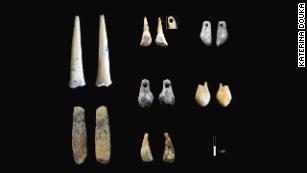
In 2007, a single foot bone was found in the cave and dated to 67,000 years ago. During excavations in 2011 and 2015, researchers found 12 additional hand and foot bones, including a partial femur and teeth, in the same layer of the cave. The researchers have named the new species luzonensis because of where it was found on the island of Luzon.
They are now the earliest human remains found in the Philippines. Previously, Homo sapiens remains were found on Palawan island and dated to between 30,000 and 40,000 years ago.
But what makes luzonensis different from other species? It’s all in the distinct premolar teeth, which vary considerably from anything identified in the other species belonging to the Homo genus.
Callao Cave on Luzon island, where the fossils were discovered.
close dialog
Receive Fareed Zakaria’s Global Analysis
including insights and must-reads of world news
Activate Fareed’s Briefing
By subscribing you agree to our
privacy policy.
The seven premolars and molars are smaller and more simplified than those of other species. Although some of the characteristics can be compared to Homo erectus and Homo sapiens, the teeth and jaw features remain distinct as far as the odd features they combine.
This factor, along with the fact that the researchers haven’t been able to remove DNA from the fossils, makes it difficult to determine where luzonensis fits, evolution-wise.
The two hand bones and three foot bones also show a unique anatomy.
Although separated by millions of years of evolution, luzonensis’ toe bone strongly resembles that of Australopithecus afarensis, or the famed “Lucy” fossil. Australopithecus lived between 2.9 million and 3.9 million years ago.
The finger bone also resembles that of Australopithecus, as well as early Homo species. The finger and toe bones are curved, like those of early hominins, likely suggesting that climbing was important to their lifestyle and survival.
“If you take each feature one by one, you will also find it in one or several hominin species, but if you take the whole combination of features, no other species of the genus Homo is similar, thus indicating that they belong to a new species,” said Florent Détroit, study author and paleoanthropologist at the National Museum of Natural History in Paris.
Complications in the evolutionary tree
Luzonensis presents a bit of a mystery because, as with the discovery of Homo floresiensis, previously unknown hominin species complicate the evolutionary tree. This also shifts the idea of which species migrated.
Given that Africa is regarded as the “Cradle of Life” and Homo erectus was found on the Indonesian island of Java, the idea is that erectus migrated out of Africa and helped disperse the species.
Floresiensis, nicknamed the “hobbit” species, have been found only on the island of Flores near Indonesia and were discovered in 2003. They lived between 100,000 and 60,000 years ago. And although they stood only around 3½ feet tall and had brains about one-third the size of a modern human’s, they made stone tools and hunted elephants.
It is believed that floresiensis was more diminutive in stature due to its island environment and limited resources. The same may be true for luzonensis, the researchers said.
Both of these species lived on islands that would have been reachable only by crossing the sea. And there is evidence of animal butchery on Luzon that dates back 700,000 years, but the researchers don’t know whether luzonensis is responsible.
The finding does build the case that hominins were already present on the island. They could have been luzonensis or the species descended from them, or perhaps they descended from another unknown group, the researchers said.
Seafaring could have happened by accident as they drifted on rafts or due to intentional navigation, the researchers said.
“We have more and more evidence that they successfully settled on several islands in the remote past in Southeast Asia, so it was probably not so accidental,” Détroit said. “Another important thing to have in mind is that you cannot successfully settle on an island with a single event of arrival of only few people, you need several individuals of course, and you need several arrivals, at least at the beginning, so that you have enough founders settled on the island.”
More exploration to come
So how did they evolve, and why do they share such varied characteristics with more ancient hominins? The answer may lie in more excavations and discoveries yet to be made on the islands of Southeast Asia.
“Our picture of homin evolution in Asia during the Pleistocene just got even messier, more complicated and a whole lot more interesting,” Matthew Tocheri wrote in an accompanying News and Views article. Tocheri, the Canada Research Chair in Human Origins at Lakehead University in Ontario, did not participate in this study.
The researchers are planning studying the biomechanical aspects of the fossils and how they may have moved, as well as more excavations of the cave or identifying new potential sites.
“As we can see now, Southeast Asia, and especially their islands, is a fantastic place for studying hominin evolution, and conducting fieldwork to find more sites with ancient archaeology and hominin fossils,” Détroit said.
Emmanuel Macron may not technically be a celebrity, but he tweets like one.
Prior to the G-7 summit, the French president declared on Twitter, “The Amazon rain forest — the lungs which produce 20% of our planet’s oxygen — is on fire.” He added that, “Our house is burning. Literally,” and called the fires an “international crisis.”
Donald Trump skips the G7 climate change meeting in France.
More repercussions — both good and bad — from the Amazon forest fires.
Thousands of fires are also burning in central Africa, but it’s not quite the same as the Amazon.
Climate activists will fly drones at London Heathrow to pressure the UK government to reduce emissions.
The Great Barrier Reef is rated as being in a ‘very poor’ state in a new report.
And more…
A friend’s young son said to her yesterday about the state of our environment: “There’s a hurricane coming to Florida and the rain forest is on fire. This is horrible!” It’s been one heckuva tough week for the Earth’s environment.
So let’s kick off the Climate Crisis Weekly with a quick look back at the G7 meeting in Saint-Jean-de-Luz, France. The crucial climate change…
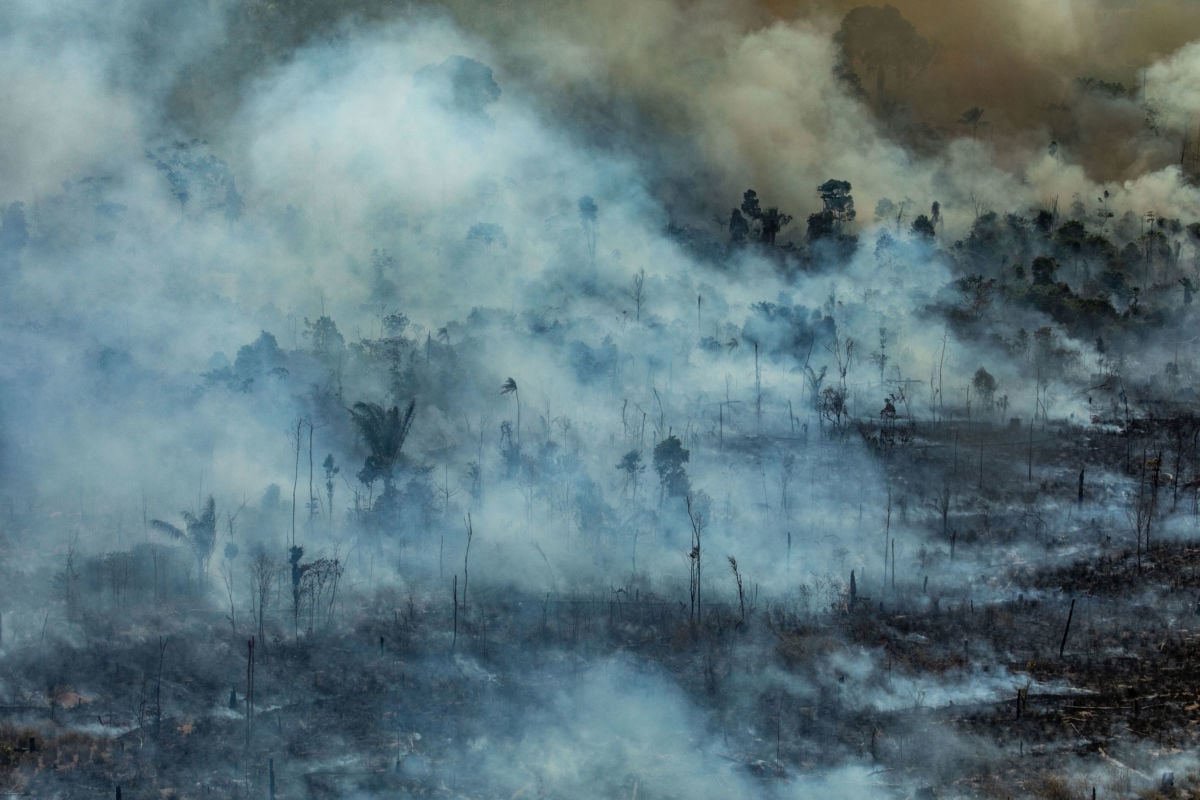
An aerial image of the Amazon burning in the Jamanxim Environmental Protection Area in the city of Novo Progresso in Pará state, Brazil.VICTOR MORIYAMA / GREENPEACE
The Amazon is burning. Nearly 75,000 fires have started in the iconic Brazilian rainforest this year to date, an 84 percent increase from the year before. Since August 10, a spate of intentionally set fires have been raging in the Amazon. But Brazil’s president Jair Bolsonaro, who took office in January, let them burn for two weeks before sending firefighters to put them out following an international outcry.


 (Dolphin hunt off Taiji pictured in 2010.)











 Exposing the Big Game