Exposing the Big Game

Forget Hunters' Feeble Rationalizations and Trust Your Gut Feelings: Making Sport of Killing Is Not Healthy Human Behavior

Exposing the Big Game

Shelter Animals Displaced By California’s Wildfires Are In Desperate Need Of Safe Homes

The state of California is currently on fire in several locations. As a result, residents are having to deal with blackouts and evacuations. The wildfires are a result of high winds – and they’ve already ravaged hundreds of acres of land, destroyed dozens of structures, and injured at least two firefighters. Of course, the human residents aren’t the state’s only affected victims. As reported by ABC 10, displaced cats and dogs rescued from the blaze are desperately in need of safety and homes.

Over the weekend, the Kincade Fire blazed through Sonoma County located in northern California. As a result, the local animal shelters had to evacuate. The Sacramento Society for the Prevention of Cruelty to Animals (SPCA) stepped in and took in the 20 dogs and 22 cats who were in need of shelter. Now, the SPCA is asking people to adopt pets.

“These animals were all in [the Humane Society of Sonoma County’s] care or already available for adoption prior to the fires, so there is no risk these animals were originally displaced by the fires,” the Sacramento SPCA posted to a Facebook post.

The pets looking for homes range in age, from little kittens to a 19-year-old cattle dog mix named Ace. The SPCA will be updating more information on their website about each animal, they’re just waiting for all of them to receive their medical check-ups. For now, you can visit the nonprofit’s adoption page and see what information is there.

Adopting vulnerable pets rescued from natural disasters is always one way of helping a community deal with the aftermath. However, the animals in California aren’t the only ones needing loving forever homes.

Also, please note that because of volume , we are unable to respond to individual comments, although we do watch them in order to learn what issues and questions are most common so that we can produce content that fulfills your needs. You are welcome to share your own dog tips and behavior solutions among yourselves, however Thank you for reading our articles and sharing your thoughts with the pack!

Proposal could ban hunting predatory animals in Massachusetts

Exposing the Big Game's avatarCommittee to Abolish Sport Hunting Blog

HAMPSHIRE COUNTY

NORTHAMPTON, Mass. (WWLP) – Massachusetts could ban predator hunting contests.

Some people want to make it illegal to hunt animals with fur in Massachusetts and Massachusetts residents will be able to voice their concerns.

“As long as they are not getting to the point where it is extinct, I don’t think the competitions are a bad idea,” said one local resident.

Massachusetts Wildlife Officials are considering a ban on hunting contests that involve the hunting of predatory animals like foxes and coyotes. The Massachusetts Division of Fisheries and Wildlife is holding a hearing Tuesday night to allow for public comment.

The proposed ban comes following concerns by critics who believe the hunting contests involving fur-bearing animals is cruel. Critics in favor of the ban also believe the killing is unnecessary and does not prevent their interactions with humans or domesticated animals.

In a statement, the…

View original post 77 more words

In Southeast Asia, illegal hunting is a more immediate threat to wildlife than forest degradation

https://phys.org/news/2019-10-southeast-asia-illegal-threat-wildlife.html

In Southeast Asia, illegal hunting is a more immediate threat to wildlife than forest degradation
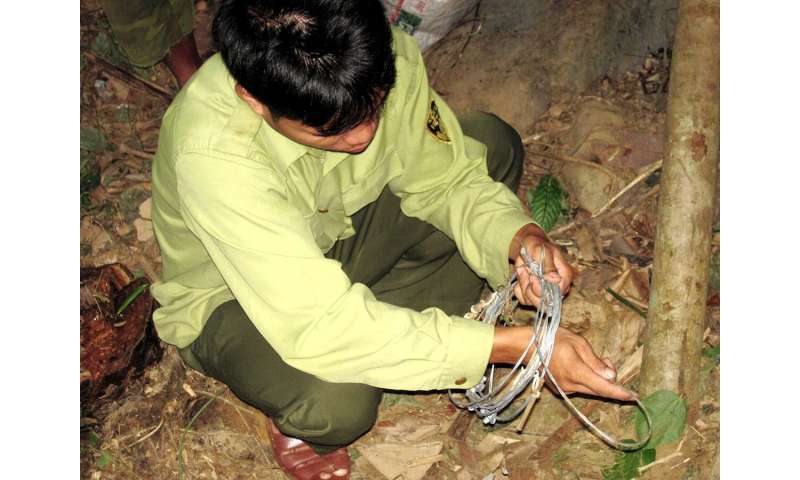
Removing snares in Vietnam. Credit: Andrew Tilker

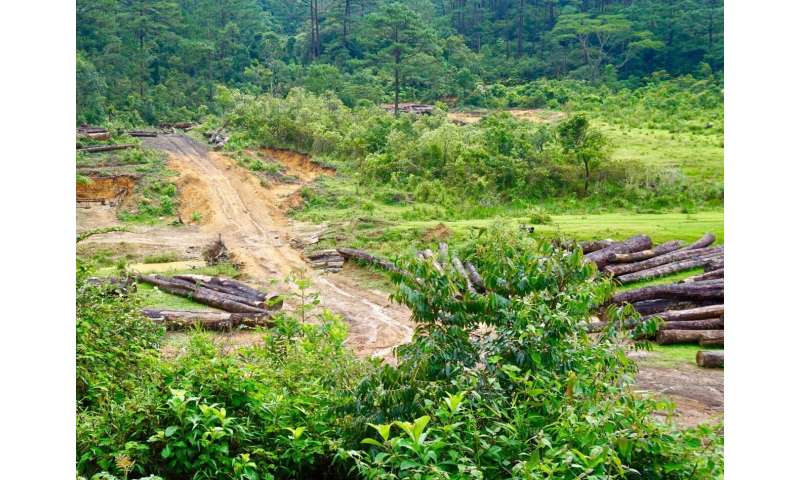
A new study carried out by the Leibniz Institute for Zoo and Wildlife Research (Leibniz-IZW) in cooperation with the World Wide Fund for Nature Vietnam (WWF-Vietnam) and the Sabah Forestry Department of the Government of Malaysia suggests that for ground dwelling mammal and bird communities, illegal hunting using indiscriminate snares may be a more immediate threat than forest degradation through selective logging. The researchers conducted a large scale camera-trapping study to compare several forest areas with logging concessions in Malaysian Borneo and protected areas in the Annamites ecoregion of Vietnam and Laos known to be subjected to illegal hunting. The results, published in the journal Communications Biology, show severe defaunation in snared forests compared to logged forests.

“We had a unique opportunity to investigate the complex mechanisms of these defaunation drivers and compare their relative severities,” says Andrew Tilker, doctoral student at the Leibniz-IZW and Asian Species Officer at Global Wildlife Conservation, one of the lead authors of the paper. “Our rainforest study sites in Malaysian Borneo are degraded through logging but have experienced little hunting, whereas our rainforest study sites in the Annamite Mountains are structurally intact but are subjected to extremely high illegal hunting pressure. Because the two study landscapes generally have similar habitats and faunal communities, it was an opportunity for us to investigate to what extent these defaunation drivers differ in their impact on  faunal communities.”

In Southeast Asia, illegal hunting is a more immediate threat to wildlife than forest degradation
Forest degradation through selective logging. Credit: Andrew Tilker

“These findings are not only interesting from an academic perspective, they also have implications for ,” says Dr. Jesse F. Abrams, postdoc at the Leibniz-IZW and co-first author. “Our results show that maintaining habitat quality as a means of protecting tropical biodiversity is, by itself, insufficient.” The researchers suggest that, whilst both defaunation drivers should be addressed to maintain tropical biodiversity, in some cases it may be more prudent to focus limited conservation resources on addressing overhunting rather than habitat degradation.

Because hunting in the Annamites is primarily accomplished by the setting of indiscriminate wire snares, the findings of the study have implications for other landscapes in Southeast Asia, which currently are facing an ever-increasing snaring “epidemic.” In this respect, the levels of defaunation found in the rainforest study sites in the Annamites by the researchers could offer a foreboding glimpse into the future of biodiversity across the wider Southeast Asian biodiversity hotspot. Co-author Ben Rawson, Conservation Director of WWF-Vietnam, says: “Industrial-scale snaring must be addressed if we are to avoid empty rainforests in the region and retain healthy populations of what are now some of the world’s rarest species.”

The study’s findings also have positive implications for conservation. Datuk Mashor Mohd Jaini Director of the Sabah Forestry Department notes, “These results show that logging concessions can be safe havens for mammal and bird communities, particularly if sustainable forest management protocols are applied, following principles of forest certification standards” Dr. Andreas Wilting, project leader, agrees. “Incorporating these degraded sites into conservation planning strategies could substantially extend the conservation real estate for the world’s tropical regions,” he says. “Our study has made it very clear that tropical rainforests must be protected from unsustainable hunting, regardless of whether they are logging concessions or protected areas. We must get ahead of the wave of indiscriminate hunting that is sweeping across Southeast Asia. Only then can we ensure the survival of Southeast Asia’s biodiversity heritage.”


Explore further

Hunting responsible for mammal declines in half of intact tropical forests

Wyoming authorities suspend search for missing hunter

Exposing the Big Game's avatarCommittee to Abolish Sport Hunting Blog

(MGN)
 

RAWLINS, Wyo. (AP) — Wyoming authorities have suspended the search for a Wyoming man missing for more than a week.

KTWO-AM reports that the Carbon County sheriff’s office spent a week searching for 44-year-old Mark Strittmater after he did not return from a solo hunting trip Oct. 19.

Authorities say Strittmater went into the Medicine Bow National Forest alone and was reported missing Oct. 20.

Authorities say they used air patrol and search dogs in efforts to find him before spending the search at 5 p.m. Saturday.

Strittmater is white; 5 feet, 8 inches tall (173 centimeters) and weighs 130 pounds (59 kilograms). He has brown hair and blue eyes.

He was last seen Oct. 19 wearing a light-colored camouflage long-sleeved shirt with gray or green pants, boots and an orange hunting cap.

View original post

SC: Coroner: Spartanburg man killed in hunting accident

Exposing the Big Game's avatarCommittee to Abolish Sport Hunting Blog

https://www.goupstate.com/news/20191029/coroner-spartanburg-man-killed-in-hunting–accident?fbclid=IwAR2ib25Oz2QusoxNL-NP1Cuqm6iQq_CSBRg8vWB1l5SlVO56m3XRz_g96DU

A 66-year-old Spartanburg man, who died in an apparent hunting accident Monday, marks the state’s first fatal fall from a deer stand in at least four years.

South Carolina Department of Natural Resources Captain Steve Simpson said Tuesday an investigation is underway following the death of Douglas E. Parton of Valley Street in Spartanburg.

Parton was hunting Monday afternoon when a family member received a message from his phone around 6:12 p.m., according to Spartanburg County Coroner Rusty Clevenger, whose agency is also investigating Parton’s death. After Parton failed to return home, a family member searched for him and found him dead near Cowpens Clifton Road and Shady Acres Road.

Clevenger said it appears the victim fell from a tree stand that was approximately 32-feet high. Parton was pronounced dead at 10 p.m. Monday.

A forensic autopsy completed Tuesday found…

View original post 538 more words

California condors reach recovery milestone

Exposing the Big Game's avatarThe Extinction Chronicles

With a population of over 100 in California and Baja, the species could soon be downlisted.

This article is from Hakai Magazine, an online publication about science and society in coastal ecosystems. Read more stories like this at HakaiMagazine.com

A narrow strip of US Route 1 brings millions of tourists a year to the steep chaparral flanks of the Santa Lucia Range of Big Sur, on the rugged central California coast. Head east into the mountainous Ventana Wilderness, however, and there are few roads and almost no development. On this remote terrain, five California condor chicks were getting ready to fledge in the October sunshine.

These six-month-old condors mark an important milestone for the species. Just 28 years ago, California condors were extinct in the wild. Now, with these five chicks, their population in central California has ticked above 100. Throughout the…

View original post 629 more words

Scientist still sees hope in climate fight

Exposing the Big Game's avatarThe Extinction Chronicles

Climatologist Phil Mote

Phil Mote, the director of the Oregon Climate Change Research Institute at Oregon State University, discusses climate change and its myths at the Columbia Forum on Tuesday night.

Climatologist Phil Mote presented 10 myths about climate change Tuesday night but ended his presentation with an 11th myth: There is no hope.

“I find several reasons for hope,” the director of the Oregon Climate Change Research Institute at Oregon State University told the Columbia Forum.

Mote pointed to an increase in solar panel installation, more people driving electric cars, wave energy testing off the coast of Newport, geothermal power plants and teenage activist Greta Thunberg.

“The young people getting passionate about this and pushing for change gives me great hope,” he said.

Mote’s presentation at Baked Alaska in Astoria opened the 30th season of the…

View original post 462 more words

For These Vampires, A Shared Blood Meal Lets ‘Friendship’ Take Flight

Common vampire bats (Desmodus rotundus), such as this group day-roosting in a cave in Mexico, can form cooperative, friendship-like social relationships.

B.G. Thomson/Science Source

Vampire bats might have a nasty reputation because of the way they ruthlessly drink their victims’ blood, but these bloodthirsty beasts can be both generous and loyal when it comes to their fellow bats.

Captive common vampire bats will share their food with hungry bat companions, and forge such a bond that they continue to hang out with these buddies once they’re released back to the wild, according to a newly published study in the journal Current Biology.

“Bats are very maligned, and vampire bats are the most maligned of the bats,” says Gerald Carter of The Ohio State University, who is also a research associate at the Smithsonian Tropical Research Institute in Panama. “What I study about them often makes people think about them in a more positive light.”

Common vampire bats don’t actually suck the blood of their victims, which are usually livestock like horses or cows. Instead, the bats make little cuts with their razor-sharp incisors and lap at the bleeding wounds.

Bats need to lap up about a tablespoon of blood every night, Carter says. If they miss two nights, these small bats get very weak, and missing three nights might mean death.

A desperate vampire bat, however, can find help in its home roost, where neighbors who did manage to drink blood are often willing to share food by regurgitating some of their last blood meal.

“The females will do this for their offspring, but they also do it for adults, including unrelated adults,” Carter says. “What’s particularly interesting about this species is these non-kin food donations.”

Carter has been studying this in captive bats for years. “We don’t need to train them to cooperate with each other,” he says. “We can just take a bat, deprive it of food for a while, put it back. And then see who is willing to share food with it. And we can just do this repeatedly over time.”

This research has shown that bats can develop social bonds with certain individual bats based on reciprocal food sharing.

“We could see that during the time the bats are in captivity that some of their relationships are getting stronger,” Carter says. “Almost certainly, there were some bats that were forming new relationships in captivity.”

He and his colleagues wondered if these social bonds were real or just something that emerged in the artificial environment of the lab because these bats were forced to hang together.

They decided to do an experiment using 23 female bats that had been captured from a large hollow tree. These bats, and their social connections, had been closely observed for nearly two years in captivity. Over that time, social grooming and food sharing increased within the group. The scientists tagged the bats with special sensors and released them back into the wild, along with a control group of 27 female bats from the wild that were also given sensors.

A team of researchers took common vampire bats (Desmodus rotundus) that had been in captivity and from the wild and tagged them with tiny sensors. The bats’ social interactions were then tracked for eight days.

Sherri and Brock Fenton

The sensors, lighter than a penny, were stuck onto the bats using surgical glue, says Simon Ripperger, a visiting scientist at the Museum of Natural History in Berlin. “They do not report the exact location,” Ripperger says. “They do report who they are with.”

Every two seconds, he explains, the sensors searched for the presence and relative proximity of all the other tagged bats. This information got sent to shoebox-sized recording stations located at the roost and at a known foraging site. Researchers tracked the bats, and their social interactions, for eight days.

The sensors, which were attached to the bats using surgical glue, could determine how close the tagged bats were to other tagged bats.

Simon Ripperger

What they found is that bats with strong histories of cooperation in the lab continued to spend time together out in the wild. “These relationships that have been forming in captivity, they seem to persist,” Ripperger says.

“The relationships are in the animals’ minds, and they’re not just a byproduct of the environment,” says Carter, who adds that other animals such dolphins, elephants and nonhuman primates also seem to have “complex individualized relationships” with others.

Whether to call these relationships “friendships,” though, is controversial.

“I’m very reluctant to use that word to describe it, and I don’t even like it when it’s in in quotes,” says Joan Silk of Arizona State University, who has studied social bonds in primates. “The bats can’t tell us how they feel, which is a really big problem in trying to figure out what’s going on with the animals. So do animals have friends? I think the answer is, I don’t know.”

Still, in nature, some creatures clearly can form social bonds based on mutual preferences of the individuals. “These strong social bonds play an important role in the lives of these bats and probably in the lives of many social animals,” Silk says.

“I think animals probably do integrate many experiences over time and build up a kind of ‘trust’ with different individuals,” Carter adds.

His research team has been expanding its tracking studies using the special sensors, also putting them on cows to see whether the tagged bats share the bloody wounds they make on these animals with other bats.

“This is a whole aspect of the behavior of vampire bats that people have just sort of looked at anecdotally,” Carter says. “That’s pretty exciting for us right now.”

Hunter Airlifted Out of Montana Mountains After Horse Fall

Exposing the Big Game's avatarCommittee to Abolish Sport Hunting Blog

Two Bear Air Rescue airlifted the man out of the remote Burris Creek area Sunday

GREAT FALLS — Montana authorities have confirmed an injured hunter was airlifted out of a remote region after two failed air rescue attempts and difficult weather conditions.

Great Falls Tribune reported Monday that Two Bear Air Rescue airlifted the man out of the Burris Creek area Sunday after a call for help was issued Saturday.

An incident report says the man fell off his horse, landed on his side on logs and was believed to have internal injuries.

Authorities say there were high winds, near zero visibility and at multiple feet of snow on the ground.

Authorities say Two Bear Air Rescue crews specialize in extractions from remote places.

Rescuers say rifle season began Saturday and there were two calls in the first 26 hours. They expect dozens more throughout the…

View original post 1 more word

Massachusetts Weighs Ban on Predator Hunting Contests

Randomly killing coyotes won’t prevent conflicts with people, pets or livestock, critics say

Massachusetts Weighs Ban on Predator Hunting Contests
Billerica Animal Control, File

Contests that involve the hunting of predator or furbearing animals like coyotes would be banned under a proposal being considered by Massachusetts wildlife officials.

Critics of the contests say they’re cruel and that randomly killing coyotes won’t prevent conflicts with people, pets or livestock.

The Massachusetts Division of Fisheries and Wildlife is planning to hold a hearing Tuesday evening at the Richard Cronin Building in Westborough to hear from the public.

Wildlife officials say the current level of coyote hunting doesn’t reduce the population, nor would hunting have an appreciable impact on coyote populations. They say despite the presence of coyotes, deer populations are thriving in Massachusetts.

Supporters of the ban, including the Humane Society of the United States, note that California, Vermont, New Mexico and Arizona have similar bans.