Exposing the Big Game

Forget Hunters' Feeble Rationalizations and Trust Your Gut Feelings: Making Sport of Killing Is Not Healthy Human Behavior

Exposing the Big Game

Blood-red skies loom over southeast Australia after deadly bushfires bring ‘one of worst days ever’

(CNN)Skies turned blood red above parts of southeast Australia on Sunday as residents sought refuge from deadly bushfires, and a senior firefighter described the previous 24 hours as “one of our worst days ever.”

Photographs of Pambula, in the state of New South Wales, showed an eerie, smoke-filled landscape, with deserted streets illuminated by an otherworldly, blazing red sky.
About 30 kilometers (19 miles) south, blood-red skies loomed over the town of Eden. There, hundreds of residents were seeking shelter on the beach on police advice, one Eden resident told CNN. Many houses have been destroyed in the area, and officials said they feared there would be fatalities.
A total of 146 fires are burning across the state, with 65 uncontained, according to the NSW Rural Fire Service (NSWRFS). About 2,700 firefighters were tackling the blazes on Sunday.
“Conditions have eased today and firefighters have gained the upper hand on several dangerous fires. There are no total fire bans in place for Monday,” the NSWRFS posted on Twitter.
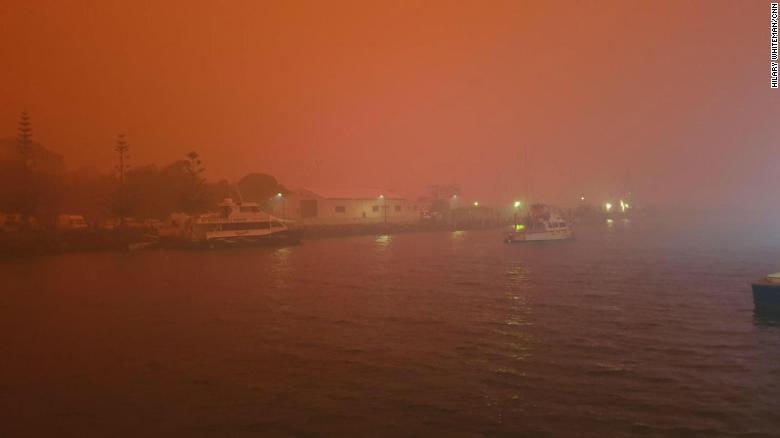
A blood-red sky looms over Eden, New South Wales, on January 5, 2020.

Earlier, NSWRFS Commissioner Shane Fitzsimmons told a news conference that Saturday was “one of our worst days ever on record.”
A “considerable number” of properties were lost across NSW on Saturday, Fitzsimmons said, adding that a 47-year-old man had died from cardiac arrest while fighting a fire threatening his friend’s home in Batlow. The man is the 24th person to die nationwide this fire season.
Separately, four firefighters in NSW were hospitalized due to smoke inhalation, heat exhaustion and hand burns. They have since been released.
Fitzsimmons said that conditions could worsen again in the coming days. “Today will be a relief — psychological relief but not what we need,” he said.
Fire-induced thunderstorms over New South Wales, seen from a flight on January 5, 2020.

Australia’s flag carrier Qantas canceled all flights to and from the country’s capital, Canberra, on Sunday due to smoke and hazardous weather conditions.
An airline passenger spotted huge clouds caused by the fires over NSW during a flight from Sydney to Melbourne on Sunday. They are pyrocumulonimbus clouds — fire-induced thunderstorms — which form when hot air rises from a ground based fire, according to CNN meteorologists. The air cools and condenses as it ascends, causing a cloud to form.
“This process is similar to the development of a thunderstorm,” said CNN Weather’s Derek Van Dam. “As such, a downdraft forms within the base of the pyrocumulonimbus cloud, allowing for embers to be picked up and carried to form new fires.”
In the neighboring state of Victoria, three fires have combined to form a single blaze bigger than the New York borough of Manhattan. The fires joined overnight Friday in the Omeo region, creating a 6,000-hectare (23 square mile) blaze, according to Gippsland’s Department of Environment, Land, Water and Planning.
The country’s capital, Canberra, smashed its heat record of 80 years, reaching 44 degrees Celsius (111 degrees Fahrenheit) on Saturday afternoon, according to the country’s Bureau of Meteorology. In the western Sydney suburb of Penrith, the mercury climbed to 48.9 degrees Celsius (120 degrees Fahrenheit) — setting a new record for the whole Sydney basin.
Victoria has declared a state of disaster, and NSW has declared a state of emergency — both granting extraordinary powers and additional government resources to battle the fires.
It marked the first time Victoria has activated these powers since the 2009 Black Saturday fires, the deadliest bushfire disaster on record in Australia with 173 people killed and 500 injured.
Speaking at a news conference Sunday, Australian Prime Minister Scott Morrison said it was another difficult night across the country — in particular in NSW, Victoria and South Australia.
Morrison — who in December faced criticism for taking a vacation to Hawaii during the fires — said the government’s response was the most significant and comprehensive ever to a natural disaster.
An eerie, smoke-filled landscape in Pambula, New South Wales, on January 5, 2020.

“I believe that’s where we need to focus our attention, and we are seeking to communicate that directly to Australians to ensure they have comfort that the response is matching the need,” he said.
“Sure there’s been a lot of commentary, there’s been plenty of criticism. I’ve had the benefit of a lot of analysis on a lot of issues. But I can’t be distracted by that, and the public, I know, are not distracted by that.
“What they need us to focus on, all of us actually, all of us focusing on the needs there and getting the support where it needs to go. That’s very much where my focus is, and that’s where it will continue to be.”
In a news release on Sunday, the Australia Defence Force (ADF) said it was significantly increasing its support in fighting the massive fires and had called up 3,000 army reserve forces and others with specialist capabilities.
An Australian army soldier helps people evacuate onto a Black Hawk helicopter in Omeo, Victoria on January 5, 2020.

They will also provide aircraft, ships and its largest vessel, HMAS Adelaide, with helicopter landing capabilities.
One priority for the ADF will be to assist in evacuations of people in isolated communities. HMAS Adelaide, the Australian Navy’s largest ship, arrived off the coast of Eden on Sunday as evacuations took place there.
Some ADF bases will be opened to house those displaced by the fires. Troops will also help move material and supplies, support recovery centers, and aid in fire trail clearance.
New Zealand and Singapore have also offered military support, and the ADF is assessing where they can help, the news release said.
Members of the UK royal family sent their “thoughts and prayers” to Australians affected by the massive bushfires through social media accounts on Saturday. Queen Elizabeth and Prince Philip issued a message of condolence expressing thanks to emergency services. “I have been deeply saddened to hear of the continued bushfires and their devastating impact across many parts of Australia,” the Queen wrote in a statement published on Twitter.
On their Instagram account, the Duke and Duchess of Cambridge said they were “shocked and deeply saddened” by “the fires that are destroying homes, livelihoods and wildlife across much of Australia,” posting a photo of a kangaroo with a burning building in the background.
Meanwhile, the Duke and Duchess of Sussex urged support for those affected by the environmental crisis in an Instagram post linking to a number of Australian fundraisers, such as the Australian Red Cross, the Country Fire Authority and the New South Wales Rural Fire Service.

Trump vows to hit 52 Iranian targets if Iran retaliates after drone strike

Exposing the Big Game's avatarThe Extinction Chronicles

BAGHDAD/WASHINGTON (Reuters) – U.S. President Donald Trump on Saturday threatened to hit 52 Iranian sites “very hard” if Iran attacks Americans or U.S. assets after a drone strike that killed Iranian military commander Qassem Soleimani and an Iraqi militia leader, as tens of thousands of people marched in Iraq to mourn their deaths.

Showing no signs of seeking to ease tensions raised by the strike he ordered that killed Soleimani and Iranian-backed Iraqi militia leader Abu Mahdi al-Muhandis at Baghdad airport on Friday, Trump issued a threat to Iran on Twitter. The strike has raised the specter of wider conflict in the Middle East.

Iran, Trump wrote, “is talking very boldly about targeting certain USA assets” in revenge for Soleimani’s death. Trump said the United States…

View original post 1,127 more words

Will Canada’s Polar Bears Disappear with Declining Sea Ice?

Exposing the Big Game's avatarThe Extinction Chronicles

Majestic polar bears in Churchill, Manitoba. Photo by Fiona Morrow.

At the edge of the unwelcoming shores of Hudson Bay a rainbow suddenly appears, both ends visible above the granite-grey, choppy waters. The ray of sunshine that comes with it is equally fleeting, bookended by sharp winds that sting any exposed inch of skin with ice.

We’ve been in Churchill, Manitoba for less than an hour but this sparse, frozen landscape is already overwhelming.

There may be no roads in or out of this tiny hamlet (population 800) but in the weeks before the deep freeze of winter really takes hold, Churchill explodes in size. In the Tundra Inn restaurant, hundreds of plates heaving with elk meatloaf, bison stew, and the house-made veggie “Borealis Burger” are served daily to tourists who have paid handsomely to stay in modest accommodations for a few days. We have come…

View original post 927 more words

Las Vegas man’s dog caught in baited trap on popular hiking trail

Exposing the Big Game's avatarCommittee to Abolish Sport Hunting Blog

LAS VEGAS (FOX5) — A Summerlin man was out hiking when his dog stepped on a baited trap. He believes it was meant to catch coyotes.

He shared the scary encounter only with FOX5.

“This was less than one foot off the trail,” the man said as he showed the trap that caught his dog.

He asked FOX5 to hide his face, but he couldn’t hide his emotions.

“Fury,” he said. “At first I was shaking. The trap was buried. There was a tuna can with some meat in it, which was right beside it.”

The man and his four-legged friend were walking a busy trail behind the Far Hills community in Summerlin. He said his dog stepped on the edge of it so it bounced up…

View original post 349 more words

Giant Chinese paddlefish dubbed the ‘Panda of the Yangtze River’ is declared extinct due to overfishing and habitat loss

Exposing the Big Game's avatarThe Extinction Chronicles

The giant Chinese paddlefish was said to be up to 22 feet in length but was on average around 10 feet long - one of the biggest freshwater fish in the world

  • The giant Chinese paddlefish up to 10 feet in length has been found to be extinct
  •  Researchers say its native Yangtze River has been affected by human activity 
  • Conservation efforts on endangered Yangtze fishes are now urgently needed. 

https://www.dailymail.co.uk/sciencetech/article-7848271/Giant-Chinese-paddlefish-dubbed-Panda-Yangtze-River-declared-extinct.html

View original post

Scott Morrison’s Hawaii horror show: how a PR disaster unfolded

Exposing the Big Game's avatarThe Extinction Chronicles

The PM went on holiday for a few days. It didn’t need to look like a political crime scene. But as usual, the cover-up made everything 10 times worse

Climate protesters at Kirribilli House
 Climate campaigners at Kirribilli House protest against Scott Morrison’s Hawaii holiday while bushfires rage across large parts of Australia. Photograph: Jenny Evans/Getty Images

Throughout history, the world’s greatest minds have attempted to simplify Ockham’s razor.

William of Ockham’s principle was a fairly simple thing – “entities should not be multiplied unnecessarily”. Isaac Newton used it to apply to competing scientific theories. Robert Hanlon riffed off it to sum up political blunders: “never attribute to malice that which is adequately explained by stupidity”. Which brings us to modern politics, where the simplest interpretation – “cock up over conspiracy” – reigns supreme.

Nixon wasn’t done in by the crime but the cover-up. And…

View original post 2,358 more words

Geoengineering Wouldn’t Be Enough to Stop Greenland From Melting

Filed to:ICE ICE MAYBE
1.5K
5
1
Illustration for article titled Geoengineering Wouldnt Be Enough to Stop Greenland From Melting
Photo: Getty

When the Greenland ice sheet went into a record meltdown in the summer of 2019, it raised a very terrifying specter of the future. Here was a 12.5-billion-ton mass of ice—one that’s been melting at a quickening pace since the 1980s—melting in a way scientists didn’t expect to happen for decades.

While the ice sheet won’t completely disappear for centuries, any further increase in its melt will put coastal communities at risk of inundation. There’s an argument to be made that we should do everything possible to save the ice, and a new study explores a very controversial idea to that end: cooling the planet.

The findings, published last month in Earth’s Future, explore what would happen if the world pumped particles high into the atmosphere that would reflect sunlight back into space. This high-altitude air conditioning scheme, known as solar radiation management or SRM, would bring down the global average temperature. The paper’s results show that cooling would help slow—though not stop—the melting of the ice sheet. That could buy coastal regions time but also change the climate in other ways that may end up hurting other regions around the world.

The threats to Greenland ice are coming from seemingly all directions. Relatively hot water has undercut the glaciers tumbling down from the ice sheet, while rising air temperatures have melted it from above. Recent wildfires have also left a cake of dark soot that absorbs more sunlight, enhancing surface melt. And then there are surface pools of water that funnel into cracks in the ice, further destabilizing it. In short, climate change is engaged in an all-out war on the ice sheet that will only intensify in the coming century. Projections indicate the ice sheet melting could lead to anywhere from 10 to 20 centimeters (4 to 8 inches) of sea level rise this century, with much higher rates of rise in the Pacific.

To understand the impact geoengineering could have on Greenland, scientists ran models that simulate the climate throughout the century under a few different scenarios. In some scenarios, greenhouse gas pollution increased throughout the century or peaked by mid-century. They then took those same scenarios and added in a splash of geoengineering. The models they ran basically shot particles into the stratosphere around the equator that then dispersed around the globe. The impacts are based in part on what happens after volcanic eruptions, and the study used the equivalent a quarter of a Pinatubo eruption every year.

The results show that the planet-cooling properties of the particles would extend to Greenland, lowering air temperatures there by about 1.1 degrees Celsius (2 degrees Fahrenheit) compared to the scenarios without geoengineering. Runoff from melt would drop anywhere from 20 to 32 percent, with the biggest difference coming under the high greenhouse gas emissions scenario. All that means sea level rise would slow.

Doug MacMartin, a Cornell scientist who has studied geoengineering, told Earther the study’s findings were in line with you’d expect from solar radiation management but that the findings used older models. Future work updated with new models could go a long way to building on the findings, and the study itself notes that some key aspects of atmospheric circulation are simplified.

But it’s not all puppies and unicorns. Geoengineering alone wouldn’t be able to stop ice from melting. It could also wreak havoc with weather in other parts of the globe, potentially pitting nations against each other. And then there’s the most concerning aspect of geoengineering, which is that once we start in on cooling the planet, stopping it could risk sudden, catastrophic climate change. So any plan to do this requires a long, hard think and making sure everyone has a say, not just rich countries with tons of coastal real estate.

“Could geoengineering affect the Arctic? How effective would it be at offsetting projected polar changes due to climate change? Would there be any side effects or unintended consequences?” Ben Kravitz, a geoengineering researcher at Indiana University, told Earther in an email. “Answering these questions is critical, and this study is a welcome step in addressing such questions.”

Indeed, as the world continues to put off the best climate change solution (which would be cutting emissions), it moves closer to considering more risky ways to address the changes set in motion by decades of unbridled fossil fuel use. That makes exploring these ideas in the scientific literature terrifying and important all at once.

“We don’t know enough about [solar radiation management] today, but we don’t want to be in a position of making hasty choices some point in the future—which is exactly why studies like this one are so important,” MacMartin told Earther in an email.

Equally important, and something that MacMartin emphasized as well, is actually doing the hard work of cutting carbon emissions. As the results make clear, blocking out sunlight is nowhere near enough to protect the coasts.

SHARE THIS STORY

GET OUR NEWSLETTER

Subscribe

MORE FROM EARTHER

Turns Out a Wild Geoengineering Plan to Refreeze Arctic Sea Ice Isn’t the Best Idea

What Would It Be Like to Live in an Era of Geoengineering?

Veganism; ‘strict’ or ‘simple’ – a matter of perspective

There's an Elephant in the Room's avatarThere's an Elephant in the Room blog

Image by Filming for Liberation

I have heard it said that ‘militant’ members of the community ‘scare off’ people from becoming vegan with ‘strict guidelines.’ I have found living vegan to be the easiest, most consistent, most nonviolent way to live that I could possibly imagine, so I have kept coming back to the idea, trying to work out why anyone would say such a thing.

I accept that depending on circumstances and the availability of food types in some parts of the world, transition to veganism may pose a few challenges, even maybe temporary inconvenience, but that’s not the same as ‘strict’. ‘Strict’ denotes something that limits one’s freedom to behave as they wish; it suggests something difficult, rigid obedience to a set of complex rules and regulations. ‘Militant’ suggests confrontation and aggression, and is often used in a derogatory manner to attempt to silence disagreement. So let’s have…

View original post 1,021 more words

Isle Royale official: Wolves could soon form pack

  DEC 25, 2019

CREDIT EVA BLUE / UNSPLASH

Wolves on Isle Royale have begun to hunt and travel as a group.

It’s part of a process park officials say could eventually lead to the formation of the island’s first new pack.

Three of the island’s 15 wolves have begun to travel together, the group is made up of two males and one female.

“It will take a little time to see if we would consider them a pack because they have to be traveling together, defending the territory, and then also we’ll see in the spring if they reproduce,” says Liz Valencia, Isle Royale National Park’s temporary superintendent. “Then we’ll have an established pack.”

Valencia says if a pack forms on the island, she’ll consider it a success. The goal is to keep moose populations in check.

“When a pack forms, then they can take down more moose and that really shows that we brought these wolves out there and so far that has been a success because they have grouped together and formed packs.”

The park has also noted that two wolf deaths from the fall of this year were caused by other wolves.

Valencia said aggression between wolves was not unexpected.

“Researchers did expect that would happen. So many wolves are on the island, they are trying to establish territories, they are trying to sort out the social hierarchy, so that will happen on the island as wolves do that.”

One of the wolves that died was an old male that was on the island before relocation efforts began.

The US, Iran, and the fallout of Soleimani’s assassination

Exposing the Big Game's avatarThe Extinction Chronicles

    The US strategy towards Iran and Iraq may have changed, but the Iranian response will be more of the same. Much more.

    by Marwan Bishara
      Iranian guards hold a picture of Iranian General Qassem Soleimani, during a protest against his killing, in front of the UN office in Tehran, on  January 3, 2020 [WANA/Nazanin Tabatabaee via Reuters]
      Iranian guards hold a picture of Iranian General Qassem Soleimani, during a protest against his killing, in front of the UN office in Tehran, on January 3, 2020 [WANA/Nazanin Tabatabaee via Reuters]

      The assassination of Iranian general Qassem Soleimani has ushered in another turbulent decade for the Middle East. United States President Donald Trump‘s decision to greenlight the assassination of the head of the Quds Force, the paramilitary wing of Iran’s Islamic Revolutionary Guard Corps, is for all practical purposes a “declaration of war” with far-reaching…

      View original post 860 more words