[I haven’t seen it yet, but this message I happen to agree with: “…the film, has suggested that unrestrained economic and population growth should be the target of environmentalists’ efforts rather than technological fixes.”]
Planet of the Humans, which takes aim at the green movement, is ‘full of misinformation’, says one online library
A still from Planet of the Humans, which has provoked a furious reaction. Photograph: Erik Pedersen/Handout
[I haven’t seen it yet, but this message I happen to agree with: “…the film, has suggested that unrestrained economic and population growthshould be the target of environmentalists’ efforts rather than technological fixes.”]
A new Michael Moore-produced documentary that takes aim at the supposed hypocrisy of the green movement is “dangerous, misleading and destructive” and should be removed from public viewing, according to an assortment of climate scientists and environmental campaigners.
The film, Planet of the Humans, was released on the eve of Earth Day last week by its producer, Michael Moore, the baseball cap-wearing documentarian known for Fahrenheit…
Are McDonald’s famous golden arches on the way out? (Photo: Adobe. Do not use without permission)
From the time the UK saw its first set of golden arches go up in 1974, our nation had never experienced a widespread closure of McDonald’s restaurants… until COVID-19 crossed our shores.
For the first time in decades, people no longer have access to the American company’s signature burgers and chicken nuggets. But is this such a bad thing for customers? And how will this impact animals?
It’s been proven that the immune systems of animals raised on lower welfare factory farms are far weaker than any other; couple this with the immense overcrowding seen on these intensive farms – where some 90 percent of farmed animals are raised – and the risk of contracting and spreading dangerous diseases is worryingly high.
McDonald’s contribution
That being said, how is McDonald’s contributing to this issue? In part due to their size, chickens are the land animals raised in the greatest numbers by far. Every single year, approximately 25 million chickens are bred and slaughtered for McDonald’s UK alone.
That’s nearly one chicken for every two Brits, before even factoring in the many other animals that suffer immensely in order to maximise the company’s profits.
But maybe these birds are raised to high welfare standards and meet a relatively painless end…? Sadly not. Despite key competitor KFC adopting a robust set of chicken welfare standards in July 2019, known as the Better Chicken Commitment, McDonald’s is still yet to follow suit.
Every single year, approximately 25 million chickens are bred and slaughtered for McDonald’s UK alone
Welfare issues
Among other issues, the company has failed to make a commitment to end the use of fast-growing chickens, meaning that the millions of birds in its supply chain grow so big, so fast, that their legs and organs are pushed to the absolute limit.
Some become unable to walk, while others die of heart attacks in just the first few weeks of their short lives. To make matters worse, these enormous birds are shockingly packed into sheds by the tens of thousands, each having as little space as an A4 piece of paper.
You’d be forgiven for thinking that the miserable, pain-ridden lives of these animals couldn’t get any worse, but sadly that’s not the case. At just five weeks old, they will experience a distressing journey to the slaughterhouse, where they will face a terrifying end. Because of the current stunning methods permitted by companies like McDonald’s, there’s no guarantee that every bird will be rendered unconscious before having their throats slit and bodies dunked in scalding hot water. The thought alone is too much to bear.
Do the animal-loving people of the UK really want chickens to be raised in such a horrific way? No.
Do they want companies like McDonald’s to put the public’s health at risk by continuing these potentially dangerous practices? Absolutely not.
The fast-food giant has failed to keep up with its competitors when it comes to offering meat alternatives (Photo: Adobe. Do not use without permission)
Meat alternatives
Could it be that McDonald’s has instead focused its efforts on reducing the sale of meat to tackle these issues? Unfortunately not.
While KFC has spared no time in introducing its first plant-based burger, and Burger King following suit with its veggie Rebel Whopper, McDonald’s has failed to satisfy the public’s growing appetite for good quality meat-alternatives. The company’s meagre offering of veggie dippers earlier this year certainly did not get its customers’ heart’s racing.
During this challenging period, we have a great opportunity to take stock of what’s going on in the food industry and reevaluate which companies are acting in the best interests of people and animals. Likewise, companies like McDonald’s have the chance to restrategize and start making meaningful changes that benefit society.
There has never been a better time for McDonald’s to step out of the dark ages of food production and into the modern day. 2020 is a dangerous time for food companies to ignore the growing demand for high animal welfare standards and delicious plant-based food. If these issues aren’t addressed soon, we could be looking at the beginning of the end for McDonald’s.
The number of wolves in Washington has reached its highest level since they were essentially eliminated from the state in the 1930s, according to a report from the Department of Fish and Wildlife.
As of December 2019, there were an estimated 145 wolves across 26 packs living in the state.
Comparatively WDFW reported 133 wolves across 27 packs in 2018.
While this is a win for wolf conservation efforts, it also creates other challenges such as increased livestock attacks. Last year was a particularly rough year for livestock attacks, WDFW Director Kelly Susewind said in a press release.
“We are working with citizens and communities to strike a balance so both livestock producers and wolves can share the landscape and thrive in Washington,” she said.
“As the wolf population begins to recover, we’re going to see population growth slow in parts of the state where the local population is nearing capacity,” wolf specialist Ben Maletzke said.
In 2019, there were 21 documented wolf mortalities, 18 of which were by landowners protecting cattle, legal tribal harvests or by the WDFW in response to livestock attacks.
Fourteen cattle across the state were killed by wolves in 2019 and another 11 were injured. WDFW notes that 85% of the wolf packs have had no involvement in cattle attacks.
“We had more negative impacts to cattle and lethal removals last year than we’d like to see. It’s been a challenging situation, but ranchers are continuing to play an important role in reducing wolf-livestock conflict,” WDFW wolf policy lead Donny Martorello said.
Since 1980, gray wolves have been listed as an endangered species in Washington. In Western Washington they are protected by the federal Endangered Species Act, and in Eastern Washington they are managed by rules in the 2011 WDFW Wolf Conservation and Management Plan.
A second round of the coronavirus is ‘inevitable,’ the nation’s leading epidemiologist says, but just how bad it is will depend on the progress the US makes in the coming months.
“If by that time we have put into place all of the countermeasures that you need to address this, we should do reasonably well,” Dr. Anthony Fauci said. “If we don’t do that successfully, we could be in for a bad fall and a bad winter.”
If states begin lifting restrictions too early, Fauci says he predicts the country could see a rebound of the virus that would “get us right back in the same boat that we were a few weeks ago,” adding that the country could seemany more deaths than are currently predicted.
So far, more than 1 million Americans have been infected and at least 58,355…
The Ingham County Sheriff’s Office said a 21-year-old was shot over the weekend after a hunter mistook him for an animal. (Source: WILX)
By News 10 |
Posted: Mon 1:42 PM, Apr 27, 2020 |
Updated: Tue 3:08 PM, Apr 28, 2020
WILLIAMSTON, MI (WILX) — The Department of Natural Resources said a 21-year-old man is doing fine after a hunter mistook him for an animal, shooting him over the weekend.
The incident happened around 2 a.m. Saturday morning in the area of Meech Road, near some railroad tracks.
Four teenagers were hunting for coyotes and one of the teenagers, 19, thought he saw a coyote in the area. He ended up shooting the 21-year-old.
The Ingham County Sheriff’s Office confirmed the 21-year-old was walking on the railroad tracks near Meech Road and Grand River Avenue when the incident happened.
As I sit in my home office, dutifully socially isolated from the rest of humanity, I find myself growing weary of the “deniers”. And I don’t only mean the dwindling numbers of conspiracy theorists claiming the COVID-19 pandemic that is imposing my self-isolation, as if it were some vast “socialist” plot to destroy capitalism and free enterprise, but also those who want to return to “business as usual”, the very thing that got us into this costly, and dangerous, mess in the first place. I finally decided to respond to one, not to change the minds of those who wrote it, but to provide an analysis of their views.
The authors are Dan Challender, Amy Hinsley, Diogo Veríssimo and Michael `T Sas-Rolfes. It…
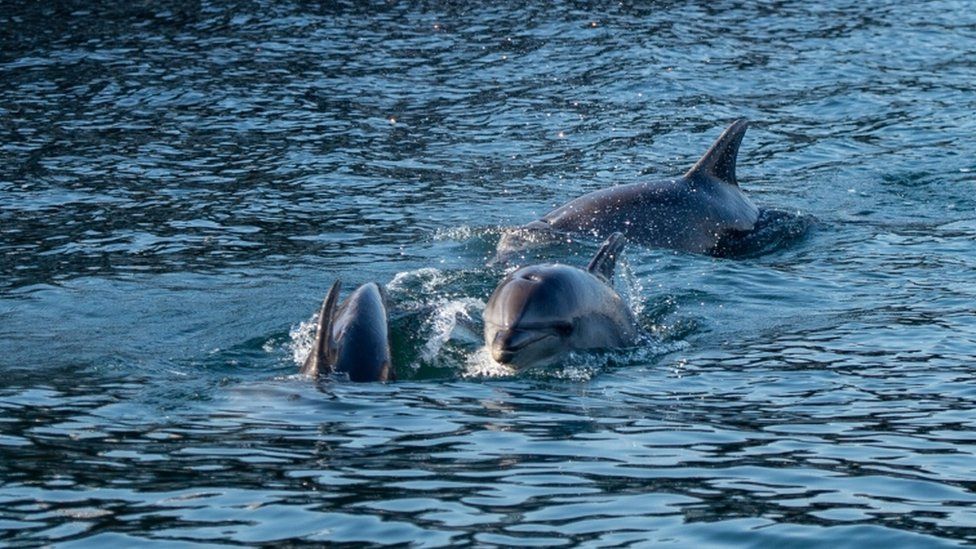
Image copyrightAFPImage captionThree types of dolphins including bluenose can be found in the Bosphorus, Istanbul
Coronavirus lockdowns globally have given parts of the natural world a rare opportunity to experience life with hardly any humans around.
Animals in urban areas are exploring emptied streets and waterways, and delighting human inhabitants along the way.
While many of these are not unique sightings, the human restrictions due to the coronavirus pandemic seem to have given animals the confidence to go deeper into our cities and stay for longer.
Others are enjoying having nature reserves and parks all to themselves, and some authorities report a boom in wildlife while tourists are away.
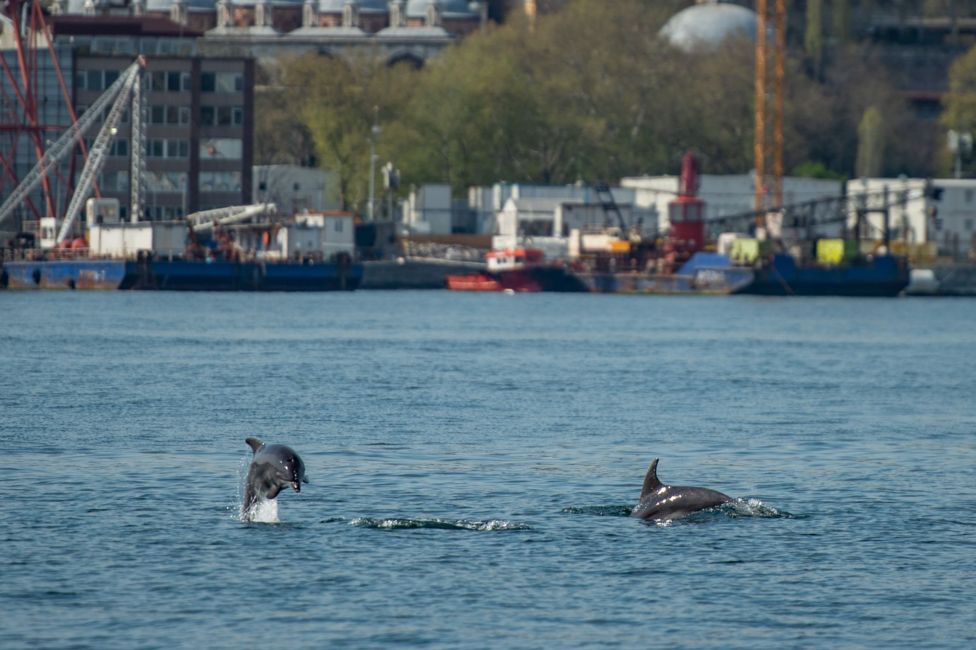
Image copyrightAFPImage captionResidents of Istanbul say dolphins are coming further up the Bosphorus than usual
The Bosphorus in Istanbul, Turkey is normally one of the world’s busiest marine routes. Huge tankers, cargo ships and passenger boats criss-cross the straits that cut the city in half 24 hours a day.
Now, with a lull in traffic and fishermen staying at home during the city’s lockdown, dolphins are swimming and jumping in the waters.
It’s not uncommon to spot the tell-tale dots of a dolphin from the city’s quays, far away in the distance. But videos posted by residents of the animals swimming near the banks show how much closer to the city they’re happy to come now.
Dolphins “are coming closer to the edge of the water as the terror of uncontrolled anglers on the shoreline has temporarily stopped,” a ship spotter who has photographed dolphins in the past told AFP.
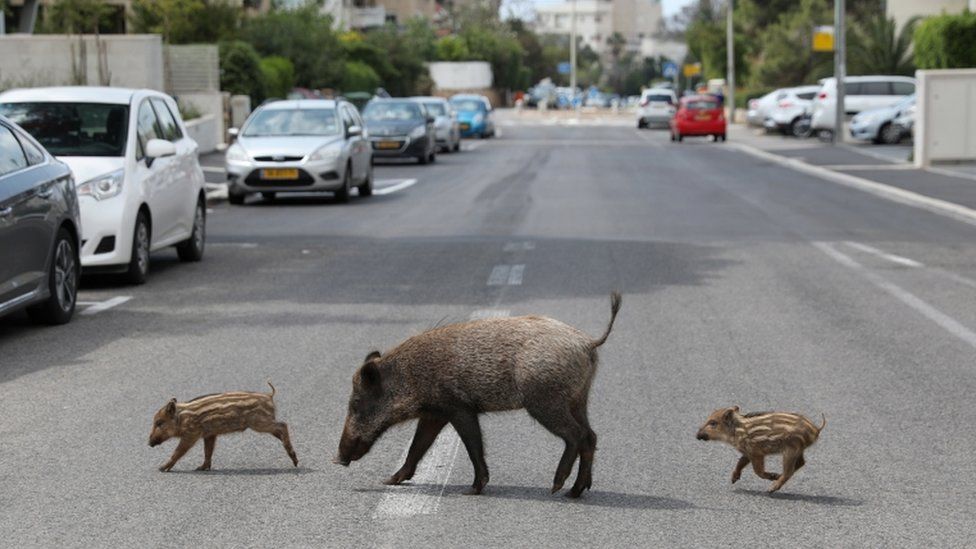
Image copyrightEPAImage captionWild boar in Haifa, Israel are enjoying food left in resident’s rubbish bins
Boars were seen snuffling and foraging for food around the city of Haifa before the pandemic, but the absence of humans has encouraged them further, residents say.
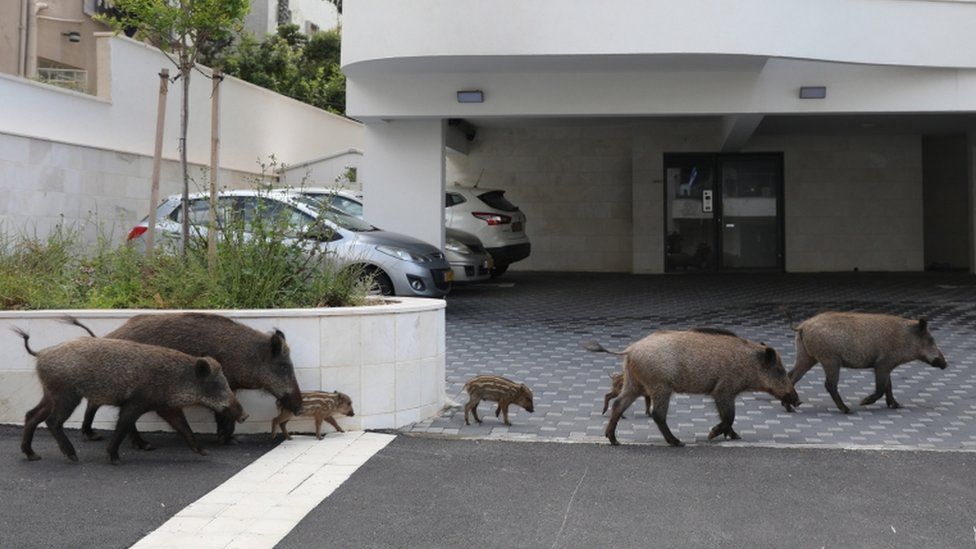
Image copyrightEPAImage captionSome groups feed the boar, but others want them to be removed
The issue is now so serious that local officials held a Zoom meeting to discuss the expanding population.
“I’m scared that after the coronavirus passes, the boars will have gotten used to coming every day, every night, every hour,” Yaron Hanan who is campaigning for a crackdown on the animals told Reuters.
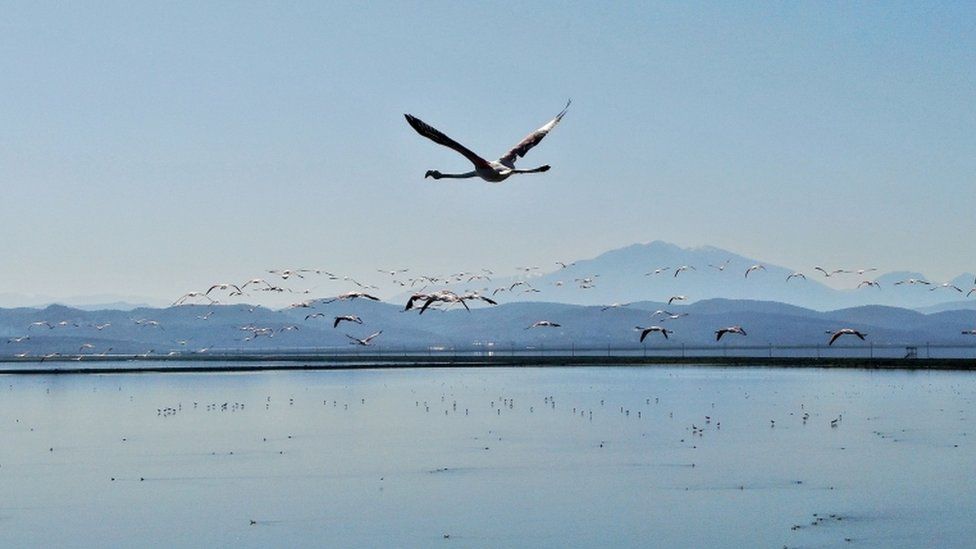
Image copyrightAFPImage caption“It’s time for love,” an environmental expert said about flamingos arriving in Albania to mate
However some species are enjoying solitude in previously busy natural reserves or parks.
In Albania, pink flamingos are flourishing in lagoons on the country’s west coastline, where numbers have increased by a third to 3,000, park authorities told AFP.
Thousands have been seen soaring over the waters at Narta Lagoon where they go to mate after flying from Africa and the southern Mediterranean.
Nearby olive oil and leather processing factories that have been accused of polluting the waters are closed, and the traffic that usually congests a road 500m away is absent, creating quiet for the birds.
Couples have been “moving a little further into the lagoon and are now starting courtship rituals,” said Nexhip Hysolakoj, the head of the Vlora protected area.
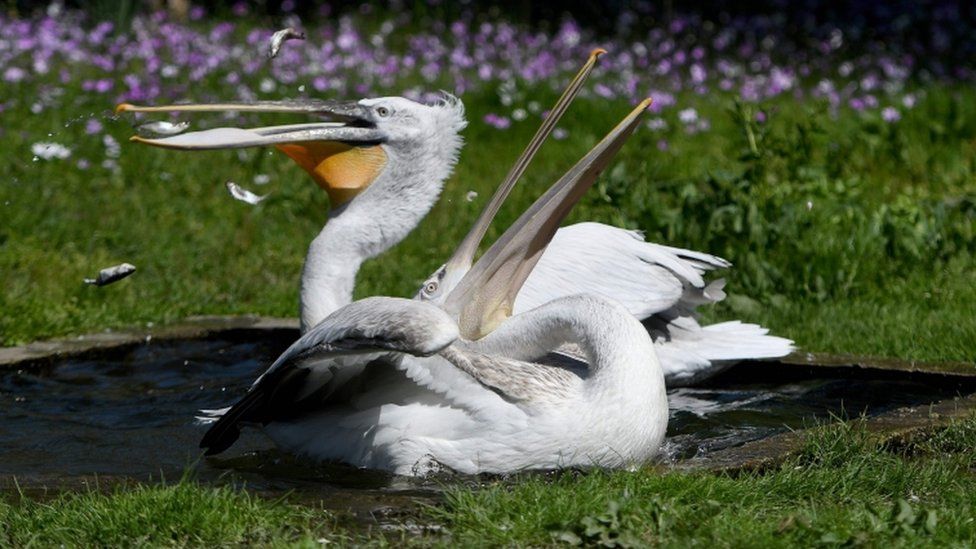
Image copyrightAFPImage captionDalmatian or curly pelicans are known for the ruffle of feathers on their heads
And in Divjaka National Park, 85 pairs of curly pelicans are nesting. The usual 50,000 monthly tourists are keeping away, creating quiet in the area where officials hope a population boon will now happen.
Image copyrightAFP/ THAILAND’S NATIONAL MARINE PARKImage captionThe Hat Chao Mai National Park caught a herd of dugong on video
The dugong, also known as sea cow, is classed as a vulnerable species and can often fall victim to fishing nets or suffer due to water pollution.
The national park has been posting videos on Facebook of large swarms of fish and other species, and says there has been a revival in wildlife since the pandemic began.
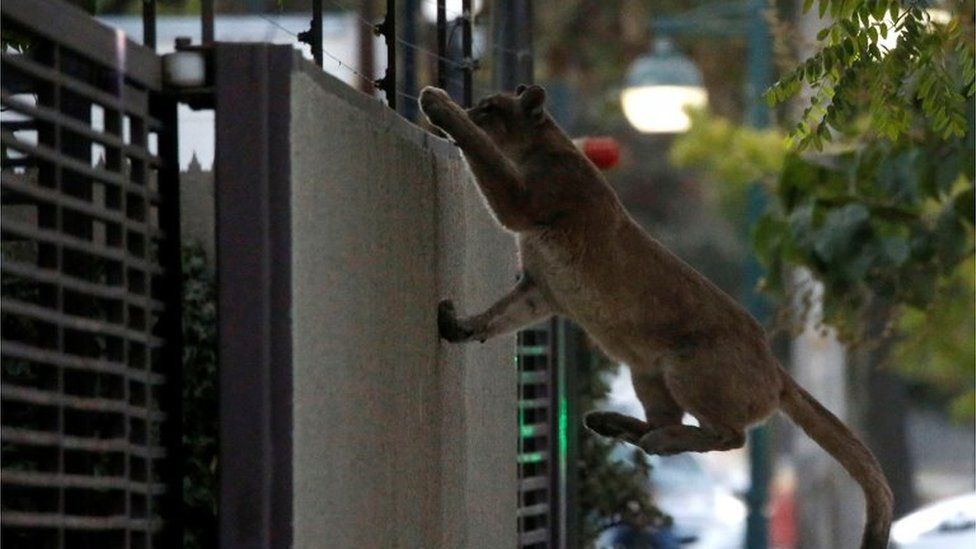
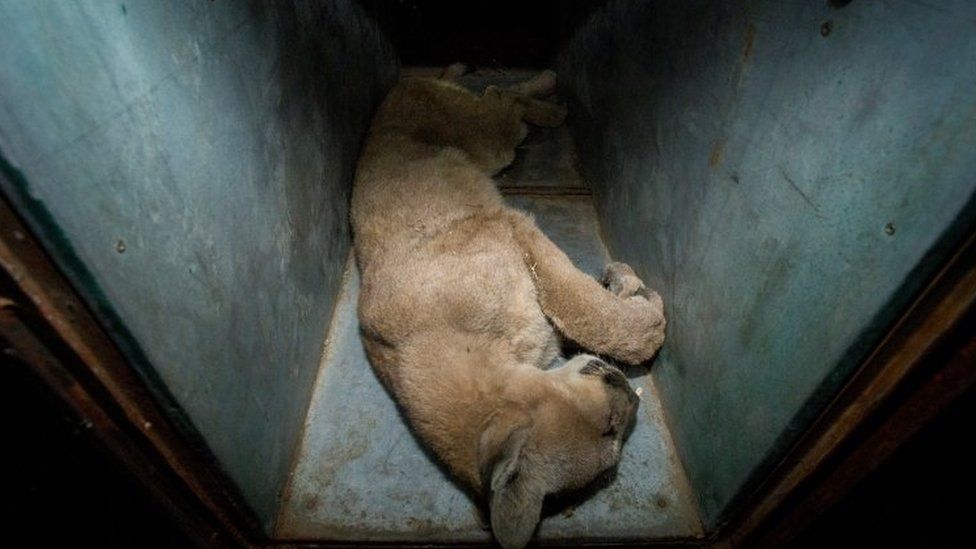
Image copyrightREUTERSImage captionThe first cougar to be spotted in Santiago was snapped jumping onto a wall
However some animals enjoying new adventures aren’t able to stay around for long.
“They sense less noise and are also looking for new places to find food and some get lost and appear in the cities,” Horacio Bórquez, Chile’s national director of livestock and agriculture service, said of the animals.
Media captionThe curious goats have been spotted eating flowers and hedges in people’s gardens
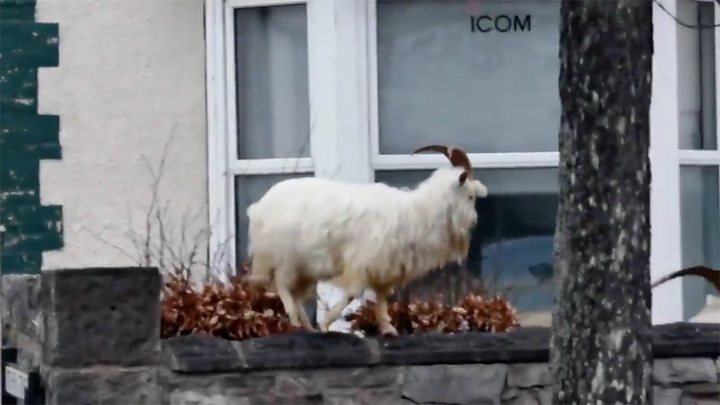
And who could forget the famous Kashmiri goats of Llandudno?
They enjoyed the deserted town in Wales and had a scamper around last month. Some even helped themselves to garden flowers and hedges.
But not all creatures are benefitting from the coronavirus lockdown.
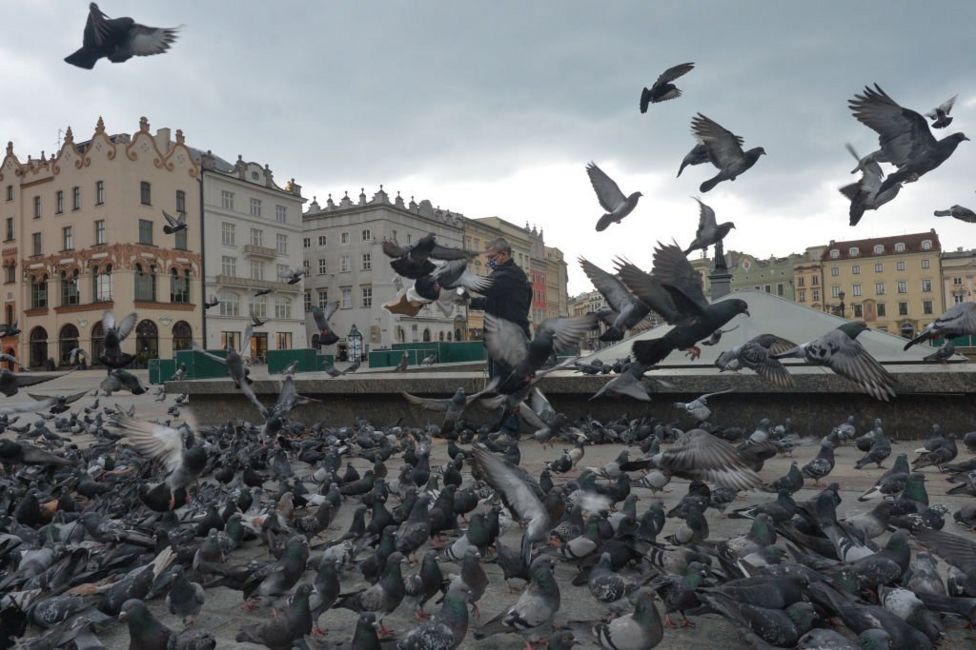
Image copyrightGETTY IMAGESImage captionMembers of Krakow’s Animal Welfare Organisation are feeding the city’s pigeons daily
Europe’s pigeons risk starvation, warns an animal rights group in Germany. That’s because the humans who normally feed them or drop morsels of food on the streets are stuck at home. The group, while acknowledging that pigeons are a problem for many cities, says they should not be allowed to die a painful death.
In Krakow, Poland, one animal welfare organisation is coming out specially to feed the flocks abandoned for the time being.
Peter T. Spooner receives funding from Europe’s Horizon 2020 ATLAS project, the National Environment Research Council (UK), and the Leverhulme Trust. The work was also part funded by the National Science Foundation (USA). He is affiliated with the Green Party (UK).
ocean circulation may have caused a shift in Atlantic Ocean ecosystems not seen for the past 10,000 years, new analysis of deep-sea fossils has revealed.
This is the striking finding of a new study led by a research group I am part of at UCL, funded by the ATLAS project and published in the journal Geophysical Research Letters. The shift has likely already led to political tensions as fish migrate to colder waters.
The climate has been quite stable over the 12,000 years or so since the end of the last Ice Age, a period known as the…
Share this with EmailShare this with FacebookShare this with Twitter
Image copyrightEPA
Image captionClosures of meat processing plants quickly affect the food supply chain
US President Donald Trump has ordered meat processing plants to stay open to protect the nation’s food supply amid the coronavirus pandemic.
He invoked a Korean War-era law from the 1950s to mandate that the plants continue to function, amid industry warnings of strain on the supply chain.
An estimated 3,300 US meatpacking workers have been diagnosed with coronavirus and 20 have died.
The UN last month warned the emergency threatened global food supply chains.
Twenty-two US meatpacking plants across the American Midwest have closed during the outbreak.
They include slaughterhouses owned by the nation’s biggest poultry, pork and beef producers, such as Smithfield Foods, Tyson Foods, Cargill and JBS USA.
“Such closures threaten the continued functioning of the national meat and poultry supply chain, undermining critical infrastructure during the national emergency,” says Tuesday evening’s executive order, invoking the 1950 Defense Production Act.
“Given the high volume of meat and poultry processed by many facilities, any unnecessary closures can quickly have a large effect on the food supply chain.”
The order designates the meatpacking plants as part of critical infrastructure in the US.
A White House official told US media it will work with the Department of Labor to issue guidance for vulnerable workers, such as over-65s and those with chronic health conditions, to stay at home.
Like lambs to the slaughter?
Analysis by Jessica Lussenhop, BBC News
The leadership of large meatpacking companies have faced tough questions over whether they did enough to prepare for the pandemic and protect workers.
On top of the fact that production lines necessitate that workers stand very close together, most are low-income, hourly workers.
Many are immigrants living paycheque to paycheque, like the ones at a Sioux Falls, South Dakota, pork plant who told the BBC that despite the risk, they have no choice but to go to work if plants are open.
Without strict adherence to safety guidelines – which are not currently being deemed “mandatory” by the Occupational Safety and Health Administration – it’s not hard to picture new outbreaks at factories, or resurgences of the virus in factories that shuttered but reopen prematurely.
All of this could leave these employees trapped in the same impossible choice they were in when the virus first began spreading in factories in late March: risk my health or lose my job.
What does the meat industry say?
John Tyson, chairman of Tyson Foods took out full-page ads on Sunday in the Washington Post and New York Times to warn “the nation’s food supply is breaking”.
“As pork, beef and chicken plants are being forced to close, even for short periods of time, millions of pounds of meat will disappear from the supply chain,” he wrote.
“As a result, there will be limited supply of our products available in grocery stores until we are able to reopen our facilities that are currently closed.”
He said millions of cattle, pigs and chickens will be euthanised because of slaughterhouse closures, limiting supplies at supermarkets.
Pork production has borne the brunt, with daily output slashed by at least a quarter.
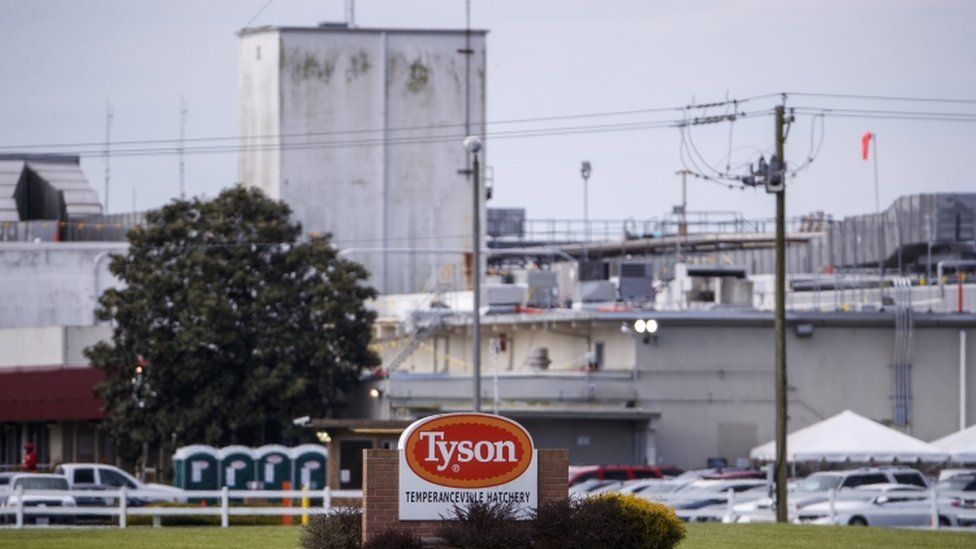
Tyson – which employs some 100,000 workers nationwide – has suspended operations at its pork plant in Waterloo, Iowa.
Smithfield Foods shut down production at its plant in Sioux Falls, South Dakota, after an outbreak infected hundreds of employees.
What do the unions say?
The United Food and Commercial Workers International Union (UFCW), the largest US meatpacking union, demanded the Trump administration compel meat companies to provide proper protective equipment and ensure daily coronavirus testing for slaughterhouse workers.
“While we share the concern over the food supply, today’s executive order to force meatpacking plants to stay open must put the safety of our country’s meatpacking workers first,” said the union.
The UFCW said the White House order would provide legal cover to companies in case employees catch coronavirus at work.
“We’re working with Tyson,” Mr Trump told reporters in the Oval Office earlier on Tuesday. “We’re going to sign an executive order today, I believe, and that will solve any liability problems.”
Richard Trumka, the president of the AFL-CIO union, said: “Using executive power to force people back on the job without proper protections is wrong and dangerous.”
Tyson Foods warns that ‘millions of pounds of meat’ will disappear from the supply chain
Canadian farmers sell about six million piglets or “feeder pigs” to farmers in the United States every year — about 20 per cent of the country’s total.Damien Meyer/AFP/Getty Images files
Broad shutdowns of major U.S. meat packing plants due to COVID-19 are deepening woes for Canadian pork farmers, choking food supply chains and snuffing out demand for thousands of baby piglets sold across the border each week.
Pork slaughtering capacity in the United States has fallen by about 25 per cent after at least 13 abattoirs were forced to temporarily halt operations due to outbreaks of the virus, according to the United Food and Commercial Workers International Union.
Those closures include three of the largest pork processing plants in the country — Smithfield Foods in Sioux Falls, South Dakota, JBS pork processing in Worthington, Minnesota and Tyson Fresh Foods in Waterloo, Iowa — which together represent about 15 per cent of U.S. capacity.
With no room at meat packing plants, thousands of pigs remain on American farms, limiting space and demand for young piglets from Canada.
Indeed, Canadian farmers sell about six million piglets or “feeder pigs” to farmers in the United States every year — about 20 per cent of the country’s total. Delivered to finishing barns at an age of 24 days old or 40 lbs, the piglets are subsequently grown to a weight of about 250 lbs and then slaughtered.
Now, problems at the meat packing level have created backups throughout the highly integrated North American supply chain, cratering demand and prices for both live hogs at processing plants and for Canadian piglets at U.S. finishing barns.
“Every day those piglets go on a train to the U.S.,” said Rick Bergmann, a Manitoba pork farmer and chair of the Canadian Pork Council. “But now the finishing barns in the U.S. are jammed up. Farmers down there are telling us ‘if I can’t sell my big pigs how am I going to take your piglets?’”
Bergmann, who typically ships 800 piglets south of the border each week, recently gave a delivery of the animals away for free rather than incur the added cost of keeping them on his farm. With each of the 800 piglets costing $40 to raise, the hit to Bergmann’s bottom line was more than $32,000.
The picture is even darker in the U.S., where discussions have turned to culling herds of animals before they grow too large for slaughter, Bergmann said.
“We’re not there yet, but these are ugly numbers we’re seeing,” he said.
As the spread of coronavirus infections in Canada delays both the delivery of animals into processing plants and the flow of finished pork products to grocery store coolers, the parallel crisis in the U.S. is likely to exacerbate any domestic shortages and price increases here, said Chad Hart, an agricultural economist at Iowa State University.
That’s because, just as Canadian farmers send feeder pigs to the U.S., American farmers send pork products back to Canada, a “rhythm has been messed up by COVID-19 and the closure of plants,” Hart said.
The parallel crisis in the U.S. is likely to exacerbate any domestic pork shortages and price increases in Canada.Stringer/Reuters files
Much of the reduced supply pumped out by U.S. meat packers is expected to be absorbed by the local market, reducing the potential for American meat to backfill any shortages of Canadian pork.
“We are in a weird situation where pork prices will be rising at the grocery store at a time when hog prices are the lowest in a decade and all because of a pinch point at the processing plants,” he said. “If you’re a hog producer, this is easily the most challenging time you have seen in your career.”
In a full-page advertisement in the New York Times on Sunday, Tyson Foods Inc.’s board chairman John Tyson warned that “millions of pounds of meat” will disappear from the supply chain as the pandemic forces processing plants to close, leading to product shortages in grocery stores.
“The food supply chain is breaking,” Tyson wrote. “Millions of animals — chickens, pigs and cattle — will be depopulated because of the closure of our processing facilities.”
If you’re a hog producer, this is easily the most challenging time you have seen in your career
A cruel twist for farmers is that the bottleneck in processing arrived at a time when global demand for pork exports soared following an outbreak of African swine fever that eliminated half of China’s domestic herd — sending the country on a global hunt for protein.
Canada was expected to benefit from that rise in demand after Beijing lifted a temporary ban on Canadian meat in January. Pork exports to China rose 46.4 per cent in February (before the COVID-19 virus swept through North America) compared to the same month a year ago, according to the Canadian Pork Council. March figures are not yet available.
“This is not a demand problem, it’s a supply chain problem,” Hart said.
But with social distancing and other procedures to protect against COVID-19 likely to be required for some time, jumping on that demand will likely remain a challenge.
“One reason the North American industry is so efficient is we can produce a lot of meat in a short amount of time,” said Hart. “To do that you need a lot of employees working very closely together. So the same characteristics that make our industry efficient are also what this virus preys upon.”













 Exposing the Big Game