


Author links open overlay panelFleurHierinkab1IsabelleBolona1Andrew M.DursoadRafaelRuiz de CastañedaaCarlosZambrana-TorreliocEvan A.EskewcNicolasRayabShow morehttps://doi.org/10.1016/j.biocon.2020.108601Get rights and content
https://www.sciencedirect.com/science/article/abs/pii/S0006320720306595
•
Trade in CITES-listed snakes is dominated by commercially purposed pythons.•
Live snakes are mainly exported by Ghana, Indonesia, Togo and Benin, and imported by China and the USA.•
Traded snakes are increasingly reported as being sourced from captivity rather than the wild.•
Potentially invasive snake species are heavily traded as pets.•
Traded venomous snakes are mainly wild-caught, potentially increasing snakebite risk.
Trade in venomous and non-venomous snakes can negatively impact wild snake populations and may drive snakebite risk for people. However, we often lack sufficient trade data to identify where the potential risks for snake population decline and snakebite are highest. Currently, the legal, international trade of 164 snake species is regulated by the Convention on International Trade in Endangered Species of Wild Fauna and Flora (CITES). We analyzed CITES-listed snake trade from 1975 to 2018 using the recently released shipment-level CITES Trade Database to identify spatiotemporal trends of snake trade and generate insights regarding snake conservation and potential public health risks from snakebite. Commercially purposed pythons dominated the global snake trade, comprising 38.8% of all traded snakes. Live snakes were mainly exported by Ghana, Indonesia, Togo, and Benin, and imported by China and the USA. Venomous snake trade comprised 10.8% of all traded snakes, and over 75% of wild-sourced venomous snakes came from Indonesia. Although traded snakes in recent years are increasingly comprised of captive-bred animals, the majority of snakes are still wild-sourced (> 60% between 2015 and 2017), including IUCN-listed species, with potentially detrimental impacts on conservation status. Further, the CITES Trade Database reveals geographic regions where venomous snakes are sourced from the wild, posing potential risks to snake catchers, traders, and pet owners. The database also documents the movement of non-native snake species through trade, with implications for conservation of native species. This study represents the first global analysis focused specifically on CITES-listed snake trade using the CITES Trade Database.
Nicholas Scapillati interviewed people throughout North America to produce heart-warming stories about human- grizzly interactions
Very soon you can put on your headphones and enter the world of grizzlies and hear stories from people who are on the front-lines of conservation.
Nicolas Scapillati, executive director of Grizzly Bear Foundation, a Vancouver based non-profit, is excited to bring grizzly stories to people’s living rooms through his podcast series, GrizzCast which will be aired on July 6.
As a grizzly advocate, Scapillati has always propagated awareness and education as the foremost tool to conserving grizzlies and reducing wildlife conflict.
Scapillati travelled across North America and interviewed people involved in grizzly conservation.
For the seven-episode series, that will release on the first Monday of each month, he spoke with people from unique professional backgrounds.
“You have scientists, hereditary chiefs, war correspondents, hunters turned conservationists, fishers and others who have such great stories,” Scapillati said, and added, that these stories will “inspire people” to see how they can play a role in conservation.”
While the colourful backgrounds and heartwarming interactions of the people add to well-researched informative pieces, the real stars of the show are the iconic grizzlies.
Scapillati said that people will be drawn in because the podcast is all about grizzlies.
“There’s so much people can learn about these animals that are so often misunderstood because people are afraid of it and don’t know how to live with it,” said Scapillati.
With more grizzlies turning up at a lot of places where they’ve historically never been before, these podcasts will be particularly helpful to “re-frame” human relationships with grizzlies.
READ MORE:Vancouver Island grizzlies: moving in, or just passing through?
There’s humour, adventure, excitement, and lots of information about the bears in each episode.
In the first episode, set in Yellowstone, Doug Peacock talks about the ‘healing power of grizzlies’ and how being around these “wonderful animals” saved his life.
In another episode, a former hunting guide from Yukon, Phil Timpany, talks about how the remorse of trophy hunts changed him to become a bear conservationist.
Closer to Vancouver Island, hereditary chief Mike Willie talks about indigenous led conservation and the cultural significance of grizzlies to the First Nations.
Scapillati and Willie also talk about Mali the beloved grizzly who was shot near Broughton Archipelago after being relocated through historic joint efforts.
Episodes of GrizzCast will be available on Apple Podcasts, Google Podcasts, Spotify, Stitcher, Castbox, YouTube and iHeart Radio.
For podcast updates and more on Grizzly Bear Foundation’s work to protect the grizzly bear, visit grizzcast.grizzlybearfoundation.comhttps://www.campbellrivermirror.com/news/b-c-grizzly-advocate-is-bringing-the-bears-to-your-living-room-through-a-podcast/
| Even those of us who have avoided falling ill are feeling the impact of the COVID-19 pandemic — social distancing, wearing masks, and staying home have come to define most aspects of our lives.Meanwhile, across the country, communities are grappling with how to slow the spread of the disease, care for the sick, and mitigate its severe impact on the economy. But, now that we have seen the destruction that can be wrought by a pandemic disease, we must also understand its cause and source. Because we have an opportunity to use that knowledge to prevent the next pandemic.Virtually all pandemics, and most infectious diseases, are zoonotic, meaning they originate in animals. COVID-19 likely originated in wildlife, as did AIDS, SARS, and Ebola. But other diseases, notably influenza, including the deadlier pandemic versions that have swept the world periodically, typically come from chickens, turkeys, and pigs. The common denominator is animal exploitation, confinement, and cruelty. Changing the way we treat animals is essential to preventing pandemics.The Animal Legal Defense Fund, as experts in animal law and policy, has published the first in a series of white papers providing background and recommendations to lawmakers to reduce our risk of zoonotic diseases. The paper — COVID-19 and Animals — documents the alarming rate of zoonotic disease produced by industrial animal agriculture in the U.S. Some of these diseases have already caused outbreaks in people, including the 1997 Bird Flu (H5N1) and the 2009 Swine Flu (H1N1). In April 2020, a highly pathogenic strain of Bird Flu (H7N3) — a strain which has caused illness in humans — was discovered in a turkey farm in South Carolina. Unless we bring an end to factory farming, it is simply a matter of time before another one of these diseases makes the jump to people, potentially with results far worse than COVID-19.COVID-19 and Animals identifies and quantifies the risks from specific industries. Further white papers, already in development, will offer in-depth legal analysis and policy recommendations for each industry. Ultimately, we will all need to lobby our elected officials to pass laws that prevent the conditions for animals that not only lead to horrific cruelty, but also put us all at unacceptable risk for pandemic diseases. Perhaps the most important lesson of COVID-19 is: An ounce of prevention is worth a pound of cure.You can read the full white paper here |
| For the animals, |
| Stephen Wells Executive Director |
ByCarolyn Kury de Castillo Global NewsPosted June 27, 2020 4:58 pm Updated June 27, 2020 8:32 pm

Descrease article font size-AIncrease article font sizeA+
Some people living in the southwest Calgary community of Springbank Hill are being a bit more cautious as they walk outside after video of a black bear in the area was captured on Wednesday.
The video shows a bear walking on a front driveway and scampering onto a front lawn and into a treed area.
Stephanie d’Obrenan grew up in Springbank Hill and loves walking her dog Todd there.
“We’ve seen moose here before and never bears,” d’Obrenan said Saturday.
READ MORE: Southwest Calgary residents on alert as bear spotted in area
But on Wednesday afternoon, Todd darted ahead of her while they were walking on Slopeview Drive.
“He goes flying after something. I look and I see these big brown ears and this big brown face and I am like, ‘My dog is going right towards a bear,’” d’Obrenan recalled.STORY CONTINUES BELOW ADVERTISEMENThttps://4ffefaa3e129f5e476542c1b7698326f.safeframe.googlesyndication.com/safeframe/1-0-37/html/container.html
A black bear popped out of the trees and came within two metres of Todd, according to d’Obrenan.
“I was screaming bloody murder. I was pretty frantic. I’ve never been so terrified. I thought my dog was going to be torn apart and eaten right in front of me,” d’Obrenan said.TWEET THIS
Her first reaction was to save her pet.
“It was absolutely terrifying and I go sprinting after him and I am very aware that I am running towards a bear at this moment. This is probably not the best idea,” d’Obrenan said.

She scooped up Todd in her arms while the bear went down into the ravine. At that point, neighbours called her to come inside.
“It’s hard to imagine how you can come face to face with a bear and try to save your pet, which is just like a child,” said Manoj Sharma, who urged d’Obrenan to get in his house to stay safe from the bear.STORY CONTINUES BELOW ADVERTISEMENThttps://4ffefaa3e129f5e476542c1b7698326f.safeframe.googlesyndication.com/safeframe/1-0-37/html/container.html
READ MORE: Black bear dines on bird seeds in Calgary backyard: ‘He’s just doing bear stuff’
The bear ended up coming back, crossing the road and slipping into Sharma’s backyard. That’s when Sharma caught the bruin on camera.“Every time I look at the video, it’s [scarier] because now if my kids come out to play, I don’t let them come out by themselves,” Sharma said.
Calgary Fish and Wildlife officers have received several reports of a cinnamon phase black bear travelling around the area by Lower Spring Bank Road.
READ MORE: Doorcam video: Mother bear, spotting opportunity, breaks into minivan at B.C. resort
According to Fish and Wildlife, officers tracked the bear and determined it has mostly been staying within the green spaces and has not been showing signs of habituated or defensive behaviour.
As of Friday, a spokesperson for Fish and Wildlife said the last confirmed sighting was near Discovery Ridge and Lower Spring Bank Road on June 24 at 4 p.m. There have been no additional reports since.
Officers are continuing to monitor the situation but a provincial Fish and Wildlife spokesperson said there are no public safety concerns at this point.STORY CONTINUES BELOW ADVERTISEMENT
READ MORE: White grizzly named by Bow Valley residents
As for d’Obrenan, she is thankful her French bulldog is still with her after his big adventure.
“I think anyone who loves their dog would probably do the same and try to get their dog. He’s my baby,” d’Obrenan said.
Residents who encounter a bear that may be a public safety concern are advised to report the incident to the nearest Fish and Wildlife office at 310-0000 or the 24-hour Report a Poacher line at 1-800-642-3800.RELATED NEWS
A new model from the University of Washington revealed that if 95% of the population wore masks in public at all times, 33,000 lives could be saved.
The coronavirus pandemic altered life as humans knew it in 2020, and as much of the world starts to examine how and when to resume daily activities, it’s clear that there are many challenges to overcome before normal daily life can resume in full.
The outbreak, which originated in late 2019 in Wuhan, China, officially became a pandemic in March. SARS-CoV-2, the virus that causes the disease COVID-19, has infected millions worldwide and killed hundreds of thousands, but more than 4 million have recovered from the ferocious disease. Health experts are conducting a frantic race to develop a vaccine while also performing vital research into the behavior of the…
View original post 2,339 more words

The law expands hunting with a crossbow, which provides a more accurate shot with greater ease than more traditional bows.

Walter Selens gives a demonstration of shooting a crossbow during a break at an education class at Buxton-Hollis Rod and Gun Club. Derek Davis/Staff Photographer Buy this Photo
HOLLIS — Andrew Goode has been using a compound bow to hunt deer for 35 years. But earlier this month, the bowhunter attended an education class at the Buxton-Hollis Rod and Gun Club to learn more about crossbows now that a new state law allows them to be used during more hunting seasons.
Walter Selens uses a rope to cock a crossbow while giving a demonstration during a break at an education class at Buxton-Hollis Rod and Gun Club. Derek Davis/Staff Photographer Buy this Photo
Halfway through the class, it was clear to Goode that he…
View original post 877 more words
https://www.plantbasednews.org/lifestyle/bakery-turns-vegan-after-watching-video-on-dairy
Owner Silvia Stocchino ‘immediately’ replaced eggs and dairy in her company’s desserts after coming across ‘This Is The Truth’LIAM GILLIVERUPDATED:JUN 27, 2020ORIGINAL:JUN 27, 2020

London bakery Fairypan Cake Studio has revealed it turned vegan overnight after watching a video on the dairy industry.
Owner Silvia Stocchino recently told popular Instagram account VegansOfLdn how she ‘immediately’ replaced eggs and dairy in her company’s deserts after coming across Earthling Ed‘s ‘This Is The Truth’.
The video reveals 18 month’s worth of footage taken on hidden cameras that were placed around dairy farms in the U.K. – showing workers ‘violently beating’ and ‘abusing’ cows.https://www.youtube-nocookie.com/embed/x9sSDTbJ8WI
“So much respect for you, Silvia. Fairypan is based in East London, their packaging is biodegradable, and the peanut butter cheesecake is the best cheesecake we’ve tried,” VegansOfLdn wrote.
“We shared a box of [gifted] treats with our non-vegan neighbors and they all approved too.”
Stocchino’s story was also shared by Earthling Ed, who thanked the baker for ‘making the change’ and described the news as ‘amazing’.

HUTCHINSON, Kan. — The Kansas fishing and hunting industry has seen a sharp increase in license sales since the coronavirus pandemic began.
Between March 1 and June 1, the state sold 11,049 residential combo hunting and fishing licenses, up from 8,870 in 2019, according to the Kansas Department of Wildlife, Parks and Tourism.
The increase comes as good fiscal news for the agency after the sale of out-of-state turkey hunting permits were suspended in April after Gov. Laura Kelly passed an executive order to curtail the spread of COVID-19.
Widespread flooding also affected the state, preventing camping and cabin rentals in many state parks, according to The Hutchinson News.
“Last year was a down year for fishing license sales due to the flooding and loss of many access sites to launch…
View original post 24 more words
https://nymag.com/intelligencer/2020/06/global-warming-is-melting-our-sense-of-time.html
JUNE 27, 2020
By David Wallace-Wells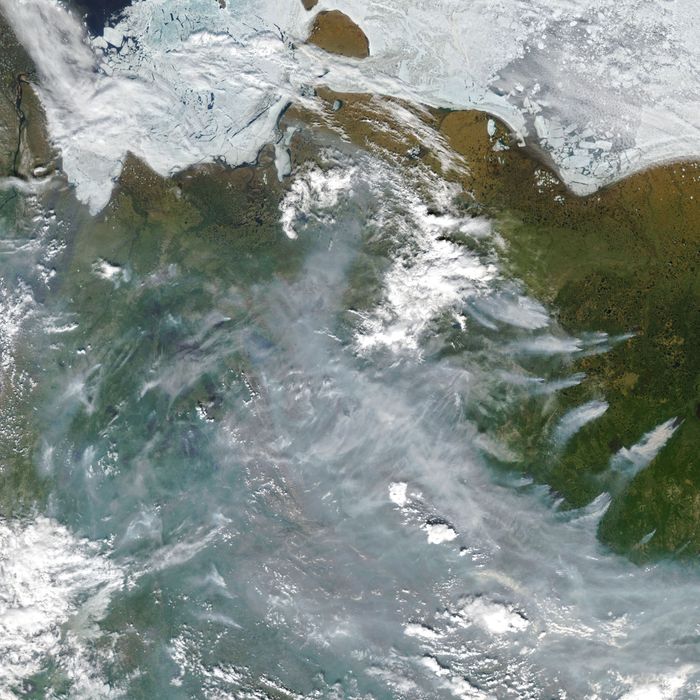 Satellite image of smoke from active fires burning near the Eastern Siberian town of Verkhoyansk, Russia, on June 23, 2020. Photo: Handout/NASA Earth Observatory
On June 20, in the small Siberian town of Verkhoyansk, north of the Arctic Circle, a heat wave baking the region peaked at 38 degrees Celsius — just over 100 degrees Fahrenheit. It was the highest temperature ever recorded in the Arctic. In a world without climate change, this anomaly, one Danish meteorologist calculated, would be a 1-in-100,000-year event. Thanks to climate change, that year is now.
If you saw this news, last weekend, it was probably only a glimpse (primetime network news didn’t even cover it). But the overwhelming coverage of perhaps more immediately pressing events — global protests, global pandemic, economic calamity — is only one reason for that climate occlusion. The extreme weather of the last few summers has already inured us to temperature anomalies like these, though we are only just at the beginning of the livable planet’s transformation by climate change — a transformation whose end is not yet visible, if it will ever be, and in which departures from the historical record will grow only more dramatic and more disorienting and more lethal, almost by the year. At just 1.1 degrees Celsius of warming, where the planet is today, we have already evicted ourselves from the “human climate niche,” and brought ourselves outside the range of global temperatures that enclose the entire history of human civilization. That history is roughly 10,000 years long, which means that in a stable climate you would only expect to encounter an anomaly like this one if you ran the full lifespan of all recorded human history ten times over — and even then would only encounter it once.
You may register temperature records like these merely as the sign of a new normal, in which record-breaking heat waves fade out of newsworthiness and into routine. But the fact of those records doesn’t mean only that change has arrived, because the records are not being set only once; in many cases, they are being set annually. The city of Houston, for instance, has been hit by five “500-year storms” in the last five years, and while the term has obviously lost some of its descriptive precision in a time of climate change, it’s worth remembering what it was originally meant to convey: a storm that had a one-in-500 chance of arriving in any given year, and could therefore be expected once in five centuries. How long is that timespan, the natural historical context for a storm like that? Five hundred years ago, Europeans had not yet arrived on American shores, so we are talking about a storm that we would expect to hit just once in that entire history — the history of European settlement and genocide, of the war for independence and the building of a slave empire, of the end of that empire through civil war, of industrialization and Jim Crow and World War I and World War II, the cold war and the age of American empire, civil rights and women’s rights and gay rights, the end of the cold war and the “end of history,” September 11 and 2008. One storm of this scale in all that time, is what meteorological history tells us to expect. Houston has been hit by five of them in the last five years, and may yet be hit with another this summer — which is already predicted to be a hurricane season of unusual intensity. Of course, that won’t be the end of the transformations. Climate change will continue, and those records — high temperatures, historic rainfall, drought, and wind speed and all the rest — will continue to fall. From here, literally everything that follows, climate-wise, will be literally unprecedented.$5 a month for unlimited access to Intelligencer and everything else New YorkLEARN MORE »
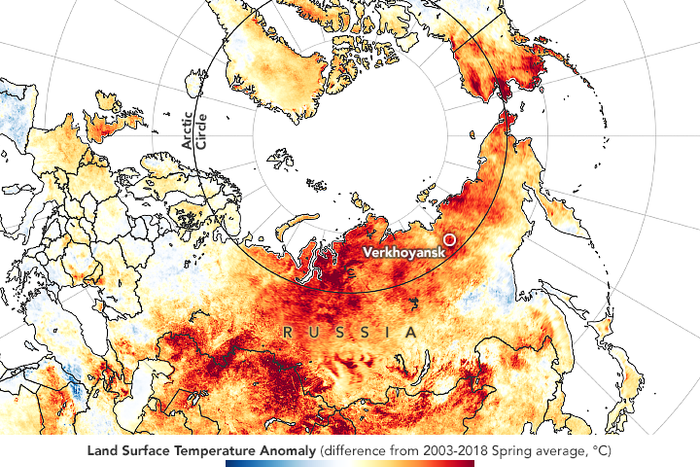
Land surface temperature anomalies from March 19 to June 20 in Eastern Siberia. The reds mark areas that were hotter than average for the same period from 2003-2018. The blues mark areas that were colder. From the Moderate Resolution Imaging Spectroradiometer (MODIS) on NASA’s Aqua satellite. Illustration: Handout/NASA Earth Observatory
The arctic numbers from June 20 are terrifying enough; with more context they become only more so. It was warmer there than it was that same day, in Miami, Florida. In fact, it was warmer north of the Arctic Circle than it has ever been, on any June day, in the entire recorded history of Miami, which has only once, in the whole tropical century for which temperatures there have been registered, reached 100. It was about 30 degrees Fahrenheit warmer, in Verkhonaysk, than the average high temperature in the region for June, which means the arctic record was the equivalent, in terms of temperature anomaly, of a 110-degree June day in New York or a 115-degree June day in Washington, D.C. According to preliminary satellite data, land surface temperature in parts of arctic Siberia reached that level last week, too — 45 Celsius, or 113 Fahrenheit. In terms of temperature anomaly, that’s the equivalent of a 130-degree day in D.C. On Capitol Hill, that would be, very comfortably, lethal heat.
Thankfully, for Americans at least, that isn’t how global warming works — its punishing effects are distributed unequally around the globe, and, at the moment, the Arctic is being punished most vindictively, warming at three times the rate of the rest of the planet. In Siberia, in May, temperatures averaged as much as 10 degrees Celsius higher than normal. The arrival of the arctic summer reignited “zombie fires” that had, improbably, burned through the arctic winter, smoldering in peat rather than burning out. Those fires, like all fires, released carbon, which is stored in trees as surely as it is in coal, in this case releasing as much CO2 in the last 18 months as had been produced by Siberian wildfires in the last 16 years. In early June, an industrial-scale oil-storage facility there collapsed when the melting permafrost on which it had been built finally destabilized, releasing about 21,000 tons of oil and turning local rivers red. That spill was about two-thirds the scale of the Exxon Valdez spill, which horrified an entire generation; this one, we’ve hardly read about, though it befell a far more ecologically degraded planet, with more than half of all carbon emissions ever produced by the burning of fossil fuels in the entire history of humanity coming since the Valdez spill. Perhaps though is a less precise word than because, the intervening generation of environmental calamity having quite thoroughly normalized horrors like these. Even Vladimir Putin — presiding over a petrostate which, so far north, actually stands to benefit from some amount of global warming — declared it an emergency. All told, the planet’s melting permafrost contains twice as much carbon as hangs in the planet’s atmosphere today, and it’s expected that over the course of the century, at least 100 billion tons of it will be released through melt, about three years worth of global emissions and functionally enough to close the window on the goals of the Paris accords.
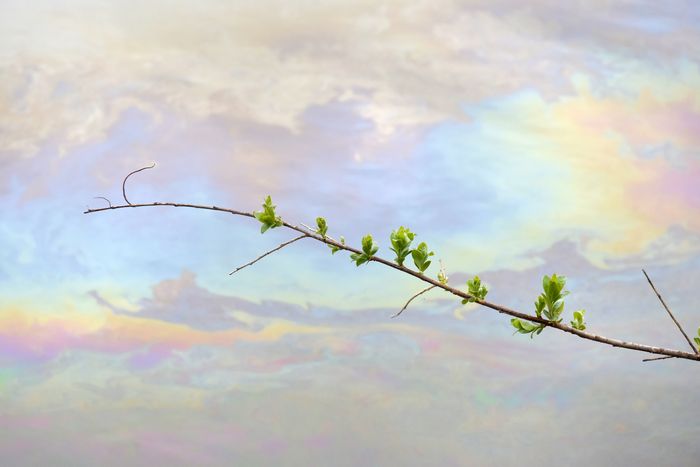
A June 11 view of the site of a diesel fuel spill at Norilsk’s Combined Heat and Power Plant No 3 in Siberia. Photo: Denis Kozhevnikov/TASS via Getty Images
That window was not open very far to begin with. One recent study suggested that even the decarbonization targets of Britain and Sweden, often hailed as global climate leaders, would produce emissions between two and three times the carbon budget required to meet the Paris goals. (And those are just their decarbonization plans, which are probably optimistic.) Another analysis suggested that, for all the talk of halving our emissions by 2030 — as the IPCC says is necessary to safely avoid 2 degrees of warming — the planet has only a 0.3 percent chance of doing so. If Donald Trump won reelection, the analysis suggested, those chances would fall to 0.1 percent — one in a thousand.
If 2 degrees is now inevitable, that doesn’t make it comfortable. Indeed, it will be, for much of the world, a horror — and the space between those two things, inevitability and horror, is the one in which we will all be forced to learn to live. At 2 degrees, it’s expected that more than 150 million additional people would die from the effects of pollution, storms that used to arrive once every century would hit every single year, and that lands that are today home to 1.5 billion people would become literally uninhabitable, at least by the standards of human history.
Those projections will invariably prove imprecise, or perhaps worse — that is both the nature of science, which proceeds by revision, and humanity, which will likely adapt to at least some measure of these impacts. But the Siberian heat wave reminds us just how large the scale of necessary adaptation will likely be — requiring us to respond not just by shoring up the proverbial shorelines of our civilizations but by preparing them in much more fundamental ways to endure conditions never seen before in the whole span of human history. It is also a reminder of just how much we miss when we regard the projections of any neat, linear model of future warming as a straightforward prediction of that future and of what level of adaptation will be require — especially when we reflexively discount the uncertainty warnings scientists invariably include, as any lay reader (including me) is likely to do. Perhaps the most important lesson of the freakish Siberian heatwave is: however terrifying you find projections of future warming, the actual experience of living on a heated planet will be considerably more unpredictable, and disorienting.
Just how freakish and unpredicted is this heatwave? Over the last few years, a growing chorus of critics have argued against one climate model built on predictions of high-end carbon emissions in particular, called RCP8.5 —arguing that, though it had been endorsed by the U.N.’s IPCC and formed the basis of much recent science since that organization’s last major report, its projections were simply implausible, relying as they did on the dramatic growth of coal use over the course if the century. As I’ve written before, that pathway does indeed look increasingly hard to credit as a model of our future, and is best understood, in terms of emissions, as an absolute worst-case scenario, which would require almost a global climate nihilism to achieve. But for those suggesting we should discard that model, or any other that charted a high-end course for warming, the arctic heatwave makes a very strong counterargument. Because even in that worst-case pathway, hundred-degree summer days in the Arctic do not become routine until the very end of the century. This heat wave is, today, an outlier, not a routine event. But that doesn’t make it irrelevant. Instead, it is giving us at least a brief preview of what the world would look like, more than a half-century from now, in a timeline we understand to be, at least in terms of emissions, impossibly pessimistic. But if our timeline could accommodate such extreme events from that worst-case one, and decades ahead of schedule, it is also a sign that “timeline” is probably a misguided way of thinking about the new swirling universe of extreme events we are plunging headlong into. Making sense of climate change requires more than trying to determine where on a particular linear plot we are and where on it we are likely to be in ten years, or in fifty. It may require more profoundly revising our sense of linearity itself. In this way, global warming isn’t just scrambling our sense of geography, with Verkhonaysk, at least briefly, playing the role of Miami. It is also scrambling our sense of time. You may feel, because of the pandemic, that you are living to some degree in 1918. The arctic temperatures of the past week suggest that at least part of the world is living, simultaneously, in 2098.
But climate change isn’t just a brutal form of time travel, it is discombobulating to our very sense of time. When looking at projections for future warming, an event like the Siberian heat wave appears as an acceleration of history, but when looking at the paleoclimate record, it seems like a trip deep into the prehuman past, toward eras like those, lasting millions of years, when palm trees dotted the Arctic and crocodiles walked in their shade there. Especially at extreme levels, warming threatens the apparent march of progress on which the modern, Western “timeline” model of history was built. But at least until the arrival of large-scale carbon removal technologies, it also illustrates the fact that time — in the form of carbon emissions, which hang in the atmosphere for centuries — is irreversible. Because we are doing so much damage so quickly, destabilizing the entire planet’s climate in the space of a few decades, warming can seem like a phenomena of the present. But its effects will unfurl for millennia, with the climate stabilizing perhaps only millions of years from now. Climate change unwinds history, melting ice frozen for many millennia and pushing rainforests like the Amazon closer to their long-overgrown savannah states. It also makes new history, drawing new borders and new riverbeds, turning breadbaskets like the Mediterranean into deserts and opening up arctic shipping routes to be contested by a new generation of great power military rivalries. It compresses history — those Houston storms, for instance, represent more than a millennia of extreme weather, concentrated in a period of just five years. And it scrambles and scatters it, too, disrupting the cycle of seasons and relocating rain belts and monsoons, among many other distortions. At the same time temperatures in Verkhoyansk reached 100 degrees, in other parts of Siberia it was snowing. Was it winter or summer, a Russian catching the national weather forecast could have been forgiven for asking. They may have wondered, is this our hellish climate future or the return of the Little Ice Age?
Contemplating the impacts of climate change from this perspective can seem naïvely abstract — and it is, when compared to the storms and the wildfires and the droughts. (Not to mention the literal plague of locusts, 360 billion of them, which have devastated agriculture in East Africa and South Asia this year, descending in clouds so thick you couldn’t see through the insects and leaving millions hungry.) But in addition to its humanitarian cruelties, for instance making pandemics like COVID-19 much more likely, warming is already recalibrating much more hard-headed models of time, too. This is a sign that warming is truly the meta-narrative of our century, touching every aspect of our lives. Beyond the catastrophes and crises, the surreal and disorienting aspects of climate change are showing up even in the most numbingly pragmatic places. Like, for instance, mortgages.
“Up and down the coastline, rising seas and climate change are transforming a fixture of American homeownership that dates back generations: the classic 30-year mortgage,” Christopher Flavelle of the New York Times reported June 19. (As it happens, the day before the record-setting temperatures in the Arctic.) As Kate Mackenzie has relentlessly chronicled for Bloomberg, mortgages aren’t the first or only financial instrument to feel the intrusion of a new climate reality much less forgiving, and less stable, than the one on which not just the financialization of the global economy but indeed all of human civilization has been erected. Insurance and reinsurance, municipal bonds and sovereign wealth funds, boutique hedge funds and massive asset-management operations are all beginning to reckon with a future made, at least, much rockier by climate change. How much rockier? Well, according to a Climate Central estimate, at least half a million American homes are on land expected, 30 years from now, to flood every single year. Altogether, those homes are today worth $241 billion. This is just homes, just in America, and annual flooding isn’t the only flood risk a homeowner or a bank might want to consider, which means, even looking only at flooding, many, many more homes are vulnerable than that. Of course, flooding is not, by any stretch, the only climate risk those homes and homeowners would face.
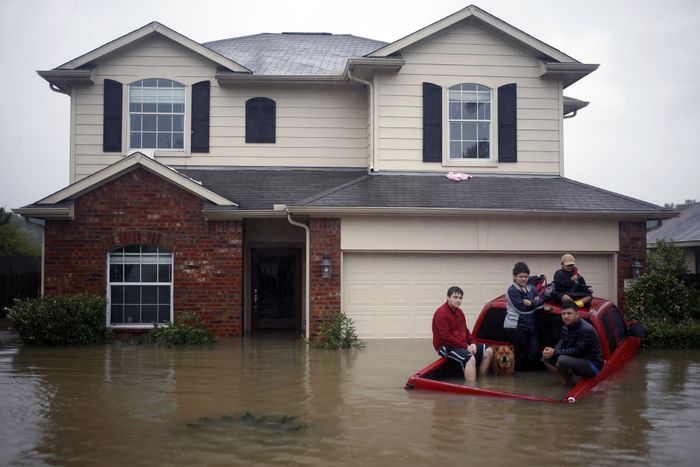
Residents with a dog sit in the back of a truck while waiting to be rescued from rising floodwaters due to Hurricane Harvey in Spring, Texas on August 28, 2017. Photo: Luke Sharrett/Bloomberg via Getty Images
Like many of those other financial instruments, a mortgage isn’t just an instrument but also a theory of time — a bet on future value built on the proposition that three decades is a long enough period to absorb the short-term turbulence of real-estate markets and a short-enough period that larger systemic shocks would not have time to develop and reverberate. That is, at least, how the mortgage looks from the bank side. From the consumer side, a mortgage represents a related, but slightly different, theory of time. For most of postwar American history, it has represented “adulthood,” as defined in mostly white and middle-class-and-up terms. For all those distortions and delusions embedded in it — ideas about housing and the real-estate market but also race and class and urbanization and family structure — the 30-year mortgage also embedded an idea about the stability of society through time, that one could expect to arrive at the end of adulthood in a world recognizable to the person who began it, and indeed that whatever changes had transpired would be, on net, of value to the homeowner, who by virtue of his or her property had become a small-scale stakeholder in the prospects of the community, the region, the nation and indeed the world as a whole. As the Times reports, both sides of that bargain are already, now, beginning to look very different.
More: https://nymag.com/intelligencer/2020/06/global-warming-is-melting-our-sense-of-time.html
 Exposing the Big Game

