The NBA and the National Basketball Players Association on Friday said 16 players tested positive for the coronavirus in the first wave of mandatory tests done in preparation for the restart of the season.
Those 16 players were part of a pool of 302 tested on Tuesday — a 5.3% rate of positive tests leaguewide.
Commissioner Adam Silver said the numbers were roughly as expected and that none of the 16 were seriously ill.
“One thing we’re learning with this virus is, so much is unpredictable,” Silver said during Friday’s conference call with National Basketball Players Association executive director Michele Roberts and NBPA president Chris Paul. “We’re not saying full steam ahead no matter what happens. We all talk daily, and we’re gonna see how this continues to play out. But we feel very comfortable right now with where we are.”
Sweden’s top disease expert says a surge in new coronavirus cases is a result of more testing. Here, people enjoy the sun and water at a bathing jetty in Malmo, Sweden, on Thursday alongside a sign instructing the public to maintain social distancing.
Johan Nilsson/TT News Agency/AFP via Getty Images
Updated at 3 p.m. ET
Swedish state epidemiologist Anders Tegnell says the World Health Organization made “a total mistake” when it included Sweden in a list of countries seeing a resurgence of the coronavirus. The WHO misinterpreted the Swedish data, Tegnell said.
“It is a total mistake,” Tegnell said, according to Swedish public broadcaster Sveriges Radio.
Sweden has been closely watched because of its controversial approach to the COVID-19 pandemic. While the country has urged people to practice physical distancing and follow other safety precautions, it has not ordered a strict shutdown. While many of…
The newest generation of global climate models is running hotter than earlier versions, with many models predicting stronger future warming than their predecessors.
It‘s a confusing trend, and scientists have been working to figure out why it‘s happening. A review paper out this week suggests that clouds—and the tiny particles that help them form in the atmosphere—have something to do with it.
For the past several years, researchers have been working on an international project known as the Coupled Model Intercomparison Project, or CMIP. Every few years or so, modelers around the world coordinate to develop a new generation of models for use in climate research, always more advanced than the generation that came before.
Crew members deploy equipment onto the ice from a Canadian icebreaker, CCGS Louis S. St. Laurent, in the Arctic Ocean. Credit: Gary Morgan, Canadian Coast Guard
Melting of Arctic ice due to climate change has exposed more sea surface to an atmosphere with higher concentrations of carbon dioxide. Scientists have long suspected this trend would raise CO2 in Arctic Ocean water.
Now University of Montana researcher Michael DeGrandpre and his patented sensors have helped an international team determine that, indeed, CO2 levels are rising in water across wide swaths of the Arctic Ocean’s Canada Basin. However, some areas have exhibited slower increases, suggesting other processes—such as biological uptake of CO2—have counteracted expected increases.
The work was published this month in the journal Nature Climate Change.
DeGrandpre is a UM chemistry professor, and in 2015 he and the company he founded, Sunburst…
A cat was rescued last week from a trap that isn’t allowed by law.
On June 17, Gale Samaroby noticed that a feral cat seen on Annie Street in Taylor had come into her backyard. That alone wasn’t unusual for Samaroby since she knows the cat, which was born about five years ago. Samaroby has fed her twice per day. The feline has been named Lilly.
“I’ve seen her ever since she was a little baby,” said Samaroby, who noted that Lilly’s mother was also feral. Lilly was the sole sibling of a litter of cats still…
Many U.S. meatpacking plants shut down this spring due to coronavirus outbreaks. Nationwide, more than 27,000 workers have become infected, and nearly 100 have died. But in late April, President Trump ordered the facilities to stay open, deeming them critical to preserving the nation’s meat supply. Special correspondent Fred de Sam Lazaro reports on the experiences of some of these workers.
Read the Full Transcript
Judy Woodruff:It has been nearly six weeks since production resumed in most meatpacking plants across the country. Many were shut down amid coronavirus outbreaks. More than 27,000 workers have become infected, and 99 have died.In late April, President Trump ordered plants to reopen or remain open, calling them critical infrastructure to preserve the nation’s meat supply.Special correspondent Fred de Sam Lazaro returns to one community in Minnesota where a pork processing plant is back online.
Fred de Sam Lazaro:Here in the Fabled Valley, the Jolly Green Giant stands tall and now even masked, but it’s actually pork, not peas, that reigns.The huge meat processing plants are now nearly back at full capacity. But things are not exactly jolly.
Woman (through translator):We’re still going to have to keep working in fear, but we know that we need to continue working. We have no option.
Fred de Sam Lazaro:In Worthington, Minnesota, population 13,000, the JBS factory was shuttered by a COVID outbreak that sickened hundreds of its 2,100 employees.The effect was felt across this region, mostly at first among hog farmers in late April. Hundreds of thousands of their animals had to be euthanized.
David Bullerman:It’s devastating. I’d like President Trump to invoke the Defense Production Act of 1950. We need to get these plants open today.
Fred de Sam Lazaro:Echoing farmer Dave Bullerman’s plea, industry executives warned, the nation’s meat supply was threatened, a claim some analysts now say was exaggerated, noting that, in April, there were record pork exports to China.
President Donald Trump:I should be signing that over the next hour or so.
Fred de Sam Lazaro:But, on April 28, President Trump did order meatpacking plants to reopen and remain open, declaring them critical infrastructure.
President Donald Trump:Taking the liability, which frees up the entire system.
Fred de Sam Lazaro:The president said his move shielded companies from liability if their workers got sick.Back in Worthington, community organizer Jessica Velasco says the plight of workers never seemed a priority.
Jessica Velasco:Folks started talking about the hog farms that were losing money. The bigger issue than was them euthanizing all those poor hogs.The conversation should have been, how can we support both the JBS employees and the hog producers?
Fred de Sam Lazaro:She says the employees, predominantly refugees and immigrants, remain largely invisible and fearful. She says many lost trust in the company because of the way it acted as more and more workers fell ill, leading the plant to shut down.Rafael, like all workers we spoke with, asked to remain ANONYMOUS.
Rafael (through translator):They told the workers not to worry, everything was OK. To be honest, they were not prepared at all. Nothing was OK. That’s where many became scared, and it was kind of you either work or you don’t eat situation.
Fred de Sam Lazaro:Rafael says he decided to quit because of a health condition that leaves them vulnerable to COVID. These three workers returned.
Man (through translator):Everyone feels scared. Everyone feels like we do here.
Fred de Sam Lazaro:JBS declined our request for an on-camera interview. It did send a video — parts of it time-lapsed — of improvements made at another plant in Greeley, Colorado, where several workers died.JBS has put some older COVID-vulnerable workers on paid furlough, and, among other steps, now requires employees to wear masks and face shields. And it installed barriers between workstations. Workers told us it feels safer, but not safe.
Steven:Personally, I think that they should make it mandatory for employees to get tested, so that we know who has it and who does not.
Fred de Sam Lazaro:The company says it tests employees who show symptoms and takes employees’ temperature when they arrive.That’s no comfort to Anna, who survived a painful COVID infection just before the plant closed.
Anna (through translator):They took mine, but it never showed a temperature. But I was already very sick. I didn’t show the symptoms.
Fred de Sam Lazaro:Most people like her have no choice but to return to work, she says.
Anna (through translator):We have family that we need to raise. We don’t have savings so we could just stay home.
Fred de Sam Lazaro:Meatpacking has long attracted new immigrants who have few options. It is an intensely tough environment, as even this JBS job posting seems to warn, standing 10 hours a day, doing repetitive tasks in very high temperatures or very low temperatures, with unpleasant odors.It’s something labor historian Peter Rachleff says most Americans avoid.
Peter Rachleff:The work force in meatpacking has almost always been people who are within one generation of having lived in agriculture, people who are able to work in that kind of blood and guts kind of environment.
Rev. James Callahan:If it was not for the immigrant community, this community would just fold up and die.
Fred de Sam Lazaro:Father James Callahan says immigrants sustain much of Worthington’s economy today, but he says this small town is not immune to the rancorous immigration debate, recalling comments he’s heard since the pandemic began.
Rev. James Callahan:Blaming the immigrant community for the spread of the virus, blaming people from the Asian communities for carrying it, I mean, a woman who said to me she was never going to eat in a Chinese restaurant again. I mean, how absurd is that?
Fred de Sam Lazaro:Are you finding a lot of that?
Rev. James Callahan:Not a lot, but enough where it becomes disturbing.
Fred de Sam Lazaro:He worries that meatpacking plants in Minnesota and elsewhere continue to see coronavirus spikes. So far, Father Callahan has presided over funerals in three-COVID related deaths of JBS workers, two of them since the plant reopened.For the “PBS NewsHour,” this is Fred de Sam Lazaro in Worthington, Minnesota.
Fred de Sam Lazaro is director of the Under-Told Stories Project at the University of St. Thomas in Minnesota, a program that combines international journalism and teaching. He has served with the PBS NewsHour since 1985 and is a regular contributor and substitute anchor for PBS’ Religion and Ethics Newsweekly.
Across the UK, hundreds of workers at meat-processing plants and abattoirs have tested positive for COVID-19.
One such place – a chicken-processing plant on Anglesey – has seen over 175 cases among workers.
The UK isn’t alone: there have been similar outbreaks across Europe and in the US. Germany’s coronavirus reproduction number (R rate) jumped to 2.88 after a COVID-19 outbreak in a meat-processing plant in North Rhine-Westphalia, which has led to 1,500 new cases.
Because of their frigid temperatures and cramped conditions, meat-processing plants around the globe have become COVID-19 hotspots.
Eating Meat Has Deadly Consequences
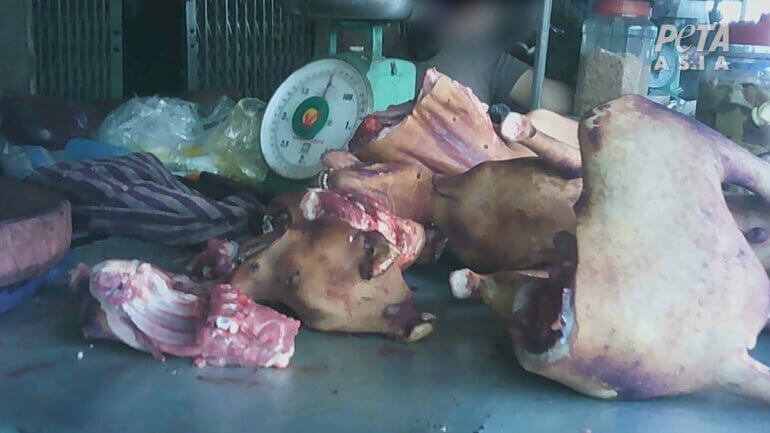
Experts say that the COVID-19 outbreak originated in a “wet market” in Wuhan, China, where humans had direct contact with live animals and dead animal flesh.
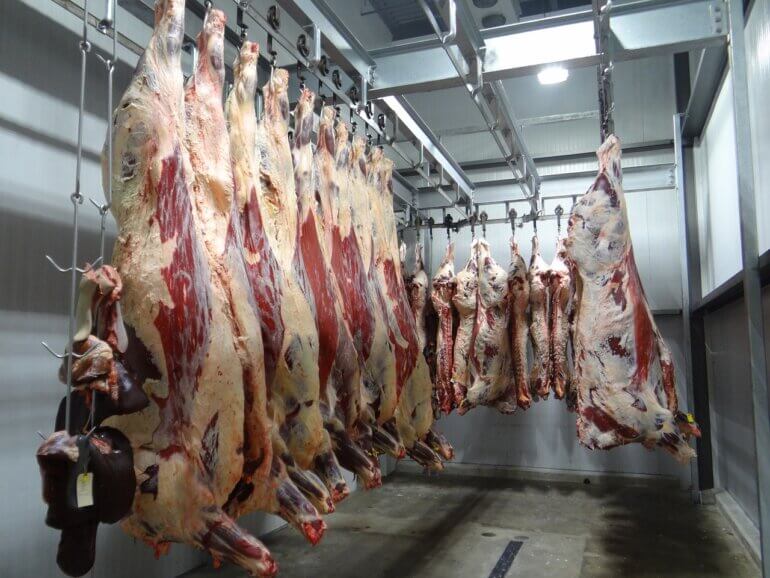
Now, this deadly disease is sweeping through blood-soaked, offal-strewn meat-processing plants and endangering workers, their families, and the whole community. And like wet markets, squalid abattoirs and meat factories are known to be hotbeds for disease.
According to Public Health England, “Many (60 to 80% [of]) emerging infections are derived from an animal source.” Filthy factory farms, abattoirs, and meat markets threaten the health of every human being on the planet by providing a breeding ground for deadly pathogens like the ones behind COVID-19, SARS, bird flu, and more.
As COVID-19 spreads like wildfire from worker to worker, PETA is calling for abattoirs and meat-processing plants to shut down and stay closed, for everyone’s protection.
What You Can Do
Not only is animal agriculture responsible for deadly pandemics and putting human lives at risk, it also causes other animals immense suffering and is destroying the planet.
Humans’ mistreatment of other animals is harming not only them but also us, and now is the time for each and every person to take responsibility for our part.
The link between outbreaks of diseases like COVID-19 and eating meat is undeniable – and the solution is clear: to prevent future pandemics, humans must stop abusing other animals and go vegan.
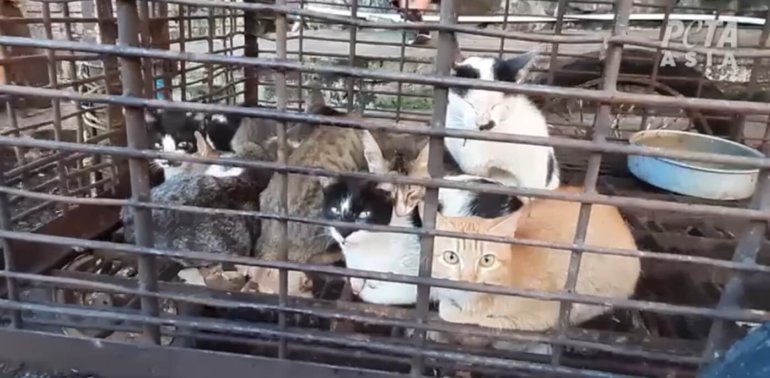
The video includes footage of living and dead animals, including bats, rats, and frogs, at wet markets in Asia. Terrified animals are confined to small cages, and floors and countertops are smeared with faeces, blood, and urine. This footage was taken in April 2020 – a month after the COVID-19 outbreak was declared a pandemic. Jack explains the link between animal exploitation and deadly diseases:
“Today, three out of every four new or emerging infectious diseases come from animals, mainly via the wildlife trade or factory farming. Unless we stop exploiting animals – and soon – there will be more pandemics to come.”
Enough Is Enough
Experts say that the COVID-19 outbreak originated in a wet market in Wuhan, China, where humans had direct contact with live animals and dead animal flesh.
Despite a growing death toll, calls by world leaders for a ban on such markets, and the continued importance of flattening the curve, these markets are still conducting business as usual.
To prevent more diseases like COVID-19, all live-animal markets must close. Join PETA in urging the World Health Organization to call for an end to live-animal meat markets:Take Action
The exploitation and slaughter of living, feeling beings has led millions of us to be infected with a dangerous disease – and it’s not the first time something like this has happened.
According to Public Health England, “Many (60 to 80% [of]) emerging infections are derived from an animal source.” Filthy factory farms, abattoirs, and meat markets threaten the health of every human being on the planet by providing a breeding ground for deadly pathogens like the ones behind COVID-19, SARS, bird flu, and more.
Will the Next Pandemic Come From a UK Farm?
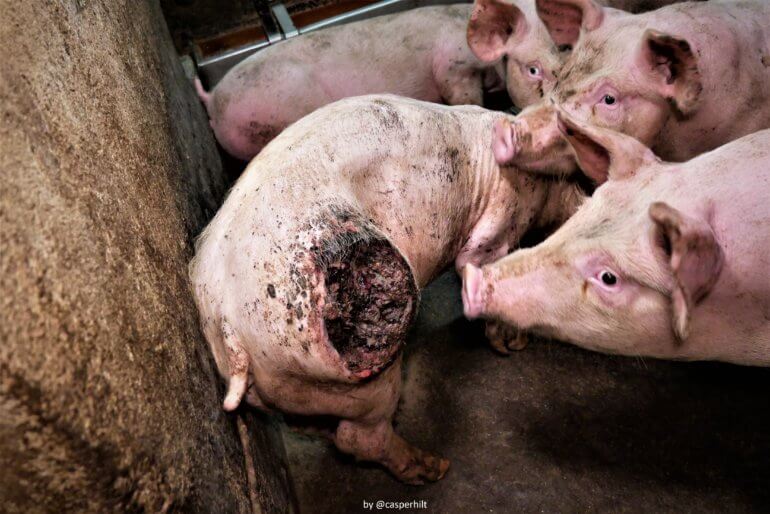
On farms in the UK, stressed animals are crammed into cages or sheds by the thousands and pumped full of antibiotics to keep them alive in filthy conditions that would otherwise kill them. Pathogens flourish in such environments.
And in part because of the widespread use of antibiotics in animal agriculture, experts believe that by 2050, more people will die of antibiotic-resistant diseases than of cancer.
What You Can Do
Not only is our mistreatment of animals responsible for deadly pandemics and putting human lives at risk, it also causes other animals immense suffering and is destroying the planet. Now is the time for each and every person to take responsibility for their part.
The video includes footage of living and dead animals, including bats, rats, and frogs, at wet markets in Asia. Terrified animals are confined to small cages, and floors and countertops are smeared with faeces, blood, and urine. This footage was taken in April 2020 – a month after the COVID-19 outbreak was declared a pandemic. Jack explains the link between animal exploitation and deadly diseases:
“Today, three out of every four new or emerging infectious diseases come from animals, mainly via the wildlife trade or factory farming. Unless we stop exploiting animals – and soon – there will be more pandemics to come.”
Enough Is Enough
Experts say that the COVID-19 outbreak originated in a wet market in Wuhan, China, where humans had direct contact with live animals and dead animal flesh.
Despite a growing death toll, calls by world leaders for a ban on such markets, and the continued importance of flattening the curve, these markets are still conducting business as usual.
To prevent more diseases like COVID-19, all live-animal markets must close. Join PETA in urging the World Health Organization to call for an end to live-animal meat markets:Take Action
The exploitation and slaughter of living, feeling beings has led millions of us to be infected with a dangerous disease – and it’s not the first time something like this has happened.
According to Public Health England, “Many (60 to 80% [of]) emerging infections are derived from an animal source.” Filthy factory farms, abattoirs, and meat markets threaten the health of every human being on the planet by providing a breeding ground for deadly pathogens like the ones behind COVID-19, SARS, bird flu, and more.
Will the Next Pandemic Come From a UK Farm?
On farms in the UK, stressed animals are crammed into cages or sheds by the thousands and pumped full of antibiotics to keep them alive in filthy conditions that would otherwise kill them. Pathogens flourish in such environments.
And in part because of the widespread use of antibiotics in animal agriculture, experts believe that by 2050, more people will die of antibiotic-resistant diseases than of cancer.
What You Can Do
Not only is our mistreatment of animals responsible for deadly pandemics and putting human lives at risk, it also causes other animals immense suffering and is destroying the planet. Now is the time for each and every person to take responsibility for their part.
Animals subjected to “euthanasia” often die by carbon dioxide poisoning, ventilation shutdown, and other mass-killing techniques that prolong suffering for minutes, even hours.Reading Time: 4 minutes
Jo-Anne McArthur/Animal Equality
The American Veterinary Medical Association’s Guidelines for the Euthanasia of Animals rightly defines euthanasia as a “good death.” But the Guidelines make all kinds of exceptions for situations in which the inhumane killing of animals—a very bad death—may be considered “euthanasia.”
People take their beloved companion animals reluctantly to the veterinarian to be euthanized, not to get rid of an inconvenience or for some other selfish purpose, but because their pet’s suffering is profound, cannot be alleviated, and will only worsen. Euthanizing a hopelessly suffering nonhuman animal or human being is an act of mercy. In such cases, the decision-makers implicitly understand the true meaning of euthanasia. The sufferer is not going to die slowly and painfully with an infusion of, say, carbon dioxide gas (CO2), or be baked to death “humanely,” as described in “How to Kill Half a Million Chickens at Once” and in “Pigs Roasted Alive in Coronavirus Mass-Extermination, Probe Uncovers” where the investigators errantly refer to the killings as “euthanizing.”
This verbal corruption confounds our discourse when, instead of a companion animal or human sufferer, the subject is a chicken, a pig, a turkey, or a mouse on a farm or in a laboratory. In these settings, the individual is one of the hundreds, thousands, or millions of captive individuals who exist solely for human use. They are born to be harmed—injured, infected, killed—for human “benefit.” When the researcher or the farmer decides in the interest of expedience to kill them, by whatever means, the term that is used to characterize the procedure is “euthanasia.”
An example appears in the Iowa State University College of Veterinary Medicine publication, Water-Based Foam for Poultry Depopulation, which cites the American Veterinary Medical Association (AVMA) in support of the mass-suffocation of poultry under rolling carpets of chemically irritating fire-fighting foam:
Euthanasia of large numbers of birds in a quick, efficient manner with welfare consideration. The process is used to control disease spread or end the suffering of dying birds during a disease outbreak or natural disaster situations.
Though decades of research have confirmed that exposure to CO2 gas causes pain, panic and slow suffocation in mammals and birds, who will desperately seek to escape a CO2-filled chamber, the AVMA Guidelines 2020 equivocate, as in this directive for killing small animals in experimental settings:
In addition to humane outcomes, an important consideration in the choice of method for euthanasia of laboratory animals is the research objectives for the animals being euthanized.
For small animals like mice and rats in laboratories: Carbon dioxide, with or without premedication with halogenated [inhaled] anesthetics, is acceptable with conditions for euthanasia of small rodents.
In other words, a “humane outcome”—a manner of death that is painless, swift, and compassionate—may be sacrificed to “research objectives” and still be called “euthanasia,” and even absurdly at times, “humane euthanasia.”
Appallingly, the AVMA has fostered a language of impunity for agribusiness and the animal research industry to the point of elevating, in public and industry discourse, the opposite of what euthanasia and humane treatment literally mean. This fraudulent usage is a perfect example of Orwellian “newspeak,” which Merriam-Webster defines as “propagandistic language marked by euphemism, circumlocution, and the inversion of customary meanings.”
It’s easy for the public and for animal advocates to get lulled into a sense of complacency when all around us the authorities use terms like “euthanasia” to not only characterize but endorse the mass killings of farmed animals and animals in laboratories by asphyxiating, baking, or engulfing them in deadly chemicals with fire-fighting foam. Animals subjected to the cruelties of carbon dioxide, fire-fighting foam, and ventilation shutdown can take up to ten minutes, even hours, to die while struggling together in agony; and many survive these automated, crude procedures only to be trashed, buried or bulldozed, alive.
Where does this leave us—the animal advocacy community—in confronting the massive, unrelenting, painful carnage of living, breathing beings? Do we ignore it because the problem is too big for us to change? Do we justify our position because, as even animal advocates have said on occasion, fraught with frustration that can degenerate into apathy, “They’re going to die anyway”?
Of course, we’re all going to die, but when it comes to our own species and our beloved companion animals, we do not invoke our mortal fate as an excuse for abuse. The conundrum in the case of laboratory animals and farmed animals isn’t simply that they are “going to die anyway.” It’s that they are going to die inhumanely in a slaughterhouse or as part of an experiment, or in the inhumane circumstances that surround slaughter and experimentation—transportation, neglect, rough handling, overwhelming stress, fear, and learned helplessness.
There is no quick or easy answer because if there were, animal advocates would champion it. But this much we know: Silence and euphemisms like “euthanasia” are not the answer. We may be uncomfortable with a problem that is so immense and seemingly intractable, but we need to speak up—and speak accurately—even if we feel we’re shouting in the wind.
As animal advocates, we cannot allow animal exploiters to define the conversation for us, lull us into false rhetoric, or determine how we regard animals. Succumbing to these pressures, we degrade the lives of the animals down to the level at which the exploiters abuse them. By submitting to linguistic subterfuges, we accommodate virtually any mistreatment of animals as acceptable. This is the moral downslide that allows agribusiness and animal researchers to inflict pain, torment, and death on animals unfazed. It’s the type of “convenience” that debased language facilitates. As advocates for animals, let us not call the brutal mass-extermination of innocent, defenseless creatures for the sake of human convenience, “euthanasia.”
For the animals’ sake, we cannot let ourselves, or the public, be “put to sleep.”
Karen Davis, PhD is the President and Founder of United Poultry Concerns, a nonprofit organization that promotes the compassionate and respectful treatment of domestic fowl including a sanctuary for chickens in Virginia. She is the author of numerous books, essays, articles, and campaigns advocating for these birds. Her latest book is For the Birds: From Exploitation to Liberation: Essays on Chickens, Turkeys, and Other Domesticated Fowl (Lantern Books, 2019).
Barbara Stagno is the President and Founder of Citizens for Alternatives to Animal Research & Experimentation (CAARE). Since 1995, Barbara has worked to oppose the exploitation of animals, especially the use of animals in experiments. She founded CAARE in 2014 to disseminate information about the power of emerging science to end the use of animals in research, while also raising awareness of their immense suffering. Before starting CAARE, Barbara was a campaign director for a national animal protection organization.





 casperhilt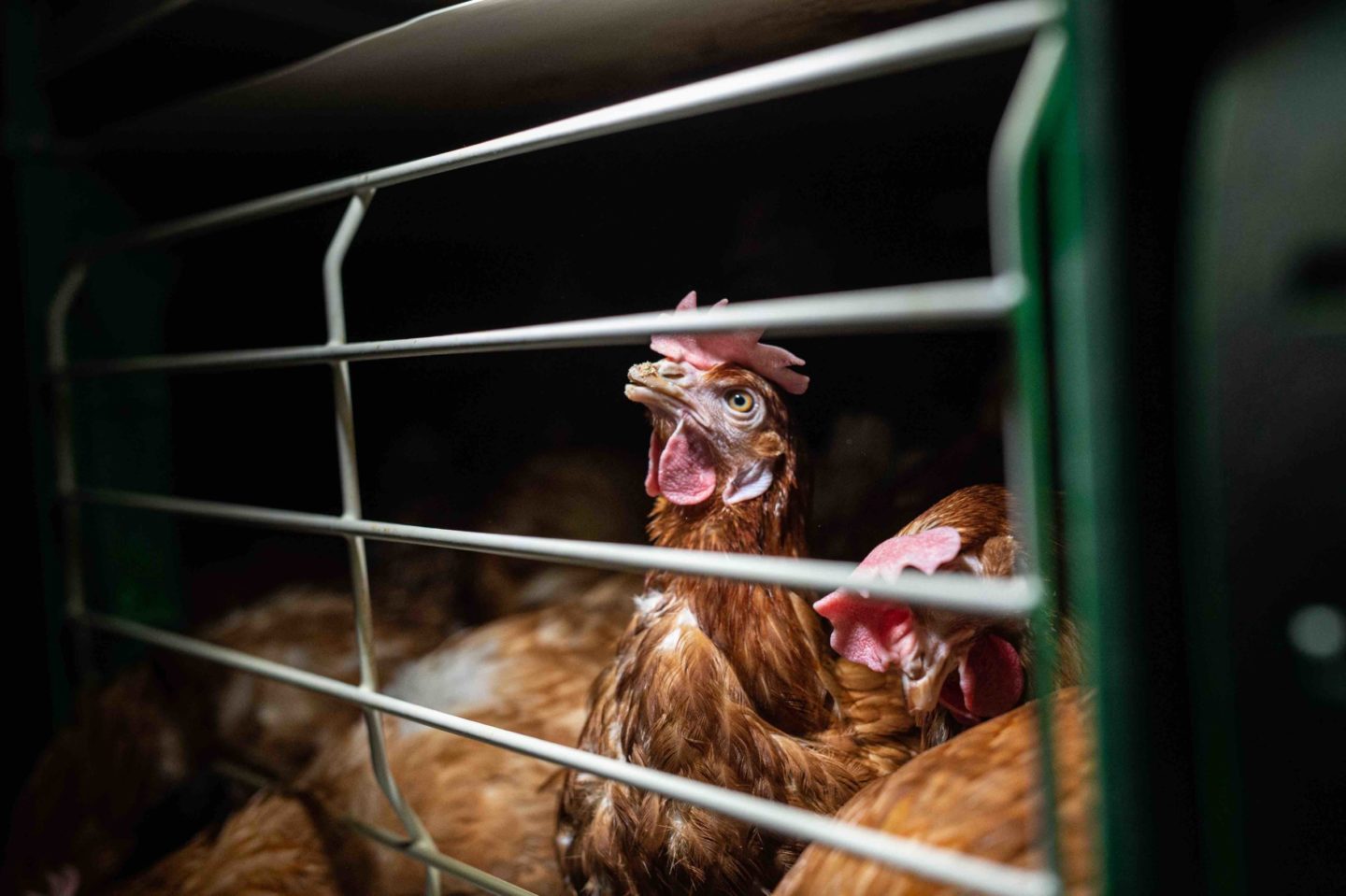
 Exposing the Big Game