| A Humane WorldKitty Block’s Blog |
| July 21, 2020 |
Pup paralyzed after brutal beating demonstrates urgency for Iowa to make animal torture a felony
3

| A Humane WorldKitty Block’s Blog |
| July 21, 2020 |


Aimless wandering and listlessness can be a symptom of CWD. Because of this, deer that are wandering away from other wildlife and on to the nearby roads can present more of a safety concern to Wisconsinites than non-infected deer.
Through a 5-year research study that began in 2016, Wisconsin’s Department of Natural Resources is hunting the effects of Chronic Wasting Disease in its deer and elk population in hopes that they can better determine how to safely combat the rising issue.
The CWD Alliance defines Chronic Wasting Disease (CWD) as a neurological disease that causes spongy degeneration of the brain in deer, elk, and moose. Found in the infected host’s central nervous system and lymphoid tissue, the disease is thought to be caused by an abnormal protein called a prion which causes other…
View original post 569 more words
By: Karen Estensen Rubio Reading Time: 4 minutes In a recent CNN report, Minnesota hog farmer Doc Hoehm regretfully stated “We put down sick pigs because you feel sorry for ‘em. But to have a healthy pig, and to take a rifle and shoot it…It’s unreal.” The Hoehms’ hog farm typically shipped over 700 hogs each week to a Smithfield plant in Sioux Falls, South Dakota. After weeks of feeling the pressure of COVID-19 closures and supply shortages, the farm tried to restrict the hogs’ diets to cut down on costs, but eventually, they started running low on money for feed. As a last resort many farmers faced, the Hoehms started culling their animals. Though the Hoehms declined to confirm which culling methods they used, several reports state that farmers are using ventilation shutdown (VSD). This method entails sealing off the building and inserting superheated steam and humidity until pigs die of hyperthermia—a body temperature higher than normal. Some farmers will pump in carbon dioxide to expedite the process. If pigs survive overnight, which some do, workers shoot the survivors in the head with a captive bolt gun. The Hoehms’ animals are not alone. Tens of millions of animals are being shot, gassed, or bludgeoned because they are no longer profitable to the industry. According to the Guardian, more than 10 million hens have been killed so far and an estimated 10 million pigs will be killed within the next four months. |
| The True Cost of Farming Animals A select few meat producers control the majority of the meat available for purchase in America today. These powerful meat monopolies don’t just spell disaster for animals, but threaten our planet and degrade the health and welfare of our local communities. JBS USA is a leading American meat processor responsible for some of the worst recalls, environmental scandals, and animal cruelty cases ever seen before. An undercover investigation produced by Animal Outlook unveiled immense suffering inside Prince Poultry, a North Carolina supplier of Pilgrim’s Pride chicken. Investigators witnessed live birds being dumped into outdoor pits where they were left to suffocate under the weight of deceased birds or starve to death, whichever happened first. JBS has been involved in widespread deforestation, public health scandals, and now at least one of its meatpacking facilities has been responsible for over 300 confirmed COVID-19 cases. Sources inside JBS’ Greeley, Colorado facility say management failed to adequately inform workers when the first COVID-19 cases broke out on the line. In fact, they did the opposite—offering workers bonuses to keep them coming back. Now, eight workers have died. Smithfield Foods: An estimated 121 million pigs are slaughtered every year in the United States, and Smithfield Foods is responsible for over 15 million of those deaths. Smithfield prides itself on raising “responsible, sustainable” pork products, but has been the focus of controversy since an undercover investigation by The Humane Society of the United States (HSUS) unveiled immense cruelty inside its facilities in 2010. Pigs were beaten, confined, and stressed, unlike what their promotional advertisement displayed just two months after the investigation. In April, workers at a Smithfield plant in Milan, Missouri sued the company for operating the plant “in a manner that contributes” to the spread of the coronavirus. “Put simply, workers, their family members, and many others who live in Milan and in the broader community may die – all because Smithfield refused to change its practices in the face of this pandemic,” the suit states. Tyson Foods produces 20 percent of the United States’ chicken, pork, and beef products and slaughters around 37 million chickens in a single week. This company has been involved in scandals regarding food safety, environmental pollution, and animal cruelty on many occasions. In 2016, an undercover investigation inside multiple Tyson Foods broiler breeder factories in Virginia revealed violent abuses: workers punching, kicking, and throwing live birds, birds crushed by forklifts, and more. The video evidence drove the first court trials for cruelty to chickens raised for meat, resulting in nine former Tyson employees being convicted of 24 counts of animal cruelty. Since the pandemic began, more than 8,500 Tyson employees at 37 poultry, pork, and beef plants have tested positive for COVID-19, and over 25 Tyson workers have died from the virus due to lack of protective measures. |
| Animal agriculture is responsible for air, land, and water pollution, species extinction, deforestation, ocean depletion, and dead zones, and a warming climate that is accelerating drought, flooding, fire, and other extreme weather events at alarming rates. While Big Meat conglomerates reap the profit from livestock production, taxpayers pay for cleaning polluted water, health care for asthma, and other public health crises associated with factory farms. According to David Robinson Simon’s seminal report Meatonomics: The Bizarre Economics of Meat and Dairy, Americans pay $38 billion per year to subsidize animal agriculture, masking the true cost of using animals for food. Industrial animal agriculture is costing us billions—in dollars and animal lives. It doesn’t have to be this way. Read the full story here |
| Post COVID-19, Let’s Forge a New Normal for Farmed Animals By: Karen Estensen Rubio Reading Time: 4 minutes In a recent CNN report, Minnesota hog farmer Doc Hoehm regretfully stated “We put down sick pigs because you feel sorry for ‘em. But to have a healthy pig, and to take a rifle and shoot it…It’s unreal.” The Hoehms’ hog farm typically shipped over 700 hogs each week to a Smithfield plant in Sioux Falls, South Dakota. After weeks of feeling the pressure of COVID-19 closures and supply shortages, the farm tried to restrict the hogs’ diets to cut down on costs, but eventually, they started running low on money for feed. As a last resort many farmers faced, the Hoehms started culling their animals. Though the Hoehms declined to confirm which culling methods they used, several reports state that farmers are using ventilation shutdown (VSD). This method entails sealing off the building and inserting superheated steam and humidity until pigs die of hyperthermia—a body temperature higher than normal. Some farmers will pump in carbon dioxide to expedite the process. If pigs survive overnight, which some do, workers shoot the survivors in the head with a captive bolt gun. The Hoehms’ animals are not alone. Tens of millions of animals are being shot, gassed, or bludgeoned because they are no longer profitable to the industry. According to the Guardian, more than 10 million hens have been killed so far and an estimated 10 million pigs will be killed within the next four months. |
| The True Cost of Farming Animals A select few meat producers control the majority of the meat available for purchase in America today. These powerful meat monopolies don’t just spell disaster for animals, but threaten our planet and degrade the health and welfare of our local communities. JBS USA is a leading American meat processor responsible for some of the worst recalls, environmental scandals, and animal cruelty cases ever seen before. An undercover investigation produced by Animal Outlook unveiled immense suffering inside Prince Poultry, a North Carolina supplier of Pilgrim’s Pride chicken. Investigators witnessed live birds being dumped into outdoor pits where they were left to suffocate under the weight of deceased birds or starve to death, whichever happened first. JBS has been involved in widespread deforestation, public health scandals, and now at least one of its meatpacking facilities has been responsible for over 300 confirmed COVID-19 cases. Sources inside JBS’ Greeley, Colorado facility say management failed to adequately inform workers when the first COVID-19 cases broke out on the line. In fact, they did the opposite—offering workers bonuses to keep them coming back. Now, eight workers have died. Smithfield Foods: An estimated 121 million pigs are slaughtered every year in the United States, and Smithfield Foods is responsible for over 15 million of those deaths. Smithfield prides itself on raising “responsible, sustainable” pork products, but has been the focus of controversy since an undercover investigation by The Humane Society of the United States (HSUS) unveiled immense cruelty inside its facilities in 2010. Pigs were beaten, confined, and stressed, unlike what their promotional advertisement displayed just two months after the investigation. In April, workers at a Smithfield plant in Milan, Missouri sued the company for operating the plant “in a manner that contributes” to the spread of the coronavirus. “Put simply, workers, their family members, and many others who live in Milan and in the broader community may die – all because Smithfield refused to change its practices in the face of this pandemic,” the suit states. Tyson Foods produces 20 percent of the United States’ chicken, pork, and beef products and slaughters around 37 million chickens in a single week. This company has been involved in scandals regarding food safety, environmental pollution, and animal cruelty on many occasions. In 2016, an undercover investigation inside multiple Tyson Foods broiler breeder factories in Virginia revealed violent abuses: workers punching, kicking, and throwing live birds, birds crushed by forklifts, and more. The video evidence drove the first court trials for cruelty to chickens raised for meat, resulting in nine former Tyson employees being convicted of 24 counts of animal cruelty. Since the pandemic began, more than 8,500 Tyson employees at 37 poultry, pork, and beef plants have tested positive for COVID-19, and over 25 Tyson workers have died from the virus due to lack of protective measures. |
| Animal agriculture is responsible for air, land, and water pollution, species extinction, deforestation, ocean depletion, and dead zones, and a warming climate that is accelerating drought, flooding, fire, and other extreme weather events at alarming rates. While Big Meat conglomerates reap the profit from livestock production, taxpayers pay for cleaning polluted water, health care for asthma, and other public health crises associated with factory farms. According to David Robinson Simon’s seminal report Meatonomics: The Bizarre Economics of Meat and Dairy, Americans pay $38 billion per year to subsidize animal agriculture, masking the true cost of using animals for food. Industrial animal agriculture is costing us billions—in dollars and animal lives. It doesn’t have to be this way. Read the full story here |
Published on July 19, 2020July 19, 2020 in News/wildlife
***For All Things Wyoming, Sign-Up For Our Daily Newsletter***https://www.youtube.com/embed/QGM0kcOCbkw?feature=oembed
She wasn’t a complete idiot.
It was probably for the best that a woman who got way too close to a herd of bison tripped when one chased after her.
That’s because the woman reportedly said that she knew the best thing to do in that situation was to play-dead.
The video, at least in this instance, appeared to show that was a good strategy. The charging bison stopped, investigated the scene, and eventually left her alone.
The individual who shot the video said the incident occurred at Nez Perce Creek and and the woman was “a Montana local so she knew to play dead in that situation.”
Of course the best way to avoid that situation is not to get too close to the bison in the first place.
Reports are that the woman was not injured.
No word on the condition of the man, appropriately dressed in green shorts and sandals, who tried to pick up a tree branch (and failed) in an effort to look like he could actually do something against a 2,000 pound bison.
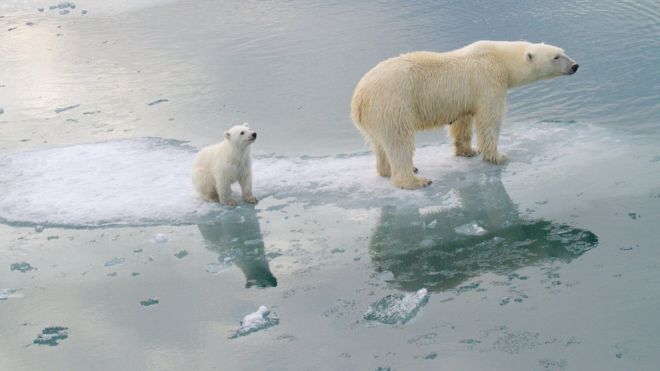 Image copyrightKATHARINA M MILLER
Polar bears will be wiped out by the end of the century unless more is done to tackle climate change, a study predicts.
Scientists say some populations have already reached their survival limits as the Arctic sea ice shrinks.
The carnivores rely on the sea ice of the Arctic Ocean to hunt for seals.
As the ice breaks up, the animals are forced to roam for long distances or on to shore, where they struggle to find food and feed their cubs.
The bear has become the “poster child of climate change”, said Dr Peter Molnar of the University of Toronto in Ontario, Canada.
“Polar bears are already sitting at the top of the world…
View original post 469 more words


“The judge basically rejected every attempt by the Trump administration to gut these common-sense waste prevention measures on behalf of their oil and gas industry cronies.”

A gas flare is seen at an oil well site on July 26, 2013 outside Williston, North Dakota. (Photo: Andrew Burton/Getty Images)
Green groups celebrated a “resounding victory for taxpayers, public health, and the environment” late Wednesday after a federal judge blocked the Trump administration from rolling back an Obama-era rule designed to limit planet-warming methane emissions.
“The Trump administration has abused every opportunity—legal or otherwise—to maximize the oil and gas industry’s profits at the expense of taxpayers, public health, and the climate.”
—Erik Schlenker-Goodrich, Western Environmental Law Center
U.S. District Judge Yvonne Rogers of the Northern District of California said the Bureau of Land Management’s (BLM) 2018 rescission
View original post 222 more words
BY REBECCA BEITSCH – 07/17/20 03:07 PM EDT 6144,433

© Getty Images
Democratic lawmakers are pushing back against Department of the Interior plans to drill in Alaska’s Arctic National Wildlife Refuge (ANWR,) arguing the agency wasn’t thorough before concluding that drilling activity wouldn’t harm local polar bears.
A review of the environmental impacts of drilling in the area “makes the unsupportable conclusion that industrializing the entire Coastal Plain—including the most important terrestrial denning habitat for among the most imperiled polar bear population on the planet—will not jeopardize the survival and recovery of the species,” Democratic lawmakers on the House Natural Resources Committee wrote to Interior in a letter spearheaded by Rep. Jared Huffman (D-Calif.).
“This fundamentally flawed analysis ignores the overwhelming scientific evidence that identifies devastating impacts to polar bears from oil and gas activities,” they added.https://b28bdec9e40d5dff0a2190c2694e4e23.safeframe.googlesyndication.com/safeframe/1-0-37/html/container.html
The so-called biological opinion produced on the topic came after the department in February made the unusual decision to open its research to public comment. The already peer-reviewed research looked at how seismic activity from the oil and gas industry affects polar bear “denning” as they raise their young cubs.
Environmentalists and scientists raised the alarm, calling it an attempt by the Trump administration to discredit its own government scientists.
“What it looks like to me is they’re giving industry the opportunity to negate the study,” said Andrew Rosenberg, director of the Center for Science and Democracy and the Union of Concerned Scientists.
The 2017 tax bill opened the door to drilling in the arctic, something Interior noted in its response.
“Representative Huffman and the other Democrat members who signed this erroneous letter apparently don’t understand that the Tax Cuts and Jobs Act enacted in 2017 requires an oil and gas leasing program in the Coastal Plain. It would serve them well to have a better, basic understanding of the laws under the jurisdiction of the Committee,” the department said in an email.
A number of major banks, including Morgan Stanley, Goldman Sachs, JPMorgan Chase and Wells Fargo, have already pledged not to finance any drilling in ANWR.
The department recently finalized another rule that would allow hunting tactics that make it easier to kill bear cubs and wolf pups in Alaska.
The rule, finalized in June, ends a five-year ban on baiting hibernating bears from their dens, shining a flashlight into wolf dens to cause them to scurry, targeting animals from airplanes or snowmobiles and shooting swimming caribou from boats.

KOTA KINABALU: A 4m-long crocodile, believed to be responsible for the death of several people in Kalabakan, has been found dead on Saturday (July 18).
The reptile is believed to have died after taking the bait set up by wildlife officials following several deaths from crocodile attacks in the area.
Tawau Wildlife Department officer Sailun Aris said they set up the trap at the Kg Tanjung Sapi River on July 15 and found the crocodile trapped at about 1.30pm on Saturday.
“We believe this was the crocodile that attacked Sukrien Jesman Yusoff at the Kalabakan river on July 3 and Nur Hayati Talib, 50, on June 25, to name a few,” he said.
He said the trap at Kg Tanjung Sapi was one of several they set between July 5 and 15.
Sailun said families of crocodile attack victims were notified of the discovery, and they requested that the reptile be cut open.
“There were human hands (in its stomach), and they have been returned to the identified family. They will bury the remains,” he said.
The crocodile, which weighs 350kg, has been buried close to the area where it was caught.
 Exposing the Big Game