Image by Andrew Skowron is of Magda, rescued from use as an egg machine
Today the first post I saw was about hens who had been used for eggs and it tore my heart out. I should have known better and not looked at the comments, but I did and guess what? There they all were, the inevitable pro-backyard, ‘know-where-your-food-is-coming-from-and-be-compassionate-like-me’, ‘from- the-lovely-woman-down-the-road’, ‘treats-them-like-her-children’ comments; comments that refuse to acknowledge that the fundamental principle of egg use is wrong, commenters determined to claim that the way they personally use hens is exceptional, so whatever message is being conveyed doesn’t apply to them.
Why is that? Seriously? Why are there so many people who imagine themselves to be ‘animal lovers’, who point-blank refuse to accept that using hens is simply wrong and insist that what they do is perfectly fine? Years of blogs, high quality shared links, science, expert analyses, heart…
2 minutes readhttps://imasdk.googleapis.com/js/core/bridge3.481.0_en.html#goog_12887255340 seconds of 14 secondsVolume 0% South Korea hints at banning dog meat
SEOUL, Sept 27 (Reuters) – South Korea’s President Moon Jae-in said on Monday there might be a need to prohibit dog meat consumption amid debate over the controversial practice and growing awareness of animal rights.
While no longer as common as before, dog meat is eaten mainly by older people and is served in some restaurants and can be bought at specific markets.
Moon made the remarks after being briefed by Prime Minister Kim Boo-kyum on efforts to improve the handling of abandoned animals and a mandatory registration system for dogs. read more
“After the briefing, he said time has come to carefully consider imposing a dog meat ban,” Moon’s spokeswoman Park Kyung-mee said in a statement.
It was the first time that Moon raised a ban, which is likely to give fresh momentum to debate over whether to curtail the practice.
A dog is pictured in a cage at a dog meat farm in Wonju, South Korea, January 10, 2017. REUTERS/Kim Hong-Ji
To boost their popularity, several presidential hopefuls have pledged to ban dog meat in recent weeks, especially as dogs have become popular as pets and advocacy groups have urged South Korea to close down restaurants and markets selling dog meat.
Lee Jae-myung, governor of the country’s most populous province of Gyeonggi and a leading presidential contender from Moon’s party, has vowed to push for a ban through social consensus.
But Yoon Seok-youl, an opposition frontrunner, has said it was a matter of people’s personal choice.
A poll commissioned by animal welfare group Aware released this month said 78% of respondents believed the production and sale of dog and cat meat should be prohibited and 49% supported a consumption ban.
But, another survey by polling firm Realmeter found people were divided over whether the government should ban eating dog meat, though 59% supported legal restrictions on dog slaughter for human consumption.
Dog meat sellers have insisted on the right to their occupation, saying their livelihoods are at risk.Reporting by Hyonhee Shin; Editing by Christian Schmollinger
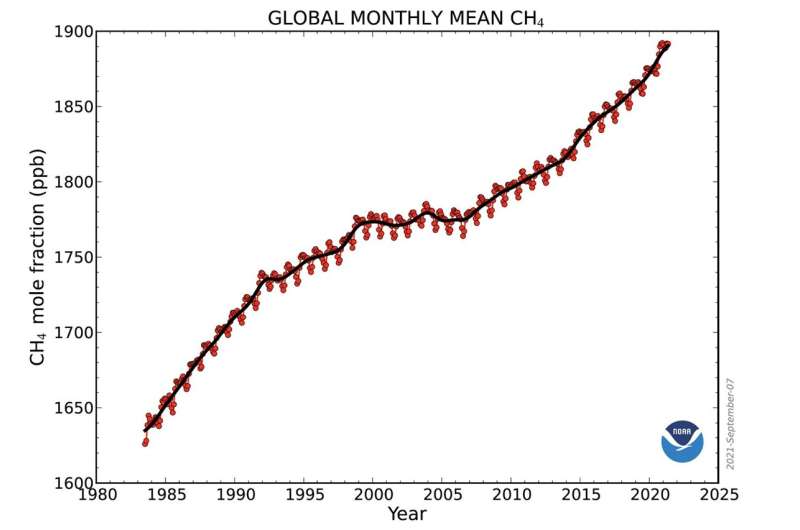
Graph shows globally averaged, monthly mean atmospheric methane abundance determined from marine surface sites since 1983. Credit: NOAA
Earlier this month, President Biden urged other countries to join the U.S. and European Union in a commitment to slashing methane emissions. Two new Stanford-led studies could help pave the way by laying out a blueprint for coordinating research on methane removal technologies, and modeling how the approach could have an outsized effect on reducing future peak temperatures.
The analyses, published Sept. 27 inPhilosophical Transactions of the Royal Society A, reveal that removing about three years-worth of human-caused emissions of the potent greenhouse gas would reduce global surface temperatures by approximately 0.21 degrees Celsius while reducing ozone levels enough to prevent roughly 50,000 premature deaths annually. The findings open the door to direct comparisons withcarbon dioxide removal—an approach that has received significantly more research…
Barges loaded with cement navigate Paraguay river, in Asuncion amid a historic drought on 22 September.Photograph: Jorge Sáenz/AP
Severe drought that began in late 2019 continues to punish the region while experts say climate change and deforestation may be intensifying the phenomenonGlobal development is supported by
In the shadow of towering grain silos that line the bank of the River Paraná, South America’s second-longest waterway, Lucas Krivenchuk stands watching workers rush to load a barge with soybeans.
“Twelve barges had to leave today, but only six will make it out: there’s no time, the water’s dropping too fast,” said Krivenchuk, general manager of the Trociuk private port in southernParaguay. “It’s the first time that any have left in two months.”
Pin ItPhoto: Stocksy/Jovo JovanovicShare on facebookShare on twitterShare on pinterestShare on emailThere’s no denying that plant-based eating is finally taking the nation by storm. (It seems like forever ago that the ketogenic diet and Paleo dominated every food convo, right?) Of course, just because something is popular certainly doesn’t mean it’s worth adopting. But this is one instance where doing so will benefit your health tremendously.
Both published in the Journal of the American Heart Association, the first study, titled “A Plant-Centered Diet and Risk of Incident Cardiovascular Disease during Young to Middle Adulthood” took into account data from 4,946 people spanning from 1986 to 2016. Researchers found that plant-based eating was directly linked to a lowered risk of heart disease—which happens to be the number one cause of death in the U.S.
The second study focused specifically on postmenopausal women. Participants followed the portfolio diet, an eating plan that emphasizes plant proteins, soluble fiber, fruit, and monounsaturated fats. Similarly to the other study, researchers found that this way of eating was linked to better heart health. Together, these studies show that plant-based eating can benefit someone no matter what age they are. Keep reading to learn more about the studies straight from the researchers and see how you can apply the intel to your own life.RELATED STORIESNot Eating Meat at Dinner Can Reduce Your Risk of Heart Disease…4 Ways Your Body Is Telling You That You’re Not Eating Enough…
Inside the link between a plant-based diet and heart health and longevity
Plant-based eating may be a central topic of conversation now, but back in 1986 when researchers of the first study started collecting data, it certainly wasn’t the movement it is today. David Jacobs, PhD, one of the study authors, explains that the goal of the study was to see if there was a connection between a diet that centered on plant-based foods and lower risk of cardiovascular disease.
The participants’ diets were evaluated over the course of 30 years using a scoring system consisting of 46 different food groups. The food groups were divided into subgroups based on their known links to heart disease. These subgroups included ‘beneficial’ foods (like fruit, veggies, beans, nuts, and whole grains), ‘adverse’ foods (including fried food, red meat, and processed foods), and ‘neutral’ foods (like non-fried potatoes, refined grains, lean meats, and shellfish). Participants had eight exams over the course of the 30 years that included lab tests, physical measurements, medical histories, and assessment of lifestyle factors. The results show a strong link: People who most ate nutritionally-rich plant foods and fewer animal products had a 52 percent lower risk of developing cardiovascular disease compared to those who didn’t have a diet where nutrient-rich plant foods were the focus.https://d43a1d10cac4c494d929d0b75d9ec065.safeframe.googlesyndication.com/safeframe/1-0-38/html/container.html
Variety is an imperative part of eating for heart health
There is one more particularly interesting result to note. While nutritionally-rich plant foods were the major driver to a high score, some animal products also contributed, such as fish, chicken, and dairy. This indicates that it isn’t necessary to give up animal products completely in order to eat with heart health in mind. Dr. Jacobs also emphasizes that there wasn’t one food in particular that was linked to a lowered risk of heart disease. “What we found is that you have to eat a variety of [nutrient-dense] foods,” he says.
The study on the portfolio diet started collecting data in 1993—again, long before plant-based eating was a term we were saying on the reg. Andrea Glenn MSc, RD, one of the study authors, says there was already scientific evidence connecting the portfolio diet to lower blood pressure levels and less inflammation. “But we didn’t know if the effects would translate into lower cardiovascular disease events, like heart attacks and stroke,” she says.
What is the portfolio diet, exactly?
If you’ve never heard of the portfolio diet, it’s an eating plan that was first developed in the early 2000s at the University of Toronto and St. Michael’s Hospital. “It is a ‘portfolio’ of cholesterol-lowering foods including plant protein, nuts, [soluble] fiber sources such as oats, barley, psyllium, eggplant, okra, and some fruits, and plant oils, such as canola, sunflower, avocado, or extra virgin olive oil,” Glenn explains. As you can see, it’s pretty synonymous with plant-based eating. Though this study focused specifically on postmenopausal women, the results echoed that of the other study: A diet high in plant-based foods was linked to an 11 percent less likelihood of developing heart disease.
How to apply this intel to your own life
Both studies offer up great news, which is that you have the power to take control of your heart health through what you eat. When asked what advice he has for people who want to apply the study findings to their life, Dr. Jacobs’s tip is simple: Eat a wide variety of nutrient-rich plants. And if you want to keep fish, lean meat, and dairy in your life too, go for it.
As a registered dietitian, Glenn recognizes that people who are used to meat being the center of every meal may find switching to a plant-based diet intimidating. Her advice is to start small, making changes in increments instead of completely changing the way you eat at once. “For example, you could start with having oatmeal with nuts and berries for breakfast or adding tofu to your dinner one or two times a week,” she says. “The great thing about the portfolio diet is that we know that even small additions of the food items can make a difference, and the more items you add, the likely the greater benefits you will see with your heart health.”
It’s never too late to start, too. Something that Dr. Jacobs and his fellow researchers saw in their findings was that regardless of how people ate earlier in life, improving their diet had a 61 percent lower risk of subsequent cardiovascular disease at the 20-year check-up compared to people whose diets got less nutrient-rich. So whether you’re 28 or 88, tweaking your diet to make nutrient-rich plants the star is worth it as far as your health is concerned.
Oh hi! You look like someone who loves free workouts, discounts for cutting-edge wellness brands, and exclusive Well+Good content. Sign up for Well+, our online community of wellness insiders, and unlock your rewards instantly.
When it comes to fitness, athletes know that what you prepare in the kitchen can sometimes be just as important as what you do in the gym – if not more so. That’s why one of the best things for anyone looking to get into great shape to do is to watch what the top athletes are eating. And as it so happens, some of their dietary habits may surprise you; did you know, for instance, that some of he world’s top female athletes have gone completely vegan?
It’s something that seems to be catching on more and more among true sporting superstars, so we thought we’d take a look at a few major examples.
Diana Taurasi
WNBA star and three-time Olympic gold medalist Diana Taurasi adopted a plant-based diet a few years back as part of a greater effort to improve her overall health. “As you get older, you get conscious of what you’re eating and how that affects your body,” she explained. “The way you look and feel that’s really helped me.”
It’s likely no coincidence that Taurasi’s coach, Sandy Brondello has also noticed marked improvement in Taurasi’s, crediting the diet for enabling her to become a better playmaker. That’s quite a remarkable thing given that Taurasi is in the later stages of her career, and now 37 years old. Yet her dedication to nutrition appears to be helping her to improve even after all her years in the league – and helping her team, too, as a result.
Venus Williams
Venus Williams famously switched to a raw vegan diet following her diagnosis with Sjögren’s syndrome, an autoimmune condition that briefly but seriously threatened her career. The condition in fact impacted Willliams’s athletic performance and overall health to the point that she withdrew suddenly from the 2011 U.S. Open, and there was speculation that she might retire.
Now that she’s eliminated animal products from her diet though, Williams has seen her symptoms subside, and has become a formidable force in the WTA once more. In fact, U.S. bookmaking services are beginning to post odds for the 2019 U.S. Open, and while Williams isn’t the favourite, it’s miraculous that she’s going to be appearing with even respectable odds. Eight years after her sudden withdrawal in 2011, Williams will be expected to compete every time she takes the court at this year’s tournament – thanks, in large part, to her dietary shift.
Alex Morgan
It wasn’t exactly a surprise when the U.S. won the World Cup earlier this year, especially considering that the Americans were the defending champions and most analysts and betting firms alike had them tabbed to lift the trophy. More simply the U.S. was a prohibitive favourite because of its incredibly talented class of players. And while it was Megan Rapinoe who stole the show bring the Cup, Alex Morgan may be the best of the Americans.
The forward credits a vegan diet for her success, with her love of animals having been the deciding factor in her decision to adopt the diet. Combined with a strenuous workout routine, Morgan’s nutrition has allowed her to become a relentless force in football. She racked up six goals of her own throughout the World Cup, and added another championship to her sensational resume.
So – Should you do it?
If you’re still unsure about turning vegan yourself, it may help to note that there are lots of tips available on how to transition to a plant-based diet. We’d also note that it may not be for everyone, and there are other way to maintain good health and athleticism. Given some of the examples above though, perhaps it’s easier to see why so many people are giving this lifestyle a chance!
Founder and Editor of Fitness Magazine. You’ll find her behind her computer or on her bike, dreaming up new ways to improve or create content for you. Twitter
States across the country have expanded controversial predator control programs in contradiction to federal goals of species protection. States are permitting or encouraging trophy hunting and hunting and trapping of predators, particularly wolves, without regard for sustainable levels. States are authorizing practices like baiting and snaring of bears, “judas” wolf collaring, use of dogs to hunt predators, shooting bears and their cubs in dens, shooting wolves and pups at dens, aerial spotting/land-and-shoot, and nighttime hunting with artificial lights.
State game programs are supported by federal funds collected under the Pittman-Robertson Federal Aid in Wildlife Restoration Act — the total amount of funding transferred to states in FY2021 was $678,894,449. Please join us in submitting a rulemaking petition to the Secretary of the Interior demanding that the eligibility of these states be subject to public comment and review as to whether their game programs are consistent with federal conservation…
I am writing to urge you to adopt regulations disqualifying states from receiving grants under the Pittman-Robertson Federal Aid in Wildlife Restoration Act if they allow hunting or trapping at levels that compromise healthy populations of wildlife, including predators, particularly grey wolves.
Pittman-Robertson currently requires states to maintain healthy populations of all species of native wildlife, but those requirements should be enforced. Federal dollars should not subsidize states that pursue practices such as baiting and snaring of bears and wolves, “judas” wolf collaring, use of dogs to hunt predators, shooting bears and their cubs in dens, shooting wolves and pups at dens, aerial spotting/land-and-shoot, and nighttime hunting with artificial lights.
Again, I urge you to take action that does not reward any state whose management practices are inconsistent with the national goal…
A judge recommended the tribe be allowed to resume its hunt of gray whales. The National Oceanic and Atmospheric Administration will make the final decision.Something went wrong.https://imasdk.googleapis.com/js/core/bridge3.481.0_en.html#goog_12711746000:04 of 02:09Volume 0% Author: Eric WilkinsonPublished: 5:27 PM PDT September 24, 2021Updated: 6:05 PM PDT September 24, 2021
NEAH BAY, Wash. — A Seattle judge has recommended the Makah Indian Tribe be allowed to resume their traditional hunt of gray whales after a decades-long legal battle with environmental groups.
Before that, the tribe had not exercised its treaty rights to hunt whales for decades because their populations were declining.
Vice-Chairman of the Makah Tribal Council Patrick DePoe was 16-years-old when he celebrated the whale’s arrival on the beaches of Neah Bay.
He says it is a lost but sacred tradition that is part of the soul of every Makah tribe member.
“It was something missing that I didn’t even know was missing until I was out there with it.”
Soon after the hunt, environmental groups took the tribe to court to prevent future whale hunting. After two decades of legal wrangling, hearings were held in Seattle in November 2019 to help decide the matter.
Now, nearly two years after that, and with the whale population rebounding to healthy levels, a judge has recommended the tribe be allowed to kill up to three gray whales a year.
Despite the victory, however, DePoe said this is a bittersweet day.
“I can’t help but reflect on the people we’ve lost over the years trying to get to this point. There are people who have passed on. There are people who have aged to the point where they might not be able to jump into a canoe and take part in something so dangerous,” he said.
The Sea Shepherd Society, which fought the tribe in the waters and the courtroom, had no comment on the decision.
During the hearings two years ago, Catherine Pruett with Sea Shepherd Legal argued no whaling should ever be allowed.
“These are highly social and sensitive creatures. We should be protecting them. They’re so important for ecosystems. As a culture, we need to know not to do this.”
Three weeks of public hearings are expected to begin in Seattle next week.
Members of the Sea Shepherd Society have previously told KING 5 News they expected defeats both in court and with NOAA and have been preparing to sue NOAA to tie the case up in court as long as possible.
For now, though, the Makah are one major step closer to putting their whaling canoe into the water once again.
“We have to finish this,” said DePoe. “We have to follow this process through. There is a finish line and there is a group that is ready to jump in and start training as soon as we give that green light.”
He was taken by Mayo One Helicopter to a hospital for serious injuries.(Pepin County Sheriff’s Office)
BySamantha NitzPublished:Sep. 25, 2021 at 12:37 PM PDT
PEPIN COUNTY, Wis. (WEAU) – One person is hurt after an ATV crash in Pepin County Friday evening.
According to the Pepin County Sheriff’s Office, on Friday at 9:12 p.m. authorities responded to a report of an ATV crash on Moritz Lane in rural Pepin County.
Authorities say 52-year-old Michael Hollister of Eau Galle, Wis. was attempting to retrieve a deer that he harvested when he lost the brakes on his ATV and rolled into a deep ravine.
Hollister was alone at the time of the crash. Due to the remoteness of the crash and troubles locating Hollister, it took authorities an extended amount of time to rescue him from the woods.ADVERTISEMENThttps://6e570e7774636e0ee5780d648c53142b.safeframe.googlesyndication.com/safeframe/1-0-38/html/container.html
Hollister was taken by Mayo One Helicopter to a hospital for…


 Image by Andrew Skowron is of Magda, rescued from use as an egg machine




 Something went wrong.

/cloudfront-us-east-1.images.arcpublishing.com/gray/UTFGXBFC7RGVJBGGGWYMJAWRLA.png)
 Exposing the Big Game