Cumberland officials recently scrapped a plan to trap beavers. (istock)
CUMBERLAND, R.I. — A town plan to trap “nuisance” beavers to reduce the flooding they cause has been halted after a town official learned the captured animals would be killed.
Mayor Jeff Mutter said the town stopped trapping beavers after a newsarticleon the plan was published May 19, and he became aware the beavers would be killed and not relocated.
“We suspended the activity the very next day,” Mutter said. He explained that at the time of approving the action, he didn’t realize state law required trapped beavers be killed unless they were released back into the same area.
“I should have been aware,” he said. When the article was published, two individuals reached out to him about the lethal action, and the trapping was immediately…
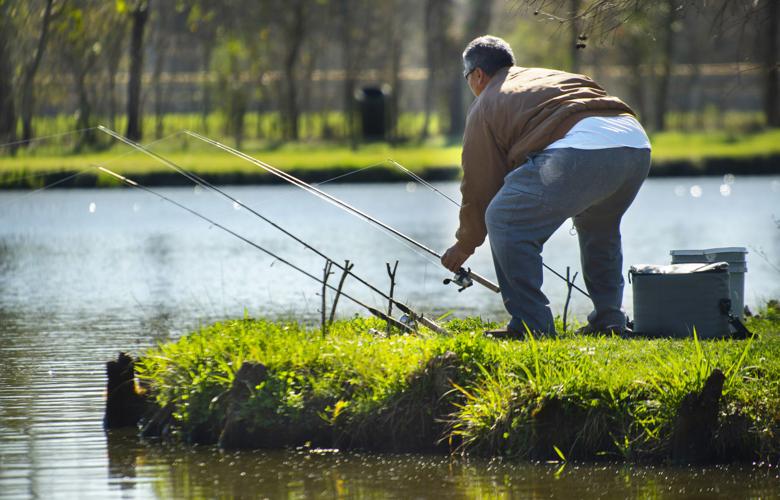
Zachary’s Mo Vo tends several rods set out with baits Tuesday, Jan. 21, 2020 on the pond at BREC’s Burbank Park, after the pond was stocked earlier that morning with approximately 400 pounds of rainbow trout. Stocking at seven community ponds across the state was done as part of the Louisiana Dept. of Wildlife and Fisheries’ ‘Get Out and Fish!’ program. The six other parks included Lafayette’s Girard Park (200 pounds), Walker’s Sidney Hutchinson Park (200 pounds), Hammond’s Zemurray Park (300 pounds), New Orleans’ Joe W. Brown Park (500 pounds), Jennings’ Oil & Gas Park (500 pounds) and Youngsville’s Southside Regional Park (200 pounds). An additional 2,100 pounds of trout were stocked in other ponds throughout the state Tuesday. The fish, which are frequently disoriented after the trip to a new…
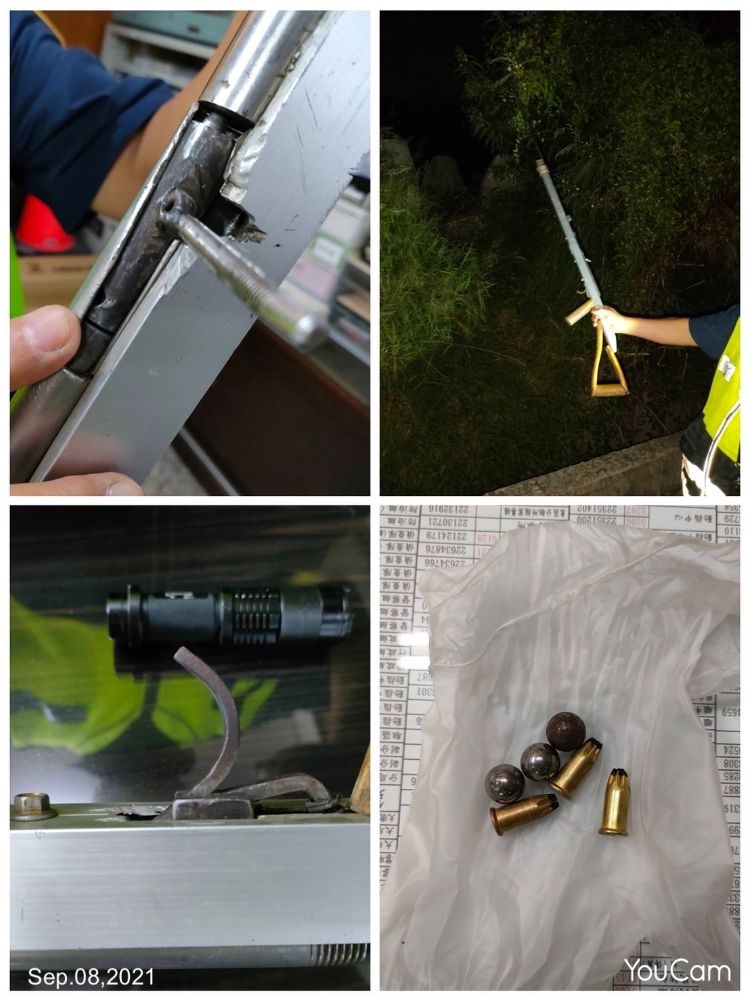
Photo courtesy of Taichung City Police Department’s Dajia Precinct
Taichung, June 8 (CNA) A Thai man handed a two-and-a-half-year prison sentence for constructing a homemade firearm from old shovels, scrap metal, and pipes said he made the weapon in order to hunt for food, according to the Taichung District Court Wednesday.
According to the verdict issued by the court, the man, a migrant worker from Thailand, was arrested on Sept. 7, 2021, after authorities found him shooting birds by an embankment in Taichung’s Da’an District.
Police then confiscated the man’s homemade firearm, as well as gunpowder, and metal pellets he was using as ammunition.
The verdict said that the worker had assembled the firearm from shovels, discarded metal pieces, and pipes in his dormitory.
In his defense, the man said he had been using the weapon to hunt for food, with his lawyer citing the…
In the first Endangered Species Act (ESA) interpretive rule produced under the Biden-Harris administration, the U.S. Fish and Wildlife Service is proposing to revisesection 10(j) regulationsunder the ESA to better facilitate recovery by allowing for the introduction of listed species to suitable habitats outside of their historical ranges. The proposed change will help improve the conservation and recovery of imperiled ESA-listed species in the coming decades, as growing impacts fromclimate changeandinvasive speciescause habitats within their historical ranges to shift and become unsuitable.
Reintroducing species of plants and animals back into areas where they have disappeared has been a regularly used technique in wildlife conservation for decades, and federal agencies were authorized by Congress to create experimental populations to aid in that…
In a recent article published in the bioRxiv* preprint server, researchers illustrated zooanthroponotic severe acute respiratory syndrome coronavirus 2 (SARS-CoV-2) transmission and viral mutations specific to hosts.
Coronaviruses, including SARS-CoV-2, can potentially infect an array of animal hosts. Although the ancestral SARS-CoV-2 animal reservoir is unknown, it has near relatives in bats. Further, an ancestor SARS-CoV-2 variant probably spread to humans through an intermediary animal host in Wuhan, China, in a seafood market.
SARS-CoV-2 is a generalist virus that infects and evolves in multiple mammals, such as companion and captive animals, humans, and wild animals. Transmission across non-human species increases the chance of SARS-CoV-2 reservoirs forming, making eradication more challenging, and offers the virus with possibilities of novel evolutionary pathways, like the emergence of new mutant lineages and the selection of adaptive mutations.
Numerous studies demonstrated that SARS-CoV-2 transmits from humans to specific animal species and, in certain instances, backward to humans. However, despite the fact that these case reports have been helpful in identifying patterns of coronavirus disease 2019 (COVID-19) transmission and adaptability among particular animal species, a worldwide, systematic analysis of the present data is lacking.
About the study
In the current work, the researchers thoroughly investigated SARS-CoV-2 transmission among mammalian species, both human and non-human, to uncover mutations linked with each species using phylogenetic analyses and publicly accessible viral genome sequences.
Utilizing a large dataset, the team systematically examined SARS-CoV-2 sequences generated from animal hosts. They used the Global Initiative on Sharing All Influenza Data (GISAID) to retrieve all existing SARS-CoV-2 genomic sequences obtained from non-human animals.
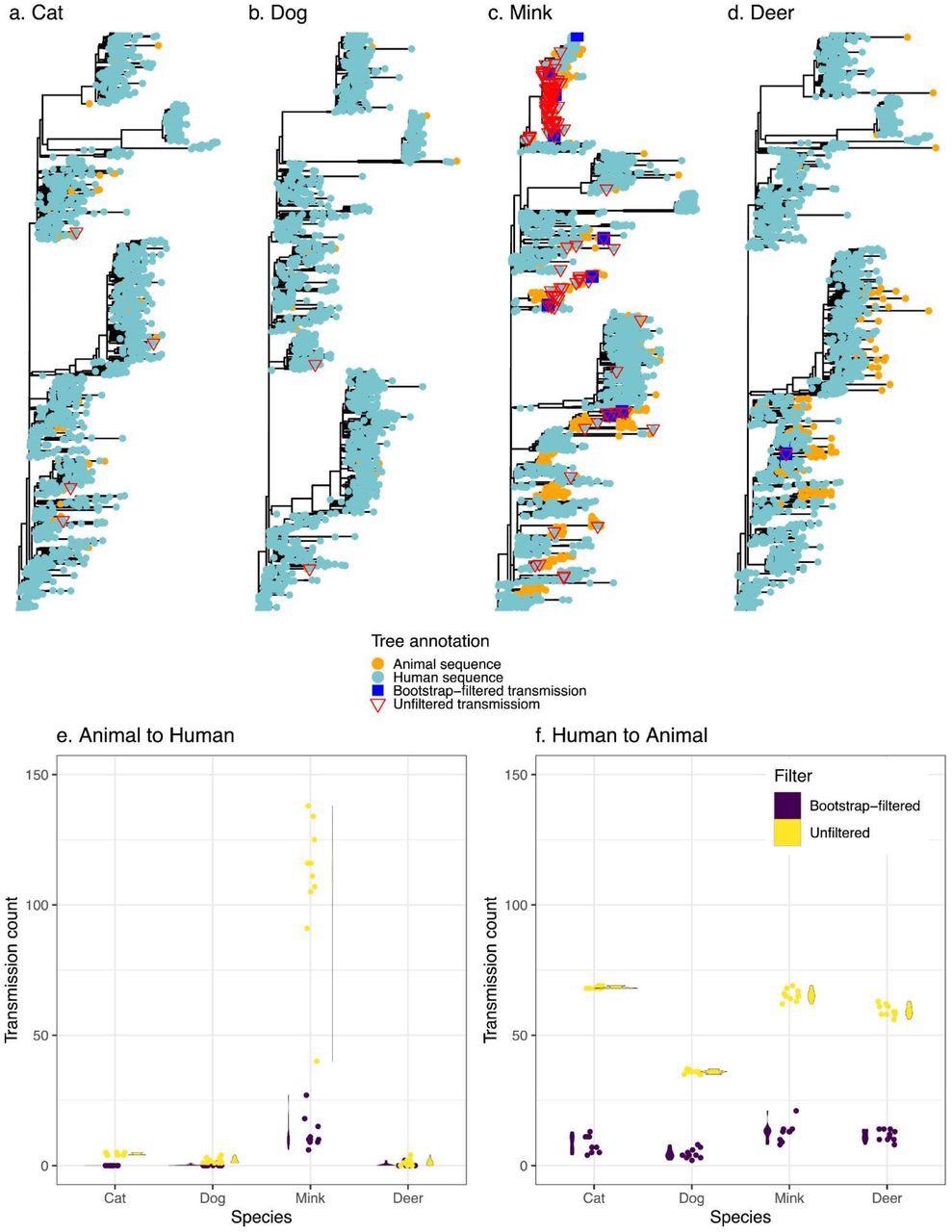
Transmission events inferred between humans and animals. Panels a-d display a representative tree for every species with animal to human transmissions marked on the tree. Trees are rooted with the Wuhan reference genome. Panels e and f display the distribution (violin plots alongside points plotted with jitter to avoid overlap) of inferred transmission counts (across 10 replicate trees) in each animal species, in both bootstrap-filtered and unfiltered trees.
The scientists estimated the relative frequencies of transmission among humans and four other often afflicted animals (Felis catus domesticus (cats), Canis lupus familaris (dogs), Odocoileus virginianus (deer), and minks) using phylogenetic approaches. They employed ancestral state restoration on viral phylogenetic trees to thoroughly explore the probable animal-to-human transmission incidents, including the transmission direction. The team’s goal was to develop a uniform comparative methodology for interspecies transmission rather than extrapolate absolute frequencies of cross-species transmission of COVID-19.
The investigators used genome-wide association studies (GWAS) to investigate mutations linked to specific animal species relative to humans. They used POUTINE, a technique that implicitly regulates population structure and interconnection between mutations by addressing just homoplasic mutations that are similar by state and not by descent, which occurs independently numerous times within the phylogeny for conducting GWAS. Besides, the researchers performed a GWAS separately to discover variants correlated with each species.
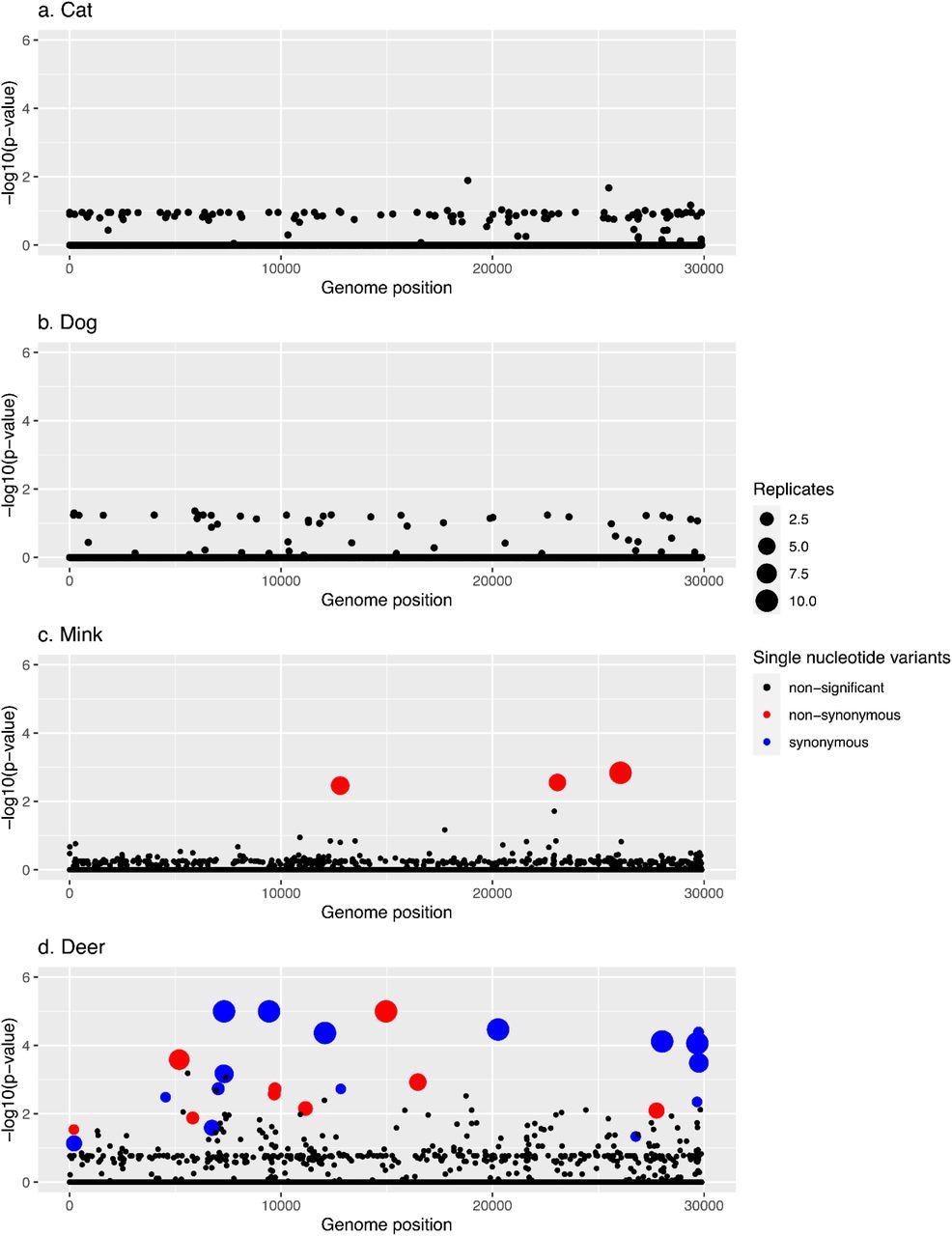
Manhattan plots summarizing GWAS hits in each animal species. In every panel, the x-axis represents the nucleotide position in the SARS-CoV-2 reference genome and the y-axis represents the -log10 of the pointwise p-values averaged over replicates. Statistically significant hits with family-wise corrected p-values of lower than 0.05 are shown in red (non-synonymous) or blue (synonymous), while non-statistically significant p-values are in black.
Results
The authors discovered that mink had the highest rate of animal-to-human SARS-CoV-2 transmission, agreeing with previous literature. On the contrary, the other examined species like dogs, cats, and deer had insignificant levels of SARS-CoV-2 transmission to humans. However, despite these findings, the possibility of SARS-CoV-2 transmission from cats or dogs to people cannot be ruled out, which could be more easily discovered with prospective household transmission research or deeper sampling.
The transmission of SARS-CoV-2 from humans to animals was consistent across species, and the slight discrepancies might be due to different sampling approaches. Although potential sampling biases may restrict predicted transmission events, the present findings serve as a valuable baseline for future research.
The team recovered the N501T mutation priorly linked with mink and two additional amino acid variations in other SARS-CoV-2 genes. They also discovered several unique deer mutations, including non-synonymous and synonymous substitutions. None of the single nucleotide variants (SNVs) were substantially linked with dogs or cats in GWAS, while 26 SNVs closely correlated with deer and three with mink.
Indeed, one of the three hits in minks appears in all 10 replicates, and at least 50% of the replicates harbored the remaining two. The three mutations, including N501T, were non-synonymous. Further, seven of the 26 hits in deer appeared in all 10 replicates, and five of them were present in at least 50% of the runs. Five of the 26 hits were intergenic mutations, whereas 12 were synonymous mutations. Additionally, 21 of the hits were cysteine (C)>uracil (U) transition mutations.
Conclusions
Together, the study findings uncovered a significant frequency of mink-to-human COVID-19 transfer incidents, while animal-to-human COVID-19 transmission from dogs, cats, and deer was uncommon. The team noted that future investigations should look into the SNVs strongly correlated with deer and minks to see if they harbor a function in variable pathogenesis, immune evasion, or modification of the host response.
The current findings support prolonged deer-to-deer COVID-19 transmission and emphasize the necessity of researching animal-related SARS-CoV-2 mutations to determine their potential influence on animal and human health. From accessible genomic sequences, the present work offers a quantitative methodology for monitoring COVID-19 transmission between animals and identifies numerous possible animal-adaptive mutations for further investigation.
*Important notice
bioRxiv publishes preliminary scientific reports that are not peer-reviewed and, therefore, should not be regarded as conclusive, guide clinical practice/health-related behavior, or treated as established information.
Monkeypox is here, and it’sspreading. The couple of dozen cases in a few countries thatwe told you about last monthare now up to over a thousand cases worldwide, with 35 reported in the United States. But the U.S. almost certainly has more cases than the statistics suggest, and there is reason to suspect that we’re already fucking up the response to the epidemic in some ways that will feel uncomfortably familiar.
We aren’t testing enough
For the first few months of the COVID pandemic, when we had the chance to contain the virus if only we could locate all the cases and their contacts, testing was woefully inadequate. Plenty of people who had…
PORTLAND, Ore. (KOIN) – There comes a time of the year when the rain slows down and the water takes a back seat to the summer parched ground… That time doesn’t appear to be here just yet.
The KOIN 6 Weather team is tracking apotentialstrong atmospheric river (AR) near the end of the week. Just like all AR events, the rain totals are expected to be high, but the exact location is in flux. An AR is essentially the gauge of horizontal water vapor transportation that can vary from situation to situation. Some conveyor belts of moisture are weaker than others, due to the strength of wind and the amount of water vapor.
What does this mean for Portland and our surrounding communities? Rainy moments are once again possible for…
The untold story about “green energy” is that it can’t possibly be scaled up to provide anywhere near the energy to replace fossil fuels. (Unless we are headed back to the stone ages, which is what some of the “de-growth” advocates favor).
Right now, the United States gets about 70% of its energy from fossil fuels. To go to zero over the next 20 years would be economically catastrophic and cost tens of millions of jobs. With gas prices at nearly double their price back from when Donald Trump left office and inflation up from 1.5% to 8% in just 15 months, we are already experiencing the economic damage from the green energy crusaders.
But we also have to ask whether green energy is even good for the environment. Some environmentalists are pointing to a little-noticed study by the World Bank showing that moving toward 100% solar, wind and electric battery energy would be just as destructive to the planet as fossil fuels. This was precisely the conclusion of a story in Foreign Policy magazine, hardly a right-wing publication.
According to the Foreign Policy analysis, moving to a “carbon-free” energy future “requires massive amounts of energy, not to mention the extraction of minerals and metals at great environmental and social costs.”
Here are some of the numbers. Going all-in on batteries, solar and wind would require:
Those tens of millions of windmills, solar panels and electric batteries for cars and trucks aren’t exactly biodegradable. So, we will have the most prominent energy graveyard with toxic pollutants that will be 100 times larger than any nuclear waste storage. And yet, the Left is worried about plastic straws!
I’m all for mining for America’s bountiful natural resources of copper, lead, magnesium and precious metals. But ironically, it’s the greens that want to shut down mines, which is like saying you want food, but you oppose farming. Talk about cognitive dissonance.
Then, the land space is needed for the windmills and solar panels. Bloomberg reports that getting to zero carbon by 2050 would require a land area equal to five South Dakotas “to develop enough clean power to run all the electric vehicles, factories, and more.”
In other words, the liberals are calling for a full-scale industrialization of America’s wilderness and landscape.
Now, even many of the most liberal areas of the country are shouting “no” to green energy in their own backyard. Vermonters are rebelling against unsightly solar panels spoiling their views. According to the Bennington Banner, “Vermont’s utility regulator has rejected permits for two 2 MW solar farms proposed in Bennington, pointing to aesthetic concerns and current land conservation measures in the town plan.”
Meanwhile, a town in Wisconsin is suing state regulators to “stop construction” of what would be “the state’s largest solar project,” according to the Wisconsin Journal.
Even blue Massachusetts residents are fighting green energy projects. Off-shore wind farms are delayed off the coast of Cape Cod, where per capita income is nearly the highest in the country, because they don’t want their ocean views spoiled from their beachfront villas.
In other words, real nature lovers are finally starting to awaken to the reality that wind and solar aren’t so green after all. A nuclear plant takes up at most 1 square mile of land. Wind and solar farms require hundreds of thousands of acres. So, to provide enough electric power to keep Manhattan lit up at night would require paving over nearly the whole state of Connecticut with windmills and solar farms.
The public is starting to ask: How is any of this green? The Green New Deal strategy makes especially no sense given that by increasing our use of clean-burning and reliable natural gas, we are reducing energy prices AND cutting carbon emissions. Add nuclear power to the mix, and we wouldn’t need to start building wind and solar farms in our forests, deserts and national parks.
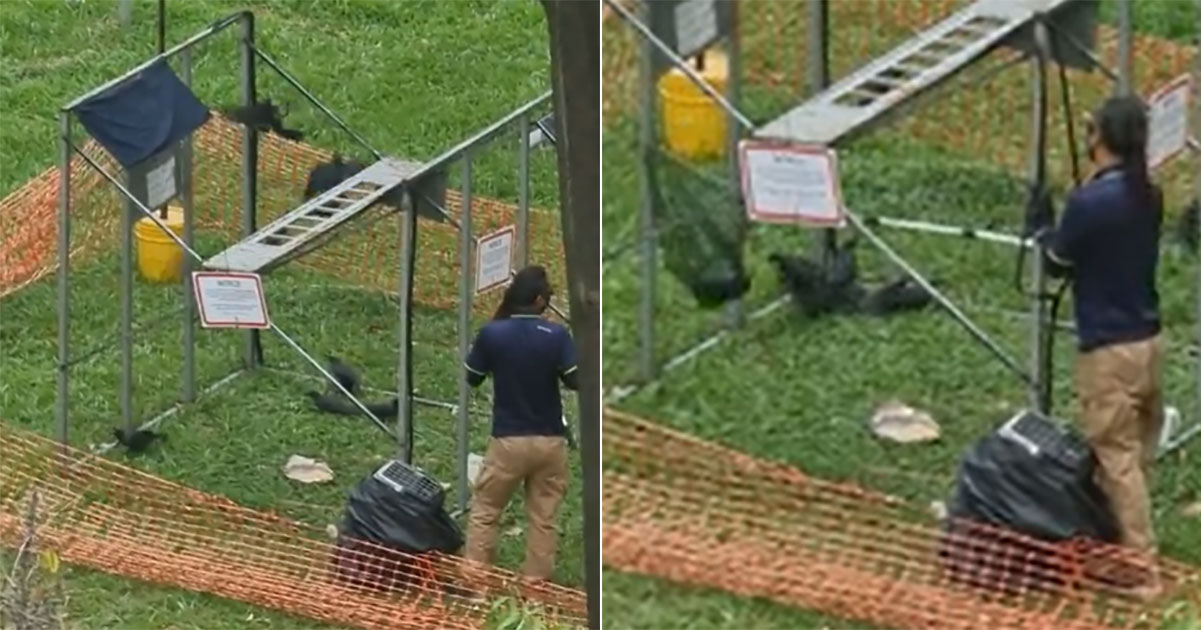
The ladder trap appeared to have been set up for the sole purpose of catching crows.
Crows that enter the trap through the ladder at the top will be unable to leave owing to the sloped shape of the trap’s roof and the carefully spaced ladder rungs.
Man removed crows calmly, methodically
Throughout the duration of the video, the man could be seen moving in a measured way as he appeared not to want to startle the birds.
He then proceeded to methodically remove the crows from the cage one by one after using his net to corner and trap each bird.
The birds he removed were placed inside a pet carrier.
Discussions on Reddit centred on the man’s role, as those who commented said he was likely hired to manage the bird population, which is a perennial issue in Singapore that has cropped up from time to time in the media.
The contraption of nets and poles has also been seen in other estates in Singapore.
Background
In the past, some 20 years ago, the management of the crow population in Singapore involved shooting them with shotguns.
The plan then was to cut the crow population from 100,000 to 10,000.
The use of shotguns to cull birds here have presented problems, besides the debate on whether more humane methods could be employed.
In February 2019, an auxiliary police officer tried to cull crows without clearing the area or checking his line-of-sight, and ended up firing multiple pellets into the front door of an HDB flat some 23m away.
His actions were deemed to have put civilians at risk.
Issue of culling
Looking at the issue from a broader perspective, culling has been called out as an ineffective long-term solution to controlling bird populations.
Speaking about the pigeon population in Singapore in particular, Anbarasi Boopal, co-CEO of Animal Concerns Research and Education Society, said in 2019 that culling these birds by poisoning them — which was one method carried out — was a short-term fix that only made the problem worse.
She said culling removes healthy pigeons to give the remaining ones more food and allow them to breed even more.
Moreover, the use of poison could also have unintended consequences, such as poisoning other animals and birds, such as quails and orioles.
Availability of food the cause of population growth
The growth of the crow population in Singapore has been attributed to the availability of food.
This was reiterated by the Ministry of National Development (MND) in February 2021 when it addressed a parliamentary question on methods to manage the crow population.
MND said “food made available by humans is a key driver of crow population growth” and that NParks received 2,750 cases of crow related feedback in 2020 pertaining to “issues such as noise, crow sightings, feeding, and crow attacks”.
MND said NParks would continue to refine their science-based management of the crow population and “develop innovative trap designs” that are both “humane and effective”.











 June 08, 2022, 10:37 AM

 Exposing the Big Game