Why don’t we have many giant animals anymore?

By Michael Dhar published 1 day ago

https://www.livescience.com/why-no-more-giant-animals

Dinosaur bones aren’t lying: animals really did use to be bigger.

A boy standing in front of the interactive T. rex at the American Museum of Natural History. We see the silhouette of the boy against the large T. rex dinosaur looking down at him from a jungle.

A boy tries out the interactive T. rex during the media preview March 5, 2019 of “T. Rex: The Ultimate Predator” an at the American Museum of Natural History in New York City. (Image credit: Photo by TIMOTHY A. CLARY/AFP via Getty Images)

Prehistoric giants used to populate the Earth. These behemoths included mighty dinosaurs, airplane-size pterosaurs, massive crocodiles and snakes, and even armadillos the size of cars. But today, there are just a few big animals on our planet.

What happened? Why aren’t there many giants left anymore?

First of all, there’s plenty of fossil evidence that the ancient past really did have larger animals — beasts that were humongous but also larger, on average, than today’s creatures, Greg Erickson, a vertebrate paleobiologist at Florida State University in Tallahassee who specializes in ancient reptiles, told Live Science. Ever since scientists unearthed the first known stash of dinosaur bones, in the 19th century, researchers have put forth ideas to explain why giants were common millions of years ago but less so today. But no one can point to one definitive answer, Erickson said. “It’s so multifactorial.” 

Sponsored Links

Looking for a Home to Host Summer BBQs? Compare Lenders.NerdWallet NMLS ID# 1617539

Related: Why are there so many giants in the deep sea?

Several major differences between dinosaurs and today’s largest animals, the mammals, may help explain the loss of behemoths, however. Along with other giant reptiles, dinosaurs could adapt to different niches as they grew bigger over life, hunting smaller prey as juveniles and larger victims as adults. In part, they could do this because they swapped out sets of teeth over a lifetime. “They replace their teeth constantly, just like sharks do. But along the way they could change the type of teeth,” Erickson said. Crocodiles, for instance, go from “needle-like teeth to more robust teeth. Mammals don’t have that luxury.”

Put another way, as some reptilian youngsters ballooned into hulking adults, they traded their relatively puny juvenile teeth for bigger weapons, allowing them, in turn, to hunt bigger meals to fuel their larger bodies.

In dinosaurs, too, air sacs likely extended from their lungs to their bones, creating sturdy but light scaffolding, Edinburgh University paleontologist Steve Brusatte told Scientific American(opens in new tab). That gave dinosaurs skeletons that were “still strong and still flexible, but lightweight. That helped them get bigger and bigger and bigger,” Brusatte said. “The same way that skyscrapers are getting bigger and bigger and bigger because of the internal support structures.” (Of course, though air sacs helped make for strong, lightweight bones, no animal could actually get as big as a skyscraper. That’s because body weight grows much faster than bone strength as animals increase in size, as physicist Neil deGrasse Tyson has explained(opens in new tab).) 

Mammals lack such air sacs, though, “that can invade the bone and lighten up the bone,” Brusatte said, “So elephant size or a little bit bigger, that might be the limit as to where mammals, at least on land” can get. … You can’t really get mammals, it doesn’t seem, to be the size of dinosaurs.”

An Asian elephant extends its trunk.
It’s believed that elephant size may be about the limit as to how big land mammals can get. (Image credit: Shutterstock)

As warm-blooded, or endothermic creatures, mammals also need a lot of fuel. “Elephants are full endotherms, and the dinosaurs, at least the herbivorous dinosaurs, probably mostly were not,” Geerat Vermeij, a professor of geobiology and paleobiology at the University of California, Davis, told Live Science. “So the food requirement for, say, a gigantic elephant would be … perhaps 5 times greater than that of even the very largest dinosaurs.” 

Paleontologists have debated whether dinosaurs were cold- or warm-blooded. But current science places many animal species on a gradient between cold- and warm-bloodedness, and dinosaurs were probably “on the low end of the warm-blooded range,” Erickson said. That made a large body less energetically expensive for dinos.

Huge size also requires the right environment. In a 2016 study published in the journal PLOS One(opens in new tab), Vermeij concluded that giantism depends mostly on sufficient resources produced and recycled by “highly developed ecological infrastructure.” In other words, the ecology needs to produce sufficient oxygen, food and habitat to grow a truly giant creature. Such ecologies had seen great development by the middle Triassic period, near the beginning of the age of dinosaurs, Vermeij wrote.

In one potentially important environmental change, ancient atmospheres had higher concentrations of oxygen. This may have played a role in gigantism, particularly among insects. Wingspans among prehistory’s biggest bugs tracked ancient increases in oxygen concentration, a 2012 study in the journal Proceedings of the National Academy of Sciences(opens in new tab) reported.

RELATED MYSTERIES

Are there any giant animals humans haven’t discovered yet?

What were the largest predators in North America?

What happened when the dinosaur-killing asteroid slammed into Earth?

Brewers of gigantism shouldn’t forget the crucial ingredient of time, either. Though animal lineages tend to get larger over the generations, it takes a vast amount of evolutionary time to reach giant sizes, Erickson said. And mass extinction events tend to wipe out larger creatures, Vermeij said, so these events can leave giant-animal slots unfilled for tens or hundreds of millions of years. “It took about 25 million years for the first mammals to reach a ton in weight,” he said. In the case of woolly mammoths, decimated by climate change and human hunters just 10,000 years ago, it may not be a coincidence that we modern humans don’t see such huge creatures: Our own ancestors helped kill them off not so long ago.

For Vermeij, the most comprehensive explanation for decreasing size comes not from physiology or environment, but from social structure. “The evolution of … organized social behavior, not just herds but really organized hunting” in mammals introduced a new form of dominance, he said. “Group hunting by relatively small predators makes even very large prey vulnerable. Individual gigantism has in effect been replaced on land by gigantism at the group level,” he wrote in the 2016 study. That is, smaller individuals working together, as happens with wolves and hyenas for example, may constitute a more effective way of getting big than building a huge body. As a result, “gigantism lost its luster on land,” Vermeij wrote. 

Social organization may also help explain a rather, ahem, giant exception to the timeline traced here: In the ocean, the biggest animals to ever live still exist today: blue whales. Sea life, Vermeij said, makes long-distance communication more difficult, hindering the development of complex hunting groups. The evolution of such groups “has happened on land much more than, at least until recently, that has happened in the ocean,” such as with killer whales, he said.

Dramatic changes in Tennessee turkey hunting

Exposing the Big Game's avatarCommittee to Abolish Sport Hunting Blog


by Richard SimmsMonday, June 6th 2022

https://newschannel9.com/sports/outdoors/dramatic-changes-in-tennessee-turkey-hunting

UserWay icon for accessibility widget

Tennessee officials have outlawed the practice of turkey "fanning," also called "reaping" on wildlife management areas. The practice is when hunters use a turkey "fan" to hide and attract or approach turkeys. Wildlife officials believe the practice can increase the possibility of accidental shootings. (Photo courtesy Realtree)

Tennessee officials have outlawed the practice of turkey “fanning,” also called “reaping” on wildlife management areas. The practice is when hunters use a turkey “fan” to hide and attract or approach turkeys. Wildlife officials believe the practice can increase the possibility of accidental shootings. (Photo courtesy Realtree)

Facebook Share Icon

Twitter Share Icon

Email Share Icon

NASHVILLE, Tenn. —The Tennessee Fish and Wildlife Commission has set the state’s hunting and trapping seasons for 2022-23, including some dramatic changes for turkey hunters.

After hearing growing reports of decreasing turkey populations, the Commission voted to open the Spring turkey season statewide two weeks later than usual in hopes of improving reproduction and nesting success. The bag limit will also be decreased from three birds to two birds, and only one bird can be a juvenile gobbler or jake.

Commissioners also opted to try for additional predator control to benefit turkeys. Turkeys build their nests on…

View original post 659 more words

US Warns Kim Jong Un of ‘Forceful Response’ to Any Nuclear Test

Jeong-Ho Lee – Yesterday 11:45 PM

React52 Comments|138

(Bloomberg) — The US warned North Korea of a strong punishment if it conducts a nuclear test, as Washington and a United Nations’ watchdog agency have said signs indicate Pyongyang could soon set off its first atomic device since 2017.

Most Read from Bloomberg

“There would be a swift and forceful response to such a test,” Deputy Secretary of State Wendy Sherman said in Seoul in a Tuesday meeting with her South Korean counterpart.

“Any nuclear tests would be in complete violation of UN Security Council resolutions,” she said, adding it would be destabilizing to the world security. Sherman didn’t elaborate on specific measures, but suggested the US could work with its allies to levy punishments.

There’s almost no chance Russia or China, which have veto power at the UN Security Council, would support any new sanctions against North Korea, as they did in 2017 following a series of weapons tests that prompted then President Donald Trump to warn of “fire and fury.” The two countries in late May vetoed a council resolution drafted by the US to ratchet up sanctions on North Korea for its ballistic missile tests this year.

The UN’s International Atomic Energy Agency said it has observed indications North Korea “may be preparing for a nuclear test.” IAEA Director General Rafael Grossi said at a meeting Monday of the agency’s Board of Governors such a test “would be a cause for serious concern.”

A test of a nuclear device would be North Korea’s seventh and the fifth under leader Kim Jong Un. His regime last tested a nuclear weapon in September 2017, which was its most powerful atomic bomb by far with an estimated yield of between 120-250 kilotons.

Any display of the weapons in Kim’s nuclear arsenal would serve as a reminder of the pressing security problems posed by Pyongyang that have simmered as US President Joe Biden’s administration has been focused on Russia’s invasion of Ukraine.

Related video: UNSC holds meet on North Korea’s nuclear tests, US calls for more stringent sanctions

about:blank

javascript:void(0)

Advertisement: Your video starts in 0 seconds.

UNSC holds meet on North Korea’s nuclear tests, US calls for more stringent sanctions

Satellite imagery indicated workers have been digging a new passageway at the Punggye-ri site, where North Korea has conducted all of its previous nuclear tests, specialist service NK News and others reported.For more on North Korea:

US, South Korea Fire Missiles in Response to Kim Jong Un BarrageN. Korea Fires 8 Missiles, Testing Biden With Launch Record Biden Has Little to Entice Kim Jong Un to Stop Weapons TestsHow Kim Jong Un Keeps Advancing His Nuclear Program: QuickTake

About 20 warplanes from the US and South Korea, including F-35A stealth fighters, conducted a combined air power demonstration over waters off the west coast of the peninsula, South Korea’s Joint Chiefs of Staff said Tuesday.

The “martial protest” showed the allies’ “overwhelming response” against North Korea’s threat, the joint chiefs said in a statement. New South Korean President Yoon Suk Yeol, a conservative who took office on May 10, has pledged closer security cooperation with Biden and a stepping up of joint military exercises.

US and South Korean forces on Monday fired eight missiles after North Korea launched a similar number the day before. It marked the first time the allies have had a tit-for-tat launch since 2017, according to the Yonhap News Agency.

North Korea’s launch pushed the number of ballistic missiles test-fired this year to an annual record of 31, which includes at least two failures. Pyongyang also appeared to be responding to what it saw as provocations, firing off what was likely the biggest single-day barrage during Kim’s decade in power as the US and South Korea finished joint naval exercises in international waters in the vicinity of Japan’s Okinawa prefecture.

North Korea for years has called joint drills a prelude to an invasion and nuclear war, and threatened retaliation.

(Updates with report of joint flights.)

Most Read from Bloomberg Businessweek

Deer hunting on decline around Pennsylvania, but Tyler State Park expects not problem

Exposing the Big Game's avatarCommittee to Abolish Sport Hunting Blog

A deer. (Photo courtesy of Unsplash)

ByGREG VELLNER|

PUBLISHED:June 5, 2022 at 9:27 p.m.| UPDATED:June 5, 2022 at 9:27 p.m.

While a decline in the number of Pennsylvania hunters has raised concern about managing deer population, there currently is no shortage of those hoping to pursue the “dense” number of whitetails at Tyler State Park in Newtown.

“We allow 150 hunters during our one-day shotgun hunt and 70 archery hunters, and we generally get double that applying for a permit,” said Phillip Schmidt, manager, Tyler State Park. “Even if there is less people hunting in the state — or even in this area – we will still probably get more applications than we can take.”

It’s a different story statewide. Because so many deer hunters are aging out of the sport – and new ones are not recruited — deer management strategies will need to change, it…

View original post 466 more words

New hunting trends to keep the old sport alive

Exposing the Big Game's avatarCommittee to Abolish Sport Hunting Blog

According to columnist V. Paul Reynolds, the statistics don’t support hunting’s naysayers.

BY V. PAUL REYNOLDSOUTDOORS COLUMNIST

Fueled by a liberal press and the animal rights lobby during the past decade, the conventional notion has come to be this: recreational hunting is on the skids, living on borrowed time. Even among the ranks of outdoor writers, there are some of my peers who have bought in to this negativity, arguing that the blood sports are terminal in Western culture.

V. Paul Reynolds, Outdoors Columnist

Is that really the case?

Statistics really don’t support the naysayers. In 2004, there were about 15 million licensed hunters in the U.S. Granted, the numbers dipped slightly below that total during the following decade, but then peaked at 15.6 million in 2018.

No doubt cultural changes have had a negative impact on the recruitment…

View original post 356 more words

What science is behind this kind of wildlife management?

Exposing the Big Game's avatarCommittee to Abolish Sport Hunting Blog

Jun 5 2022, 6:14 AM

https://vtdigger.org/letters_to_editor/what-science-is-behind-this-kind-of-wildlife-management/

Tweet

Share

Email

We’re told Vermont Fish & Wildlife Department decisions are always based in science. What is F&W’s science behind:

  • Opposition to a shortened hound hunting season in the Conte Refuge to protect ground nesting birds?
  • Bear hound training when bears are still nursing cubs and need calories for their cubs’ care, not fleeing a pack of hounds?
  • Trapping that does not discriminate what is caught, and can injure or kill protected and endangered species as well as family pets?
  • Relying on killing moose as the best solution to fight winter ticks?

An inflexible position that sport trapping and hounding “traditions” cannot be challenged lock us into an outdated understanding of wildlife management. Culture changes; dogfighting is now banned in the U.S., and an increasing number of states ban some forms of hounding and limit or ban trapping due to public safety and…

View original post 150 more words

US bird flu outbreak: millions of birds culled in ‘most inhumane way available’

Controversial asphyxiation method used in 73% of culls this year despite vets urging its use to be limited

https://www.theguardian.com/environment/2022/jun/06/us-bird-flu-outbreak-millions-of-birds-culled-in-most-inhumane-way-available

Dead birds being dumped into a disposal truck
Dead ducks are dumped into a disposal lorry at a farm. More than 38m birds in the US have been culled during this year’s bird flu outbreak. Photograph: Jo-Anne McArthur/We Animals Media

Animals farmed is supported by

Animals farmed

About this content

Marina BolotnikovaMon 6 Jun 2022 02.00 EDT

The US poultry industry has increasingly switched to “the most inhumane method available” to cull tens of millions of birds during the latest outbreak of avian influenza, according to government data.

Outbreaks of the disease, also known as bird flu, have wreaked havoc across Europe and the US this year, with 38 million birds killed in the US so far.

But how these birds are killed has generated controversy, with veterinarians and animal welfare campaigners urging an end to the use of the ventilation shutdown method, which kills animals by sealing off the airflow to the poultry sheds and increasing temperatures to lethal levels.

Workers have described the method as like “roasting animals alive”. European officials have said it should not be used in the European Union.

Advertisement

In the US, however, the American Veterinary Medical Association (AVMA) lists ventilation shutdown with supplemental heat as “permitted in constrained circumstances” for “depopulation”.

A new analysis has found that it has now become the main method for killing birds, used in nearly three-quarters of culls.

The analysis of US Department of Agriculture (USDA) data by the Animal Welfare Institute found 73% of culls in the US in February and March (the most recent period for which data is available) involved the use of ventilation shutdown.

This represents a dramatic shift from the last bird flu epidemic, in 2015, which resulted in the killing of 50 million farmed birds in the US. During that outbreak, the animals were predominantly killed by carbon dioxide poisoning or smothered in a blanket of firefighting foam.

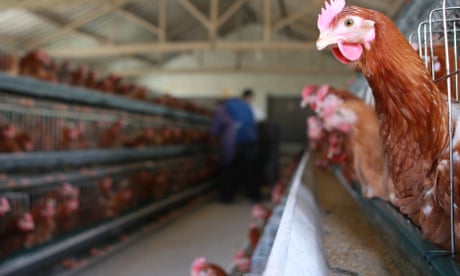
Chickens roost at a poultry farm in China.
A person in a hazmat suit stands in the doorway of a huge barn
More than two-thirds of culls in the US so far this year involved the use of ventilation shutdown. Photograph: Jo-Anne McArthur/We Animals Media

Advertisement

“The default method of killing seems to have changed from foam to ventilation shutdown,” said Dena Jones, director of the AWI farm animal programme, who said the design of poultry housing “ensures they won’t be able to humanely kill them”.

A USDA spokesperson said “some housing designs do not allow for effective depopulation using foam” and that the carbon dioxide method was “hindered by supply shortages”. The department financially compensates farmers for culling animals.

Activists have protested against the widespread use of ventilation shutdown, most notably by disrupting basketball games to draw attention to Glen Taylor, the billionaire owner of the Minnesota Timberwolves team who also owns an Iowa egg farm where 5.3 million hens were killed using ventilation shutdown.

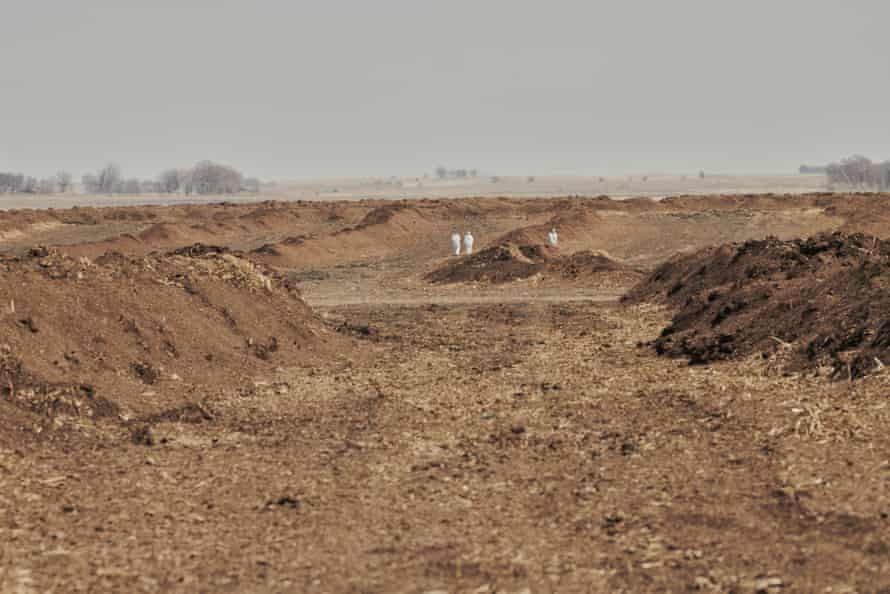
Two figures in white protective suits are seen in the distance amid mounds of bare soil
The burial pit for some of the millions of chickens at an egg plant in Rembrandt, Iowa. Photograph: Dan Brouillette/The Guardian

A coalition of vets and animal rights advocates have urged the AVMA to reclassify the method as “not recommended”. The lack of response so far from the AVMA “harms animals and the veterinary profession’s reputation as caring advocates for animals”, according to Crystal Heath, a vet and co-founder of the ethical veterinary group Our Honor.

In the EU and the UK, birds are culled with carbon dioxide gas or nitrogen-infused foam, which are considered to be more humane methods than using firefighting foam when carried out correctly because they render the animals unconscious before killing them, Jones said.

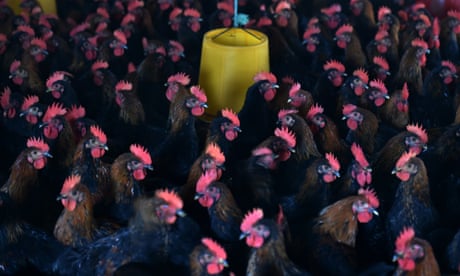
Chickens at a farm in Hefei, in China's Anhui province.

Advertisement

The European Food Safety Authority says ventilation shutdown should not be used, but there have been reports of producers in France being given emergency permission to use it.

The EU also considers the use of firefighting foam to kill birds as inhumane because it entails “drowning in fluids or suffocation by occlusion of the airways”.

The USDA did not respond to a question about whether any steps were being taken to require less painful cull methods or prevent ventilation shutdown from becoming the default in future outbreaks.

“Megadrought” threatens Arizona water cutbacks

Exposing the Big Game's avatarThe Extinction Chronicles

Jun 4, 2022-Energy & Environment

5. https://www.axios.com/2022/06/04/arizona-drought-water-cutbacks

Photo illustration of a dried out section of Lake Mead with a cotton plant and abstract shapes.
Photo illustration: Shoshana Gordon/Axios. Photo: Mario Tama/Getty Images

Arizona and the other six Western states that are part of the Colorado River Basin are in the midst of a 22-year “megadrought” that ranks as the region’s worst in 1,200 years.

Why it matters:If the situation worsens, restrictions on outdoor residential water use could be only a couple of years away, Arizona Department of Water Resources director Tom Buschatzke tells Axios.

  • The drought,driven in large part by human-caused climate change, has already caused water cutbacks for central Arizona farmers and new requirements for homebuilding in Phoenix’s fast-growing southeastern suburbs.
  • There’s no end in sight to the drought, which experts said should be considered the new normal due to climate change.

Much of the stateis dependent on water for agricultural and residential use from the Central…

View original post 545 more words

Police discover 30 dead animals in home of South Carolina animal rescue CEO

The county sheriff said this was one of the worst cases of animal cruelty he has ever seen

By Landon Mion | Fox News

Fox News Flash top headlines for June 5

Fox News Flash top headlines are here. Check out what’s clicking on Foxnews.com.

NEWYou can now listen to Fox News articles!

Listen to this article

0:00 / 2:121X

BeyondWords

A South Carolina animal rescue CEO was arrested after police found 30 dead animals inside her home while responding to a complaint about a “smell of death” coming from the residence.

GROWL CEO and director Caroline Dawn Pennington, 47, was arrested Friday and charged with 30 counts of ill-treatment of animals after police discovered 28 dogs and two cats decomposing in crates and cages inside her home.

Caroline Dawn Pennington, 47, was charged with 30 counts of ill-treatment of animals.

Caroline Dawn Pennington, 47, was charged with 30 counts of ill-treatment of animals. (Richland County Sheriff’s Office)

According to deputies, the animals had been dead for a significant period of time based on the level of decomposition, and appear to have died from starvation and dehydration. The animals were laying in their own waste when the situation was uncovered.

A spokesperson for the sheriff’s department said investigators believe the animals were neglected and had been left alone in their cages for seven to nine months before their deaths.

PHILADELPHIA MASS SHOOTING: VICTIMS IDENTIFIED BY POLICE, INCLUDING MENTOR TO YOUNG BOYS

Richland County police found the deceased animals on May 22, when they arrived to perform a wellness check after a neighbor called to report a “smell of death” coming from the home.

NORTH CAROLINA HOSPITAL SHOOTING: 1 INJURED, SUSPECT FLED SCENE

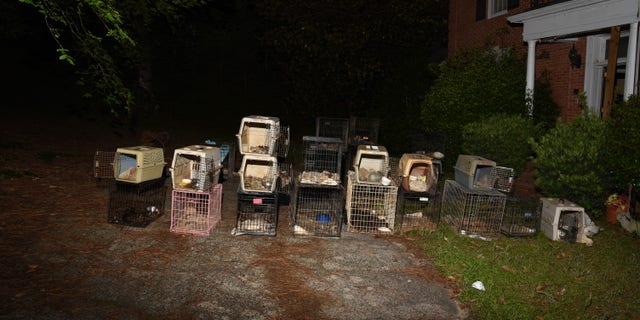
30 dead animals were found inside the home of a South Carolina animal rescue CEO.

30 dead animals were found inside the home of a South Carolina animal rescue CEO. (Richland County Sheriff’s Department)

Sheriff Leon Lott said this was one of the worst cases of animal cruelty he has ever seen.

“It’s appalling, and it’s heartbreaking,” he said, according to WYFF. “This is someone who was entrusted by the community to care for these animals and find them homes. She betrayed that trust, and she betrayed the trust of these innocent animals who relied on her.”

Pennington was also employed by the Kershaw County Humane Society, but the organization revealed that she would no longer be working for them.

KENTUCKY SUSPECT SHOT AND KILLED DEPUTY WHO LET HIM SMOKE AFTER ARREST

FILE- Police lights features on the top of a cruiser.

FILE- Police lights features on the top of a cruiser. (Fox News)

“We were unaware of the former employee’s actions and are truly shocked and heartbroken,” Kershaw County Humane Society said in a statement. “Our dedicated staff will continue with our mission to serve the lost and homeless pets of Kershaw County.”

Richland County Animal Control and the sheriff’s department worked to remove the animals from the home.

CLICK HERE TO DOWNLOAD THE FOX NEWS APP

Pennington is also being investigated for potential fraud, given that GROWL is a registered non-profit organization. Anyone who has made documented donations to the organization in the last year is asked to contact the Richland County Sheriff’s Department.

Muslim countries express outrage to India over derogatory remarks about Islam

June 6, 20228:03 AM ET

THE ASSOCIATED PRESS

Indian Muslims shout slogans as they react to the derogatory references to Islam and the Prophet Muhammad made by top officials in the governing Hindu nationalist party during a protest in Mumbai, India, on Monday.

Rafiq Maqbool/AP

NEW DELHI — India is facing major diplomatic outrage from Muslim-majority countries after top officials in the governing Hindu nationalist party made derogatory references to Islam and the Prophet Muhammad, drawing accusations of blasphemy across some Arab nations that have left New Delhi struggling to contain the damaging fallout.

At least five Arab nations have lodged official protests against India, and Pakistan and Afghanistan also reacted strongly Monday to the comments made by two prominent spokespeople from Prime Minister Narendra Modi’s Bharatiya Janata Party. Anger has poured out on social media, and calls for a boycott of Indian goods have surfaced in some Arab nations. At home, it has led to protests against Modi’s party in some parts of the country.

The controversial remarks follow increasing violence targeting India’s Muslim minority carried out by Hindu nationalists who have been emboldened by Modi’s regular silence about such attacks since he was first elected in 2014.

Over the years, Indian Muslims have often been targeted for everything from their food and clothing style to inter-religious marriages. Rights groups such as Human Rights Watch and Amnesty International have warned that attacks could escalate. They have also accused Modi’s governing party of looking the other way and sometimes enabling hate speech against Muslims, who comprise 14% of India’s 1.4 billion people but are still numerous enough to be the second-largest Muslim population of any nation.

Sponsor Message

https://1ec8d5f64f3aec65da93bbda3340018e.safeframe.googlesyndication.com/safeframe/1-0-38/html/container.html

Modi’s party denies the accusations, but India’s Muslims say attacks against them and their faith have increased sharply.

The anger has been growing since last week after the two spokespeople, Nupur Sharma and Naveen Jindal, made speculative remarks that were seen as insulting Islam’s Prophet Muhammad and his wife Aisha.

Modi’s party took no action against them until Sunday, when a sudden chorus of diplomatic outrage began with Qatar and Kuwait summoning their Indian ambassadors to protest. The BJP suspended Sharma and expelled Jindal and issued a rare statement saying it “strongly denounces insult of any religious personalities,” a move that was welcomed by Qatar and Kuwait.

Later, Saudi Arabia and Iran also lodged complaints with India, and the Jeddha-based Organization of Islamic Cooperation said the remarks came in a “context of intensifying hatred and abuse toward Islam in India and systematic practices against Muslims.”

India’s Foreign Ministry on Monday rejected the comments by the OIC as “unwarranted” and “narrow-minded.” On Sunday, India’s embassies in Qatar and Kuwait released a statement saying the views expressed about the Prophet Muhammad and Islam were not those of the Indian government and were made by “fringe elements.” The statement said that strong action had already been taken against those who made the derogatory remarks.

The criticism from Muslim countries, however, was severe, indicating that insulting Prophet Muhammad was a red line.

Qatar’s Foreign Ministry said it expected a public apology from the Indian government, and Kuwait warned that if the comments go unpunished, India would see “an increase of extremism and hatred.” The Grand Mufti of Oman described the “obscene rudeness” of Modi’s party toward Islam as a form of “war.” Riyadh said the comments were insulting and called for “respect for beliefs and religions.” And Egypt’s Al-Azhar Mosque, the Sunni world’s foremost institution of religious learning, described the remarks as “real terrorism (that) can plunge the entire world into severe crises and deadly wars.”

The remarks made by Sharma during a TV program in India and Jindal in a tweet risk damaging India’s ties with Arab nations.

India maintains strong relations with Gulf countries, which rely on millions of migrant workers from India and elsewhere in South Asia to serve their tiny local populations and drive the machinery of daily life. India also depends on oil-rich Gulf Arab countries, such as Saudi Arabia, to power its energy-thirsty economy.

The remarks also led to anger in India’s archrival and neighbor, Pakistan, and in Afghanistan.

On Monday, Pakistan’s Foreign Ministry summoned an Indian diplomat and conveyed Islamabad’s “strong condemnation,” a day after Prime Minister Shahbaz Sharif said the comments were “hurtful” and “India under Modi is trampling religious freedoms & persecuting Muslims.” India’s Foreign Ministry responded by calling Pakistan “a serial violator of minority rights” and said it should not engage “in alarmist propaganda and attempting to foment communal disharmony in India.”

“India accords the highest respect to all religions,” ministry spokesperson Arindam Bagchi said.

Criticism also came from Kabul. The Islamic Emirate of Afghanistan said the Indian government should not allow “such fanatics to insult … Islam and provoke the feelings of Muslims.”

Modi’s party also faced anger from some of its own supporters, but it was for a different reason. Many Hindu nationalists posted comments on social media saying the government was buckling under international pressure.

Anti-Muslim sentiments and attacks have risen across India under Modi. Last week, U.S. Secretary of State Antony Blinken said India was seeing “rising attacks on people and places of worship,” eliciting a response from New Delhi, which called the comments “ill-informed.”

More recently, religious tensions have escalated after some Hindu groups went to a local court in northern Varanasi city to seek permission to pray at a 17th century mosque, claiming that it was built by demolishing a temple. Critics say these tensions have been further exacerbated by Indian television anchors during raucous debates.