Image caption,The vision is to live in harmony with nature by 2050
Major UN talks aimed at striking a deal on safeguarding nature have been moved from China to Canada.
The COP15 UN Biodiversity Conference began as virtual, online talks in October last year.
Negotiations were meant to reconvene in Kunming, China in April but that was repeatedly postponed due to Covid.
The talks are aimed at setting global policy for the next decade. They will now conclude in Montreal between December 5-17.
The aim of the summit, which China will still chair despite the venue change, is to approve the final version of the draft UN Convention on Biological Diversity (CBD).
COP 15 President, Minister Huang Runqiu said: “China would like to emphasize its continued strong commitment, as COP President, to work with all Parties and stakeholders to ensure the success of the second part of COP 15, including the adoption of an effective Post-2020 Global Biodiversity Framework, and to promote its delivery throughout its Presidency.”
Observers have previously slammed the “snail’s pace” of negotiations and are pressing for a strengthening of ambitions.
The outcome will decide how the world will address the challenges of reducing the extinction risk threatening more than one million species, protecting 30% of land and sea, eliminating billions of dollars of environmentally-damaging government subsidies and restoring degraded ecosystems.
ADVERTISEMENT
Andrew Deutz, Director of Global Policy, Institutions and Conservation Finance at The Nature Conservancy said his organisation was “relieved and thankful that we have a firm date for these critically important biodiversity final negotiations within this calendar year.
The global community is already behind in agreeing, let alone implementing, a plan to halt and reverse biodiversity loss by 2030, a plan that people and wildlife desperately need.”
Animal Control: Steel leg clamps outlawed in state of California
A squirrel in Live Oak was caught by two illegal steel leg traps Sunday and now animal advocates are offering a reward for information leading to an arrest and conviction in the case. (Santa Cruz County Animal Shelter — Contributed)
PUBLISHED:June 21, 2022 at 4:39 a.m.| UPDATED:June 21, 2022 at 4:41 a.m.
LIVE OAK — A squirrel was euthanized after a resident discovered the rodent flailing with two different miniature steal traps clamped onto his limbs Sunday evening.
The Santa Cruz County Animal Shelter is seeking information on the individual who set illegal steel rodent traps in the Live Oak area. (Santa Cruz County Animal Shelter — Contributed)
Now, a nonprofit wildlife emergency response group has put up a cash reward for the arrest and conviction of whoever set the illegal…
BOSTON — Hundreds of dead birds have washed up on Martha’s Vineyard and animal control officials there think a highly contagious strain of avian flu may be responsible.
Hundreds of cormorants like these shown in Cape Elizabeth in 2021 have washed up dead on Martha’s Vineyard.Shawn Patrick Ouellette/Staff Photographer
The Tisbury Animal Control posted an “avian influenza warning” on social media Monday, telling residents that hundreds of dead cormorants have washed up all over the island and it’s “extremely dangerous” for a small island.
Animal control officers collected the birds and sent many to the Massachusetts Division of Fisheries and Wildlife for testing.
The animal control office said the new strain could become a major issue that may take years to recover…
The Russian military pounded away at pockets of resistance across parts of eastern Ukraine on Tuesday whiletwo American veteranscaptured by Russian troops waited to learn if they will face the death penalty.
The beleaguered eastern city of Sievierodonetsk isone of the last areas in the Luhansk regionthat Russia has failed to completely overwhelm. About 568 civilians, including 38 children, remain holed up with Ukraine fighters at the Azot chemical plant, said regional governor Serhiy Haidai. The civilians are primarily employees of the company, and their families andhave refused to evacuate, Haidai said.
“Today everything that can burn is on fire,” Haidai said.
The Russian military controls about 95% of the Luhansk, which along with Donetsk comprises the Donbas region that the Kremlin has coveted since withdrawing from a botched assault on the Ukraine capital of…
Copyright 2022 The Associated Press. All rights reserved
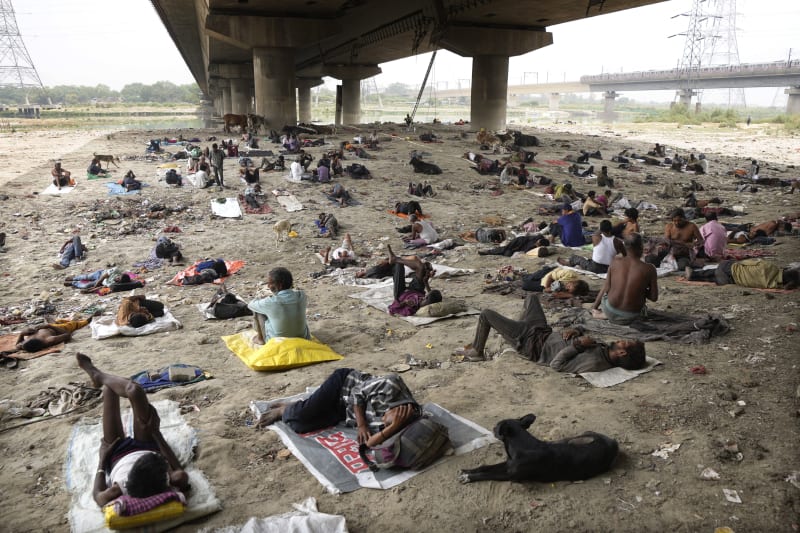
“Cueball”, left, talks about his dog Lindsay with neighbor Terry Reed, right, at their tents Friday, May 20, 2022, in Phoenix. Hundreds of homeless people die in the streets each year from the heat, in cities around the U.S. and the world. The ranks of homeless have swelled after the pandemic and temperatures fueled by climate change soar. (AP Photo/Ross D. Franklin)
PHOENIX– Hundreds of blue, green and grey tents are pitched under the sun’s searing rays in downtown Phoenix, a jumble of flimsy canvas and plastic along dusty sidewalks. Here, in the hottest big city in America, thousands of homeless people swelter as the summer’s triple digit temperatures arrive.
The stifling tent city has ballooned amid pandemic-era evictions and surging rents that have dumped hundreds more people onto the sizzling streets that grow eerily quiet…
Adrian Phillips testified that an altercation where he was held down by Bayden Williams and only able to watch as the father of his girlfriend was strangled, left him humiliated. Photo / Mike Scott
By
Natalie Akoorie
Open Justice multimedia journalist, WaikatoVIEW PROFILE
WARNING: This article discusses suicide and may be upsetting.
As Adrian Phillips sat on a beach near Miranda and prepared to smoke weed he got a message telling him Bayden Williams was on his way to Thames for tea.
Phillips told the High Court at Hamilton he decided to confront the young father on the Kopu-Hikuai Rd over a fight they’d been involved in earlier in the year, for which he thought Williams owed him an apology.
Phillips is on trial for the murder of his former “mate” Williams, on August 5, 2020.
Last month, the US Forest Service (USFS) announced it would freeze prescribed burn work across all 193 million acres of the land it manages until mid-August.
The decision came on the heels of several prescribed burns that grew out of control in the Southwest US. The biggest of them, the combined Calf Canyon and Hermits Peak fires, have grown to more than 300,000 acres, the largest in New Mexico history. Hermits Peak began when high winds carried a prescribed fire out of bounds, while Calf Canyon grew out of the smoldering embers of a months-old burn.
Nation-wide pauses on prescribed burns aren’t unprecedented. Last August, USFS Chief Randy Moore ordered his agency to immediately extinguish any fires to avoid stretching resources in a year that he described as “different from any before.” What makes the 2022 review significant, however, is that the Forest Service is using the pause to investigate whether climate change requires retooling fire management strategies.
“We’re seeing some really unprecedented type of [fire] behavior … where we have had prescribed fires escape,” Moore said at a May conference hosted by the International Association of Wildland Fire. “So I think we are doing our due diligence, and we owe it to the American people when we see these things happen to pause.”
Scientists both in and outside the Forest Service agree that regular, low-intensity burns are an essential tool for reducing wildfire risk. In its 10-year wildfire crisis strategy, partly funded by the 2021 infrastructure bill, the Forest Service states that it must double or even quadruple the scope of its fuel reduction work. While it currently burns or thins about 2 million acres a year, it will need to average another 5 million acres over the next decade to hit its targets.
There’s an inherent challenge in restoring that spark. After a century of fire suppression, the same landscapes that stand to benefit from prescribed burns are also the ones most prone to catastrophic wildfires. And a warmer world, combined with staffing shortages in fire crews, makes planning burns in those areas more challenging.
“In 99.84 percent of cases, prescribed fires go as planned,” Moore wrote in his announcement of the policy.
But politicians have often targeted prescribed burns that go wrong, even if they support fire management policies in theory. Michelle Lujan Grisham, New Mexico’s governor, said in a statement that the Forest Service should “tak[e] full responsibility” for the fires this spring. “The federal government must take a hard look at their fire management practices and make sure they account for a rapidly changing climate.”
Advocates of prescribed fire say that the pause makes some sense.
“Even though I’m a huge proponent of bringing good fire back to the landscape, how can you not take some time to reflect?” says Zander Evans, who lives in Santa Fe, New Mexico, and serves as executive director of the Forest Stewards Guild, a nonprofit that advocates for ecological management of forests.
Yet according to Evans, it’s a mistake to fully blame the Forest Service, which was working to address the overgrown forests that make the West increasingly prone to massive fires. “When you look at the area where Calf Canyon burned, we haven’t been able to do restoration [including prescribed burning] in that area. It breaks my heart,” he says. He contrasts it to the western slope of the same mountain range, much of which has been intentionally burned over the last decade. Last year, when a wildfire popped up there in dry conditions, firefighters were able to contain it.
“This is public benefit work,” says Craig Thomas, the founder of the Fire Restoration Group, which advocates for prescribed burns. “The question that we all need to talk about is: What is our honest capacity to predict change over what time frame, and how reliable is it?”
Planning prescribed fires
It’s clear that the rising heat and drought caused by climate change make wildfires more common. But managed fires are based on conditions on the ground, which means they should, ideally, already incorporate climate trends.
Typically, the fire manager—better known as the “burn boss”—writes out a prescription well in advance that specifies the requirements for a burn: from staffing, to the moisture of the forest floor, to the weather forecast. Even then, the boss and a supervisor are supposed to review whether drought or other climate conditions have changed enough to require an amended plan. The burn boss then only greenlights the fire if it meets all the right specs.
When a fire escapes the prescribed boundaries, the Forest Service reviews the problem in what’s called a “lessons learned” report. In the case of the Hermits Peak fire, that will be incorporated in this summer’s federal review, says Julie Anne Overton, public affairs officer for the Santa Fe National Forest, where the prescribed burn was first conducted. But so far, local USFS officials have said that when foresters began the burn, weather conditions and forecasts were within the ranges needed for a safe operation. By their accounts, the fire only escaped when “unexpected erratic winds” picked up, blowing embers into surrounding forests.
“I think what we need to sort out is: Was it a surprise?” Thomas from the Fire Restoration Group says. “Did something happen that no one could predict?”
Why climate change matters
Although burn decisions are supposed to incorporate climate trends, there are good reasons to think that prescribed burning might be harder in a more combustible world.
Most of the time, climate change won’t make it harder to predict the weather, says Tim Brown, a climatologist at the Desert Research Institute in Nevada who studies weather prediction, fire, and emergency management decisions.
“I think there are two potential impacts on prescribed fires,” he says. “One is, we are seeing more extreme weather events, and that by itself can make it easy to find yourself outside prescription parameters.”
Still, he says, he doesn’t know the extent to which burn bosses incorporate larger-scale climate data into prescriptions. “We’ve been in a drought,” he explains. “Now, I’m sure [fire managers] are fully aware of that. But does this happen to be the climatological time of year when it’s most windy?” That, in addition to the speed at which a hotter atmosphere dries out plants and soil, could drive rapid changes in fire conditions.
The second impact of climate on prescribed fire has to do with annual fire conditions, Brown says. “Folks are starting to see shorter burn windows.” And that means that more prescribed fires need to be packed into those short bursts.
Thomas also points to the challenges of burning more land in less time. It might take 10 days of prescribed burning to treat a thousand acres, he says; a weather forecast at the beginning of the prescribed burn might not cover the full scope of the project, which means the conditions could change while the fire is underway. With climate change, the risk of that runs higher.
“We have to treat prescribed fire like an emergency.”
Zander Evans, Forest Stewards Guild
According to an email from E. Wade Muelhof, deputy press secretary for USFS, those are the exact questions the agency hopes to ask in its review.
Muelhof says that the Forest Service is still assembling the team of experts for its prescribed burn analysis this summer, but that it intends to include “climate scientists, wildfire researchers, meteorologists, predictive services and social scientists, fire management officers, fuels management specialists, burn bosses, private practitioners, and tribal representatives for current and traditional ecological knowledge.”
According to Muelhof, the team will tackle questions like: “Is the most current research on climate change informing our prescribed fire program? Do we need to adjust our decision-making due to climate change? Are our models accurately accounting for climate change? Do we let models substitute for instincts as decision-makers?”
At the end of the 90-day review, he says, the Forest Service intends to have a clearer sense of “what may need to be changed with burn plans, [and] acceptable risk for the agency with prescribed fire.”
More firefighters wanted
As the Forest Service climate-proofs its burning protocols, experts note that it will also have to expand its staffing for fire lines.
Having more hands on deck can reduce the risk of prescribed burns in different ways. Spot fires can be better controlled when there are ample firefighters on site. But just as importantly, the agency can put in extra work during low-risk seasons if it has more staff on call.
For the most part, federal prescribed burn crews are the same people that respond to wildfires. And the Forest Service’s wildland firefighting is already understaffed for 2022: It’s going into this summer with about 1,000 open seasonal firefighting jobs, and still needs to figure out how to implement a pay raise approved by the new infrastructure bill.
Balancing short staffing, especially in the winter when the agency hires fewer seasonal workers, with the need to treat more land, could push managers to burn more often in risky shoulder seasons, Thomas says.
Evans, of the Forest Stewards Guild, agrees: When conditions are right for prescribed burns, agencies need to have the staff available to take advantage. “We have to treat prescribed fire like an emergency,” he says. “This past winter, there were a few days we had a decent [snow] dump.” Those storms cut down the chances that a fire would spread, providing a ripe opportunity for burning.
Piles of burning brush near Santa Fe National Forest last winter. Forest Stewards Guild.
Muelhof noted that’s a gap the Forest Service plans to study as well. “Questions in this area may include if we have enough personnel for the scale of prescribed fire that needs to be done on the landscape, exploring the tension between personnel for wildfire suppression and prescribed fire, and whether our budget policies play into decision making and the ability to react,” he wrote in his email.
Evans says that the Forest Guild, along with a group of New Mexico nonprofits, has had some success in the last year by hiring a team of local prescribed fire workers who could strike when conditions were right. The group, called the “All Hands All Lands Squad,” was only five people, but supported federal, tribal, and private burns. And that could be a model for burning safely in shorter windows, Evans adds. “We set up this crew so that when we see a storm coming, we have dedicated people who are ready to go.”
Asked about the usefulness of AR-15s, Senator John Thune (R-SD) told CNN: “They are a sporting rifle. It’s something that a lot of people [use] for purposes of going out target shooting — in my state, they use them to shoot prairie dogs and, you know, other types ofvarmints.”
AR-15-style rifles are especially popular forwildlife-killing contests. As the Humane Society of the United States reports: “Texas appears to have more wildlife killing contests than any other state, with at least 155 taking place since 2015. The events target bobcats, coyotes, foxes, raccoons, badgers, jackrabbits, mountain lions, ringtails, opossums and other species.” New Mexico, one of the few states to restrict wildlife-killing contests, recently bannedcoyote-killingcontests, but prairie-dog-killing contests are still legal.
As the National Shooting Sports Foundation (NSSF), the trade association for civilian arms manufacturers, points out, the…
Consortium receives £1.5 million from Biotechnology and Biosciences Research Council and Defra to develop new strategies to tackle future avian influenza outbreaks.
Scientists are joining forces in a new £1.5 million research consortium to tackle avian influenza.
The consortium has received the money from the Biotechnology and Biosciences Research Council and Defra to develop new strategies to tackle future bird flu outbreaks.
Outbreaks occur each year due to the UK’s position in the migratory flight path for wild birds flying across northern Europe, but the country was particularly hit in the winter.
Prevention zones
More than 100 cases – including of H5N1 highly pathogenic avian influenza – were reported across the UK and temporary bird flu prevention zones, which required kept birds to be housed indoors, were set up by the CVOs for the UK, Scotland, Wales, and later Northern Ireland in November.
An eight-strong consortium – headed by the APHA and including The Pirbright Institute, The Roslin Institute, the RVC, universities of Cambridge, Leeds and Nottingham, and Imperial College London – will develop strategies to tackle outbreaks that can then be shared with international partners.
Partnership
The project will bring together expertise from microbiologists, epidemiologists, virologists, genomics specialists and mathematical modellers.
Research will include:
why some strains form larger and longer outbreaks
the difference in transmission and infection in different bird populations
spread of infection over time and across species
resistance
predicting how it will evolve and spread in the future
It will also look, for example, at why some birds, such as ducks, are more resistant to bird flu strains.
Combine expertise
UK CVO Christine Middlemiss said: “This new consortium will allow us to combine our expertise at a national level to increase the speed and quality of our research, ensuring we can develop new strategies to aid our efforts against this insidious disease, and hopefully in time reduce the impact on the poultry sector.”
APHA head of virology and project manager Ian Brown said: “This investment in a new research consortium will bring together the greatest minds from eight world-leading British institutions to address gaps in our understanding of bird flu, helping us to control the spread of the disease, while furthering UK animal health science and ensuring we maintain our world-leading reputation in the field.”
Proud
Munir Iqbal, head of Pirbright’s avian influenza virus group, said: “As an institute we are extremely proud to be part of this.
“Avian influenza is an economically important virus that has devastating effects on the poultry industry; therefore, improved understanding of the virus will give us more insight into how it spreads, and inform our control strategies to prevent it from spreading to people and other animals.”
Guillaume Fournié, senior research fellow at the RVC, said: “The scale of the incursion of highly pathogenic avian influenza virus in the UK and Europe over the winters 2020-21 and 2021-22 makes it necessary to review gaps in our understanding of the dynamics of these viruses, and especially the role of wild birds in spreading, and potentially maintaining, their circulation.”
Virus dynamics
Dr Fournié added: “As part of this project, the RVC will contribute to improve our understanding of highly pathogenic avian influenza virus dynamics in wild bird populations, at the interface between wild birds and domestic poultry, and its potential to cause large outbreaks among farms.
“This information will allow us to inform the design of more targeted surveillance activities and risk mitigation interventions better tailored to the UK poultry sector.”







/cloudfront-ap-southeast-2.images.arcpublishing.com/nzme/QBX7QUSGFBEDPWACZGDJLJJES4.jpg)




 Exposing the Big Game