Largest ever freshwater fish caught; it’s a stingray at 13 feet long and more than 600 pounds

Updated: Jun. 20, 2022, 1:55 p.m. | Published: Jun. 20, 2022, 11:31 a.m.

https://www.oregonlive.com/environment/2022/06/largest-ever-freshwater-fish-caught-13-feet-long-and-more-than-600-pounds.html

large fish
In this photo provided by Wonders of the Mekong taken on June 14, 2022, a team of Cambodian and American scientists and researchers, along with Fisheries Administration officials prepare to release a giant freshwater stingray back into the Mekong River in the northeastern province of Stung Treng, Cambodia. A local fisherman caught the 661-pound (300-kilogram) stingray, which set the record for the world’s largest known freshwater fish and earned him a $600 reward. (Chhut Chheana/Wonders of the Mekong via AP)AP
facebook
twitter

Signed-in readers now can bookmark stories to read later.

NEW!

By The Associated Press

BANGKOK — The world’s largest recorded freshwater fish, a giant stingray, has been caught in the Mekong River in Cambodia, according to scientists from the Southeast Asian nation and the United States.

The stingray, captured on June 13, measured almost 13 feet from snout to tail and weighed slightly under 660 pounds, according to a statement Monday by Wonders of the Mekong, a joint Cambodian-U.S. research project.

The previous record for a freshwater fish was a 646-pound Mekong giant catfish, discovered in Thailand in 2005, the group said.

The stingray was snagged by a local fisherman south of Stung Treng in northeastern Cambodia. The fisherman alerted a nearby team of scientists from the Wonders of the Mekong project, which has publicized its conservation work in communities along the river.

The scientists arrived within hours of getting a post-midnight call with the news and were amazed at what they saw.

“Yeah, when you see a fish this size, especially in freshwater, it is hard to comprehend, so I think all of our team was stunned,” Wonders of the Mekong leader Zeb Hogan said in an online interview from the University of Nevada in Reno. The university is partnering with the Cambodian Fisheries Administration and USAID, the U.S. government’s international development agency.

Freshwater fish are defined as those that spend their entire lives in freshwater, as opposed to giant marine species such as bluefin tuna and marlin, or fish that migrate between fresh and saltwater like the huge beluga sturgeon.

large fish
In this photo provided by Wonders of the Mekong taken on June 14, 2022, a man touches a giant freshwater stingray before being released back into the Mekong River in the northeastern province of Stung Treng, Cambodia. A local fisherman caught the 661-pound (300-kilogram) stingray, which set the record for the world’s largest known freshwater fish and earned him a $600 reward. (Chhut Chheana/Wonders of the Mekong via AP)AP

The stingray’s catch was not just about setting a new record, he said.

“The fact that the fish can still get this big is a hopeful sign for the Mekong River, ” Hogan said, noting that the waterway faces many environmental challenges.

The Mekong River runs through China, Myanmar, Laos, Thailand, Cambodia and Vietnam. It is home to several species of giant freshwater fish but environmental pressures are rising. In particular, scientists fear a major program of dam building in recent years may be seriously disrupting spawning grounds.

“Big fish globally are endangered. They’re high-value species. They take a long time to mature. So if they’re fished before they mature, they don’t have a chance to reproduce,” Hogan said. “A lot of these big fish are migratory, so they need large areas to survive. They’re impacted by things like habitat fragmentation from dams, obviously impacted by overfishing. So about 70% of giant freshwater fish globally are threatened with extinction, and all of the Mekong species.”

large fish
In this photo provided by FISHBIO taken on June 14, 2022, village residents watch as a team of Cambodian and American scientists and researchers, along with Fisheries Administration officials prepare to release a giant freshwater stingray back into the Mekong River in the northeastern province of Stung Treng, Cambodia. A local fisherman caught the 661-pound (300-kilogram) stingray, which set the record for the world’s largest known freshwater fish and earned him a $600 reward. (Sinsamout Ounboundisane/FISHBIO via AP)AP

The team that rushed to the site inserted a tagging device near the tail of the mighty fish before releasing it. The device will send tracking information for the next year, providing unprecedented data on giant stingray behavior in Cambodia.

“The giant stingray is a very poorly understood fish. Its name, even its scientific name, has changed several times in the last 20 years,” Hogan said. “It’s found throughout Southeast Asia, but we have almost no information about it. We don’t know about its life history. We don’t know about its ecology, about its migration patters.”

https://2a008c9b8b545891541e05189abfff30.safeframe.googlesyndication.com/safeframe/1-0-38/html/container.html

Researchers say it’s the fourth giant stingray reported in the same area in the past two months, all of them females. They think this may be a spawning hotspot for the species.

Local residents nicknamed the stingray “Boramy,” or “full moon,” because of its round shape and because the moon was on the horizon when it was freed on June 14. In addition to the honor of having caught the record-breaker, the lucky fisherman was compensated at market rate, meaning he received a payment of around $600.

Don’t endanger aquatic ecosystems in the name of solving climate change

Corporate developers have deployed the climate card in an apparent attempt to turn conservation-minded Americans against each other and convince coastal communities to hand over our most precious resources.

By Roger Berkowitz and Sarah SchumannUpdated June 20, 2022, 3:00 a.m.

https://www.bostonglobe.com/2022/06/20/opinion/dont-endanger-aquatic-ecosystems-name-solving-climate-change/

29

Drift boats anchor in large clusters in the Naknek River, on June 19, 2020, awaiting the start of red salmon fishing in Alaska’s Bristol Bay.
Drift boats anchor in large clusters in the Naknek River, on June 19, 2020, awaiting the start of red salmon fishing in Alaska’s Bristol Bay.COREY ARNOLD/NYT

In late May, the Environmental Protection Agency revived proceedings under the Clean Water Act that, if finalized, would prevent destructive copper and gold mining in one of the world’s most valuable salmon watersheds: Bristol Bay, Alaska. As members of the nation’s fishing and seafood industries, we applaud this move and urge the EPA to finalize robust watershed protections as swiftly as possible.

Bristol Bay produces 50 percent of the world’s sockeye salmon, which in turn support 15,000 fishing and seafood jobs and sustain the area’s Yup’ik, Dena’ina, and Alutiiq ancestral ways of life. In recent years, Bristol Bay has been cresting the wave of one record-breaking harvest after another, at a time when salmon returns to other Alaska watersheds have trended downward. The nation cannot afford to put that abundance at risk, and full protection under theClean Water Act would ensure that it never has to.

Advertisement


Regrettably, mine developers have latched onto a new argument to salvage the fate of their hapless investments: the urgency of solving climate change. In a recent press release, the CEO of the Pebble Limited Partnership, which owns mineral rights to the largest deposit in the Bristol Bay watershed, called the EPA’s move to protect Bristol Bay “a giant step backward for the Biden administration’s climate change goals.” Presumably referring to the large amounts of copper needed to mass-produce components of renewable energy systems and electric vehicles, this statement appears to be a last-ditch effort to fool the public into accepting a mining proposal so destructive that 2.5 million comments have been submitted opposing it since 2012.

Get Weekend Reads from Ideas

A weekly newsletter from the Boston Globe Ideas section, forged at the intersection of ‘what if’ and ‘why not.’Enter EmailSign Up

The sight of a developer so cunningly transforming the incontrovertible urgency of climate change into a cudgel to beat back environmental scrutiny should give us all pause.

ADVERTISING

Advertisement


In New England, too, we are being told that jeopardizing fishery-supporting ecosystems is the price we must pay to solve climate change. Here, the argument is coming from offshore wind proponents, who are working hand-in-glove with the Biden administration to set a course to install 30 gigawatts of offshore wind capacity by 2030 — from a baseline of almost zero in just eight years — and 110 gigawatts by 2050, with most of the initial development taking place off New England and the mid-Atlantic and limited environmental review taking place prior to the issuance of leases.

What would this scale of development look like? With today’s technology, 110 gigawatts would be almost 8,500 turbines — 137 times the size of the Vineyard Wind facility planned for south of Cape Cod. It would mean near-continuous construction on the continental shelf for three decades. While no one knows what the ecological impacts of such construction might be (and that’s precisely our point), evidence suggests they may include alterations of the acoustic and sensory environment, electromagnetic fields, and current and wind patterns, affecting a variety of species whose survival depends on these aspects of the underwater world.

Offshore wind off New England and mining in the Bristol Bay watershed are linked by more than just spurious ultimatums invoking climate catastrophe as the inevitable consequence of keeping these wild places wild. It also happens that offshore wind, which requires hundreds of miles of electrical cables measuring up to 11 inches in diameter, is the most copper-intensive of all renewable energy technologies. Every mile of cable laid across the ocean floor will spur greater pressure to mine copper in precious, irreplaceable places like Bristol Bay.

Advertisement


No one has more at stake from climate change than those who catch wild fish for a living. But fishermen won’t succumb to false dichotomies. Our leaders must get serious about pursuing solutions that work for both the climate and aquatic ecosystems — not one at the expense of the other. Addressing climate change is indeed urgent, but this urgency is no excuse for allowing reckless mining in Bristol Bay or potentially reckless energy development in New England waters.

Roger Berkowitz is founder and CEO of Legal Sea Foods Marketplace and president of the Massachusetts Seafood Collaborative. Sarah Schumann fishes commercially in Rhode Island and Alaska and coordinates the Fishery Friendly Climate Action campaign.

Oregon Commission Votes to Better Protect Wildlife From Trapping

Exposing the Big Game's avatarCommittee to Abolish Sport Hunting Blog

Reduced Trap Check Times Still Longer Than Most States

https://biologicaldiversity.org/w/news/press-releases/oregon-commission-votes-to-better-protect-wildlife-from-trapping-2022-06-17/

PORTLAND,Ore.— The Oregon Fish and Wildlife Commission adopted new rules today that reduce some of the state’s trap check times, making it less likely that animals will suffer for extended periods of time and more likely that non-target wildlife can be safely released.

These new rules require trappers using live restraining devices to check their traps every 48 hours. The changes were adopted by a vote of 6-1.

Oregon previously had four different trap check times, ranging from 48 hours to 30 days. For animals the state deems “predatory,” check times for live restraining traps ranged from 72 hours to seven days. Today’s decision reduces those trap check times to 48 hours. The commission also voted to reduce the trap check times for kill traps or snares from 30 days to 14 days.

“This is a step in…

View original post 334 more words

Not just for the birds: Avian influenza is also felling wild mammals

Something was wrong with the foxes. That was what callers to the Dane County Humane Society in Wisconsin kept saying in April, as they reported fox kits, or young foxes, behaving in strange ways: shaking, seizing or struggling to stand. The kits, which were often lethargic and wandering by themselves, also seemed unusually easy to approach, showing little fear of humans.

“We just kept getting calls,” said Erin Lemley, a wildlife veterinary technician at the humane society’s wildlife center. “And the foxes started coming in.”

Some of the kits that were admitted for treatment were quiet and withdrawn, she said. Others stumbled around or had seizures, their heads ticcing, their eyes flicking rhythmically. After the staff ruled out rabies, low blood sugar and other potential causes, laboratory testing revealed a surprising culprit: a highly virulent strain of bird flu.https://5e2990388dffc32040b40c52dcc57abe.safeframe.googlesyndication.com/safeframe/1-0-38/html/container.html?n=0

“It was not a fun surprise,” said Dr. Shawna Hawkins, a zoo and wildlife veterinarian at the University of Wisconsin-Madison.

The virus, a type of bird flu known as Eurasian H5N1, has been spreading rapidly in the United States this spring, infecting flocks of farmed poultry in 36 states and prompting mass culls of domestic birds.

But this version of the virus appears to be taking a much greater toll on wild birds than previous lineages have, finding its way into ducks, geese, gulls and terns, among many others. That, in turn, means that the virus poses an elevated danger to mammals that prey on those birds, including wild red foxes.https://5e2990388dffc32040b40c52dcc57abe.safeframe.googlesyndication.com/safeframe/1-0-38/html/container.html?n=0

At least seven U.S. states have detected the virus in red fox kits, to which the pathogen appeared to be particularly lethal. Two bobcats in Wisconsin, a coyote pup in Michigan and skunks in Canada have also tested positive for the virus, as have foxes, otters, a lynx, a polecat and a badger in Europe. (Two human cases, one in the United States and one in Britain, have been reported as well, both of which were in people who had close contact with birds.)

There is no evidence that mammals play a significant role in spreading the virus, and the risk to humans remains low, experts said. “This is very much still an avian virus,” said Richard Webby, an influenza virus expert at St. Jude Children’s Research Hospital in Memphis, Tennessee.

But evolution is a numbers game, he said, and the more mammals the virus infects, the more opportunities it has to pick up new mutations that could help it spread among foxes, bobcats or even humans.https://5e2990388dffc32040b40c52dcc57abe.safeframe.googlesyndication.com/safeframe/1-0-38/html/container.html?n=0

“What it’s going to take for this virus to transition from being a duck or a chicken virus to being a mammalian virus is more chances to replicate in those mammalian hosts,” Webby said. “So that’s why when we see these mammals being infected by this virus, we do take notice.”

Twitching foxes

The new lineage of the virus spread through Europe, Africa, the Middle East and Asia last year, sparking outbreaks in wild and domestic birds. It also showed up in a handful of wild mammals, including fox kits in the Netherlands in the spring of 2021.

By the end of the year, the virus had made its way to North America. As it raced through the migrating American bird population this spring, reports began to emerge of infected fox kits — first in Ontario and subsequently in Wisconsin, Minnesota, Michigan, Iowa, Alaska, Utah and New York.https://5e2990388dffc32040b40c52dcc57abe.safeframe.googlesyndication.com/safeframe/1-0-38/html/container.html?n=0

In some bird species, the virus caused obvious neurological symptoms, and many infected foxes displayed abnormal behaviors, too. They twitched, walked in circles and salivated excessively. In the most severe cases, the foxes developed seizures; death often followed shortly after, experts said.

Post-mortem examinations revealed that many of the kits had pneumonia, said Dr. Betsy Elsmo, a diagnostic pathologist at the Wisconsin Veterinary Diagnostic Laboratory who performed the necropsies. When she examined the animals’ brain tissue under a microscope, Elsmo saw clear signs of damage.

“There was a lot of inflammation in the brain microscopically,” she said. “The pattern of injury that I saw was consistent with a viral lesion.”https://5e2990388dffc32040b40c52dcc57abe.safeframe.googlesyndication.com/safeframe/1-0-38/html/container.html?n=0

So far, the virus appears to be taking a greater toll on fox kits than adult foxes, potentially because the young animals do not yet have fully developed immune systems, experts said.

But the overall infection and mortality rate is unknown. “We’re just getting kind of anecdotal reports in nature right now,” said Michelle Carstensen, the wildlife health program supervisor for the Minnesota Department of Natural Resources.

Wisconsin officials also detected the virus in two adult bobcats this spring. “Both bobcats showed reduced to no fear of humans,” Dr. Lindsey Long, wildlife veterinarian for the Wisconsin Department of Natural Resources, said in an email. “They were noted sitting on porches and in close proximity to human activity without the usual fear response.” One bobcat seemed to be shivering, while the other appeared to be having trouble breathing, she added. The bobcats, which were euthanized, had microscopic brain lesions that were “pretty much identical” to those in the affected foxes, Elsmo said.https://5e2990388dffc32040b40c52dcc57abe.safeframe.googlesyndication.com/safeframe/1-0-38/html/container.html?n=0

The virus was also recently detected in a coyote pup in Michigan, said Dr. Megan Moriarty, the wildlife veterinary specialist at the state’s Department of Natural Resources.

Scientists suspect that the animals are acquiring the virus by eating infected birds. In a laboratory study, researchers had previously demonstrated that red foxes that were fed infected bird carcasses could contract, and then shed, the virus.

Although it is possible that the virus has evolved in ways that make it better at infecting mammals, scientists say that the most probable explanation for the sudden rise in infected mammals is that this lineage is infecting enormous numbers of wild birds, increasing the odds that hunters and scavengers might stumble across infected food sources.https://5e2990388dffc32040b40c52dcc57abe.safeframe.googlesyndication.com/safeframe/1-0-38/html/container.html?n=0

So far, the virus does not appear to be causing enough illness or death in wild mammals to put these species at risk, experts said. And there is no evidence of sustained mammal-to-mammal transmission. “Mammals are generally considered to be dead-ends for highly pathogenic avian influenza,” Moriarty said. An early analysis of viral genomes from the Wisconsin fox kits suggests that the infections are essentially a series of one-offs — the result of individual foxes coming into contact with infected birds rather than foxes transmitting the virus to each other. “The preliminary data that we have suggests that these are all independent spillover events,” Elsmo said.

But much remains unknown, including whether the virus will establish itself in wild birds for the long haul, which could pose a sustained risk to mammals.

And even isolated mammalian infections provide the virus with new opportunities to evolve. “There’s a risk of it adapting to and then transmitting between mammals, and then you have a new problem,” said Dr. Jolianne Rijks, a veterinarian at the Dutch Wildlife Health Center. Some state officials said that they had started more routinely testing sick mammals for the virus, especially ones with neurological symptoms. Animals that test positive should also have samples of their virus sequenced so scientists can monitor for any potentially worrisome changes, Webby said.https://5e2990388dffc32040b40c52dcc57abe.safeframe.googlesyndication.com/safeframe/1-0-38/html/container.html?n=0

Experts also encourage members of the public to report any wild animals that appear to be acting strangely. “That’s how all this started,” Elsmo said, “as citizens seeing abnormally behaving kits and reporting them.”

LETTER TO THE EDITOR: Real hunters don’t use assault rifles

Exposing the Big Game's avatarCommittee to Abolish Sport Hunting Blog

— Timothy Eisele

Watch now: Phil Hands draws a cartoon about Ron JohnsonPlay Video

spaceplay / pause

qunload | stop

ffullscreen

shift+slower / faster

volume

mmute

seek

.seek to previous

126seek to 10%, 20% … 60%

    Follow along as State Journal cartoonist Phil Hands draws his latest cartoon about the decision of U.S. Sen. Ron Johnson, R-Oshkosh, to run for reelection.

    https://trinitymedia.ai/player/trinity-player.php?pageURL=https%3A%2F%2Fmadison.com%2Fopinion%2Fletters%2Freal-hunters-dont-use-assault-rifles—-timothy-eisele%2Farticle_64088f18-f59c-5f45-909c-a0404f9a91b0.html&partner=Flex&textSelector=I2FydGljbGUtYm9keQ%3D%3D&unitId=2900003117&userId=db063fbd-17fa-4319-9c5c-0f55968d927d&isLegacyBrowser=false&version=20220614_2b0e703b1c35dc27923efad982d90287089da03e&useCFCDN=0&themeId=140

    Many Republicans won’t pass commonsense gun legislation, afraid of the gun lobby.

    Well, hunters are gun owners, and many of us back commonsense regulations.

    We use firearms, not weapons. We accept a three-shell limit for hunting waterfowl. We accept it is not sporting to hunt deer with a machine gun.

    So ban all AR-style semi-automatic weapons meant to kill people, not…

    View original post 74 more words

    Letter: Rifle for assault, not hunting

    Exposing the Big Game's avatarCommittee to Abolish Sport Hunting Blog

    ByTerrence Dunn, Vancouver

    Published:June 19, 2022, 6:00am

    Share: https://www.columbian.com/news/2022/jun/19/letter-rifle-for-assault-not-hunting/

    James Ault uses some trivial characteristics of the AR-15 to justify his false claim that it is a hunting rifle rather than an assault rifle (“AR-15 is natural evolution,”Our Readers’ Views, June 15). It is more instructive to look at relevant characteristics of the AR-15. Its ammunition is the 5.56 NATO cartridge, the same as the M16. This is the cartridge that all NATO armies, including the U.S. Army, must use in their assault rifles. The barrel velocity of the AR-15 is the same as that of the M16 at 3,300 feet/second.

    To reload the firing chamber, the AR-15 and M16 use exactly the same semi-automatic gas-piston system. It is key to the functioning of an assault rifle. While the AR-15 is sold without the fully automatic function of the M16, fully automatic function can easily be added to…

    View original post 72 more words

    The climate crisis is hitting the planet’s working classes the hardest and they know it

    Exposing the Big Game's avatarThe Extinction Chronicles

    Jeff Sparrow

    https://www.theguardian.com/commentisfree/2022/jun/18/the-climate-crisis-is-hitting-the-planets-working-classes-the-hardest-and-they-know-it

    The conservative commentariat could not be more wrong in dismissing global heating as a concern of only the ‘woke elite’

    Indian woman carrying water pitcher on her head
    The climate crisis is not a concern only of the rich. Water had to be brought by train to India’s state of Rajasthan during May’s global heating-induced heatwave.Photograph: Prakash Singh/AFP/Getty Images

    Sat 18 Jun 2022 16.00 EDT

    “What do you mean, ‘why am I working in this heat?’ If I don’t work, we will die of hunger.”

    That was how Shiv Kumar Mandal, a Delhi rickshaw driver,explainedwhy he continued to transport passengers during a prolonged and horrific temperature spike thatexperts attribute to global heating.

    Mandal, one presumes, does not consider planetary warming a topic relevant only to the rich.

    Yet, in the wake of the Australian federal election, we’re hearing versions of that claim again and again and again.

    Lismore’s residents are living…

    View original post 1,024 more words

    WA congresswoman says no to bill that would send millions to fish and wildlife agencies

    Exposing the Big Game's avatarCommittee to Abolish Sport Hunting Blog

    June 18, 2022 at 6:00 am

    In this image from video, Rep. Cathy McMorris Rodgers, R-Wash., speaks on the floor of the House of Representatives at the U.S. Capitol in Washington in 2020. (House Television via AP)
    In this image from video, Rep. Cathy McMorris Rodgers, R-Wash., speaks on the floor of the House of Representatives at the U.S. Capitol in Washington in 2020. (House Television via AP)

    Skip Ad

    By

    ERIC BARKER

    Lewiston Tribune

    https://www.seattletimes.com/seattle-news/politics/wa-congresswoman-says-no-to-bill-that-would-send-millions-to-fish-and-wildlife-agencies/

    A bill that could deliver much-needed funding to state and tribal fish and wildlife agencies passed the U.S. House of Representatives and moves on to the Senate for consideration.

    The Recovering America’s Wildlife Act was approved 231-190 Tuesday. Rep. Mike Simpson, a Republican from Idaho’s 2nd Congressional District, co-sponsored the legislation and voted in favor of it. His fellow Republican, Rep. Russ Fulcher from Idaho’s 1st Congressional District, voted no.

    Cathy McMorris Rodgers, a Republican representing Eastern Washington, also voted no.

    If approved by the Senate and signed by President Joe Biden, the bill that amends the popular Pittman-Robertson Wildlife Restoration Act would direct the…

    View original post 1,161 more words

    Northeast sees record-low temperatures on Father’s Day

    By 

    Steven Yablonski, FOX Weather

    June 19, 2022 8:54am 

     Updated

    Record low temperatures have been reported in the Northeast while record heat continues in the middle of the country.
    Record low temperatures have been reported in the Northeast while record heat continues in the middle of the country.FOX Weather

    ORIGINALLY PUBLISHED BY:

    FOX Weather

    It’s a cool start to Father’s Day across parts of the Northeast and mid-Atlantic, with many areas seeing temperatures below average during the day.

    The cooler temperatures result from a large dip in the jet stream along the East Coast that has allowed cooler air to filter into the Northeast and parts of the mid-Atlantic.

    That dip will also allow for the excessive heat to remain trapped under a ridge of high pressure in the middle of the country.

    In fact, heat alerts are in effect across the Plains and upper Midwest as temperatures there could get to or above 100 degrees.

    The National Weather Service in Boston says daytime high temperatures will be more typical of late April or early October rather than the middle of June.

    Some cities have already reported record-low temperatures in Sunday morning, and other records are in jeopardy of falling.

    Most of the record low temperatures are expected across parts of the Northeast and southern New England, but other records stretching from the mid-Atlantic into the Ohio Valley could also fall.

    SUN East Record Lows Plot
    The cooler temperatures result from a large dip in the jet stream along the East Coast.

    Wheeling, West Virginia, is expected to fall back into the mid-40s to start the day.

    Temperatures in the Ohio Valley and the mid-Atlantic will warm up nicely after a cool start to Sunday.

    It will be into the mid to upper 70s from Columbus, Ohio into Charleston, West Virginia, Richmond Virginia and Washington.

    East Departures1
    Millions of Americans across the region will notice how cool it is after days of warmer temperatures.

    Pittsburgh and New York City will get to the low-70s, but it will be much cooler further north.

    Boston will only see a high temperature of around 62 degrees after a rainy start to the day.

    And in northern New England, places will be even colder.

    East Daily Highs and Lows1
    Most of the record low temperatures are expected across parts of the Northeast and southern New England.

    Bangor, Maine, for example, will only see a high temperature of 49 degrees.

    Millions of Americans across the region will notice how cool it is after days of warmer temperatures.

    Temperatures will be slightly below average across the Ohio Valley and mid-Atlantic, but further north, like in New York City, temperatures will be 5 to 10 degrees lower than normal.15

    What do you think? Post a comment.

    Further north, temperatures are expected to be 20 degrees below average, with some areas of northern New England feeling even cooler.

    Monkey shot dead as Mexican cartels’ passion for exotic pets leaves bloody toll

    Spider monkey dressed up as gang mascot killed in shootout, and man dies in Michoacán after trying to pet captive tiger

    The monkey in the ‘bulletproof’ vest who died in the State of Mexico shootout.
    The monkey in the ‘bulletproof’ vest who died in the state of Mexico shootout. Photograph: Supplied

    Associated Press in Mexico CityFri 17 Jun 2022 14.04 EDT

    Mexican narcos’ fascination with exotic animals has been on display this week after a spider monkey dressed up as a drug gang mascot was killed in a shootout, a 200kg tiger wandered the streets in the Pacific coast state of Nayarit, and a man died after trying to pet a captive tiger in a cartel-dominated area of western Michoacán state.

    Eleven suspected gang members died in the shootout on Tuesday in the state of Mexico, which surrounds the capital. Photos from the scene showed a small monkey dressed in a tiny camouflage jacket and a tiny “bulletproof” vest sprawled across the body of a dead gunman.

    Authorities in the State of Mexico confirmed the authenticity of the photos.

    AdvertisementSearing testimony increases odds of charges against Trump, experts saycron’s centrist grouping to lose majority inparliament, say projected results

    https://imasdk.googleapis.com/js/core/bridge3.519.0_en.html#goog_2059104622

    https://imasdk.googleapis.com/js/core/bridge3.519.0_en.html#goog_719864654

    https://imasdk.googleapis.com/js/core/bridge3.519.0_en.html#goog_1325269299

    “A primate was killed at the scene, which was presumably owned by a criminal who was also killed at the scene,” state prosecutors said in a statement, adding: “An autopsy will be carried out on the animal by a veterinarian specialized in the species.” They said animal-trafficking charges would be considered against the suspects who survived the shootout.

    Then on Wednesday, the attorney general for environmental protection said it had seized a tiger in Tecuala, in the Pacific coast state of Nayarit, near the border with Sinaloa, which is home to the cartel of the same name.

    The office said it acted “after receiving reports about a Bengal tiger that was wandering the streets of Tecuala”, and found that the animal was being illegally kept there.

    Those reports were based on a video posted on social media earlier this week, showing a young woman shrieking as she came across the tiger on the street in a residential neighborhood. “Be quiet, it might come close,” a woman can be heard saying on the video.

    Authorities said the tiger’s claws and fangs had been removed, and a man can be seen later in the video casually tossing a rope over the tiger’s neck and leading him away.

    Perhaps the most tragic story came out of the western state of Michoacán, which has long been dominated by the Carteles Unidos gang and the Jalisco cartel.

    On Sunday, authorities confirmed that a man was seriously wounded by a tiger in Peribán, Michoacán, a town in the state’s avocado-growing region, where gangs have long extorted protection payments from the lucrative avocado trade.

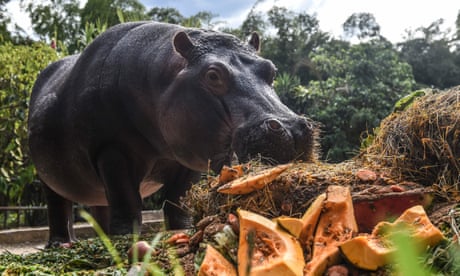
    Pablo Escobar’s zoo had four illegally imported hippos. The feral herd now numbers about 80.

    Advertisement

    In a video posted on social media, whose authenticity could not be confirmed, the man is seen calling the tiger to the side of a fenced enclosure. “Come on, come,” the man can be heard entreating.

    The man stands outside the enclosure, apparently feeding the tiger with one hand, while he stretches his other arm through the chain-link fence to stroke the animal’s neck.

    The man then shrieks in pain after the tiger quickly wheels and bites the extended arm and refuses to let go.

    Michoacán state law enforcement authorities confirmed that the man was taken to a hospital, where he died a few days later from his injuries.

    Security analyst David Saucedo said drug traffickers often keep exotic animals as a symbol of status and power, imitating the Colombian drug lords of the 1980s and 90s.

    “Mexican drug traffickers copied from the Medellín cartel the custom of acquiring exotic animals and setting up private zoos,” said Saucedo. “According to the code of the drug trafficking aristocracy, having a private zoo was a prerequisite for being part of the circle of big-time drug traffickers.”

    In some cases, the animals had a more sinister use.

    “Some drug cartel capos, like Zetas leader Heriberto Lazcano, acquired exotic animals to torture or disappear their victims,” Saucedo said. “Several of his enemies were devoured by the tigers or the crocodiles that the Zetas kept in their pens or cages.”

    Lazcano himself was killed in a shootout with Mexican military personnel in 2012.

    https://www.theguardian.com/world/2022/jun/17/mexican-drug-cartels-exotic-pets-animals-monkey-killed