DEC conservation officers ticketed a hunter (not shown in photo) last month for illegally killing a black bear in the Montezuma National Wildlife Refuge. It was the first time a bear had been sighted in the refuge, according to DEC.
Signed-in readers now can bookmark stories to read later.
A hunter killed a black bear last month in the Montezuma National Wildlife Refuge in Seneca County. According to the New York State Department of Environmental Conservation, refuge biologists say it is the first confirmed sighting of a black bear within the refuge’s boundaries.
DEC conservation officers working a spotlight detail on the night of Nov. 18 received a report that a K-9 trained in wildlife recovery had tracked a bear shot earlier in the day. Officers later interviewed the hunter at…
DefaultMono SansMono SerifSansSerifComicFancySmall CapsDefaultX-SmallSmallMediumLargeX-LargeXX-LargeDefaultOutline DarkOutline LightOutline Dark BoldOutline Light BoldShadow DarkShadow LightShadow Dark BoldShadow Light BoldDefaultBlackSilverGrayWhiteMaroonRedPurpleFuchsiaGreenLimeOliveYellowNavyBlueTealAquaOrangeDefault100%75%50%25%0%DefaultBlackSilverGrayWhiteMaroonRedPurpleFuchsiaGreenLimeOliveYellowNavyBlueTealAquaOrangeDefault100%75%50%25%0%
It’s been months since Steve Keel disappeared after going on a hunting trip to Alaska. For the first time, his friend who went on the trip with him spoke.
A deer hunter in Lancaster County recently hung upside down for an hour before Pennsylvania Game Commission staff and personnel from local fire companies could bring in multiple extension ladders to get down from his tree.
According to Lancaster County Game Warden Greg Graham, the hunter’s treestand failed, but his safety harness prevented any injuries that would have required a hospital stay.
He noted that the hunter was saved because he followed advice to always wear a fall restraint when using any type of elevated stand.
Many of the other reports in the December Field Office Reports from the Game Commission involved hunters doing the wrong thing and getting caught, and in some cases taking additional wrong actions.
Graham also reported that he found multiple Game Law violations…
FILE – This image taken from video provided by Fort Huachuca shows a wild jaguar on Dec. 1, 2016, in southern Arizona. An environmental group on Monday, Dec. 12, 2022, petitioned the U.S. Fish and Wildlife Service to help reintroduce the jaguar to the Southwest, where it once roamed for hundreds of thousands of years before being whittled down to just one of the big cats known to survive in the region. (Fort Huachuca via AP, File)(ASSOCIATED PRESS)
PHOENIX (AP) — An environmental group on Monday petitioned the U.S. Fish and Wildlife Service to help reintroduce the jaguar to the Southwest, where it roamed for hundreds of thousands of years before being whittled down to just one of the big cats known to survive in the region.
The male jaguar, named Sombra — shadow in Spanish —…
By Leo Wolfson, State Politics Reporter Leo@Cowboystatedaily.com
Nina Webber, a Wyoming Republican Party national committeewoman and two-time state House candidate from Cody, is facing misdemeanor charges for reckless endangering while hunting.
Webber, 58, was cited by the Park County Sheriff’s Office along the North Fork Highway outside Wapiti in the early morning hours of Nov. 30.
According to thePowell Tribune, Trout Creek Ranch Manager Cory Williams said he and his wife were forced to seek cover outside their home that morning as bullets rained down on him and his wife. They came from a group of hunters shooting on the opposite, southern side of the North Fork Highway.
Williams said one bullet “whizzed” by his head.
‘Unsafe Hunting’
Williams said he heard about two dozen shots fired…
Conservationists want 30% of the ocean protected, but small-scale fishers and Indigenous people say a blanket ban punishes them for a crisis they didn’t create while commercial vessels can still trawl with impunity
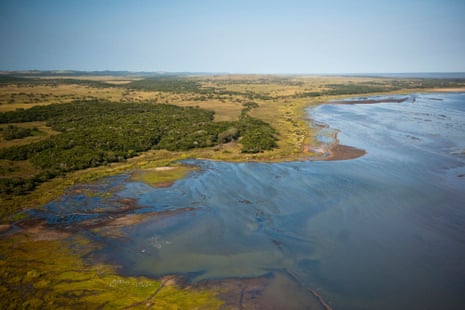
It is one of South Africa’s largest nature reserves, where hippos, elephants and endangered black rhinos live among wetlands, savannah and lakes. But iSimangaliso wetland park, a Unesco world heritage site favoured by wealthy eco-tourists for its biodiversity, is also the site of an increasingly deadly battle, between the people who live there and the conservationists ostensibly tasked with protecting it.
The rural Nibela community in KwaZulu-Natal province, one of the country’s poorest regions, have fished in Lake St Lucia for generations. It is their traditional land, but it is also a marine protected area (MPA), with regulations that restrict gillnet fishing and access to the lake. The park authorities generate income via tourists, who can pay 2,000 rand (about £100) for a deep-sea fishing trip. But the local fishers – who gain little or no benefit from the park and are not allowed fishing permits – say they are labelled poachers by armed park rangers who patrol the lake.
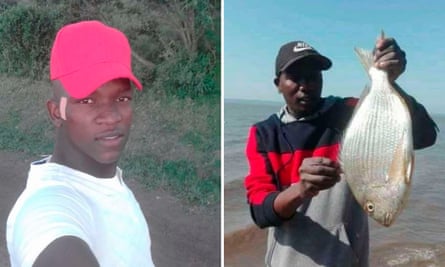
Last year, the conflict left a fisher missing, presumed dead – the second in two years from the same family. Police are treating as murder and attempted murder the death and disappearance of two brothers at iSimangaliso. On 12 November 2021, Thulani Mdluli, 24, went missing and is presumed dead after an altercation with rangers. The park authorities claim the rangers were shot at by poachers; the fishers protest they were unarmed. A little more than a year before, on 16 September 2020, Thulani’s brother, Celempilo Mdluli, 30, was shot dead, allegedly by rangers, as he fished.
View of the iSimangaliso wetland park and Lake St Lucia. Photograph: Alamy
“We depend on fishing to put food on the table,” says Thomas Nkuna, 68, a fisher and father of 10 from KwaZulu-Natal. He says the struggling community has always fished to feed their families – long before permits were needed – and have no choice but to continue, even without permission.
“We have to fish at night, to hide from the rangers. But rangers patrol the waters and confiscate our tools,” he says. “Sometimes we run away. Fishermen have been killed by the rangers.”
The deaths are an extreme example of what has become a common problem. As scientists warn that biodiversity loss threatens to tip the world into its sixth mass extinction, many are pushing for a global target to conserve one-third of the world’s land and sea by 2030. From Antigua to Zambia, more than half of the world’s governments back this 30×30 target, which could be adopted at December’s biodiversity negotiations at Cop15 in Montreal.
Left, Thulani Mdluli, a local fisher, has been missing since 12 November 2021. Right, Thulani’s brother, Celempilo Mdluli, was fatally shot while fishing on the protected lake in September 2020
On Tuesday, Agnès Callamard, Amnesty International’s secretary general, warned that in its current form the 30×30 proposal was “a grave risk” to the rights of Indigenous peoples and to conservation. She urged world leaders in Montreal to place Indigenous communities at the heart of the agreement.
Far away from the international spotlight, small-scale fishing and Indigenous communities say they are being forced to pay for a biodiversity crisis they bear little responsibility for creating. From Colombia to the UK, they are fighting against marine protected areas and fishing bans, arguing they are being disproportionately affected compared with commercial fisheries.
Artisanal fishers tell us they have struggles with marine protected areas – in some cases they are being displaced in the name of conservation
Amélie Tappella, Crocevia Centro Internazionale
In Colombia, where shark fishing was banned in 2020 to help end the shark fin trade, artisanal fishers from Afro-Colombian communities who have fished shark for centuries for local consumption say the ban threatens their cultural heritage and food security. In Greenland, traditional hunters in remote areas who have fished for narwhals for generations are at loggerheads with scientists who say the animal is on the brink of extinction. Hunters criticise the scientists for not listening to their traditional knowledge and question their counting methods.In the ‘Bakhmut meat grinder’, deadlocked enemyforces slog it out
In the UK, a vicar has led opposition to a marine protected area on the Holy Isle of Lindisfarne because, she says, it would have a “massive socio-economic” impact on locals who survive on fishing.
Hugh Govan, of the University of the South Pacific, who specialises in ocean governance, describes the 30×30 target as a “neocolonialist” approach.
“It imposes decisions on land and sea use on developing countries without evidence that these are the best tools to achieve their legitimate sustainability and development ambitions,” says Govan. “A bit rich coming from the countries that drive the global crises.”
He questions the real-world value of protection zones, which are often poorly governed.
“All too often, the most destructive fisheries are allowed or even subsidised to continue, while subsistence and community fisheries are criminalised,” he says.
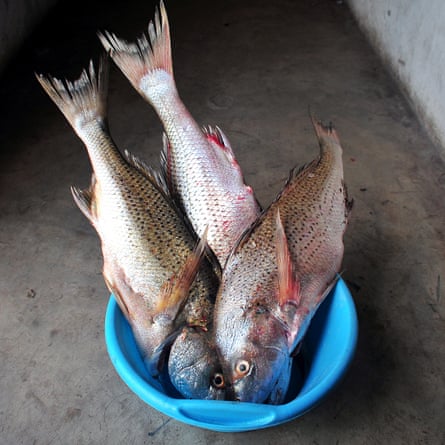
Fish from Lake St Lucia feeds Nibela communities and is also sold in markets around northern KwaZulu-Natal to generate income for families. Photograph: Lucas Ledwaba
Govan points to a controversial decision last year by Kiribati, which heavily relies on revenue from fishing licenses, to open the largest marine reserve in the world – the “no take” Phoenix Islands Protected Area – to commercial fishing. But the decision, Govan says, was based on research suggesting the MPA was doing nothing to conserve tuna. Instead, Kiribati argued, it would rely on an alternative method known as marine spatial planning to conserve ocean resources in a way that benefits its people. The approach has been used in Ecuador to balance conservation against moderate fishing, with inevitable compromises.
Imposed targets, such as 30×30, could even make things worse in developing countries, Govan argues, because it risks alienating coastal communities who, if involved in management, are adept at governing their own resources.
In the coral triangle of Indonesia, for example, a study in June comparing different management styles of MPAs found that allowing Indigenous people to participate in their management yielded more biomass than applying heavy-handed penalties. In the UK, the Sustainable Food Trust has found that small-scale fishers employ 10 times as many people as industrial fishers while having a lower environmental impact, using much less fuel and producing a fraction of the carbon emissions.
“Artisanal fishers from all over the world tell us they have struggles with marine protected areas – in some cases they are being displaced in the name of conservation,” says Amélie Tapella of Crocevia Centro Internazionale, an Italian NGO that acts as secretariat of the International Planning Committee for Food Sovereignty, a platform of grassroots farmers and small-scale fishers.
Not including these communities risks losing invaluable knowledge and expertise, she says. “If governments only focus on establishing marine protected areas, not consulting the artisanal fishing communities or even entrusting them with direct management, we will lose their unique knowledge that allows us to find the key to a world where man and nature coexist.”
One alternative approach to MPAs is being piloted in Port St Johns, in Eastern Cape, South Africa: a collaborative, “bottom up” project that will treat the community and government as equal partners in conserving resources. This pilot, lead by WWF South Africa, will offer the impoverished fishing community much-needed access to better markets for east coast lobster, a species that fetches a low price locally, in exchange for engaging in more sustainable fishing practices.
Craig Smith, senior manager of WWF South Africa’s marine programmes, who is leading the pilot, believes MPAs are necessary to reverse biodiversity loss. The problems arise, he says, when the needs of coastal communities are not taken into account as well.
“MPAs in South Africa have been very much a top-down approach,” says Smith. “The consultation process is a tick-box exercise. The government has set up MPAs, but does not have mechanisms in place where local communities can be accommodated. We don’t want to go down that road.”
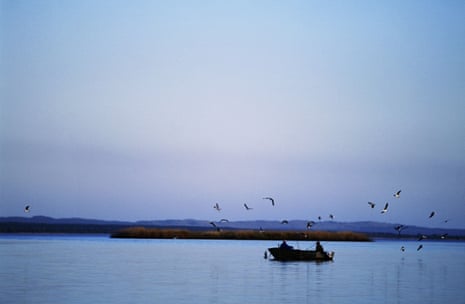
Fishers in a boat surrounded by gulls on Lake St Lucia. Photograph: Alamy
Jones Thomas Spartegus, youth representative for the World Forum of Fisher People in India, says new restrictions in the Gulf of Mannar biosphere reserve in Tamil Nadu are squeezing the community’s fishing rights while commercial vessels continue to trawl the ocean.
“Here, people view the ocean for two purposes: one for the ‘blue economy’ and the other, by conservationists, for the species,” says Spartegus.
“But my life in a traditional fishing community is being endangered.”
For nine days, Montana hunters will have to turn to older firearm technology.
Montana Fish, Wildlife and Parkstells us that starting tomorrow, (Saturday, December 10), Muzzleloader Heritage Season begins and runs through December 18. And it is not just some token tribute to the ways of the past, where an anticipated small handful of participants have to share the season with other hunters. Nope, it is a passed-into-law Montana kind of thing.
Ukraine’s 63rd Brigade Moves East – With Trench Family Of Wartime Pets
When FWP says the season is for muzzleloaders only, they pretty much mean muzzleloaders only. No other means of taking game, including archery, is allowed. Now, there are some areas that have elk shoulder seasons running through February 15, where firearms and archery equipment…
Animal advocates are demanding new legislation after a deer was shot just steps away from the facility in Hampton Bays that released it back into the wild.
Evelyn Alexander Wildlife Rescue Center rehabilitates around 3,000 animals a year – including deer that head into the forest.
Ginnie Fratti, founder of the rescue center, says a couple of days into the hunting season, they heard a loud bang and found a deer they had released back into the wild in January 2022 that was shot by a hunter.
“I ran and tried to save her, and the hunter was standing right there – not even 10 feet from our building structures,” Fratti said.
ADVERTISING
The hunter was so close because there is a hunting area right near the Evelyn Alexander Rescue Center.
Illegal and unsustainable fishing, fossil fuel exploration, the climate crisis and disease are pushing marine species to the brink of extinction, according to the International Union for Conservation of Nature (IUCN) red list, with populations of dugongs, abalone shellfish and pillar coral at risk of disappearing for ever.
Marine life is facing a “perfect storm” of human overconsumption, threatening the survival of some of the world’s most expensive seafood, according to the conservation organisation, which publishes the most up-to-date information on the health of wildlife populations on Earth.
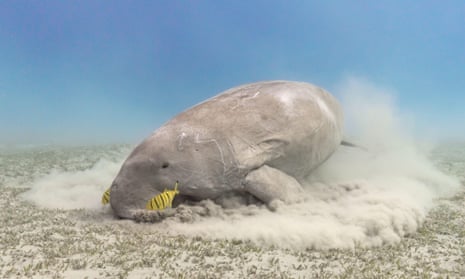
From South Africa to Australia, 20 of the world’s 54 abalone species are now threatened with extinction, according to the first IUCN scientific assessment of the species group. In east Africa and New Caledonia, dugongs – marine mammals that largely feed on seagrass – are close to extinction, damaged by oil and gas exploration, bottom-trawling, chemical pollution and mining.
The information comes as countries negotiate this decade’s biodiversity targets for protecting the planet at Cop15, with draft proposals to take radical action on species extinction this decade.
“Today’s IUCN red list update reveals a perfect storm of unsustainable human activity decimating marine life around the globe. As the world looks to the ongoing UN biodiversity conference to set the course for nature recovery, we simply cannot afford to fail,” said Dr Bruno Oberle, IUCN director general. “We urgently need to address the linked climate and biodiversity crises, with profound changes to our economic systems, or we risk losing the crucial benefits the oceans provide us with.”
Those at risk include the endangered Omani abalone, found off the Arabian peninsula, which has disappeared from more than half its range due to pollution from agricultural and industrial runoff, which causes harmful algal blooms. On the west coast of South Africa, poaching by criminal networks, many connected to the international drugs trade, has devastated populations of the perlemoen abalone.
In the western Indian ocean, fewer than 250 mature dugongs are left, with fewer than 900 in New Caledonia.
“Strengthening community-led fisheries governance and expanding work opportunities beyond fishing are key in east Africa, where marine ecosystems are fundamental to people’s food security and livelihoods,” said Evan Trotzuk, who led the east Africa red list assessment of the mammals.
“Further, the creation of additional conserved areas where dugongs live, particularly around Bazaruto Archipelago national park [in Mozambique], would also empower local communities and other stakeholders to find, implement, and benefit from solutions that halt long-term declines in dugong abundance, as well as in seagrass extent and quality,” he said.
Sign up to Global Dispatch
Free newsletter
Get a different world view with a roundup of the best news, features and pictures, curated by our global development team
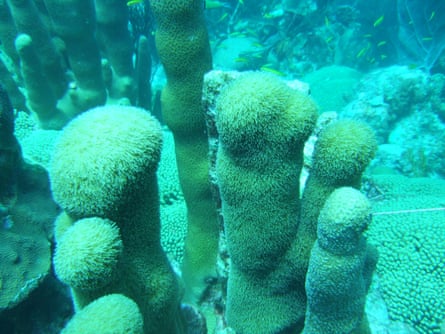
The IUCN has moved pillar coral’s status from vulnerable to critically endangered following a dramatic drop in its population. Photograph: Francoise Cabada-Blanco/IUCN
The pillar coral, found from the Caribbean to the Yucatan peninsula, was also part of the most recent round of IUCN red list assessments and has been moved from vulnerable to critically endangered after its population shrank by more than 80% across its range since 1990. The decline was caused by disease, bleaching from the climate crisis and fertiliser runoff.
There are 150,388 species that have been assessed by scientists for the IUCN red list, of which 42,108 are threatened with extinction. More than 1,550 of the 17,903 marine animals and plants analysed are at risk of disappearing for ever, with global heating affecting at least 41% of threatened marine species.








 Exposing the Big Game