NEW JERSEY — Black bear hunting season in New Jersey will go ahead, albeit later than originally planned. A New Jersey appeals court judge ruled in the state’s favor Tuesday in a legal battle brought by a coalition of animal-welfare groups.
The hunting period will run through Saturday, with check stations open from 4-7 p.m. Tuesday and from 12-7 p.m. for the remainder of that period, according to the state Division of Fish and Wildlife. The season officially ends 30 minutes after Saturday’s sunset.
An injured hunter was air rescued by Maryland State Police on Friday after he became trapped by marshy terrain inside a Dorchester County nature refuge.
According to anews release, the MSP Trooper 6 crew responded to Blackwater National Wildlife Refuge near Cambridge, Maryland, to rescue the hunter, who had fallen about 14 feet out of a tree stand. Trooper 6 is assigned to the Easton section of the Maryland State Police Aviation Command.
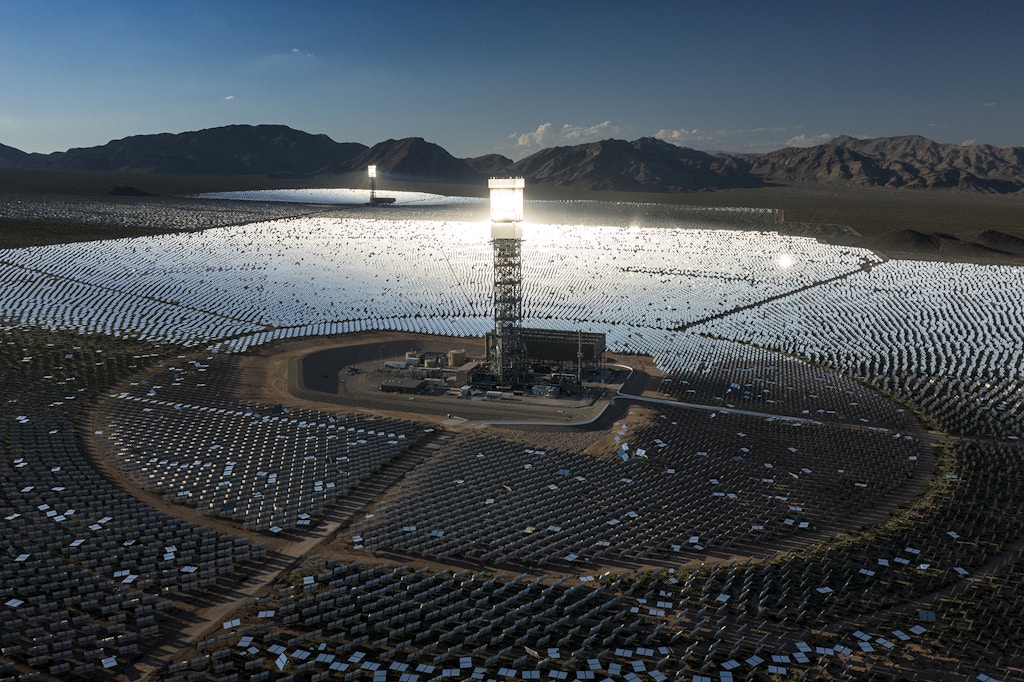
A boiler tower surrounded by mirrors at the Ivanpah Solar Electric Generating System in the Mojave Desert, Calif., on Aug. 26, 2022.
Photo: David McNew/Getty Images
CONSERVATION BIOLOGY FINDS itself in a terrifying place today, witness to mass extinction, helpless to stop the march of industrial Homo sapiens, the pillage of habitat, the loss of wildlands, and the impoverishment of ecosystems. Many of its leading figures are in despair. “I’m 40 years into conservation biology and I can tell you we are losing badly, getting our asses kicked,” Dan Ashe, director of the U.S. Fish and Wildlife Service under President Barack Obama, told me recently. “There are almost no reasons to be optimistic.”
This might explain the discipline’s desperate hitching of its wagon to the climate movement. Climate, after all, is the environmental cause du jour, eclipsing all other sustainability concerns, increasingly attractive as a rallying cry for a public that has canonized it as one of the major political, social, and economic issues of our time. Mainstream climate activism of the Bill McKibben variety points toward a grandly hopeful end within the confines of acceptable capitalist discourse: decarbonization of the global economy, with technologies driven by profit-seeking corporations subsidized by governments. Taking up this banner of optimistic can-do-ism, the environmental movement has convinced itself, and sought to convince the public, that with a worldwide build-out of renewable energy systems, humanity will power its dynamic industrial civilization with jobs-producing green machines while also — somehow — rescuing countless species from the brink.
“But this happens to be a lie,” Ashe told me. “The lie is that if we address the climate crisis, we will also solve the biodiversity crisis.”
“The lie is that if we address the climate crisis, we will also solve the biodiversity crisis.”
A group of conservationists took up the question of climate and extinctions last year in the journal Conservation Letters, warning that “threats to biodiversity are increasingly seen through the single myopic lens of climate change.” The authors, who titled their article “An inconvenient misconception: Climate change is not the principal driver of biodiversity loss,” included Joel Berger, a wildlife biologist at Colorado State University; evolutionary biologist Andrew Dobson, who teaches at Princeton; and Tim Caro, an evolutionary ecologist at the University of California, Davis. “There is an assumption,” they observed, “that climate change is now the most important ‘horseman of the biodiversity apocalypse’” — despite this being “at best premature.”
When it comes to effects on wildlife, climate change is more like a mule, slow and plodding. Yes, a warmed atmosphere is projected to be a significant factor in the extinction crisis in future decades, but what’s destroying species today is habitat fragmentation and loss, overhunting and overexploitation, agricultural expansion, pollution, and industrial development. It isn’t climate change that caused a 69 percent loss in total wildlife populations between 1970 and 2018, according to a World Wildlife Fund study published this year. The cause is too many people demanding too much from ecosystems, or human overshoot of the biophysical carrying capacity of the Earth.
Overshoot is a product of both excessive numbers and rising affluence. Access to the things that create what we call quality of life, like indoor lighting and temperature controls, especially air conditioning; more diverse dietary choices, especially meat; and greater access to transportation, especially air travel — all signs of rising affluence, all delightful if you are a human, yet all demand more energy and material inputs that involve scouring and denuding more wildlands and animal habitat to feed, clothe, house, and energize burgeoning humanity.
According to the co-authors of the Conservation Letters piece, we are “dangerously ignoring” this reality and instead doubling down on the “distortion” that climate mitigation is all that matters to protecting wildlife. Over the last 30 years, the proportion of scientific papers closely tying climate change and global warming to changes in patterns of biodiversity has “steadily increased,” according to their analysis. Media coverage of climate change in relation to biodiversity has followed suit, repeating and compounding the error. The net result of this “misguided focus on climate change” has been the undermining of conservation science “as an evidence-based scientific discipline.” As Dobson put it to me, “If conservation biologists don’t take a balanced look at the evidence, they can’t claim to be evidence-based.”
The crux of the problem is that mainstream environmentalists have siloed climate change as a phenomenon apart from the broad human ecological footprint, separate from deforestation, overgrazing of livestock, megafauna kill-off, collapsing fisheries, desertification, depleted freshwater, soil degradation, oceanic garbage gyres, toxification of rainfall with microplastics, and on and on — the myriad biospheric effects of breakneck growth. Climate change is “but one symptom of an environmentally dysfunctional system of constant growth of economies and populations,” ecologist William Rees, professor emeritus at the University of British Columbia, told me.
“The meta-problem that we need to keep our eyes on,” Rees said, is ecological overshoot. Modern techno-industrial culture, he writes, “is systematically — even enthusiastically — consuming the biophysical basis of its own existence.” Rees describes this as a malignant process, humanity as cancer.
Rees is hardly alone in his stark assessments of the status quo. In the most recent letter of “world scientists’ warning,” a semiannual notice to the public, 12 experts in life sciences, global system dynamics, and ecology noted that “most planetary boundaries that regulate the state of the Earth are beyond their safe space. Therefore, climate change is not a stand-alone issue. It is part of a larger systemic problem of ecological overshoot.”
The authors added the commonsense observation that humanity “cannot sustain unlimited growth in a finite world,” a physical law of life on Earth that we ignore at our peril.
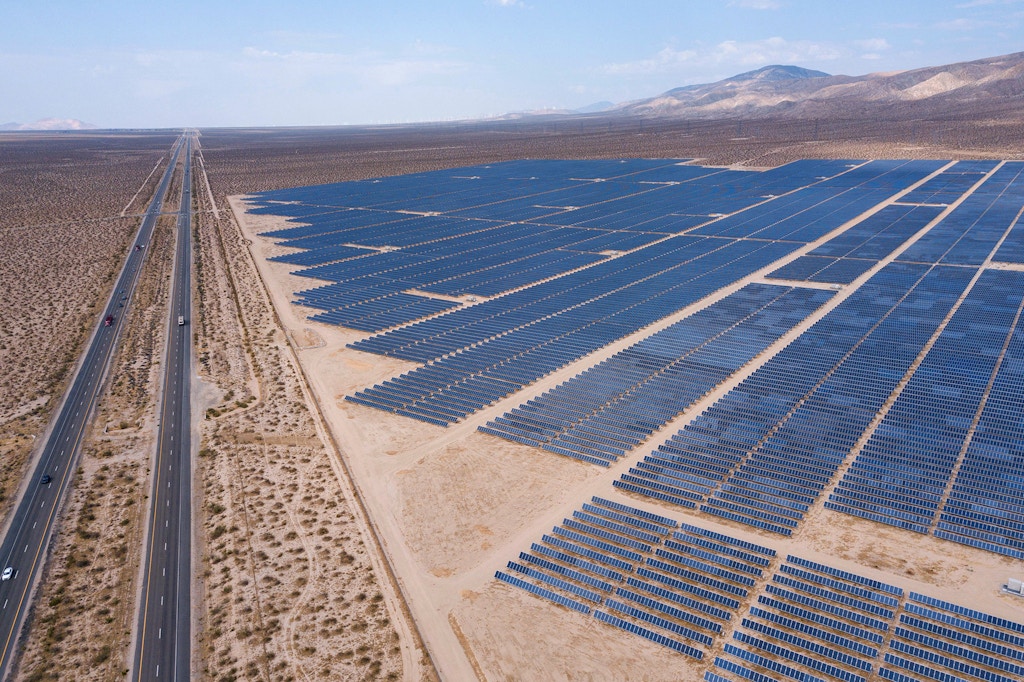
Solar panels that are part of an electricity generation plant near Mojave, Calif., on June 18, 2021.
Photo: Patrick T. Fallon/AFP via Getty Images
IT MAY BE that solving the climate crisis, because we will solve it with bold technologies to maintain ourselves in overshoot — as opposed to practicing humility and restraint with an eye toward contraction of the human enterprise — will accelerate extinctions, due to the demands for space and minerals to drive the technologies. To generate solar and wind power on the scale necessary to decarbonize the U.S. utility and transportation sectors, for example, requires land use on a massive scale.
Solar and wind occupy much larger acreage than oil and gas, requiring networks of roads and utility corridors, transportation and transmission capacity that doesn’t exist today. Environmental lawyer Michael Gerrard, founder and director of the Sabin Center for Climate Change Law at Columbia Law School, estimates that the U.S. needs a tripling or even quadrupling of transmission capacity — up from the 160,000 miles of high-voltage power lines now in operation — to move all the new green energy to consumers, who are mostly in cities, from the remote places where it’s harvested.
A report for the Brookings Institution states that wind and solar require 10 times more land per unit of power produced than coal- or natural gas-fired power plants, a figure that takes into account the land torn up and habitat destroyed in order to drill out, pump, and transport fossil fuels. “Renewable power production,” the report states matter-of-factly, “will take place in areas that have not seen energy development.”
There is also the global scale of mining needed to extract and process the lithium, nickel, cobalt, rare earths, and other necessities for renewables infrastructure. The net result: Decarbonizing will likely lead to huge fragmentation of land, in the U.S. and overseas, particularly in minerals-rich China and the “global south.” And not just wildlife will be affected: The “death villages” around the Bayan Obo mine in China, source of 70 percent of the world’s rare earths, are testament to the health cost of green-tech mining, which is only going to accelerate in pace and scale.
Consider the green destruction of habitat now unfolding in the Mojave Desert across California and Nevada, where the rush to build industrial solar is catastrophic for native flora and fauna. “Utility-scale solar is just as bad as urbanization and development,” said Patrick Donnelly, who works at the Center for Biological Diversity investigating the environmental effects of the renewable energy rush in the American West. “The result is that the Mojave is in big trouble.”
Start with site-specific Mojave plant species such as the tricorner milkvetch and the white-margined beardtongue, lovely rare flowers endemic only to certain valleys and basins. They are goners under the solar regime. From there the picture only gets uglier, with the likely wiping out of huge stretches of habitat for the broad suite of Mojave fauna: foxes, hawks, badgers, rabbits, and, most prominently, the desert tortoise, the keystone species of the Mojave, whose construction of extensive burrows provides homes for at least a dozen other species. “If there were no desert tortoises to dig new burrows,” states a Fish and Wildlife Service manual about the species, it would lead to “the demise of the ecosystem.”
“The worst thing these massive solar projects do is cause direct habitat loss for the tortoise and friends,” Donnelly told me. The grim future that rampant solar development promises for Mojave wildlife is already in evidence where migratory passages for tortoises have been compromised by existing solar. Climate change modeling tells us the optimal temperature range for the tortoise is moving steadily northward, and so the tortoise will seek the path north to survive. Critical passages for this expected migration have been cut off. Ivanpah Valley, a bottleneck between the east Mojave and the north Mojave, is now severed by solar. Pahrump Valley, another passage to the north, is slated for solar that will have a similar blockading effect. There are tens of thousands of acres in the Mojave Desert containing what the U.S. Bureau of Land Management calls “high density populations” of desert tortoise that are now being developed for solar, with the expected result, according to Donnelly and other watchdogs, that tortoises there will wink out.
Some 60,000 acres of BLM land adjacent to near-pristine Death Valley National Park have been proposed for industrial solar. One of the sites is Sarcobatus Flat, a wild place mostly empty of human habitation, which is a value in itself, as wildlife needs big open spaces free of the meddling of Homo sapiens. Situated in the Great Basin-Mojave transition zone, Sarcobatus is a vast valley of Joshua trees, greasewood, and blackbrush. The Joshua tree, which the Fish and Wildlife Service is considering for protection under the Endangered Species Act, is on a path to extinction, Joshua tree woodlands being one of the most imperiled ecosystems in the American West. The solar project at Sarcobatus Flat would kill, bulldoze, and stack in cordwood piles between 50,000 and 70,000 of the trees, according to a field estimate by the nonprofit Basin and Range Watch.
The Great Basin Desert to the north, meanwhile, remains mostly free of the techno-industrial regime. But that’s ending with the advent of new electrical transmission projects into these remotest parts of Nevada, a project called Greenlink that electricity and natural gas provider Nevada Energy is funding. Greenlink North, pending approval, is planned to run along Highway 50, the famous Loneliest Road in America, from Reno to Ely, through some of the wildest parcels of public land in the state — and prime habitat of the endangered greater sage-grouse. This ground-nesting bird, like the desert tortoise, is an indicator species of landscape health.
The purpose of the transmission line, as Nevada Energy has made clear, is to render solar economically feasible in those remote sun-rich landscapes. Greenlink North, along with the associated solar fields it will make possible, is expected to devastate some of the last strongholds of sage-grouse in north-central Nevada, as the birds are exquisitely sensitive to the light and noise of development.
We will be a kind of gleaming metallic Noah’s Ark that carries few animals, only lots of people.
It may be that global society can achieve a measure of sustainability in climate terms — but on a planet that has been stripped of creatures like the tortoise and the sage-grouse, shorn of natural agency, reduced to a biological pauper, its last wildernesses occupied for the greater good of the industrial juggernaut. We will be a kind of gleaming metallic Noah’s Ark that carries few animals, only lots of people.
Pondering these matters, Dan Ashe had arrived at a revelation that amounted to a conservation biologist’s worst nightmare. “I’ve come around to the idea that a lot of the diversity of life on Earth may be incompatible with human ambitions and aspirations. On the other hand,” he told me, “I can be very optimistic about climate because ultimately humanity is going to deal with carbon pollution. It’s an issue for our well-being. We can solve it by building machines and making money. That’s obvious in the Inflation Reduction Act. … But with the biodiversity crisis, you can’t solve it with machines, and it involves constraints on our making money. And history shows we aren’t very good at constraint.”
Ashe suggests that conservation biologists cease the empty claims about “saving the planet” with climate mitigation and start speaking truth: There is at present no plan, in any country, anywhere, on a global or national scale, to address extinctions, biodiversity crash, and habitat loss. The dismal reality is that with a green build-out, we will be saving not the complex web of life on Earth but the particular way of life of one privileged domineering species that depends for its success on a nature-ravaging network of technological marvels. Only once this truth is understood can honest decisions be made about what kind of world humanity wishes to inhabit in the age of ecological disorder.
A search team emerges from the woods in Goshen early Friday after the body of a missing hunter was found.PHOTO BY TODD MAISEL
GOSHEN— A hunter who had gone missing on Wednesday was found dead early Friday.
The body of the man, who has not been identified, was found about 10 a.m., according to state police. Goshen is in Hampshire County, about 30 miles east of Pittsfield.
The man had been reported missing about 5 p.m. Wednesday after calling someone from his cellphone, according to Western Mass News.
Rescuers gathered at the scene of a search operation in Goshen on Friday after the body of a missing hunter was found in the woods nearby.PHOTO BY TODD MAISEL
Search teams from state police, the Chesterfield Fire Department, and the Berkshire Mountain Search and Rescue team had been dispatched, using a K-9 unit and…
BELLEVILLE, Ill. (AP) — State wildlife officials suspect that bird flu killed at least 300 waterfowl recently found dead at public hunting sites across southern Illinois.
The Illinois Department of Natural Resources said Tuesday the wild birds, mostly snow geese, have been found dead at Baldwin Lake, Pyramid State Recreation Area, Rend Lake and Carlyle Lake.
The wild birds are believed to have died of avian influenza, the DNR said in a news release. The state agency is asking anyone who sees 20 or more dead birds at one spot to report those birds deaths to a district wildlife biologist, theBelleville News-Democratreported.
Wednesday, November 30, 2022 |Updated Nov 30, 2022 9:14 am CST
GUN DEER SEASON HUNTING INCIDENTS
At the publication time of this news release, the DNR reports eight firearm-involved injuries and one fatality for the entire 2022 gun deer season.
Sauk County, Woodland Township:On Nov. 19, 2022, at approximately 11:10 a.m., a 22-year-old male was the victim of a gunshot wound to the thigh. During a deer drive, a 20-year-old male shooter, who was a driver in the hunting party, shot at a running deer, striking the victim, who was a stander in the hunting party. The victim was transported to the hospital and treated.
Marquette County, Mecan Township:On Nov. 19, 2022, at approximately noon, while in a ground blind in a field, a 69-year-old female was…
So asked the headline in a Washington Post column about National Pork Producers Council v. Ross. The Supreme Court case, argued in October, involves a voter-passed ban in California on in-state sales of meat and eggs from livestock confined by means the electorate deemed animal cruelty.
The law, Proposition 12, bans sales of pork produced with gestation crates, enclosures that the Post columnist, a supporter of the law, described: “Five-hundred-pound pregnant sows are confined in a metal crate sized to fit their bodies. For 16 weeks of gestation, the sows can’t turn around or stretch their legs. When they’re ready to give birth, the pigs are taken to the ‘Farrowing Barn’ for a week to 10 days where they deliver their tiny progeny. The piglets scramble through another confined space to suckle their mothers, who are soon returned to the Gestation Barn for another round of 16-week torture.”
But while Californians consume 15 percent of the nation’s pork, they produce almost none themselves, importing it from other states. Therein lies the challenge before SCOTUS from the National Pork Producers Council and the American Farm Bureau Federation: California, they say, is regulating how producers in other states must raise their animals and increasing their production costs. The plaintiffs say that this violates the “dormant commerce clause,” the US Constitution’s implicit, long-understood rule that states cannot inordinately intrude on interstate commerce.
Roughly two-thirds of producers use gestation crates. But producers such as Tyson Foods have said they can sate Californians’ appetite for pork without crates, while companies like the Cheesecake Factory are phasing out their use. Economists found negligible effects on the industry from Prop 12, passed in 2018.
Lawyer and animal rights advocate Steven Wise (LAW’76), founder and president of the Nonhuman Rights Project, has argued for decades, in print and in court, that higher animals such as chimps and elephants deserve legal status as autonomous beings, with the right to freedom from captivity. He worries that a loss by California before the high court would jeopardize animal welfare laws elsewhere, as he told BU Today.
Q&A
WITH STEVEN WISE
BU Today: On the legal merits, should the justices uphold California’s law?
Wise: Setting aside the relevant animal welfare questions, Pork Producers deals with whether a California law can dictate to all 50 states how pork production is managed—which is a tremendously complex question. The constitutional stakes involve troublesome questions that arise when, for example, one state with limited pork production enacts a law that will likely have significant economic effects in other states, especially when a majority of the pork producers in the United States are from outside the enacting state. There are many layers to the “legal merits” here.
The plaintiffs say the California law will raise pork prices nationwide, but some major pork producers have said otherwise. Is the uncertain effect California’s strongest argument for upholding the law?
In my view, the question of pork prices is not relevant. Upholding the law could lead to rising prices. Or it could not. This is not an area of expertise for me. What is clear to me is that pigs that are raised for food are treated inhumanely, and this law rightly seeks to address that issue.
What is clear to me is that pigs that are raised for food are treated inhumanely, and this law rightly seeks to address that issue.Steven Wise
Approximately 20 years ago, the New York Times wrote that pigs and laying hens are the most cruelly mistreated of factory farmed animals. That concern moved 62-plus percent of California voters to approve this law; is a state’s right to make its laws likely to sway most justices?
I can only guess about what will sway these justices in this particular case. Many states have their own laws related to animal welfare and food safety. All California did here was ban the sale in California of pork from pregnant and nursing pigs confined to spaces so small they can’t turn around. While there is a dormant commerce clause argument to be made, in truth, this law simply gives pork producers a choice if they want to sell their products in California to meet California’s standards.
Some worry that if California wins, we’ll have an unmanageable regimen that will allow each state to decide what cannot be sold within its borders—say, genetically modified food. What about that concern?
This is a typical slippery slope–type argument that we hear in our cases all the time. At the end of the day, this case is about Proposition 12, a law passed by the people of California, regarding pork production. That is what the court should be looking at.
If the court should rule against California, are there alternative animal welfare measures that would pass legal muster? Or are we simply not at the point where sufficient numbers of Americans are troubled by how our food is produced?
If the court should rule against California, my worry is that there might be animal welfare measures that could be similarly challenged. I believe there are growing numbers of Americans that are troubled by how our food is produced and the many other ways we treat nonhuman animals inhumanely. My hope is that they won’t stand for a rollback of animal welfare jurisprudence in this case or any other.
The first incident occurred the weekend before Thanksgiving on November 20 in Wisconsin, where 11-year-old Easton Thom, a sixth-grade student at Berlin Middle School, was shot. A statement from the Wisconsin Department of Natural Resources said that when the 41-year-old man accompanying Thom on theirdeer-hunting tripattempted to unload a firearm on the back seat of a vehicle, he accidentally fired the weapon and hit the young boy in the chest.
This stock image shows a hunter with a gun, left. and a…








 Exposing the Big Game