Enforcement Agents cited a New Iberia man for alleged deer hunting violations on Jan. 15 in Iberia Parish. Agents cited Jarrod Ransonet, 45, for intentional concealment of wildlife, possession of an illegally taken deer and hunting without a deer license. Agents were on patrol during the archery only season when they observed two subjects fully dressed in camouflage at the Patout Boat Launch loading hunting gear into their vehicle. Agents made contact with the two subjects, which turned out to be Ransonet and a juvenile. During questioning, Ransonet informed agents they were hunting wild hogs. Agents then observed brown hair protruding from a pile of camouflage hunting jackets. Agents discovered a fresh dead antlerless deer shot with a rifle concealed underneath the jackets. The antlerless deer was seized and donated to a local charity. Intentional concealment of wildlife brings a $900 to $950 fine and up to 120 days in jail. Possession of…
Top scientists and security experts moved the “Doomsday Clock” forward on Tuesday to just 90 seconds to midnight -– signaling an increased risk to humanity’s survival from the nuclear shadow over the Ukraine conflict and the growing climate crisis.
The new timing of the clock set by the Bulletin of the Atomic Scientists is closer to midnight than ever before.
The hands of the clock, which the Bulletin describes as a “metaphor for how close humanity is to self-annihilation,” had been at 100 seconds to midnight since January 2020 — the closest to midnight it had been in its history.
A decision to reset the hands of the symbolic timepiece is taken each year by the Bulletin’s science and security board and its board of sponsors, which includes 10 Nobel laureates.
The Laurel High School wrestling team can qualify for the WPIAL Class 2A team tournament on Wednesday with a win at Hampton, but the Spartans will be without a key member of their squad.
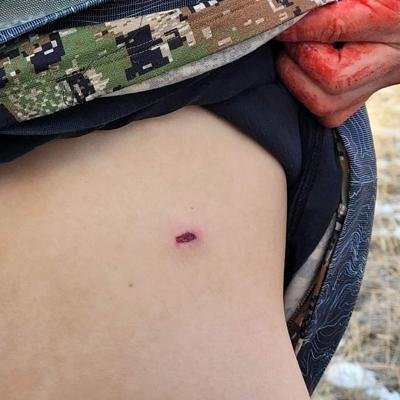
Laurel’s Colin Bartley, a four-year starter and two-time WPIAL finalist, is out for the season after suffering a gunshot wound to his upper thigh in a hunting accident on Dec. 29, Laurel coach Kevin Carmichael said.
“It was a real shock to hear the news,” Carmichael said. “It’s a shame to see his career come to an end this way. We’re just hoping he can walk again.”
Bartley broke into Laurel’s starting lineup as a 106-pound freshman in the 2019-20 season and made an immediate impact by placing second in the WPIAL and sixth in the Southwest Region to…
A hunter from the Nez Perce Tribe sustained minor injuries after he was hit by a bullet fragment near Beattie Gulch on Tuesday, law enforcement officers confirmed on Thursday.
The incident was initially ruled an accident, and authorities have filed no charges against the man who shot the bullet that grazed the hunter. However, they are continuing to investigate the incident further.
Park County Sheriff Brad Bichler said in a phone call that on Tuesday morning, shrapnel from a bullet struck Jackson Wak Wak on U.S. Forest Service land near Beattie Gulch. The area lies just north of Yellowstone National Park near…
The masses have never thirsted after truth. They turn aside from the evidence that is not to their taste, preferring to deify error, if error seduce them. Whoever can supply them with illusions is easily their master, whoever attempts to destroy their illusions is always their victim. – Gustave le Bon (1841 – 1931)
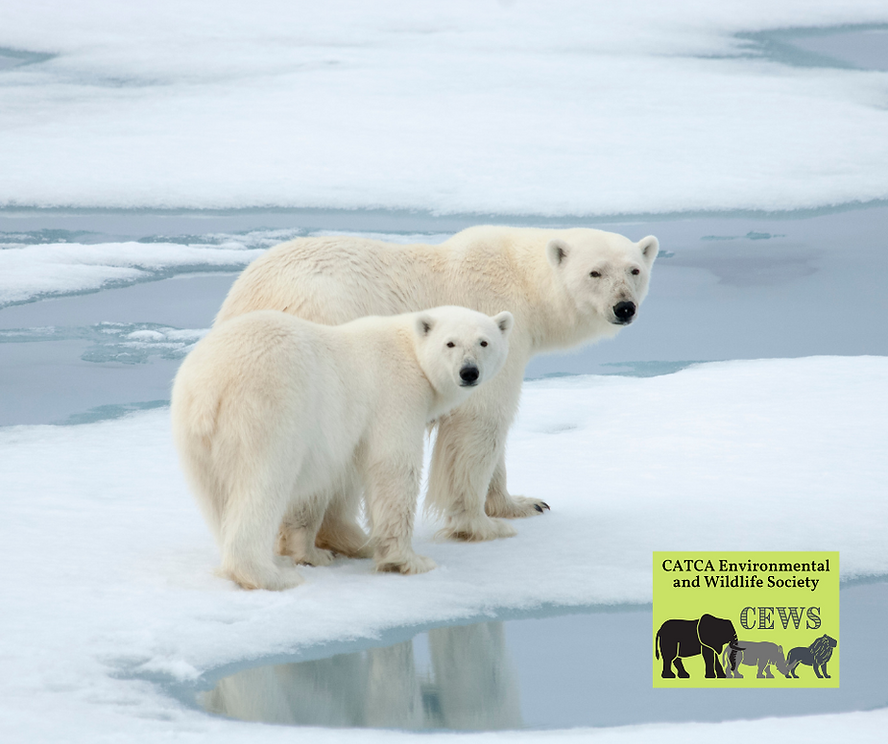
As 2022 drew to a close news media broke a story about yet another study showing how seriously polar bears are declining around western Hudson Bay. Because of the centralized location of the community of Churchill, Manitoba, it is one of the areas where the bears are most studied, and near the southern end of their current range, however, they regularly occur south as far as James Bay, in my own province of Ontario – for now.
The news was that latest figures based on aerial surveys found there were 618 polar bears, down from the last time such a survey was conducted, in 2016, when there were 842 bears.
That is new information, and I am pleased that so much of Canada’s mainstream media (MSM) reported it, but surprised that seasoned bear biologists expressed, according to news reports, amazement at the precipitancy of the decline. If we go back to the 1980s, the number of polar bears in this region has gone down by nearly half. The trend was obvious, there have been no significant changes for the better and
we still kill them, for profit.
The polar bear is an iconic symbol of climate change, itself most associated with overall global warming. Depending on which article you read, the arctic, broadly defined, is warming two to four times faster than the rest of the world. Global warming affects ringed seal populations because they need the sea ice to survive. and the ice is disappearing. Ringed seals are the main food source of female polar bears.*
But as University of British Columbia Professor Emeritus William Reese keeps trying to tell us, climate change, climate chaos, global warming – whatever you want to call it – is a symptom, more than a problem, as he explains here: https://un-denial.com/2021/02/06/by-william-rees-climate-change-isnt-the-problem-so-what-is/. I urge you to listen to him as he gives one of the most important half hour online talks in existence.
Lemmings, bunnies and boom-bust cycles:
I’ll get back to polar bears in a moment, but first consider snowshoe hares and lemmings. Many Canadians informed about the basics of wildlife population dynamics know that both the hares (https://academic.oup.com/bioscience/article/51/1/25/251849) and the lemmings
(https://www.nature.com/articles/news000601-10) are famous for their boom-bust population cycles, wherein their populations increase year after year until a critical mass is reached, and there is an abrupt die-off, often triggered by disease and stress. Their respective populations fall to well below the number the environment can sustain, popularly known as the “carrying capacity,” before starting to work their way back up.
This is called a boom-bust cycle and is often most noticeable in wildlife of the polar and sub-polar regions.
When the animals’ numbers start to soar above the carrying capacity of their environment, approaching the peak – nearing the top of the boom – it is called the “plague phase” of the growth curve, and is followed by the inevitable crash – the bust. Predators benefit from the higher prey numbers, thus experiencing increases in their own populations, boom, and themselves crash when suddenly they have far less food, the bust.
What is happening with humans exactly resembles what happens with other species as they soar upward in numbers to the plague phase, except that we humans, unlike rabbits and rodents, can draw resources from other parts of the world, fueled only in the last tiny fraction of our existence by fossil fuels fed into modern technology. Our numbers can keep going higher, keep depleting essential resources at increasing amounts, racing toward the plague phase and the unavoidable bust.
This ability to delay the inevitable allows some of us to pretend everything is not so bad. But if everyone were to live as well, consuming as much, as North Americans do, we’d need earth to be slightly more than five times larger than it is. We’re doing reasonably well where I live, in southern Ontario, because we can afford to draw food from the rest of the world. But not all of the rest of the world has enough for us all, world-wide. Even so, where I live, we are complaining about food prices and shortages.
Professor Reese’s Zoom talk explains it all far better and more accurately than can I, but the bottom line is that we are entering the plague phase of the “boom” part of the boom-bust cycle – except, it is not cyclic with us. This is a first time ever event, a one-off global population boom, with the peak near, and the bust already manifesting itself in numerous ways, from bare grocery shelves to often deadly immigration surges, wars, famines, disease, vast wildfires, draughts, desertification, floods, and despair.
Of course, all such problems have occurred here and there throughout recorded history, but not at the current, and growing, rates, nor in so many places in such short time spans and at such magnitudes. And all are symptoms of our historically recent, sudden, and overwhelming dependence on fossil fuels.
No single thing we could do would save more species than whatever we might do to flatten the curve that represents increase in fossil fuel use – nothing – and ask yourself what are the governments of the world doing toward that end? In Canada we taxpayers give money to extract and sell more fossil fuels.
And still we kill:
If we go back ten thousand years, when humans started to shift from being nomadic gatherers and hunters to becoming stock herders and settled farmers, we see that about 99 percent of the “mammal biomass”, the entire weight (“mass”) of all mammals in the world, consisted of wild mammals, from bumblebee bats and pygmy shrews to savannah elephants and blue whales, more than 5,400 different species.
Now? The wild mammal biomass is only about 1 percent of all mammal biomass, the rest killed off or displaced by humans, who weigh in at about 32 percent of all mammal biomass, and by the domestic mammals humans use, mostly to eat, which account for about 67 percent of the planet’s mammal biomass.
The exact figures can be disputed by a percentage point or two, yes, but in fact we have nearly wiped out most individual wild mammals, and individual wild birds, too. Domestic poultry, mostly chickens, now account for about 70 percent of the world’s bird biomass. If we factor in fish, reptiles, and amphibians along with the birds and mammals – all the vertebrate animals – it’s the same story, at least among monitored species whose approximate population sizes we know, showing about a 60 percent decline since 1970. Even insects are in serious decline, including those vital to the pollination of plant species of importance both to maintaining what is left of biodiversity, and our own food sources.
And still we displace wildlife, destroy wildlife habitat, kill wild animals directly, or through poisons, traps, or simply crush them under the weight of our destructive presence in their midst.
Canada: The Polar Bear Hunting Capital of the World:
Polar bears don’t recognize international borders, and so the five nations – range states – in which wild polar bears regularly live, Russia, USA, Canada, Greenland, and Norway (Svalbard), comanage them, dividing the world polar bear population into 19 “subpopulations”, of which thirteen are in Canada, host to two thirds of all polar bears.
Canada is also the only country that allows polar bear trophy hunting.
Hunting “management” is supposedly based on “sustainability”. The principal is sometimes expressed in economic terms: the animals allowed to be hunted are superfluous to the population’s need to sustain numbers that the environment can support, and so the offtake is comparable to spending money from the interest earned from the principal in capital investment. You can spend interest or let it build, earning more interest (compounding) to the degree that circumstances (analogous to the environment’s carrying capacity) allow, but you spend the capital at your peril. If the net amount – the combination of capital and interest – is declining, there is no interest to be spent, only capital. In such circumstances
spending capital, unless well invested, only hastens to slide to foreclosure or bankruptcy, analogous to extinction – except somewhere there is always more money. When a species goes extinct, there are no more; none at all and no other place for a species to invest itself; nothing more to borrow.
That’s just an analogy, metaphorical and imperfect, although perhaps less so than you might imagine. We can see that the carrying capacity of the environment for polar bears is limited; if the things they depend on vanish, so do they.
But in our pre-fossil-fuel-use history, even though we exterminated many species, there was (usually, but with some exceptions) alternatives to be had somewhere over the horizon. The world is big, and we posed no great overall threat to most species-wide until fossil fuels allowed us to also enter into our own, first ever boom-bust “cycle”.
Following publication of her new book, Minding the Climate: How Neuroscience Can Help Solve Our Environmental Crisis, recently published by Harvard University Press, Dr. Ann-Christine Duhaime, a pediatric neurosurgeon at Massachusetts General Hospital, was interviewed by the New York Times. She said, “Our brain design evolved primarily for short-term decision-making focused on circumstances related to immediate, tangible survival: I do this action, and I get this food.”
“Climate change,” she continued, “is difficult because it is longer term rather than immediate. It is difficult to perceive directly; we didn’t need to evolve carbon dioxide sensors for survival. The results of our pro-environment actions remain largely invisible. Additionally, the things that cause climate change are rewarding. Fossil fuels have made our lives easier in many ways. They have also made many people wealthy.”
Exactly. Although it was not her intent, Duhaime’s comments succinctly explain why we still kill polar bears; why we eliminate the ecological equivalent of capital. In the tens of thousands of years that humans have hunted arctic wildlife (see Grisly find suggests humans inhabited Arctic 45,000 years ago | Science | AAAS ) whenever there have been large numbers of polar bears seen, it is because there are large numbers of polar bears overall, and that’s been true right up to recent times.
The indigenous people of the far north survived some of the harshest living conditions on earth not by being hesitant about doing what needed to be done in the short term. Doing otherwise did not lead to passing on one’s genes! Not discounting art and craftsmanship, virtually every aspect of traditional, pre-colonial Inuit culture is directed toward survival. That includes heeding traditional lore and elder knowledge. It also includes taking advantage of all aids, which includes, now, the rich visitors who are willing to pay to kill, and keep trophy parts of, polar bears.
Two views:
I speak very generally, but there is a dichotomy of opinion between the Inuit traditionalists and their supporters, and what the science is telling us. On one side, the hunting of polar bears is rationalized because, it is claimed, there are lots of bears. On the other side, science shows us that no, polar bears are going increasingly hungry, and their numbers are in serious species-wide decline. However, they are concentrating at food sources, which are often where humans are also concentrated. What humans waste is often what polar bears, arctic foxes, gulls and ravens and other wildlife will eat.
Whatever those concentrations of bears near Inuit settlements or communities meant in the past, it was a past very different from the current, rapidly changing present, and incredibly different from the future envisioned if we don’t change our practices and policies more than we seem capable of doing. And we now know that the kind of overview not possible until recently, thanks to aircraft and cameras, shows that concentrated numbers of polar bears does not mean more polar bears. The time when it did mean that was not a time of rapid loss of sea ice; of hugely expanded numbers of humans; of toxins now occurring in arctic wildlife (and humans); of high-powered rifles, snowmobiles, and motorboats; of imported food supplementation and health care services; of rapid international travel, melting permafrost, and much else.
In his book, Polar Bears: Beloved and Betrayed, author Morten Jørgensen, equates legal hunting with poaching, pointing out that nearly three polar bears are shot, most legally, every day (and more so in Canada then elsewhere). There are always reasons to kill.
Legal polar bear killing is highly regulated in regions where enforcement of such regulations can range from difficult to impossible, thus non-existent. Those regulations are designed to benefit local people. If the rich and powerful Safari Club International members really need to kill a bear so badly that they’ll pay handsomely to do so, where’s the harm? Apart from the trophy parts, the dead bears are almost completely used locally in communities where other options are limited, and money is more valuable per unit of food purchased than it is here. Our complaints notwithstanding, most of the foods we take for granted cost a fraction of their price in the far north. Of course, Kraft macaroni, Campbell soup, veggie or any other burgers, bread or eggs or granola or much else is often only available at all in the far north, or often in my local grocery store, because of fossil fuels, in a viciously insane spiralling dance of cause and effect ultimately resulting in our mad plunge into humanity’s plague phase, the bust, now unfolding.
And that brings me back to the tranche of MSM articles that ended 2022, on how rapidly polar bears have declined, and are still doing so.
It is, as I said, the “surprise” that “experts” claim that surprised me. In private conversation that I will, with his permission, make public here, Morten Jørgensen said, “Legalities are irrelevant when basic conservation principles are overlooked. There can never, by definition, be a sustainable take from dwindling, depleted or even recovering populations. And if the precautionary principle is not applied and prioritized in management situations where the conservation status is murky, all subsequent legalized exploitation might as well be illegal (poaching). They all know this, of course. Which is one of the reasons they have agreed to meet my books with silence. They have no arguments.”
Exactly. We have in Canada a lot of entirely justified guilt over our often horrific mistreatment (up to the present, to be sure) of indigenous people – people whose ancestors arrived in the western hemisphere many thousands of years earlier than those of most of the people who now write, and enforce, the growing plethora of laws, rules and regulations necessary if we are indeed to define ourselves as something distinctive from all other species whose ancestry we ultimately share. The controls we impose upon ourselves define civilization and civilization defines humanity’s distinctiveness within the world’s population of living beings. Killing wildlife is a bone much more easily tossed to the indigenous people than anything approaching real resolution of concerns caused by that previous, at too many times ongoing, abuse.
Evolution has programmed us to be adaptive. Both Reese and Duhaime, drawing on what we know about human thought processes, agree we can change, but it requires more effort than accomplished to date.
Meanwhile, we have done things that have worked to slow the fiercely accelerated rates of extinction that we have triggered, mostly of little-known species. We have done this by identifying causes and reducing or eliminating them.
What’s killing off the polar bears? Climate change. Okay…working on it, but not getting far. Is there anything easier we can do in the meantime?
Yes. We can stop killing them. We can stop rationalizing the killing of them. We can stop pretending that that killing a species in decline is “sustainable”. And we can stop being surprised that what we saw happening – their decline measured earlier – is still happening.
If we stop climate change, it will take a long time. Will polar bears last that long? They might, but first, stop killing them.
* The mature male polar bear is much larger and stronger than the mature female, thus can access some prey, such as bearded seals, walrus, even beluga whales, not accessible to the female. But the female is solely responsible for raising cubs. Polar bears eat not meat but fat, and for female polar bears through most of their range the best source of necessary fat levels in her diet is the ringed seal. That is because the ringed seal forms snow shelters on ice on water – sea ice – where she nourishes her pup, and have maintain an opening to the water below, where she can try to escape predation, or search for food.
Mother polar bears can break through these shelters to capture the fat-rich seals or their pups, thus acquiring the essential fat when needed to provide milk and energy to raise her cubs. As well, smaller seals can swim, and fish, under sea ice – ice with water under it – but need to come up for air and use “blow holes” to do this. Polar bears (and Inuit) often wait by such holes to kill the seals as they emerge to breath.
And so, loss of sea ice, as is happening at unprecedented rates, is deleterious to the survival potential of sea-ice dependent ringed seals (themselves therefore at risk from climate change; at the moment they are still a common species listed under the “least concern” category by the International Union for the Conservation of Nature — IUCN), thus, polar bears. Sometimes a dead whale or large fish may wash ashore, and provide a good fat source for mother bears, but males usually will chase females and young, even kill cubs, to protect such food sources, although they may be quite amendable to sharing if there is enough to go around. Polar bears congregate at food sources, giving an impression of abundance.
Polar bears are increasingly trying to access other food sources, such as birds’ eggs and young, to the point where they will risk fatal falls by clambering about colonies of birds on cliffs seeking chicks or eggs.
It is possible that the odd individual bear might have a genetically heritable ability to access alternative nutriment sources, and pass that character on – that is, put simply – how evolution works, but not if it is legally (or otherwise) shot. We need to address fossil fuel use, but have not done so, but we can stop killing polar bears.
The death of an endangered vulture at the Dallas Zoo is not believed to be from natural causes.
About a week prior, a clouded leopard at the zoo went missing for several hours before being found.
Police said a suspicious cut was made in the leopard enclosure, as well as that of some monkeys.
Police are investigating after a series of strange events at the Dallas Zoo.
First, a clouded leopard escaped from her encampment, which had a “suspicious” tear in it. Next, another cut was found in an enclosure containing langurs, a type of monkey native to Africa and Asia. Now, a vulture has died under what the zoo is calling “unusual” circumstances.
“This weekend, our staff found that one of the endangered vultures in our Wilds of Africa habitats had died. The animal care team is heartbroken over this tremendous loss,” the Dallas Zoo said in a statement on Saturday.
“The circumstances of the death are unusual, and the death does not appear to be from natural causes,” the statement continued, adding: “In the past week, we have added additional cameras throughout the Zoo and increased onsite security patrols during the overnight hours. We will continue to implement and expand our safety and security measures to whatever level necessary to keep our animals and staff safe.”
Rose Lavelle whipped out a marvelous back-heel assist to help give Alex Morgan her first goal of 2023
US Women’s National Team star Rose Lavelle is virtually unstoppable with the ball at her feet.
The midfielder showcased her brilliance with a jaw-dropping assist vs New Zealand on Wednesday.
Lavelle whipped out a no-look back-heel pass to help give Alex Morgan an easy first goal of 2023.
Rose Lavelle is considered one of the most creative playmakers the US Women’s National Team has ever seen.
And Wednesday afternoon in New Zealand, she showed the world exactly why.
The 27-year-old midfielder dished a stunning back-heel assist to Alex Morgan, bamboozling a pair of Ferns defenders and dazzling viewers back home in the process. With Lavelle’s ball leading into a wide-open expanse of the 18-yard box, Morgan easily found the back of the net and doubled the Stars and Stripes’ lead.
Lavelle’s on-ball prowess was among the most striking highlights of the USWNT’s 4-0 victory in Wellington. But when she was asked about her ability to “create havoc” with the ball at her feet, the Ohio native was quick to deflect attention away from herself and offer credit to her teammates instead.
“I have really good players around me that help me look good,” Lavelle said after the game. “I have a lot of good people to get the ball to me and then a lot of good people for me to feed to. It’s a fun group to play with.”
While that may be true, Lavelle’s answer brushes over just how crucial her dribbling and distributing talents are to unlocking the four-time World Cup champions’ offense. So let’s take a look at how her brilliant assist unfolded in Wednesday’s game — and how Lavelle was key to the play that led to goal No. 2:See More
The zoo did not provide additional details about the vulture’s death but said it contacted the Dallas Police Department, which is investigating the matter. Dallas Police did not immediately respond to Insider’s request for comment.
The Dallas Zoo first made national headlines earlier this month when a female clouded leopard named Nova was not inside her habitat when staff arrived on the morning of January 13. The zoo said the leopard, which it described as not dangerous, weighed 25 pounds and was “bigger than a house cat and smaller than most bobcats.”
Nova was missing for several hours before she was located near her enclosure and quickly secured. The zoo said she had no signs of injury and quickly settled back into her usual routine.
Sgt. Warren Mitchell, a public information officer for the Dallas Police said during a press conference held while Nova was missing that “after investigating, it is our belief that this was an intentional act.”
In a follow-up statement, police said they determined “a cutting tool was intentionally used to cut an opening in the fencing of the Clouded Leopard’s habitat.” They also said they were made aware of a “similar cut” made in the langurs’ enclosure, but that all of the monkeys were accounted for.
Police added the investigation was ongoing and that it was not yet clear if the cuts in the leopard enclosure and the langur enclosure were related.
The world’s population of North Atlantic right whales has been decimated in recent years by human-caused vessel strikes and rope entanglements, and now another member of this rare species faces the same fate.
A 4-year-old female right whale found heavily entangled about 20 miles east of Rodanthe, North Carolina, is “likely to die,” according to the fisheries division of the National Oceanic and Atmospheric Administration.
An aerial survey team from Florida’s Clearwater Marine Aquarium spotted the whale January 8, noticing several wraps of line around its mouth and tail, and additional line trailing behind it. The entanglement has caused numerous wounds across the whale’s body and allowed tiny parasitic crustaceans known as whale lice to thrive on its head, according to images NOAA Fisheries and its partners reviewed.
The division’s biologists have preliminarily determined these details meet the criteria of a “serious injury,” meaning the whale “is likely to die,” NOAA said in a news release.
Scientists at the New England Aquarium, which manages the North Atlantic Right Whale Catalog tracking the identification and sighting history of right whales, identified the whale as No. 4904, the daughter of an adult female named Spindle (right whale No. 1204). Spindle was recently seen with a new calf off the coast of St. Catherines Island, Georgia. The last known sighting of No. 4904 was in May 2022 in Massachusetts Bay.
When No. 4904 was first spotted this month, entanglement response teams didn’t “mount a response … because it was too late in the day and the whale was too far from shore,” NOAA said. “However, as conditions permit, NOAA Fisheries will work with authorized responders and trained experts to resight her. We will further document the entanglement, and determine if an entanglement response will be possible.”
An ‘unusual mortality event’
In 2017, NOAA Fisheries declared an “unusual mortality event” (UME) as the number of dead, injured or ill North Atlantic right whales in Canada and the United States began to rise – largely due to human interaction, specifically via vessel strikes and entanglements.
No. 4904 is 94th on the list of all right whales affected in any way by this event.
“This is more bad news for this species that has been suffering from many years of ineffective protection,” said Gib Brogan, campaign director at Oceana, an international organization working to protect and restore the world’s oceans. “To hear that there is another entanglement is frustrating, because we know that more needs to be done (to prevent it).”
Today, it’s believed there are probably fewer than 350 right whales remaining worldwide. Right whales impacted by the UME represented 20% of their already endangered population – a significant setback to the recovery of an endangered species in which deaths are outpacing births, NOAA said. Additionally, only about a third of right whale deaths are documented, meaning the situation could be worse than what is known.
The potential death of No. 4904 could exacerbate the strain on the species. Female right whales can’t reproduce until around age 10, and they bear one calf after a year-long pregnancy, according to NOAA.
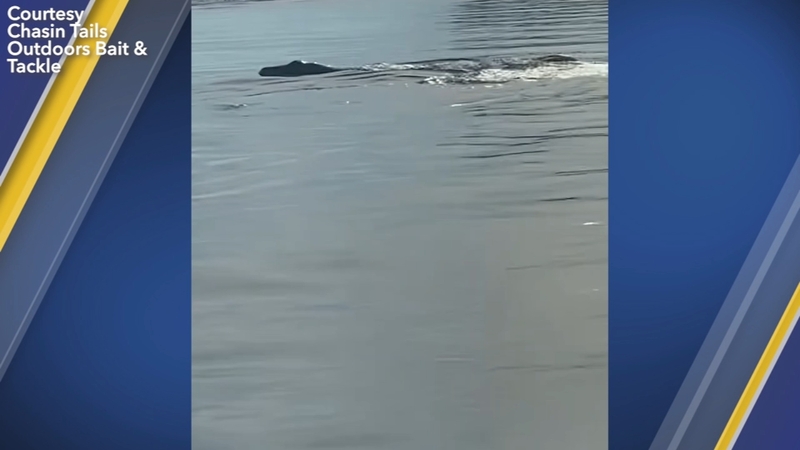
Is it an alligator? Is it a fish? Or could video of some creature off the NC Coast be something completely different?
The normal or healthy interval between right whale births is three years, but these days, the average is every six to 10 years – likely because of stress, insufficient food sources and ocean noise caused by human activities, according to NOAA. Ocean noise can harm right whales’ ability to navigate, identify their surroundings, find food and mates, and detect and avoid predators and human hazards.
There are fewer than 100 known breeding females remaining. While the species would need to reproduce 50 or more calves per year over a period of multiple years to stop the decline and foster recovery, only 57 have been born since 2017. Only 15 right whale calves were spotted during the 2021-2022 calving season.
North Atlantic right whales’ ill-fated encounters with humans didn’t begin in 2017. By the early 1890s, commercial whalers had hunted them to the brink of extinction, according to NOAA. The species got its name from being the “right” whales to hunt, since they floated when killed. Whaling is no longer a threat due to a 1935 ban on the commercial hunting of North Atlantic right whales, but the species has never recovered to pre-whaling numbers.
And right whales’ decline affects more than just their species.
“As they eat, they will process that food and essentially fertilize the oceans … which is proven to be important to the health of the oceans,” Brogan said. “The oceans produce a tremendous amount of oxygen that we breathe. They moderate climate, they absorb a tremendous amount of heat that’s being produced by humans, and they provide food for billions of people.”
If you see an entangled whale, “please do not intervene, and instead call the experts for the whale’s sake as well as yours,” NOAA said.
OMAHA, Neb. (WOWT) – Two business owners have been sentenced after allegedly violating the Lacey Act.
Josh Bowmar, 32; Sarah Bowmar, 33; and Bowmar Bowhunting LLC; all from Ankeny, Iowa, were sentenced by Judge Michael D. Nelson on Thursday, Jan. 12, in federal court in Omaha for conspiracy to violate the Lacey Act.
The Lacey Act is a federal law prohibiting the trafficking of wildlife that was taken in violation of a law or regulation.
The Bowmars and their LLC pleaded guilty to violating the Lacey Act and were sentenced to three years of probation and 40 hours of community service each. They must also pay a $75,000 fine, a $44,000 money judgment, and $13,000 in restitution.
As part of their probation, the Bowmars are prohibited from…
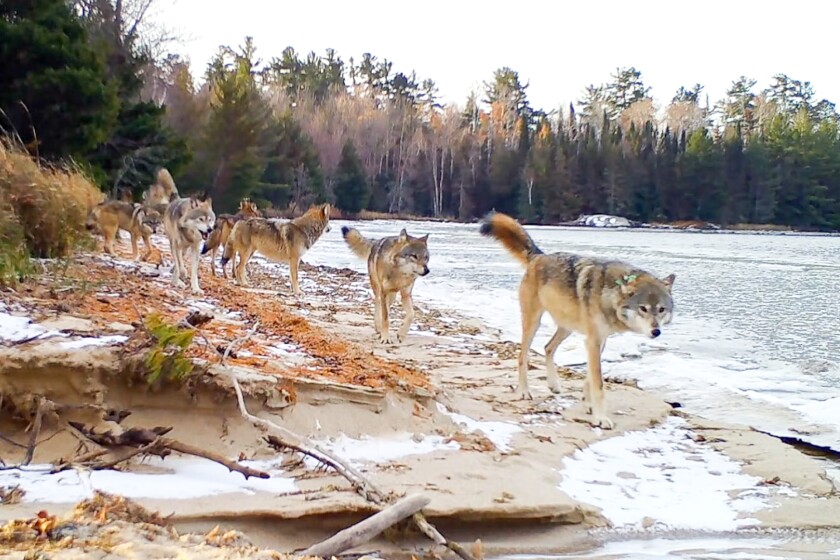
Half of the deaths among collared wolves at Minnesota’s Voyageurs National Park are caused by humans.
Members of the Shoepack Lake pack of wolves in Voyageurs National Park are captured on a trail camera placed by researchers in the Voyageurs Wolf Project. A new study at five national parks shows humans are a major cause of wolf deaths, mostly when wolves roam outside park boundaries.
DULUTH — Humans were the most frequent cause of death for research wolves that live in five of the nation’s most highly protected places, national parks, and those deaths led to long-term consequences for wolf packs, a new study has discovered.
Some 36% of collared wolves in the five parks included in the study died at the hands of humans, usually when they ventured just…
SWEETWATER COUNTY— The Sweetwater County Commission unanimously opposed a resolution during its meeting Tuesday that would have condemned coyote hunting contests in Sweetwater County.
Madhu Anderson, Founder of the Wyoming Wildlife Protection Group, presented the Commission with a resolution “opposing the indiscriminate killing of wildlife in the form of wildlife killing contests”.
The Wyoming Coyote Classic and the Wyoming Best of the Best tournaments that take place in Rock Springs are noted in the resolution, along with several other wildlife hunting contests offering prizes for the killing of bobcats, foxes, coyotes, and other predators.
Advertisement – Story continues below…
The resolution states that “the purposes and goals of many wildlife killing contests are profit or prizes, and not personal consumption, protection of property, or the ethic of conservation.”
It goes on to say, “wild carnivore species, including coyotes, foxes, and bobcats, are an…




 CBS Dallas
 Top Stories








 Top Stories







/cloudfront-us-east-1.images.arcpublishing.com/gray/U2GM7EMRDJOOPBRHK2NLP57D3I.jpg)



 Exposing the Big Game