PINEVILLE, La. (KALB) –The Rapides Parish Sheriff’s Office is investigating after a complainant claimed a Covert Hunter Camera was stolen from Pinehill Road in Pineville on January 12.
RPSO said a white man dressed in blue jeans, a camouflage shirt and brown boots, was captured on cellular deer camera footage. The man was carrying a black and gray pump action shotgun with a pistol stock. Once the image was captured, the cellular camera went missing.
The estimated value of the camera is $250.
If you have any information on this investigation, contact RPSO or Crime Stoppers.
Crime Stoppers is a private non-profit organization. Crime Stoppers IS NOT a law enforcement agency and DOES NOT conduct investigations. They never want your name. They just give you a…
The Washington Department of Fish and Wildlife is dedicated to preserving, protecting and perpetuating the state’s fish and wildlife resources, according to the agency’s webpage. (WDFW)
LEWISTON – A Washington hunting and conservation group said this week it intends to sue Gov. Jay Inslee for failing to maintain a balance of perspectives on the state’s Fish and Wildlife Commission.
Washingtonians for Wildlife Conservation charges that the governor, when selecting commissioners to serve on the nine-member panel, hasn’t followed the direction laid out in Washington code. The group said Inslee’s recent appointments to the commission have made decisions that harm hunters and some wildlife populations, and favor predators and anti-hunters.
“The commission is on solid footing with the environmental groups and the animal rights groups,” said the organization’s president Mark Pidgeon, of…
The Montana Department of Livestock requires hunters to obtain an aerial hunting permit to hunt predatory animals from aircraft. (Graphic: Montana Department of Livestock)
MISSOULA, Mont. —The Montana Department of Livestock requires hunters to obtain an aerial hunting permit to hunt predatory animals from aircraft.
Applicants for an aerial hunting permit must complete an application form prior to Jan. 31 and submit a fee.
Permits will be valid from Feb. 1 to Jan. 31.
The following information was released by the Montana Department of Livestock:
This is a Public Notice of requirement to obtain an aerial hunting permit to hunt predatory animals from aircraft.
Pursuant to MCA 81-7-501, a person, except an employee of the state, its subdivisions, or the federal government who is acting within the scope of the person’s employment, may not engage in the aerial hunting of predatory animals, as defined…
Dutch farms are feeling the squeeze from EU rules and need to make sweeping changes to the farm system – could a huge producer like the US follow suit?
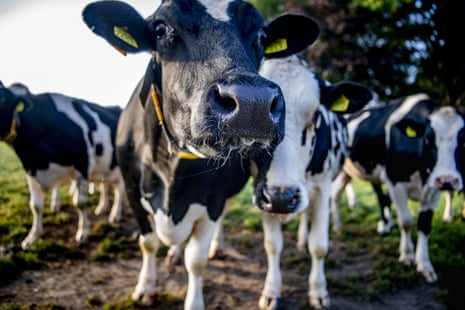
Cows in a meadow at a dairy farm in Zundert, the Netherlands. Photograph: Robin Utrecht/REX/Shutterstock
Ingrid de Sain is one of thousands of dairy farmers in the Netherlands who says she sometimes lies awake at night. Since a court ruling in 2019 which found the Dutch were breaking European environmental law, her farm of 100 cows in north Holland has been illegal.
Like the other 2,500-plus farmers whose environmental permission was suddenly invalid, she wants a future where she can earn a living and farm legally again.
The Netherlands is first to face questions scientists believe will soon come to all intensively farmed areas: how can we balance the needs of the environment with the way we farm and grow? Have we reached “peak meat”, like peak oil: so much livestock, so much local pollution, that the only sustainable future is in reduction? They’re questions the US, the world’s largest producer of beef, will also soon have to answer.
In November, the Dutch government announced the first part of a €24.3bn ($26.3bn) plan to buy out up to 3,000 farms and major industrial polluters near protected nature reserves – if necessary, through compulsory purchase, “with pain in our hearts”. It is hugely controversial and only initial outlines have been announced after a year of protests, tense negotiations and a report in October recommending buying out the top 500 or 600 polluters within a year.
The reason is that the emissions of ammonia, nitrogen oxides and nitrous oxide are damaging areas of unique, natural landscape known as Natura 2000 habitats, which the country is bound by EU law to protect. The government says this means reducing local nitrogen compound emissions from between 12% and 70%, including slashing the Netherlands’ 118 million farmed animals by 30% by 2030, according to Netherlands Environmental Assessment Agency projections.
Tjeerd de Groot, a member of the house of representatives in the Netherlands and agriculture spokesman for coalition party D66, advocates halving the numbers of pigs and poultry, raising fewer cows and grazing them on pasture, rather than importing grain and soy for feed. “Everywhere you look, there’s a problem with agriculture,” he said, citing the toll the resulting pollution has taken on biodiversity and water quality. “Yes, we have been a big exporter but now we are paying a big price in the environment.”
The production system of meat and dairy in the Netherlands can no longer be held at this level
Natasja Oerlemans, of the World Wide Fund for Nature Netherlands
Environmentalists believe the Netherlands needs to change all elements of its food system chain to provide a good income for different methods of farming. “All the signs are red,” said Natasja Oerlemans, head of the food team at the World Wide Fund for Nature (WWF) Netherlands. “The production system of meat and dairy in the Netherlands can no longer be held at this level. That’s been clear for years.”
All eyes are on the Netherlands, according to scientists who believe the world needs action to reduce livestock – rather than relying on voluntary pollution reduction or technological measures that may be unproven at scale.
“The major difference to previous measures is a reduction in livestock numbers,” said Dr Helen Harwatt, a senior research fellow at Chatham House and climate policy fellow at Harvard University. In 2019 she led a group of scientists calling for action to ensure livestock declines. “We tend to only see technological approaches to reducing nitrogen at the point of production or reducing leakage to the environment, rather than reducing the amount of agricultural production. It’ll be all eyes on the Netherlands to learn from this transition.”
Livestock – farmed both for meat and for dairy – have major environmental impacts, and Harwatt argues that reductions should be part of a broader green action. “Currently, the aspiration globally is to protect more land for biodiversity, reverse biodiversity loss, reduce greenhouse gas emissions, halt deforestation and increase livestock production,” she said. “There are currently far more livestock on the planet than wild animals, and more than three times the human population. Livestock production is forecast to continue increasing, as diets transition across the world to include more animal products. Something has to give and it shouldn’t be the climate or biodiversity.”
Countries such as Denmark and the US may soon face similar predicaments, according to Pete Smith, professor of soils and global change at Aberdeen University in Scotland. “We demonstrated last year that animal agriculture is responsible for 57% of greenhouse gas emissions from the food system,” he said. “It has a disproportionate effect on the climate. We have too many livestock for the climate to support, and it’s the intensity of farming that’s the issue. I’m not surprised the Netherlands is taking the lead as it has the biggest problem.”
The US, meanwhile, is the world’s largest producer of beef, chicken meat and cow’s milk, and is the second largest producer of pork. “If we compare foods in terms of their nutrient pollution impact per kilogram produced, nothing is higher than beef,” said Harwatt. “Two-thirds of all crop calories produced in the US are used for feed crops. But livestock production contributes less than 1% to US GDP, and at least twice as much food for humans could be produced on land currently used to grow feed crops for farmed animals.”
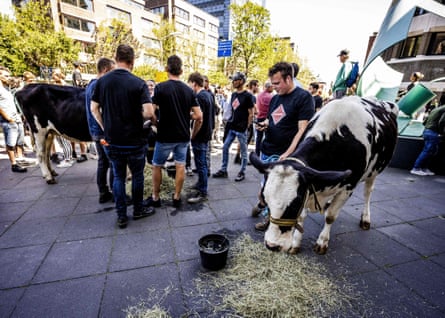
Farmers demonstrate with their cows outside the Dutch house of representatives on 28 June 2022. Photograph: Jeffrey Groeneweg/ANP/AFP/Getty Images
The US is set to produce 12,820,000 metric tons of beef and veal this year, according to the United States Department of Agriculture – a slight fall of 6% due to drought conditions, but with increased production of pork and chicken.
Animal farming has been linked to 17,900 US deaths a year from air-based pollution, and the United States Environmental Protection Agency says agricultural runoff is the leading cause of “water quality impacts to rivers and streams, the third leading source of lakes and the second largest source of impairments to wetlands”. One example is the Mississippi River.
Dr Matthew Hayek, assistant professor in environmental studies at New York University, advocates deciding a point of “peak livestock” and aiming for reduction, rather than trusting climate mitigation strategies such as seaweed additives or manure digesters. “They don’t address part of the problem and their technical efficiency hasn’t been shown at levels of scale – especially when you compare with just producing and consuming less,” he said.
“In the United States, in midwestern states especially, there are still way higher levels of nitrogen concentration and ‘impaired waters’ than are federally allowed. But states can carve out exemptions, and this is what has been done across Iowa and a lot of corn- and meat-heavy states. There’s just not the legal mechanisms or social pressure to address them – especially given you have so much social and regulatory capture by the agricultural industries.
“We also have a certain amount of nitrogen pollution that is ‘allowed’. The way that we deal with a lot of ‘point source’ pollution from industrial animal farming is by spreading it out over fields and miraculously turning it into non-point source pollution, which can’t be strictly regulated,” he added.
Hayek believes “soft” policies such as vegan-by-default menus in New York City hospitals could be combined with local regulation, like the 2010 “total maximum daily load” limit to improve water quality in Chesapeake Bay – as well as increasing public awareness. “Often, we are not even choosing to eat meat; we are choosing because we don’t recognise that there’s a choice not to eat meat,” he said. “We’re also not really combining the micro scale with the macro scale in our regulatory frameworks. We’re looking at one farm or one field, but we aren’t asking the question: is that nitrogen load in that watershed higher than that watershed can handle?
In the small, densely populated Netherlands, it might seem easier to address “macro” policy in a country of 17.8 million people.
But political action here is fraught with conflict, competing interests, anger and distrust.
Farmers complain of hanging in uncertainty for years; say pollution sources such as aviation, road travel and industry are scarcely addressed; and assert their sector has made more reductions than any other. “People in the countryside have been innovating for 30 years to reduce nitrogen – there’s no other sector that has done as much,” said Kees Hanse, a farmer and windfarm owner in Zierikzee who is standing in Zeeland elections for the growing BBB Farmer-Citizen Movement. “We don’t want to get ever bigger but we will continue to innovate and keep trying to create safe food resources for people. Nitrogen reductions are not about buying up farmers. It should come from industry, air traffic, shipping, car movements.”
Farmers always followed the rules. If I could make ends meet with 50 cows, why would I milk 100?
Dairy farmer Ingrid de Sain
Meanwhile the idea of suggesting the Dutch should eat less meat was so controversial that it was quietly removed from a 2019 climate awareness campaign by a former agriculture minister.
Some believe that a nitrogen pricing system, part of the new proposals, will help.
“Farmers haven’t done anything wrong: they have just done what the economy dictates,” said MP de Groot. “Because there’s no pricing of pollution, food is too cheap. The damage has been counted by an institute at €7bn a year, in the Netherlands. You should [monetise] that – and then the economy will change.”
Environmentalists like Oerlemans call for scrutiny of other parts of the food chain – including banks and feed producers – as well as help for farmers to transition to better-paid, lower-intensity farming plus services such as nature development, flood plain management and carbon sequestration.
But for dairy farmers like de Sain – one of those the government wants to legalise by making “peak polluters” stop – certainty cannot come soon enough. “Farmers always followed the rules,” she said. “If I could make ends meet with 50 cows, why would I milk 100?”
A family’s dog tragically lost its life while out in the woods with its owner … because we’re told a hunter accidentally mistook it for a coyote and shot it.
Jennifer Heller, owner of 8-year-old malamute Hunter, shared the loss of her pup on Facebook … saying her husband Chris put reflective collars and harnesses on their dogs and took them to a “very commonly used walking path by our house” in Berks County, PA.
While there, she says Chris unleashed Hunter but kept him close — eventually coming across a group of hunters. After finding out there was an extension on hunting season, she says Chris went to go leash up their dog … but claims it was shot before he could get to him.
Jennifer says her husband yelled for help and they loaded Hunter in a truck and drove like crazy to get…
Scientists say phenomenon coupled with growing climate crisis likely to push global temperatures ‘off the chart’
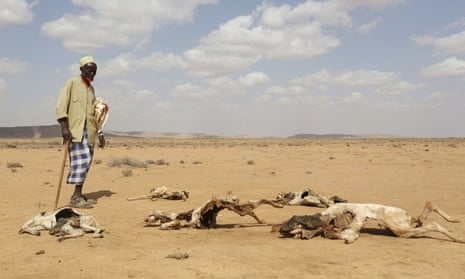
A man looks at the carcasses of animals that died due to an El Niño-related drought in southern Hargeisa, Somaliland, in April 2016.Photograph: Feisal Omar/Reuters
The return of the El Niño climate phenomenon later this year will cause global temperatures to rise “off the chart” and deliver unprecedented heatwaves, scientists have warned.
Early forecasts suggest El Niño will return later in 2023, exacerbating extreme weather around the globe and making it “very likely” the world will exceed 1.5C of warming. The hottest year in recorded history, 2016, was driven by a major El Niño.
It is part of a natural oscillation driven by ocean temperatures and winds in the Pacific, which switches between El Niño, its cooler counterpart La Niña, and neutral…
In this photograph taken on January 10, 2023 French truffle hunter Anne-Marie Pouzergues shows a basket of truffles to her dog in the Dordogne countryside near Brantome, southwestern France.
Truffle foragers in Italy have long sought to get rid of competition in search of “black gold.”
Ruthless hunters have resorted to dropping poison-laced treats to tempt truffle-sniffing dogs.
Police and locals are trying to crack down on the deadly poisonings, according to reports.
Top editors give you the stories you want — delivered right to your inbox each weekday.Email address
By clicking ‘Sign up’, you agree to receive marketing emails from Insider as well as other partner offers and accept our Terms of Service and Privacy Policy.
While truffle-sniffing dogs in the rolling hills of Italy sniff out earthy treasures worth over $4,000 per kilogram, their owners are on the lookout for something deadly lurking in the brush: poisoned treats, laced with snail bait and strychnine, intended for their specially-trained pooches.
Laced hot dog pieces and bits of meatball are tossed into the wooded hills by competitive foragers aiming to injure or kill the trained dogs and prevent their handlers from being able to find more truffles, according to reports by The New York Times and Wall Street Journal.
Rare Italian truffles are in short supply due to climate change and the challenges of foraging. The most sought-after varieties can cost upwards of $5,000 a pound and a trained truffle-sniffing dog with a high earnings potential can cost owners upwards of $8,500.
“It’s all about getting rid of the competition,” The Wall Street Journal reported Saverio Dogliani, a 57-year-old truffle hunter whose dog, Floki, has been poisoned twice, said.
French truffle hunter Anne-Marie Pouzergues (C) digs the ground after her dog found some truffles, in the Dordogne countryside near Brantome, southwestern France on January 10, 2023.
The poisoned treats claim the lives of multiple dogs and wildlife such as deer and foxes, each year. The Wall Street Journal reported one vet in the town of Alba treats between eight and 10 poisoned truffle dogs per year, though the actual number of cases is likely much higher and sometimes impacts family dogs — not just those in search of the truffles.
Martina Ercoli’s chocolate lab, Brando, was killed earlier this month after she said he took a “poisoned bite” from the ground. The dog died in Ercoli’s brother’s arms within half an hour. She posted on Facebook that the Italian police told her he was the third dog that week to be poisoned by “these criminals, presumably people who hunt truffles and spread poisonous morsels to kill each others’ dogs in war.”
A group of truffle hunters wearing camouflage searched the area where Brando was poisoned, hoping to rid the brush of leftover poison. Among them was Antonio Morasca, who told The New York Times about the death of his own dog, Thor, who this month also ate a bit of poisoned hot dog that had rolled under his car.
“I took it out of his mouth, but he ran off — he loved to run off — and got another one in his mouth,” Morasca told The New York Times. “He started trembling. We got him back to the town, and he started foaming. We made him eat salt to vomit, but the whites of his eyes had turned red. His legs stretched out, and he became rigid. He was dead before we got to the clinic. A half an hour.”
Truffle hunter Jean-Luc Monteillet shows a black truffle found by one of his dogs during a search through the oaks of the Domaine of Montine in Grignan, southern France on December 23, 2022.
Italy’s national police have dispatched poison-detecting dogs to the woods of Alba in hopes of eliminating the source of the poisonings, which regularly claim the lives of truffle dogs in the region, according to The Wall Street Journal.
“It’s getting worse,” Agent Emanuele Gallo told The Wall Street Journal. “There is more competition, and unfortunately illicit means are being used more.”
Locals, fed up with the risks to their loved ones, have taken the hunt for the poisoners into their own hands. Belardo Bravi, a truffle hunter whose dog Bella was nearly killed by poison over a decade ago, installed cameras on his truck and joined the informal group of truffle foragers hunting for those responsible.
“When I catch him and see him in the piazza,” Belardo Bravi told The New York Times. “I’ll break his little hands.”
NATCHITOCHES, Parish – A Rapides Parish man was injured in a hunting accident in south Natchitoches parish on Saturday.
According to authorities the 67-year-old fell out of a tree stand. He was airlifted to a Shreveport hospital with what are described as moderate injuries.
Louisiana department of wildlife and fisheries agents are investigating the accident.
BALIJAN, Jan 15: In a freak accident, a man shot at his father-in-law in a case of mistaken identity with a bore gun while on a hunting trip causing him serious injuries on Saturday. SDPO Balijan Maga Tago informed that as per the report received, at around 0800hrs to 0900hrs one Paniram Phangsu, resident of Helemsapori, District Biswanath, Assam was shot by an unknown person at Helemsapori Reserve forest. Upon getting the information, police followed up on the matter and found that the victim was shifted to RK Mission hospital, further he was referred to TRIHMS for further treatment. The police team led by SDPO Balijan reached TRIHMS and enquired from the family members and took update of the victim’s condition. During the course of the inquiry it was found that the victim and his son-in-law Panye Takar of Dariya Hill went…
CLEARWATER, Fla. — SeaWorld Orlando said a dolphin that suffered injuries from a crab trap in Clearwater has made remarkable progress.
In July, lifeguards and Clearwater Fire and Rescue located the dolphin near Pier 60. He suffered injuries from a crab trap and was unresponsive. Rescuers could not locate his mother.
“A lifeguard noticed this object kind of bouncing in the waterways and went out to see what it was,” said Ashley Killo, a SeaWorld Animal Care Specialist.
NOAA officials deemed the animal “unreleasable” due to its age. The dolphin could not communicate or hunt for its own food.
Ashley Killo, a SeaWorld Animal Care Specialist, said the dolphin continued to hit major milestones over the past six months.
“He came to us roughly under 60 pounds. He’s now over 100,” said Killo. “You can still see some of the scaring on the fluke itself where he’s missing part of it and then of course, you can still see some of the indentations where the line was wrapped around his peduncle so the part that leads to his flukes.”
The dolphin named “Ridgeway” is able to swim once again. When he first arrived at SeaWorld for care, he was in critical condition and was unable to swim. He drinks special formula from a bottle. Once he starts eating fish, the bottle feeds will gradually be reduced.
Ridgeway has been moved to a dolphin nursery pool in the park. He socializes with other dolphins, including adult females and also plays with other calves close to his age.
“He was put in our dolphin nursery pool in the park for anyone to see. He’s out there. He’s swimming around. He has teamed up with some of our older females, which is exactly what dolphins are going to do,” said Killo.
Killo said Ridgeway’s story serves as a reminder for people to pick up their trash like fishing lines and crab traps.
“If you’re fishing, don’t leave your fishing line, don’t cut your fishing line. If you have crab traps, make sure you’re coming back for them. It’s all of these things humans can do that can make a world of difference for these animals,” said Killo.


/cloudfront-us-east-1.images.arcpublishing.com/gray/QZ5DSCNUPVEQXMZZAAANX7RUYY.png)









 Exposing the Big Game
