




Sun., March 12, 2023https://www.spokesman.com/stories/2023/mar/12/the-hired-gun-of-the-livestock-industry-this-feder/


1 of 4
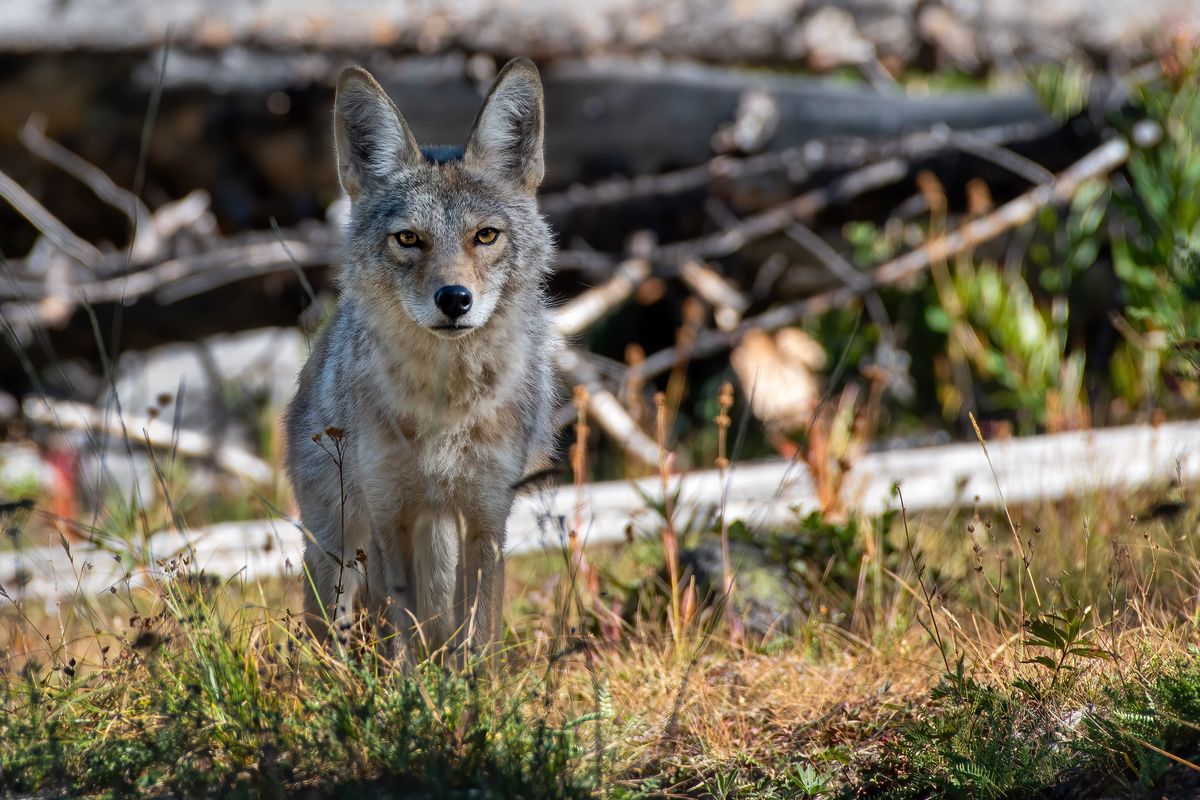
A coyote pauses on a hiking trail Sept. 4 in the Pasayten Wilderness near Loomis, Wash. Wildlife Services killed 64,131 coyotes in 2021, including 614 in Washington. (Colin Tiernan / The Spokesman-Review)
By Colin Tiernan colint@spokesman.com(509) 459-5039
Wildlife Services kills animals for a lot of different reasons — more than 300 reasons, in fact.
Starlings can become targets for eating feed at dairies, nesting in power lines and hurting native species.
Wildlife Services lists 94 different reasons for killing and dispersing beavers.
Beavers can chomp down trees wanted by loggers. Their dams can cause water to run over roads, flood soybean fields and block irrigation ditches.
More than 250 badgers died in 2021 for being in the wrong places. Wildlife Services often kills or disperses them for digging in pastures, hayfields, cemeteries and golf courses.
They shot them down from the sky.
It happened two winters ago in Adams County, but the federal government won’t say where. A pilot and gunner did it from a plane while flying low over wheat stubble on the Palouse or some desolate expanse in the Scablands.
The winds would have been calm. It was cold that day, around freezing, according to National Weather Service records. They could have started early in the morning, when wildlife is out and about and easy for a sharpshooter to see.
Exactly who wanted the animals dead and how much the killing cost is a mystery, but on Feb. 24, 2021, a little-known agency within the U.S. Department of Agriculture killed 67 coyotes to protect cattlemen’s herds.
Wildlife Services kills and disperses animals. It was founded to aid ranchers and farmers but its role has grown over the decades. Today, the agency also prevents birds from hitting airplanes, rodents from damaging buildings and predators from eating young salmon, to list a few of its responsibilities.
In its own words, Wildlife Services provides “federal leadership and expertise to solve wildlife conflicts to allow people and wildlife to coexist.”
Many livestock producers say Wildlife Services helps them stay in business. Predators cost ranchers more than $200 million in losses every year, according to the Department of Agriculture.
“When you talk about dollars that predators cost us, personally for me it’s huge,” said Dr. Jill Swannack, a veterinarian and rancher who serves as president of Washington State Sheep Producers.
Wildlife Services didn’t make anyone available for an interview, but public affairs specialist Tanya Espinosa said in an email that the agency’s methods are “biologically sound, environmentally safe and socially acceptable.”
Conservationists tend to disagree.
Brooks Fahy, executive director of Predator Defense, has spent the past 30 years trying to dismantle Wildlife Services.
He learned about the agency while running a wildlife hospital in Oregon. People kept bringing him pets that had been caught in Wildlife Services’ traps or poisoned by M-44 devices – often referred to as “cyanide bombs.”
Fahy said Wildlife Services’ methods are scientifically unsound, inhumane and little more than a taxpayer-funded subsidy for agriculture.
“It’s a federal program that, on behalf of ranchers, kills predators to supposedly protect livestock,” he said.
Carter Niemeyer, a wolf expert and biologist who spent 26 years as a Wildlife Services trapper and supervisor, said some of the agency’s work is valuable. Unlike Fahy, he has no issue with killing specific animals that repeatedly cause problems.
But Niemeyer also calls Wildlife Services “the hired gun of the livestock industry.”
“We just spend way too much time overkilling carnivores,” he said. “I would term it needless killing. That’s what it is.”
Wildlife Services has an almost $200 million annual budget and kills nearly 2 million animals every year, including tens of thousands in Eastern Washington.
Yet despite its macabre work, few members of the general public know the agency exists.
Sristi Kamal, deputy director of the Western Environmental Law Center, said Wildlife Services is one of the most opaque agencies in the federal government.
“They are shrouded in mystery,” she said.
American governments have been sponsoring wildlife killing for agriculture since the 17th century.
The Massachusetts Bay Colony in 1640 passed a bounty law that promised hunters 40 schillings per wolf. Dozens of bounties, for various species, still exist today. The Foundation for Wildlife Management – funded in part by the Idaho Department of Fish and Game – reimburses expenses for wolf hunters.
The federal government started killing animals on its own in the early 1900s. Different agencies have had the job over the years, and they’ve undergone occasional rebrands. Before 1997, Wildlife Services was called Animal Damage Control.
Fahy said the renaming was an attempt to keep the agency out of the public eye.
“If you asked 99.99% of the public what Wildlife Services was, they wouldn’t have a clue,” he said. “And if they were to guess, they would guess it’s an agency that helps wildlife.”
Even though it keeps a low profile, Wildlife Services receives substantial taxpayer funding. In 2021, the most recent year with data available, the office had a $189 million budget.
Details on that budget are scarce.
Approximately 46% of the funding came directly from the federal government. The rest comes from other federal agencies, state and local governments and private businesses.
Wildlife Services doesn’t offer much detail on where its money goes, either. It spent $76 million on human health and safety, $53 million on agriculture, $37 million on property and $23 million on natural resources in 2021.
While pinpointing Wildlife Services’ spending is a challenge, the bulk of its budget pays for killing and scaring away wildlife.
The agency stresses that it relies on nonlethal approaches whenever possible. In 2021, it dispersed 25 million animals, including 10.6 million starlings, 3.5 million ring-billed gulls and 1.5 million lesser snow geese.
Wildlife Services uses a lot of loud and bright dispersal tools. Firing blanks and setting off pyrotechnics – firecracker-like devices – are common techniques. Other options include lasers, car horns, waving arms, paintballs, dogs, drones and human effigies – aka scarecrows.
Fahy and Kamal support nonlethal strategies, but they and many conservation groups say Wildlife Services should do more to avoid indiscriminate killing.
In 2021, the agency killed 1.8 million animals nationwide and 165,616 in Washington.
More than half of all animals killed throughout the U.S. were invasive species. Poisoning starlings and shooting feral pigs, two species that wreak havoc on North American ecosystems, doesn’t inspire much public outcry.
But wildlife advocates strongly oppose the killing of native animals.
For instance, Wildlife Services in 2021 killed more than 64,000 coyotes, 400 black bears and 24,000 beavers. Those figures include 614 coyotes, 32 black bears and 119 beavers in Washington.
Kamal and Fahy generally oppose the killing of carnivores, which is often done to decrease predation on calves and lambs. Predators control prey populations, they point out, and removing them disrupts native ecosystems.
Conservationists, though, acknowledge the necessity of some lethal removals.
Keeping birds away from airports is one of Wildlife Services’ less controversial jobs, even though it can entail killing uncommon native species.
For example, the agency killed two badgers in 2021 for Fairchild Air Force Base. Wildlife Services also killed four long-billed curlews – chihuahua-sized birds with preposterously long bills – for threatening aviation safety at an undisclosed location in Grant County.
Steve Holmer, vice president of policy for the American Bird Conservancy, said his organization doesn’t view lethal removals at airports as “a conservation concern.”
“Aviation safety is a real issue,” he said.
On Jan. 15, 2009, an Airbus 320 took off from LaGuardia Airport and began its journey to Charlotte, North Carolina.
A few minutes after takeoff, the Airbus hit a flock of Canada geese. The plane’s engines sucked in some of the birds and shut down, leaving the jet without power at 2,800 feet.
Capt. Chesley “Sully” Sullenberger III landed the plane safely in the Hudson River and all 155 passengers survived. “The Miracle on the Hudson” made Sullenberger a national hero and inspired a Clint Eastwood film, starring Tom Hanks.
But for pilots, the incident is an important reminder of the danger birds pose to aircraft.
Wildlife Services works with hundreds of airports, including the Spokane International Airport and Fairchild Air Force Base, to avoid bird strikes and other wildlife collisions.
The Spokane International Airport didn’t respond to requests for comment, but airmen at Fairchild said keeping wildlife away from tankers and helicopters is critical.
“Anything that is going to hit the aircraft is a hazard,” said Capt. Brad Daniel, a KC-135 pilot and flight safety officer for the 92nd Air Refueling Wing. “Even small birds – at high speeds and hitting the right component – could be a threat.”
Maj. Brett Neilson, a helicopter pilot and flight safety officer with the 36th Flight Rescue Squadron, said hitting a bird can be catastrophic for a chopper.
“You take a goose in your lap at 100 mph, that could be fatal,” he said.
The best way to avoid collisions is to make the base inhospitable for birds, Daniel said. The Air Force tries to limit pools of standing water and mow grass to discourage nesting.
Still, Wildlife Services kills thousands of birds every year for airports. The agency in 2021 killed 38 animals for the Spokane International Airport and 328 for Fairchild Air Force Base.
Fahy said he understands that bird strikes are a real safety issue, but argues Wildlife Services could do more to keep wildlife away from airports.
Daniel and Neilson said lethal removals are unavoidable when other tactics fail and praised Wildlife Services.
“For our purposes,” Daniel said, “they’ve been amazing.”
Figuring out where Wildlife Services kills animals isn’t always easy.
In Freedom of Information Act requests, the Department of Agriculture redacts anything that could reveal the location of an agricultural operation. The department says it can’t release addresses because federal law prohibits sharing locations of farms or ranches that provide information “in order to participate in programs of the Department.”
That makes it hard to know precisely who uses Wildlife Services. Only a few addresses, often belonging to airports, show up in public records.
The Grant County Public Utility District’s address is one of the few that pops up in Eastern Washington. The electricity provider hires Wildlife Services to disperse and kill predators that eat spring chinook salmon and summer steelhead.
The National Oceanic and Atmospheric Administration requires the Grant County Public Utility District to protect those endangered species while they make the 58-mile trip on the Columbia River between the Priest Rapids and Wanapum dams, northwest of the Hanford Nuclear Site.
“It’s our task to enhance or improve their survival through our section of the river as they migrate to the ocean,” said Tom Dresser, the public utility district’s fish and wildlife manager.
Passing through dams and turbines leaves fish disoriented and vulnerable. Thousands of young salmon and steelhead get picked off in tailraces, the sections of river immediately following a dam.
Gulls, common mergansers and double-crested cormorants are all adept at fishing for salmon and steelhead. Wildlife Services kills hundreds of those birds in Washington annually.
Northern pikeminnows, a native species that has flourished since the installation of dams throughout the Columbia River basin, eat millions of salmon and steelhead while the fish swim to and from the Pacific Ocean. Wildlife Services caught and killed more than 75,000 pikeminnows in 2021, all in Washington. The Bonneville Power Administration even funds a pikeminnow bounty program.
Dresser said Wildlife Services tries to scare away birds when possible. The public utility district has stretched wires above the tailraces as well, in an attempt to keep birds out.
Killing native birds to bolster salmon populations has spawned legal fights, however. Fahy said he’s “absolutely against” killing one native species for the sake of another.
Dresser said some lethal removals are needed to aid endangered fish.
“We’ve seen predation rates as high as 15%, 18% of our tagged fish as part of research studies,” he said. “It can be a very large percentage of the population without some type of active and passive control efforts.”
Wildlife Services’ detractors mostly criticize its efforts to help agriculture, especially the livestock industry.
The agency kills predators that can eat chickens, lambs, calves and other farm animals. In 2021, the agency killed more than 600 bobcats, 300 wolves and 200 cougars.
In the Evergreen State, cougars and wolves are managed by the Washington Department of Fish and Wildlife. Fish and Wildlife has killed eight wolves and 114 cougars in the past two years.
Wildlife advocates emphasize that carnivores are an essential component of healthy ecosystems. Removing them can cause prey populations, like deer and rodents, to grow out of control.
“It creates more problems in the long run,” said Timothy Coleman, director of the Kettle Range Conservation Group.
Wildlife Services is probably best known for killing coyotes.
It kills tens of thousands of them every year in more than a dozen ways. Aerial gunning from a small plane, with shotguns, is the most common technique.
Catching coyotes in neck snares, shooting them from the ground and poisoning them with cyanide capsules are also standard methods.
While the job can be grisly, many ranchers say it helps keep them afloat.
The Washington Cattlemen’s Association declined to comment but Swannack, who raises sheep near Lamont, in Whitman County, said Wildlife Services is “a huge boon and benefit to the sheep industry.”
Swannack said predation is her second-biggest cost after feed. Coyotes attacking lambs is a major problem, she said.
“Our take on coyotes is they’re fine as long as they don’t eat sheep,” she said.
Swannack said ranchers do what they can to avoid killing predators. Fencing, flashing lights and loud noises can help. Guard dogs are effective. Some sheep producers will place a llama or donkey with their herds as a protector.
If none of that is enough, Wildlife Services is needed, Swannack said.
“When we can’t handle it ourselves, we can hire them to help us get rid of problem animals,” she said.
Jami Beintema, who has 40 sheep on 33 acres in Ellensburg, said Wildlife Services might have saved her flock last spring when she and her husband couldn’t figure out what was killing their ewes.
“I lost five registered, beautiful, very, very pregnant ewes in a really short time frame,” she said.
Beintema said she did her best to protect her sheep. She put them in a pen at night. She had cameras and a motion detection system that shined a spotlight on predators when they got close. But they still found a way to get in.
A Wildlife Services agent found the weak point in Beintema’s pen, trapped a female coyote and killed it. Beintema hasn’t lost any animals since.
“I don’t kill coyotes just because I see one,” she said. “We’ve killed one in 20 years.”
Kamal disagrees that killing predators is necessary, especially when Wildlife Services isn’t targeting a specific problem animal. She also noted that the agency only puts a small fraction of its budget toward expanding its nonlethal program.
Espinosa said Congress since 2020 has provided dedicated dollars for nonlethal approaches. In the past three years, Congressional funding for nonlethal methods has gone from $1.38 million to $4.55 million.
Wildlife advocates argue killing predators is an ephemeral solution. Studies have shown reducing populations causes female coyotes to produce more pups.
“Killing coyotes just makes more coyotes,” said Samantha Bruegger, executive director of Washington Wildlife First. “We’re killing coyotes to kill coyotes, we’re not killing them for long-term solutions.”
Fahy said if producers lose livestock, they should invest more heavily in sheds, guard dogs and other preventative measures. Taxpayers shouldn’t have to subsidize wildlife killing, he said.
“This isn’t rocket science,” Fahy said. “If you’re doing it the right way, you’re not going to have a problem.”
Swannack responds by noting that she pays Wildlife Services directly for its work. She also says criticizing Wildlife Services for being taxpayer-funded is a weak argument.
“Why does the government pay for anything?” she asked. “We have a government for the betterment of the people. I think it would be easy to argue that having a food supply is to the betterment of the people.”
Niemeyer, who helped lead the U.S. Fish and Wildlife Services’ wolf reintroduction effort in the Rockies, said he believes killing predators is frequently “senseless.” Ranchers lose far more animals to disease and bad weather than carnivores, he said.
Looking back on his career with Wildlife Services, Niemeyer said he was “misguided” and thought he was making the world a better place by removing predators.
“I’ve seen the error of my ways,” he said.
He doesn’t think the agency is going anywhere.
“People have been going after Wildlife Services since the ’50s and ’60s,” Niemeyer said. “Cats have nine lives, Wildlife Services has hundreds.”
March 13, 20235:06 AM ET
https://www.npr.org/2023/03/13/1162042220/climate-change-sierra-nevada-zombie-forests

Young giant sequoia trees are seen during a prescribed pile burning on Feb. 19 in Sequoia National Forest. Researchers say 20% of Sierra Nevada conifers are a mismatch with their climate.
Mario Tama/Getty Images
Some of the tall, stately trees that have grown up in California’s Sierra Nevada are no longer compatible with the climate they live in,new research has shown.
Hotter, drier conditions driven by climate changein the mountain range have made certain regions once hospitable to conifers — such as sequoia, ponderosa pine and Douglas fir — an environmental mismatch for the cone-bearing trees.
“They were exactly where we expected them to be, kind of along the lower-elevation, warmer and drier edges of the conifer forests in the Sierras,” Avery Hill…
View original post 410 more words

Dave Golowenski
Special to The Columbus Dispatch
AD
0:15
SKIP
https://imasdk.googleapis.com/js/core/bridge3.562.0_en.html#goog_952217680

Americans with deep pockets are known to jet to Honduras for the local fishing. Bonefish, tarpon and marlin make for an attractive menu, although an exotic Central American location and easy rum surely add to the appeal.
Not widely considered, on the other hand, is the question of how many Hondurans come north to the United States for the hunting and fishing. The guess is anyone keeping count might not have to count high.
Honduras is home to things not readily found in the United States – tropical jungles being one, ancient ruins being another. But one temptation found in the states and not in Honduras is the bald eagle, the designated U.S. national bird although Ben Franklin thoughtwild turkeysmight make a superior emblem.
“I wish the bald eagle had not been chosen as the…
View original post 350 more words
SHARE: https://kslx.com/da-ya-think-im-angry-rod-stewart-lambasts-vile-trophy-hunting-in-bid-to-outlaw-the-practice/

IAN WEST/PA IMAGES VIA GETTY IMAGES
Rod Stewartis rallying to bring an end to trophy hunting, which he called“savagely cruel and senseless.”
The Mirrorreports Sir Stewart signed onto the publication’s campaign to ban the practice in the U.K. and bar hunters from bringing their killsback home. The effort was launched aheadof a critical vote on a potential law change in thecountry on Friday.
When supporting the outlet’s bid, Stewart said in a statement, “We are in danger of losing some of the world’s most magnificent wildlife because of the selfishness of ‘trophy’ hunters.”
“How can this so-called sport be considered a pleasure or even fair when the opposition is unarmed?” he continued, adding that it’s “time to stand up for animals.”
Stewart’s remarks were echoed byLiam GallagherofOasis. “Trophy hunters are spoilt little brats; haven’t they got enough toys to…
View original post 110 more words
https://phys.org/news/2023-03-scientists-substance-life-earth.html
A team of Rutgers scientists dedicated to pinpointing the primordial origins of metabolism—a set of core chemical reactions that first powered life on Earth—has identified part of a protein that could provide scientists clues to detecting planets on the verge of producing life.
The research, published in Science Advances, has important implications in the search for extraterrestrial life because it gives researchers a new clue to look for, said Vikas Nanda, a researcher at the Center for Advanced Biotechnology and Medicine (CABM) at Rutgers.
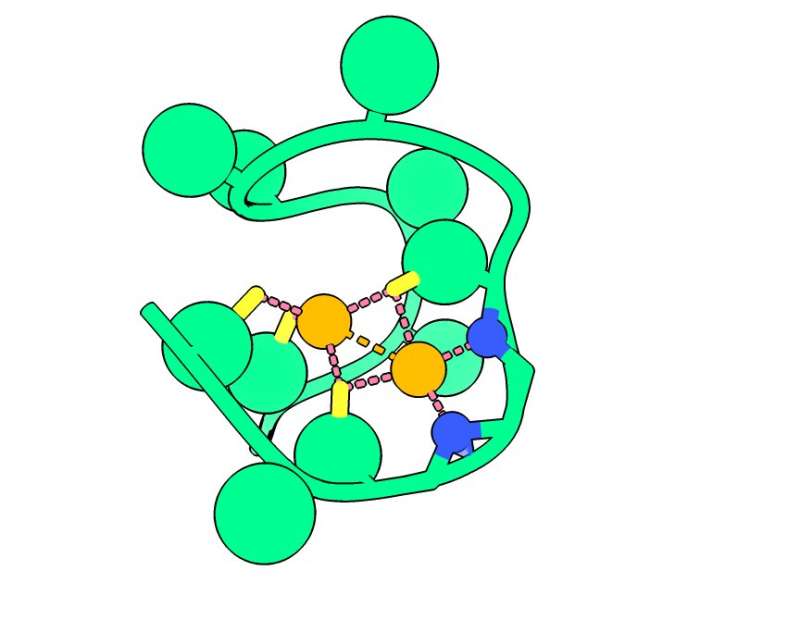
Based on laboratory studies, Rutgers scientists say one of the most likely chemical candidates that kickstarted life was a simple peptide with two nickel atoms they are calling “Nickelback” not because it has anything to do with the Canadian rock band, but because its backbone nitrogen atoms bond two critical nickel atoms. A peptide is a constituent of a protein made up of a few elemental building blocks known as amino acids.
“Scientists believe that sometime between 3.5 and 3.8 billion years ago there was a tipping point, something that kickstarted the change from prebiotic chemistry—molecules before life—to living, biological systems,” Nanda said. “We believe the change was sparked by a few small precursor proteins that performed key steps in an ancient metabolic reaction. And we think we’ve found one of these ‘pioneer peptides.'”
The scientists conducting the study are part of a Rutgers-led team called Evolution of Nanomachines in Geospheres and Microbial Ancestors (ENIGMA), which is part of the Astrobiology program at NASA. The researchers are seeking to understand how proteins evolved to become the predominant catalyst of life on Earth.

When scouring the universe with telescopes and probes for signs of past, present or emerging life, NASA scientists look for specific “biosignatures” known to be harbingers of life. Peptides like nickelback could become the latest biosignature employed by NASA to detect planets on the verge of producing life, Nanda said.
An original instigating chemical, the researchers reasoned, would need to be simple enough to be able to assemble spontaneously in a prebiotic soup. But it would have to be sufficiently chemically active to possess the potential to take energy from the environment to drive a biochemical process.
To do so, the researchers adopted a “reductionist” approach: They started by examining existing contemporary proteins known to be associated with metabolic processes. Knowing the proteins were too complex to have emerged early on, they pared them down to their basic structure.
After sequences of experiments, researchers concluded the best candidate was Nickelback. The peptide is made of 13 amino acids and binds two nickel ions.
Nickel, they reasoned, was an abundant metal in early oceans. When bound to the peptide, the nickel atoms become potent catalysts, attracting additional protons and electrons and producing hydrogen gas. Hydrogen, the researchers reasoned, was also more abundant on early Earth and would have been a critical source of energy to power metabolism.
“This is important because, while there are many theories about the origins of life, there are very few actual laboratory tests of these ideas,” Nanda said. “This work shows that, not only are simple protein metabolic enzymes possible, but that they are very stable and very active—making them a plausible starting point for life.”
The National Weather Service said the next torrent could exacerbate the severe flooding that overwhelmed the area in the past few days
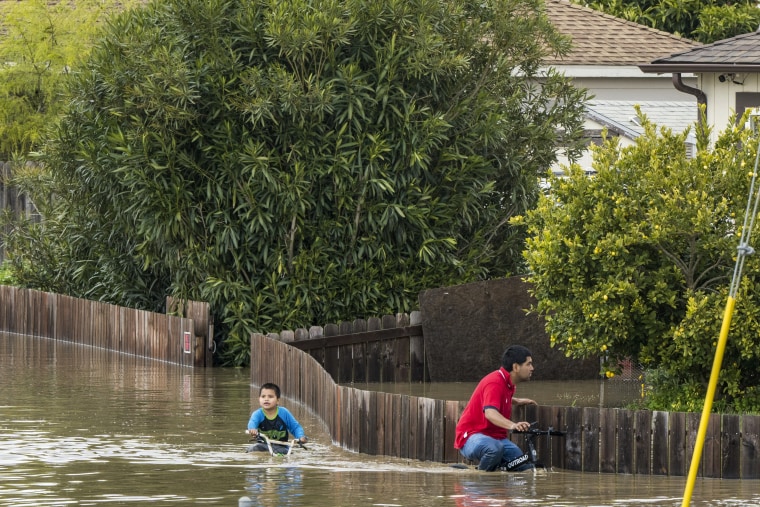
A boy and a man ride bicycles through floodwaters in Watsonville, Calif., on March 11, 2023.Nic Coury / AP
Link copiedSAVECreate your free profile or log in to save this article
March 12, 2023, 9:01 AM PDT
ByAssociated Press
WATSONVILLE, Calif. — Wet, miserable weather continued across huge swaths of California on Sunday as an atmospheric river that caused major flooding flowed eastward and makes way for another onslaught of rain and snow that could yet again pummel the beleaguered region as soon as Monday night.
The National Weather Service said the next torrent could exacerbate the severe flooding that overwhelmed the area in the past few days, including a levee failure that prompted widespread evacuations Saturday in farming communities near the state’s Central Coast.
Across Monterey…
View original post 626 more words
The snake-like species is under threat from smugglers, the climate crisis and Europe’s appetite for traditional dishes
Ashifa Kassamin Madrid
@ashifa_kSun 12 Mar 2023 06.00 EDT
It was billed as a once-in-a-lifetime experience; an exclusive meal created by five of the world’s top chefs in exchange for actor Robert De Niro’s help in promoting Madrid Fusion, a global gastronomy summit. As the cameras clicked and flashbulbs popped, the chefs rolled out a 16-course meal studded with caviar, red prawns and black truffle.
The initiative waswidely applauded.But the inclusion of two dishes featuring eel – a ubiquitous ingredient across much of Europe – sparked consternation in some quarters.
“I was surprised,” said Miguel Clavero Pineda, a senior scientist at Spain’s National Research Council. “It’s like there is no awareness that this is a species on the brink of extinction.”
The ecologist is part of a…
View original post 805 more words
idfg-jbrower
https://idfg.idaho.gov/article/slow-down-stay-alert-and-give-wildlife-brake-you-drive-winter
Friday, March 10, 2023 – 1:15 PM MST
With more snow in the higher elevations, big game herds throughout the state migrate to lower elevation winter ranges and cross Idaho’s highways and roads.
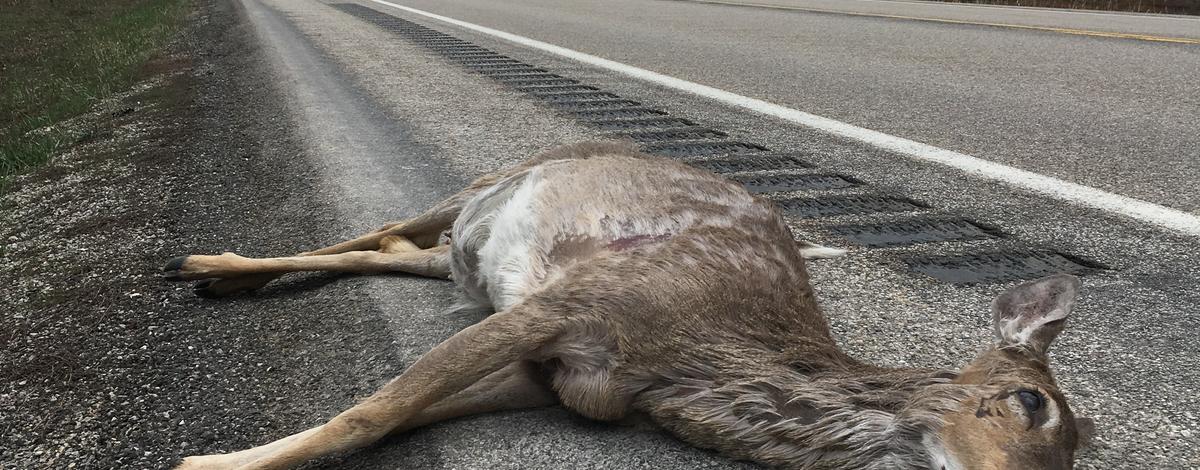
Winter is already tough for deer, elk and other big game animals, and being near busy roads and highways can be deadly, so drivers are asked to keep a sharp eye out and avoid costly and potentially dangerous collisions.
Collisions between vehicles and wildlife are not only dangerous, they are expensive. Hitting a deer or an elk often results in thousands of dollars in vehicle damage, not to mention a preventable loss of wildlife.
The following are precautions to help reduce your chances of an animal collision:
Of course, some accidents are unavoidable. Motorists should report any injury collision to the public safety dispatcher by calling 911, which will send officers to the scene. If possible, move your vehicle to a safe place and alert on-coming traffic with your emergency flashers until law enforcement authorities arrive.
Drivers who come across a dead animal on the side of the road are encouraged to report the roadkill on Idaho Fish and Game’s website. The information collected on wildlife collisions helps identify high-risk areas and possible solutions to make highways safer.
People may also recover and keep certain game animals killed by accidental auto collisions. You have 24 hours to notify Fish and Game if you salvage an animal, and 72 hours to obtain a salvage permit. For more information on Fish and Game’s roadkill and salvage webpage, including reporting requirements and a list of species legal to salvage, refer to or contact your nearest Fish and Game office.

 Exposing the Big Game