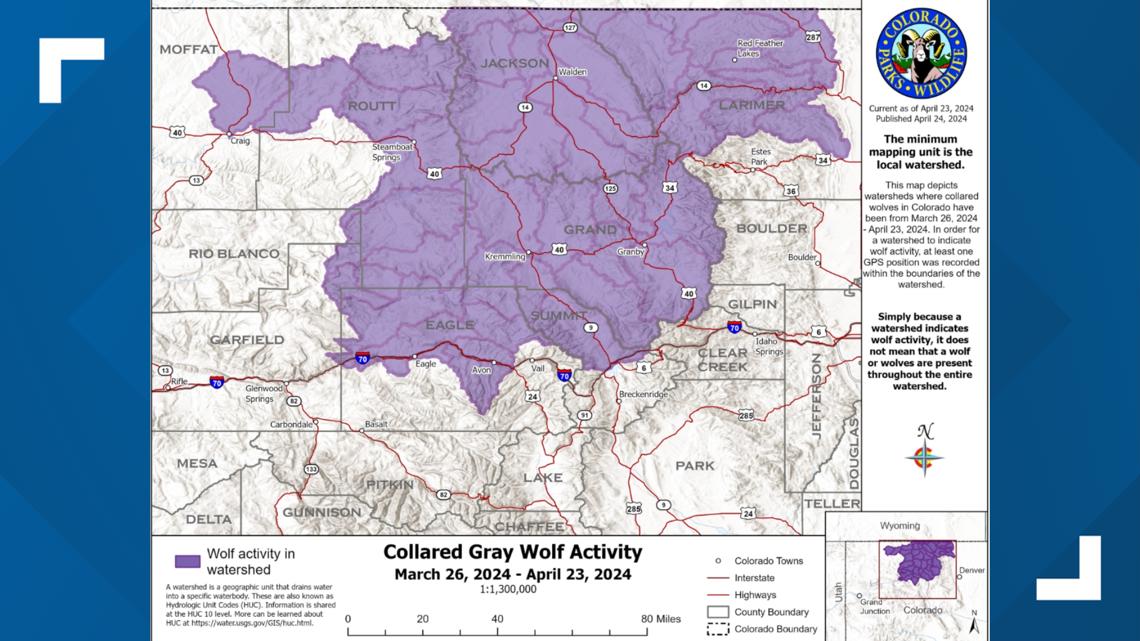
DENVER — A map released Wednesday by Colorado Parks and Wildlife (CPW) shows that gray wolves have crossed into watersheds east of the Continental Divide and onto the Front Range.
The new CPW map shows collared wolf activity between March 26 and April 23. The map shows that over the past month, at least one wolf with a GPS collar traveled in watersheds in Larimer and Boulder counties.
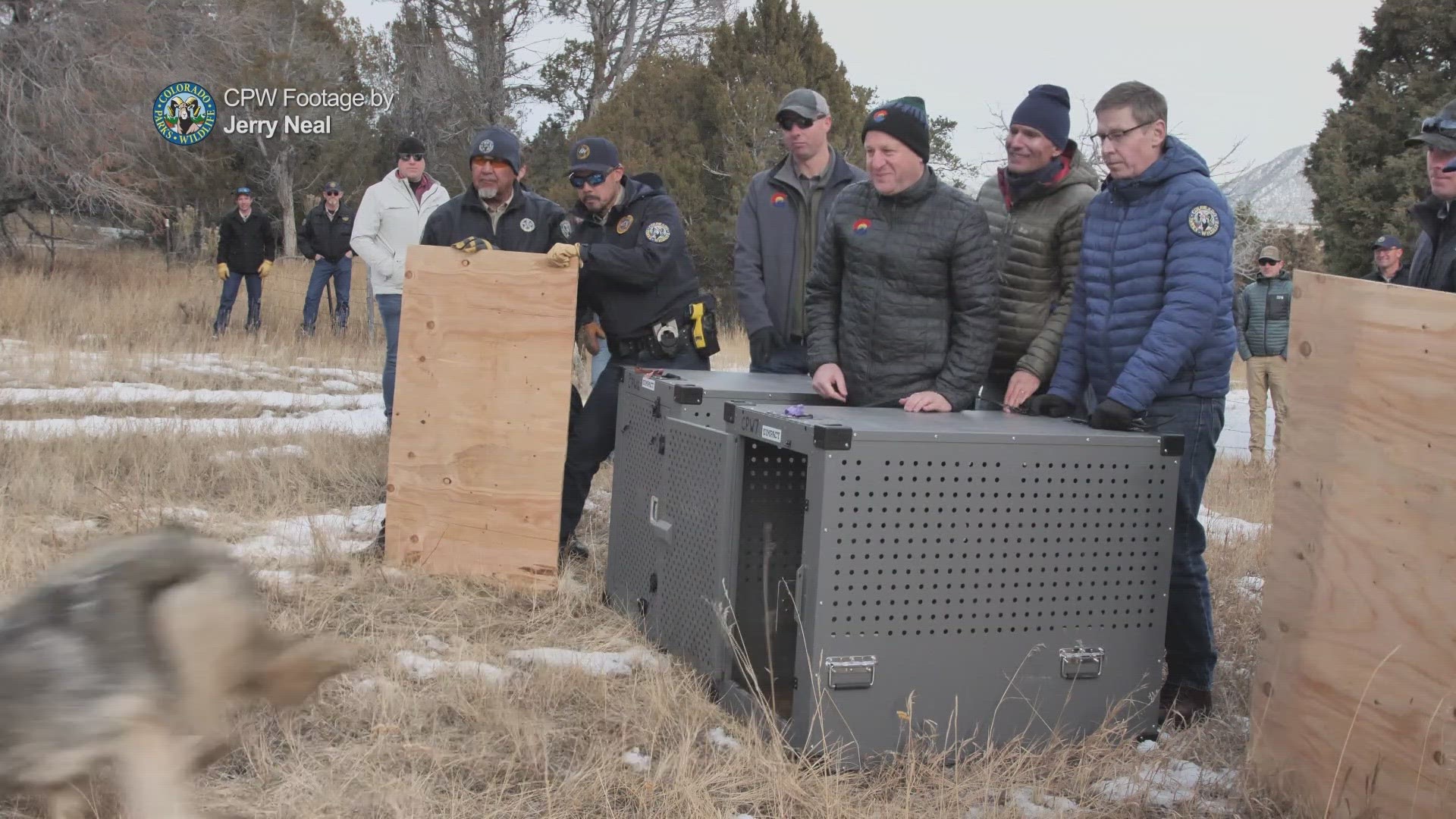
Ten gray wolves were released in Grand and Summit counties in mid-December in accordance with a voter-approved reintroduction program. Those were in addition to two wolves that dispersed into Jackson County on their own and produced six pups in 2021. In February 2023, Colorado Parks and Wildlife (CPW) officials placed collars on two of those wolves in North Park.
On April 18, authorities confirmed that one of the reintroduced wolves was found dead in Larimer County. The wolf appeared to die from natural causes, though a necropsy will determine the cause of death.
> The video above aired Tuesday: Wolf released as part of reintroduction found dead in Larimer County
Two of the 10 collars placed on reintroduced wolves have failed. CPW said the animals with failed collars are traveling with wolves that have functioning collars. Wildlife officials also confirmed the wolves with the failed collars are alive after seeing them from an airplane, CPW said.
Credit: Colorado Parks and Wildlife
Wolf activity in Colorado between March 26 and April 23, 2024.
The CPW activity map shows wolf activity in watersheds. Just because an area shows wolf activity doesn’t mean that wolves are present through the entire watershed or are currently there, CPW said.
CPW said the collars record a position every four hours. After four locations are recorded, that data is transmitted via satellite to biologists. CPW staff can use the data to see where wolves have been but not where they are at any current point in time, the agency said.
The map will be updated on the fourth Wednesday of every month, CPW said.
CPW also said on Wednesday that it has launched a website for wolf depredation reports to keep the public informed about confirmed livestock deaths by wolves.
Wolves have killed six cattle in Grand and Jackson counties this month. Several stockgrowers associations asked CPW to lethally remove the wolves responsible for the livestock deaths.
CPW responded in a letter on Tuesday that the wolf possibly responsible for the depredations is the male of a pair that are “denning” and that the female’s GPS collar indicates she is likely in a den. The letter says that removing the “male breeder” would be irresponsible management and possibly cause the den to fail.
“The biological interpretation of this is that she was likely in a den during the time when connectivity with the collar was interrupted, which aligns with the expected timing of wolf reproduction,” the letter says. “This would be the first den from wolves reintroduced to Colorado. We are working diligently to confirm the den, and hope to have information on this soon.”
Colorado Parks and Wildlife released five gray wolves onto public land in Grand County, Colorado on Monday, Dec. 18, 2023. Pictured is wolf 2303-OR. Photo courtesy Colorado Parks and Wildlife Wolves-main-image-for-press-release-2302-OR
U.S. Fish and Wildlife Service has confirmed one of the 10 recently released wolves has been found dead in Larimer County of apparent natural causes.
Found on April 18, the USFWS is investigating and has sent the carcass for a necropsy to determine the cause of death. According to a spokesman, USFWS is working cooperatively with Colorado Parks and Wildlife in an investigation and a final determination on the animal’s death will be made following the necropsy. USFWS said that a mountain lion could be at fault as a natural cause.
Colorado Parks and Wildlife released five gray wolves onto public land in Grand County, Colorado on Monday, Dec. 18, 2023. Pictured is wolf 2303-OR. Photo courtesy Colorado Parks and Wildlife
REQUEST FROM STOCKGROWERS DENIED
Letters from various stakeholder groups asking CPW to lethally remove two wolves that they say are chronic depredators, save for a comment from Gov. Jared Polis’ spokesperson, were finally answered, though denied, late on April 23.
The Middle Park Stockgrowers were the first to request the removal of two wolves that are responsible for six depredations through a letter sent April 18 and a second request on April 22.
CPW Director Jeff Davis told the group he recognizes that ranchers and CPW staff have experienced “challenging” times with a “lack of quality sleep at a critical time for your operations” at the same time the agriculture industry is dealing with “other challenges.”
“Please know that CPW takes our responsibilities to and our relationships with ranchers and the industry very seriously. We cannot accomplish our mission to perpetuate wildlife without these strong partnerships. It’s not lost on me that these very tense times are putting a great deal of strain on our relationships. We hope that no matter what, we can continue to work together to successfully avoid and minimize impacts on the agricultural industry while restoring wolves to Colorado.”
Davis said the wolf that could be “implicated in these depredations is the male of a pair that we believe to be denning.” He said GPS points from the female’s collar indicate that she is likely in a den. In early April, GPS points stopped uploading and very recently those points began to upload again. The points for this female’s collar are showing a very localized position. The biological interpretation of this is that she was likely in a den during the time when connectivity with the collar was interrupted, which aligns with the expected timing of wolf reproduction. This would be the first den from wolves reintroduced to Colorado. “Removing the male breeder at this point would be irresponsible management and potentially cause the den to fail, possibly resulting in the death of the presumed pups. This is not a desirable result and I am therefore not going to take action at this time to lethally remove this animal.”
Davis told the group the wolf population in Colorado is far below any restoration goal, and CPW has the legal duty to establish a self-sustaining population of wolves while minimizing conflict risk. Any consideration of lethal removal will be carefully deliberated to ensure it does not conflict with these legally mandated restoration goals. As the wolf population in Colorado grows, and as we get to points where we enter different management phases, the approach to lethal removals will likely become more liberal.”
CHRONIC DEPREDATION STILL NOT DEFINED
Davis said “some other states have quantitative metrics to define chronic depredation, it is important to understand that simply meeting that metric does not necessarily initiate lethal removal. An evaluation of the circumstances, including an evaluation of the status of the entire wolf population, informs decisions on wolf management. As you are aware, Colorado’s Wolf Restoration and Management Plan does not have a quantitative definition of what constitutes chronic depredation. This was intentional, and results directly from the recommendations of the Stakeholder Advisory Group. The Colorado Parks and Wildlife Commission will be considering whether it is advisable to modify the plan to quantitatively define chronic depredation, and if so what that definition should be, at the commission meetings this summer.” Davis said since CPW staff began working with the affected ranchers to deploy conflict minimization tools in this area, depredation has ceased, at least for the time being.
“We are prioritizing this geography for deployment of more conflict minimization tools in the immediate future and expanding their availability to other willing landowners.” Davis also clarified that the state does not have a definition of chronically depredating wolves, and said “to continue to state that we brought known problem wolves into the state is a falsehood” but doubled down on the 10 released wolves not hailing from chronically depredating packs.
“Where wolves and livestock share the landscape, there will be conflict. We will hold tight to the recommendations of the TWG and what is stated in our plan that we will not bring currently chronically depredating wolves into the state.”
“I know that you will not be satisfied with the determination to not lethally remove wolves at this time, and I hope that you understand that we are working to implement the state’s Wolf Restoration and Management Plan and to implement state statute, while also working diligently to address the conflicts that livestock producers experience,” he said. “It has proven to be a tremendously difficult and challenging task for all involved.”
Multiple letters of support followed from the North Park Stockgrowers, who represent the area where Don Gittleson ranches. Gittleson’s request to remove two other wolves after repeated cattle and working dog deaths and attacks was also denied in December. Other letters included groups like the Colorado Woolgrowers, Grand County Sheriff Brett D. Schroetlin, Middle Park Cowbelles, and Yuma County Cattlemen.
A statement from Gov. Polis’ Press Secretary Shelby Wieman read:
“It is widely known that wolves are opportunistic hunters and Colorado voters were fully aware of the diet of wolves and made the decision to reintroduce wolves. Now CPW and CDA will work with ranchers on how to successfully and non-lethally deter predation, as is being done successfully in many other states that have both vibrant and successful ranching sectors and a much larger population of wolves than Colorado. The state has also launched a reimbursement for confirmed wolf-caused depredation on cattle of up to $15,000 per loss. Through effective non-lethal management, CPW and CDA look forward to partnering with ranchers to reduce predation.
Polis’ office said the “cornerstones of the wolf reintroduction program are to establish a viable wolf population and to reduce impacts on ranchers. Lethal control of wolves when there are only 12 known wolves in the state is premature.”
The administration said the state agencies, which work together through a memorandum of understanding, have been building the capacity to anticipate and prepare for any predator livestock incidents and are working towards deploying range riders and other conflict minimization tools to help with non-lethal deterrence. Additionally, livestock producers who submit a claim may be eligible for the fair market value of livestock lost to wolf depredation. A dedicated Wolf Depredation Compensation cash fund has $175,000, provided from the state’s General Fund, in its balance and will receive $350,000 additional General Funds per fiscal year to keep a healthy balance in the fund on an ongoing basis. For the current fiscal year, CPW has spending authority for up to $175,000 from this fund to compensate livestock owners for wolf depredation. CPW requested increased ongoing spending authority of up to $525,000 per year beginning FY 24-25 in the department’s budget proposal, which is currently being considered by the General Assembly as part of the Long Bill which will be signed into law.
“The Colorado Department of Agriculture and CPW continue to work with the Middle Park Stockgrowers and the Grand County community on a plan that would help employ non-lethal deterrent tactics, such as range riders. CPW has installed fox lights and is putting up fladry as we speak as well as conducting night watches for the past four nights. CPW is encouraging producers to use all the appropriate and legal tools available to them to protect their livestock. Range riders are effective, boots-on-the-ground support to livestock producers to help protect herds from wolves. A human presence like a range rider can help manage livestock and deploy non-lethal deterrents to avoid the depredation of livestock. While the department’s budget request to the legislature for scaling up range riders is pending at the legislature and will likely be signed next week, CDA and CPW are deploying available resources to provide immediate support and are working on a plan to deploy on-the-ground assistance through range riders this month.”
On April 3 a rancher in Elbert County found an animal resembling a wolf in a coyote trap on private land, according to a recent article in The Fence Post. A U.S. Fish and Wildlife Service spokesperson confirmed in an email to Outdoor Life that “this animal is a gray wolf from the Great Lakes population.”
The USFWS was notified of the discovery by Colorado Parks and Wildlife after the rancher reported it to a CPW wildlife officer. That officer coordinated with the federal agency to collect tissue samples and send them to a lab for DNA analysis. The lab results revealed that the animal in question was a gray wolf from the Great Lakes population, which is genetically distinct from the gray wolf population of the Northern Rockies.
“This is not a wolf from the ten recently released by Colorado Parks and Wildlife in December 2023,” the USFWS spokesperson told Outdoor Life. He added that the federal agency was working with CPW to investigate the discovery, as gray wolves in the Great Lakes population — unlike wolves in the Northern Rockies — remain under federal protections as an ESA-listed species.
The wolf was an 84-pound male, and it was caught by a trapper in a legal leg-hold trap that had been set for coyotes, according to The Fence Post. Body grip devices, foothold traps, and cable device traps are prohibited in Colorado, but landowners who are eligible for a 30-day agricultural trapping exemption can still use these devices, according to state regulations. The USFWS has not released a cause of death or any other details as part of its open investigation.
Even more puzzling is how a wolf from the Great Lakes region ended up in Elbert County, which lies in eastern Colorado not far from the heavily populated Front Range. Elbert County butts up against El Paso County, where Colorado Springs is located. The county seat of Kiowa is less than 50 miles southeast of Denver and roughly 25 miles east of Interstate 25.
Related video: 2 wolf deaths under investigation in Colorado (KDVR-TV Denver)
that have found dead in Colorado this month,
Loaded: 10.95%Play
Current Time 0:03
/
Duration 2:44Quality SettingsCaptionsFullscreen
KDVR-TV Denver
2 wolf deaths under investigation in ColoradoUnmute
The Fence Post reports that the wolf did not have a GPS tracking collar or show any signs that a collar had been removed, and CPW’s wolf activity map does not show any of the state’s known wolves passing through the county in recent months. An unnamed neighboring rancher told The Fence Post he thought the wolf could have been someone’s pet, but there is currently no other evidence supporting this theory.
It is possible that the wolf made it all the way from the Great Lakes to Elbert County on its own. Gray wolves are known to roam, and in 2023, researchers tracked a collared wolf from Michigan’s Upper Peninsula that traveled more than 4,000 miles over an 18-month period.
Minnesota is home to the highest number of gray wolves in the region, with an estimated population of more than 2,500. A map from 2018 shows that the Minnesota Department of Natural Resources has observed wolf packs as far south as Anoka County. That county is located not quite 900 miles as the crow flies from Elbert County, Colorado.
LARIMER COUNTY, Colo. — One of the 10 wolves released in Colorado in December as part of the state’s reintroduction plan has been found dead in Larimer County, the U.S. Fish and Wildlife Service said.
The USFWS is investigating the death with the cooperation of Colorado Parks and Wildlife. The USFWS became aware of the death on April 18, they said in a statement.
A necropsy will determine the cause of death, but the USFWS said initial evidence suggests the wolf likely died of natural causes.
The USFWS is involved in the investigation because the gray wolf is a federally listed species under the Endangered Species Act, according to the statement.
Ten gray wolves were released in Grand and Summit counties in mid-December in accordance with a voter-approved reintroduction program. The wolf found dead in Larimer County was one of those 10 wolves, the USFWS said.





 Related video: 2 wolf deaths under investigation in Colorado (KDVR-TV Denver)

 KDVR-TV Denver
 Exposing the Big Game