Wyoming hunter parks in Jackson Hole town square with wolf he shot strapped to roof of SUV [Last year]
2

April 23, 2024
Media Contacts: info@projectcoyote.org, 415.945.3232
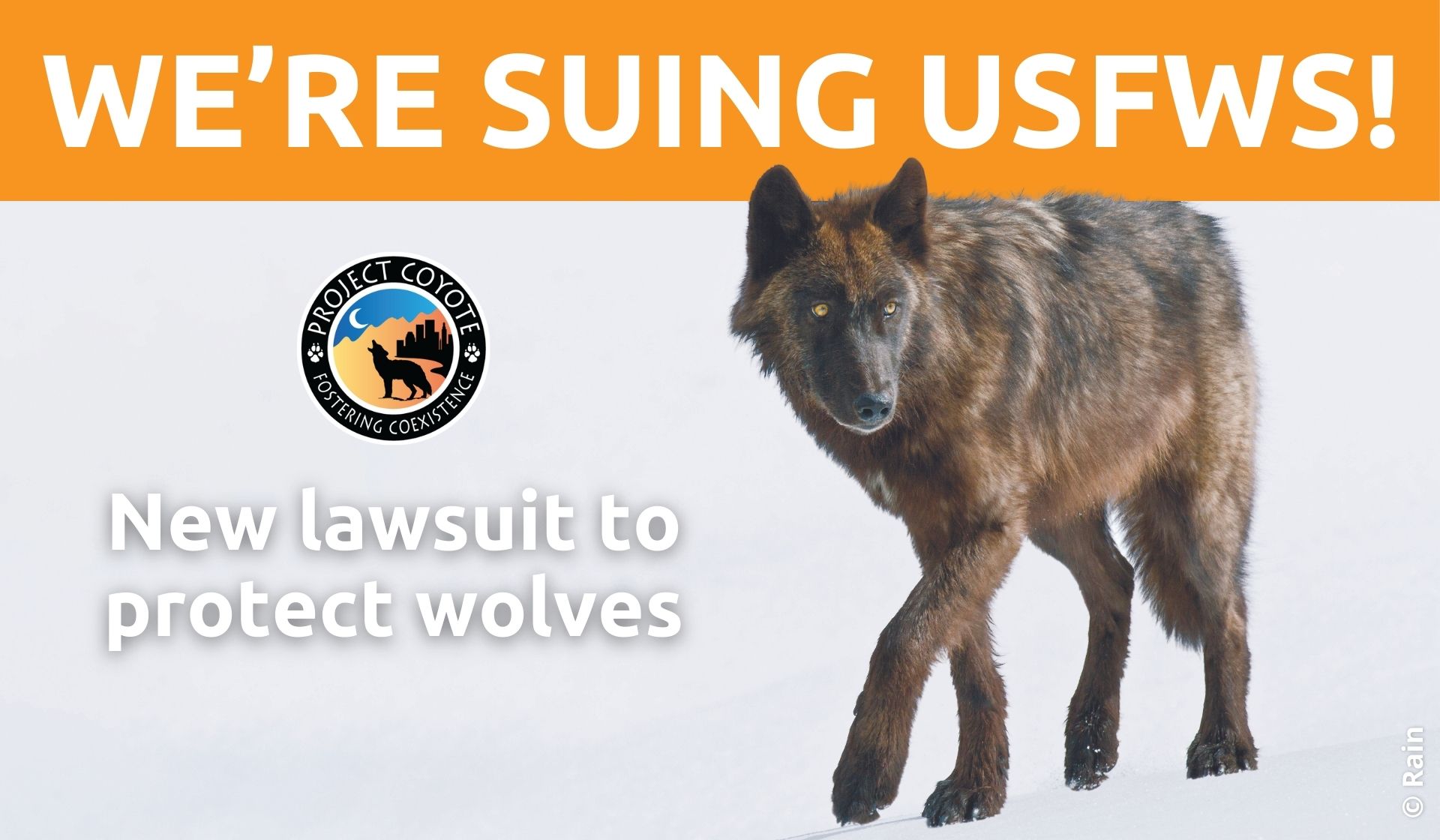
WASHINGTON D.C. —On the heels of the recent drawn-out torture of a captured and bound gray wolf, a coalition of organizations has filed their 60-day Notice of Intent to Sue the U.S. Fish and Wildlife Service (FWS) for their refusal to restore Endangered Species Act (ESA) protections to the Western gray wolf. The Notice of Intent may be viewed at this link.
In July 2021, this coalition—Animal Wellness Action, the Center for a Humane Economy, Project Coyote, Kettle Range Conservation Group, Footloose Montana, and Gallatin Wildlife Association—along with dozens of other organizations filed a petition with the FWS requesting federal ESA protections for gray wolves in the Western United States.
“The U.S. Fish and Wildlife Service is continuing to allow the same unlimited and unregulated killing practices that nearly wiped wolves off the landscape in the 20th century,” said Renee Seacor, carnivore conservation director with Project Coyote. “Time and time again, the U.S. Fish and Wildlife Service has lost in court when challenged over gray wolf protection. We fully expect the same with this deeply flawed decision.”
The FWS released an initial 90-day finding in September 2021 that relisting the Western gray wolf as endangered “may be warranted.” The agency then inexplicably reversed course on February 7, 2024, when it found in its final decision on the petition that the Western gray wolf is not entitled to ESA protection.
Three weeks after this decision, a man in Wyoming ran down a gray wolf with a snowmobile, captured her, taped her muzzle shut, paraded her in a local bar while subjecting her to extended abuse—including going so far as to kiss the dying wolf while being filmed, the wolf too weak to do anything but bare her teeth—and finally killing her. While Animal Wellness Action argues that these actions are punishable under Wyoming criminal law, and numerous veteran law enforcement professionals have called for felony charges, he was required only to pay a $250 fine for live possession of wildlife.
“States have proven they cannot be trusted to sustain the wolf species,” commented Jessica Karjala, executive director of Footloose Montana, based in Missoula, MT. “They not only allow but endorse bounties on wolves. They have encouraged increased hunting and quotas on wolves, spotlighting, baiting, trapping, snaring, hound hunting. Here, Wyoming is turning a blind eye to the heinous acts of Cody Roberts. The delisting of wolves has led to the failure of state wildlife agencies to protect wolves.”
“It is so disappointing to see one of our Nation’s federal agencies, the only agency that has the responsibility to conserve, protect, and enhance fish, wildlife, and plants in their native habitat, become so disengaged from their mission and from reality on the ground,” said Clint Nagel, president of the Gallatin Wildlife Association, based in Bozeman, MT. “Our Nation’s wildlife deserve so much better.”
“It was illegitimate for the U.S. Fish & Wildlife Service to continue to deny gray wolf relisting protection under the ESA for our small population of state-listed endangered gray wolves in Washington state,” said Timothy Coleman, director of Kettle Range Conservation Group, based in Republic, Washington. “Outside of Northeast Washington, just a couple of wolf packs exist, and there are no packs in the entire southern Cascade and Pacific Coast wolf recovery region that includes high quality habitat in Olympic National Park. Slaughter of gray wolf source population stifles migration from Idaho and Montana and will likely delay wolf recovery for decades across Washington state.”
The biggest threat facing the gray wolf is human-caused mortality. Since 2021, Rocky Mountain states have liberalized legal killing of wolves and removed discretion from their fish and wildlife agencies in favor of letting lawmakers use wolves as a political cudgel. Unlawful killings, including poaching and poisoning, are on the rise too. Higher mortality rates will result in further loss of genetic diversity and connectivity between wolf populations across the Western U.S. And worse, in their refusal to list the wolf, the FWS is relying heavily on highly suspect data on wolf populations from states that use population-estimate methodologies that have been criticized by scientific experts.
“Despite having admitted that Rocky Mountain states use means and measures ‘at odds with modern professional wildlife management,’ the FWS has still failed to properly account for the impact of the uptick in human-caused mortality on Western wolf populations, as they are required to do under law,” said Kate Chupka Schultz, senior attorney with the Center for a Humane Economy, who prepared the Notice. “Compounding that error, FWS is also failing to apply best available science to the analysis—ignoring the good science and instead relying on the bad. These are just two of the multiple ways the FWS is violating federal law.
Now, this coalition of conservation organizations has formally sent their notice, arguing that the FWS’ failure to list the Western gray wolf violates both the ESA and the Administrative Procedure Act (APA). This notice is the third filed in recent months by various organizations against the FWS for failing to protect the gray wolf.
The coalition is now awaiting the expiration of the 60-day notice period before filing their lawsuit in federal court.
[Another older article…]
by Meteor Blades
Daily Kos Staff Emeritus (This content is not subject to review by Daily Kos staff prior to publication.)
Saturday, October 19, 2013 at 12:37:36p PDT
245 NEWRecommend Story253Share

Bill Addeo swears he didn’t park an SUV with a dead wolf strapped to the roof on the Town Square just for the attention. Addeo sat on a bench next to his Ford Excursion across the street from the Cowboy bar Thursday afternoon, eager to answer questions posed by folks passing by. “It’s a neck shot,” Addeo said. “The bottom of the neck is blown apart and there’s blood everywhere, so I didn’t want to put him in the back.”
Addeo had brought the wolf to Jackson Hole so that Wyoming Game and Fish officials could collect a DNA sample. The 85-pound female was shot in the company of four other wolves, all of them said to be satiated from eating the antelope they had killed. This is the second year of trophy wolf-hunting in Wyoming since wolves were reintroduced in the 1990s into central Idaho and Yellowstone National Park in Wyoming in an effort to build their packs to sustainable levels in parts of their old range. Since the trophy season began Oct. 1, 11 wolves [have been reported killed legallyhttp://wgfd.wyo.gov/web2011/Departments/Hunting/pdfs/WOLF_SUMMARY0004703.pdf]. Two more were killed by poachers before the season started but are counted against the season’s limit of 26 wolves. Originally, the limit had been set at 52.
https://imasdk.googleapis.com/js/core/bridge3.636.0_en.html#goog_163428554
4 years ago today: Trump tried to make Clorox great
again
Read More
But the wolf Addeo tossed onto his roof was shot in the 80 percent of Wyoming that makes up its wolf predator zone where there is no season, no limit and no hunting license required. So Addeo could have shot all five wolves if the four survivors had not scattered after he killed their companion. Twenty-nine wolves have been killed in the predator zone in 2013. In the town square of Jackson Hole, passersby stopped for a look at Addeo’s “trophy” and whipped out their cameras:
Despite the interest, nobody gave Addeo flak for putting his wolf on display. “There hasn’t been one person that’s said anything negative,” he said. “Everybody’s happy.”
Other wolf hunters may be more circumspect in their exhibitionism than Addeo, but the killing of the gray wolf will go on in spite of the fact that wolves are a blessing to the ecosystem. They generally take weak, diseased animals as prey, they tend to drive out coyotes who, because of their larger numbers, take far more domestic livestock than wolves, and they reduce the environmental damage from over-abundant numbers of elk, deer and antelope, that abundance being partly a consequence of the wolves being exterminated in the first place.
Such considerations get nothing but the pfffffft from wolf-haters today, however, anymore than they would have a century ago. And they’ve been fighting for the right to kill wolves ever since they were reintroduced after a bitter political fight. In the 1930s, after decades of concerted effort, bounty hunters, ranchers and settlers achieved their objective of wiping out the gray wolf in the Lower 48 states. Gray wolves were placed on the Endangered Species List in 1974. In the 1980s, a few wolves naturally recolonized northern Montana. More were reintroduced in Idaho and Yellowstone in 1994.
By 2002, wolf populations in much of the region met federal criteria for being delisted from the protections provided under the Endangered Species Act of 1973. But lawsuits kept that from happening. In 2008, Idaho and Montana came up with wolf management plans in return for delisting. But that sparked another lawsuit launched by the Center for Biological Diversity. This succeeded in requiring that delisting be done by region, not by state. However, Congress overrode that decision in 2011 with a law specifically delisting the gray wolf in Idaho and Montana in April 2011.
Wyoming, however, didn’t come up with a management plan. The view of officials there, in public and private, was that wolf are vermin. That hard-nosed attitude made it impossible even for a right-wing Congress to delist as they had done in Idaho and Montana.
By December 2011, an estimated 328 wolves were roaming Wyoming in 48 packs, two-thirds of them outside Yellowstone. The Wyoming delisting ultimately resulted from negotiations between Wyoming Republican Governor Matt Mead and then-Secretary of the Interior Ken Salazar. Initially, the whole state was going to be a free-fire zone. Eventually, that was cut to a mere 80 percent of the state where a wolf can be killed at any time, for any reason, without a license. The rest is subject to a short hunting season and a limit of 26 animals. When the final USFWS rule on delisting was published last September, an array of more a dozen environmental organizations [sued again]:
“Wyoming’s wolf management policies open the door to unlimited wolf killing throughout most of the state and provide inadequate protection for wolves even where killing is regulated,” [according to a press release issued by one of the two coalitions that filed suit at the time.]
But the delisting proceeded for all the United States except an estimated 75 wolves of the Mexican sub-species in Wyoming and New Mexico.
“I think the plan is premature,” [declared] Norman Bishop, the former Yellowstone National Park biologist who led public outreach for wolf reintroduction. Michael Hutchins, who retired last year as director of the Wildlife Society, calls for “better science” and objects to wolves being “delisted out of political expediency.” “This decision could derail wolf recovery efforts in areas around the country where it has barely begun,” warns Defenders of Wildlife.
But then wolf recovery isn’t exactly a priority in Wyoming.
••• •••
One group fighting the delisting is Defenders of Wildlife. You can help them out by clicking here].
••• •••
ADDENDUM: It should be noted that eight states have wolf-hunting seasons. Licenses range from $11.50 for residents in Idaho to $500 for non-residents in Michigan. The population figures are all minimum population estimates based on actual counts: The estimates for Alaska are 7,700 to 11,200, according to the U.S. Fish & Wildlife Service. Wolves have never been under Endangered Species Act protection in Alaska. Wyoming: 358 wolves (season in part of state and free-fire zone in the rest) Michigan: 658 wolves Wisconsin: 809 wolves Minnesota: 2200 wolves Montana: 625 wolves Idaho: 750 wolves Washington: 43 wolves No hunting season: Oregon: 46 wolves Colorado: Unknown, could be zero Utah: Unknown, rumored sightings, but population could be zero A subspecies called the Mexican gray wolf was reintroduced into central Arizona and New Mexico in an area called the “Blue Range Wolf Recovery Area.” There are now 13 packs plus lone wolves totaling 66 animals in that area. They are still protected under the ESA.
Urges reform of cruel and antiquated policies that allow native predators to be tortured, run over with vehicles, and other atrocities EUGENE, OR – In response to the state of Wyoming grabbing international headlines this month for an egregious act of animal cruelty and killing perpetrated by a resident named Cody Roberts–followed by the state taking no substantive actions to adequately punish the perpetrator or improve their wildlife policies–we have called for a boycott of Wyoming until they bring their wildlife policies into the 21st century. The state of Wyoming bears responsibility for the Cody Roberts incident. Their policies made it possible. Perversely, they are on record saying they value wildlife, that its protection is of utmost importance, that they have the “gold standard” of wildlife management. In reality, there are no protections for wolves in 85 percent of the state. They tell people they can kill wolves and coyotes on sight and by any means. Along with their neighboring Northern Rocky Mountain states, Idaho and Montana, Wyoming wildlife officials see no value in the essential ecosystem services wolves and other native predators provide and feel no need to substantively support caring for livestock using nonlethal practices. We are calling for an end to the cruelty and the implementation of humane, science-supported wildlife policies. We encourage all environmental, conservation, animal rights and animal welfare groups to ask their followers and supporters to boycott Wyoming. We feel that only strong financial pressure, combined with an ever-increasing public outcry, will bring about the change that is needed. |
| # # # Predator Defense is a national nonprofit advocacy organization devoted to protecting essential native predators, helping people learn to coexist with wild animals, and ending America’s war on wildlife.They have been championing native predators with science, sanity and heart since 1990. |
| Predator Defense | predatordefense.org |
By Emily Mae Czachor
April 22, 2024 / 1:35 PM EDT / CBS News
Researchers have drawn a possible link between the deaths of two hunters in the last couple of years from a rare neurological condition. A report, authored by medical experts from the University of Texas at San Antonio and published earlier this month in the clinical journal Neurology, suggests the men contracted it by consuming venison from deer infected with chronic wasting disease, a degenerative illness not conclusively shown to be transmissible from animals to humans.
Both men hunted at the same lodge and consumed meat from the same deer population before each developed Creutzfeldt-Jakob disease and died soon afterward, the report’s authors said. They did not give the lodge’s specific location. Creutzfeldt-Jakob disease is one of several prion diseases — uncommon neurodegenerative disorders affecting humans that are characterized by an abnormal folding of proteins in the brain, according to the Centers for Disease Control and Prevention. Symptoms broadly mimic those of dementia, although patients afflicted with Creutzfeldt-Jakob deteriorate much more quickly.
The new study centered around the initial death of a 72-year-old man in 2022 who “presented with rapid-onset confusion and aggression,” the authors said. That man apparently had a history of eating meat from a deer population known to be infected with chronic wasting disease. His friend, who had eaten venison from the same deer population, died later from Creutzfeldt-Jakob disease.
The friend’s death came within a month of him developing symptoms typical of the illness, like seizures and agitation, according to the study, and a postmortem ultimately confirmed his diagnosis with a variant form of it called sCJDMM1. Authors said that finding may point to “a possible novel animal-to-human transmission of CWD,” although they acknowledged it did not definitely prove that consuming venison from a deer infected with chronic wasting disease eventually caused Creutzfeldt-Jakob disease in any human being. But that possibility could not be definitively ruled out, either.
“Although causation remains unproven, this cluster emphasizes the need for further investigation into the potential risks of consuming CWD-infected deer and its implications for public health,” they said in the report. CBS News contacted the report’s lead author for comment but did not receive an immediate response.
Prion diseases, including Creutzfeldt-Jakob disease, can have long incubation periods but progress rapidly once symptoms start to present themselves and are always fatal. While they are not well understood, exposure to certain pathogens that then trigger the brain proteins to fold is believed to be the cause.
According to the Mayo Clinic, Creutzfeldt-Jakob disease is thought to emerge in four different ways: sporadically, the most common form, where someone develops the disease without a clear trigger; by inheriting certain genetic changes that cause prion proteins to develop; through contaminated medical instruments used during surgeries or other medical procedures, which is rare; and through consumption of contaminated beef, which is even rarer.
A variant form of Creutzfeldt-Jakob disease has long been tied to eating beef from cattle infected with mad cow disease, or bovine spongiform encephalopathy, which is another prion disorder. The connection between the infections in cattle and humans who ate beef from those cattle gained international attention when it was recognized publicly by government health officials in the United Kingdom in the 1990s, following a string of disease outbreaks.
Even though chronic wasting disease falls, along with mad cow, under the umbrella of prion disorders affecting animals, experts have said no strong evidence exists to indicate that prions seen in chronic wasting disease can infect humans. Some big questions remain about the disease’s transmission across species though, and there have been a few experimental studies that suggest, at least, that chronic wasting disease is transmissible to primates. The CDC writes in a discussion about prion transmission that, however experimental, those studies “raise the concern that CWD may pose a risk to people and suggest that it is important to prevent human exposures to CWD.”
Chronic wasting disease has been reported in free-ranging deer, elk and moose in 32 states across the continental U.S. and four Canadian provinces, as well as in some farmed deer and elk, according to the CDC. The agency has noted that the overall occurrence of the disease nationwide is relatively low, but it can spread quickly through populations where it has been established, and, in the event that it is established, “the risk can remain for a long time in the environment.”
Several hundred deer have tested positive for the disease in Minnesota over the last 20 years or so, mainly in the southeastern part of the state, CBS Minnesota reported. Last year, experts said a captive deer in Wisconsin tested positive for the illness just a few months before officials in Yellowstone National Park announced they had detected the disease in a deer in that area for the first time.
 Exposing the Big Game