Sports Illustrated Swimsuit model Christen Harper credits plant-based diet for keeping her bikini-ready

https://www.aol.com/sports-illustrated-swimsuit-model-christen-080017648.html

STEPHANIE NOLASCO

May 19, 2024 at 1:00 AM

Sports Illustrated Swimsuit model Christen Harper credits plant-based diet for keeping her bikini-ready

When it came time to slip into a skimpy swimsuit, Christen Harper was ready for her close-up.

The model was photographed by Ben Watts in Portugal for the 2024 Sports Illustrated Swimsuit issue. The outlet is celebrating its 60th anniversary.

The fiancée of Detroit Lions quarterback Jared Goff told Fox News Digital following a plant-based diet has been her secret to looking — and feeling — her best in swimwear.

SPORTS ILLUSTRATED SWIMSUIT MODEL KATE UPTON MAKES SIZZLING COMEBACK FOR 60TH ANNIVERSARY ISSUE

Christen Harper modeling a white swimsuit
Christen Harper was photographed in Portugal for Sports Illustrated Swimsuit’s 2024 issue.

“I’m a longtime animal lover,” said the 30-year-old. “I never wanted to do anything that would hurt them. That’s what initially made me make the switch to a more plant-based lifestyle.

“I live in California, the mecca for that kind of eating,” she chuckled. “So, it hasn’t been too hard. But it’s a choice I made to just eat vegetables. … For me, it was an easy choice, and it makes me feel so good. I feel like I’m glowing from the inside out just eating that type of food. … And I have a fun time trying to come up with more plant-forward recipes.”

READ ON THE FOX NEWS APP

Christen Harper modeling a purple bikini
Christen Harper walks the Sports Illustrated Swimsuit Shows runway during Miami Swim Week at W Hotel Miami Beach July 7, 2023, in Miami Beach, Fla.

The new issue of Sports Illustrated Swimsuit was published May 17 with seven covers. For her spread, Harper insisted she didn’t have to take on a new diet to get in shape. Her usual routine had given her plenty of confidence. But stocking up on fruits and veggies over animal products hasn’t always been easy, she admitted.

Christen Harper modeling a zebra print bikini
Christen Harper, a Southern California native, was discovered by SI through the Swim Search open casting call in 2021.

“I’m a quarter Japanese, so I grew up eating so much Japanese food, which included a lot of sushi,” said Harper. “For me, that was the hardest part, to kind of let that go. It has been so much a part of my childhood and growing up. But there are so many good plant-based alternatives these days. I love a tofu roll or an avocado roll. You can get the same feeling and still go to a sushi bar.

Christen Harper wearing a hot pink cut-out swimsuit
Christen Harper said Japanese food, specifically sushi, is one of her guilty pleasures.

“I realized the most important part about food is sharing the experience with the people you’re with,” she shared. “It doesn’t matter what you’re eating as long as you feel like you’re a part of the experience. So, I still love going to sushi bars and eating delicious Japanese food. I just pick veggie options. … Everything else has been pretty easy.”

Harper said those who are curious have plenty of options these days to savor plant-based dishes without compromising on taste.

CLICK HERE TO SIGN UP FOR THE ENTERTAINMENT NEWSLETTER

Christen Harper modeling a white t-shirt and high-cut black string bikini bottom
Christen Harper is an avid follower of the plant-based lifestyle.

“That’s the first cardinal rule. You have to go out and do whatever it is you want to do,” said Harper. “If you like dining out with friends and going to restaurants, don’t miss out on that. It doesn’t have to be so black and white.

“First, you can try going plant-based at home. You can start slow, adding a few plant-forward ingredients to your meals or trying a new plant-forward recipe. Remember, you’re choosing to feed your body. Have fun with it. And, personally, that was the most fun thing about going plant-based — dining out at restaurants.

Christen Harper wearing a sparkling black sheer off the shoulder dress
Christen Harper began modeling more than a decade ago.

“Many restaurants these days have plant-based options,” Harper noted. “But if you notice that the menu doesn’t show a lot of options, I’ll ask the server to have the chef come up with a fun plant-based dish. It allows the chef to be creative or try a recipe they don’t normally get a chance to make, just for you. It might just be a bunch of different veggie sides put together, but usually, they love getting that opportunity to make something unique. And it’s fun to try something different, something you wouldn’t usually order.

https://e1c30daf0c28b4f73b325a8f84d3dfe2.safeframe.googlesyndication.com/safeframe/1-0-40/html/container.html

Christen Harper in a cut-out hot pink bikini
Christen Harper launched a collab of bikinis last year with B Swim.

“But almost everything can be turned more plant-based,” Harper added. “Even Taco Bell. One of my favorite things there is swapping out the meat for beans. I can get a delicious taco or Crunchwrap Supreme anywhere just the way I like it. And sometimes going plant-based is as simple as making a little switch from meat to beans, or meat to veggies. It’s about getting a little creative and making it fun and delicious.”

Christen Harper modeling a green bikini on the runway
When it comes to comfort food, Taco Bell is one of Christen Harper’s go-tos.

Harper said when she’s not hitting the waves at the beach, she likes to try new recipes at home.

“My go-to is always pasta,” said Harper. “I love to make a spicy rigatoni with a homemade sauce that’s all plant-based. I love to make soups and rice bowls with fresh seasonal veggies. I am not the best cook, but I’m learning to get better. Right now, I’m doing a sourdough baking experiment. That’s my next journey. I’ll let you know how that goes.”

Harper said posing for the magazine has given her a body confidence boost.

LIKE WHAT YOU’RE READING? CLICK HERE FOR MORE ENTERTAINMENT NEWS

Christen Harper modeling a sea green one piece on the runway
Christen Harper said being part of SI Swimsuit has given her a boost of confidence.

“It’s really hard to be a woman,” she said. “You feel constantly judged, and you’re often comparing yourself. It was partly Sports Illustrated that gave me the confidence to be me. It was wonderful to flip through the pages and see women who looked like me. We know now how important it is to see yourself represented in the media. … And this magazine loves you no matter what you look like or how you show up. They love you for you. … It’s the biggest bubble of empowerment.”

Christen Harper wearing a white tube top and blue-green pants
Christen Harper regularly volunteers with local organizations.

“I’ve been a model since I was 9 years old,” Harper reflected. “For about 15 years of my life, I was going through the modeling industry, which was a little stricter and a little less inclusive. They needed you to fit in a specific sample. Sometimes my body would fluctuate, and I wouldn’t be that same size anymore. You would get ridiculed by agents.

“But Sports Illustrated broke down those walls. They made the industry more inclusive, allowing everybody to feel important and included. That was such a shift for me, to realize that it’s OK to be different. It’s OK to be a little curvier. We can still celebrate ourselves and what we bring to the table”

Christen Harper posing to the side in an orange satin dress
Christen Harper co-won the annual Swim Search and was named co-Rookie of the Year in 2022.

Harper said Goff has been her biggest cheerleader in trying out for SI Swimsuit. The pair met on Raya, a dating app favored by celebrities.

The couple was first linked in 2019. They announced their engagement in June 2022.

Rob Gronkowski, Camille Kostek, Jared Goff and Christen Harper posing together for a step and repeat photo
From left: Rob Gronkowski, Camille Kostek, Jared Goff and Christen Harper attend as Sports Illustrated Swimsuit celebrates the launch of the 2022 Issue and Debut of Pay With Change at Seminole Hard Rock Hotel & Casino Hollywood May 21, 2022, in Hollywood, Fla.

“I went through the Swim Search process, which included me posting a video of myself out there in hopes I would get chosen for the magazine,” said Harper. “I was so nervous. I was worried about what people would think about me.

“He was like, ‘You’ve got to go for it. Who cares if you don’t get it? Just put yourself out there.’ And he’s been there for me throughout this entire experience. I’m just so lucky because he cheers me on in every aspect of my life, whether I’m in a bikini or anything else. During the season, I get to cheer him on and then, during the off-season, he cheers me on.

Christen Harper in a gold sparkling dress next to Jared Goff in a grey blazer and black shirt
Jared Goff and Christen Harper attend the 2024 Sports Illustrated Swimsuit Issue launch party at Hard Rock Cafe in Times Square May 16, 2024, in New York City.

“When I first got into SI, he was so pumped,” said Harper. “We got a big poster … and he put it right up in his office. He does his work and looks at my poster. My first calendar, which was untouched, is still all over his office. He’s been so supportive and so happy for me. He knew how big of a dream it was for me.”

The Southern California native was a co-winner in the 2021 Swim Search, and she was named co-Rookie of the Year with Katie Austin following their 2022 issue appearance. She was featured in the 2023 issue.

HOW BIODIVERSITY LOSS HARMS HUMAN HEALTH

BLOGCLIMATE, ENERGY, AND ENVIRONMENTHOW BIODIVERSITY LOSS HARMS HUMAN HEALTH

BY MJ ALTMAN ON MAY 18, 2023

CLIMATE, ENERGY, AND ENVIRONMENT

A young girl and her grandmother catch crabs and fish in the shallow waters near Bednell Bay in northeast England. Climate change is already affecting biodiversity in the area: Low water availability in the summer, and increased flooding and coastal erosion affects the rich diversity of habitat and species found there. Photo: SolStock

Without nature, we are nothing. Yet humans are destroying the environment and the living creatures that call our planet home at unprecedented rates — at our own peril. From increasing the threat of disease to disrupting our global food chain, biodiversity loss across the globe is threatening the very foundation of our future and the well-being of everyone, everywhere.

The devastating effects of climate change on human health are already on display: famines triggered by once-in-a-century droughts or flooding; death and suffering wrought by some of the strongest hurricanes and heat waves in modern history.

But what is less well known is how biodiversity loss is harming our health and threatening the basic ecological cycles that keep us alive.

“We are out of harmony with nature,” UN Secretary-General António Guterres told world leaders at last year’s Biodiversity COP. “Humanity has become a weapon of mass extinction. … And ultimately, we are committing suicide by proxy.”

One reporter called biodiversity loss a “mounting under-the-radar crisis,” and disturbing signs are appearing all over the globe, from beaches awash in sargassum seaweed to massive fish die-offs in polluted waterways. In fact, according to the United Nations Environment Programme, biodiversity is declining faster than at any other time in human history. Right now more than 1 million species are facing extinction.

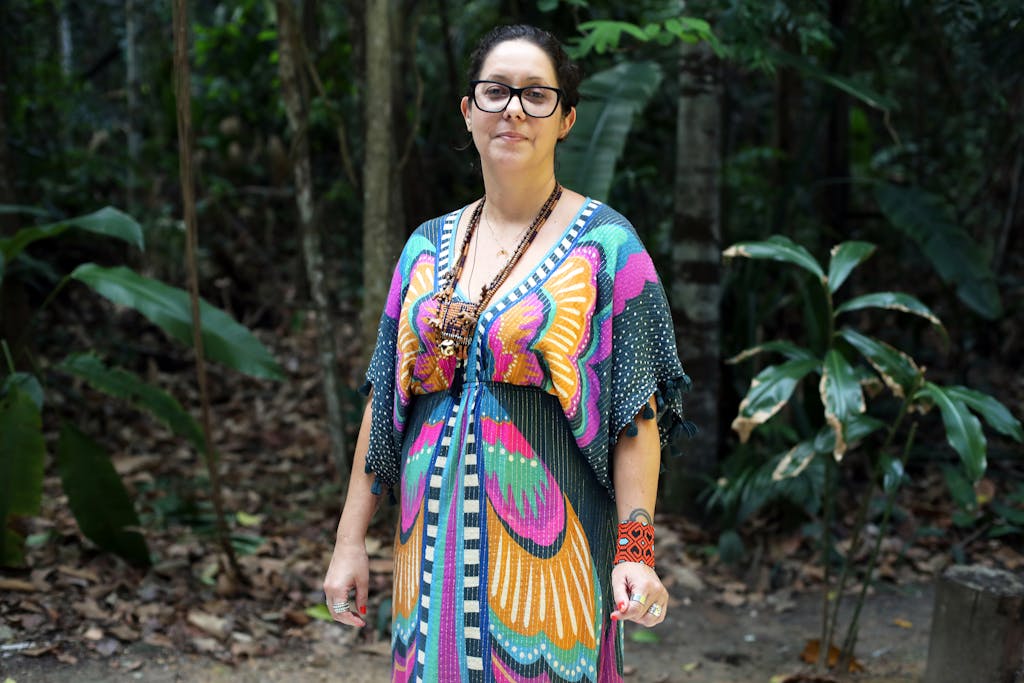
Veterinary scientist Dr. Alessandra Nava in Manaus, Brazil. Photo: Michael Dantas

IN THE AMAZON, A CALL FOR ONE HEALTH

There are few places on the planet where the threat of biodiversity loss is more evident than the Amazon, which is being destroyed by record levels of deforestation despite being home to one-third of the planet’s species — the greatest concentration of biodiversity on Earth.

Because habitat destruction brings humans and wildlife into closer contact, it dramatically increases our risk of exposure to “zoonotic spillover,” which occurs when pathogens — bacteria or viruses that cause disease — jump from animals to humans. In fact, more than 75% of emerging infectious diseases in humans are caused by pathogens that originally circulated in animals, leading to millions of deaths each year. According to some estimates, as many as 1.6 million viruses are contained within mammals and birds across the globe, some of which could be deadly if or when they become transmissible to humans.

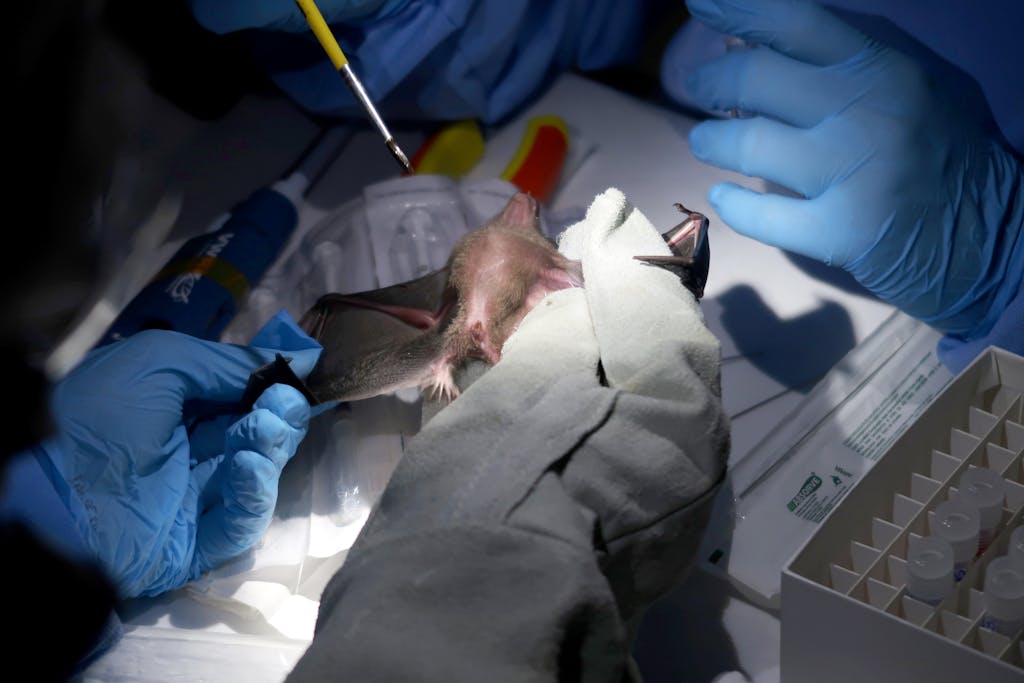
Dr. Alessandra Nava, a veterinary scientist based in the Brazilian city of Manaus, has made the rainforest her laboratory. She has dedicated her career to collecting samples from small mammals for the Fiocruz Amazônia Biobank, a research collection she helps oversee as part of a growing effort to track the spread of zoonotic pathogens, and perhaps ultimately help predict or even prevent another pandemic.

Veterinary researcher Dr. Alessandra Nava draws a blood sample from a bat captured near Manaus, Brazil. Her work is part of a growing effort to track the spread of zoonotic diseases in the Amazon rainforest as deforestation brings humans and wildlife into closer contact. Photo: Courtesy of Alessandra Ferreira Dales Nava

Her work exemplifies a holistic approach, fittingly dubbed “One Health,” that recognizes the indivisible link between animal, human, and environmental well-being. The UN-led initiative brings together the public health, veterinary, and environmental sectors and promotes food and water safety, nutrition, the control of zoonotic diseases, pollution management, and more.

“Nobody talked about ‘One Health’ 25 years ago,” Dr. Nava says. “When we keep the forest intact, it serves as a buffer zone.”

PROTECTING NATURE, JUST AS NATURE PROTECTS US

A higher risk of infectious outbreaks is just one of the many repercussions of biodiversity loss on human health.

By disrupting the delicate ecological balance that regulates our planet’s oxygen, water, and nutrient cycles, we risk unraveling the entire food chain by harming the many different species — large, small, and microscopic alike — that work together to pollinate, nourish, and ultimately sustain all of the plants and animals we consume. According to the UN Food and Agriculture Organization, for example, the alarming drop in the global bee population could upend agriculture as we know it.

Species extinction and habitat destruction also mean forfeiting the untapped potential of our natural world to yield new medicines for treating health problems. In fact, 70% of all cancer drugs today are natural or bio-inspired products. And scientists are still discovering new species each year, including a fungus that can eat plastic.

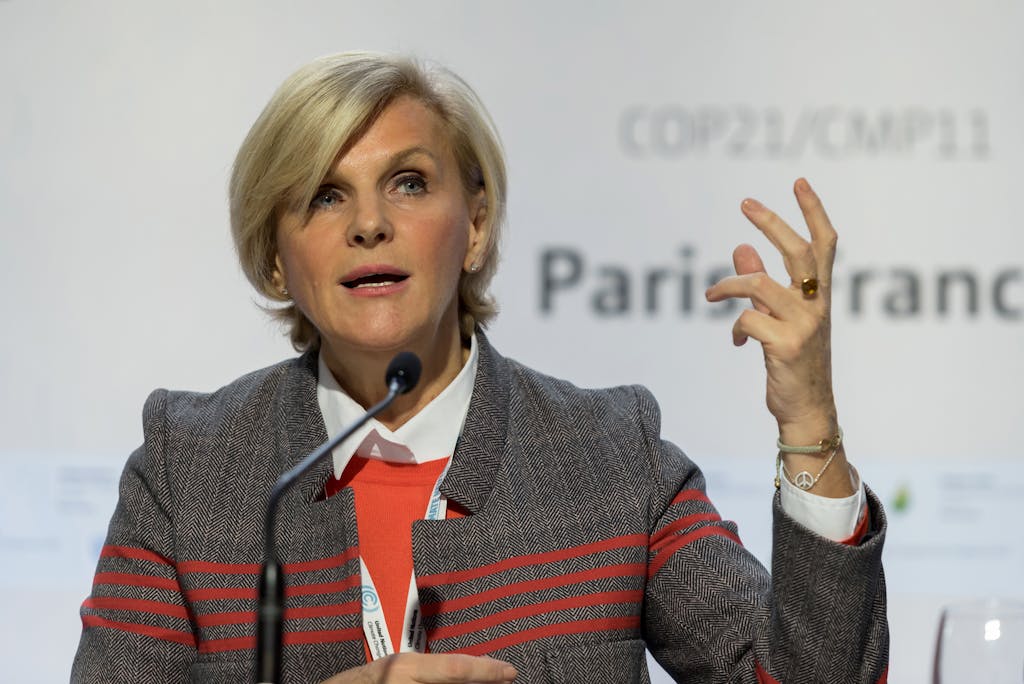
Dr. Maria Neira, WHO Director, Department of Public Health, Environmental and Social Determinants of Health, delivers a speech during the UN Climate Change Conference, COP21, in December 2015. Photo: Jonathan Raa/NurPhoto

Nature also provides significant and often underestimated mental health benefits for people. Dr. Maria Neira, Director of the Department of Environment, Climate Change and Health for the World Health Organization, witnessed this firsthand while working in refugee camps in Central America. There, she helped launch a project to grow traditional medicinal herbs that helped displaced families cultivate a sense of purpose, community, and beauty in an otherwise desperate situation.

“You rely on nature if you want to survive: It gives you food, it gives you water, it gives you trees that will protect the quality of the air you breathe,” Dr. Neira says. “It’s common sense: You need to protect what is protecting you. If we don’t, we are the losers, not the planet.”

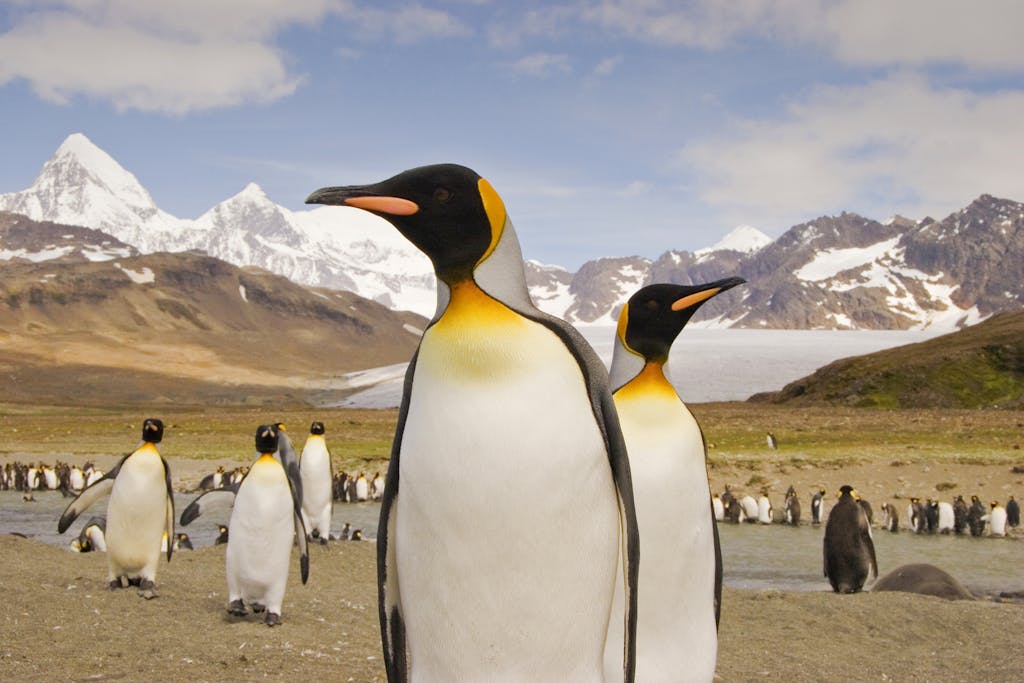
The King Penguins of South Georgia Island are an indicator species, which means that the size and health of their populations indicates the overall health of their ecosystem. A healthy penguin population indicates a healthy marine ecosystem. Photo: Gen Productions

HALTING THE ‘BIODIVERSITY APOCALYPSE’

Here’s the good news: Solutions already exist to restore and preserve the ecological well-being of the planet. Experts and advocates have long championed several critical ways to protect both biodiversity and human health.

Protecting and restoring natural habitats
Conservation is key. Today, according to the UN, one-third of the planet’s land is degraded, making it harder to feed a global population that recently surpassed 8 billion. Restoring biodiversity could also slow down climate change by storing carbon dioxide from the Earth’s atmosphere. Land and ocean ecosystems currently absorb 60% of human-caused emissions.

“Coastal and marine ecosystems like mangroves, sea grasses, and wetlands store far more carbon than terrestrial forests, sometimes up to 10 times as much,” says Susan Ruffo, the UN Foundation’s Senior Advisor for Ocean and Climate. During hurricanes, mangroves and other natural habitats can also shield coastlines from storm surges and flooding, averting loss of life and health impacts including respiratory illnesses, post-traumatic stress disorder, and infectious outbreaks that emerge after extreme weather events.

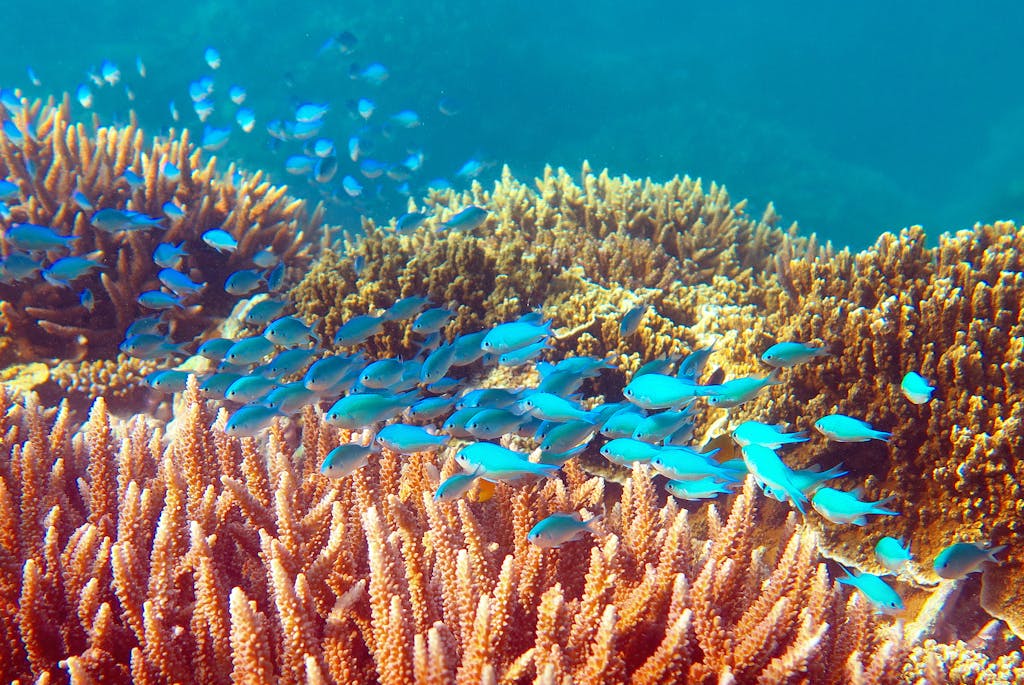
On the Great Barrier Reef, a school of blue fish swims above hard coral that’s beginning to bleach Coral bleaching can occur when sea surface temperatures rise or when there are changes in water quality, increased sun exposure and extreme low tides that also cause corals to bleach. Photo: Matt Francey

Prioritizing island nations
Islands play an outsized role in the planet’s biodiversity, hosting 20% of the Earth’s species despite taking up less than 4% of its surface area, according to Dr. Shobha Maharaj, a climate scientist and lead author for the latest report of the Intergovernmental Panel on Climate Change. The Caribbean, for instance, is home to 10% of the world’s coral reefs and approximately 1,500 species of fish and marine mammals. These “island-endemic” species are especially vulnerable to habitat destruction, pollution, and environmental changes. In fact, Dr. Maharaj says 80% of known species extinctions have occurred on islands. Yet there is a troubling absence of data from these places, Dr. Maharaj says, often as a result of inadequate investment and resources. A citizen of Trinidad and Tobago in the Caribbean, she says more people from island nations, particularly small island developing states, should be included in international decision-making to ensure that their unique insights, as well as the unique health threats they face, can inform global policy.

Supporting sustainable agriculture, fishing, shipping, and land use
Humanity’s continued reliance on industrial practices that raze the landscape — like oil drilling, fracking, mining, and factory farming — is destroying ecosystems while displacing, contaminating, and killing a vast number of species. A recent study found that croplands are expanding 58 times as fast today as they were 20 years ago, mainly to feed livestock amid the booming demand for meat.

Another priority: Promoting sustainable use of the ocean while addressing the hazards of industrial production, consumption, and the international shipping industry on life under water. Overfishing, ocean acidification, and plastic pollution are harming marine biodiversity and, in turn, reducing global fishing stocks, which 1 billion people worldwide rely on as a primary protein source.

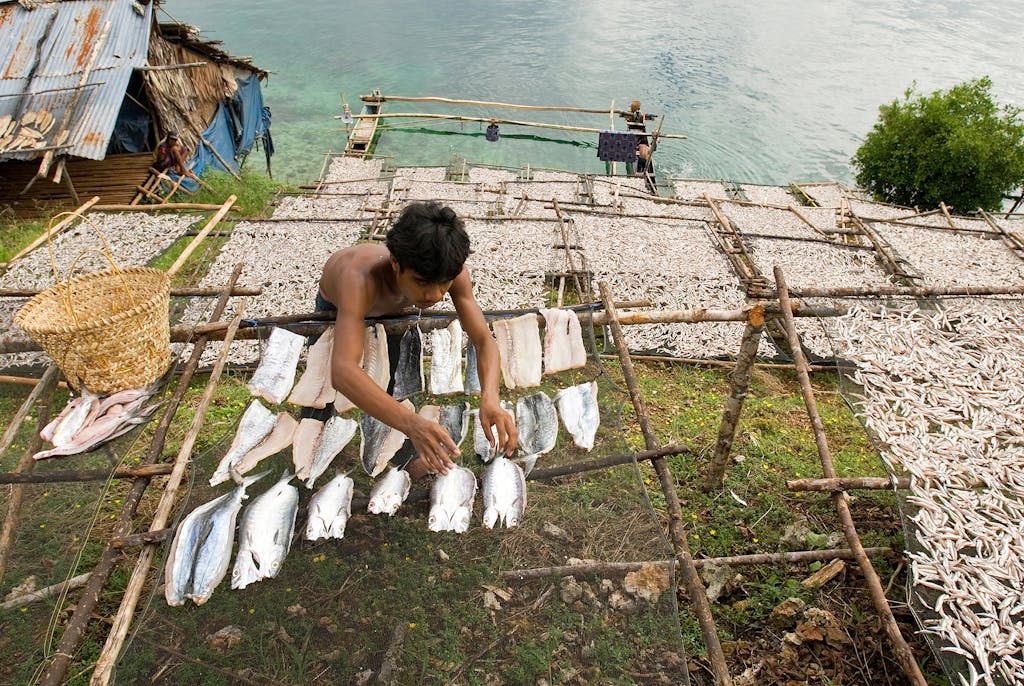
Butonese fishermen dry their catches under the sun in a temporary fishing village they set up on Waigeo Island, Raja Ampat Indonesia. Photo: Zafer Kizilkaya

Respecting Indigenous knowledge and rights
Indigenous people have long served as the planet’s most effective environmental stewards. In fact, research confirms that when Indigenous communities control the land, biodiversity flourishes. Yet only a few countries recognize Indigenous land rights. At the same time, given their close relationship and reliance on nature, Indigenous communities are often among the first to face the consequences of biodiversity loss. That’s why safeguarding their land rights, traditional knowledge, and political representation will be crucial to protecting the health of the land, air, water, soil, and wildlife and, in turn, human health overall.

This means incorporating Indigenous wisdom on the environment into global policymaking. In Indonesia, for example, a community-based coastal management system called sasi uses a traditional calendar to determine when certain species of fish can be harvested. In doing so, fishers avoid inadvertently depleting fish stocks during essential breeding seasons and, thus, maintain local food security.

NOW OR NEVER FOR NATURE

Protecting global biodiversity is too complex to be tackled by one country alone. Recent diplomatic breakthroughs such as the “30×30” initiative to protect 30% of the Earth’s land and water by 2030 could signal a turning point for global cooperation on ecological health.

But one thing is clear: Time is running out to take meaningful action on biodiversity loss. In the Amazon, for example, scientists warn that cutting down too many trees could result in the entire ecosystem degrading into grasslands — an irreversible tipping point that would drastically alter how the planet circulates water and oxygen, putting human health at risk.

“Without nature, we have nothing. Without nature, we are nothing,” UN Secretary-General António Guterres said at last year’s Biodiversity COP, where he urged world leaders to rally around a plan that “beats back the biodiversity apocalypse” by tackling its root causes: unsustainable consumption and production that views ecosystems as playthings of profit.

“It’s time,” he declared, “to forge a peace pact with nature.”

Surprise! This Tiny Animal May Be The Long-Lost Ancestor of Cows, Pigs, And Deer

NATURE19 May 2024

https://www.sciencealert.com/surprise-this-tiny-animal-may-be-the-long-lost-ancestor-of-cows-pigs-and-deer

ByDAVID NIELD

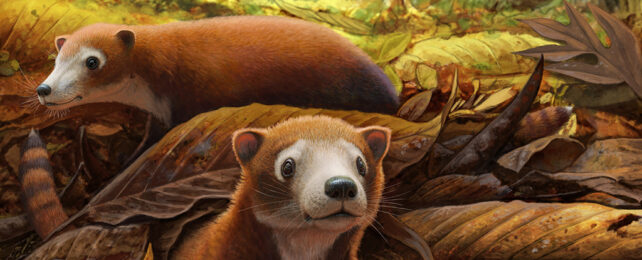
Militocodon lydaeA reconstruction of Militocodon lydae. (Denver Museum of Nature & Science)
Meet the newly discovered species Militocodon lydae: Thought to be about the size of a rat and weighing up to 455 grams or 16 ounces, this small mammal is the likely ancestor of all modern hoofed animals, called ungulates.

The animal would have lived around 65 million years ago, appearing just after the extinction of the dinosaurs, and was identified from part of a skull and jawbone recovered from the Corral Bluffs, a fossil site in Colorado.

According to the researchers behind the discovery, the creature fills some important gaps in our knowledge of the Periptychidae family of early mammals, which ascended after the dinosaurs‘ departure.

“The discovery and thorough descriptions and comparisons of the partial M. lydae skull represent an important step toward unraveling the complex evolutionary history of periptychid mammals,” paleontologist Lucas Weaver of Kent State University in Ohio and colleagues write in their published paper.

Earth Sciences fieldwork
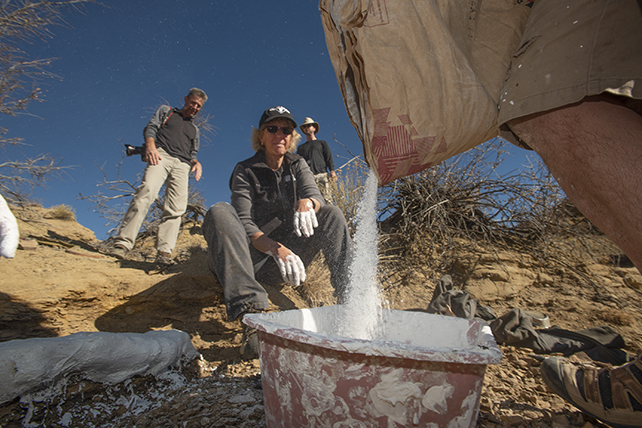
Fieldwork in the Corral Bluffs. (Rick Wicker)

After unearthing the specimen and cleaning it up, the team used sophisticated scanning techniques, 3D reconstructions, and teeth comparisons – measuring them against teeth from other fossils and modern-day animals – to put M. lydae in the right place on the evolutionary tree.

Key to the research was evidence that the animal’s teeth were used to shear and crush rather than grind. That suggests the small creature would eventually lead to the cows, pigs, and deer we have today.

The researchers have only found a handful of M. lydae fossils across the last eight years, so further discoveries and studies are still needed to confirm that this small and rather cute-looking animal is indeed what we think it is.

“The continued discovery and study of early Paleocene archaic ungulates will almost certainly reveal more specimens that do not fit neatly into existing taxonomic bins, forcing us to contend with an evolutionary history tangled by evolutionary grades and transitional forms,” the researchers write.

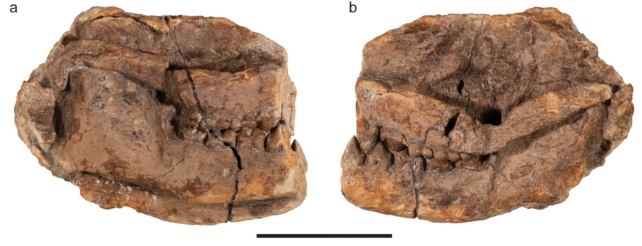
Two photos of small square shaped fossils of an animal's skull
Militocodon lydae skull viewed from each side, with several teeth preserved. Scale bar equals 2 cm. (Weaver et al., Journal of Mammalian Evolution, 2024)

Each new fossil discovery gives researchers a chance to refine and rethink the pattern of evolution on Earth – almost like the bigger picture comes into sharper focus every time a new find is analyzed.

Tracing the evolution of animals directly after the demise of the dinosaurs has been challenging for experts because of a paucity of fossils from this time. The Corral Bluffs site, which paleontologists have been excavating for decades, is proving increasingly valuable in helping to tackle that problem.

It would have been a time of speedy and widespread diversification in the animal kingdom, but particularly for mammals. After the dust settled from the asteroid impact, and with the dinosaurs out of the way, mammals like M. lydae took the opportunity to thrive.

“Rocks from this interval of time have a notoriously poor fossil record,” explains Denver Museum of Nature & Science paleontologist Tyler Lyson, who led the research team.

“The discovery and description of a fossil mammal skull is an important step forward in documenting the earliest diversification of mammals after Earth’s last mass extinction.”

The research has been published in the Journal of Mammalian Evolution.