Researchers find unexpectedly large methane source in overlooked landscape
Reply

August 5, 202410:16 AM ET
By
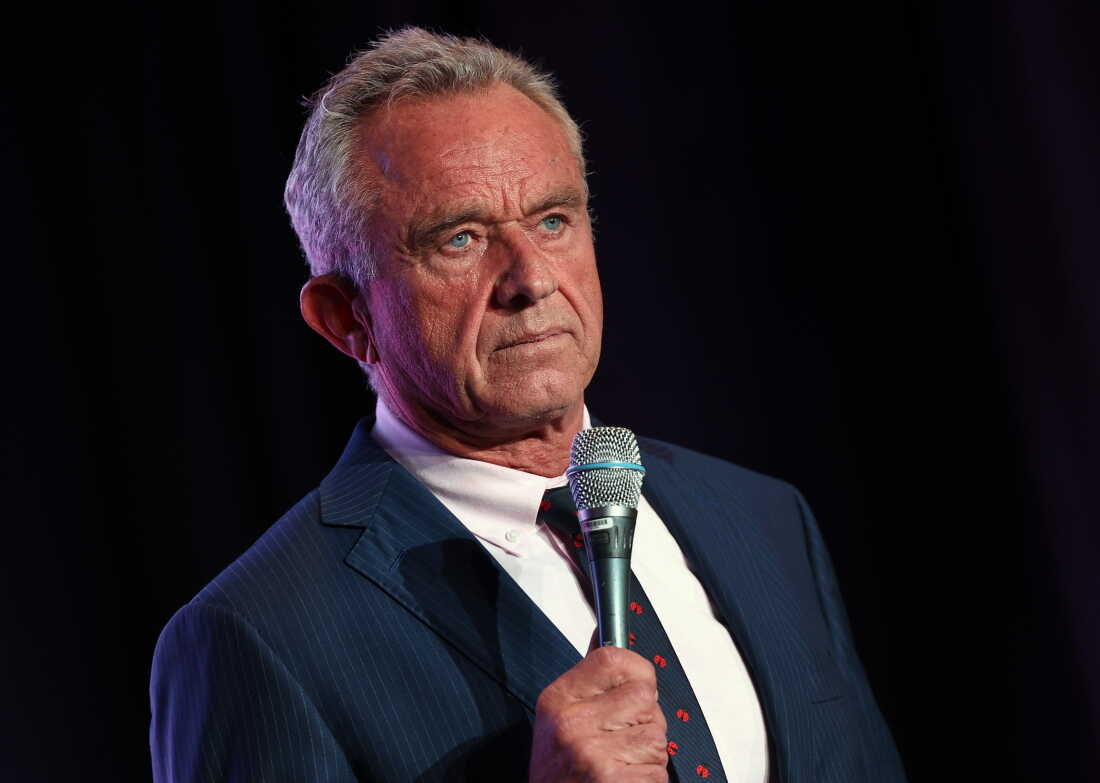
Independent presidential candidate Robert F. Kennedy Jr., pictured in May, released a video over the weekend recounting a 2014 incident in which he dumped a dead bear cub in Central Park to make it look like it had been in a bike crash.
Kevin Dietsch/Getty Images
For more on the 2024 election, head to the NPR Network’s live updates page.
A decade after the shocking discovery of a bear cub carcass in Manhattan’s Central Park, the mystery of who dumped it there has finally been solved.
And the man taking responsibility is none other than presidential candidate Robert F. Kennedy Jr.
The conspiracy theorist-turned-third-party candidate’s campaign has weathered a series of increasingly improbable-sounding scandals in recent months, from Kennedy’s admission that a worm ate part of his brain to his denial of reports that he once ate barbecued dog (he said it was a goat).
Sponsor Message
RFK unleashed this latest one himself, in a three-minute video posted to X (formerly Twitter) on Sunday.
It shows him sitting at a kitchen table, telling an incredulous-looking Roseanne Barr (yes, the canceled comedian) about how the dead bear ended up in his van upstate and, ultimately, on top of a bicycle beneath a bush in New York City’s largest urban park.
Kennedy, an animal lover and former environmental lawyer, says he was driving upstate early one morning to take a group of people falconing in the Hudson Valley when a driver in front of him fatally hit a bear cub.
“So I pulled over and I picked up the bear and put him in the back of my van, because I was gonna skin the bear,” he explains matter-of-factly. “It was in very good condition and I was gonna put the meat in my refrigerator.”
Kennedy added that it is legal in New York State to get a bear tag to take home a roadkill bear. Such a tag must be written up by a law enforcement officer.
The bear never made it back to his Westchester home, however.
Kennedy says he got waylaid by a busy day of falconry, and then had to rush back to New York City for a dinner at Peter Luger Steak House, which ran late.
Sponsor Message
“I had to go to the airport, and the bear was in my car, and I didn’t want to leave the bear in the car because that would have been bad,” Kennedy continues.
Then, as he put it, “the little bit of the redneck in me” had an idea.
Kennedy just happened to have an old bike in his car, which he said someone had asked him to get rid of. He recalled that the city “had just put in the bike lanes” after a number of serious accidents, and decided to stage the bear in Central Park as if it had been hit by a bike.
“I wasn’t drinking, of course, but people were drinking with me who thought this was a good idea,” Kennedy said. “So we went and did that and we thought it would be amusing for whoever found it, or something.”
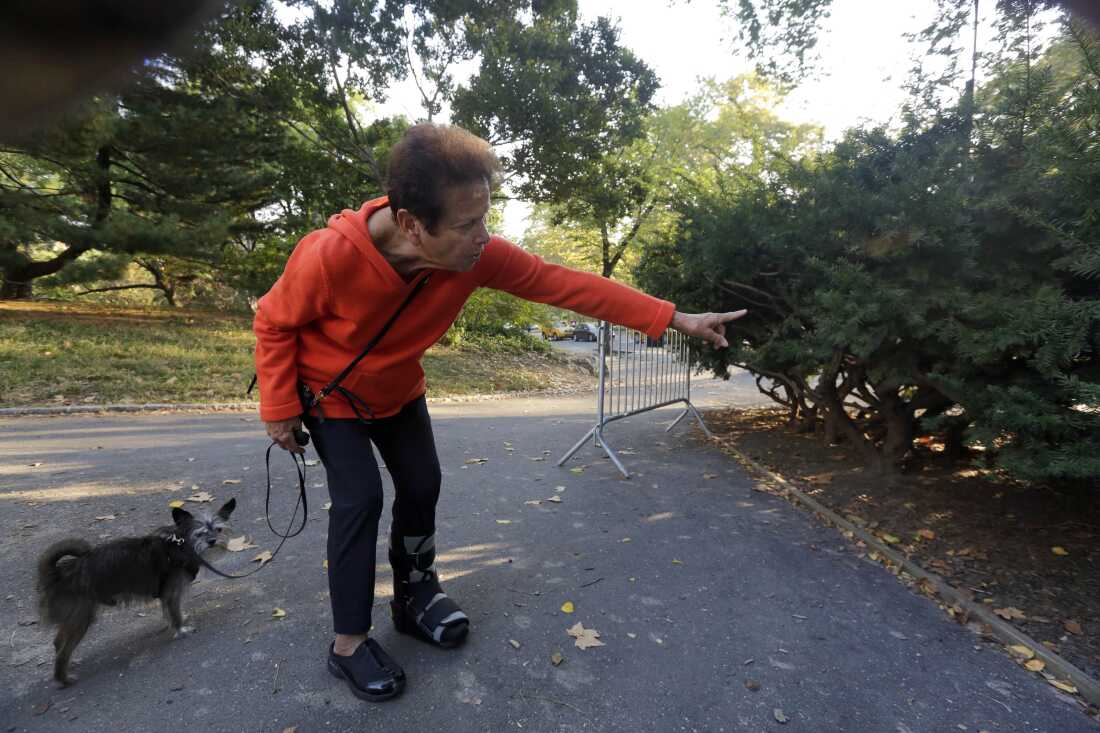
Florence Slatkin, with her dog Paco, points to the spot where she and a friend discovered a dead bear cub in New York’s Central Park, on Oct. 7, 2014.
Richard Drew/AP
The six-month-old, 44-pound cub made national news after a dog walker stumbled upon it that fateful October morning, in a wide-open part of the park right near the path where thousands of people run and bike each day.
Weirdly enough, one of the New York Times reporters who covered the mystery was Caroline Kennedy’s daughter Tatiana Schlossberg, RJK Jr.’s first cousin once removed. She told the paper this weekend that “like law enforcement, I had no idea who was responsible for this when I wrote the story.”
Law enforcement took the bear to Albany for analysis and determined that it had been hit by a car, likely outside the park. They also confiscated the bicycle to test for fingerprints.
“I was worried because my prints were all over that bike,” Kennedy says in the video, drawing laughs from the room.
But the mystery remained unsolved, and the story eventually faded away. Now, almost 10 years later, Kennedy said he was prompted to come clean ahead of an anticipated New Yorker exposé: “Looking forward to seeing how you spin this one,” he captioned the video.
Sponsor Message
“They asked me, the fact checkers, and, you know, it’s gonna be a bad story,” he says with a laugh.
The New Yorker piece, published online Monday morning, situates the bear anecdote within a larger look at Kennedy’s famously checkered past and motivations for running.
It also includes a photo of Kennedy, who was 60 at the time, posing with his hands inside the bear’s bloody mouth and an exaggerated grimace on his face.
“Maybe that’s where I got my brain worm,” he told the magazine.
Kennedy also made headlines during the Republican National Convention in July after a leaked call with former President Donald Trump captured the Republican nominee criticizing vaccines (a stance for which Kennedy is famous) and appealing to Kennedy with a vague, “I would love for you to do something.”
Kennedy apologized to the president and, seeking to quash speculation, vowed to stay in the race. But he has seen his support dwindle — down to single digits in several national polls — in the weeks since President Biden announced his withdrawal. His fight to get onto state ballots has reportedly been a financial drain, and he’s canceled multiple campaign appearances over the last month.
August 5, 2024 by Sentient Media Leave a Comment
By Seth Millstein, Sentient Media
In the 10,000 years since humans first developed animal agriculture, livestock farming has become central to modern society. Unfortunately, it’s also become one of the biggest drivers of climate change and environmental destruction. Animal farms create a staggering amount of air, water and land pollution, and with the consequences of climate change worsening by the year, addressing the environmental impacts of livestock farming is more important than ever.
Global warming is an enormous part of climate change, but it’s not the only part. The concept of climate change encompasses not only rising global temperatures, but all sorts of other changes to the natural composition of Earth and its atmosphere, such as water pollution and land degradation. Here are some of the ways livestock farming contributes to those changes.
One of the biggest ways livestock farming contributes to climate change is through the emission of greenhouse gasses, which trap heat in the Earth’s atmosphere and cause global temperatures to rise. Insofar as livestock is concerned, there are three greenhouse gasses in particular of note.
Because there are multiple greenhouse gasses with different warming potentials, greenhouse emissions are commonly converted to and measured in CO2-equivalents, or CO2-eq.
In various ways and to varying degrees, livestock farming emits all of the aforementioned greenhouse gasses. Here’s how.
Livestock are a significant source of methane emissions, thanks to a natural biological process called enteric fermentation. Cows, sheep, goats and other ruminant livestock have microbes in their digestive systems that decompose and ferment the food they eat, and methane is a byproduct of this fermentation process.
That methane is released into the atmosphere when the animals burp or fart, and it’s also contained in their urine and manure. One cow can produce up to 264 pounds of methane every year, and it’s estimated that in total, enteric fermentation from ruminant livestock is responsible for 30 percent of global anthropogenic methane emissions.
Farm animals produce around 450 million tons of manure every year, and figuring out what to do with it is a major challenge for livestock farmers. Some farms store manure in large piles, landfills or lagoons — known as “settlement ponds” — while others simply dump it onto cropland and use it as untreated fertilizer.
All of these management methods result in the release of methane and nitrous oxide, which manure also contains. When manure is stored in an environment with insufficient oxygen, as is often the case with landfills and lagoons, it undergoes a process known as anaerobic decay, and releases nitrous oxide and methane into the air as a result. In addition, structural failures or extreme weather events often cause the manure in settlement ponds to leak into nearby soil and waterways.
When manure is used as fertilizer, it releases nitrogen into the soil. That’s the point of fertilizer, as plants need a certain amount of nitrogen to grow. But when farms use this type of fertilization as a disposal method for excess manure, they often over-apply it to the crops in question, which causes the soil to absorb more nitrogen than is necessary.
You might wonder why it matters if soil contains too much nitrogen. There are two intertwined reasons: nutrient runoff and soil erosion.
Nutrient runoff occurs when rain, wind or other environmental forces disrupt soil and carry it into nearby waterways. When that soil has been fertilized with untreated manure, it pollutes the water in question, both with nitrogen and other toxins that are common in manure, like phosphorus. Nitrogen and phosphorus both stimulate algae growth, and excessive algae growth in a body of water leads to harmful algal blooms.
As their name implies, harmful algal blooms have a host of damaging environmental consequences. They release toxins that kill aquatic life and poison the drinking water, which can cause serious illness and even death in humans. Algal blooms reduce the amount of dissolved oxygen in the water, which aquatic life relies on, and prevent light from penetrating the water’s surface, thus choking the life out of coral reefs and other aquatic plants that are crucial to Earth’s ecosystems.
Nutrient runoff is exacerbated by another consequence of livestock farming: soil erosion. This is when topsoil particles become loosened and detached, which diminishes the quality of the soil and makes it much more susceptible to nutrient runoff.
A degree of soil erosion occurs naturally, but livestock farming greatly accelerates it in a few ways. One is overgrazing, which is when livestock graze on pastures for extended periods without the pastures being given time to recover. The hooves of cows, goats and other ruminant livestock can erode the soil as well, especially when many of them are grazing in one place.
Don’t like ads? Become a supporter and enjoy The Good Men Project ad free
In addition to making nutrient runoff more likely, eroded soil is less fertile and can support fewer forms of plant life. It is also worse at retaining water, which can increase the risk of drought.
It’s impossible to assess the environmental impacts of livestock farming without also discussing deforestation — the practice of permanently clearing out trees from forested land and repurposing the land for other uses. Humans deforest around 10 million hectares of land every year, and 41 percent of tropical deforestation is carried out to make way for cattle pastures.
Deforestation is a monumentally damaging practice, and exacerbates all of the aforementioned impacts of livestock farming: greenhouse emissions, nutrient runoff and soil erosion.
When forested land is cut down, greenhouse emissions increase in two ways — one temporary, one permanent.
Trees absorb and store carbon dioxide from the atmosphere, which makes them an indispensable resource for reducing global temperatures. When they’re cut down, however, all of that carbon dioxide is released back into the air. What’s more, the absence of trees in a previously forested area means that, for an indefinite period of time, any atmospheric carbon dioxide that would otherwise have been sequestered by the trees remains in the atmosphere instead.
The greenhouse gasses emitted during livestock-driven deforestation, combined with the gasses emitted by livestock farms themselves, account for 11-20 percent of all greenhouse gas emissions worldwide. In the Amazon, which has traditionally been one of the world’s largest sequesterers of carbon, so much land has been deforested that the rainforest is in danger of becoming a net emitter of carbon instead.
In forested land, trees play an important role in protecting and preserving the soil. The canopy they provide protects the soil from the sun and rain, while the trees’ roots help hold the soil in place.
Needless to say, clearing all of the trees in a forested area means that the soil doesn’t get any of these benefits. As a result, the soil becomes eroded even before any livestock might step foot on it, which in turn increases the likelihood of nutrient runoff and water pollution.
The environmental impact of livestock farming can’t be ignored. The sector’s contribution to deforestation, habitat loss and pollution of all kinds significantly exacerbates climate change. Absent a significant reduction in global meat consumption, it will continue to present a formidable challenge to the long-term health of Earth and its many inhabitants.
Don’t like ads? Become a supporter and enjoy The Good Men Project ad free
This article originally appeared in Sentient at https://sentientmedia.org/how-does-livestock-affect-climate-change/.
Edith Olmsted
Mon, August 5, 2024 at 7:43 AM PDT
https://www.yahoo.com/news/rfk-jr-deranged-dead-baby-144352071.html
1 min read1.1k
Robert F. Kennedy Jr. posed for a shocking photograph with a dead bear cub he’d picked up on the side of the road in 2014, shortly before dumping its carcass in Central Park.
A photo published in The New Yorker Monday shows Kennedy sitting in the back of a car, with his hand placed in the mouth of a deceased bear cub. The animal is visibly bloodied from its accident, and Kennedy’s face appears contorted with phony anguish at the bite.

When asked about the photograph, Kennedy told The New Yorker, “Maybe that’s where I got my brain worm.”
After showing his furry find off to his friends, Kennedy brought the cub’s body to Manhattan, where he proceeded to mutilate it to make it appear like it’d been killed by a cyclist, according to The New Yorker.
Before the story broke Monday, Kennedy posted a video on X, in which he said that he thought the dead bear would be “funny for people” and “amusing for whoever found it or something,” he said, because of a recent spate of bike accidents in New York City.
Kennedy said he’d originally intended to take the bear cub home, skin it, and keep its meat but had run out of time before having to go to the airport.
Kennedy, who is running as an independent candidate for president of the United States of America, was polling at 5.5 percent Monday, according to Project 538.

 Exposing the Big Game