The truth about the ‘de-extinction’ of the dire wolf after 10,000 years
Reply

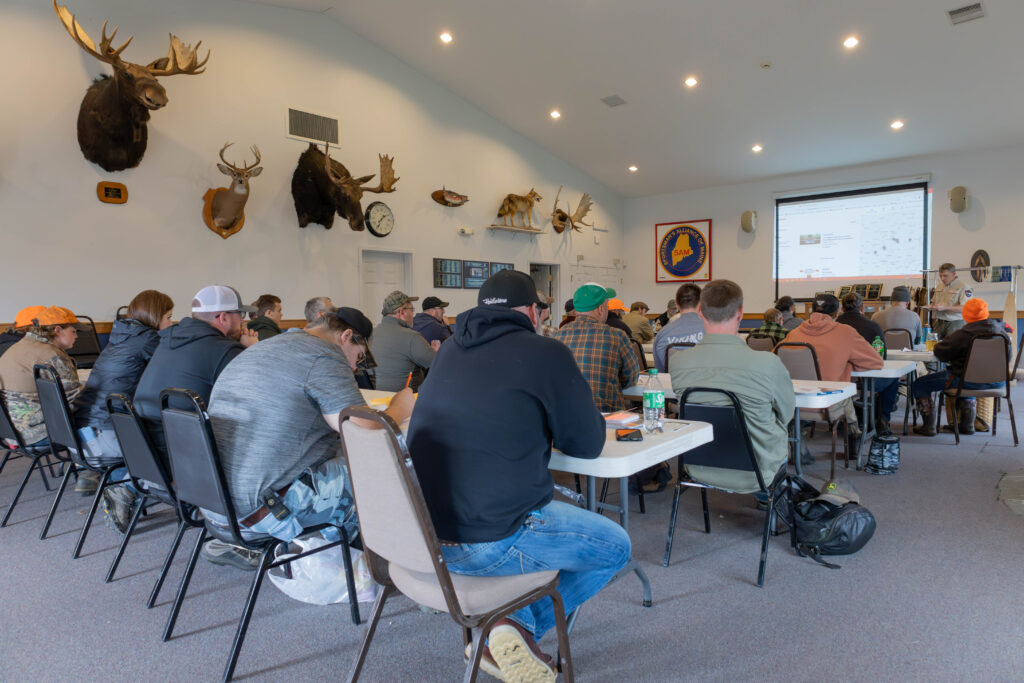
Photo courtesy of Ron Fournier TRAPPER CLASS — The classroom was full at this 2023 trapper education class the state of Maine offered. Participants can get their trapper license after successfully completing the course.
Staff, Piscataquis Observer •April 8, 2025
By Julie Harris, Bangor Daily News Staff
Trapping animals may be one of the oldest types of hunting in Maine. At least that’s what one member of the Maine Trappers Associated was pointing out when he said this country was built on the fur trade.
But it also has evolved. Maine allows foot-hold traps, but has specific regulations on how they are set, how often the trapper has to tend them and when and where they can be used. The law also bans trapping lynx and requires an exclusion device that helps keep the protected species safe.
And unlike many states, Maine requires trapper education in order to obtain a trapping license. Interest in trapping is on the rise. The Maine Department of Inland Fisheries and Wildlife is also working on closing a loophole that allows people from other places who have had trapper licenses to come to Maine and get one without going through an education course.
The number of people taking IF&W trapping courses has increased from 149 in 2020 — the COVID-19 pandemic year — to 770 in 2024, and is still going strong, he said.
Not all states require trapper education to obtain a license. Maine law allows someone who has taken a course elsewhere or who has had a prior license in another state to get a license without taking the state’s education course.
An element of the department’s omnibus bill LD152 will close that loophole, and require everyone to take trapper education, according to Ron Fournier, recreational safety supervisor for the DIF&W.
The state offers beginner courses on trapping and the Maine Trappers Association has at least five members who are certified instructors. The state and the MTA work together too. The state’s course is based on the one taught through the MTA.
“We just added more equipment and new ideas and we stay with the student beyond the course, through next-step programs,” Fournier said.
As a matter of fact, trapper education is the most in-demand course the department offers at the moment. The backlog of people who want to get into trapping has prompted DIF&W to offer additional sessions.
David Trahan, executive director for Sportsman’s Alliance of Maine, told the Maine trappers during their recent meeting it is the predominant class the state is offering at SAM’s new outdoor recreation education facility.
SAM’s facility is perfect for DIF&W’s classes that teach people how to hunt for various species, fish, trap, use a compass and other skills. It is centrally located in Augusta and has the environment needed for students to experience outdoors what they have learned in the classroom, Fournier said.
Maine requires an online course or its equivalent of a 132-page manual with a 40-page workbook; how to avoid catching a lynx video; and an eight-hour in-person class. There also are “next step” classes, such as how to process your furs.
Three of the primary reasons people said they signed up for trapping class were to expand their outdoor activities into something new, predator management and catching, processing and selling furs.
People also liked being outdoors, obtaining some of their own food and having new material for crafts.
Students are taught the different ways the animals they trap can be used to minimize waste, how to talk to non-trappers non-confrontationally and how to tell the story of trapping and its scientific benefits.
The DIF&W does not actively promote trapping, he said, but sees it as an education opportunity.
Maine has one of the most restrictive and comprehensive courses in the nation, and it’s in step with conservation, he said, pointing out that all instructors are state-certified and members of the Maine Trappers Association. Biologists, the state’s wildlife team and the MTA all are involved in the curriculum.
“There’s a culture shift. People are seeing trapping as sound conservation management,” Fournier said.

StudyFindsFollow
4.3K Followers
MELBOURNE BEACH, Fla. — Florida’s Indian River Lagoon made headlines in 2013 when bottlenose dolphins began washing up dead on shores in alarming numbers. By year’s end, 77 dolphins, roughly 8% of the local population, had died in what scientists term an “unusual mortality event” (UME).
Homebuddy.comHere’s The Average Price of a 6-Hour Gutter Upgrade in Winthrop
This wasn’t the first dolphin die-off in the lagoon. Similar events had occurred in 2001 and 2008, but the 2013 incident stood apart. For the first time, researchers identified “ecological factors” as the primary cause. But what exactly happened to trigger such widespread deaths?
A team of Florida scientists from various universities and research institutes traced a disturbing sequence that begins with nutrient pollution from human activities, triggers massive algal blooms, destroys critical underwater habitats, and forces dolphins to switch to less nutritious prey, with fatal consequences.
Their findings, published in Frontiers in Marine Science, show how human impacts on coastal environments can harm even apex predators like dolphins. As the researchers note, bottlenose dolphins function as “sentinel species” in coastal ecosystems, canaries in the coal mine that signal when environmental conditions have deteriorated.
A healthy Bottlenose Dolphin leaping out of the water. (Tory Kallman on Shutterstock)
Despite its name, the Indian River Lagoon isn’t actually a river. This coastal system stretches about 250 kilometers along Florida’s east coast and consists of three connected bodies of water: Mosquito Lagoon, Banana River Lagoon, and the Indian River Lagoon proper. With only five inlets connecting to the Atlantic Ocean, most in the southern portion, water in some areas takes over a year to flush out and refresh.Related video: Amazing Animals Living in the Ocean (AZ Animals US)
about:blank

Amazing Animals Living in the Ocean
This poor circulation makes the lagoon particularly susceptible to pollution. The surrounding region has experienced tremendous population growth, from roughly 97,000 people in 1940 to about 1.6 million by 2010. More people mean more fertilizers, septic systems, and other sources of nutrient-rich runoff flowing into the lagoon.
For years, the ecosystem remained relatively stable despite these pressures. Then came 2011, when everything changed. Massive blooms of microscopic algae called phytoplankton appeared throughout the lagoon. These weren’t brief episodes but persistent blooms that lasted 3-6 months.
Thick algae clouds in the water blocked sunlight from reaching the lagoon floor. Without adequate light, two essential habitats began dying off: seagrasses rooted in the bottom and larger floating algae (macroalgae) that many fish use for shelter and food.
#1 Rated Hearing Aid In The US
By 2012, surveys documented more than a 50% drop in seagrass coverage and a dramatic 75% decrease in drifting macroalgae. This habitat collapse quickly affected the fish communities that dolphins depend on for survival.
To track how these changes impacted the dolphins, researchers used several techniques. They analyzed chemical elements called stable isotopes in muscle samples from 147 stranded dolphins collected between 1993 and 2013. These isotopes are like food fingerprints that get stored in body tissues, revealing what the animals had been eating over previous months.
The team also examined teeth from 44 dolphins born between 1957 and 2015. The collagen in dolphin teeth preserves these chemical signatures from when the tooth formed, creating a historical record of environmental changes.
After 2011, clear evidence showed dolphins had shifted their diets. They were eating less ladyfish (Elops saurus) and more sea bream (Archosargus rhomboidalis). For adult dolphins, this meant a 14-20% decrease in ladyfish consumption with a 9-25% increase in sea bream.
Pet Health Gurus3 Toxic Foods for Dogs: The One Meat You Should Never Feed Your Dog
This wasn’t just a simple dietary switch; it had serious implications. The researchers measured the energy content of both fish species and found ladyfish provide about 4.5 kilojoules of energy per gram, while sea bream deliver only about 3.9 kilojoules per gram. In simple terms, this is like comparing a high-calorie food to a low-calorie one. Dolphins needed to catch and eat approximately 15% more sea bream than ladyfish to get the same nutritional value.
For animals that must consume large quantities of fish daily, typically 4-5% of their body weight, this created a significant energy deficit. A 400-pound dolphin needs to eat 16-20 pounds of fish every day. If those fish contain less energy, the dolphin must either find and catch more or slowly starve.
The dolphins weren’t choosing sea bream over ladyfish out of preference. Data from the Florida Fish and Wildlife Conservation Commission showed ladyfish populations in the lagoon had crashed after 2011, while sea bream numbers increased. The dolphins were simply eating what was available, but what was available wasn’t giving them enough nutrition.
The problem reached far beyond the 77 dolphins that died during the 2013 event. When researchers assessed 337 living, free-swimming dolphins in the northern parts of the lagoon that same year, they found 64% were underweight and 5% were severely emaciated. The ecological changes had created a widespread nutritional crisis throughout the dolphin population.
Other factors likely worsened the situation. Unusually cold water temperatures in 2010 and 2011 would have increased the dolphins’ energy requirements at precisely the wrong time. When water temperatures fall below 10°C (50°F), dolphins burn more calories maintaining body temperature, creating a perfect storm: higher energy needs coupled with less nutritious food.
Unlike some previous dolphin die-offs linked to low salinity, that wasn’t a factor here. Salinities in the lagoon were actually increasing during this period, moving closer to normal seawater conditions rather than dropping to stressful levels.
This research reveals a sobering chain reaction: Nutrient pollution from the growing human population fueled massive algal blooms. These blooms blocked sunlight, killing seagrass beds and drifting macroalgae that fish need to thrive. The habitat loss altered fish communities, forcing dolphins to switch to less nutritious prey. This dietary shift, possibly made worse by cold temperatures, led to widespread malnutrition and, eventually, many deaths.
Bottlenose dolphins live 40-60 years in the wild and integrate signals from throughout the food web as top predators. Their deaths serve as an alarm bell about ecosystem health.
There is room for hope. Efforts are underway to reduce the nutrient loads that triggered the algal blooms, with targets for safe levels set for 2035. However, additional adaptive management strategies may be needed to prevent future harmful algal blooms.
Environmental issues we often consider separately are sometimes deeply intertwined. When we alter one part of an ecosystem, effects can ripple through in ways that eventually threaten even its most resilient inhabitants.
Researchers analyzed stable isotopes (different forms of elements like carbon and nitrogen that vary based on diet) in teeth from 44 dolphins born between 1957-2015 and muscle samples from 147 stranded dolphins collected between 1993-2013. These chemical signatures revealed what dolphins had been eating and how their environment changed over time. The team tracked prey availability using standardized fish sampling data from seine net hauls throughout the lagoon. They measured energy content of fish species in the lab and examined seagrass coverage, macroalgae biomass, and water quality data to establish connections between habitat changes and dolphin health.
Dolphin diets shifted significantly after 2011, with a 14-20% decrease in ladyfish consumption and a 9-25% increase in sea bream consumption among adults. Laboratory analysis revealed sea bream provide approximately 15% less energy (calories) per gram than ladyfish (3.9 vs. 4.5 kilojoules per gram), meaning dolphins would need to eat more to maintain their energy needs. These dietary changes coincided with dramatic ecological shifts: seagrass cover decreased by more than 50% between 2010-2012, while drifting macroalgae biomass fell by 75-85% following persistent algal blooms. During the 2013 mortality event, malnutrition was identified in 61% of dolphin deaths, compared to an average of 17% in other years. Surveys found 64% of living dolphins were underweight and 5% severely emaciated.
The stable isotope analysis couldn’t account for all potential prey species in dolphin diets. Sample sizes were relatively small for certain subgroups, particularly young dolphins. Since the study primarily relied on stranded dolphins, the samples may not fully represent the entire population. The research would have benefited from more extensive prey sampling and analysis of samples from healthy, free-swimming dolphins. While the study established connections between ecological changes and dolphin mortality, it couldn’t completely rule out other contributing factors like disease or environmental contaminants.
This study documents a clear chain of ecological effects from human activities to marine mammal mortality: nutrient pollution triggered algal blooms, which destroyed key habitats, which altered fish communities, which forced dolphins to change their diets, leading to malnutrition and death. This demonstrates how comprehensive ecosystem monitoring can identify environmental threats before they cause catastrophic outcomes. The partial recovery of seagrass and macroalgae after 2012 suggests these habitats can rebound if conditions improve. Bottlenose dolphins serve as valuable sentinel species for coastal ecosystem health due to their longevity, position as top predators, and dependence on intact food webs.
Research was funded by contracts from the St. Johns River Water Management District and grants from the Indian River Lagoon National Estuary Program, John H. Prescott Marine Mammal Rescue Assistance Grant Program, SeaWorld Busch Gardens Conservation Fund, and others. Fisheries monitoring was supported by Florida saltwater fishing license proceeds and Federal Aid in Sport Fish Restoration Act funding. The authors declared no conflicts of interest, though one author disclosed being an editorial board member of Frontiers at submission time, which had no impact on the peer review process.
The study, “An unusual mortality event for bottlenose dolphins links to altered diets resulting from ecological changes,” was published in Frontiers in Marine Science on April 7, 2025. The research team included Megan K. Stolen, Wendy Noke Durden, Teresa Jablonski, Graham A. J. Worthy, Richard Paperno, and Charles A. Jacoby from Hubbs-SeaWorld Research Institute, University of Central Florida, Florida Fish and Wildlife Conservation Commission, and St. Johns River Water Management District.

 Exposing the Big Game