The Okeene Rattlesnake Roundup
Reply


Michigan’s geese are under threat. Across the state, permits are being applied for in order to authorize the mass killing of geese, with entire flocks rounded up and gassed in a cruel and unnecessary attempt to reduce their numbers.
Michigan’s geese are being scapegoated for human-caused environmental issues, despite the availability of humane, non-lethal solutions. With the May 16, 2025, deadline for residents to apply for goose gassing permits fast approaching, now is the time to act. Contact key officials to demand science-based, non-lethal solutions over mass killings, and attend the April 10th Natural Resources Commission Meeting in Lansing to make your voice heard.
Decisions about Michigan’s wildlife should not be left to a handful of lakefront homeowners with a vested interest in exterminating geese for convenience. The broader community deserves a say in how these situations are handled.
Michigan’s geese are being systematically targeted based on misleading claims, while the real threats to waterways — agricultural runoff, septic failures, and pollution—go ignored. Mass culls (killings) ignore these root causes while inflicting suffering on animals who are merely trying to exist in their natural habitats.
The methods used to kill geese are both inhumane and irresponsible. Entire families are captured and painfully gassed to death. To make matters worse, the discarded bodies of these birds are thrown into landfills, raising concerns about the potential spread of disease, particularly bird influenza. If geese were truly a health risk, their carcasses would not be disposed of in a manner that allows scavengers to spread the virus further.
Michiganders have the power to stand up for geese and demand ethical, non-lethal management solutions in their own communities. Humane deterrents, such as habitat modification and hazing, are not only effective but also sustainable long-term solutions. Join us in raising your voice against these cruel and unnecessary killings.
You can also explore our goose resources for communities and decision-makers to learn more about how you can advocate for non-lethal solutions. The geese of Michigan deserve our protection. Speak up to ensure that they receive it. Let’s make sure they get it.
In March, we hosted a virtual panel discussion for Michigan residents with experts on water quality and non-lethal goose mitigation. Please watch and share the replay, along with these helpful resources, so you can advocate for geese with confidence.

Take action now to protect Michigan’s geese! Contact your officials to oppose mass-killing permits and demand humane, science-based solutions. Attend the April 10, 2025, Natural Resources Commission Meeting in Lansing to make your voice heard in person.
1. Make Calls. Call your local officials to oppose mass-killing permits and to demand humane, science-based solutions.
Governor Gretchen Whitmer
Phone: (517) 335-7858
Michigan DNR Director, Scott Bowen
Phone: (517) 284-6367
Michigan Natural Resources Committee
Phone: (517) 373-2426 / (855) 347-8014
DNR Wildlife Division – Sarah Thompson
Phone: (517) 284-9453
Local USDA Office
Phone: (517) 318-3471
2. Get Informed. Watch our goose mitigation virtual panel for Michiganders with experts on water quality and non-lethal options. Access speaker contacts, presentations, and resources in this helpful guide.
Visit our website for more resources: www.stopgooseabuse.org
3. Make the Connection. Geese are being scapegoated for avian flu, yet the disease is primarily spread through the mass confinement of chickens in factory farms, where they are raised for their flesh. This not only threatens human health but also contributes to the abuse and suffering of chickens.
Explore a compassionate alternative—check out our Vegan Starter Guide today!
4. Show Up In Person. Attend the Natural Resources Commission Meeting on April 10 and speak up for geese! Take a look at the agenda for more information, and read over the guidelines for public comments. When you arrive, please sign up to speak for up to three minutes.
Where: Lansing Community College, West Campus Rooms M119-121 5708 Cornerstone Drive, Lansing, MI 48917
When: 9:30 a.m.
5. Send Your Comments. Send your comments to ask Michigan officials to stand up against cruelty to geese.
Sign to immediately deliver your comments to:
In Defense of Animals provides an easy to use for to send your comments. Look for the blue form on the right side of the page:
In Defense of Animals fully expects and strongly urges all people involved in this campaign to act responsibly and lawfully and to respect the personal interests and privacy rights and concerns of any individuals who may be affected by, or become the subject of, your protests or related efforts.

International Respect for Chickens Day May 4, 2025
Urge NY Governor Hochul to Permanently Shut Down Live Bird Markets
UPC “Don’t Gobble Me!” Truck and Bus Ads Are Turning Heads
Urge Marriott to Discontinue Feather & Down Products
Chickens Talk. Are You Listening?
Podcast: Avian Influenza (Bird Flu) – Fiction versus Fact
Karen Davis, President and Founder of UPC, Has Passed Away
The Humane Hoax: Essays Exposing the Myth of Happy Meat, Humane Dairy, and Ethical Eggs
“What Does Animal LIBERATION Really Mean?” Now Posted!
What’s Wrong with ‘Humanely Raised’ Poultry and Eggs?
FOR THE BIRDS
“Can Only Be Described with Superlatives”
– Animal Culture Magazine
Alliance to End
Chickens As Kaparos
EndChickensAsKaporos.com
Vegan Starter Kit
Great Recipes & More
Order Printed Copies!
PO Box 150
Machipongo, VA 23405 USA
|
Melanie Stetson Freeman/Staff
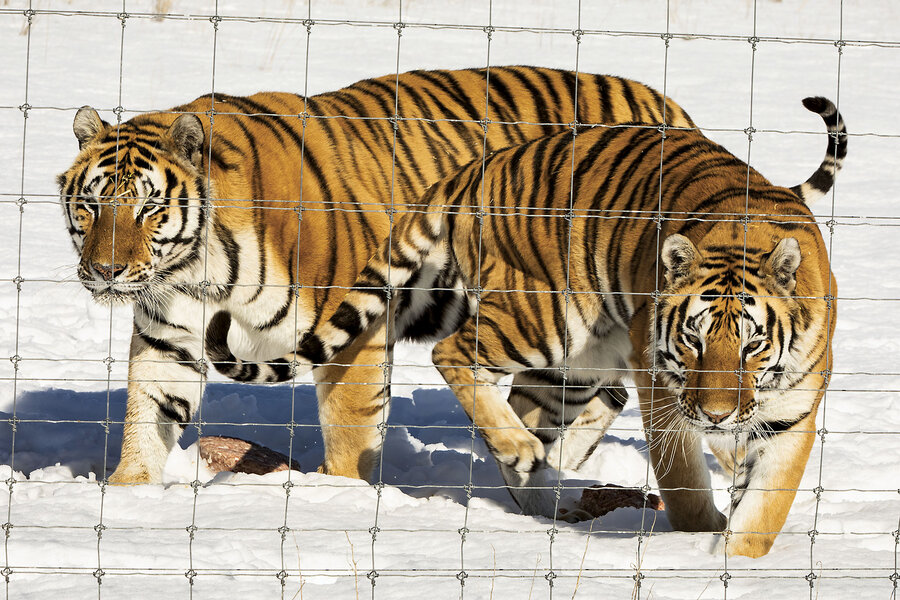
ROAM SWEET ROAM: Mobo (back) and Noelle, a bonded tiger pair, interact at The Wild Animal Sanctuary in Keenesburg, Colorado, Oct. 10, 2024.
April 04, 2025, 7:00 a.m. ET|Keenesburg, Colo.
At a distance, the snowy Rocky Mountains line the horizon like lace. Otherwise, it’s hard to tell this is Colorado, given the tigers, lions, leopards, and other foreign carnivores.
This isn’t a zoo, and don’t let the fencing fool you. This is The Wild Animal Sanctuary, where more than 450 animals brought to Colorado’s eastern plains get a second chance to roam. The sanctuary spans over 1,200 acres and rehabilitates captive exotic and endangered animals. For some, this might be the first time their paws have touched grass.
Below the elevated walkway where visitors watch, a jaguar patrols the edge of a fence. The nonprofit says Manchas was a neglected pet in Mexico, confused about his identity after he was raised by the family’s dogs. Other rescues have come from Bolivian circuses, an Iowa mall, and a shuttered Puerto Rican zoo. About 150 came from the cages of the Netflix show “Tiger King.”
Some formerly captive exotic animals have never had their paws touch grass before. The Wild Animal Sanctuary gives them space to roam.
In the view of Austin Hill, public relations director at the sanctuary, the need to rescue animals can result from owners’ warped priorities. “People were trying to mistake human want for animal need,” he says.

Melanie Stetson Freeman/Staff
BEAR ESSENTIALS: Chumlee, a Syrian brown bear, walks in his enclosure. Visitors can watch the bears below from an elevated viewing platform.
Perhaps some exceptions are the lions that hail from a zoo in Ukraine. Rescued from Odesa, they were spared Russia’s war.
Rehabilitation takes time. And progress, when it comes, appears in behavior. For the big cats, for example, roaming is a welcome sign. Roaring is also good. So is falling asleep on one’s back, with legs limp and stomach exposed. The cats would do that only, the humans here assume, if they felt safe.
One lioness, spotted on a recent tour, is in just this pose with her jaw gone slack. During the Monitor’s second visit in December, most of the sanctuary’s bears were missing from the scene. They were busy hibernating, dreaming bear dreams.
Recommended

The sanctuary expands beyond just this site, and includes a wild mustang refuge in Colorado’s northwest. Overall, the nonprofit has about 100 staff members and some 160 volunteers. From a safe distance, workers here build rapport with the animals.
Mr. Hill can name the rescues at first glance, as if ticking off the roster of a favorite football team. Foxes with tails that float behind them, light as scarves, frolic in a ditch. That’s Benedict, Suzette, Pickles, and Pancake.
The sanctuary provides over 100,000 pounds of food a week at its peak. Meals are offered at random times to replicate an authentic habitat. Another callback to the wild comes in sound.
Deepen your worldview
with Monitor Highlights.
By signing up, you agree to our Privacy Policy.
Already a subscriber? Log in to hide ads.
The lions start a call-and-response – thunder from their throats. The conversation builds, with groans and grunts and heaving sighs, rattling the valley and its birds. Several seconds pass till I remember how to breathe.

Melanie Stetson Freeman/Staff
THE LYIN’ KINGS: Lions Leo II (center) and Nala lie in the sun while a liger, a cross between a lion and a tiger, named HeDaBomb stands in their enclosure.

Melanie Stetson Freeman/Staff
FOX TROT: A red fox rescued from a farm that bred foxes for fur and fashion spends the day in its enclosure. Red foxes come in many colors.

Melanie Stetson Freeman/Staff
WALK ON THE WILD SIDE: A tiger strolls through an enclosure, with mountains in the distance. The sanctuary is home to more than 450 wild animals.

Melanie Stetson Freeman/Staff
THE CROWD GOES WILD: Sanctuary visitors use binoculars to check out animals from the raised viewing platform.

Melanie Stetson Freeman/Staff
MEAT AND GREET: Mobo enjoys a block of frozen meat fortified with vitamins. He is fed on a random schedule to replicate what his diet might be in the wild.

Melanie Stetson Freeman/Staff
WOLF PACK: Two wolves rest in the snow. The sanctuary houses nearly 40 wolves that were rescued from illegal or abusive situations.

Melanie Stetson Freeman/Staff
HOME FREE: Diesel, a Syrian brown bear, roams in his enclosure. He and three others of his kind were rescued from a roadside zoo.
For more visual storytelling that captures communities, traditions, and cultures around the globe, visit The World in Pictures.

2 Apr 2025Atlantic Forest
A wildlife rescue center in Rio de Janeiro is giving animals a second chance after they’ve been torn from the Atlantic Forest by poachers, a Mongabay short documentary showed.
At the Vida Livre (Free Life) Institute, the team of volunteer veterinarians and biologists rehabilitate thousands of wild animals — from parrots with broken beaks to newborn armadillos and drugged monkeys — helping them recover so they can be returned to their natural habitat.
In September 2024, two capuchin monkeys were brought in after staff at the Rio Botanical Garden noticed unusual behavior in the primates. Blood tests confirmed they’d been given sedatives, which poachers often sneak into treats like bananas to subdue their victims. In March 2025, another two arrived in the same condition.
“When they arrived, they were very uncoordinated,” Roshed Seba, the president of the Vida Livre Institute, told Mongabay in a video interview. “They were evaluated by the vet and had their blood taken.” They were also given food and water to help them recover.
The institute, which turns 10 this year, has treated more than 13,000 animals. Most are native to Brazil’s Atlantic Forest, including sloths, owls, anteaters, boas, toucans and even pumas.
One toucan lost half of its upper beak during an attempted capture by traffickers. After its rescue, the team used a 3D printer to make a prosthetic beak, allowing it to eat and resume its normal functions.
In another case, a sloth was drugged the same way as the monkeys. “Imagine drugging a sloth,” Seba said. “It almost died.”
Wildlife traffickers often use social media to sell animals as pets. Birds, especially male songbirds, are the most trafficked for their songs. Without them in the wild to reproduce, the wild population is weakened and the species’ reproductive capacity diminishes.
“Wildlife trade has more impacts than people imagine,” Juliana Machado Ferreira, the executive director of Freeland Brasil, a nonprofit fighting wildlife trafficking, told Mongabay. “Apart from the individual animal who suffers greatly, we also lose pollinators, seed dispersers, animals that have an ecological role in nature.”
Illegal wildlife trade ranks as the world’s fourth most lucrative international organized criminal enterprise, behind drugs, weapons and human trafficking. “Wildlife trafficking can only exist in conjunction with other crimes such as fraud, forgery, smuggling, criminal association, among others,” Ferreira said.
The Vida Livre institute says it hopes to educate the public about the harm caused by buying birds or monkeys as pets. And for the wildlife rehabilitated at the center, the goal is always to release animals back into the wild to live in freedom in their natural habitat. “I would love for the institute to be empty,” Seba said, “and to be only dedicated to talking about the beauty of Brazil’s fauna to inspire people.”
Banner image: A young orange-spined hairy dwarf porcupine (Sphiggurus villosus) rescued by the Vida Livre institute. Image by Rafael Bacelar for Mongabay.
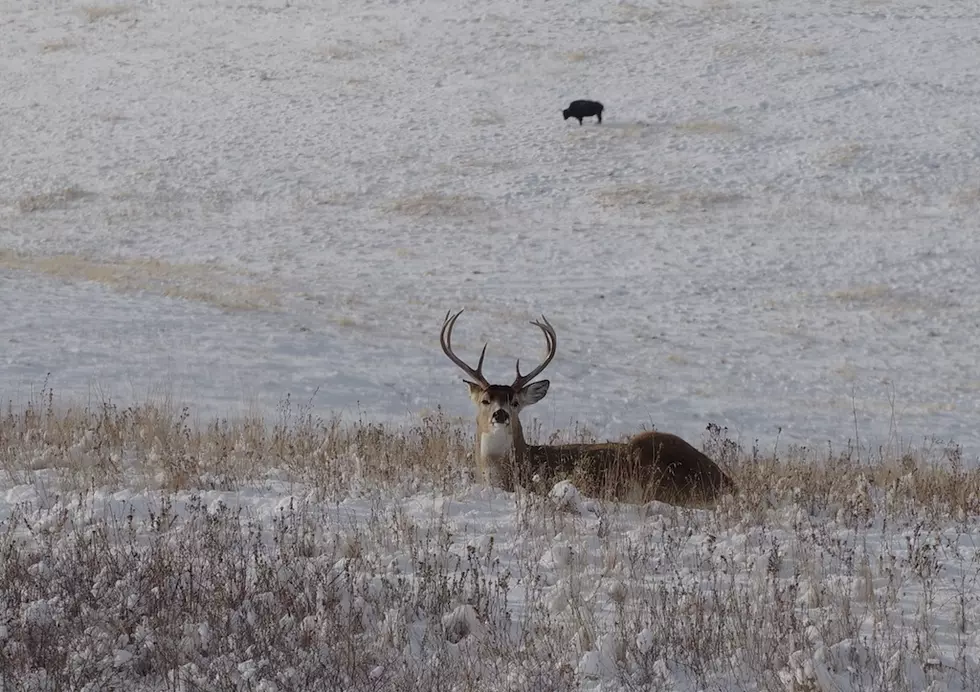
Missoula CurrentPublished: April 7, 2025Wildlife in the Evaro area. (William Munoz/Missoula Current)
Steve Platt
We are lucky to live in Montana where wildlife is held in trust by the State, for the benefit of all. Unlike in Europe, Montanans do not need to be rich to hunt.
Last session, HB 635 awarded wealthy non-residents owning 2,500 acres of land with guaranteed deer and elk tags. HB 635 violated one of the tenets of the North American Model of Wildlife Conservation, guaranteeing wealthy non-residents special access to deer and elk tags, while ordinary non-resident hunters and resident hunters got nothing in return.
Proponents argued that HB 635 would solve hunter crowding, publicly stating that it would “reduce non-resident hunting by up to 30,000 hunter days annually” by moving vast numbers of public land hunters to private lands. That is proven to be utterly false, eliminating the sole benefit this bill might have offered to resident sportsmen.
According to FWP, HB 635 had no impact on hunting pressure whatsoever. Landowners with this much land are likely only hunting their own properties. HB 635 really isn’t moving any hunters from public to private.
Only 131 non-resident landowner tags were issued last year, hardly noticeable out of the 17,000 non-resident deer and elk combo tag holders, and nowhere near the 2,550 tags that proponents said would be used by this program. More than 130 hunters looks even smaller when compared to the 85,253 total number of non-residents who hunted Montana in 2024. We were duped.
So, since HB 635 didn’t fix or have any real impact on hunter crowding, what are we left with?
Just a giveaway to large landowners who don’t even live here.
Worse, giving non-residents tags for nothing in return actually disincentivizes Block Management. One of the existing perks for Block Management cooperators, both resident and non, is that they’re given a deer and elk license (in addition to cash from license sales) as a thank you for providing public access. But if non-residents who own chunks of Montana can get these tags (actually 5 tags if they own over 12,500 acres) for providing nothing, what does that do to the existing access incentives? It makes them worthless.
But now, with HB 907, we can right this wrong by repealing the non-resident landowner preference and instead motivate non-resident landowners to enroll in Block Management. Non-resident landowners who provide public access are already given a deer and elk tag. HB 907 would also allow those landowners in permitted districts to buy a 2nd bonus point, increasing their odds of drawing their permits each and every year. That’s fair to all landowners and all hunters.
Providing access would not be forced, just rewarded. It’s not mandatory. If a non-resident landowner doesn’t want to enroll in Block Management, that’s fine. They can enter the drawings just like everyone else, or they can look at the many other customizable public access options that FWP offers as ways to guarantee their tags or permits.
The longer we let this program go without correcting it, the more entitled these wealthy out-of-state landowners will become. And they’ll just keep extending their hands asking for more and more, while obligated to provide nothing in return.
Eliminating non-resident handouts and turning these instead into reasonable incentives for public access, as HB 907 would do, is something all Montanans can get on board with. And by the sounds of it, the only ones who disagree are the lobbyists paid by out-of-state interests. It’s time to repeal HB 635 and pass HB 907.
Steve Platt is a retired archaeologist, conservationist, hunter and fisherman. He lives in Helena.
 Exposing the Big Game