Paris, Ayr residents fined total of $10,500 for bird hunting offences
Reply

Facing unprecedented stress, Israelis struggling to care for their pets are overwhelming animal rescue groups, whose funds are drying up without visitors. But rescues continueShare in TwitterShare in WhatsAppGift this article
Send in e-mailSend in e-mailGo to commentsPrint articleSaveSave article to reading listZen Read

An injured donkey wearing pajama bottoms to protect his legs at Starting Over Sanctuary.Credit: Yael OrenRuth SchusterGet email notification for articles from Ruth SchusterFollow
Jun 18, 2025
Israel’s animal rescue organizations have come under exceptional stress since the start of war with Iran on Friday. More Israelis are dumping their pets, none are showing up to adopt any and income is vanishing, they report.
Animal welfare associations are perennially stressed to begin with, but wartime tends to be worse as people fleeing attacks lose or abandon pets, and as animals frightened by alerts, sirens and blasts run away. The war between Israel and Iran is arguably characterized by conflict and stress at a level new to Israelis, and by a spike in animals in trouble, according to animal rescue volunteers.
– Advertisement –
about:blank

All the societies Haaretz spoke with report a significant increase in calls from people asking to bring over their pet because they just can’t take care of them anymore. Others call in hope of pet hostelry services, which are generally not on offer. (There are some pet hotels in Israel.)

“On Friday morning, we learned that we are in another war,” says Yael Arkin, the CEO of the Let the Animals Live organization, told Haaretz by phone. “On Sunday morning, when our hotline opened up, suddenly instead of people calling about animals needing medical help –a lot of calls were people trying to get rid of their pets. Calls like that always happen, but we suddenly realized there were more, a lot more – people trying to dump dogs and cats and even a rabbit.”
Email *
Please enter a valid email addressSign Up
By signing up, I agree to Haaretzterms and conditions
The problems the animal rescue groups face aren’t confined to city dwellers and their pets. On Sunday, a horse terrified by explosions escaped its enclosure and was found running down a major highway. Startled drivers called the Starting Over Sanctuary in central Israel, says Sharon Cohen, founder and manager.
– Advertisement –
“Our volunteers managed to locate and stop the horse and contacted the police with the information,” Cohen says. “His owner was located. He hadn’t even been aware the horse was gone.”
The day before, on Saturday, the Society for Prevention of Cruelty to Animals in Israel in south Tel Aviv fielded four tiny kittens that had been abandoned in a box next to their facility. On Sunday, there were four more, says SPCA spokeswoman Sigal Nesher.

SPCA Israel is almost a century old, and runs nine compounds for dogs and three batteries. The Iran war has created desperate financial straits, she adds. Their sources have completely evaporated: adoptions, seminars, classes and community activities, such as birthday parties for children. Even the annual assistance the SPCA gets from the Environmental Protection Ministry, between 80,000 to 100,000 shekels a year, is up in the air: This year the paperwork never even arrived, Nesher says. Only the animals keep arriving, and the SPCA and its branches are a no-kill organization.
– Advertisement –

00:00PreviousPlayNext
00:00 / 01:29MuteSettingsFullscreen
Copy video url
Play / Pause
Mute / Unmute
Report a problem
Language
Share
Vidverto Player
“We have a huge question mark over our heads. If 2,000 people would each donate 50 shekels to us, that would set us up,” Nesher says.

The timing of the Iran war seems to have been particularly unfortunate for animals in the sense that spring and summer tend to be bad for pets, the rescuers says.
“A lot of people abandon animals in April, because that’s when they travel, and there are fewer adoptions,” Nesher explained. And now as missiles fly and people are fearful and many are unsure where they may be living, or expect to spend a protracted time in army reserves – they don’t want the hassle of feeding, walking and cleaning after the pet as well, and the rescue associations are being overwhelmed.

“All the animal welfare organizations are doing their part now,” says Cohen, and all are having to cope with people begging them to shelter their pets in the cattery or dog pound, theoretically on a temporary basis.
Or they need other help. Starting Over has even fielded desperate calls from people asking for somebody to come help wedge large (and elderly) dogs into the car, because the family can’t pick them up and doesn’t want to abandon them, she says. But too many are tying their dogs by their leash to the door handle of an animal rescue organization or a shop, or leaving cats abandoned in a box with no note.

Cohen founded Starting Over eight years ago in Moshav Herut, central Israel. With the start of the Gaza war in October 2023, its rescue and welfare farm was inundated with traumatized, burned and injured cats, dogs, donkeys, goats, pigs and more, from both the south and north of the country. Many have been rehomed by this time, but when the Iran war began last week, the progress was reversed.
It’s hard to know how many cats are abandoned. A person abandoning their cat may just move and leave it behind, based on the common perception that cats can “manage” on their own. Dogs, on the other hand, are registered, and you can’t just dump them and drive away – it’s illegal. When they take fright and get lost, dogs can be more easily regained because under Israeli law, they have to be “chipped.”
Of course, this all depends on the owner answering the phone, Cohen notes. But there’s little point in chipping a cat in Israel, a veterinarian told Haaretz: No vet would check for it.
Another problem faced by animals in wartime is that, as tensions mount, schools are closed, parents are in military reserve duty and afraid of rocket attacks at any time – people aren’t taking their pets to the vet, Nesher added. “If the dog is scheduled to get a shot, he’ll have to wait,” she says.

With income shrinking and donations from visitors nonexistent, and volunteers arriving in smaller numbers because of reduced public transportation, the only thing that’s rising is the numbers of animals, Nesher says. “We are losing money every day,” from clinic visits that don’t happen (but the clinic running costs continue), birthday parties left uncelebrated, seminars not held, adoption packages that don’t go through.
In fact, animal adoptions in Israel have been declining since October 7, Arkin says. “We associate the trend to a lot of things, mainly economic stress, and [the trend of] buying breed dogs.” And since the war with Iran began, calls to dump dogs have more than doubled.

“Very few cats,” Arkin adds. But in about 20 percent of cases, she estimates, they can be persuaded to change their mind.
Email *
Please enter a valid email addressSign Up
By signing up, I agree to Haaretzterms and conditions
If a person has had a dog for years, by the time they have called an association to come take it, they are in extreme stress. Offering genuine help, for instance, even just to cover food costs for a month or medical care for the pet, can make the difference, Arkin says. “We can help with training. If a dog is terrified during the alerts and develops a behavioral condition, often a meeting with a vet or trainer or a medication can help, reducing the stress for the family.”


Let the Animals Live even has a program to help people adopt old dogs from the age of 8 and above, or dogs with medical problems. The adoption is free, and in the case of those who are sick, they receive free medical care for life, Arkin says.
She adds that in the last year, people adopted more cats than dogs, and return rates were lower.
“A person who adopts a cat means it – they’re usually people who know what a cat is, and are intent on their purpose,” she muses. Families are like, oh everybody has a dog, let’s get one too, dog! And then a siren goes off and it does on the floor and.
To contact Let the Animals Live shelter, Israelis can call 03-624-1776, extension 3. To make donations, anybody from anywhere can call +972-3-624-1776, extension 2.
After his video and images of coyote pups in Graceland Cemetery went viral, the author offers insight on these longtime Chicago residents.
June 20, 2025, 10:26 am
It’s a rule of nature: When animals give birth, their babies are almost always cute.
It’s certainly true for coyotes. And that helps explain why my social media posts showing coyote pups in the North Side’s Graceland Cemetery and Arboretum went viral, racking up 19,000 likes on BlueSky and more than 2 million views on Instagram — way more than I expected when I posted the pictures June 12. Let’s face it: Coyote pups are pretty darn adorable. Especially when they howl along with the siren of an emergency vehicle, a moment I happened to catch on video.
I’ve been photographing Chicago coyotes since 2018, when I spotted one sneaking around near sculptor Lorado Taft’s Eternal Silence, a fearsome Grim Reaper–like statue in Graceland. Since then, I’ve seen many coyotes at Graceland and in other graveyards and parks around the city, engaged in a variety of activities: lying lazily in the grass, yawning with their mouths stretched wide, yipping and howling, pacing back and forth over a bridge, rolling around in snow, walking over ice-covered ponds, chasing squirrels, and swallowing a whole squirrel (with fur and bones and everything else going down the hatch). But I’ve never seen a coyote act aggressively toward people. They usually try to avoid us.
In March, Radiolab podcast cohost Lulu Miller asked me to help her see some Chicago coyotes, and I knew just where to go: Graceland, where I’d counted seven coyotes a few months earlier. But these critters are awfully good at hiding. We walked around for an hour and half without any luck. Just when we were just about to give up, a gravedigger got our attention and helpfully pointed out a furry canid prowling nearby. It was soon joined by two more. After playing around a bit, they went on their way, weaving between the tombstones.
Miller was delighted to catch a glimpse of these wild creatures in the city, a moment she included in “The Howler: The Dog Who Joined a Coyote Pack,” a recent episode of Terrestrials, the fun Radiolab spinoff series for kids.
Coyotes mate in the first few months of the year, so I wasn’t too surprised when I saw signs posted June 1 at Graceland, mentioning the recent birth of coyote pups. But the message was rather alarming: “Due to EXTREMELY AGGRESSIVE COYOTE BEHAVIOR, dogs are TEMPORARILY NOT PERMITTED on Graceland Cemetery grounds. Coyotes are currently PROTECTING NEWBORN PUPS in nearby dens. They are highly territorial at this time and have exhibited AGGRESSIVE BEHAVIOR toward dogs brought in by visitors.”
On June 10, Block Club Chicago reported about Graceland’s temporary ban on dogs, and the story included Colin Boyle’s photos of those pups. I went looking for them the next morning. By that time, Graceland had taken down the signs about the dog ban and the aggressive coyote parents. New placards were posted, offering Project Coyote’s tips about how to keep dogs safe from coyotes, such as: “Never let your dog chase or play with a coyote. … Avoid walking small dogs at dawn.”
Over the next two mornings, I witnessed pups scampering around, going in and out of holes in the ground, with no adult coyotes in sight. I counted six or seven pups, though it was hard to keep them all straight. Another photographer said there were eight, noting that they appear to be 5 or 6 weeks old. Using a 600 mm lens, I took photos and videos from more than 100 feet away. I hoped that was far enough to avoid disturbing the little ones.
I knew my social media posts would get attention, but I had no idea just how much. People have posted more than 1,000 comments on the Instagram post, turning it into a freewheeling forum on coyotes. Here is just a small sample:
@conniecandoit: When I die, I want them outside my grave
@ride_on_enjoy: Other items prohibited at this time: anvils, rockets, dynamite, roadrunners, deliveries from Acme, Inc.
@aglgm04: They are so cute! How hard is it to resist scooping them up and snuggling with them 🥰
@wyldwulf13: Ppl on here talking about petting them. Joke or not, leave them be. Keep a safe distance and appreciate them from afar. Don’t be the reason they pay the ultimate price!! The cemetery has water and plenty of plants/wildlife for them. No food. Feeding them can create a dangerous situation. They aren’t pets. They can’t be domesticated. Ppl with dogs should learn to keep them on a leash at the cemetery. It’s a cemetery, NOT a park. Let’s all just coexist ✌️
@basedfrix: Omg @ clueless cityfolk. Coyotes are a nuisance animal, frequently kill pets and farm animals, and need to be eradicated, regardless of how cute you find their pups.
@sue.dipasquale: We are the ones invading their territory. We build and build and build. If you clear cut land the wildlife has to move somewhere. Leaving these coyotes alone for a few weeks isn’t a big deal. Walk your dogs somewhere else.
@megan_glori_: They’ve been living in Graceland Cemetery for years. I live in the neighborhood and everyone respects them. They dug a hole under the wall surrounding the cemetery and sometimes come out into the neighborhood. There’s a dog park next to the cemetery so we see them sometimes. They pretty much ignore the dogs and people and no one bothers them. Most people seem to love them. My dog is very interested in them and has howled along with them!
@rachelehman: It’d be great if folks DIDNT post shit like this [Instagram post]. You’re endangering those pups. Reply from @beckgrajeda: if you look at the comments, most people are expressing their concern for the pups. And it spreads awareness! AND it allows people to appreciate the animals from afar.
@resaswhimsy: You may not see the adults, but they are certainly nearby. Coyotes feed primarily on small rodents and other small prey. Respect their territory and avoid them when you see them. Human-coyote interactions are extremely rare and usually caused by humans approaching them or carelessly exposing small animals in their habitat. These are very intelligent, social animals. They are our brothers. Treat them respect and they will help control rodent populations living near humans.
I’ve gone back to Graceland a few times over the past week. The pups make occasional appearances, but they aren’t easy to spot as they hide in several dens. I haven’t seen any crowds of paparazzi, but there are usually a few people walking the roadways with cameras or just gazing around the graveyard, hoping to see a wild puppy.
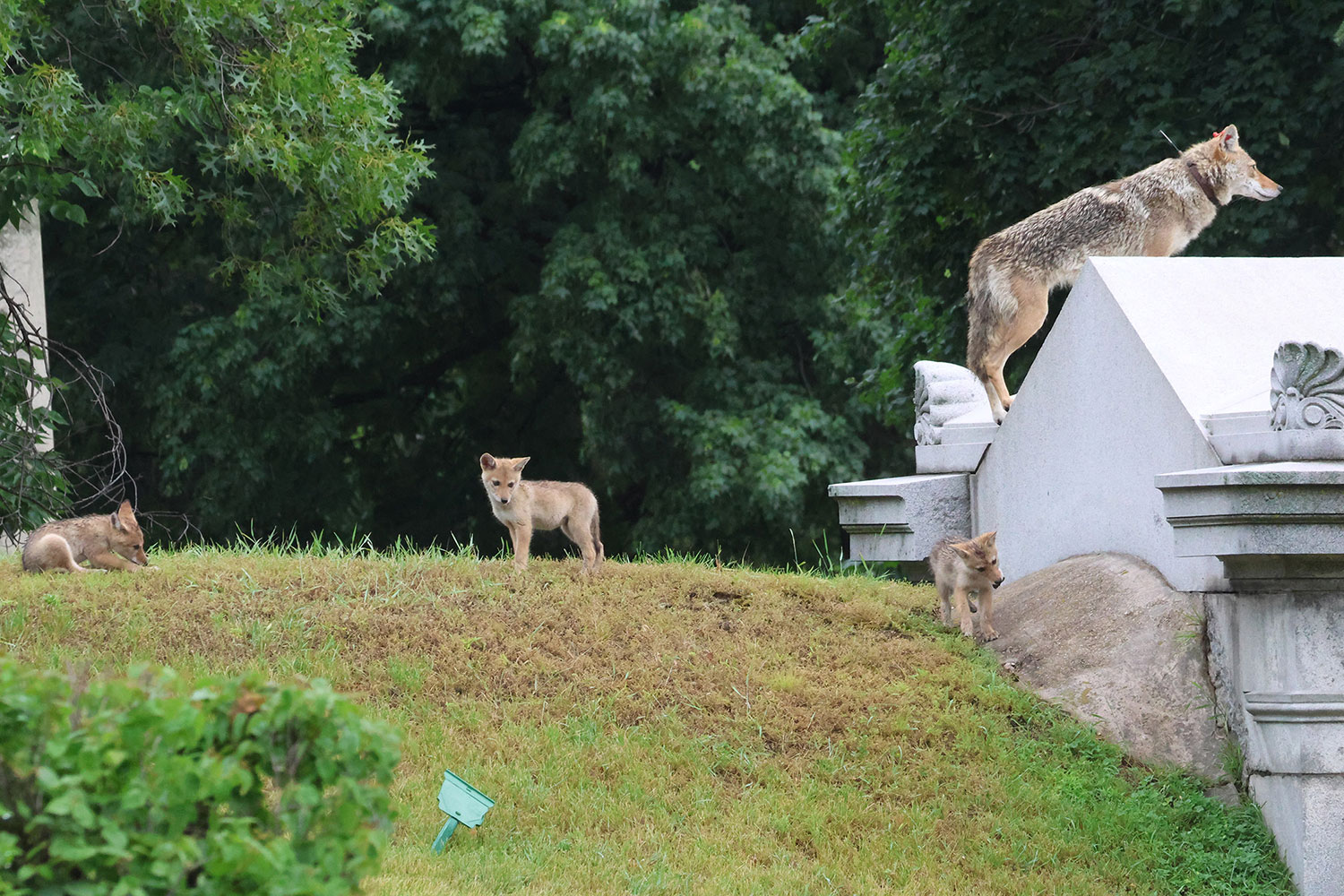
On Thursday morning, I saw an adult male coyote emerging from a space hidden under a tree. Papa yote, I presume? I knew it was male because it had red ID tags in its ears, plus a collar with a radio antenna. The Urban Coyote Research Project, which is observing and studying Cook County’s estimated 2,000 coyotes, tracks many of the animals, using red ear tags to identify males and yellow ear tags for females. I’m pretty sure this one was an older male coyote I’ve been seeing at Graceland for the past several years.
Three pups came out of hiding and followed this guy up a small hill, where he hopped on top of a large tomb and surveyed the landscape for a minute. After glancing back at the pups, he trotted out into the cemetery, leaving them behind. I’m guessing he went looking for food. The pups dawdled for a few minutes, eyeing me, and then disappeared back under the tree.
The odds are that some of these pups won’t survive for long. “Our research indicates that coyotes of all ages in the Chicago area generally have roughly a 60 percent chance of surviving each year, even juveniles in their first year,” wildlife ecology professor Stanley D. Gehrt reports in the 2024 book Coyotes Among Us: Secrets of the City’s Top Predator (written with journalist Kerry Luft). “Still, the survival rates of juvenile coyotes in Cook County are approximately five times higher than the 13 percent survival rate reported for rural juvenile coyotes.”
In rural areas, coyotes are hunted and trapped. In Chicago, the leading cause of death is getting hit by automobiles: Vehicles were responsible for 41 percent of the coyote deaths studied by the Urban Coyote Research Project, where Gehrt is the principal investigator. Given how sparse and slow-moving the traffic is inside cemeteries like the 121-acre Graceland, these are pretty good places to avoid becoming road kill.
It takes nine months for pups to reach adult size. They usually stay with their family pack for a while, eventually venturing off once they become sexually active. “Many leave during their first fall and winter, and others leave a few months later during their first mating season, in February or March,” Gehrt writes.
Gehrt argues that humans and coyotes must learn how to peacefully coexist: “Seeing them should not be cause of alarm but rather a reminder that one of nature’s most tenacious survivors will be living with us and we with them, for some time to come. Coyotes are here to stay.”
 Exposing the Big Game