Brazil manatee hunters become advocates as village turns to ecotourism
Reply

By Dr. Flavio Lehner
MINS
17 Jun 2025
With summer underway, the sea ice in Canada’s Hudson Bay is melting rapidly, transforming it from a solid hunting platform for polar bears to open water. This annual pattern forces polar bears to land and marks the beginning of their fasting period, as their main prey, seals, become inaccessible to them until the bay freezes over again in winter.
This year, sea ice in Hudson Bay started to melt relatively early. Western Hudson Bay’s sea ice cover just dropped to below 50%, while Southern Hudson Bay just dropped below 80%. By late July, Hudson Bay will have melted out completely for the year. Readers might recall last year’s extremely unusual ice melt season, which saw persistent winds push and pile up sea ice in Western Hudson Bay, preserving the ice there and providing hunting opportunities for polar bears deep into July. However, this meant that at the same time there was very little sea ice left in Southern Hudson Bay, which saw its earliest sea ice disappearance date on record, with potentially negative impacts for polar bears there.
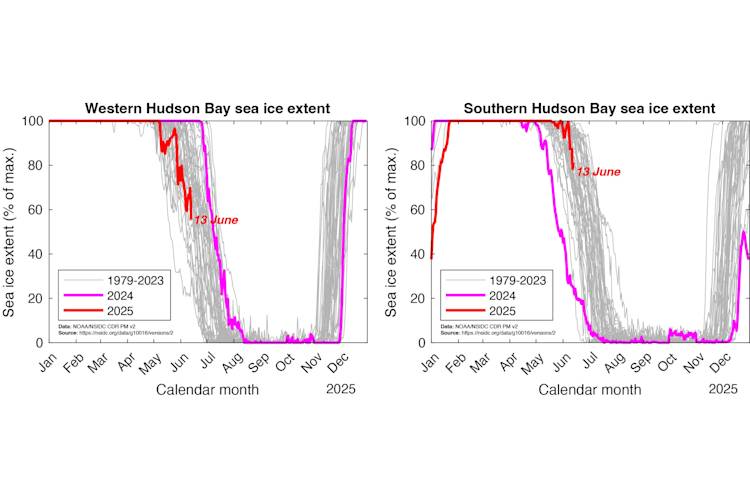
Sea ice extent in Western and Southern Hudson Bay. All years since satellite observations are available are shown (1979-2025), with the unusual year 2024 highlighted in magenta. The ongoing 2025 melt season is shown in red. Data from NOAA/NSIDC.
However, it’s not just the extent of sea ice that matters to polar bears, but also the “quality” of the ice. This year, the sea ice is already broken-up into many small ice floes, as can be seen on satellite images, possibly due to the generally declining sea ice thickness and recent windy conditions in the region. While this type of ice still provides some opportunities to hunt for seals, it is overall difficult for bears to navigate efficiently. Indeed, looking at the recent distribution of GPS-tracked bears in Western Hudson Bay, we see that most have made their way to the western edge of the sea ice and are getting ready to come ashore to their typical summer grounds around the town of Churchill, Manitoba; some bears already have.
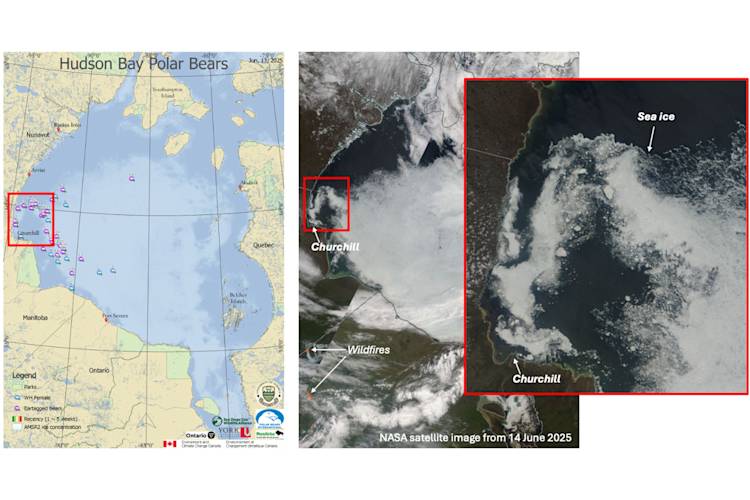
Sea ice and polar bears in Hudson Bay this year. (left) Distribution of tracked polar bears in Western Hudson Bay on 13th of June 2025, showing many getting ready to come ashore. (right) Satellite image of sea ice conditions on 14th June 2025. The zoomed-in image shows the thin and broken-up sea ice north-east of Churchill, Manitoba.
Dr. Andrew Derocher, a Professor of Biological Sciences from the University of Alberta, reports from field work this spring that bears weren’t in great shape and seemed to struggle to kill the typical number of seals. He expects the bears to come ashore soon, unless a strong easterly wind event pushes sea ice back into Western Hudson Bay and delays the disappearance of sea ice. However, the weather forecast for the next week is for the opposite – continued winds from the West, as is typical in that region this time of year. Together with the current sub-optimal sea ice conditions, this does not bode well for polar bears in Western Hudson Bay. As the bears come ashore this summer, researchers will be able to get a better look at them to determine their health.
Polar bears consider a variety of factors when deciding between coming ashore or staying on the ice a little longer. If they are desperate for food, they might stay, but the melting and drifting sea ice might then require them to put in a longer swim later to get back to shore. As often in nature, it is a tradeoff between energy expenditure and food. Historically, bears have chosen to come ashore early rather than stay out longer on such thin and patchy ice. It’s an open research question whether bears will adapt their behavior if ice conditions change. While polar bears are adapted to handle some such uncertainty, the warming climate and ever-lengthening ice-free period in Hudson Bay make it increasingly difficult for bears to stay well-fed and healthy.
 by Oil City StaffJune 17, 2025

By Wyoming Game and Fish
SHERIDAN, Wyo. — On June 14, Wyoming Game and Fish Department personnel received a report that a cow moose had been shot in a confrontation with an angler on the North Tongue River in the Bighorn National Forest near Bear Lodge Resort.
When game wardens responded, they found the moose deceased from her injuries.
Advertisement

18
The game wardens interviewed the angler who said he had encountered the moose at close range in thick willows. He fired multiple shots at the moose when she became agitated and charged him.
Wardens searched the surrounding area and found two young-of-the-year moose calves that they believed the cow was defending. Due to their inability to survive without their mother, the calves were euthanized.
The North Tongue River and nearby areas are prime moose habitat. These areas are also popular with anglers and other recreationists who can take steps to prevent conflicts with moose and other wildlife.
Advertisement
about:blank
Game and Fish warns that while moose can be found in many areas of the Bighorn National Forest and adjoining lands, they spend significant time in riparian areas – the areas in and around rivers, streams and ponds. Pay particular attention to your surroundings while in these areas, watching and listening for movement.
Despite their large size, moose can be difficult to spot in thick vegetation such as willows. Make noise and move carefully through areas with low visibility. People are urged to be especially watchful during times of low light, such as early morning or late evening, as their dark coloring makes moose hard to see.

OregonLive.comFollow
24.3K Followers
Story by Gosia Wozniacka, oregonlive.com
• 1d •
4 min read

How to restore water quality in thousands of miles of polluted waterways in Oregon? Call in the beavers – the animals, that is, not the football team.
That’s what new legislation – approved this week – essentially seeks to do.
The bill has garnered passionate support and adamant opposition during committee hearings, with more than 1,600 people submitting written testimony.
Wacker Neuson Bs60-2Plus Vibratory Rammer
The bill passed the House in April in a vote of 35 to 18 and the Senate on Monday 17 to 11 and now goes to Gov. Tina Kotek for her signature.
It requires state wildlife officials to adopt rules that prohibit the trapping of beavers on public lands classified as polluted waterways, in the hopes that the animals make themselves at home and do what beavers do best – build dams that filter out excess nutrients and contaminants, dig canals that create wetlands, slow water flow and create habitat for fish and wildlife.
Oregon has more than 122,000 miles of polluted or “impaired” rivers and streams, according to the state Department of Environmental Quality. That’s likely a severe undercount – the department has surveyed just over 40% of the state’s waterways and labeled more than two-thirds of them as impaired.
According to DEQ’s surveys, the top factors that lead to water quality declines are high stream temperature, dissolved oxygen, sedimentation and the presence of toxins. The agency is required to restore those waterways but it’s expensive and time-consuming.Related video: Restoration projects involving beaver habitat. (FOX 13 Seattle)
about:blank
Loaded: 55.19%Play

Current Time 0:01
/
Duration 0:30Quality SettingsFullscreen

Restoration projects involving beaver habitat.Unmute
0
Beavers, said bill supporters, can do it for free.
“If we started from scratch to create a resource to improve water quality and quantity on our impaired streams, we couldn’t do better than beavers,” said Sen. Jeff Golden, D-Ashland.
Once killed off en masse and maligned, the animals – now dubbed nature’s engineers – have seen a renaissance in popularity and protection in recent years due to their ecological contributions. Oregon has recently reclassified them as “furbearers,” animals whose fur has commercial value, meaning they’re now overseen as wildlife not pests. The state also now requires private landowners to secure a permit to kill nuisance beavers.
Supporters point out that the new beaver bill doesn’t change existing laws that permit trapping or removing beavers on private land. But it prohibits beaver harvest on or adjacent to streams, rivers or watersheds that flow through or adjoin public land and are classified as impaired. The harvest prohibition doesn’t apply to navigable waterways when the adjacent land is private.
Abu Garcia Ambassadeur Reel Part – 5001C Handle Kit W/ Hardware
More than half of beaver trapping in Oregon takes place on private land, mostly for fur.
During the 2023-24 harvest season, trappers killed 1,495 beavers statewide, with 53% of the trapping occurring on private land, 4% on federal or state land and 40% on navigable river/open water, state wildlife officials said.
“Based on these figures, we would expect the harvest ban to impact a portion of the harvest on federal, state and navigable river/open water (on or near public) lands,” said Michelle Dennehy, a spokeswoman with the Oregon Department of Fish and Wildlife.
It’s unknown how many beavers inhabit polluted waterways – nor how many live in Oregon overall – though experts agree their population is just a tiny percentage of their original numbers.
State wildlife officials are finishing up surveys of beaver populations to quantify their distribution across the state, the underpinning of a new plan to help the animals recover. Generally, beavers are present in all major watersheds and typically observed in areas with suitable habitat, Dennehy said.
L’artiste Women’s Spring Step Leather Sandals, Size 40 Us 9
Trappers and some other landowners opposed the new bill, arguing that additional prohibitions would hurt their livelihoods by limiting their source of income and could lead beavers to create significant damage.
“When beaver numbers swell unchecked, they cause extensive damage to agricultural lands, disrupt infrastructure and threaten the habitats of other wildlife. Trapping is not merely a hobby for many of us; it is a necessary practice that allows us to maintain harmony between human needs and wildlife conservation,” wrote Trevin Franks, a trapper from Hood River.
The bill requires the Oregon Department of Fish and Wildlife to publish a map showing the waterways where the new beaver protections will apply.
The department hasn’t taken a position on the bill, but Dennehy said it’s unclear whether the legislation will lead to its intended benefits. That’s because there are fewer beaver dams on public lands, likely due to the lack of hardwoods such as willow and alder that are conducive to beaver dam construction.
To bring in more beavers and their beneficial building skills, trapping closures should be paired with management of plants and trees to provide suitable habitat for dam building, she said.
— Gosia Wozniacka covers environmental justice, climate change, the clean energy transition and other environmental issues. Reach her at gwozniacka@oregonian.com or 971-421-3154.
 Exposing the Big Game