The Police at Skukuza are investigating a shooting incident after a suspected poacher was fatally wounded by Field Rangers inside the Kruger National Park (KNP) on Friday, 21 March 2025.
The Section Rangers of the SANPARKS at the Lower Sabie Section are said to have come into contact with two suspected poachers around 15:00 whilst on patrol duties. It was during this period when the two were spotted and, instead of stopping, the two ran into the bushes. Tracing of the two individuals by the Rangers commenced until they were spotted again at about 18:15.
This time around, the two alleged poachers reportedly started shooting towards the Rangers. In response, the Rangers returned fire and it was during this time where one alleged poacher got shot whilst another one got away.
Field Rangers are said to have summoned for Medical Personnel and also alerted the Skukuza SAPS. The injured man unfortunately succumbed to his injuries before he could receive assistance.
During processing of the scene, a hunting rifle with two ammunition as well as a knife were found in his possession. The paramedics certified him dead at the scene.
The circumstances surrounding this incident form part of the investigation by the Police. The man has not yet been identified.
This incident is similar to another one that reportedly occurred in Malelane area of the Kruger National Park on Tuesday, 18 March 2025 whereby one alleged poacher was fatally shot. During that incident, two alleged poachers were spotted by the Field Rangers. A shootout ensued between the Rangers and the alleged poachers. One vanished into thin air and the other one sustained some injuries then later succumbed. A hunting rifle with ammunition were also found in his possession. The alleged poacher has also not been identified.
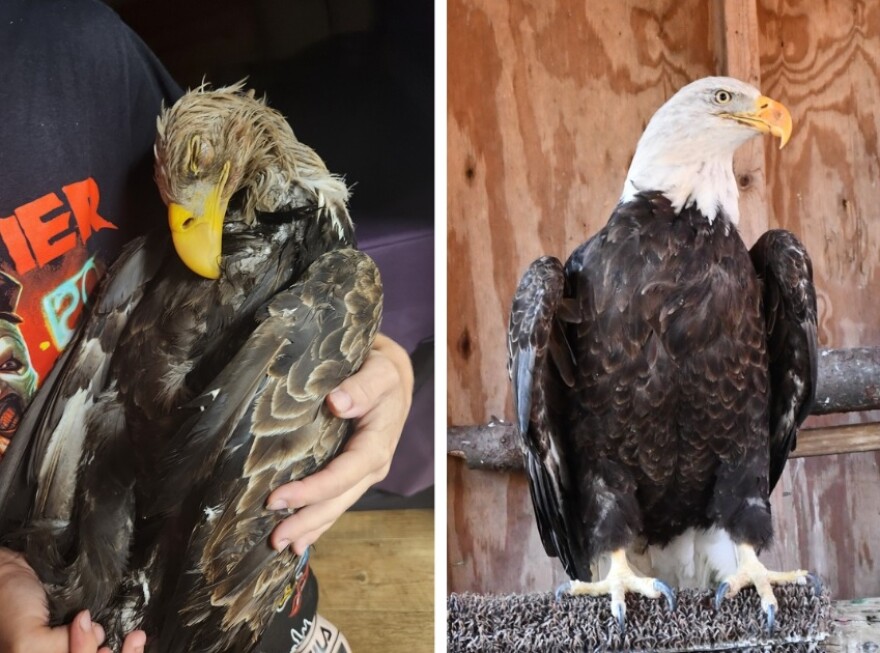
HAMILTON TWP., MONROE COUNTY, Pa. — It was an emotional moment late last month when Napoleon, an adult bald eagle, was released into the wild after months of treatment for heavy metal toxicity.
“You cry tears of joy, because he is back out there, and tears of you’re going to miss him, almost — but this is what we want,” said Kat Schuster, a licensed wildlife rehabilitator and lead clinic manager at Pocono Wildlife Rehabilitation & Education Center.
“This is the outcome that we were looking for and for him. When he first came in, he was eating on his own, then he stopped. There were ups and downs with him.”
Napoleon’s rehabilitation and release into the wild is a bright spot amid a dangerous time for bald eagles in the Lehigh Valley and the rest of the commonwealth.
Bird flu continues to threaten wild bird populations, causing so far more than a dozen bald eagles to be euthanized across Pennsylvania.
‘Positioned to withstand losses’
While local and state experts said decades of conservation work has bolstered the species enough to weather the recent surge of infection, there are plenty of other threats to bald eagles still out there — especially heavy metal toxicity, negatively impacting the species.
Since December, 18 bald eagles statewide have been euthanized because of symptoms of HPAI, or highly pathogenic avian influenza — commonly called bird flu — according to data from the state Game Commission.
That total includes three in Northampton County and four in nearby Berks County.
“Our population also has an abundance of non-breeding adults that are awaiting an opportunity to pair up and often do very quickly. So, eagles would seem well-positioned to withstand losses related to HPAI.”
Travis Lau, communications director with the state Game Commission
“In general, bald eagles have a healthy population here,” state Game Commission Communications Director Travis Lau said.
“They are no longer on a list of any threatened or endangered species, which says a lot for a species that as recently as 1983 had only three known nests in Pennsylvania.
“Our population also has an abundance of non-breeding adults that are awaiting an opportunity to pair up and often do very quickly.
“So eagles would seem well-positioned to withstand losses related to HPAI.”
Risk to people remains low
An influenza type A virus, HPAI or H5N1, is highly contagious and often fatal in birds.
It can be easily spread from bird to bird in some species through direct contact with an infected animal’s mucous membrane, feces and/or blood.
The virus, which hit the United States in 2022, has jumped from birds to dairy cows, as well as other mammals, and has caused one human death.
There have been no reported bird flu infections in dairy cows or people in Pennsylvania. Health officials, both locally and nationally, say the risk to people remains low.
‘The worst is behind us’
Recent infections have come amid the annual snow geese migration. However, with warmer weather around the corner, the snow geese should be making their way out of the region.
Each spring, tens of thousands of migratory snow geese make their way through Pennsylvania, heading north to colder climates to breed.
They tend to gather in large, concentrated flocks, increasing the amount of pathogens to which they’re exposed.
“I think there’s a lot of hope that the worst is behind us regarding this resurgence of HPAI.”
Travis Lau, communications director with the state Game Commission
“Things have tapered significantly in recent weeks, which is reflected by the detection list showing none since March 4,” Lau said.
“Meanwhile, snow goose migration is wrapping up, with the majority of snow geese having already pushed through Pennsylvania.
“So I think there’s a lot of hope that the worst is behind us regarding this resurgence of HPAI.”
The three Northampton County eagles euthanized included birds known to residents, such as one of a mated pair at Minsi Lake Wilderness Area.
In addition to bald eagles and snow geese, bird flu has claimed several other of the Valley’s wild animals.
In Northampton County, bird flu is cited as the cause of death for three red-tailed hawks, a great horned owl, a red-shouldered hawk and a black vulture, according to Game Commission data.
In Lehigh County, the virus has caused the death of a red fox, an American cow and two red-tailed hawks.
‘It’s common’
Napoleon, found in August in Lehigh County, was covered in human waste and unable to fly by the time Pocono Wildlife rehabilitators worked with him.
“He was basically, completely lifeless,” Schuster said. “We don’t know exactly where he got covered in the goo that he was covered in, or how that happened to him. He didn’t tell us.
“He was cleaned up. He was very weak. We did a blood toxicity level — it was high. He did go to the vet several, several times.”
Napoleon, named for his short stature and feisty demeanor, was found to have zinc and copper toxicity, as well as suspected blindness in one eye.
“A lot of the birds that we get in that are high levels, it’s lead,” Schuster said. “It’s from sinkers, it’s from BB guns or bullets. It’s very unusual to have zinc and copper.”
Heavy metal toxicity, especially lead, appears to be an increasing problem for bald eagles countrywide. It can cause neurological issues, leg paralysis and organ failure.
“It’s common,” Pocono Wildlife lead avian specialist Sampson Metzgar said.
“All eagles have lead in their system that come in — it’s just a matter of how high they are. If it’s over a certain amount, then it’s considered detrimental.”
“A lead fragment the size of a grain of rice is lethal to a mature bald eagle, meaning that a standard 150 grain lead bullet can poison 10 eagles.”
American Eagle Foundation
“A lead fragment the size of a grain of rice is lethal to a mature bald eagle, meaning that a standard 150 grain lead bullet can poison 10 eagles,” according to the foundation’s website.
“The deadly metal accumulates in an eagle’s system over the course of their lives, meaning that there is no safe amount of lead exposure.
“For this reason, lead is often called ‘the silent killer.’”
When a bird comes to the center with heavy metal toxicity, it’s heartbreaking, Schuster said.
“They lose weight, they stop eating,” she said. “They are just basically sitting there with their head hanging. And to see a majestic bird in that state is heartbreaking.”
Research shows exposures often are the result of unintended consequences from lead ammunition fragments and fishing tackle that are left behind in the field.
“You have the hunters that hunt responsibly, and the fishers that fish responsibly make sure that they’re taking their arrows, sinkers back with them,” she said.
However, there are many who don’t, and it’s only a matter of time before wild animals become exposed.
“We don’t know how [Napoleon] ingested that much zinc or copper, but he was on what’s called chelation off and on for several weeks, back and forth to the vet,” she said.
Chelation therapy binds heavy metals, removing them through excretion.
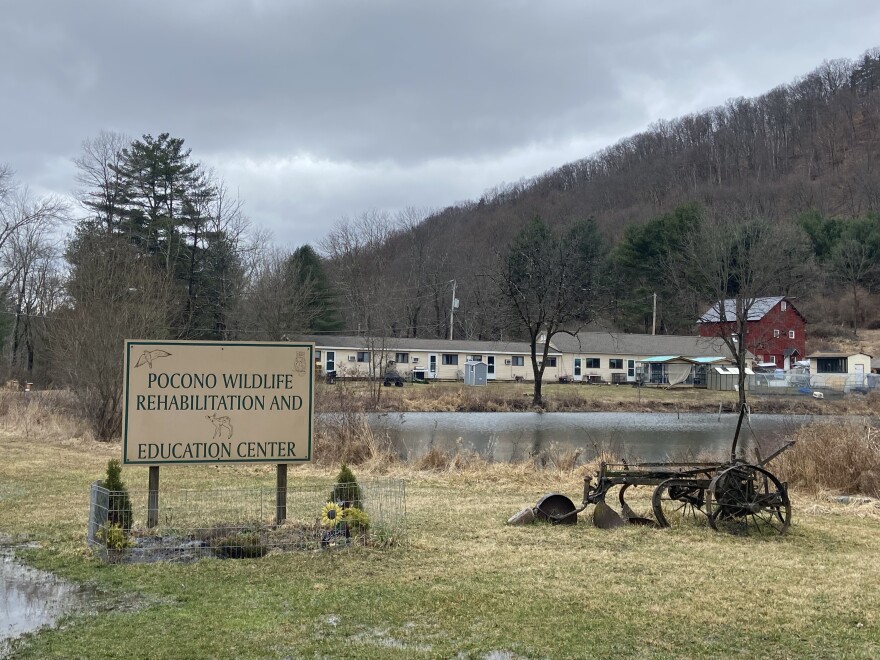
The Pocono Wildlife Rehabilitation and Education Center is a wildlife rescue service based in Hamilton Township, Monroe County.
‘They’re all success stories’
While Napoleon came into the center eating on his own, he soon stopped, but staff continued to work with him, eventually finding success.
By December, he was eating well and his blood tests were coming back normal, officials said.
“I like to think it was a trust thing and that he was feeling much better and getting his strength back,” Schuster said. “But there’s no way to really know.”
There was worry that he wouldn’t be releasable, because of the blindness in one eye, but Schuster said he started following his food with that eye, too.
He soon moved to a larger enclosure, where he built his strength and bided time, waiting for a break in the icy winter weather.
“He was flying around the cage. He was landing on the perches,” she said. “We have a large tree stump in there that he would land on and eat.
“The prey testing went well, and then it was a matter of just waiting for weather. February was so snowy and so icy.”
Near the end of February, Napoleon was released on the grounds of the center. Staff watched as he flew around before landing on the top of a tree.
“For me, they’re all success stories,” Schuster said. “Because even if they don’t make it, they were warm. They were safe. They weren’t being attacked by something else and dying in that way.
“These things matter to us — the quality of life and the quality of death.”
Residents who see a dead or sick animal, can report it to the state Game Commission by calling 1-833-PGC-WILD (1-833-742-9453).
A gobbler’s eye is ultra discerning and critical, and suffers no mistake. But, if all we did was hunt by ourselves, alone, we would miss the camaraderie, the sharing of wild experiences and all the shared fun.
Like a big red fox running past us on his way to feed those young pups we saw in the old woodchuck den.
Or how about the time we saw the Cooper’s hawk whose “reach exceeded its grasp,” by catching a bird so big that it could only fly 20 yards or so at a time? So it made its way through the woods in 20-yard increments, but never letting go of its prey. Feeling a twinge of spiritual kinship, we said, “Fellow hunter, you had good luck, we sure could use some now, too.”
And admiring the way the sunlight hits a handful of blossoming wild apple trees, covered with what seems like puffy piles of white and pink flowers, experienced only by actually walking in the woods. And then there are the laughs; all the laughs and stories, fooling around, poking fun and good-natured kidding.
Make no mistake about it, turkey hunting is serious business, but maybe even intensified by the humor which is such a part of it.
There is just something about turkey hunting that brings out the laughter and “needling,” unlike any other of the outdoor sports.
Why? Maybe the humor is deeper and stronger than other types of hunts, primarily because of the criticalness of the situation. I like to equate it to being in a schoolroom with a stern teacher. Just can’t stop laughing sometimes. And in those times, the harder we try, the tougher it is.
Get the Daily Briefing newsletter in your inbox.
Start your day with the morning’s top news
Delivery: DailyYour Email
Remember those moments when we were not supposed to laugh and the more we tried to hold it in, the stronger the laugh became, so much so as violent, silent, gut-straining shakes? Remember we’d gasp out, finally, “Don’t … don’t … I’ll pee my pants.” The actual incident which created the laughter was situational, impossible to remember, and not worth the effort to explain to someone else. And we always lamely finished the explanation with something like, “Well, I guess you just had to be there.” Felt a bit foolish.
That ambivalent state occurs when in the presence of beings that require we keep perfectly straight composure and that we remain in a controlled and constrained state; be it a teacher, preacher, boss, or a wise, old, humorless turkey gobbler.
Wild turkey gobblers have absolutely no sense of humor and send us to the office in a heartbeat every time they bust us. Their kind has strutted and gobbled across the earth for millennia with nary a snicker, chuckle, giggle, or laugh. They do not have it in their bones to cut us any slack. They are unforgiving and the most deadly serious critters around. They are devoid of curiosity. And they lack any sense of fun. Tom turkeys have only one look, a stern stare.
Maybe the reason for their lack of humor lies within their bones. After all, according to recent paleontology, they are the descendants of dinosaurs. And any offspring, millions of years down the line from Tyrannosaurus Rex, must be genetically predisposed to be “dry” and mean-spirited. But perhaps even our modern turkey is more crotchety than his great forbearer T. Rex – down the long tunnel of time, and now a feathered grouchy curmudgeon. Gobblers do not tolerate mistakes. Let them be that way.
You see, actually our ancestors were chased, harassed, hunted and munched by dinosaurs down through the millennia. But we got bigger and stronger and turned into the hunter while they got smaller. And we discovered how good they taste.
Now we are the hunter and they are the hunted.
Maybe there is some innate resentment lodged in a nook in that walnut-sized brain … a tiny recess of their genome that goes all the way back to when their ancestors ruled the earth. But now the hunting boot is on the other foot and as the saying goes, “He who laughs last … laughs best.”
After a thorough investigation, two people were found guilty of several wildlife offenses.
The offenses including unlawful hunting and residency fraud, related to the illegal harvest of a mule deer in Hunt Unit 114 on the Utah-Nevada border, mostly in the Humboldt-Toiyabe National Forest.
Officers from the Utah Division of Natural Resources (DNR) tipped the Nevada Department of Wildlife (NDOW) in December 2022 about a resident of Panguitch, Utah, who reportedly used a fake resident hunting tag to kill a huge 5×4 mule deer in Nevada.
According to NDOW, the person was not eligible for the resident tag used in the hunt as investigators verified that they had lived in Utah for more than three years.
Authorities discovered through search warrants and investigative methods that the spouse of the person in question, who filled out applications and obtained licenses under false pretenses, was responsible for the fraudulent application and tag purchases.
Both people were charged with felonies, gross misdemeanors, and misdemeanor wildlife offenses following an in-depth review of official papers, bank records, and digital evidence.
The primary suspect’s hunting privileges were suspended for five years after they entered a guilty plea to aiding and abetting unlawful possession, a serious offense.
The offender was also given a 12-month probationary period with stringent conditions, a 60-day suspended jail sentence, and a total loss of 36 hunting bonus points.
In addition, a $4,999.99 joint civil penalty was imposed on both parties.
In addition to sharing the civil penalty, the second person was found guilty of a misdemeanor offense, which led to license suspension and financial penalties exceeding $600.
“This case could not have been solved without the crucial collaboration between NDOW and Utah DNR, this case exemplifies the importance of interagency partnerships in protecting wildlife and enforcing conservation laws.”
– said Lieutenant Anderson
According to NDOW, a hunting or fishing license suspension in one participating state is recognized and enforced in all other member states under the Interstate Wildlife Violator Compact (IWVC), which prohibits someone from getting a license in another state.
They say Alaska is the only state not included in this pact, which covers 49 states.
Therefore, thee two people who were given a five-year hunting right suspension will thus not be able to get a license in any of the states that are involved.
NDOW says residency fraud is still a major problem that undermines conservation financing and denies opportunity to legitimate hunters.
The significance of public collaboration in safeguarding animal resources is highlighted by this example.
NDow says sportsmen and the general public can utilize the new NDOW Tip app or the OGT hotline at (800) 992-3030 to report wildlife crime.
CHEYENNE, Wyo. — An Alabama man was recently convicted in a decades-old Wyoming Game and Fish Department wildlife case after failing to appear in court for more than 20 years.
Kenny Craig, 53, of Elkmont, Alabama, and formerly of Lysite, Wyoming, was arrested in March 2024 on a bench warrant issued in February 2000 after he failed to appear in court for multiple hunting violations.
The Wyoming Highway Patrol arrested Craig during a traffic stop in Crook County. He was taken to jail and later released on a $1,000 bond.
Advertisement
16
On June 25, 2024, Craig was convicted in Fremont County Circuit Court for the original wildlife crimes he committed during the 1998 hunting season. As part of a plea agreement, 9th Judicial District Circuit Court Judge Dan Stebner accepted Craig’s no-contest plea to one count of taking a deer without a license. He was ordered to pay $410 in fines and court costs, along with $1,000 in restitution for the illegally taken buck mule deer. His hunting, fishing and trapping privileges were suspended for three years. In exchange for his plea, three additional charges were dismissed and two further violations were not charged.
Craig’s violations date back to Oct. 24, 1998, when he illegally killed a 5-by-5 buck mule deer on Game and Fish’s Sand Mesa Wildlife Habitat Management Area near Riverton. He was hunting in Deer Hunt Area 157 — a limited-quota area — with a general deer license, which was not valid for that hunt area. Craig failed to tag the buck and later used his brother’s limited-quota license to validate the animal illegally.
In addition, Craig illegally purchased a Wyoming resident general deer and elk license before meeting the state’s residency requirement. At the time he only lived in Wyoming for three months after moving from New Mexico. Wyoming law requires a person to be a resident for at least one year before applying for or purchasing a resident hunting or fishing license. Craig also failed to complete the mandatory hunter education course, which is required for anyone born after Jan. 1, 1966.
Advertisement
about:blank
Game and Fish began investigating Craig in fall 1999. Now retired game wardens Chris Daubin and Brad Gibb investigated the case. After collecting evidence and completing the case, four must-appear citations were issued and two additional violations were pending. Craig was scheduled to appear in court in late October 1999 but failed to do so and fled to Alabama.
A bench warrant was issued in February 2000, but Craig remained outside Wyoming until his recent arrest.
“There is no statute of limitations for wildlife crimes in Wyoming,” said Lander Region Wildlife Supervisor Jason Hunter. “Cases like these send a clear message: wildlife crimes will not be ignored, no matter how much time has passed.
Advertisement
about:blank
“Lawful sportsmen take great care to apply for the correct licenses in the correct areas and follow the existing laws and regulations. It shows respect for the resource, too. Violators must be held accountable when they don’t follow the rules. This ensures there are opportunities for all users to enjoy the wildlife resource well into the future.”
While all the original investigating officers, prosecutors and judges involved in the case have since retired, Fremont County Attorney Pat LeBrun and Assistant County Attorney Ember Oakley pursued the charges based on the detailed case reports compiled by officers at the time.
“I’m pleased that Mr. Craig has been held accountable for his wildlife crimes in Wyoming,” Oakley said. “This case demonstrates the exceptional work of our Wyoming wardens and their dedication to thorough investigations. Even 20 years after the crime, we were able to pick the case up and complete the prosecution. Their top-notch work is essential to protecting our state’s wildlife.”
ELY, Nev. (KOLO) – Two Utah residents have been found guilty of residency fraud and illegal hunting in connection with the illegal harvest of a mule deer near the Utah/Nevada border.
Neither suspect was identified by the Nevada Department of Wildlife.
In December of 2022, officers with the Utah Division of Natural Resources handed over a tip to the Nevada Department of Wildlife about a Utah resident who had allegedly harvested a large mule deer using a fraudulent hunting tag.
Investigators determined the suspect had been a Utah resident for more than three years and were thus ineligible to use the tag.
“Residency fraud is becoming a real problem,” said John Anderson, Game Warden Lieutenant for the Nevada Department of Wildlife. “In the past, we might see just a handful of these types of cases, but in the last few years that number has grown to a point where our game wardens are spending quite a bit of time investigating residency fraud. That’s valuable time where they could be in the field protecting the states resources.”
Authorities were able to uncover the fraudulent application and tag purchases were coordinated by the individual’s spouse, who completed applications and license applications under false pretenses. Both were subsequently charged with felony, gross misdemeanor, and misdemeanor wildlife violations.
The primary suspect pleaded guilty to aiding and abetting unlawful possession, resulting in a five year suspension of their hunting license. They also received a suspended jail sentence of 60 days, a 12-month probation period, and a combined loss of 36 hunting bonus points.
Both suspects were also ordered to pay $5,000 in fines.
The second suspect was convicted of a misdemeanor, resulting in license suspension, and fines exceeding $600.
“This case could not have been solved without the crucial collaboration between NDOW and Utah DNR,” said Lieutenant Anderson. This case exemplifies the importance of interagency partnerships in protecting wildlife and enforcing conservation laws.”
CENTRAL POINT, Ore. – Oregon authorities are dealing with the increasing use of thermal imaging devices in illegal hunting activities. These devices, which detect heat signatures, give hunters an unfair advantage by making animals visible in darkness or through cover.
“When you look at them through a thermal scope, they’re going to glow white or red, or whatever the settings are, and just, no matter the brush, no matter if they’re crouched down, hiding, and tall grass, whatever, they’re just going to stick out and glow like a candle out there,” said Mathew Vargas, a wildlife biologist with Oregon Fish and Wildlife’s Rogue District.
The use of thermal imaging scopes is prohibited in Oregon. “There’s no hunting at nighttime to begin with,” Vargas said. He added that the technology undermines fair chase, a principle valued by both the Oregon Department of Fish and Wildlife and the hunting community.
Vargas said that wildlife has adapted to the environment with camouflage and other natural defenses. Thermal imaging disrupts these adaptations. “It causes an unfair advantage for people at that point,” Vargas said.
Enforcement of the ban on thermal imaging is challenging. Oregon State Police Fish and Wildlife troopers must catch individuals in the act of using the devices for illegal hunting. “It’s not illegal for somebody just to have a thermal imaging scope and go look for wildlife,” Vargas noted.
Vargas said it is up to the hunting community in reporting suspected illegal activity. “There’s a lot of benefits to having the hunter community be on our side and give us tips and information and call things in that look suspicious,” he said.
Vargas believes the issue is present throughout the state. “My guess is, it’s an issue everywhere, and it’s just a matter of finding the people doing it,” he said.
Illegal use of thermal imaging is sometimes associated with other offenses, such as spotlighting at night, trespassing, or other poaching activities. In December, Oregon state police arrested 13 individuals during recent operation in Clackamas County for illegally using thermal imaging devices to hunt big game. Officials seized 14 infrared thermal imaging devices along with a rifle and four deer, after months of investigation.
Residents are encouraged to report any suspicious activity to the Turn In Poachers (TIP) Line at 1-800-452-7888 or *OSP (*677) from a mobile phone.
Thermal imaging equipment and rifle seized during the arrest of 13 hunters in December 2024.
It’s morning in a hunting blind at the Santiam Valley Ranch, a private duck hunting club near Turner, Oregon. It’s cold and wet. But it’s not hunting season, so Mike Totey isn’t shooting.
“I remember going out with my dad and uncles and family friends before I was even hunting,” Totey says. “I cherish those memories. You know, I lost my Dad 10 years ago and he was one of my favorite hunting partners.”
As the cost of thermal imaging cameras has dropped, from thousands of dollars to about $200, Totey says, more hunters have started using them to find deer or elk. But officials are cracking down on hunters using the technology.
Pointing to a tangle of blackberry bushes less than 10 feet away, Totey explains that the benefits are obvious.
“There are pheasant and quail out there,” he says. “Upland birds, tight under cover. If you had thermal imaging, maybe you could find those over in that thick brush there.”
A few years ago, the state made hunting with thermal imaging cameras illegal. Totey says the Oregon Hunters Association agrees with the ban.
“They evolved pretty quickly and started getting used in the hunting community and people were like, ‘You know, I think that might be crossing a line,’” he says. “For some people it crossed a line much sooner than others. Others might say, ‘I don’t think that line has been crossed at all and I don’t understand why I can’t use it.’”
Oregon Hunters Association Conservation Director Mike Totey, pictured in Turner, Ore., on March 12, 2025, says thermal imaging in hunting is controversial — some see it as ethical, others don’t, with opinions varying on whether it crosses a line.
What would happen if someone brought a thermal camera to Totey’s hunting blind?
“We’d tell him to basically take it back to the truck. We can’t have that out here,” Totey says. “Just because you’re not the one holding the device, doesn’t mean you’re not benefiting from it or using it.”
“We’ve been receiving a lot of complaints about thermal users involved in hunting,” said Lt. Clint Galusha with the Oregon State Police.
He’s one of 128 wildlife enforcement officers in the state. He said technology is constantly evolving to make hunting easier, whether it be rifle scopes with clearer glass that automatically calculate range, duck decoys that move like the real thing, or just clothes that are warmer and lighter.
“I think in general, technology, as it increases, we have to look at the regulations and how they affect ethical hunting and fair chase,” Galusha said.
Lt. Clint Galusha of Oregon State Police emphasizes that evolving technology, from advanced rifle scopes to realistic decoys, requires ongoing regulation to ensure ethical hunting and fair chase practices.
The Oregon Hunters Association defines ethical hunting and fair chase as the sportsmanlike and lawful taking of a wild animal in a manner that doesn’t give the hunter an unfair advantage. Unfair means the deer or elk or bird should have a reasonable chance of escape.
The OHA wants fair chase hunters to understand that hunting is not only about what is legal, but also about what is honorable. The group said technology shouldn’t reduce the skill of hunting to simple shooting.
Brian Wolfer with the Oregon Department of Fish and Wildlife said poaching with illegal tech affects other hunters, because it reduces the population of the species.
“We are setting the hunting season relative to the population, and so you have that reduction in opportunity for lawful hunters,” Wolfer said.
There are lots of longstanding technological prohibitions for hunters. For example, they’re not supposed to use lights at night, because it robs prey of the ability to use darkness to escape.
“We don’t allow people to use scopes that electronically link with range finders, or phones that would automatically adjust point of aim, and things like that,” Wolfer said.
But not everyone follows the law, and laws change significantly from state to state. Galusha said people flout the laws for many reasons.
An infrared thermal imaging camera captures a deer in the woods at an unspecified location, showing the grass at 45.8 F and the deer’s fur at 78.2 F. The camera brand has been cropped out of the original image. (License link)
“Some shoot for the thrill of killing. They’ll leave them and the meat would be wasted,” Galusha said. “Some harvest it and give to others, their family or friends. Sometimes it’s just cutting off the head, and taking the head and antlers as a trophy.”
Fines for poaching in Oregon can reach $50,000, and jail time is an option. The Oregon Department of Fish and Wildlife has a tip line to report unsporting conduct at 1-800-452-7888.
The Clackamas County District Attorney’s office has filed several different wildlife charges against the 13 hunters arrested in December.
Oregon State Police are not releasing more information at this time citing an ongoing investigation.
This story comes to you from the Northwest News Network, a collaboration between public media organizations in Oregon and Washington.
With non-hunters having more and more say on hunting matters via voting for anti-hunting officials or ballot initiatives, it is more important than ever to choose how you speak to others about hunting. (Photo courtesy of Justin Moore)
March 21, 2025By Andrew McKean
My buddy Ed has a way with verbs. He says he “stuck” a buck when he connects with his bow, he “blasts” or “schwee-schwacks” deer with his rifle, and he “gives dirt naps” to the elk he drops in the Montana mountains.
His is colorful and descriptive language, but those verbs don’t convey much empathy for the animals that will feed his family and quench his passion for hunting. I don’t care that much. I know Ed as a hard and serious hunter, and his earthy descriptions of killing wildlife form a sort of code between committed hunters. I find myself sometimes describing how I “blasted” a duck or goose.
But what if a non-hunter or even an anti-hunter overhears Ed? They’re likely to judge him—and by extension, other hunters—as a careless butcher with little regard for wildlife simply by the words he uses to describe the final part of a successful hunt.
Ed’s vocabulary is an extreme example of a debate I bet you’ve heard and maybe participated in. It’s whether we hunters “kill” or “harvest” the animals we hunt. If you think this particular choice of words is just one more reflection of political correctness intruding in our traditions, you’re dead wrong. The debate goes all the way back to the founder of modern wildlife management, the venerable Aldo Leopold.
Leopold, the poet laureate of wildlife management, is best known for his lyrical essays collected in “A Sand County Almanac,” but earlier in his career he outlined the basis for the scientific management of America’s recovering wildlife populations. He borrowed heavily from the language of farming, which is where we get our management practices of “planting” hatchery trout, “improving” habitat and managing big-game herds for “maximum sustainable harvest.” It’s almost Biblical. We hunters reap what we sow.
In his 1933 textbook “Game Management,” Leopold described the work of newly formed fish-and-game agencies in agricultural terms: “Game management is the art of making land produce sustained annual crops of wild game.” In that construct, “harvest” is the natural term to describe hunters’ role in managing wild crops.
We’ve passed that term down through generations. To “harvest” a deer sounds responsibly utilitarian, a social contract in which we pledge to convert a commodity, wild meat, to feed our families. The term has the happy byproduct of being just clinical enough to convince non-hunters that we hunters are doing a public service and that we approach the task with unemotional detachment.
How many hunters have experienced that heart-pounding moment when we decide to take the life of a wild animal? All of us. It’s what unites and defines us as hunters. There’s nothing clinical or detached about it, and the charged emotion of the moment is what keeps us doing it, getting out of bed at obscenely early hours, venturing into wild places, enduring cold and discomfort, finding and killing wild animals.
The honesty of this life-taking moment confirms that humans are authentic predators, a recognition that connects each of us to nameless ancestors who fed the families that ultimately produced us. In this moment, we are killers, not harvesters, and we should be comfortable with the act and the term.
I write this with the expectation that most of you will nod in agreement. After all, you’re readers of a hunting magazine. But I probably wouldn’t describe myself as a “killer” of game to an audience that doesn’t share my deeply personal relationship with wildlife. In mixed company, I stay away from charged terms, so my description of “killing” a deer becomes a “harvest” of the same deer.
I might say I “took” a deer, or even “managed to bring a deer home,” which sounds like I gave it a ride, buckled smartly into the passenger seat. I recognize that I’m not being fully honest when I use euphemisms to describe the act of killing, but I’m comfortable with that, because it’s not my goal to turn my audience against me or my fellow hunters.
I think this is an important recognition, and I mention it this month as hunters prepare for seasons to come and reflect on seasons past. March is the month for storytelling, for recreating the details and the emotion of past hunts. Stories are the most enduring parts of a hunt, living on long after the venison or goose is eaten, and the most powerful stories bring an audience to the field, the chase, the smell of the snow and the sound of the wind in the trees. As a storyteller, I don’t wish to push my audience away with graphic or politically charged words.
If I have to sanitize my vocabulary to not alienate some people, I figure it’s worth a certain amount of euphemizing. The alternative is that I could allow non-hunters to discount all hunters as bloodthirsty or oblivious to the biological, cultural and emotional implications of taking an animal’s life. These are folks who may, then, vote for anti-hunting politicians or support ballot initiatives that seek to ban certain types of hunting.
The fact remains, I hunt to kill, and in some ways I kill to have hunted. It’s an honest verb and one that connects us with not only our ancestors, but also the rest of nature. After all, a grizzly bear that might come upon an oblivious human isn’t interested in “harvesting” us. It aims to kill us, and that’s the correct and accurate description of the relationship between predators and prey, whether you’re a human hunter, a coyote pouncing on voles or a bass smashing baitfish.




 by