Big bears scored on Canada hunt, and more in the latest Manitowoc outdoors report
Reply


But anyone wanting to replace their turkey with a dodo for future Christmas’ will be sorely disappointed.
THE long-extinct dodo could be brought back from the dead by 2028, nearly 350 years after humans hunted them into extinction.
Either that, or the long-lost Tasmanian tiger, the CEO of a landmark gene-editing company told The Sun.
Sign up for The US Sun newsletterSign up
Your info will be used in accordance with our Privacy Policy


Colossal Biosciences, understood to be the world’s first de-extinction company, is trying to bring the woolly mammoth, tasmanian tiger (thylacine) and dodo back from the dead.
Some 4,000 years after extinction, the woolly mammoth species is on track to have its first baby born via an artificial womb by 2028, thanks to a recent breakthrough.
But in an interview, CEO Ben Lamm said the woolly mammoth wouldn’t be the first extinct species to be born by that year.
“I don’t believe the mammoth will be the first species,” he said. “You know, it’s 22 months of gestation (incubation).”

Lamm, instead, reckons the dodo or the Tasmanian tiger might be born first, due to their shorter development times.
While these animals are expected to visually resemble the extinct species they’re modelled on, they will be genetically engineered versions.
For example, scientists hope to edit gene cells taken from a well-preserved woolly mammoth that was found frozen.
They will then combine those genes with the genes of an Asian elephant, the woolly mammoth’s closest living relative.
Scientists will also isolate the cold-resistant traits of a woolly mammoth, such as its thick hair, to insert into the Asian elephants genome.
Essentially, Colossal will create a cold-resistant version of the Asian elephant to exist in the Arctic Tundra.
Similar techniques will be used for the Tasmanian tiger and the dodo.
While there is some dispute over how exactly the dodo went extinct, the species thrived on the island of Mauritius until the arrival of settlers in the late 1500s.
The dodos were easy to catch because they had not yet learned to be afraid of humans, and lived together in small wooded areas of the island.
While accounts say they did not taste very nice, they were often caught and stewed by arriving sailors.
It wasn’t just humans that feasted on the dodo, but the rats, goats, pigs, deer and macaque that emerged there too.
Dodos only lay one egg per year, which became food for new incoming species, and significantly accelerated their extinction.
https://imasdk.googleapis.com/js/core/bridge3.670.0_en.html#goog_1224267667Play Video
Gruesome way humans killed 12-ton woolly mammoths in Ice Age finally revealed as scientists squash spear-hunting ‘myth’
But anyone wanting to replace their turkey with a dodo for future Christmas’ will be sorely disappointed.
Trophy hunting woolly mammoths in the Arctic Tundra, or Tasmanian tigers in Australia and the US will also be strictly prohibited.
“We aren’t bringing animals back to hunt them and we aren’t bringing animals back to eat them,” Lamm explained.
“It would be sad [if they were hunted], but we’d hope that the governments and partners that we’re collaborating with would help us in the enforcement of those protections.”
While just one dodo, tasmian tiger or woolly mammoth born in the 21st Century would be considered a triumph to any layman – Lamm’s vision goes further.
“I don’t define that as a success,” he said, adding “I think that you have to engineer in enough genetic diversity so you have small populations.”
Lamm doesn’t just want one or two of each species resurrected, but fully, self-sustainable populations across various different regions.
“Our conservation partners have found success in rewilding, or rebounding populations from as many as five to ten individuals (animals),” he said.
“I think that we will probably engineer small herds of mammoths, thylacine and dodos and others to help spur that.


“But then we probably have multiple different breeding populations would be the goal.
“So, you know, our goal isn’t to make one. I’ll tell you, the second one’s a lot cheaper than the first one. So, I think we’ll probably make as many as possible.”
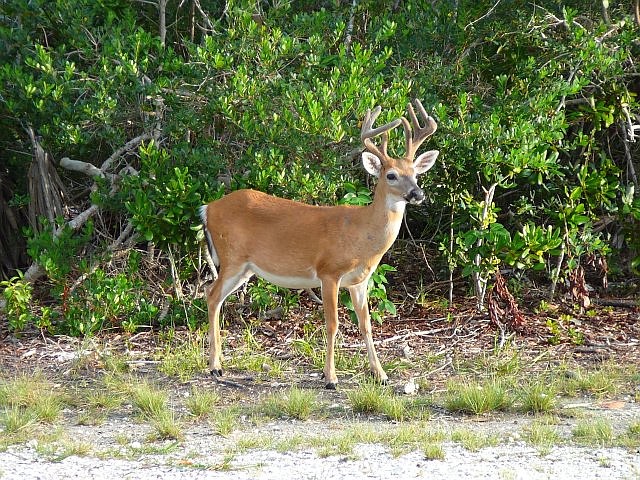
A healthy white-tailed deer.
Idaho Fish and Game
by HAILEY HILL
Staff Writer | October 5, 2024 1:07 AM
This year’s deer hunting season will look a little different for North Idaho wild game processors after cases of chronic wasting disease were confirmed in the Bonners Ferry deer population.
CWD is a neurological disease found in deer, elk and moose that causes degeneration of the animal’s brain, resulting in emaciation, abnormal behavior, loss of bodily function and eventually death.
Woods Meat Processing in Sandpoint still plans to process wild game — however, the shop will not accept any carcasses from CWD zones, which are designated by Idaho Fish and Game. Additionally, a negative CWD test is required for harvested, boneless meat.
ADVERTISING
“If anybody tells you they’re not doing anything different, that’s not a good thing,” said Jody Russell, co-owner of Woods Meat Processing.
Mike Edgehouse, who operates a mobile meat processing business called Primal Edge Pursuits, believes working exclusively with wild game — and one animal at a time — is what will allow him to avoid potential for contamination.
“I think those who do both domestic and wild game are in a much tougher position,” Edgehouse said.
Such was the case for Mountain View Custom Meats, a Coeur d’Alene shop that stopped processing wild game meat two years ago when the first case of CWD was confirmed in Idaho.
Since the shop is located on private property, owner Kevin Trosclair explained, they did not want to risk CWD prions getting into the property’s groundwater and infecting nearby wildlife and livestock.
“We decided from a safety standpoint that we don’t want to have that in our shop,” Trosclair said.
Idaho Fish and Game has designated Units 14, 18 and a portion of unit 1, the portion of Boundary County east of the Selkirk Mountains crest, as CWD Management Zones as of Oct. 1. Fish and Game prohibits the transport of whole deer, elk or moose carcasses out of these zones.
Mandatory sampling is required for all mule deer and white-tailed deer harvested in units 14, 18, 23, 24, 32A and the same portion of unit 1, according to IFG 2024 CWD Hunting Rules.
Any-weapon hunting for white-tailed deer opens Oct. 10.

