Parents of boy, eight, killed in shooting tragedy say he was ‘perfect’ and ‘full of mischief’
Reply


Advertisement
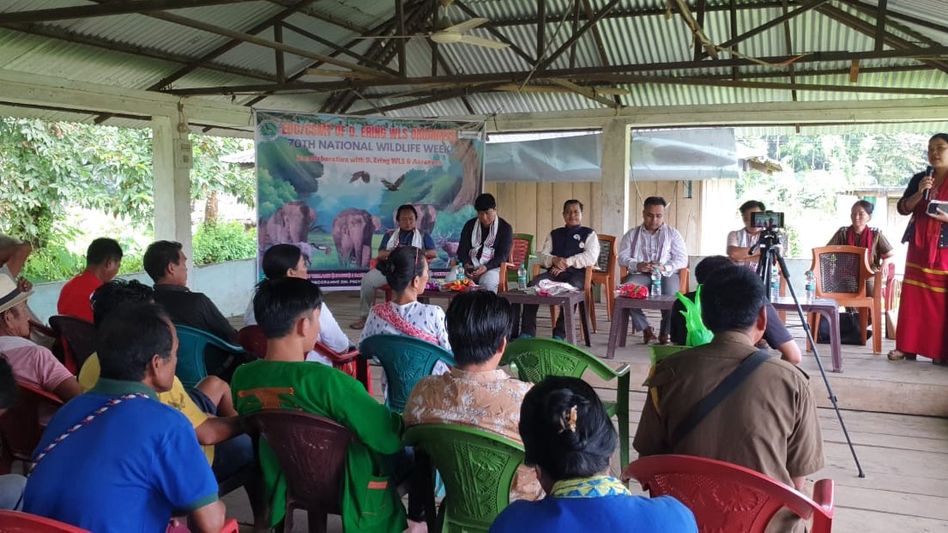
Arunachal Pradesh’s East Siang District Deputy Commissioner, Tayi Taggu, has alerted the public, especially firearm license owners in Seram and other villages that anyone who lends their guns to hunters will be treated as a hunter and will face the same penalties, including imprisonment.
Taggu stated this during a programme which was held as part of the National Wildlife Week at Seram village under Mebo Sub-Division on October 5.
The DC was the chief guest at the event which was organised by the Eco-Development Committee-cum-Community Surveillance & Monitoring Team (EDC/CSMT) of D. Ering Wildlife Sanctuary in collaboration with D. Ering Wildlife Sanctuary and Aaranyak, a reputed NGO based in Guwahati.
The program on the prevention of wildlife crimes and anti-drugs was held during the Wildlife Week celebration, featuring East Siang District Deputy Commissioner Tayi Taggu, Superintendent of Police Dr. Sachin Kumar Singhal, Additional Deputy Commissioner Mebo Sibo Passing, Divisional Forest Officer D. Ering WLS Smty Kempi Ete, Nodal Officer of the Government Rehabilitation Centre Pasighat Dr. Oson Borang, and East Siang District Anti-Drug Warrior Chairman Gumin Mize as guests and resource persons.
A plantation programme was also held before the commencement of the awareness programme where the DC, SP and other guests planted some tree saplings provided by the RO Mebo Range under Pasighat FD, Domek Koyu.
Welcoming the attendees at the celebration, Amit Modi, President of the EDC/CSMT of Borguli WL Range fringe villages, expressed his gratitude on behalf of the EDC/CSMT. He expressed hope that the messages delivered by the district and sub-division heads, along with the management of D. Ering WLS and resource persons on anti-drug efforts, will be heeded and followed by the villagers in their commitment to wildlife conservation and in combating the growing drug menace.
Range Officer Sibiyamukh/Namsing Range of D. Ering WLS, Oyem Mize said that the hunting incidents in the sanctuary from fringe villages are reducing gradually, further appealing to the village elders and GBs to support the sanctuary management in restricting hunting of wildlife in and around the sanctuary.
DFO, D. Ering WLS, Kempi Ete said that the wildlife week is celebrated by organising several events of awareness programmes, essay competitions, among others for the students in the school.
She also informed that the process of relocating and translocating rhinos in the sanctuary is underway, the completion of which will make the sanctuary a noted tourist destination.
Meanwhile, EDC/CSMT Chairman, Maksam Tayeng said that the D. Ering WLS is rapidly regaining its lost glory owing to hard and dedicated efforts made in the last 5-6 years to secure the sanctuary from hunting by taking drastic actions against the habitual and notorious hunters.
“Due to improved protection and the gradual increase in wildlife populations, which creates a conducive environment for new initiatives in the sanctuary, the reintroduction process for Rhinos and Tigers is underway with the active support of 39th Mebo MLA Oken Tayeng and Chief Minister Pema Khandu. Once completed, this initiative will economically benefit the fringe villages through eco-tourism. I also urge the government to accommodate unemployed youth from the fringe villages of the sanctuary by providing them with employment opportunities that will arise following the reintroduction of Rhinos and Tigers,” added EDC/CSMT Chairman Tayeng.
Anti-drug Chairman, Gumin Mize and Nodal Officer of Government, Rehab Centre, Dr. Oson Borang as resource persons together emphasised that the youth should be adequately made aware from getting spoiled by the drug addiction.
Meanwhile, Tayi Taggu referenced his recent executive order banning the misuse of guns that were issued to various individuals in the villages for self-defense and other purposes, adding, “Any gun owner who lends or gives their guns to hunters or their relatives involved in hunting activities will also be treated as a hunter and will face the same penalties, including the permanent seizure of their firearms,” he warned.
Furthermore, he noted that most of the hunters arrested from D. Ering WLS for hunting were using guns belonging to others, including retired government servants and politicians. He criticised the greed of some individuals in the community who are felling large trees that are essential for maintaining moisture and ecological balance and advised the villagers to be vigilant against such wrongdoings and to assist the government in preserving and protecting forests and wildlife.

Instagram user Patrick Montgomery recently shared additional details related to the killing of a mountain lion in Colorado, with some of this information said to address what took place from the side of the person who killed the animal. Montgomery’s post about the situation is accompanied by numerous photos of the big cat (warning: graphic in nature), along with the shovel presumably used to kill the animal.
In case you missed initial reporting on the situation, Colorado Parks and Wildlife detailed how a man was at a campground west of Cañon City on September 26 when a mountain lion was being abnormally aggressive toward the man and his dog. As the mountain lion approached the pair and shortened the distance to about 10 feet, wildlife officials say the man’s dog engaged the animal, with the man then striking the lion with a shovel and killing it. Officials noted that the preliminary investigation pointed to justified self-defense.
The post from Montgomery claims to provide additional detail on the matter, noting that the man involved was a friend of a friend who is a raft guide living in a camper near the Royal Gorge. The post explains that the incident took place around midnight, with the lion said to have targeted the man’s husky. The guide reportedly grabbed the shovel and whacked the big cat to get it to leave, but when it returned, he struck it again, ultimately killing the animal in order to protect himself and his dog.
While officials aren’t considering this to be a mountain lion ‘attack’ on a human because the man involved wasn’t injured and didn’t come in direct contact with the mountain lion, the additional information related to the encounter is enough to send chills down any outdoor recreator’s spine. Mountain lions are rarely seen and aggressive behavior toward humans is even more rare, but this situation goes to show that dangerous encounters are still a very real possibility.
This incident took place weeks before Coloradans are set to vote on whether or not the hunting of mountain lions (and other wild cats) should be allowed in Colorado, with hunting often considered to be a key method of population management.
The ballot item that will be voted on is Initiative 127, with proponents for the ban claiming that hunting causes animals unjust pain and trauma, also positing that mountain lion (and bobcat) populations are able to naturally self-regulate without a need for involvement in Colorado’s hunting program. It’s also worth noting that those who support this ban would still be agreeing that self-defense killings are justified.
Meanwhile, those who oppose the initiative argue that the measure would restrict the abilities of Colorado Parks and Wildlife to use their expertise to make science-based decisions related to the management of the local mountain lion population, also noting that the current approach toward management of the species seems to be working as the state’s mountain lion population is quite healthy. Additionally, those against proposition 127 have noted that increased mountain lion numbers could mean more frequent damages sustained by ranchers due to depredation of livestock, with these ranchers also losing the ability to seek reimbursement for damages should the initiative pass.
This ballot initiative comes a few years after wolf reintroduction was narrowly approved by Colorado voters via a similar method. That approval has since been questioned countless times by those who opposed the measure with the term ‘ballot box biology’ often linked to the program – this term being a reference to voters making decisions related to the management of the state’s wildlife instead of allowing those decisions to be made by wildlife experts hired by the state.
As it relates to this recent Cañon City encounter, some of those leaving comments about the situation online have expressed concern that this type of encounter could happen more frequently if the local mountain lion population is left unchecked. Additionally, concern has been expressed related to what an increased mountain lion population could mean for Colorado’s prey animals, such as deer.
Those wondering whether or not hunting may have an impact on Colorado’s mountain lion numbers may want to consider the impact of a mountain lion hunting ban that was put in place in California, where lions haven’t been hunted since 1972, with cougars later classified as a ‘non-game’ species in 1990 (it’s a different state with different factors, but perhaps the most comparable example of a similar situation in the US). In a study related to the population of California’s mountain lions that spanned years of 1906 to 2018, the population was estimated to be at its highest around the start of the 1900s, dipping to a low around the time that the mountain lion hunting ban was enacted. Since the ban, the population has continued to grow, approaching levels much closer to those seen 100 years ago by 2018 (chart seen on page 75 of this document). This presumably points to a ban on hunting having the potential to mean a larger mountain lion population.
And then there’s the question of what a larger mountain lion population might mean for local ungulates.
As it currently stands, around 500 mountain lions are killed via hunting each year in Colorado. With adult mountain lions killing approximately one deer per week for consumption, the absence of 500 cats means that roughly 26,000 additional deer have a chance to escape death (napkin math, I know). It’s estimated that there are around 400,000 to 450,000 deer statewide, with this 26,000 number representing about five to seven percent of that population. It’s also worth noting that the average lifespan of a mountain lion in the wild is about eight to 13 years, thus multiple years of survival in the absence of death via hunting would need to be taken into account if the 500 mountain lions killed by Colorado hunters each year were to keep predating on ungulates for years to come. There’s debate over whether or not this additional predation would impact the stability of the deer population or help qualm concerns related to chronic wasting disease, which plagues local cervids and thrives when high population density is present.
While Initiative 127 is heavily tied to hunting, a large part of the proposal also seems to boil down to whether or not one believes that wildlife experts should have a hand in the population management of big cat species.
Full details related to this initiative can be found here. Scroll down to page 39.
Proposed legislation would ban experimentation and research if they would harm the animals
, Madrid
Tuesday September 24 2024, 8.26pm BST, The Times

In 1975 the founder of a new field of biomedical ethics came up with 15 criteria by which someone’s “humanhood” could be judged.
Among the qualities defined by Dr Joseph F Fletcher, an ordained Episcopal priest in the US and a controversial professor of ethics who espoused the virtues of euthanasia, were some minimal intelligence, self-awareness, self-control, a sense of time and concern for others.
These, he said, distinguish us from our animal ancestors.
Yet today the Spanish government is citing Fletcher’s research as part of efforts to create a law to protect animals, arguing that the hominid family of primates, which includes gorillas, orangutans, bonobos and chimpanzees, is close to another family member — humans — in cognitive ability.
The objectives of the law, according to the ministry of social rights, which is drafting the legislation, are the prohibition of experimentation and research on great apes if it causes them harm.
It will also establish the conditions of their ownership or custody as well as ban their use for commercial purposes, including in shows, and the improvement of efforts for their conservation.
The government has taken the first step by launching a public consultation on the law that would affect the animals. The reason for the law lies in their “genetic closeness” to humans and because “they share the 15 attributes that bioethicist Joseph Fletcher once established to define the human personality”, says the ministry’s public consultation document.
The government argues that in addition to the fact that Spanish law considers animals to be sentient beings, in 1997 an international confederation decided to classify great apes in the Hominidae family, alongside humans and our extinct ancestors.

Chimpanzees are classified as part of the Hominidae family alongside humans
AFP/GETTY IMAGES
“This decision, accepted by the entire scientific community, is of great importance as it puts these beings on the same level as our ancestors, homo erectus, homo habilis, australopithecus, etc,” says the document.
The ministry adds that great apes “have cognitive abilities such as learning, communication and complex reasoning that bring them close to those of human beings”.
The creation of the legislation was mandated by the Animal Welfare Act, which was passed last year, where it was introduced as an additional provision during its passage through parliament.
The idea of a law on great apes is not new in Spain. In 2006 the organisation Proyecto Gran Simio promoted a non-legislative proposal but it did not prosper. “This law on great apes would be the first in the world and in this way Spain would recognise what science admits and supports, that non-human hominids are our evolutionary brothers and sisters and being within our own family, they deserve special recognition,” Pedro Pozas Terrados, head of of the project, said.

