FILE – In this photo provided by the U.S. Department of Agriculture, an animal caretaker collects a blood sample from a dairy calf vaccinated against bird flu in a containment building at the National Animal Disease Center research facility in Ames, Iowa, on Wednesday, July 31, 2024. (USDA Agricultural Research Service via AP, File)
By JONEL ALECCIAUpdated 3:05 PM PDT, October 3, 2024Share
Two dairy workers in California were infected with bird flu, the 15th and 16th human cases detected this year in an ongoing outbreak affecting the nation’s dairy cows, health officials said Thursday.
The latest cases were found in workers who had contact with infected cattle in California’s Central Valley, where more than 50 herds have been affected since August. The workers developed eye redness known as conjunctivitis and had mild symptoms.
California health officials said the workers were employed at different farms and there is no known link between the two cases, suggesting that they were infected through animal contact, not by people.
The U.S. Centers for Disease Control and Prevention on Thursday confirmed the positive test results, the first for California. CDC officials said new cases of bird flu in people exposed to infected animals is “not unexpected.” The risk to the public remains low, they added.
Advertisement
Across the U.S., more than 250 dairy herds have been infected in 14 states since the outbreak of H5N1 avian influenza was confirmed in March. Avian influenza has been spreading in wild and domestic birds in the U.S. for several years but recently was found in dairy cows.
Before this year, one case of bird flu was detected in a person, a Colorado poultry worker who fell ill in 2022. Most cases this year have been detected in workers who had contact with cattle or poultry in Colorado, Michigan and Texas. A person in Missouri was also infected, but that person had no known contact with animals and the source of that illness has not been determined.
___
The Associated Press Health and Science Department receives support from the Howard Hughes Medical Institute’s Science and Educational Media Group. The AP is solely responsible for all content.
Let’s step forward into the modern era and vote ‘Yes’ to protect our Colorado wild cats from trophy hunting and trapping. With a ‘Yes’ vote on Proposition 127, Coloradans have an opportunity to express our current values and connect our minds with our hearts. A chance to end the ecologically unsound, unsporting and cruel practice of chasing down hundreds of mountain lions each year with packs of dogs, for nothing other than heads and hides.
This harassment and killing of our mountain lions is indefensible. A wealth of science shows it is not necessary. Science shows mountain lion numbers will not explode out of control. Deer and elk numbers will not go down.
Last season about 50% of mountain lions killed were females. Long after weaning from mother’s milk, kittens still need their mothers to survive. The great toll on females inevitably orphaned kittens last year, left alone and starving in the middle of winter.
The ecologically unsound, unnecessary assault on our Colorado wild cats doesn’t end there. Our bobcats are trapped, beaten to death or strangled without limit; furs then sold for profit outside the USA.
If trophy hunting and trapping of our Colorado wild cats serves no ecological purpose and is clearly inhumane and cruel, it must stop.
A ‘Yes’ vote on proposition 127 will reflect the hearts and educated minds of Coloradans.
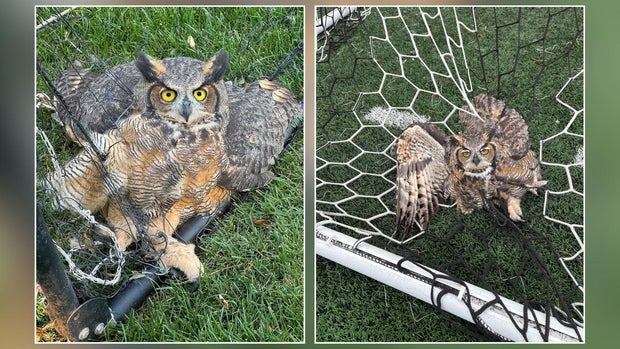
ST. PAUL, Minn. — We’re “owl” all in this together — that’s the message experts at the Raptor Center are pushing after five raptors got caught in soccer nets while on the hunt.
One red-tailed hawk and four great horned owls got themselves into a tight situation after getting caught in nets.
“Five in the month of September is a lot in one short period of time,” said Dr. Dana Franzen-Klein of the Raptor Center.
Franzen-Klein said entanglement admissions are higher than usual this year and a major problem for younger birds.
“This time of year, young great horned owls are separating from parents and learning how to hunt on their own,” Franzen-Klein said. “(They are) less experienced and so focused on hunting that they don’t see the soccer net at night.”
Raptor Center
Experts say entanglement injuries can be the most difficult to treat even leading to death.
“It restricts blood flow to their wings can cause them to get really swollen and get muscle strains that are really painful, and they may fly away but they are uncomfortable and can’t fly well enough to survive,” Franzen-Klein said.
She believes the best way people can help our feathered friends is to remove the nets or tip down the net.
“That’s a real easy thing you can do so it’s flat against the ground so birds will not get tangled in it,” Franzen-Klein said.
She also recommends regularly checking soccer nets and any landscape netting around your home.
Portrait of chicken close-up. Breeding chickens for meat
With the race on to investigate the first possible human-to-human infections of bird flu in the United States, avian flu experts from around the world are meeting in Fayetteville this week to contain the spread.
This is the second year for theInternational Avian Influenza and One Health Emerging Issues Summit, a four-day conference held virtually and in-person at the Don Tyson Center for Agricultural Sciences in Fayetteville, part of the University of Arkansas System Division of Agriculture.
The summit is significant because there are not many other conferences in the United States, or even globally, that bring together international experts to discuss the disease, which is increasingly alarming scientists as it spreads through poultry and infects other species.
“We decided to do this summit because the world is getting hit very badly by this virus that is now basically a pandemic,” said Guillermo Tellez-Isaias, the summit’s organizer and a research professor in the Center of Excellence in Poultry Science, a unit of both the Division of Agriculture and the University of Arkansas Dale Bumpers College of Agricultural, Food and Life Sciences. “It is present in all continents now, even Antarctica.”
“We are facing a unique virus that has been able to adapt and infect other species that it traditionally did not used to infect,” Tellez-Isaias told Arkansas Times. (In Vietnam, 47 tigers, three lions and a panther died in zoos because of bird flu, Agence France-Presse reported Wednesday. In 2023, avian influenza killed tens of thousands of pelicans and more than 700 sea lions in Peru.)
In July, Reuters published a report based on interviews with more than a dozen disease experts who characterized the avian flu as a “pandemic unfolding in slow motion.” The experts said its rapid spread to more than 100 dairy herds in the U.S., as well as infections found in other mammals including alpacas and house cats, is an alarming indication that bird flu could soon be transmissible between humans.
Since April 2024, the CDC reports that there have been 14 human cases of avian influenza in the U.S. All but one were the result of direct contact with sick cows or poultry. The source of the most recent human case, the one in Missouri that may have resulted in human-to-human transmission, is still unknown. (Note, the CDC says the immediate risk to the general public from bird flu remains low.)
It would be prudent not to forget that a pandemic in 1918 that killed at least 50 million people globally, known as the Spanish flu, was caused by a virus “with genes of avian origin,” according to the U.S. Centers for Disease Control and Prevention. Although the origin of that influenza strain is not known, the 1918 outbreak was called the Spanish flu because it killed millions of people in Spain as it spread worldwide. About 500 million people, or half the world’s population at the time, contracted the Spanish flu, making it the worst pandemic in modern history. (Strains of the disease have continued to infect humans globally, with some outbreaks resulting in notably high fatality rates nearing 50% of those infected.)
Though the data remains imprecise, estimates of global deaths from the COVID-19 pandemic range from about 7 million to close to 20 million, less than half of the death toll of the Spanish flu.
While a great deal of the content presented at the International Avian Flu Summit this week is esoterically scientific in nature, and largely focusing on the risks the bird flu continues to pose to the poultry industry, the event is again notable in relation to COVID-19.
The national and international response to the coronavirus pandemic was catastrophically disorganized and shockingly dysfunctional, revealing not just cracks, but gaping fissures, in unquestionably broken public and global health systems that led to countless unnecessary deaths.
The response to COVID was so bad, The Lancet labeled it a “massive global failure” in a 2022 report from the medical journal’s COVID-19 commission. The death toll from the coronavirus “is both a profound tragedy and a massive global failure at multiple levels,” the Lancet commission wrote. “Too many governments have failed to adhere to basic norms of institutional rationality and transparency, too many people – often influenced by misinformation – have disrespected and protested against basic public health precautions, and the world’s major powers have failed to collaborate and control the pandemic.”
About 1,000 people representing 55 countries are taking part in the International Avian Flu Summit. Organizer Tellez-Isaias, the UA poultry professor, said the conference is intended to address some of the failures that occurred during COVID-19.
“If this virus is able to adapt to humans, it will make COVID-19 look like a small cold compared to the mortality that the human race could see,” Tellez-Isaias said. “It happened before with the 1918 Spanish flu. It could happen again. We need to prepare ourselves and work together. This is serious.”
Throughout the week, International Avian Influenza Summit participants will craft recommendations centered on the avian flu and global efforts, or lack thereof, to contain it and monitor its spread in commercial farming, wildlife and humans. The recommendations will be presented to the World Health Organization, the CDC, the Food and Agriculture Organization of the United Nations and the World Organization for Animal Health, among others, Tellez-Isaias said.
“This is something that is going to have to involve the collaboration of agencies that involve human and animal health at all levels in all countries,” Tellez-Isaias said. “What we are facing is a problem that needs to be controlled as soon as possible.”
Undoubtedly the poultry industry in Arkansas and elsewhere has a vested interest in controlling bird flu. Infections in Arkansas have been sporadic and mostly isolated, but the industry has had to cull millions of birds.
The poultry sector engages in numerous unsavory business practices, but if it takes Big Chicken to get policymakers to pay attention to what could become another global pandemic in an instant, then kudos to Tellez-Isaias and his colleagues for making this very important summit happen.