(CNN)A California sea lion rescued in mid-December after it was found suffering from pellet gun wounds had to be euthanized because of its injuries.

(CNN)A California sea lion rescued in mid-December after it was found suffering from pellet gun wounds had to be euthanized because of its injuries.
By Karen Davis, PhD, President, United Poultry Concerns
If we cannot imagine how chickens must feel being grabbed in the middle of the night by men who are cursing and yelling at them while pitching them into the crates in which they will travel to the next wave of human terror attacks at the slaughterhouse, then we should try to imagine ourselves placed helplessly in the hands of an overpowering extraterrestrial species, to whom our pleas for mercy sound like nothing more than mere noise to the master race in whose “superior” minds we are “only animals.”
– Karen Davis, The Holocaust and the Henmaid’s Tale
“The garbage dump is crammed with our heads and entrails.”
– Rooster narrator of “Cockadoodledoo” by Isaac Bashevis Singer

Month-old chickens in a commercial operation courtesy of the PEW Charitable Trust
Some people will say that treating creatures badly in order to eat them is a far cry from treating creatures badly simply because you hate them, but Charles Patterson notes in his book, Eternal Treblinka: Our Treatment of Animals and the Holocaust, that the psychology of contempt for “inferior life” links the Nazi mentality to that which allows us to torture and kill billions of nonhuman animals and millions of human beings with no more concern for them and their suffering than Hannibal Lecter and Jame Gumb feel for their victims, apart from the pleasure they derive from the taste of their victims’ pain, in Thomas Harris’s book, The Silence of the Lambs. That book says that the plight of the lambs screaming in the slaughterhouses – the whole human enterprise of degradation, cruelty, and murder – “will not end, ever” (Harris, 366).
Eternal Treblinka reminds us of all those other slaughterhouses that were running alongside the human ones under the Nazis – “Around-the-clock killing and butchering” conducted at Treblinka, Auschwitz, in Dresden, and elsewhere (Patterson, 129). In their diaries and letters, Nazi officials note indifferently such things as “huge slaughter of chickens and pigs” (Patterson, 125), and they dote on their meals. One writes to his wife: “The sight of the dead – including women and children – is not very cheering. Once the cold weather sets in you’ll be getting a goose now and again. There are over 200 chattering around here, as well as cows, calves, pigs, hens and turkeys. We live like princes. Today, Sunday, we had roast goose (1/4 each). This evening we are having pigeon” (Patterson, 129).
In Eternal Treblinka, chickens and pigs shriek as they are being cursed and butchered. Nazis bear their souls in letters and diaries. We read the opposing testimony of Holocaust survivors and their descendants. A question raised over and over by those who became vegetarians rather than perpetuate the legacy of butchery in their own lives, is “How can ‘we’ do to ‘them’ what was done to ‘us’ and not even recognize it?” Because, says Albert Kaplan, “we have learned nothing from the Holocaust” (Patterson, 167). Kaplan tells of a visit he made in Israel to a kibbutz Holocaust museum near Haifa: “Around two hundred feet from the main entrance to the museum is an Auschwitz for animals from which emanates a horrible odor that envelops the museum. I mentioned it to the museum management. Their reaction was not surprising. ‘But they are only chickens’” (Patterson, 166).
Christa Blanke, a former Lutheran pastor in Germany and founder of the organization Animals’ Angels, cites a link between how we treat animals and Nazism. First we strip the animals of their dignity – “The degradation of the victim always precedes a murder” (Patterson, 228). But, we want to know, why do humans want to degrade and kill? Serial killer Ted Bundy said it wasn’t that he had no feelings of remorse for his victims, but that those feelings were weak and ephemeral compared to his rapacious emotions (Rule). Naturalist John Muir wrote that the people he knew enjoyed seeing the passenger pigeons fill the sky, but they liked shooting and eating them more – “Every shotgun was aimed at them” (Teale, 46).
The Holocaust thus raises questions, and we long for answers. Why, asked Isaac Bashevis Singer, do we pretend animals don’t feel in order to justify our cruelty, but even more importantly, why do we want to be cruel to animals? Is comfort with cruelty, taking pleasure in cruelty, a trait we carry from our past in our genes? Why, when we have the technology to duplicate animal products, do people insist they have to have meat? Why do we praise technology for developing substitutes for cruder practices in other areas of life while balking at its use to end slaughterhouses, which technology can do?
The Holocaust epitomized an attitude, the manifestation of a base will. It is the attitude that we can do whatever we please, however vicious, if we can get away with it, because “we” are superior, and “they,” whoever they are, are, so to speak, “just chickens.” Paradoxically, therefore, it is possible, indeed requisite, to make relevant and enlightening comparisons between the Holocaust and our base treatment of nonhuman animals. We can make comparisons while agreeing with philosopher, Brian Luke: “My opposition to the institutionalized exploitation of animals is not based on a comparison between human and animal treatment, but on a consideration of the abuse of animals in and of itself” (Luke, 81).
Paradoxically, while the words “Nazi” and “Holocaust” represent unique historical phenomena, they can transcend these phenomena to function more broadly. And a broader approach to the Holocaust would appear to hold more promise for a more enlightened and compassionate future than attempting to privatize the event to the extent that its only permissible reference is self-reference. A broader approach provides a more just apprehension of past and present atrocities, while connecting the Nazis and the Holocaust to the larger ethical challenges confronting humanity.
In A Little Matter of Genocide: Holocaust and Denial in the Americas 1492 to the Present, Native American scholar Ward Churchill writes that the experience of the Jews under the Nazis is unique “only in the sense that all such phenomena exhibit unique characteristics. Genocide, as the Nazis practiced it, was never something suffered exclusively by the Jews, nor were the Nazis singularly guilty of its practice” (Churchill 1997, 35-36).
One of the many questions that emerge from the current debate about the use of the Holocaust to illuminate humankind’s relationship to billions of nonhuman animals is the extent to which the outrage of having one’s own suffering compared to that of others centers primarily on issues of identity and uniqueness or on issues of superiority and privilege. The ownership of superior and unique suffering has many claimants, but as Isaac Bashevis Singer observed speaking of chickens, there is no evidence that humans are more important than chickens (Shenker, 11).
There is no evidence, either, that human suffering, or Jewish suffering, is separate from all other suffering, or that it needs to be kept separate and superior in order to maintain its identity. But where, it may be asked, is the evidence that we humans have had enough of inflicting massive preventable suffering on one another and on the individuals of other species, given that we know suffering so well, and claim to abhor it? In Eternal Treblinka: Our Treatment of Animals and the Holocaust, Charles Patterson concludes: “the sooner we put an end to our cruel and violent way of life, the better it will be for all of us – perpetrators, bystanders, and victims” (232). Who but the Nazi within us disagrees? If we are going to exterminate someone, let it be the fascist within.
Adam Crook is accused of killing his dog in Melrose Friday night. (Melrose Police)
The 44-year-old Melrose man accused of beating his dog to death with a rock claimed he was euthanizing the animal.
Adam Crook was arraigned Tuesday in Malden District Court on a charge of cruelty to an animal in connection with the killing of his dog, authorities said.
“In this case, the defendant allegedly struck his dog, Derby, multiple times in his backyard,” Middlesex District Attorney Marian Ryan said. “After being certain the dog was deceased the defendant allegedly buried it behind his home.”
According to a police report reviewed by the Boston Herald, Crook claimed his dog was 17 years old and he had discussed euthanizing the animal with a friend who is a veterinarian.
Crook told police he decided to kill the dog Friday while his son was away, the Herald reports. Crook put Tylenol PM in the dog’s food.
The newspaper cited a police report that said Crook wanted to make sure the dog was dead, so he grabbed a rock and struck the dog in the head several times.
Crook showed police where the dog was buried, the Herald reports.
Police said Crook dragged his dog from his home into the backyard Friday night and struck the dog in the head with a large rock several times.
“The defendant then allegedly retrieved a shovel from his home and subsequently buried the dog,” the district attorney’s office said.
On Sunday, police executed a search warrant at Crook’s home and located the dead dog and other evidence. The dog’s body was taken to the Cummings School of Veterinary Medicine at Tufts University by the Law Enforcement Liaison for the Animal Rescue League Alan Borgal.
“The defendant’s alleged actions are truly disturbing,” Melrose Police Chief Michael Lyle said. “This arrest would not have been possible without the close collaboration among our officers and our partners with the Animal Rescue League and federal law enforcement.”
The Herald reports a home health care aide saw Crook strike the animal. Crook hog-tied the dog outside his home, the newspaper reports.

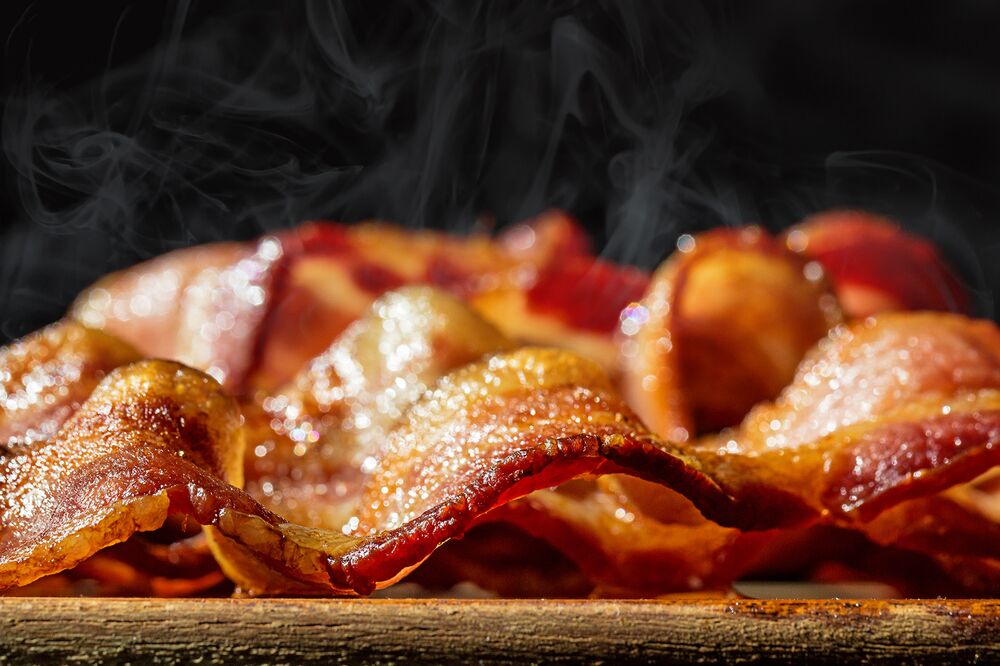
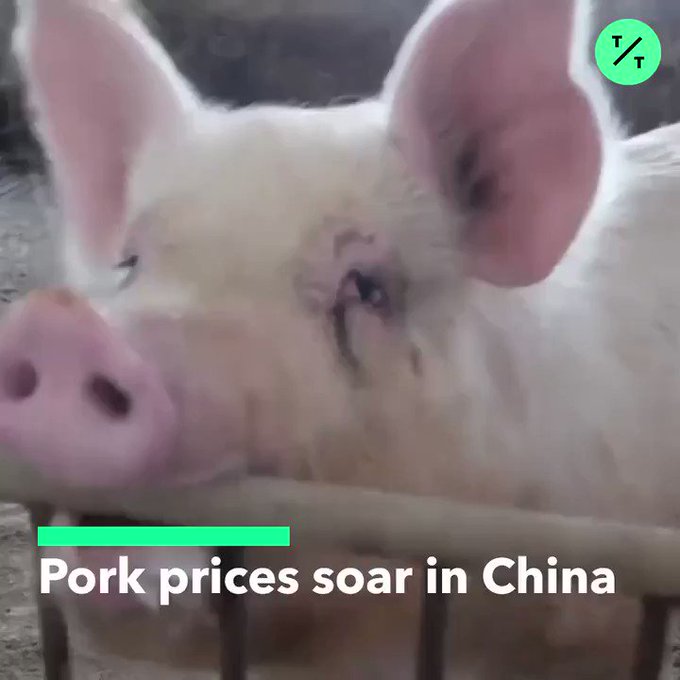
Bringing home the bacon will cost more. Blame African swine fever.
Pork is heading for the steepest annual increase in 15 years
Source: Food & Agriculture Organization of the United Nations
“It doesn’t matter where you are in the world at the moment, pork prices are up,” said Justin Sherrard, Rabobank’s Utrecht-based global animal-protein strategist, in a telephone interview. “China is the market to focus on. Firstly, because it’s big and, secondly, because this is really the first place that African swine fever started to hit.”
Read More: The Deadly Virus That’s Killing Off Millions of Pigs
Prices will remain high for at least the next three months in the lead up to the Lunar New Year on Jan. 25, a peak time for pork consumption in China, Vietnam and other countries that celebrate the festival. Retailers will have “no choice” but to pass on at least some of the extra cost to consumers, Sherrard said.
A snapshot of what shoppers are paying for 500 grams (18oz) bacon
Source: Online retail data
By the end of 2020, China’s swine herd will slump to 275 million head, down almost 40% since the beginning of 2018, before the world’s largest animal disease outbreak began, according to the U.S. Department of Agriculture. That will pull down global pork production by 10% in 2020.
China’s annual pig production has been savaged by African swine fever
Source: U.S. Department of Agriculture
2019 & 2020 are forecasts
“African swine fever has had a significant impact on the production of pork in China and increasingly in Vietnam and other Southeast Asian countries,” said Tim Foulds, Euromonitor International’s head of research for Australasia. “Government attempts to control the crisis, including the large-scale culling of animals, resulted in pork production dropping dramatically in 2019.”
Prices in China have surged 120% since deadly pig outbreak reported
Source: China Ministry of Commerce
Reduced domestic supplies will boost China’s demand for foreign pork, resulting in record prices and imports. However, Chinese consumers will “feel the pinch,” with a 32% slump in per-capita pork consumption over two years, the USDA said in an Oct. 10 report.
African swine fever, which kills most pigs in a week but isn’t known to harm humans, has had a greater impact in China than in any country or previous outbreak, and the disease there is now considered endemic, or generally present, according to the USDA.
China’s $118 billion market dominates global pork sales
Source: Euromonitor International

Companies across the world are moving quickly to bring to the market hamburgers and other meat products that are grown from animal cells in a lab.
This month, Israeli-based company Future Meat Technologies raised $14 million to build a production plant for its cultured meat products, joining several dozen other start-ups poised to launch their first commercial products within the next couple years.
Lab-grown meat will replicate the taste and consistency of traditional meat. Many expect the move to the lab will especially appeal to people concerned about the role land-based animal agriculture has in accelerating climate change.
But as investments and research ramp up for lab-grown meat, more people are debating the environmental and health implications of widespread production of alternatives.
Some researchers speculate that depending on the efficiency of the production process, the rise of the cultured meat industry could actually make climate change worse than traditional beef production. One issue is the longer lasting impact of carbon pollution versus methane gas pollution.
“Lab meat doesn’t solve anything from an environmental perspective, since the energy emissions are so high,” said Marco Springmann, a senior environmental researcher at the University of Oxford.
“So much money is poured into meat labs, but even with that amount of money, the product still has a carbon footprint that is roughly five times the carbon footprint of chicken and ten times higher than plant-based processed meats,” he said.
Despite these findings, commitment to protecting the environment is at the forefront of marketing efforts by plant-based protein and lab-created meat companies. Analysts project the market could be worth as much as $85 billion by 2030.
Animal agriculture remains a giant global economic force. It’s responsible for nearly 15% of global greenhouse emissions, according to United Nations estimates. Roughly 65% of those emissions come from beef and dairy cattle.
Dozens of start-ups are racing to be the first to sell their lab-grown beef within the year. So far, the U.S. has at least nine cell-culturing companies out of the several dozen worldwide. The leading industries plan to release the first products, including like ground beef and chicken nuggets, by the end of this year.
Proponents of cultured meat say that producing it in a lab helps preserve endangered species and other animals, reduces greenhouse gas emissions and significantly curbs land and water use. Most of the cultured meat start-ups boast a firm commitment to protecting the environment.
MosaMeat in the Netherlands says that cultured meat generates up to 96% lower greenhouse gas emissions, and the company predicts that once cultured meat becomes a mass-market food, there will be no need for industrial farms.
In the U.S., San Francisco-based Memphis Meats says its businesses use significantly less land, water energy and foot inputs. Tyson Foods and Cargill have both invested in the company.
Future Meat Technologies says its cultured products will take up 99% less land, 96% less freshwater and emit 80% less greenhouse gases than traditional meat production, according to its Life Cycle Assessment.
“One of the reasons that Future Meat Technologies stands out in the cultured meat field is that our proprietary high yield production process lends itself naturally to distributive manufacturing,” said the company’s founder Koby Nahmias. “Because it’s so efficient, I think we’ll see more than an add-on to cattle production, but that it will start replacing it.”
The company’s process will allow farmers to shift production to a more sustainable, lower-risk and high-efficiency process, Nahmias said, and the small size of the company’s production modules can also be powered by renewable energy.
Since the cultured-meat industry is in such an early stage, it’s difficult to assess the actual carbon footprint of producing on a large scale without clear data on production processes.
As companies continue to develop their alternative meat products they’ll likely face increasingly climate-conscious consumers or stricter regulations on emissions as the planet warms. This could encourage the growing industry to use cleaner energy and technologies for cultured meat, researchers say.
However, if large-scale cultured meat industries start producing a lot of carbon dioxide pollution, it could be as damaging for the planet as the beef and cattle emissions, according to the research published in the journal Frontiers in Sustainable Food Systems.
The impact would depend on decarbonized energy generation and the production systems cultured meat companies use, the study says. The research points out that emissions from a meat lab produce energy made up of carbon dioxide, which persists in the atmosphere for hundreds of years. In contrast, methane, a potent greenhouse gas produced by raising and killing cattle, disappears from the atmosphere in about 12 years.
“In the past year, we’ve seen more hype and investment around cultured meat,” said John Lynch, a researcher at Oxford University and co-author of the report.
“If these companies want to sell cultured meat as an environmental alternative, they will need to look at renewable energy resources for production. They need to have the drive to do it,” he said.
Of course, that research is based on speculating about how labs will produce their products and contain emissions. The companies are not yet producing on a commercial scale and are still trying to cut costs as they compete to bring the product to the market.
“We’ll need to take a step back and urge a bit more caution if environmental messaging continues to be a big part of advertising for cultured meat,” Lynch said. “The interest of the companies is making it clear how will they produce in an environmentally sustainable way.”
In a similar movement away from eating animals, companies like Beyond Meat and Impossible Burger have gained popularity over the past few years. They produce fake meat products made from pea protein or genetically modified soy for consumers who want the taste to imitate a real burger, and market the environmental benefits of their products.
However, those fake meat products have also been debated by scientists, who argue that it’s healthier and better for the environment to consume plant foods rather than processed alternatives.
Future Meat’s Nahmias said that the research indicating that lab-grown meat could be worse for the environment than regular beef was widely “mischaracterized” as a claim against cultured meat.
“Under extreme cases, if you’re using polluting energy, you can get to parity with traditional meat,” he said. “We’re far away from that extreme case, so I don’t see that as a problem.”
Future Meat’s efficiency is expected to improve 10 times more in their new pilot production facility, he added, and the distributive manufacturing model will allow producers to couple each small facility to local renewable energy production.
“We are working in an industry with tight margins and thus a necessity for efficiency,” said Cai Linton, founder of London-based start-up Multus Media, a group that’s working to reduce the cost of lab-grown meat.
“As a company, our biggest environmental policy will be minimizing waste, particularly with regard to single-use plastics and fresh-water, and ensuring the electricity we use is produced sustainably and in a clean way.”
Linton said that by the time his start-up is ready to scale up, he’s confident the facilities will have net-zero carbon emissions.
“At this early stage, our estimations on efficiency and environmental impact will always be open to scrutiny since they are only projections,” he said. “We must also consider that although the research and development required to create a commercially viable product may not have environmental protection at its core, the long term benefits of this technology far outweigh the short-term cost.”
By Sarah Lazarus, CNN
Updated 10:30 PM ET, Wed October 16, 2019 A deer trapped in a homemade
snare.
A deer trapped in a homemade snare.
(CNN)Across Southeast Asia, wild animals are being hunted out of existence
to feed growing demand for bushmeat, according to conservationists.
Thomas Gray, science director with conservation group Wildlife Alliance,
which operates in Cambodia, says that snares — simple traps made of wire
and rope — have become the single biggest threat to ground-dwelling animals
in Cambodia, Vietnam and Laos over the last decade.
Snares collected by community rangers in Nakai-Nam Theun — a protected area
in the Annamite Mountains in Laos.
Snares collected by community rangers in Nakai-Nam Theun — a protected area
in the Annamite Mountains in Laos.
The scale of the problem is “phenomenal” says Gray.
Between 2010 and 2015, more than 200,000 snares were removed by patrol teams
from just five protected areas in the region. But despite these efforts,
says Gray, law enforcement patrols can’t keep pace with poachers and stop
the slaughter.
Typically made from motorbike and bicycle brake cables, snares are cheap and
simple to construct. Traditionally, hunters made snares from rattan and
other natural forest products which were “relatively weak and decomposed
relatively quickly,” says Gray. Wire snares require much less skill to make
and can last for years.
The hunters’ targets are animals they can sell as food, including wild pigs,
muntjac deer, civets and porcupines.
But the tragic thing about snares, says Gray, is that “they take out
everything.” Animals caught in these “barbaric” devices face a lingering
death, he says. A few manage to escape, but are likely to die from their
injuries — sometimes because they have gnawed off a limb to free
themselves. Trapped animals without market value are simply left to rot in
the forest.
Southeast Asia’s forests once teemed with myriad species, including sun
bears, striped rabbits, marbled cats, hog badgers and monkeys.
But the snaring epidemic is leading to what conservationists call “empty
forest syndrome.” “In some areas there are no mammals larger than a rodent
left,” says Gray.
A perfect storm
In Cambodia, setting snares is illegal in protected areas — where most of
the wildlife is found. Selling the meat is also illegal, says Gray.
But that has not deterred poachers.
Demand for wild meat is fueled in part by rising incomes in the region, says
Regine Weckauf, illegal wildlife trade advisor with Fauna & Flora
International. Research conducted by the non-profit in Cambodia identified
two main types of consumer.
Found with its arm caught in a snare by researchers from the Laos
conservation group Anoulak, this stump-tailed macaque was released back into
the wild.
Found with its arm caught in a snare by researchers from the Laos
conservation group Anoulak, this stump-tailed macaque was released back into
the wild.
“In rural areas, people generally consume bushmeat because they like the
taste,” says Weckauf. “Often, they don’t realize it’s been sold illegally.”
For urban consumers, in the capital Phnom Penh and other big cities, eating
wild meat is an “elite practice” she says — and it’s almost exclusively men
who do it.
Procuring wild meat when entertaining associates demonstrates power and
status, says Weckauf. “It shows that the man can afford the meat and that
he’s well connected and knows how to source it.” In cities, many consumers
know that wild meat is illegal, so providing it also sends the message, “I
am untouchable,” she says.
Similar patterns of consumption have been observed in Vietnam.
A sambar deer caught in a snare in Belum Telemgor forest in northern
Malaysia, near the Thai border.
A sambar deer caught in a snare in Belum Telemgor forest in northern
Malaysia, near the Thai border.
According to Gray, the perception of bushmeat as a prestige food has
combined with changes to the landscape to create a “perfect storm” for
Southeast Asia’s wildlife.
“Fifty years ago, people would have set snares within walking distance of
their village, for their own consumption,” he says, “but the rest of the
forest wasn’t snared.”
Since then, he says, rampant deforestation, expanding road networks and the
ubiquity of motorbikes have led to forest interiors becoming accessible like
never before and subsistence hunting has developed into commercial poaching.
Cambodia’s wildlife is also squeezed because the country has one of the
biggest deforestation problems in the world. It was once cloaked in lush
forests but huge expanses have been cleared by loggers and to make way for
roads, fields and vast rubber plantations.
Analysis by scientists from the University of Maryland and Global Forest
Watch has revealed that although other countries are losing more forest in
terms of area, Cambodia’s forests are being cleared especially rapidly. The
country lost four times as much forest in 2014 as it did in 2001.
However, although logging and deforestation destroy the animals’
habitat, Gray says that by the time the trees are cut down, most of the
animals have already been killed by hunters.
Snares, home-made guns and chainsaws confiscated by Wildlife Alliance's
rangers in Cambodia's Cardamom rainforest.
Snares, home-made guns and chainsaws confiscated by Wildlife Alliance’s
rangers in Cambodia’s Cardamom rainforest.
The toll of snaring on many species across the region has been devastating.
The saola, a mysterious antelope-like animal that was only discovered by
scientists in 1992, is on the brink of extinction — it has fallen victim to
snares despite not being a target species, says Gray.
The dhole — a tawny-colored wild dog — is also highly endangered.
“There are probably fewer dholes left than tigers,” says Gray, ‘but they
don’t get the same level of attention.”
Dholes are especially susceptible to being caught in snares, he says,
because they roam over large distances in search of pigs and deer which are,
themselves, becoming increasingly rare because of snaring. Gray says dholes
are thought to be extinct in Vietnam and are likely to become extinct in
Laos. “There is still a decent population in Cambodia, but if we don’t solve
the snaring crisis, they will go too.”
This dhole pup was born in San Diego Zoo's Wild Animal Park. Its
counterparts in the wild are being killed by snares.
This dhole pup was born in San Diego Zoo’s Wild Animal Park. Its
counterparts in the wild are being killed by snares.
Changing behavior
Wildlife Alliance operates a team of 110 rangers who work “24/7”
removing snares from the Cardamom rainforest in western Cambodia , says
Gray. In 2018 alone, the team, working in partnership with the Cambodian
Ministry of Environment, removed 20,000 snares and destroyed 779 illegal
forest camps — structures built inside protected areas where poachers sleep
and store equipment and animal carcasses.
Rescued creatures are cared for at the Phnom Tamao Wildlife Rescue Centre,
which houses more than 1,400 animals — some of which are released in safe
areas and some of which stay there for the rest of their lives, depending on
the severity of their injuries.
This work is vital, but it’s not nearly enough, says Gray.
A Wildlife Alliance ranger rescues a common palm civet in Cambodia's
Cardamom Rainforest. Civets are often found dead in snares, but this one
survived the ordeal.
A Wildlife Alliance ranger rescues a common palm civet in Cambodia’s
Cardamom Rainforest. Civets are often found dead in snares, but this one
survived the ordeal.
Gray believes legislative reform is needed.
Currently, snaring is almost a “risk-free crime,” he says, because although
it is illegal in protected areas, “the chances of catching someone
red-handed in the act of setting a snare are close to zero.”
In 2001, the Cambodian government created the Wildlife Rapid Rescue Team in
an effort to crack down on the trade. The team says it has saved more than
70,000 live animals, seized 54 tons of animal body parts and arrested 3,400
traffickers.
Heng Kimchhay, who heads the team, says the Cambodian government has created
more than 27 thousand square miles of protected areas (around 40% of
Cambodia’s total land mass) and assigned additional personnel to combat
poaching on protected land.
But, he says, the illegal wildlife trade has grown in size and
sophistication and his team needs more staff, more training and more
equipment.
Chhouk, a male elephant, was found as a baby wandering alone in the forest
in northeastern Cambodia. He had lost a foot to a poacher's snare and
was close to death. Wildlife Alliance took him to Phnom Tamao Wildlife
Rescue Centre where he was given a prosthetic foot and has been cared for
ever since.
Chhouk, a male elephant, was found as a baby wandering alone in the forest
in northeastern Cambodia. He had lost a foot to a poacher’s snare and was
close to death. Wildlife Alliance took him to Phnom Tamao Wildlife Rescue
Centre where he was given a prosthetic foot and has been cared for ever
since.
Gray would like to see the “intent to snare” treated as a serious crime.
“If someone is walking in the forest with snare materials — such as 50
motorbike brake cables — they are clearly planning to set snares,” he says.
But while poaching remains lucrative, there is only so much that legislation
and enforcement can achieve. The key to solving the snaring problem, some
believe, is behavior change.
“We need to understand why people consume bushmeat and the best ways to
persuade them to stop,” says Weckauf.
Fauna & Flora International plans to work with marketing firms and
communication specialists to find solutions geared to human psychology, she
says. “We want to use the kind of techniques that have successfully
persuaded people to wear seat belts, to use mosquito nets and to stop
wearing fur,” she says.
These efforts are essential, says Gray, because otherwise “we face the loss
of species, the loss of heritage, and the loss of tens of millions of years
of evolution that have created Southeast Asia’s unique wildlife.”
https://www.cnn.com/2019/10/16/asia/southeast-asia-snaring-crisis-hnk-intl/i
ndex.html
Last convicted shark-dragger Benac will get fishing license back in 2022
(Beth Clifton collage)
TAMPA, Florida––Holding out for a lighter sentence under a plea bargain offer did not wholly pay off on September 12, 2019 for Robert Lee “Bo” Benac III, 30.
But Benac did avoid a felony cruelty conviction and will get his fishing license back two years sooner than shark-dragging buddy Michael Wenzel, even if he will have to perform more than twice as much volunteer community service work meanwhile.
Benac was the last of three Florida men to settle charges originally filed as felony cruelty, after they shot and dragged a blacktip shark to death behind a speedboat on June 26, 2017 near Egmont Key in Hillsborough County waters.
Mark Wenzel (left) & Bo Benac (right)
(Facebook photo)
Benac, of Bradenton, Florida, pleaded guilty to misdemeanor charges of aggravated cruelty to animals and violating Florida Fish & Wildlife Conservation Commission fishing rules.
Benac was sentenced to serve 10 days in the Hillsborough County jail , the time to be served on weekends, plus 11 months on probation. Benac is also to pay a $2,500 fine and perform 250 hours of community service, half of those hours at an animal shelter.
Benac in addition lost his fishing license for three years.
Benac in March 2019 reportedly refused the same plea deal that fellow shark-dragger Wenzel, 22, accepted. Wenzel, who was videotaped exulting as the men dragged the dying shark, accepted the same jail and probation time, and the same fine of $2,500, but was required to perform only 100 hours of community service, and had his fishing privileges suspended for five years.
Clockwise from top: Michael Wenzel, Bo Benac, Spencer Heintz, & Nick Easterling.
Wenzel pleaded guilty, reported Joe Hendricks of the Anna Maria Sun, “to a third-degree felony count of aggravated cruelty to animals. A second and similar third-degree animal cruelty charge was dismissed.”
Wenzel, like Benac, also pleaded guilty to violating Florida Fish & Wildlife Conservation Commission rules, Hendricks wrote.
“The misdemeanor charge pertained to the illegal taking of a shark,” Hendricks explained. “Video shows Wenzel using a .38 caliber revolver to shoot the shark. State law prohibits taking a shark by any other means than with a hook and line.”
From left, Michael Wenzel, Bo Benac, and the blacktip shark they dragged.
A third Florida man involved in the shark dragging incident, Spencer Heintz, 23, escaped prosecution when Florida assistant state attorney Andrew Hubbard on May 1, 2018 told the court that the state had dropped all charges against him due to a purported lack of evidence.
Heintz had faced two counts of aggravated cruelty to animals.
“Another Florida man on the boat that day, 24-year-old Nicholas Burns Easterling, did not face charges, because he provided information and cooperated with the investigation,” said Courthouse News.
The major evidence against the defendants was a widely distributed video that Wenzel posted to social media on July 24, 2017
.

BILLINGS, Mont. — Montana wildlife officials are offering a $1,000 reward for information in the shooting of possibly dozens of pelicans along the Bighorn River.
State game wardens have reported retrieving about a dozen dead pelicans along a stretch of the river downstream of Yellowtail Dam. The river in that area is popular among fly fishers.
Fish, Wildlife and Parks spokesman Robert Gibson says the birds are being killed with a shotgun.
Pelicans are a protected under federal law as migratory birds.
The reward is offered for information that leads to the conviction of those responsible. Call 1-800-TIP-MONT.
A Florida woman was arrested after a passerby caught her on video putting her dog into the trunk of a car and driving away. The woman had attempted to get the dog euthanized at a local shelter but was turned away.
Sarah Ann Perry no longer wanted to keep her dog. So on Wednesday, the Cocoa, Florida, woman brought him to her local shelter.
Things went downhill from there.
According to the Brevard County Sheriff’s Office, after the folks at the facility said they were full, she asked to have the mixed breed pet named Neptune, euthanized. The shelter told her they did not euthanize animals and turned her away.
“She became extremely angry,” said Brevard County Sheriff Wayne Ivey on the agency’s Facebook page.
Ivey then shows video, shot by a concerned citizen in the shelter’s parking lot, of what Perry did next: She jerks Neptune’s leash and shoves him into the trunk of her car.
Investigators soon tracked down Perry at her home, and took her into custody for the “despicable way she treated this poor helpless pet,” the sheriff said. The charge: animal cruelty, a felony.
As for Neptune, the dog was examined and found to be in very poor health and extremely malnourished.
According to a police report, his ribs, lumbar, vertebrae, pelvic bones and other bones were “visible from a distance.”
Neptune is being cared for at the Brevard County animal care center. Perry was released after posting $2,000 bond.
UPDATED: Thu., Sept. 5, 2019, 11:05 a.m.

When Janahlee Jonas stepped off the helicopter in Canada’s northern backcountry, she didn’t know what to expect.
She hadn’t seen her husband, Jordan Jonas, in 77 days. She wondered if Jordan, who is naturally lean, would be emaciated. Or sick. Or injured. Or all three. After all, he’d been living in the subarctic wilderness for nearly three months, eating only what he could hunt or scavenge.
But when the helicopters’ engines cut out, her worries dissipated in the frigid Canadian air.
“The first thing I heard was his laugh, and I was like ‘Oh, he’s fine. He’s totally fine,’ ” she said in an interview Wednesday. “He didn’t suffer at all out here.”
While others struggled in the harsh Canadian subarctic, Jordan Jonas, a native of Athol, Idaho, thrived.
For that, he won $500,000.
Jonas, 36, spent 77 days living near Canada’s Great Slave Lake for the sixth season of the History Channel’s reality television show “Alone.” Unlike other reality shows, camera crews didn’t follow his every movement. Instead, Jonas was given three cameras and tasked with filming himself.
His goal? Outlast nine other contestants.

Janahlee Jonas sneaks up on her husband, Jordan Jonas on the final day of the reality TV show, Alone. Jordan Jonas, originally from Athol, Idaho, won the sixth season of the show. (Janahlee Jonas / COURTESY)
Each contestant was allowed to bring 10 items. Jonas brought paracord, a saw, an ax, a sleeping bag, a frying pan, a ferro rod, fishing line and hooks, bow and arrows, trapping wire and a multitool. With those tools, he built a shelter and thrived in the punishing conditions.
When he shot a moose, he became the first person in the show’s history to kill a large animal. He also made a fishing net out of the paracord and caught a 25-pound pike on his final day.
Contestants don’t know when others have dropped out, making it both a physical and psychological challenge. Contestants’ health is checked regularly, though. If they lose too much weight, they can be pulled by the show’s doctors. Or they can choose to tap out at any time.
And so, on the 77th day, in late November 2018, when the crew came to check on Jonas, he had no idea he was the last person standing. Instead, he thought it was just another health check.
“I wasn’t ready for it to end,” he said. “At 77 days, I had zero hope of winning yet. I was completely surprised.”
Instead, he’d mentally prepared to be out there at least 90 days. When his wife stepped off the helicopter, he estimated he still had 200 pounds of moose meat, 60 pounds of fish, an entire wolverine (which he killed with an ax), hares and a squirrel.
Just days prior, other contestants were choking down boiled hare feet and reindeer moss.
“I actually had a lot of fun,” Jonas said.
The sixth season aired this past summer, with the season finale shown in late August. That’s when Jonas was announced as the winner.
His success is a testament to an adventurous life. Jonas grew up on a farm near Athol. After graduating from Sandpoint High School, he attended North Idaho College and worked at Lighthouse Foods in Sandpoint. Then he spent the “better part of a year” riding freight trains around the country with his brother.
“It felt like a good coming-of-age type thing to do,” he said. “You get exposed to a mode of life that is not scheduled, and it feels a lot more free.”
After hopping trains, he headed to Russia to help build orphanages. There he met, and eventually lived with, nomadic Evenki reindeer herders. They taught him how to live with, and off, the land.
“To be honest with you, when I went to Russia I didn’t know people still lived like that,” he said.
The rhythm of nomadic hunter-gatherers reminded Jonas of his time on the trains. Free and unstructured. A day determined only by the most immediate of needs.
“When you’re in the forest, you wake up in the morning and there are things that need to be done. You might need to fish or get food,” he said. “But you do it on your own time, according to your own wisdom.”
Jonas traveled to Russia and Siberia a half-dozen times over the next few years. Eventually, he met Janahlee. The two married and had two children, Ilana, 3, and Altai, 2. A third child is on the way.
Now, the family lives in Lynchburg, Virginia.
And then they called in the spring of 2018.
“I definitively knew it is what I’m good at,” he said. “It would be crazy to say no.”
He didn’t prepare much, although he said he practiced shooting with his recurve bow and tried to gain weight.
“In the history of the show, most people that have won have been pretty chubby,” said the 6-foot-2, , 175-pound Jonas. “And part of me was thinking I might be too thin for this sport.”
In August, he found out he’d be heading to northern Canada, a climate perfect for his Siberian experience. A month later, he watched a helicopter fly off. He was alone.
“It’s really surreal,” he said. “The helicopter flies away and you have your 10 items and you don’t know anything about your area.”
He didn’t waste time. Within an hour of being dropped off, he’d shot a rabbit. The pursuit of food dominated his mind – and his time.
“It was all about food,” he said. “I threw up a shelter in less than a day. Then 100% of my energy was get food. Get food.”
He set snares for rabbits, fished and hunted moose. A steady supply of rabbit meat and fish kept him moving, but he knew he’d need more if he was going to go the duration.
He’d built a series of fences to funnel any passing moose into a particular area, and he had hung a number of cans to warn him when they were there. On day 20, it all came together. A bull moose wandered in, possibly responding to Jonas’ call from the night before. Jonas shot, then tracked the animal, eventually finding it dead near the lake shore. He skinned and gutted it with his Leatherman.
“It was like this whole burden off your back,” he said. “You’re gonna starve, you’re gonna starve. Finally, I’d gotten that off my back for a while.”
But his success brought new challenges, including the question of how to store the meat. At first, he stored it in trees and on a shelf he’d made in his shelter. But he forgot about the resident wolverines. One morning he woke up and found a store of moose fat gone.
So he set out more tin cans, and a few days later he heard – then saw – a wolverine return. The animal was behind a bush, but Jonas decided to risk a shot anyway.
The arrow ricocheted through the bush and pierced the animal through its back leg, pinning it to the ground. Jonas charged the snarling creature and killed it with his ax.
“That was super intense,” he said. “I can’t believe I killed a wolverine with an ax.”
No other major obstacles appeared for Jonas. In fact, he enjoyed nearly his whole experience. The worst part, he said, was worrying about things that might happen. Like missing Christmas with his family. Or running out of food.
“I had stressors,” he said. “But they were all things that were far off in the future. Had I been completely focused on the present, I don’t think I would have had any issues at all.”
Day-to-day, he enjoyed being alone, in the woods hunting and fishing for a living. Worrying about simple things. Food. Dry clothes. Warmth.
In fact, in many ways the whole experience was more difficult for his wife. She had support from her extended family through the 77 days, but it was hard for her and the two children.
“Both kids were pretty much on me the whole time,” she said. “I think what ended up happening was they didn’t want me to leave. So they ended up circling around me and making sure I didn’t leave, too.”
Plus, she had no idea how her husband was doing. All the show producers would tell her was that he was still out there. Nothing about his condition.
“I felt like I ended up worrying and losing weight,” she said, “And he was totally fine.”
That made the reunion all the more sweet. And the $500,000 prize gives the family some breathing room and a chance to reconnect.
They plan to move back to North Idaho, at least part time, and Janahlee will likely study nursing at North Idaho College.
“I’m glad it went as well it as did,” she said. “Obviously, I was worried about him. I didn’t realize how well he’d done until I saw everything and heard everything.”