Animal Rights and Public Health Advocates Disrupt NYC Health Commissioner Mary Bassett Over Ritual Sacrifice

Animal Rights and Public Health Advocates Disrupt NYC Health Commissioner Mary Bassett Over Ritual Sacrifice

JULY 1, 2018 BY 

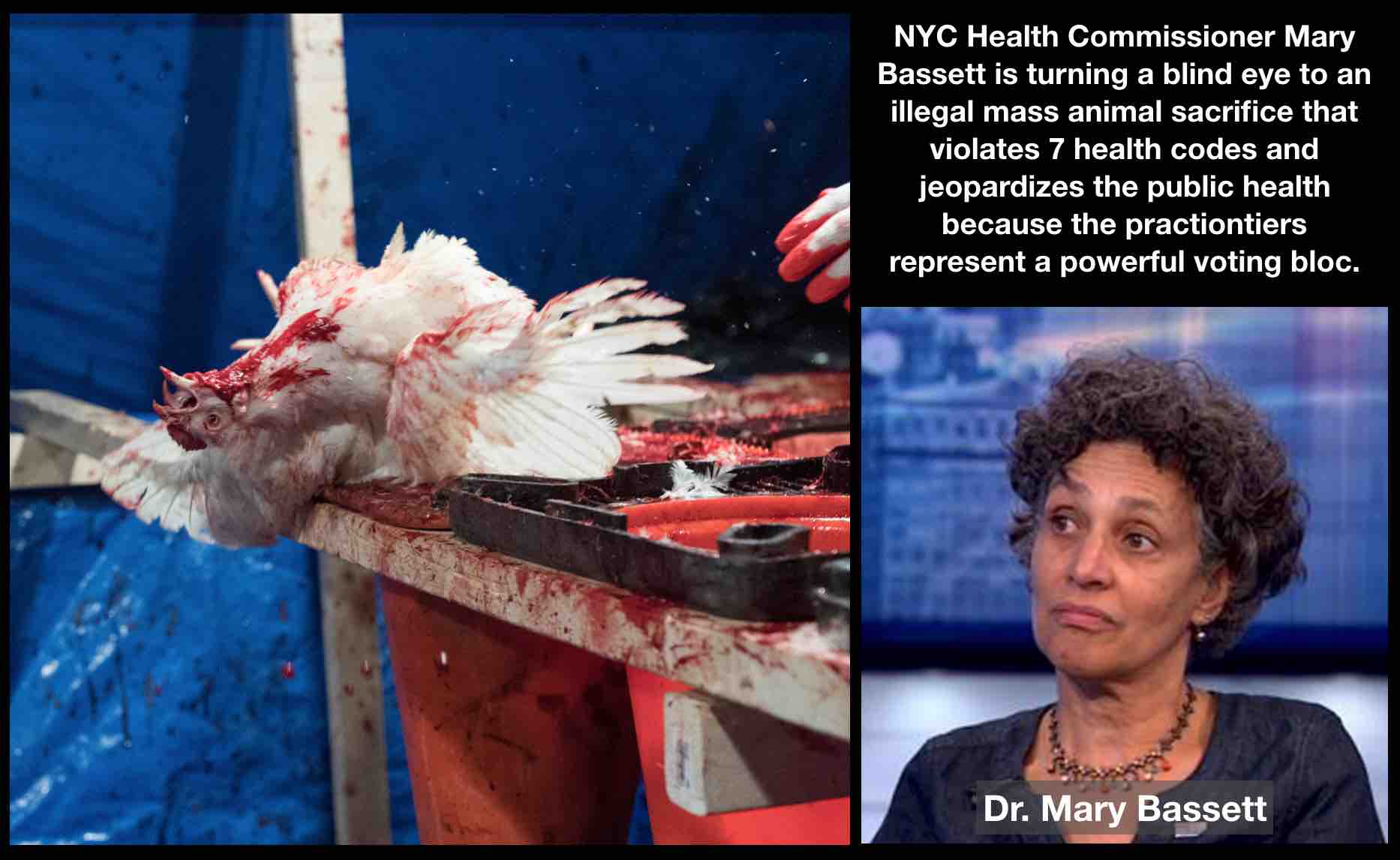
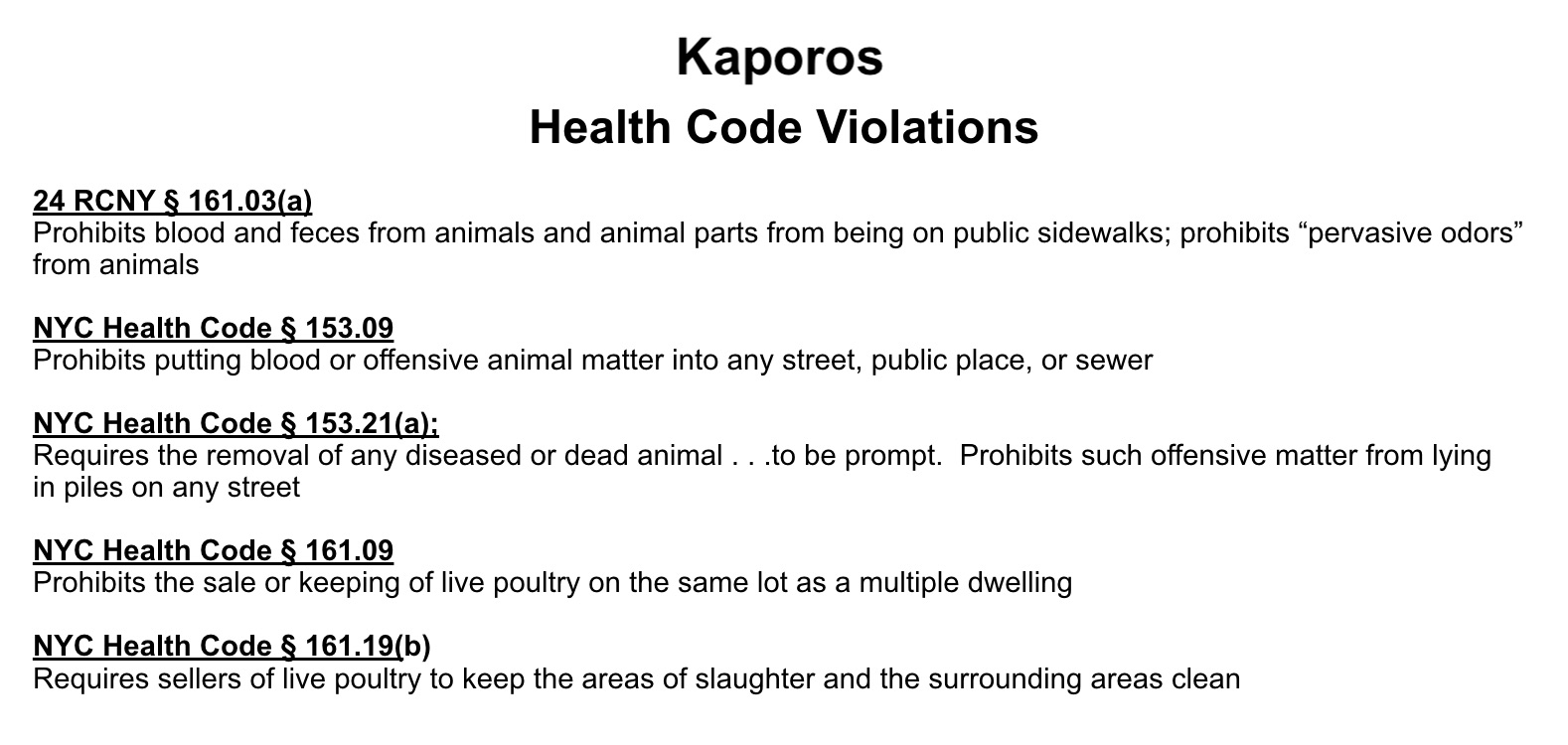
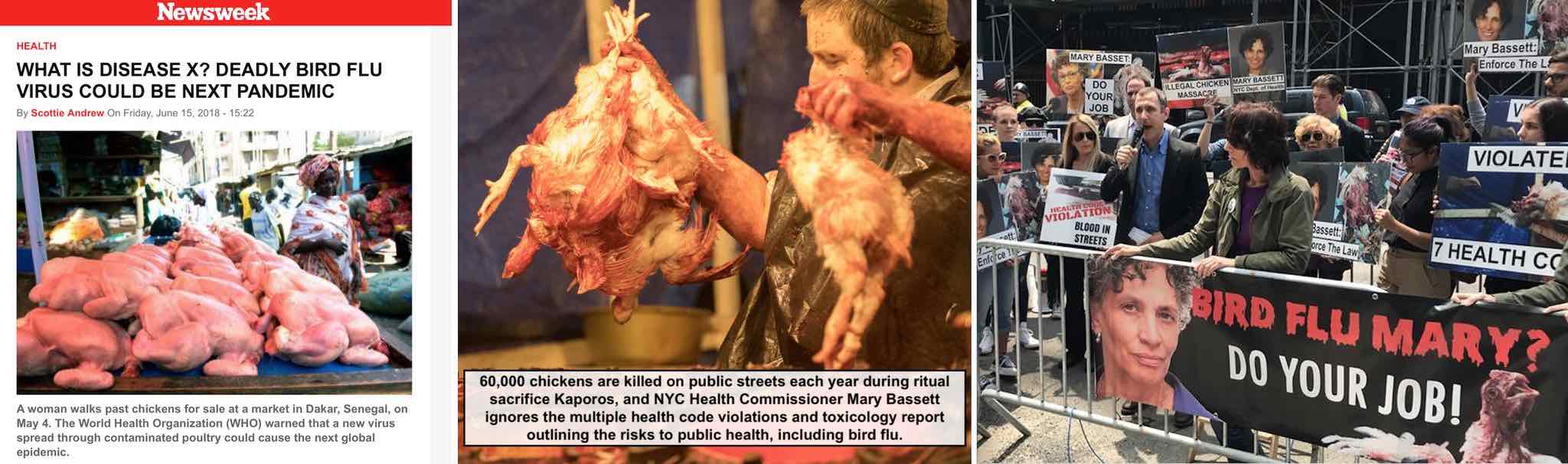
As NYC Health Commissioner Mary Bassett began delivering remarks at a forum about charitable giving, activists angered by her refusal to enforce health codes violated during an animal sacrifice shut down her talk.  This was the fifth time that activists have disrupted Commissioner Bassett over her support of Kaporos, a religious ritual during which ultra-Orthodox Jews in New York City swing an estimated 60,000 six-week old chickens around their heads and slaughter them, contaminating the streets and sewers with their blood, body parts, feathers and feces.

“How can Commissioner Bassett make a presentation in good conscience about taking care of the less fortunate when she’s endangering the health of some of NYC’s most vulnerable residents?” asked Nathan Semmel, one of the organizers of the disruption. “We know we can’t ask Dr. Bassett to align her behavior with the values she publicly espouses, but we can demand that she enforce the law.”

A dozen animal rights and public health advocates disrupt NYC Health Commissioner over her refusal to enforce health codes violated during a mass animal sacrifice on public streets.

The most recent protest comes on the heels of news about the spread of bird flu. On June 15th, Newsweek reported that The Centers for Disease Control said the current strain of avian influenza has “the greatest potential to cause a pandemic of all human viruses.”  If the flu spreads to the United States, New Yorkers will be particularly vulnerable because tens of thousands of city residents come into contact with the sick and dying chickens who are stacked in crates on the streets for several days leading up to the Kaporos ritual.

NYC Health Commissioner Mary Bassett refuses to acknowledge a toxicology report which includes avian flu as one of many health risks associated with the ritual sacrifice Kaporos (center photo: Unparalleled Suffering Photography)

Sources inside the administration say that Commissioner Bassett is refusing to enforce the health laws because the ultra-Orthodox Jews who violate them represent a powerful voting bloc that helped to elect her boss, NYC Mayor Bill de Blasio.

NYC Health Commissioner Mary Bassett refuses to acknowledge the multiple health codes are violated during a mass sacrifice of 60,000 six week old chickens on public streets.

“Not only does Dr. Bassett refuse to enforce the health codes, but she also refuses to acknowledge a toxicology report which unequivocally states that the violations jeopardize the public health by exposing New Yorkers to e-coli, salmonella, avian flu and many other pathogens and toxins,” said Jessica Hollander, who participated in the protest.  “Her decision to put politics ahead of public health will come back to haunt her if a disease outbreak occurs because she has been warned by experts that the illegal animal sacrifice poses serious health risks.”

Multiple health codes are violated during Kaporos, a ritual animal sacrifice, but NYC Health Commissioner Mary Bassett turns a blind eye because the practitioners represent a powerful voting bloc.

Koko The Gorilla Dies; Redrew The Lines Of Animal-Human Communication

Koko, the gorilla who became an ambassador to the human world through her ability to communicate, has died. She’s seen here at age 4, telling psychologist Francine “Penny” Patterson (left) that she is hungry. In the center is June Monroe, an interpreter for the deaf at St. Luke’s Church, who helped teach Koko.

Bettmann Archive

“The Gorilla Foundation is sad to announce the passing of our beloved Koko,” the research center says, informing the world about the death of a gorilla who fascinated and elated millions of people with her facility for language.

Koko, who was 46, died in her sleep Tuesday morning, the Gorilla Foundation said. At birth, she was named Hanabi-ko — Japanese for “fireworks child,” because she was born at the San Francisco Zoo on the Fourth of July in 1971. She was a western lowland gorilla.

“Her impact has been profound and what she has taught us about the emotional capacity of gorillas and their cognitive abilities will continue to shape the world,” the Gorilla Foundation said.

Throughout her life, Koko’s abilities made headlines. After she began communicating with humans through American Sign Language, she was featured by National Geographic — and she took her own picture (in a mirror) for the magazine’s cover.

That cover came out in 1978, seven years after Koko was chosen as an infant to work on a language research project with the psychologist Francine “Penny” Patterson. In 1985, the magazine profiled the affectionate relationship between the gorilla and her kitten: Koko and All Ball.

In 2001, Koko made a fast friend in comedian Robin Williams, trying on his glasses, showing him around and getting him to tickle her. Then they made faces at each other — and the gorilla seemed to recall seeing Williams in a movie. Years later, in 2014, Koko was one of many who mourned Williams’ passing.

YouTube

Koko amazed scientists in 2012, when she showed she could learn to play the recorder. The feat revealed mental acuity but also, crucially, that primates can learn to intricately control their breathing — something that had been assumed to be beyond their abilities.

Her ability to interact with people made Koko an international celebrity. But she also revealed the depth and strength of a gorilla’s emotional life, sharing moments of glee and sadness with researchers Patterson and Ron Cohn.

As Barbara J. King wrote for NPR about the BBC documentary Koko: The Gorilla Who Talks, when it aired on PBS in 2016:

Famously, Koko felt quite sad in 1984 when her adopted kitten Ball was hit by a car and died. How do we know? Here is nonhuman primate grief mediated through language: In historical footage in the film, Patterson is seen asking Koko, “What happened to Ball?” In reply, Koko utters these signs in sequence: cat, cry, have-sorry, Koko-love. And then, after a pause, two more signs: unattention, visit me.”

YouTube

Now, it’s humanity’s turn to mourn Koko.

Thousands of people are commiserating on the Gorilla Foundation’s Facebook pageposting about Koko’s death. The top comment comes from Jess Cameron:

“Legit bawling like a baby right now. This news just breaks my heart. From an early age I was fascinated with Koko and she taught me so much about love, kindness, respect for animals, and our planet.”

With Koko’s passing, the Gorilla Foundation says it will honor her legacy, working on wildlife conservation in Africa, a great ape sanctuary in Maui, Hawaii, and a sign language app.

The foundation says those who want to share condolences can do so by emailing kokolove@koko.org.

The Hen is a Symbol of Motherhood for Reasons We May Have Forgotten,  So Let Us Recall


*By Karen Davis, PhD, President of United Poultry Concerns*

*”Her love of her children definitely resembles my love of mine.” *
– Alice Walker

*”The emphasis has been on smaller, more efficient but lighter-weight *
*egg machines.” *
– American Poultry History

In our day, the hen has been degraded to an “egg machine.” In previous
eras, she
embodied the essence of motherhood. In the first century AD, the Roman
historian
Plutarch praised the many ways in which mother hens cherish and protect
their
chicks, “drooping their wings for some to creep under, and receiving with
joyous
and affectionate clucks others that mount upon their backs or run up to them
from every direction; and though they flee from dogs and snakes if they are
frightened only for themselves, if their fright is for their children, they
stand their ground and fight it out beyond their strength.”

The Renaissance writer Ulisse Aldrovandi described how, at the first sign
of a
predator, mother hens will immediately gather their chicks “under the
shadow of
their wings, and with this covering they put up such a very fierce defense –
striking fear into their opponent in the midst of a frightful clamor, using
both
wings and beak – they would rather die for their chicks than seek safety in
flight.” Similarly, in collecting food, the mother hen allows her chicks to
eat
their fill before satisfying her own hunger. Thus, he said, mother hens
present,
in every way, “a noble example of love for their offspring.”

I saw this love in action, when a hen named Eva jumped our sanctuary fence
on a
spring day and disappeared, only to return three weeks later in June with
eight
fluffy chicks. Watching Eva with her tiny brood close behind her was like
watching a family of wild birds whose dark and golden feathers blended
perfectly
with the woods and foliage they melted in and out of during the day.
Periodically, Eva would squat down with her feathers puffed out, and her
peeping
chicks would all run under her wings for comfort and warmth. A few minutes
later
the family was on the move again.

One day, a large dog wandered in front of the magnolia tree where Eva and
her
chicks were foraging. With her wings outspread and curved menacingly toward
the
dog, she rushed at him over and over, cackling loudly, all the while
continuing
to push her chicks behind herself with her wings. The dog stood stock still
before the excited mother hen and soon ambled away, but Eva maintained her
aggressive posture, her sharp, repetitive cackles and attentive lookout for
several minutes after he was gone.

Sitting on her nest, a mother hen carefully turns each of her eggs as often
as
thirty times a day, using her body, her feet, and her beak to move each egg
precisely in order to maintain the proper temperature, moisture,
ventilation,
humidity, and position of the egg during the 3-week incubation period.
Embryonic
chicks respond to soothing sounds from the mother hen and to warning cries
from
the rooster. Two or three days before the chicks are ready to hatch, they
start
peeping to notify their mother and siblings that they are ready to emerge
from
their shells, and to draw her attention to any distress they’re experiencing
such as cold or abnormal positioning.

A communication network is established among the baby birds and between
them and
their mother, who must stay calm while all the peeping, sawing, and
breaking of
eggs goes on underneath her as she meanwhile picks off tiny pieces of shell
that
may be sticking to her chicks and slays any ants that may dart in to
scavenge.
During all this time, as Page Smith and Charles Daniel describe in The
Chicken <http://www.upc-online.org/fall2000/chicken_book_review.html>
Book <http://www.upc-online.org/fall2000/chicken_book_review.html>, “The
chorus of peeps goes on virtually uninterrupted, the unborn chicks
peeping away, the newborn ones singing their less muffled song.”

During the first four to eight weeks or so, the chicks stay close to their
mother, gathering beneath her wings every night at dusk. Eventually, she
flies
up to her perch or a tree branch, indicating her sense that they, and she,
are
ready for independence.

Whenever I tell people stories about chickens enjoying themselves, many
become
very sad. The pictures I’m showing them are so different from the ones
they’re
used to seeing of chickens in a state of absolute misery. *The New York
Times*
restaurant critic William Grimes wrote of a beautiful black hen who entered
his
life unexpectedly one day, an apparent escapee from a poultry market in
Queens.
“I looked at the Chicken endlessly, and I wondered. What lay behind the
veil of
animal secrecy? Did she have a personality, for one thing?” His curiosity is
satisfied by close acquaintance with and observation of the endearing bird.
By
the end of his bittersweet book My Fine Feathered Friend
<http://www.upc-online.org/021009fine_feathered.html>, he and his wife Nancy
“had grown to love the Chicken.”

We have to start looking at chickens differently, so that we may see them as
Alice Walker described her encounter with a hen she watched crossing the
road
one day with three little chicks in Bali. In her essay, “Why Did the
Balinese
Chicken Cross the Road?” in Living By the Word
<http://alicewalkersgarden.com/2010/10/living-by-the-word/>, Walker writes:

It is one of those moments that will be engraved on my brain forever. For
I
really *saw* her. She was small and gray, flecked with black; so were her
chicks. She had a healthy red comb and quick, light-brown eyes. She was
that
proud, chunky chicken shape that makes one feel always that chickens, and
hens
especially, have personality and *will*. Her steps were neat and quick and
authoritative; and though she never touched her chicks, it was obvious
she was
shepherding them along. She clucked impatiently when, our feet falling
ever
nearer, one of them, especially self-absorbed and perhaps hard-headed,
ceased
to respond.

Let us with equal justice perceive chickens with envisioned eyes that
pierce the
veil of these birds’ “mechanization” and apprehend the truth of who they
are. In
*The Chicken Book*, Page Smith and Charles Daniel remind us, most
poignantly: “As
each chick emerges from its shell in the dark cave of feathers underneath
its
mother, it lies for a time like any newborn creature, exhausted, naked, and
extremely vulnerable. And as the mother may be taken as the epitome of
motherhood, so the newborn chick may be taken as an archetypal
representative of
babies of all species, human and animal alike, just brought into the world.”

This is What Wings Are For.

__________________________

KAREN DAVIS, PhD <http://www.upc-online.org/karenbio.htm> is the President
and Founder of United Poultry Concerns, a
nonprofit organization that promotes the compassionate and respectful
treatment
of domestic fowl including a sanctuary for chickens in Virginia. She is the
author of Prisoned Chickens, Poisoned Eggs: An Inside Look at the Modern
Poultry
Industry, More Than a Meal: The Turkey in History, Myth, Ritual, and
Reality,
The Holocaust and the Henmaid’s Tale: A Case for Comparing Atrocities and
other
groundbreaking publications.


United Poultry Concerns is a nonprofit organization that promotes
the compassionate and respectful treatment of domestic fowl.
Don’t just switch from beef to chicken. Go Vegan.
http://www.UPC-online.org/ http://www.twitter.com/upcnews

Prayer Circle for Animals #371: International Respect for Chickens

April 23, 2018

*Please Join Us For Our Daily Noon Prayer*

“COMPASSION ENCIRCLES THE EARTH FOR ALL BEINGS EVERYWHERE”

And Our Prayer for the Week from Judy Carman

*MAY 4 IS INTERNATIONAL RESPECT FOR CHICKENS DAY; ALL OF MAY IS THEIR
SPECIAL*
*MONTH*. Let’s get ready. This event was introduced by United Poultry
Concerns in
2005 “to celebrate chickens throughout the world and protest the bleakness
of
their lives in farming operations.” UPC suggests many possible actions we
can
take, as well as posters and handouts to order, on the website. This Sikh
story
brings home the truth that chickens are precious individuals who love life
just
as we do. “A man was once given a chicken by his guru and told to go and
kill it
[him or her] where nobody could see. The man tried and tried to find a place
where he could kill the chicken without anybody’s seeing and finally gave
up and
went back to the guru. ‘Why couldn’t you find a place where nobody would
see you
kill the chicken?’ asked the guru. ‘Because everywhere I went, the chicken
saw,’
said the man.” (From *How to Think if You Want to Change the World*, p. 138)

*OUR PRAYER THIS WEEK IS FOR ALL CHICKENS TO BE RESPECTED FOR WHO THEY ARE
AND TO*
*BE LIBERATED FROM HUMAN VIOLENCE AND DOMINATION:* We give thanks for United
Poultry Concerns and all the activists who have worked tirelessly for years
to
show the world that chickens are amazing, courageous, beautiful and loving
beings. We give thanks for all the information we have now to help us
educate
pre-vegans. We ask for blessings of peace for every single individual among
the
billions who are being killed. For while the killing machines grind on, we
know
that each precious chicken has lost friends, children, mothers, and suffered
terrible pain and heartache. We honor and memorialize them all—the fallen.
And
we pray for strength, clarity and inner peace, that we may stand in
solidarity
with them as long as it takes to win their freedom from human violence at
last.
And as our tears fall for them, may we also feel that spiritual joy that
comes
from being awakened to our very real kinship with chickens. What a blessing
it
is to know that they are our friends, not our food. Help us to be love and
to
bring love to all people and all beings. As always, I send my thanks to
each of
you, dear Prayer Circle members, for joining this circle of compassion and
shining the Light of Truth for all to see, so that one day soon, all beings
will
be free.

*May compassion and love reign over all the earth for all beings
everywhere.*
*Thank you all for your devotion to truth, love, liberation and peace for
all*
*beings.*

With Love, peace, and gratitude from Judy Carman, and greetings from Will,
Madeleine, and the Circle of Compassion team.

*PLEASE SHARE* this prayer by going to the Prayer Circle for Animals
Facebook <https://www.facebook.com/groups/prayercircleforanimals/>.
This prayer is posted there. You can also share ideas and prayer requests on
that facebook.

*PLEASE VISIT* the Circle of Compassion website
<http://circleofcompassion.org> for “A prayer a day for animals;”
and the Daily Noon Prayer. To help expand this ministry, donations are
gratefully accepted.


United Poultry Concerns is a nonprofit organization that promotes
the compassionate and respectful treatment of domestic fowl.
Don’t just switch from beef to chicken. Go Vegan.
http://www.UPC-online.org/ http://www.twitter.com/upcnews
http://www.facebook.com/UnitedPoultryConcerns

View this article online
<http://upc-online.org/respect/180428_prayer_circle_for_animals_371.html

Egg Industry Ballot Measures Seek to Legalize Battery Cages in California

https://stoptherottenegginitiative.org/

Vote NO on Proposition (TBA)

“This initiative should be fiercely opposed by everyone who cares about farm animal suffering. HSUS’s collusion with the egg industry is disturbing. From legalizing battery cages to allowing as little as one square foot of space per hen — this initiative would be a disaster for millions of egg-laying hens who would still be left suffering in battery cages throughout California.”

— Friends of Animals (FoA)
Email Address*

Egg Industry Ballot Measures Seek to Legalize Battery Cages in California

The United Egg Producers and the Association of California Egg Farmers are each pushing measures for 2018 that would explicitly legalize battery cages throughout California.

In nearly identical measures, these industry trade associations are attempting to repeal California’s present hen-housing law which was overwhelmingly approved by voters 10 years ago. That law, though not without issues, states that egg-laying hens must be given enough space to be able to “fully spread both wings without touching the side of an enclosure or other egg-laying hens.”

The industry’s measures would repeal that — and replace it with language that explicitly legalizes battery cages throughout the state. And regardless of whether the hens are in cages or in horrific multi-level “cage-free” factory systems, the industry needs only to provide hens with one square foot of space per hen. For political cover, the United Egg Producers (UEP) is relying upon the co-opted Humane Society of the United States and tag-alongs who are gathering signatures to put the egg industry’s toxic measure on the ballot.

Read more >

The “Easter” Chick – A Lost Soul


By Karen Davis, PhD, President, United Poultry Concerns

*Easter Egg Hunt and Egg Gathering*

The association of a hen’s egg with Easter and Spring survives ironically
in the
annual children’s Easter Egg Hunt, for the origin of this ritual has been
largely forgotten.

Traditionally, the finding of eggs was identified with the finding of
riches.
The search for eggs was part of farm life, because a free hen sensibly lays
her
eggs in a sheltered and secluded spot. Today’s children hunt for eggs that
were
laid by a hen imprisoned in a mechanized building, most likely in a wire
cage.
The widespread disappearance of the home chicken flock in the 1950s ended
the
gathering of eggs laid by a hen in the place she chose for her nest.
Historian
Page Smith writes in *The Chicken Book*, “My contemporaries who have such
dismal
memories of chickens from the unpleasant chores of their youth had
experienced
already the consequences of putting living creatures in circumstances that
are
inherently uncongenial to them.”

Wilbor Wilson provides the background to this change in *American Poultry*
*History*. He writes: “As the size of poultry ranches increased, the chore
of egg
gathering became drudgery instead of pleasure. Rollaway nests with sloping
floors made of hardware cloth offered a partial solution, but the number of
floor eggs increased when the hens did not readily adopt the wire-floored
nests.
This changed with development of the cage system which left the hen no
choice.”

*The Hen as a Symbol of Motherhood*

In our day, the hen has been degraded to an “egg machine.” In previous eras
she
embodied the essence of motherhood. The First Century CE Roman historian and
biographer Plutarch wrote of the mother hen in *De amore parentis* [
*parental*
*love*]: “What of the hens whom we observe each day at home, with what care
and
assiduity they govern and guard their chicks? Some let down their wings for
the
chicks to come under; others arch their backs for them to climb upon; there
is
no part of their bodies with which they do not wish to cherish their chicks
if
they can, nor do they do this without a joy and alacrity which they seem to
exhibit by the sound of their voices.”

In Matthew 23:37, the mother hen is evoked to express the spirit of
yearning and
protective love: “Jerusalem, Jerusalem, how often have I wished to gather
your
children together, even as a hen gathers together her chicks.”

The Renaissance writer Ulisse Aldrovandi wrote of mother hens in the 16th
century:

They follow their chicks with such great love that, if they see or spy at
a
distance any harmful animal, such as a kite or a weasel or someone even
larger
stalking their little ones, the hens first gather them under the shadow of
their wings, and with this covering they put up such a very fierce
defense
– striking fear into their opponent in the midst of a frightful clamor,
using
both wings and beak – they would rather die for their chicks than seek
safety
in flight. . . . Thus they present a noble example in love of their
offspring,
as also when they feed them, offering the food they have collected and
neglecting their own hunger.

*The Role of the Rooster*

The family role of the rooster is nowadays less well known to most people
than
the motherhood of the hen. The charm of seeing a rooster with his hens
appears
in Chaucer’s portrait of Chanticleer in *The Canterbury Tales*:

This cock had in his princely sway and measure
Seven hens to satisfy his every pleasure,
Who were his sisters and his sweethearts true,
Each wonderfully like him in her hue,
Of whom the fairest-feathered throat to see
Was fair Dame Partlet. Courteous was she,
Discreet, and always acted debonairly.

In ancient times, the rooster was esteemed for his sexual vigor; it is said
that
a healthy young rooster may mate as often as thirty or more times a day. The
rooster thus figures in religious history as a symbol of divine fertility
and
the life force. In his own world of chickendom, the rooster – the cock – is
a
father, a lover, a brother, a food-finder, a guardian, and a sentinel.

Aldrovandi extolled the rooster’s domestic virtues:

He is for us the example of the best and truest father of a family. For
he not
only presents himself as a vigilant guardian of his little ones, and in
the
morning, at the proper time, invites us to our daily labor; but he sallies
forth as the first, not only with his crowing, by which he shows what
must be
done, but he sweeps everything, explores and spies out everything.

Finding food, “he calls both hens and chicks together to eat it while he
stands
like a father and host at a banquet . . . inviting them to the feast,
exercised
by a single care, that they should have something to eat. Meanwhile he
scurries
about to find something nearby, and when he has found it, he calls his
family
again in a loud voice. They run to the spot. He stretches himself up, looks
around for any danger that may be near, runs about the entire poultry yard,
here
and there plucking up a grain or two for himself without ceasing to invite
the
others to follow him.”

A nineteenth-century poultry keeper wrote to his friend that his Shanghai
cock
was “very attentive to his Hens, and exercises a most fatherly care over the
Chicks in his yard. . . . He frequently would allow them to perch on his
back,
and in this manner carry them into the house, and then up the chicken
ladder.”

___________

*KAREN DAVIS, PhD is the President and Founder of United Poultry Concerns

It’s Hard to Be Ethically Consistent While Tap-Dancing on Eggshells

My objection to hunting, trapping and seal clubbing is colorblind as well as culture-blind. I oppose cruelty to animals, no matter who is doing the shooting, trapping or clubbing. A victim doesn’t suffer any less because of the ethnicity or cultural beliefs of their executioner. An animal’s right to a life, free from harm, trumps anyone’s right to exploit or kill them.

Over the weekend I received the following question, which I’ll attempt to answer below…

Q:

Dear Mr. Robertson,

I was wondering your opinion on the subject of animal rights vs. the rights of indigenous people. What do you think about hunting by Native American tribes, or the hunting of seals by the Inuit? Also, of course, the various other tribes around the world that have their culture based off of hunting. What do you think about their participation in hunting, trapping, etc?

A:

Hmmm, one of those questions…one of those I-wouldn’t-touch-that-with-a-ten-foot-pole kind of questions. Do I risk being called a hypocrite, or “culturally elite?” I could spend all day tip-toeing around this—tap-dancing on egg shells—but here’s an answer just off the top of my head:

My objection to hunting, trapping and seal clubbing is colorblind as well as culture-blind. I oppose cruelty to animals, no matter who is doing the shooting, trapping or clubbing. A victim doesn’t suffer any less because of the ethnicity or cultural beliefs of their executioner. An animal’s right to a life, free from harm, trumps anyone’s right to exploit or kill them (unless someone is literally starving to death and has no other options, which is not the case for most who hunt, trap, club seals, harpoon whales or trade in bushmeat).

Why oppose the Japanese or the Faeroese for slaughtering dolphins or pilot whales and not the Makah for killing grey whales, or even the Inuit for hunting bowhead whales? We’re all part of the species, Homo sapiens, and our ancestors all used to live by hunting and trapping. For better or worse, we’re all moving forward technologically, so there’s no reason we shouldn’t all move forward in our treatment of non-human animals.

That’s my humble opinion, anyway. It might not be popular, but it’s ethically consistent.

Text and Wildlife Photography© Jim Robertson

Text and Wildlife Photography© Jim Robertson

Animal People and Sexual Misconduct

As revolting as the revelations about some HSUS officials are, those who
recently resigned or were let go did at least bring farmed animals as
individuals with feelings and intelligence into mainstream focus for the
first
time in HSUS history. This is not to excuse anything, but to say that a
change
in HSUS leadership and workplace conduct may not mean that the organization
will
now show more progressive leadership on behalf of farmed animals and
veganism. I
worry it will revert to its more traditional programs and attitudes even if
the
offensive office behavior is eliminated.

As for sexual harassment of women and worse, while women rightly object to
being
treated as objects whose bodies may be physically assaulted and
disrespected by
men, this experience, magnified a trillion times over, is precisely what
chickens and pigs and cows and all farmed animals, “laboratory” animals,
aquatic
animals, “entertainment” animals and others endure endlessly at the hands
of our
species.

If we are outraged that certain male employees in our movement have
disrespected
their female colleagues physically and professionally, we had better stand
up
and be counted for our nonhuman animal victims for whom interspecies sexual
assault and every form of intimate, repulsive violence perpetrated by human
beings against them and their bodies is their experience of being alive in
the
flesh. Veganism is not a superficial “food choice.” It is ethical activism
on
behalf of the most profoundly, helplessly victimized beings on the planet.

Animal agriculture is now, and always has been, rooted in violating the sex
organs, mating choices, and reproductive processes of helpless animals.
Humans
“breeding” animals – the very word breeding – is an obscenity. We cannot
claim
to care about animals while obscenely consuming their muscles, their nursing
mother’s milk and their eggs, or suggesting to others that these
obscenities may
be practiced “humanely.”

As animal advocates, we must amplify the animals’ voices and be their
Voice: “ME
TOO!”

For a comprehensive look at interspecies sexual assault of farmed animals
for
business and pleasure, please see and share my article Interspecies Sexual
<http://www.upc-online.org/turkeys/170613_interspecies_sexual_assault-a_moral_perspective_full_article.html>
Assault: A Moral Perspective
<http://www.upc-online.org/turkeys/170613_interspecies_sexual_assault-a_moral_perspective_full_article.html>
.

Karen Davis, PhD
President
United Poultry Concerns


United Poultry Concerns is a nonprofit organization that promotes
the compassionate and respectful treatment of domestic fowl.
Don’t just switch from beef to chicken. Go Vegan.
http://www.UPC-online.org/ http://www.twitter.com/upcnews
http://www.facebook.com/UnitedPoultryConcerns

View this article online
<http://upc-online.org/alerts/180205_animal_people_and_sexual_misconduct.html>

The Humane Society of the United States accepts the resignation of Wayne Pacelle as president and CEO

The Humane Society of the United States announced that it has accepted the resignation of Wayne Pacelle, as president and CEO, effective immediately.  Wayne has served in this capacity since 2004, and previously served for 10 years as the organization chief political and communications operative.

The HSUS has named Kitty Block as acting president and CEO. Ms. Block, an attorney, is currently president of Humane Society International, The HSUS’s global affiliate.

“The last few days have been very hard for our entire family of staff and supporters,” said Rick Bernthal, Chairman of the Board of The HSUS.  “We are profoundly grateful for Wayne’s unparalleled level of accomplishments and service to the cause of animal protection and welfare.”

“We are most grateful to Kitty for stepping forward to lead the organization as we continue to advance our mission, which has never been more important,” added Bernthal.

Ms. Block has served at The HSUS since 1992, first as a legal investigator to the investigations department, then to oversee international policy work related to international trade and treaties. In 2007, she was promoted to Vice President of Humane Society International, later to Senior Vice President, and last year became President of this affiliate overseeing all HSI international campaigns and programs. Ms. Block received a law degree from The George Washington University in 1990 and a bachelor’s degree in communications and philosophy from the University of New Hampshire in 1986.

Additionally, The HSUS announced the resignation of Board member Erika Brunson.

http://www.humanesociety.org/news/press_releases/2018/02/humane-society-of-the-united-states-accepts-wayne-pacelle-resignation.html?credit=web_hpfs1_020217?referrer=http://news.url.google.com/url?sa=j&url=http%3A%2F%2Fwww.humanesociety.org%2Fnews%2Fpress_releases%2F2018%2F02%2Fhumane-society-of-the-united-states-accepts-wayne-pacelle-resignation.html%3Fcredit%3Dweb_hpfs1_020217&uct=1508175977&usg=AUWVE-py-gbxUxBNkmibzDEk6-s.