Pipeline leak fouls creek near grizzly management area in northwestern Alberta

DSC_0033

http://www.metronews.ca/news/canada/2016/06/14/pipeline-leak-fouls-creek-near-grizzly-protection-area-in-northwestern-alberta.html


Reddit this!

CALGARY — A pipeline leak has spilled an estimated 380,000 litres of light petroleum within five kilometres of a provincially designated grizzly bear management zone in northwestern Alberta, and an undetermined amount of it has reached a nearby creek.

Producer ConocoPhillips Canada said in a statement posted on its website Tuesday that the leak of condensate, a liquid produced with natural gas, was seen at a pipeline right-of-way near its Resthaven gas plant about 65 kilometres northeast of Grande Cache last Thursday afternoon.

It said its staff also observed condensate in nearby Webb Creek.

The Alberta Energy Regulator said condensate was visible as a sheen on the surface of the creek for about 4.5 kilometres below the pipeline leak.

The creek flows to a beaver dam and then into the Simonette River. While no sheen was visible on the river, an analysis indicated hydrocarbons present at slightly above minimum detection limits, the provincial agency said.

The AER said it was the largest hydrocarbon leak from a pipeline since Nexen, a subsidiary of China’s CNOOC Ltd., spilled five million litres of bitumen emulsion in July 2015.

Meanwhile, the company said the pipeline, which along with the gas plant is jointly owned  by ConocoPhillips and Calgary producer Paramount Resources (TSX:POU), has been shut down and isolated and the company has activated its emergency response plan.

“We have deployed over 150 responders to the site with equipment to contain the release and mitigate any environmental impact,” the company said, adding that it had reported the leak to the regulator after discovering it last Thursday.

Fencing and amphibian barriers have been erected to keep wildlife away and a wildlife biologist is on site, it said.

Spokeswoman Michelle McCullagh defended the five-day lag between discovering the leak and beginning what it promises will be daily updates on its website.

“Our first priority was making sure there were no residents in the area, notifying the trappers, the First Nations and all the authorities and then, of course, our continued safety for all of our responders on site and then protecting the environment,” she said.

No residents were found in the isolated area and the company has seen no evidence of animals or fish hurt by the spill as yet, McCullagh said, adding that the company doesn’t know how long it will take to clean up the spill.

The gas plant is still operating, she said.

Mike Hudema of Greenpeace Canada described the number of pipeline spills in Alberta as “alarming.”

“While we learn the details of this latest incident we need to ask ourselves how many more spills will it take before we begin to move away from pipelines and make the renewable energy transition other countries are already implementing,” he said in a email.

The regulator said in a statement Tuesday that staff members were at the site, which is in the Little Smoky caribou range and near a core grizzly bear management zone.

It said it has issued an environmental protection order to ConocoPhillips directing the company to contain the release and prevent it from spreading, while controlling access, collecting water and soil samples and submitting a final report to the AER.

The regulator said no cause has been established and an investigation is underway.

One of the key uses of condensate is to dilute raw Alberta oilsands crude to allow it to flow in a pipeline to market.


Wildlife officer who spared bear cubs denied return to job

Featured Image -- 11003

http://www.timescolonist.com/news/local/wildlife-officer-who-spared-bear-cub
Jeff Bell <http://www.timescolonist.com/authors?author=Jeff%20Bell> / Times
Colonist
April 20, 2016 06:00 AM

< http://www.timescolonist.com/news/local/wildlife-officer-who-spared-bear-cu
bs-denied-return-to-job-1.2235136#story-carousel> Next
< http://www.timescolonist.com/news/local/wildlife-officer-who-spared-bear-cu
bs-denied-return-to-job-1.2235136#story-carousel>

Bryce Casavant’s actions last July came after the cubs’ mother was judged to
be too habituated to humans and was killed for twice raiding a freezer at a
Port Hardy-area home.
The decision not to kill the cubs led to Casavant’s suspension.
That sparked an online petition for his reinstatement that reached close to
310,000 supporters. The case attracted international attention, which
included comedian Ricky Gervais sticking up for Casavant via Twitter.
Casavant, 33, returned to work in late August in a different job at an equal
pay grade.
He said he and the government have reached an agreement that sees him become
a natural-resource officer with the Ministry of Forests, Lands and Natural
Resource Operations, while at the same time pursuing a PhD at Royal Roads
University.
“The province of B.C. is fully supporting me in my educational endeavours,”
he said.
The general duties of a natural-resource officer include enforcement and
patrol relating to resource-management laws, which can cover such areas as
the Wildfire Act, the Forest Act and the Water Act.
Casavant described the combination of work and school as “a different
direction.”
He said he accepted the consequences after the action he took with the cubs.
“Generally speaking, people are faced with difficult decisions every day in
their lives and I made one, and I was willing to be held accountable
professionally and legally for that decision,” he said. “This is now the
outcome of that.”
Casavant said his PhD research will focus on “the social aspects of conflict
wildlife.”
“I think there’s different social perceptions within society of predators,
and how that relates to the urban interface, how that shapes our prevention
and response measures,” he said.
“It’s not just conservation officers – you have a lot of police responding
to conflict wildlife throughout the province.”
The cubs, who have been named Jordan and Athena, were taken to the North
Island Wildlife Recovery Centre where they are doing well in the company of
other bears.
“It looks very positive,” said centre founder Robin Campbell.
Campbell said the pair will be released this year, likely in the summer or
fall.
“They’ll have transmitters on them so we’ll be able to follow them.”
jwbell@timescolonist.com

– See more at:
http://www.timescolonist.com/news/local/wildlife-officer-who-spared-bear-cub
s-denied-return-to-job-1.2235136#sthash.t36jlVb8.dpuf

The Future of Grizzly Bears

Taking Note

A grizzly bear in Yellowstone National Park.
JIM URQUHART / REUTERS
By ROBERT B. SEMPLE Jr.
MARCH 4, 2016

The 1973 Endangered Species Act, a landmark environmental measure much detested by developers and other commercial interests, is credited with saving the bald eagle, the peregrine falcon, the American alligator and the gray wolf, among other species. If the U.S. Fish and Wildlife Service has its way, the grizzly bears in the Greater Yellowstone Ecosystem will soon join that company of once-close-to-extinction creatures that no longer needed the act’s protection. On Thursday, the service proposed to remove grizzlies in the Yellowstone region — meaning the national park, and the states of Idaho, Montana and Wyoming — from the endangered species list, whose protections the bears have enjoyed since 1975.

If the bears are ultimately “de-listed” — a comment period on the proposal is now underway — it will represent another triumph for the act. By 1975, the grizzly population had dwindled from an estimated 50,000 animals in the Lower 48 to fewer than 200 in the Yellowstone region, and bears were dying faster than they could reproduce. Protected from hunting and trapping by the act, the Yellowstone population has since grown to between 700 and 1,000 animals, a number the agency’s scientists and many independent observers see as proof of biological recovery and sufficient to guarantee an expanding, sustainable population going forward.

But whether de-listing will ultimately prove to be a triumph for the grizzlies remains to be seen.  The draft conservation strategy published along with the proposal contains strict mortality limits as well as protections against development of grizzly habitat….

Most crucially, the future of the grizzlies depends on the states to which their protection is now entrusted. And here there is reason to pause and cross one’s fingers. Consider the case of the Rocky Mountain gray wolf.  The service de-listed the wolf in Idaho and Montana after scientists concluded that it had reached sustainable populations in its range, and turned wolf management over to the states. Both states soon embarked on wolf hunts; the wolf was not de-listed in Wyoming, where the anti-wolf animus characteristic of the region was particularly virulent, and where the wolf is still under federal protection. The service says that wolf populations have remained stable throughout the region, but this is testament to their ability to breed rapidly, not to any particular affection or sense of responsibility among the politicians of Idaho, Montana and Wyoming.

The environmental groups that have decried the service’s new proposal, including the Sierra Club, argue not only that the proposed de-listing is scientifically premature but also that the states simply cannot be trusted to make it work. They have sound historical reasons for feeling that way. It will ultimately be up to this administration and its successors to insure that its promise to the grizzlies — and it is indeed a promise — is honored.

Wildfires leave Okanogan Co. wildlife hungry

I remember back (not long ago) when wildfires were just a natural events that left the forest refreshed and renewed. Now, human manipulation and ultimately, anthropogenic climate change, have made fires more and more catastrophic for all–including the wildlife.

http://www.krem.com/news/local/okanogan-county/many-animals-left-hungry-after-okanogan-wildfires/45064888

Whitney Ward and KREM.com 6:14 PM. PST February 16, 2016

OKANOGAN COUNTY, Wash. – Okanogan residents said today a bear that died last week in their area likely woke up from hibernation too early from a lack of food before winter.

2 On Your Side found it the same problem is affecting animals across Central Washington. It was all thanks to two years of historic wildfires that caused massive amounts of land damage.

“A lot of animals were killed in the fire itself last summer,” Okanogan resident Jon Wyss said. “And many more died shortly after from burns and other injuries. But now, 6 months later, there is plenty of wildlife still suffering.”

The fires destroyed many of the habitats for the animals which meant no food and little shelter. Thousands of deer were left without food after trees and grass were burned.

“When you burn 250,000 acres in 2014 and 500,000 acres in 2015, there’s not a lot of forage,” Wyss said.

Washington Department of Fish and Wildlife officials told 2 On Your Side it could take up to a decade for all the foliage to regrow. That could lead to many animal populations to struggle for years and farmers could carry the burden.

“There’s 11,000 deer without food,” Wyss said. “They’re struggling and they’re competing against our agriculturalists, eating limbs off the trees, the buds, the hay.

2 On Your Side learned that with so many deer going on to farmland for food, it can bring predators like wolves and cougars closer to homes.

Washington Department of Fish and Wildlife officials also said the harder it is for deer means it’s easier for predators. But officials also said that nature will correct itself and the wildlife population will rebound eventually.

An Oasis for Bears in Romania

By , February 3, 2016

LiBearty-1-cristi-si-lidia-020216
Guest Post: Claudia Flisi visits the LiBearty sanctuary for orphaned and abused bears in Transylvania.

Did my guide know something I didn’t? Adrian refused to accompany me inside the LiBearty Sanctuary outside of Zărnești in Braşov County, Transylvania. He knew about the work of the sanctuary of course; he is Romanian-born and a professional guide. But he demurred: “My heart is too soft so I cannot go with you. Please understand.”

I did understand. Zărnești is in the heart of the Carpathian Mountains, the crossroads of monstrous myths. Yet the back stories of the sanctuary’s shaggy residents are more unbelievable than Bram Stoker’s tales of Transylvanian vampires. Deliberate blinding, forced alcoholism, involuntary drug addiction, and calculated maiming – not to mention orphans sold into slavery – are oft-told tales at LiBearty Sanctuary.

The back stories of the bears at the sanctuary are more unbelievable than Bram Stoker’s tales of Transylvanian vampires.

The 69-hectare reserve is the largest refuge for brown bears in the world in area and numbers. Since Romania hosts 60 percent of all wild brown bears in Europe (not counting Russia) and also is home to the largest remaining virgin forest on the continent, the location makes sense.

What doesn’t make sense is how the bears have fared in their proximity to man. LiBearty’s 80-some bears have suffered more cruelty and bestiality than the human mind can comprehend – never mind that humans alone have been responsible for such cruelty.

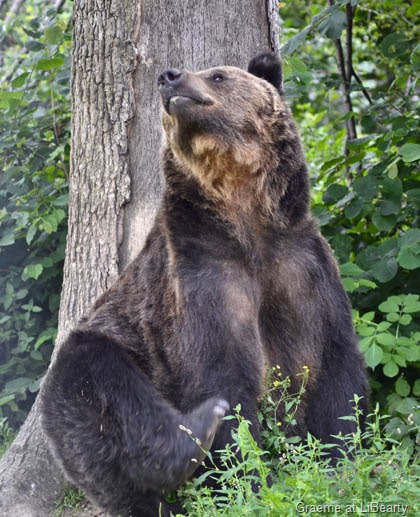
LiBearty-Graeme-020216Take Graeme for example. Graeme and his brother were orphaned by hunters in 1994. They killed the cubs’ mother for sport, then locked up the two brothers in a small cage to serve as attractions for visitors to a mountain mining company.

As mining declined, the growing cubs fought for what little food came their way, and Graeme was blinded in one eye. A zoo took him away to pace for years in a wire enclosure, while his brother was abandoned to starve to death in his tiny cage.

Graeme came to LiBearty in 2013 and now, after 21 years of suffering, enjoys open spaces with trees, ponds, and grass, and an ursine companion from his zoo days.

Or Max. Born in 1997 and orphaned soon after, Max became a tourist attraction as a cub. He was chained near a castle in Sinaia so visitors could pay to have their pictures taken with him. To make sure he wouldn’t cause problems as he grew, Max was deliberately blinded and his sharp canine teeth and claws were cut off. Pepper spray was sprayed into his nose to keep him from reacting to smells, and he was drugged every day with tranquilizers dissolved in beer.

LiBearty rescued him in 2006. They couldn’t restore his sight, so they created a private acre-large enclosure for him, where he bathes in his own pool, hibernates in his own den, and spends his days enjoying the sun and the sounds of nature.

“Soon she began to recognize the sound of our car and would stand up to greet us when we arrived.”

Max’s story, his expressive face, and his gentle demeanor move visitors more than those of any other resident of the sanctuary. When I mentioned seeing him to Adrian after my visit, he blanched. “I knew that bear. I would see him in Sinaia when he was still a cub. I knew something was wrong, but there was no one to complain to, back then …”

The fact that “there was no one to complain to” is what moved Cristina Lapis to create the sanctuary in the first place. A long-time animal activist, Lapis is a former journalist from the city of Brașov, about 30 km. northeast of Zărnești. She and her husband Roger, France’s honorary consul to Romania, established the Millions of Friends Association (AMP) in 1997, focusing on the rescue of stray dogs. It is the oldest animal welfare NGO in the country, and today looks after 700 dogs in two shelters.

LiBearty-Cristina-Lapis-020216Less than a year after starting AMP, Lapis encountered Maya. The young brown bear was in a small dirty cage near the tourist attraction of Bran Castle in Transylvania. She had no regular food, no care, no stimulation, only the jeering of tourists and the occasional beer bottle.

Lapis recalls her “boundless rage against the people who could condemn such an animal to a slow and painful death like this.”

For the following four years, Lapis, her husband, and friends traveled 100 miles every day to bring food, water and companionship to the neglected bear. Results were initially promising: “We were able to improve her health and lift her spirits … Soon she began to recognize the sound of our car and would stand up to greet us when we arrived.”

The problem was that Maya had nowhere to go. Zoos at that time were not an improvement in space or cleanliness. There were no shelters for large wild animals, and no money to maintain them, had they existed.

Maya became depressed again, as animals do in captivity. She self-mutilated her right paw, ripping her flesh to the bone. She lost her appetite and the will to live. She died literally in the arms of Cristina Lapis, as the latter rocked her and stroked her fur, on March 11, 2002. Over the bear’s stiffening body, Lapis vowed that she would create a sanctuary for other bears so that they would not suffer a similar fate.

Lapis vowed that she would create a sanctuary for other bears so that they would not suffer a similar fate

LiBearty Sanctury…

More: http://www.earthintransition.org/2016/02/oasis-bears-Romania/

Hunting to Scare Grizzlies?

http://www.grizzlytimes.org/#!Hunting-to-Scare-Grizzlies/c1ou2/5696cb910cf263fc5a89bf50

Hunting to Scare Grizzlies?

January 13, 2016

|

David Mattson

Kill grizzly bears to make them afraid of humans. This idea has gotten a lot of air time in recent years as one of several justifications for removing endangered species act (ESA) protections for Yellowstone’s grizzlies, most recently in a January 10th editorial by the Editorial Board of the Bozeman Chronicle. Delisting (another term for removing ESA protections) would clear the way for a sport hunt managed by the states of Wyoming, Montana, and Idaho, which are currently squabbling over a share of the sport kill in anticipation of devolution of authority from the federal government to them.

The idea of instilling fear in grizzlies through a hunt is emotionally charged because there have been several bear-caused human fatalities in the Yellowstone region during the last few years. The media, of course, has duly sensationalized each death. So the idea is to have sport hunters kill grizzlies to teach them to fear people. As a result, there will be fewer bear attacks. People will be safer. To borrow a phrase from Valerius Geist, a proponent of hunting bears, people will have “freedom of the woods.” Hmm. Well…

Although some people obviously consider hunting to be a self-evident guarantor of human safety, there is, in fact, little or no empirical support for this proposition. There is essentially no evidence that a sport hunt instils fear in grizzlies. The proposition also defies logic and everything that we otherwise know about grizzly bears. If nothing else, how can a dead bear learn anything? A point that has been made by many others besides me.

Having made my assertion, I should probably elaborate, noting, though, that a thorough review of the evidence (or lack thereof) would probably bore you, the reader, to tears. Which means that I will confine myself to a (relatively) brief and necessarily cursory overview. So put on your seat belt and send me your questions if you want more detail.

Grizzly Bear Fundamentals

The first point to be made is that grizzly bears exist at a baseline characterized by a greater tendency to respond aggressively to perceived threats compared to other bear species. Steve Herrero, a Canadian behavioral ecologist, was the first to speculate that this aggressiveness was rooted in the evolutionary history of grizzlies. Grizzlies (AKA brown bears) evolved in open environments where safety depended on standing your ground and intimidating or beating back any threat. (You can find more on the formative evolutionary environments of grizzlies by following this link and this link).

Even so, grizzlies can exhibit a high degree of tolerance for humans and other bears that might otherwise be viewed as threats. You can see this in coastal environments where bears have become highly socialized and tolerant of each other because of frequent interactions with conspecifics concentrated around salmon spawning streams. Or among bears that have interacted enough with benign humans to internalize a less fear-based response—a process known as “habituation.”

So, a couple of key points are worth making at this juncture: First, grizzlies seem to be hard-wired genetically to deal with perceived threats aggressively. Second, and perhaps more importantly, grizzlies can become less reactive to people, not as a result of heightened fear, but rather as a result of the opposite. These fundamentals alone call into question the logic of using hunting to increase human safety. Killing grizzlies (and, as I address later, we’ve done a lot of that even with ESA protections) is unlikely to rewire the genetic underpinnings of their behavior; and less fear rather than more is probably going to make people safer, especially if we continue to reduce the number of circumstances (e.g., garbage around human residences or hunters near freshly-killed elk) that allow people to do things that trigger aggressive responses from even the most tolerant bears. More on that a little later.

Welcome to the Vacuum

Another important point to make up front is that we know virtually nothing about the behavioral and motivational responses of bears to hunting, certainly little that is grounded in research. The closest we come is a study out of Scandinavia showing that hunted brown bears increased their night-time activity, with little obvious relevance to whether humans were thereby safer. A  coarse-grained review by Jon Swenson, a Scandinavian bear researcher (and, for a while, a Montana biologist), suggested that hunted European brown bears might be more wary, but that this possible behavioral response was trumped by whether food was available near people. Bears were likely to seek out food regardless of whether they were hunted or not, which goes back to my point immediately above about garbage and hunter-generated carrion.

By contrast, we know quite a bit about the negative and often unintended consequences of selectively hunting adult males of various carnivore species. Insofar as livestock depredation and other conflicts are concerned—including the type that could lead to human injury—we tend to get more rather than fewer. This is because adolescent males tend to gravitate to areas where the dominant resident males have been removed by hunters. And adolescent male bears are notoriously prone to push human boundaries. Moreover, sport hunting tends to disrupt the social order of bear populations, which often results in more cub-killing by males and, with that, unexpected and sometimes problematic population declines.

So, a couple more points: There is little or no direct evidence that bears become warier with hunting, and certainly no evidence that people become safer. On the other hand, conflicts with people can paradoxically increase, along with unanticipated declines in bear populations. So, again, not a compelling case for the benefits of sport hunting.

The Immediate Circumstances of Attacks

At this point I return to Steve Herrero, who has spent essentially his entire professional career looking at the immediate circumstances of bear attacks, with emphasis on behaviors of the involved people and bears. His research shows that most attacks by grizzlies happened because people were moving quietly (or sometimes rapidly) through the woods, or because the bears were lured to the vicinity of people by food. The former set of circumstances led to surprise encounters. Adult females with cubs almost invariably responded aggressively to protect their young. On the food front, when grizzlies spent more time around people the odds mounted of us doing something stupid (or unintentionally risky), or of bears simply getting curious. So, surprise encounters and foods that attract grizzlies are prominent drivers of risk. And, again, foods were typically in the form of garbage or the remains of elk and moose that hunters had recently killed. Only rarely did Steve find that outright predation was a factor, typically as night attacks on people camping in tents.

This comports with what we know of circumstances surrounding the bear attacks that have occurred around Yellowstone. Several people have been injured or even killed because they were moving quietly through the woods (sometimes jogging), surprising a female that then defended her cubs, or a bear that defended a carcass, or, in the case of some hunters, just simply a bear that defended its personal space. But surprise encounters are a central theme. Then there were the few night attacks on people in tents, probably (or, in one instance, almost certainly) by bears that were in the habit of checking out campgrounds for food. So, the food factor. And then there were the odd-balls, such as the botanist killed by an enraged boar grizzly recovering from being trapped and drugged (again, a surprise encounter), or the photographer killed by a frantic female that he had pushed beyond endurance. In this latter case, the stupidity factor.

So, given these concrete circumstances, what can be deduced about prospects for increasing human safety by hunting grizzlies? Well…unless you kill most bears, you are not going to substantially reduce the chance of surprise encounters. Nor, as I noted earlier, are you going to eliminate the hard-wired tendency for grizzlies to defend themselves from a perceived threat when surprised, especially when guarding cubs or food. Hunting also does not deal with the availability of foods near people. And we would be foolish to expect that grizzlies will be less motivated to procure food because we are hunting them. Obtaining food is another hard-wired drive for bears, especially during the late summer and fall when they are putting on fat to get through hibernation. And hunting does not address the stupidity factor.

As a bottom line, when looking at the reasons why people get injured by grizzlies, I am hard-pressed to divine how hunting will increase human safety. Unless, perhaps, we kill most of the grizzly bears in and around Yellowstone, as our European ancestors did.

And We’ve Already Run the Experiment

On top of this, we’ve already run the experiment and found no evidence that it has worked. Which is to say, we’ve functionally been hunting Yellowstone’s grizzlies for years, complete with gunshots, blood, gory remains, and lots of associated human scent and sign. Think, for example, of all the grizzlies that have been killed by big game hunters during surprise encounters or in conflicts over hunter-killed elk—increasingly. Or by ranchers and other people in defense of life-and-property. Functionally this is probably little different from a sport hunt, except in the heads and on the balance-sheets of wildlife managers. We’ve essentially been hunting grizzlies in Yellowstone, without any evidence that it has affected human safety one way or another.

And What About Yellowstone Park?

And then there is Yellowstone National Park, where a substantial proportion of the bear attacks and resulting human fatalities have occurred. There will not be a sport hunt in the Park, even with a delisted grizzly bear population. So, even assuming the unlikely–that hunting would cause bears to avoid us because they are more fearful, how will this effect be propagated through over 2 million acres in the core of the ecosystem? From hunted bears on the periphery, which will presumable be killed by humans at a higher rate compared to protected bears living in the core–in Yellowstone Park? In the face of a resulting net movement of bears outward rather than inward? Unlikely.

But We Probably Can Make Bears Fear Us Even More

At this point I’ve run much of the gauntlet of evidence and found little or no support for the idea that human safety can be enhanced by sport hunting. At least the traditional kind of sport hunting that focuses on killing trophy-worthy adult males, with little overt selection for bears known to be involved in conflicts with humans.

But there is a kind of hunting that probably could have an effect, and to understand this potential we need to look at what we know about relations among bears. More specifically, bears fear other bears, more than they probably fear humans. And there are reasons for this.

For example, there is ample evidence that fear motivates adolescent bears and females with young cubs to exert themselves to avoid other adults, even to the extent of spending more time near people. In fact, we can unintentionally serve as shields of sorts for bears that are seeking protection from aggressors of their own species. There are several reasons for all of this. Adolescents are often chased by solitary adults, and on occasion, probably thrashed to within inches of their lives…sometimes even killed. Likewise, cubs can be killed during encounters with adult grizzlies other than their mother, a phenomenon known as infanticide. All of this entails unpleasant experiences and interactions that happen on a relatively frequent basis, which fosters learning and even generalization of experiences.

So, what does this have to do with how we might hunt Yellowstone’s grizzlies, with the objective of engendering fear of humans? It seems pretty obvious. You selectively hunt and kill cubs–but leave the mothers alive. And you trap bears, with an emphasis on adolescents, club them to within inches of their lives, and then let them go. And do this repeatedly and for as many bears as possible.

Having suggested such an approach, I find the prospect disgusting. But, then, I am sure there are some hunters out there that would relish the prospect of killing cubs and torturing trapped bears. The same hunters that have done something similar with wolves and coyotes. But the backlash from the broader public would be predictable, dooming such a hunting strategy to an early demise. Moreover, not unlike abused dogs, abused bears might, in fact, be even readier to attack a human should a surprise encounter happen.

Still, if the issue really is just simply about making grizzlies fear us… Or is the ardent promotion of sport hunting really about something else?

Concluding Thoughts

Take the case of Terry Schramm, a self-styled cowboy from Pennsylvania working for self-styled out-of-state ranchers who own the Walton Ranch in Jackson Hole. Or the legislator-rancher Albert Sommers who raises cows in the Upper Green River of Wyoming thanks to heavy subsidies by environmentalists (in the form of a $1 million plus conservation easement), by the federal government (in the form of well-below-market-price grazing fees), and by the state of Wyoming (in the form of generous compensation for any cows that he claims are lost to predators). In a recent Wyofile article, both of these icons of the modern west explicitly or implicitly suggested that their fraught lives would be a lot less problematic if there were many fewer grizzlies in a lot fewer places.

A record 59 grizzlies died in the Yellowstone ecosystem in 2015

By | December 22, 2015 <!–


–>

1KSHARES1K0010×1KSHARES

Conflicts with hunters and livestock were among the reasons a record 59 grizzly bears died in the Yellowstone ecosystem in 2015, the federal government’s grizzly coordinator said last week.

In addition to running into hunters and being removed for killing stock, grizzlies also faced a dry year and were seen more often in developed areas, said Chris Servheen, grizzly bear recovery coordinator for the U.S. Fish and Wildlife Service. He leads the effort to establish an enduring population in the Yellowstone region.

The number of deaths “was the highest number of grizzly mortalities in the Yellowstone Ecosystem since 1970,” Servheen said in an email. He put the number in perspective, writing that the losses are “not a big deal in terms of population-level impacts.

“Remember,” he wrote, “that there are three times as many bears in the ecosystem today as in 1970.” An estimated 717 grizzlies live in the ecosystem today, according to the Interagency Grizzly Bear Study Team, but some question the accuracy of that figure.

Grizzly deaths are recorded according to sex and age. The number of females older than two years is an important component of the population. Consequently, managers have set an annual limit for adult female mortalities at 7.6 percent of the population.

In 2015 adult female grizzly deaths exceeded that figure by 0.1 percent, Servheen wrote. Adult males died at 11.7 percent, well below their 15 percent limit.

“Bottom line is that annual mortalities fluctuate in natural systems and individual years will vary,” Servheen wrote.

Numbers are key part of Endangered Species Act delisting

The health and size of the population are critical factors as the federal government begins to remove Endangered Species Act protection from the Yellowstone-area population. Wyoming, Idaho and Montana could subsequently institute a grizzly hunting season.

Fifty-five of the deaths in 2015 were human-caused. Investigators are probing the death of 19 Yellowstone-area grizzly bears, according to the mortality table. “Investigation” is a label applied to probes of grizzlies believed killed by hunters, poachers or nefarious actors.

Fourteen bears were killed or otherwise removed from the population for conflicts with livestock and 12 for getting human food or for property damage, the 2015 mortality table shows. Five bears were euthanized through management actions, four died as a result of collisions with vehicles, two were natural deaths and three bears died of unknown causes.

The 2015 mortality figure of “known and probable” deaths exceeds the previous annual high of 55 that was set in 2012, grizzly bear advocate and watchdog Louisa Willcox wrote WyoFile in an email. There also are unrecorded bear deaths, she said, and they could bring the 2015 tally up to 90 bears.

Although the federal population estimate was set at 717, it covers a range that could be as low as 642, Willcox said. That led to her worst-case estimate.

“Bottom line: there could be as few as 552 bears in the ecosystem,” she wrote. If 90 bears out of 642 were killed, that amounts to 12 percent of the official population number and would bring the ecosystem count to “below the basement level of 600.”

Six hundred is the fewest bears that the U.S. Fish and Wildlife Service would allow — after delisting — before it would prohibit “discretionary mortality.” U.S. Fish and Wildlife director Dan Ashe referenced that limit in a letter he sent to state game directors in September.

An agency spokeswoman said the 600-bear minimum likely would never be reached after Endangered Species Act protections are removed. “The goal would be to manage for approximately 674 grizzly bears to ensure a sustainable and resilient population that utilizes the entire available habitat in the Greater Yellowstone Ecosystem,” Serena Baker wrote in an email. “We do not anticipate population numbers to dip down to 600 bears.”

Members of the Interagency Grizzly Bear Study Team also say the population survey could under-estimate bears by 40 percent. That wide range perplexes some, including Wyoming Wildlife Advocates. That nonprofit advocacy group asked Ashe in November for a “definitive GYE grizzly bear survey.”

Federal estimates spread over a range of plus or minus 472 bears, wrote Kent Nelson, director of the group. “At this point IGBST’s ‘best available science’ starts looking more like a wild-ass guess,” Nelson wrote Ashe.

“There is a far better alternative to the chaotic situation,” he wrote. That would constitute “a survey of the GYE grizzly population using DNA hair analysis.”

The current estimates are based on mathematical modeling, following observations, including those made from aerial surveys.

Clarification: The official 717 count is for the “Demographic Monitoring Area,” that covers about 20,000 square miles across most, but not all, of the Yellowstone ecosystem. The IGBC mortality chart includes bears killed throughout the ecosystem. Officials have said 10 Yellowstone ecosystem grizzlies died in 2015 outside the DMA — Ed.

DSC_0033

Bear attacks Boy Scout leader who entered Rockaway cave,

http://www.nj.com/morris/index.ssf/2015/12/scout_leader_attacked_by_bear_scouts_uninjured_may.html

Update: State officials have identified the victim and shared details of the attack.

ROCKAWAY TOWNSHIP — The leader of a Boy Scout troop was attacked by a bear while leading three scouts through the woods Sunday afternoon, according to authorities.

The unidentified man was airlifted to Morristown Memorial Hospital with what authorities described as non-life threatening injuries, Rockaway police said in a statement.

Need to know facts about black bears in New JerseyHundreds of black bears are harvested each year in New Jersey. Here are some must-know facts about the state’s largest land mammal. (Video by Andre Malok | NJ Advance Media for NJ.com)

Police were called to the scene around 12:26 p.m., when one of the scouts reported that the man had been attacked after entering a cave off one of the hiking trails surrounding the Splitrock Reservoir.

Local officers and firefighters were joined by a state police helicopter to search the 625-acre area straddling the Rockaway-Kinnelon border, using signals from a scout’s cell phone to locate the group, according to police.

Why did N.J. extend the 2015 bear hunt?

Why did N.J. extend the 2015 bear hunt?

Nearly 500 bears have been killed in this year’s hunt as of Friday but still the rate is below what biologists say is needed to keep the black bear population stable — and to stop it from pushing out further.

Rockaway Mayor Michael Dachisen said the three scouts were not injured during the incident, and were taken to township police headquarters before being released to family members.

Police declined to identify the leader, saying his family had yet to be notified. The scouts are members of Troop 69 based in Boonton Township, according to Rockaway Police Chief Martin McParland.

The bear has yet to be captured, though representatives of the Department of Environmental Protection will be setting traps in an attempt to locate it, the chief added.

Charlottesburg Road was blocked off for nearly a mile around the reservoir as authorities scoured the area this afternoon. A helicopter and emergency vehicles sat in a field about a mile from the scene of the attack.

The attack comes amid lingering debate over how to handle the state’s bear population, spurred by the four-day extension of an annual hunt for the animals across North Jersey.

DEP officials and other proponents argue that the steps are necessary to counter increased interactions between humans and the species — including the state’s first fatal bear attack in 150 years in 2014 – while animal rights and conservation activists contend that it is both inhumane and ineffective.

Bob Considine, of the New Jersey Department of Environmental Protection, said the Division of Fish and Wildlife had not yet been able to interview the victim but was hoping to do so today. The division was on the scene, he said.

Should the N.J. bear hunt be allowed? | Poll

Should the N.J. bear hunt be allowed? | Poll

The fifth consecutive bear hunt that began last Monday in the state’s northwestern region has attracted a flurry of reader comments.

Patrick Esposito, who lives down Charlottesburg Road, told NJ Advance Media that bears sometimes approach him but usually do not cause a problem. He said people often camp by the reservoir.

Esposito said news of the attack was “a little unnerving.”

Jeff Tittel, president of the N.J. Sierra Club, said many people do not know how to back away from a bear slowly, which makes the bear think the people are prey.

“The day after the hunt, there’s a bear-human incident, so it just shows that the whole purpose of the hunt was a failure — that it’s really [more] about having a trophy hunt than it is about managing bears,” Tittel said.

Psychological Reality Equals Orphaned Bear cubs

http://www.bornfreeusa.org/weblog_canada.php> Born Free USA Canadian Blog by Barry Kent MacKay

_____

< http://feedproxy.google.com/~r/CanadianProjects/~3/_iD7TaMHBg4/weblog_canada.php?utm_source=feedburner&utm_medium=email> Psychological Reality Equals Orphaned Bear Cubs

Posted: 27 Nov 2015 07:22 AM PST

Bear Cub <http://www.bornfreeusa.org/images/blogs/canadianblog/bear_cub_sm.jpg> © John Buie

In animal protection work, rule number one to successful resolution of any animal abuse issue is this: be right! Be correct and accurate in what you say and back it up as well as you can with objective, science-based documentation. Pay due attention to, and address, the rationales given for the abuse, whatever they are, and separate fact from fiction from speculation from what one might wish. But, always remember that facts are not enough; being right is a necessary foundation (but not enough to win the day).

As I alluded to <http://www.bornfreeusa.org/weblog_canada.php?p=5215&more=1> last week, that is just not enough. And, no issue better illustrates this frustration than the Ontario spring bear hunt controversy discussed in my previous blog. Contrary to all evidence, it appears that most people want the very thing that does not work: to allow the Ontario Ministry of Natural Resources and Forestry (MNRF) to go ahead with plans for a spring black bear hunt over most of the province (ostensibly, in part, to reduce the likelihood of conflicts between bears and humans). The problem is that there is an abundance of evidence—including assessments done by the MNRF’s own scientists and the Environmental Commissioner of Ontario, plus a committee struck years ago to examine the issue—that it won’t do that, and may even exacerbate the problem.

Much research has been done on the difficulty people have in objectively identifying degrees of risk. There have been various attempts to explain the phenomenon, such as this <https://www.psychologytoday.com/articles/200712/10-ways-we-get-the-odds-wrong> popular version meant for lay readers on the Psychology Today website. In the last decade, as an advocate, I’ve found myself reading numerous science texts and peer-reviewed research on human cognition, trying to understand how or why people can believe that which is demonstrably not true. We all do it, and scientists know we do, but the public too often assumes that simply believing something makes it true and lacks the training or inclination to determine truth from fiction.

A theory that explains why we so often err is that one part of the human brain, the intuitive part, unconsciously but persistently informs us (which is to say, influences the more conscious and analytical part of the brain) with beliefs that may or may not be accurate. The analytical part of the brain is consciously driven, but cannot reasonably be expected to override the intuitive part without very tangible, mindful, physically measureable effort.

Decision-making of the first of these two methods serves to allow us to act in the absence of the need to fully assess the risk: a trait of obvious selective value. All of this is explored in books like Thinking Fast and Slow by Daniel Kahneman (2013), but not the sort of thing likely to be perused by the “average” voter, bear hunter, or politician.

Thus, we may fear snakes and spiders, even in regions where there are no venomous species, as many people do—and yet feel comfortable around automobiles, which present a true and documented relatively high risk to our individual survival.

We also tend to provide extra weight to events precisely because they are spectacular and unlikely. Thus, there may be disproportionate fear. An estimated 450 people die from falling from their beds per year in the U.S., for example, but years go by with no one being killed by a black bear.

The risk of death from falling out of bed is easily reduced by such simple and inexpensive actions as sleeping on a mattress on the floor, sleeping in a bed with crib-sides or restraints, or sleeping with heavy padding on the floor on both sides of the bed, and yet almost no one bothers with such basic, convenient, and inexpensive precautions. Black bears are notoriously shy and secretive, but they do need food, and in times of shortages, by avoiding making food (“attractants”) available, bears simply have no reason to become a nuisance.

The political benefit to the MNRF’s proposal comes not only from the advantage of making many Ontario residents think they are being more, not less, protected from Human/Bear Conflicts (HBCs), but also by making them think there are monetary savings to them as tax payers.

In part, the latter may well be true, although not to the degree perhaps assumed. A significant percentage of the cost of maintaining greater safety from HBCs has been downloaded from the provincial level, thus shared by all provincial tax-paying Ontarians, to the municipal level, and is thus now borne, in good part, by the very communities who think they are being protected.

A myth has been promulgated in central and northern Ontario that the Bear Wise program, prior to the Ontario government severely cutting its funding, didn’t work. But it did, when the community involved cooperated. In Elliot Lake, over a 10-year period, nuisance bear calls declined by 53% – 91% each year. But, as research has clearly shown, the lower the amount of natural food (due to variations in weather), the more frequent the calls, although still significantly reduced.

Saying Bear Wise didn’t work is like warning parents not to leave something dangerous around children, and then having a tragedy when the advice is ignored, and using it to prove the warning didn’t work. By implementing the recommendations of Bear Wise, there were objectively provable results. And yet, when we had a full-blown spring bear hunt during a shortage in natural bear browse (Ontario black bears are predominately vegetarian) in 1991 – 1992, there were as many complaints about bear encounters as there have been in the absence of the spring bear hunt.

Bear Wise, properly funded by all Ontarians, works; the spring bear hunt does not. Cutting funds to Bear Wise shifts costs from being shared across the province—including the largest population centers—to only those communities in central and northern Ontario, while suckering them into thinking they are being well served.

The spring bear hunt, for reasons given in my last blog, causes the orphaning of bear cubs. Let’s not assume it makes anyone safer from bears. Like cock-fighting, dog-fighting, bull-fighting, and trophy hunting, it, at best, creates profits from animal suffering. We Ontarians can do better.

Keep wildlife in the wild,
Barry

Featured Image -- 10557

Save Andy the Polar Bear

Jill Kjonso
Fort Lauderdale, FL
129,761

Supporters

A polar bear named Andy is in trouble, and he needs our help. When he was not yet full-grown, Andy was fitted with a tracking collar by researchers. As he has grown, the collar has malfunctioned — it stopped transmitting a signal, and, last month, a photographer captured a photo of Andy with evident trauma around his neck from the extremely tight collar with a  release mechanism that has clearly failed. Andy’s life is at risk.

US and Canadian authorities were alerted to Andy’s situation, but so far no one is taking action or claiming responsibility for the collaring. Evidence suggests that it was likely the University of Alberta that placed the collar on Andy, yet all they have said in response to recent public pressure to help him is “options to find the bear are being examined.”

Time is running out, and we need to take real action. We are calling on the University of Alberta to immediately institute an active search for Andy, so they can remove the collar and provide all necessary treatment to ensure his well-being.

Locals in the area of Alaska where Andy was last seen have complained about polar bears with too-tight collars for years. Complications from collaring occur far too often, as the collaring process involves stressful chases, harmful sedation, and sometimes causes death. Collaring of polar bears is invasive and dangerous and there are simply far too few of this majestic species left to play with their lives.

It is true that Andy is just one polar bear, and scientists may see his plight as “collateral damage” in the interest of research for the good of all polar bears. But there is no justification for his strangulation, and research institutes that endeavor to capture and collar threatened species must be held responsible for their health and well-being.

In the meantime, the University of Alberta must use their resources to track Andy, remove the collar, and get him the medical attention he needs. Adding your voice to this petition will let them know that we are holding them accountable for Andy’s well-being, and that we will accept nothing short of immediate action.

If you would like to voice your concern for Andy, please contact the Executive Director of the Research and Ethics Office, Susan Babcock and Professor Andrew Derocher:                        susan.babcock@ualberta.ca                                        derocher@ualberta.ca


Letter to
University of Alberta
Andrew Derocher
Read more 

</a></div></div>” data-tolerance=”20″ data-_block=”A polar bear named Andy is in trouble, and he needs our help. When he was not yet full-grown, Andy was fitted with a tracking collar by researchers. As he has grown, the collar has malfunctioned — it stopped transmitting a signal, and, last month, a photographer captured a photo of Andy with evident trauma around his neck from the extremely tight collar with a release mechanism that has clearly failed. Andy’s life is at risk.<br />US and Canadian authorities were alerted to Andy’s situation, but so far no one is taking action or claiming responsibility for the collaring. Evidence suggests that it was likely the University of Alberta that placed the collar on Andy, yet all they have said in response to recent public pressure to help him is “options to find the bear are being examined.” <br />Time is running out, and we need to take real action. We are calling on the University of Alberta to immediately institute an active search for Andy, so they can remove the collar and provide all necessary treatment to ensure his well-being.<br />Locals in the area of Alaska where Andy was last seen have complained about polar bears with too-tight collars for years. Complications from collaring occur far too often, as the collaring process involves stressful chases, harmful sedation, and sometimes causes death. Collaring of polar bears should only be done when absolutely necessary, as it is invasive and dangerous, and there are simply far too few of this majestic species left to play with their lives. <br />It is true that Andy is just one polar bear, and scientists may see his plight as “collateral damage” in the interest of research for the good of all polar bears. But there is no justification for his strangulation, and research institutes that endeavor to capture and collar threatened species must be held responsible for their health and well-being.<br />In the meantime, the University of Alberta must use their resources to track Andy, remove the collar, and get him the medical attention he needs. Adding your voice to this petition will let them know that we are holding them accountable for Andy’s well-being, and that we will accept nothing short of immediate action.”>A polar bear named Andy is in trouble, and he needs our help. When he was not yet full-grown, Andy was fitted with a tracking collar by researchers. As he has grown, the collar has malfunctioned — it stopped transmitting a signal, and, last month, a photographer captured a photo of Andy with evident

Read more 

 https://www.change.org/p/university-of-alberta-save-andy-the-polar-bear?recruiter=58625131&utm_source=share_petition&utm_medium=facebook&utm_campaign=autopublish&utm_term=des-md-action_alert-no_msg&fb_ref=Default