Exposing the Big Game

Forget Hunters' Feeble Rationalizations and Trust Your Gut Feelings: Making Sport of Killing Is Not Healthy Human Behavior

Exposing the Big Game

Ducklings keep getting stuck in fish ladder at Sullivans Pond

‘Ducklings in the river can’t be Dartmouth’s cat-up-a-tree call for the fire department’

The ducklings were staying close to their mother and away from the fish gate on Friday morning. (Emma Davie/CBC)
8
comments

Halifax Regional Fire and Emergency is calling it Duckgate.

Baby ducks have been getting stuck in a fish ladder at Dartmouth’s Sullivans Pond — and people are calling Station 13 on King Street to come to the rescue.

“Ducklings in the river can’t be Dartmouth’s cat-up-a-tree call for the fire department all the time,” said Coun. Sam Austin.

Firefighters from Station 13 attempt to help ducklings caught in the fish gate at Sullivans Pond last month.(Submitted by Stephanie Keddy)

The fish ladder provides a pathway for fish to travel easily to other bodies of water. It’s also a beautiful addition for those who frequent the park.

“Through practice you discover your design flaws and one of the pieces in the fish ladder that no one thought about fully is what would happen to ducklings when they get to the other side,” Austin said.

He said the lip of the fish ladder is too high for the ducks to hop over, plus there is a strong current. “It’s perfect for fish, but it’s too strong for ducklings,” said Austin.

The ducklings appear to be unable to get back out of the fish gate once they’ve gone into it. (Submitted by Stephanie Keddy)

But while passersby are calling with concerns about the ducks, it’s the people that the city and fire department are worried about.

“We’ve witnessed the ducks going down over the slide,” said Chuck Bezanson, a Halifax Fire assistant chief. “I think it’s almost like a fun park for them and they come running right back up.

“So, we respond because we’re more concerned residents will try to rescue the ducks and maybe … hurt themselves in the process.”

Bezanson said the fire department has been in touch with Hope for Wildlife to try to find a solution because it can’t be left up to the firefighters.

“Anytime that you take a firefighter and occupy him with a non-essential duty, you run the risk that the firefighter won’t be available to respond to someone when they do need them for a life-safety type of event,” he said.

Coun. Sam Austin says the city is looking at possible solutions to make the fish gate more duck friendly.(Robert Short/CBC)

A spokesperson for Halifax Water said potential solutions are being reviewed.

Austin said it’s still in the early stages, but he doesn’t think netting would work because debris from the river would get caught.

He said someone would have to regularly check to make sure it wasn’t clogged. But he said retrofitting may be an option.

“It’s not an easy fix because it’s already built,” Austin said.

The city and the fire department are urging citizens to stay out of the water.

“We all love the ducklings, but do not go in the river yourself,” Austin said. “The fire department is the appropriate one to call.”

Bezanson said the department isn’t worried about the ducklings — their mother, or Mother Nature, will figure it out.

But for now the firefighters are taking the calls like water off a duck’s back.

Bird Therapy: On The Healing Effects Of Watching Birds

TWEET THIS

An uplifting and hopeful memoir and social commentary about how becoming deeply connected to the natural world through bird watching helped teacher and author Joe Harkness to deal with serious mental health issues, and could help many others, too

Bird watching teaches mindfulness and helps people lose themselves in something bigger than themselves and their troubles. (Credit: Joe Harkness / Bird Therapy / via Twitter)

Bird watching teaches mindfulness and helps people lose themselves in something bigger than themselves and their troubles.
(Credit: Joe Harkness / Bird Therapy / via Twitter)

JOE HARKNESS / BIRD THERAPY

As we go through life, we all suffer the slings and arrows of outrageous fortune at some time or another. Loss of a loved one. Divorce. Illness. Unemployment. A domineering boss. Co-workers who steal credit for your ideas or work. Money problems. Bullying neighbors. Fear of what the future may bring. Social isolation. The list goes on and on. Although common, events such as these can trigger mental health challenges for anyone.

In fact, mental health issues affect one out of four people every year, as we’ve learned during the month of May, which has been observed as Mental Health Month in the United States since 1949. Yet, despite how common — how shared — mental health problems are, the subject still remains taboo. It’s rarely spoken of.

The most common mental health problems are depression and anxiety, which often show up together. As we learn in the book, Bird Therapy(Unbound, 2019: Amazon US / Amazon UK), these two unwelcome guests, along with Obsessive Compulsive Disorder, eventually ended up causing Special Educational Needs Coordinator, Joe Harkness, to suffer an emotional breakdown that nearly drove him to suicide in 2013.

Cover for Bird Therapy by Joe Harkness and published by Outbound Books (2019).

Cover for Bird Therapy by Joe Harkness and published by Outbound Books (2019).

JOE HARKNESS / BIRD THERAPY / OUTBOUND BOOKS

The opening paragraph of this book is difficult to read, especially for anyone who has been in a similar situation. But the honesty and vulnerability of the writing resonates deeply and keeps you reading, almost like following a delicate golden thread through a dark labyrinth and out into brilliant light again.

This somber beginning provides the context upon which Mr. Harkness builds his argument that being part of nature in some meaningful way is an essential element in an emotionally healthy life. In Mr. Harkness’s case, birds are his ticket to the outdoors, and birding is the elixir that saves him from his secret anguish. Mr. Harkness shares the (sometimes harsh) reality of his mental health struggles, but we learn how bird watching positively impacts his life, how it provides a special place to where he can escape the maelstrom of modern life, and how it increases his social connectedness by providing the opportunity to meet others with a similar passion for birds. We see how birding heals him.

Although I’m a lifelong birder, I was particularly interested to learn how birding develops mindfulness. Birding is a meditative practice that immediately appeals to all your senses — listening to bird sounds and songs, looking at their plumage colors and patterns, observing their complex and often subtle behaviors, identifying their habits and habitats — but weirdly, I’d not made this connection between birding and mindfulness before.

Nonetheless, even if you aren’t a bird watcher (Mr. Harkness didn’t start out a birder, either), you will be captivated by the story, and will find yourself becoming more aware of the birds around you — their sounds and behaviors and relationships — and noticing the positive impact that regular bird watching has on your mental health.

Writing this memoir was almost certainly therapeutic. The author is a careful observer and his thoughtful descriptions of his own mental state likely served as a valuable roadmap of his progress towards healing. The author’s lucid prose tracks his recovery, along with his setbacks, and provides encouragement to the reader to discover similar effects for themselves. To ensure that the main points are clear, there is a list of useful tips at the end of each chapter. By following the author’s journey back into the light, you can become conscious of common themes in your own inner conflicts and uncover unexpected connections with countless others who share these same struggles.

The author reaches out to others, too. Throughout the book, Mr. Harkness includes data and responses from an online survey that he conducted on his blog, and interweaves findings from published scientific studies revealing that birding (or even just getting out into nature) is correlated with improved mental health. This observation is not new: it was introduced and popularized by biologist, theorist, and author, Edward O. Wilson in his 1984 book, Biophilia, where he defined the Biophilia Hypothesis as “the urge to affiliate with other forms of life”. More recently, Richard Luov breathed new life into this idea by referring to it as “nature deficit disorder”.

But this book is more than a personal journal and more than just homework. In addition to advice and information for how to deal with mental health issues, it is candid and accessible and, at times, amusing. Fans of Richard Mabey’s popular book, Nature Cure, and Kate Bradbury’s lovely and often introspective The Bumblebee Flies Anyway, will find much to ponder in this memoir. The book also includes exquisitely beautiful pen-and-ink illustrations by artist, Jo Brown.

Although Mr. Harkness (and his birds) are British, mental health issues — like birds — respect no boundaries. Whether you enjoying bird watching or wildlife photography or just being in nature, this book provides a useful examination for how these quiet interests can bolster and support your mental and emotional wellbeing. Further, this uplifting and insightful book will provide inspiration and new ideas to mental health professionals and much-needed comfort and hope to everyone struggling with mental health issues.

Joe Harkness has written his Bird Therapy blog for the last three years. His writing has appeared in Birdwatch magazine and in the literary journal, The Curlew, amongst others. Mr. Harkness recorded three ‘Tweets of the Day’ for BBC Radio 4. He works as a Special Educational Needs Coordinator and has worked with vulnerable groups for nine years. He lives in Norfolk.

Bird Therapy: On The Healing Effects Of Watching Birds | @GrrlScientist

Follow me on Twitter or LinkedIn. Check out my website.

Although I look like a parrot, I am an evolutionary ecologist and ornithologist as well as a science writer and journalist. As a writer, my passion is to use words and i…

https://www.forbes.com/sites/grrlscientist/2019/05/31/bird-therapy-on-the-healing-effects-of-watching-birds/#dcbb1b1bba69

Silencing the Songbirds: Southeast Asia’s illegal and unsustainable trade is pushing a multitude of songbird species towards extinction.


By Chris R. Shepherd –

Having birds around is something most Canadians take for granted. Spring, especially, is full of bird songs as the migrants return and mating season’s singing rituals commence. However, in some parts of the world, these songs are being silenced by the illegal and unsustainable wildlife trade.

Black-winged starlings are in high demand in Indonesia, and as a result, very few are left. Enforcement efforts in the bird markets are needed to end the trade in these Critically Endangered birds. Photo: Chris R. Shepherd / Monitor

Globally, the illegal wildlife trade is estimated to be worth between US$7 billion and US$23 billion annually. While its clandestine nature makes accurate valuation impossible, it is considered the fourth most lucrative global crime after drugs, humans, and arms. It is recognized as a major threat to biodiversity, often acting in concert with habitat loss and hunting, compounded by unchecked demand, weak legislation, lax enforcement, public indifference, and widespread corruption—and it is pushing a multitude of birds towards imminent extinction.

At current rates of over-harvesting and habitat conversion, it is estimated that one-third of Southeast Asia’s bird species will be extinct by 2100, with at least 50% representing global extinctions. Of the approximately 850 species of bird native to Southeast Asia, more than 50 are assessed as Critically Endangered by the IUCN Red List of Threatened Species.

Bird markets are found in most towns and cities throughout Indonesia, with thousands of birds being openly traded daily. Photo: Jordi Janssen / Monitor

Birds are traded for meat, for their parts used in traditional medicines, and as cagebirds. Among the birds in trade are the songbirds. Desired for their remarkable singing abilities, colourful plumage, and increasing rarity, Southeast Asian songbirds are trapped in the millions from the wild and traded on both a national and international scale.
Despite many species being afforded legal protection by national laws and regulatory policies in some countries, enforcement efforts are often lacking, allowing the songbird trade to continue unhindered. Enforcement takes a backseat, often because the authorities lack the necessary knowledge and awareness. Although sellers are often found to be aware of the illegality of their actions, they are not deterred by any threat of prosecution.

The fascination with songbirds is deeply ingrained in various Asian cultures and involves hundreds of species. Throughout the region, particularly in Indonesia, Malaysia, Thailand, and Singapore, songbird competitions, where birds are judged on their singing abilities, are highly popular. Songbirds, especially rare species or those extraordinarily attractive, are also frequently kept as status symbols.

Indonesia is at the centre of this conservation crisis, having more species of songbirds threatened by illegal and unsustainable trade than any other country. Already, many endemic species have been pushed to the edge, with only a mere handful of individuals left in existence, such as the Black-winged myna Acridotheresmelanopterus, the Javan green magpie Cissathalassina, the Rufous-fronted laughing thrush Garrulaxrufifrons, and the Niashill myna Gracularobusta. Some species, such as the Javan pied starling Sturnus jalla, are believed extinct in the wild and remain only in the hands of collectors and traders.

Javan Green Magpies, like this one photographed in a conservation breeding program in Indonesia, are all but extinct in the wild thanks to the illegal bird trade. Photo: Chris R. Shepherd / Monitor

In 2015, the Southeast Asian Songbird Crisis Summit was heldin Singapore, gathering experts to address the crisis with utmost urgency. The summit saw the formation of the Southeast Asian Songbird Working Group, which would devise a Southeast Asian songbird action plan. In 2016, the Conservation Strategy for Southeast Asian Songbirds in Tradewas launched, which included a list of high priority species and necessary actions to stave off their extinction—some of these numbered fewer than 100 individuals. In 2017, the IUCN SSC Asian Songbird Trade Specialist Group (ASTSG) was formed to further elevate efforts. Made up of experts from conservation organizations, academia, zoological institutions, and enforcement agencies,it is tasked with conducting research on the taxonomy and wild populations, monitoring trade, lobbying for enhanced protection and effective enforcement, establishing and expanding ex situ assurance and breeding colonies, and developing education and community outreach. In early 2019, the ASTSG met for the first time since its formation to identify immediate priorities for the more than 40 species listed as priority species that will likely vanish if actions are not taken.

Birds, like these White-rumped Munias, are crammed into cages for sale in the bird markets. Mortality rates are extremely high in conditions like these, further fueling the demand for more wild-caught birds. Credit: Jordi Janssen, Monitor

The Monitor Conservation Research Society (Monitor), established in 2017, has joined this effort to protect songbirds from extinction. Through its Asian songbird programme, Monitor aims to put the Southeast Asian Songbird Conservation Action Plan into motion by concentrating on trade, legislation and enforcement. By continuing extensive research in key countries within Southeast Asia, Monitor seeks to gather much needed trade data—the lack of evidence and information is the greatest obstacle to legally protecting these species. Finally, to ultimately eliminate or significantly reduce the illegal and unsustainable trade in songbirds, government buy-in in the countries in question is essential. Monitor and partners will use evidence obtained through research on the trade to assist and lobby governments in key countries to increase their enforcement efforts, improve existing laws and policies and provide effective protective measures to commercially traded species. Through these efforts, it is hoped the songs of all Southeast Asia’s songbird species will be heard in the wilds forever.

Dr. Chris R. Shepherd is a vice-chair of the IUCN SSC Asian Songbird Trade Specialist Group and is the executive director of the Monitor Conservation Research Society (Monitor). Having worked on wildlife trade issues for more than 25 years, Dr. Shepherd focuses largely on lesser known species and species groups threatened by trade, such as the songbirds.

Millions of Birds Are Vacuumed to Death Every Year for Our Martini Olives

[I don’t usually go around agreeing with Trump, but I won’t defend windmills when it comes to bird-killing… and noise. Eventually we’ll need to quit trying to supply power for quite so many humans…]

<https://www.vice.com/en_us/article/3k3vd8/millions-of-birds-are-vacuumed-to
-death-every-year-for-our-martini-olives>

Olives have a better flavor if they’re harvested at night, which is bad news
for the birds who tend to sleep in those trees.

Earlier this week, President Donald Trump stood behind a podium in
Hackberry, Louisiana, spitting hyperbolic half-truths about the Green New
Deal, assorted Democrats, and the eternal shittiness of LaGuardia airport
(OK, that was one of the truth-truths). He also spent 30 bewildering seconds
talking about bird cemeteries.

“You want to see a bird cemetery? Go under a windmill sometime,” he said.
“You’ll see the saddest—you got every type of bird. You know, in California
you go to jail for five years if you kill a bald eagle. You go under a
windmill, you see them all over the place. Not a good situation.”
Advertisement

First, no, I do not want to see a bird cemetery. But if someone does want or
need to see a large quantity of bird carcasses, European olive groves have
them by the millions. According to an absolutely horrifying report from
Nature, every year, more than two million birds are literally sucked out of
trees and killed by the machinery used to harvest olives in Portugal and
Spain.

The olive season stretches from October through January and, unfortunately,
it overlaps with the migration patterns of millions of birds who seek out
the warmer climates in those countries. Olives have a better flavor if
they’re harvested at night when the temperatures are cooler, which is
tragically bad news for the birds who tend to sleep in those trees.

“The machinery is perfectly fine if used during the day, as birds are able
to see and escape while they are operating… However, during the night they
use very strong lights which confuse the birds and lead to their death as
they are ‘sucked in’ by the tractor,” Vanessa Mata, the lead researcher at
Portugal’s Research Center in Biodiversity and Genetic Resources told The
Independent.

The birds affected include several different warblers, thrushes, wagtails,
and finches, as well as the common robin. “It’s a real problem with serious
environmental repercussions that transcend the Andalusian and national
geographical limits, affecting the environmental values of several countries
within the European Union,” the Andalusian Ministry of Environment and
Planning wrote in a report.

The Ministry estimates that more than two million birds are vacuumed to
their deaths every year and, as a result, it is asking for changes to the
harvesting process. (It would also like the machinery operators to stop
illegally selling the dead birds to “rural hotels for consumption as ‘fried
bird.’”)
Advertisement

In Portugal, the Institute for Nature Conservation and Forests (INCF)
estimates that an average of 6.4 birds are killed in every hectare of olive
groves; those groves cover 15,000 hectares in the country’s Alentejo region.
But—disappointingly—the INCF president has decided that 96,000 dead birds
aren’t “statistically relevant” enough to prohibit nighttime harvesting. He
said that they’ll just count the bird carcasses later this year, and maybe
decide what to do then. ( Nature reports that the other countries with
significant numbers of olive groves, France and Italy, have not released any
data on bird deaths.)
“Numbers of farmland birds in Europe have plummeted by 55 percent over the
last three decades and this is another shocking example of how modern
agricultural practices are impacting our bird populations, including some UK
species passing through the region,” Martin Harper, the director of
conservation for the Royal Society for the Protection of Birds told The
Independent.

I’d be willing to trade slightly less flavorful olives for the lives of
several million birds. Because nobody—honestly, NOBODY—wants to see a bird
cemetery.

678 birds released from traps, nets and illegal aviaries in 10 weeks – CABS

A Great Migration is in Danger

Help Save the Sandhill Crane


Every year, sandhill cranes fly thousands of miles from their breeding grounds as far north as the Arctic down to their winter nesting grounds in the Southwest. This is one of the greatest migrations on Earth, and it happens in our own backyards across the American West.

But this ancient migration is in peril due to wasteful, inefficient, and unsustainable water use that is drying up our rivers. The crisis is growing on the Rio Grande and especially in the Bosque del Apache National Wildlife Refuge in New Mexico, where the cranes could end their great migration on a depleted, dry river instead of the lush floodplain upon which they depend.

The Bosque del Apache Refuge was created to save wildlife like the iconic sandhill crane. However, as long as we continue living beyond our means, not even a refuge can save these birds if the lifeblood of the river runs dry.

The sandhill cranes depend on the Rio breathing life into the refuge, and the Rio depends on people like you to save it.


Pigeons to be discussed at Lithgow Council meeting

UNWANTED RESIDENT: A plan to try and reduce pigeon numbers will go before council next Monday night. Picture: SUPPLIED.

 UNWANTED RESIDENT: A plan to try and reduce pigeon numbers will go before council next Monday night. Picture: SUPPLIED.

Councillors will discuss the best way to take back Lithgow’s CBD from a flighty foe at the council meeting on Monday, July 23.

A report on the issue of pigeons inhabiting buildings around Lithgow’s Main Street has come to council, recommending council conduct an education program informing business owners how to discourage pigeons from living on their property.

It summarised a variety of strategies used to manage pigeon populations including shooting, trapping and exclusion strategies like destroying nests and making sure all bins are lidded.

“In recent years it has become evident that the pigeon population in the Lithgow CBD area has increased to nuisance levels particularly evident in warmer months,” the report states.

“Whilst the responsibilities for pigeon control will mostly fall to private property owners, the management of feral pigeons in the central business district (CBD) is an issue that needs to be explored.”

Related stories

It stated that Bathurst Council had instigated a joint management campaign with business owners, which involved setting traps (council contributed half of the cost of traps) and shooting programs at night with an air rifle four times a year.

Lithgow Council staff estimated that such a program would cost $1000 for each business in the Lithgow CBD that implements trapping, and from then on $6000 per year for the quarterly shooting program.

“Both participation and financial contribution by private property owners would be central to any program succeeding,” the report stated.

“However, in current economic circumstances gaining that ‘buy in’ may be a challenge.

“Council participation in preparing a strategy and conducting programs would also be a challenge based on limited financial and staff resources.”

The report suggests council carry out a “limited program” consisting of an education campaign, “to advise property owners on techniques such as exclusion (netting, bird spikes, gutter guards); nest destruction; covering bins; and refraining from feeding pigeons.”

Councillors will vote on the recommendation on Monday, July 23, at the council meeting.

Neat Experiment Suggests Crows Are Even Better Toolmakers Than We Thought

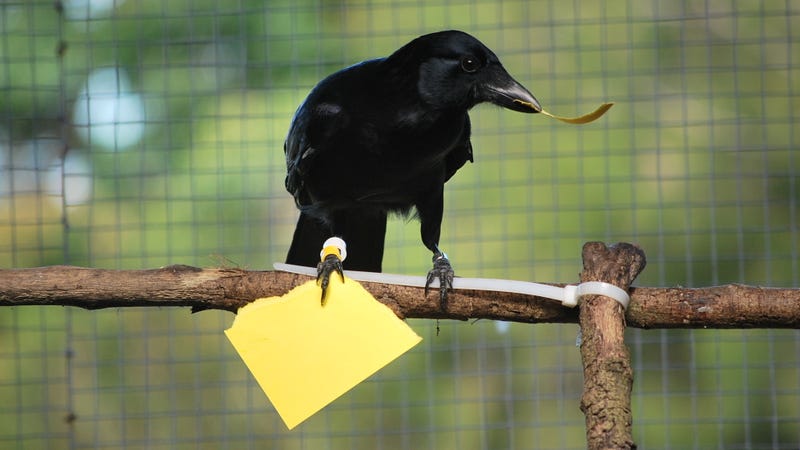
A New Caledonian crow building a tool card.
Photo: Sarah Jelbert

New research shows that crows can recreate tools from memory, a capacity previously thought impossible for birds.

Crows are super smart—we knew that already. In addition to understanding causality and analogies, they can remember human facesplan ahead, and hide their food from others. But crows are also known for their amazing tool-building skills, which they use to construct sticks, hooks, and barbs from plant material. New research published today in Scientific Reports suggests this ability, at least among New Caledonian crows (a particularly intelligent species of corvid), is more sophisticated than we thought, and that these birds are able to construct tools from memory.

In human societies, cultural evolution and tool building is an iterative process, whereby social traditions improve over time due to teaching, language, and imitation. But among New Caledonian crows, it’s not clear if their tool-making skills are the result of imitation, or an ability acquired through the passing down of cultural traditions. A going hypothesis is that tool designs are in fact culturally transmitted, and that it’s done through a process known as “mental template matching.”

“Under the mental template matching hypothesis, New Caledonian crow tool designs could be passed on to subsequent generations if an individual used or observed the products of tool manufacture (such as their parents’ tools), formed a mental template of this type of tool design (a mental representation of some or all of the tool’s properties), and then reproduced this template in their own manufacture,” explain the authors in the new study.

A New Caledonian crow inserts a card tool into food dispenser.
Photo: Sarah Jelbert

Researchers Russell Grey from the University of Auckland, New Zealand, Sarah Jelbert from the University of Cambridge, along with colleagues from several other institutions, conducted an experiment that now provides the first evidence in support of this assertion.

The researchers trained eight crows to drop bits of paper into a vending machine, which the birds did to receive food rewards. The crows later learned that only cards of a specific size, either large pieces measuring 40 x 60 mm or small pieces measuring 15 x 25 mm, were rewarded. Once the crows were trained to recognize which sizes of paper tools resulted in a food reward, the scientists took all paper pieces away and replaced them with a single large sheet of paper that didn’t fit into the dispenser. Incredibly, the birds tore up the large card to create pieces that matched the size of the paper they previously used to earn rewards. The researchers called it “manufacture by subtraction.”

Importantly, the birds did not have visual access to any of the previous scraps of paper. The experiment suggests the birds held a mental image of the desired tool in their minds, which they used to construct the new tool. It also means some species of birds may have the ability to improve tools over time (something not proven in the study, but alluded to as a possibility), which they could do by recreating and then adjusting other designs they’ve seen and memorized. That’s an important consideration, because the ability to modify items from memory is typically associated with tool-making cultures, such as humans and some nonhuman primates.

Edward A. Wasserman, an experimental psychologist and brain scientist at the University of Iowa who wasn’t involved with the new research, says the study is an important addition to our understanding of avian intelligence, and that the conclusions were “clear and compelling.” That said, he wasn’t surprised by the results.

“The prime limitation on our appreciation of avian intelligence is the lack of creativity in our own experimental methods,” Wasserman told Gizmodo. “Birds keep looking smarter as we conduct more ambitious and assiduous experiments.”

Wasserman was also keen to point out that crows aren’t the only intelligent birds.

“Pigeons, parrots, and jays have all been found to exhibit remarkable abilities to learn and remember a wealth of challenging tasks,” he said. “This evidence has come from both naturalistic observations and controlled laboratory experiments. The fact that the last common ancestor of birds and mammals lived 300 million years ago raises a profound question: was that ancestral species also smart or did intelligence evolve independently? That will be a hard question to answer.”

Ducks are NOT Easter Toys! Do Not Buy, Sell,  or Release These Birds into “the Wild”!  

from: United Poultry Concerns <http://www.UPC-online.org>
23 March 2018

Dear Friends,

Each year, parents and others buy ducklings, baby chicks and rabbits on
impulse
for Easter. Most of these animals are discarded once the charm of “oh, how
cute”
wears off. Most people have no idea how to care for them, and few if any
buyers
spend money on veterinary care. Millions of Easter ducklings, chicks and
rabbits
are dumped in the woods or near water, where they cannot survive. Many are
already sick, lame, malnourished and dehydrated.

Please read and share the following information. Please print out and
distribute
“*Are All Your Ducks In a Row?*” to libraries and elsewhere, including
shopping
centers and retailers like Tractor Supply, where baby animals are sold at
Easter. Those not sold are trashed. There is nothing cute, cuddly or kind
about
the business of “Easter” ducklings, chicks and rabbits.

*Thank you for helping to educate people. *
*– United Poultry Concerns*

– Are All Your Ducks In a Row? Did You Know…?
<http://www.upc-online.org/hatching/are_all_your_ducks_in_a_row.pdf>

– Ducklings Are Not Easter Toys
<http://www.upc-online.org/ducks/170303_ducklings_are_not_easter_toys.html>

Learn more here:

– School Hatching Projects <http://www.upc-online.org/hatching>
– Humane Education <http://www.upc-online.org/humane_education.html>

Thank you to New Jersey animal rights activist, Suzanne Dragan, for making ”
*Are*
*All Your Ducks In a Row?*” an important part of our Humane Education
program.


United Poultry Concerns is a nonprofit organization that promotes
the compassionate and respectful treatment of domestic fowl.
Don’t just switch from beef to chicken. Go Vegan.
http://www.UPC-online.org/ http://www.twitter.com/upcnews
http://www.facebook.com/UnitedPoultryConcerns

View this article online
<http://upc-online.org/hatching/180323_ducks_are_not_easter_toys.html

We Were Right about Snow Geese and We’re Right about Ross’s Goose, Too

http://www.bornfreeusa.org/weblog_canada.php?p=6342&more=1#more6342

by Barry Kent MacKay,
Senior Program Associate

Born Free USA’s Canadian Representative

Published 03/16/18

Ross's GooseRoss’s Goose
Drawing by Barry Kent MacKay

In front of me is a small booklet with the catchy title, A Critical Evaluation of the Proposed Reduction in the Mid-continent Lesser Snow Goose Population to Conserve Sub-arctic Salt Marshes of Hudson Bay. It was published by the Animal Protection Institute (now Born Free USA) and the Humane Society of the United States in 1998, and co-authored by biologist Vernon Thomas and me.

The arguments we made failed to stop the U.S. and Canada from enacting an absurd increase in bag-limits and open seasons and the use of electronic decoys for hunters after the “lesser” snow goose, which breeds in the mid to western arctic. The geese had undergone dramatic increases in numbers. For reasons too complex to address here, it was feared they’d damage large parts of the arctic ecosystem by their habit of “grubbing” – pulling plants out by the roots when feeding. They were called “overabundant,” a term that is entirely in reference to subjective value systems.

What bothered me then, and what bothers me now, is the lack of scientific rigor in the documentation presented to defend the vast increases in hunting kills proposed and enacted. References to previous high numbers of snow geese were misrepresented or ignored.

We made several predictions, and in the two decades since then, we’ve been proven correct. Put simply, one prediction was that the proposed hunting increase wouldn’t work. It didn’t. We predicted that the real threat to arctic and subarctic ecosystems came from global climate change. That is proving to be true, too.

But, governments and the public trust wildlife management types have made something out of a career out of alarmist rhetoric about the population “explosion” in these geese, and in the Ross’s goose. Sadly, they are believed. Ross’s goose is a smaller version of the snow goose and was apparently once reasonably abundant (it’s hard to know as early observers tended not to distinguish it from the snow goose), but had become endangered by the early 20th century, and is now again common, perhaps more so than ever before. The Americans have already been shooting extra numbers of this species and, although we were able to slow Canada down, years ago, now it has again proposed an increased bag limit for Ross’s goose.

I have written to the Canadian government in opposition to increasing bag limits for this small goose. Beyond a “natural” tendency people attracted to wildlife management have to “manage,” to control, nature, what I think was behind the original concern two decades ago can be seen here. Numbers of hunters were in freefall, and it’s hunting that justifies so much of the wildlife management profession and pays the expenses and salaries of wildlife management professionals.

But, not only are increasing numbers of people taking pleasure from viewing and photographing – but not killing – wildlife, even many who dohunt refuse to kill more than they can eat, and, as we predicted, just knocking the top off the population curve allows high numbers of these species to continue.

Keep Wildlife in the Wild,
Barry